Test of
hypothesis /
Test of
significance
Submitted by-:
Dr. Jayesh Vyas (M.V.Sc.)
Test of Hypothesis/ Test of
significance
– Procedure which enable us to decide
whether the accept or reject hypothesis.
– The test used to ascertain whether the
difference between estimator & parameter
or between two estimator are real or due to
chance are called test of hypothesis.
Terms used in testing a hypothesis
– Null hypothesis(H0)-: Hypothesis which is
tested for possible rejection, under the
assumption that is true called H0.
– Alternative hypothesis(H1)-: Hypothesis
which is complementary to null
hypothesis.
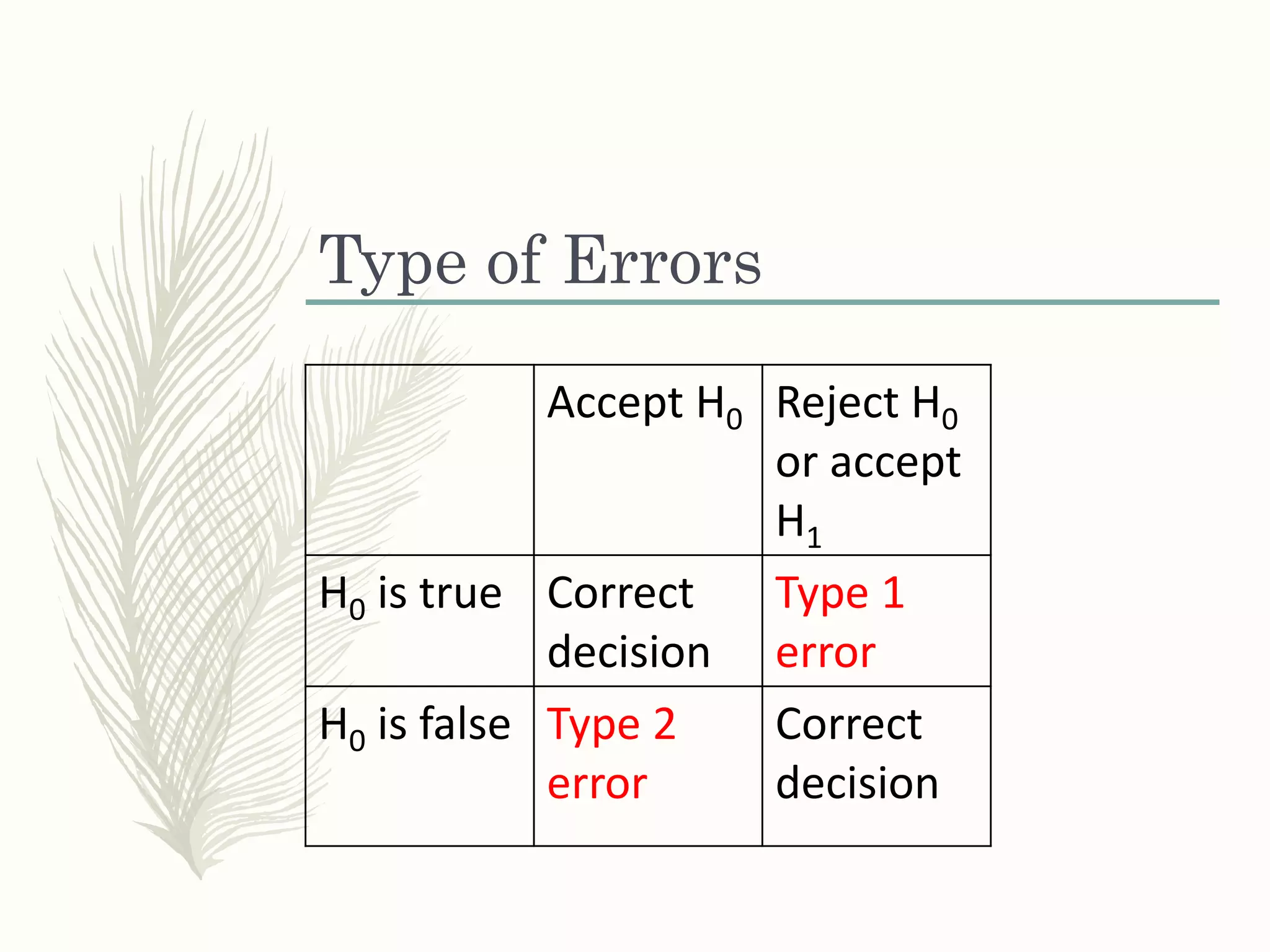
Type of Errors
Accept H0 Reject H0
or accept
H1
H0 is true Correct
decision
Type 1
error
H0 is false Type 2
error
Correct
decision
Level of significance (LOS)
– We want to minimize the size of both
types of errors, however with fixed size
testing procedure, both the errors can’t be
minimize simultaneously.
– So, we keep the size or probability of
commonly type 1 error, fixed at certain
level called level of significance.
– In biological experiments LOS usually
employed 5% or 1%.
– If LOS is chosen 5% that means probability
of accepting a true hypothesis is 95%.
– The LOS also called size of rejection region
or size of critical region.
Degree of freedom (df)
– It is no. of independent observation used
in the making of statistics.
– d.f. = total no. of observation (n) - no. of
independent constraint (restriction) (k)
– λ= n-k
T-test
– Developed by W. S. Gossett.
– It is parametric test.
– It is small sample test.
– Suppose 𝑥1, 𝑥2, … 𝑥 𝑛 be a random sample
size 𝑛 drawn from population with mean µ
and variance 𝜎2
, then T- statistics defined
as
– 𝐭 =
𝐗−𝛍
𝐒 𝐧
𝑋= sample mean, S= SD of sample, n= no. of observation
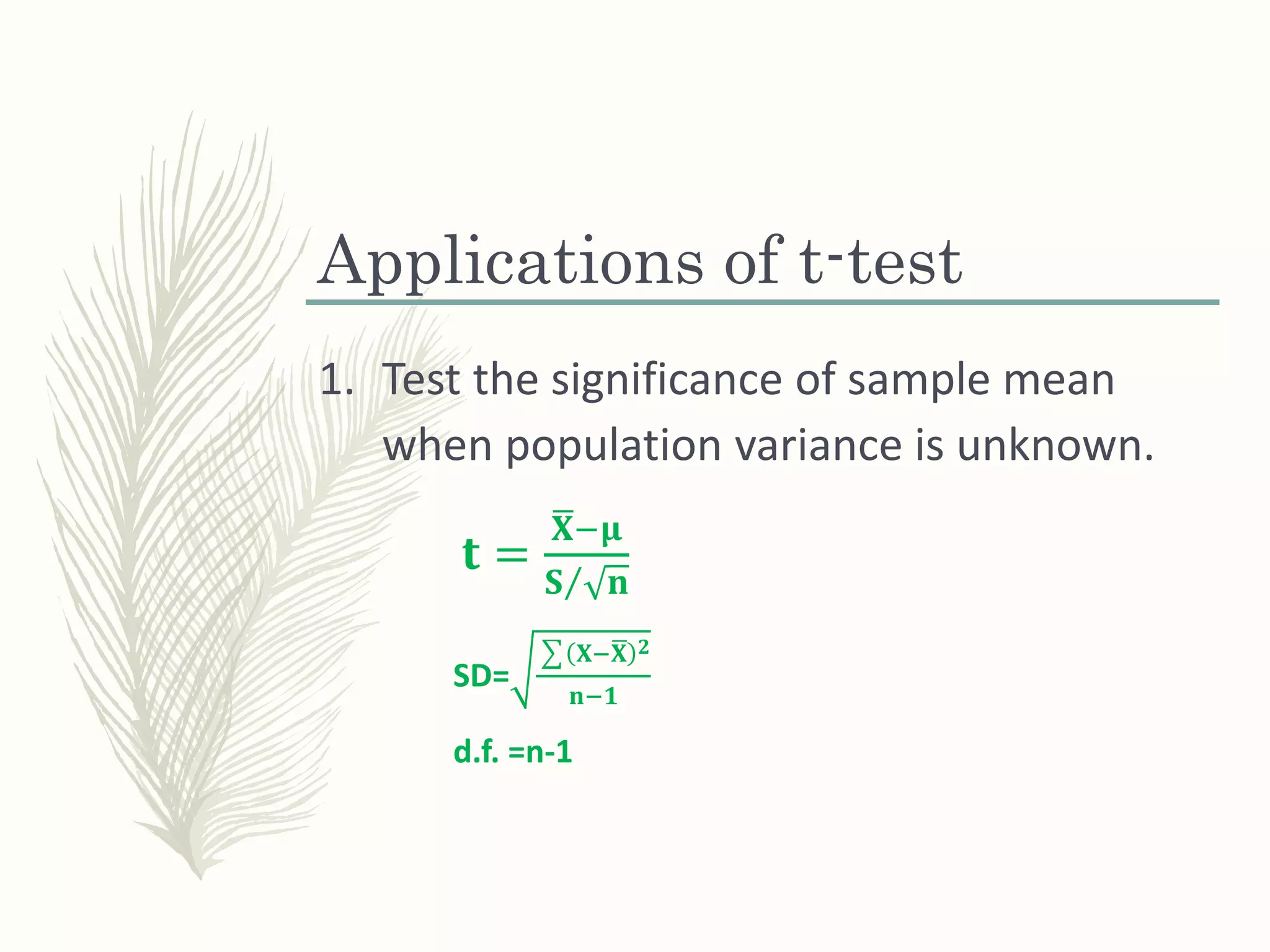
Applications of t-test
1. Test the significance of sample mean
when population variance is unknown.
𝐭 =
𝐗−𝛍
𝐒 𝐧
SD=
𝐗− 𝐗 𝟐
𝐧−𝟏
d.f. =n-1
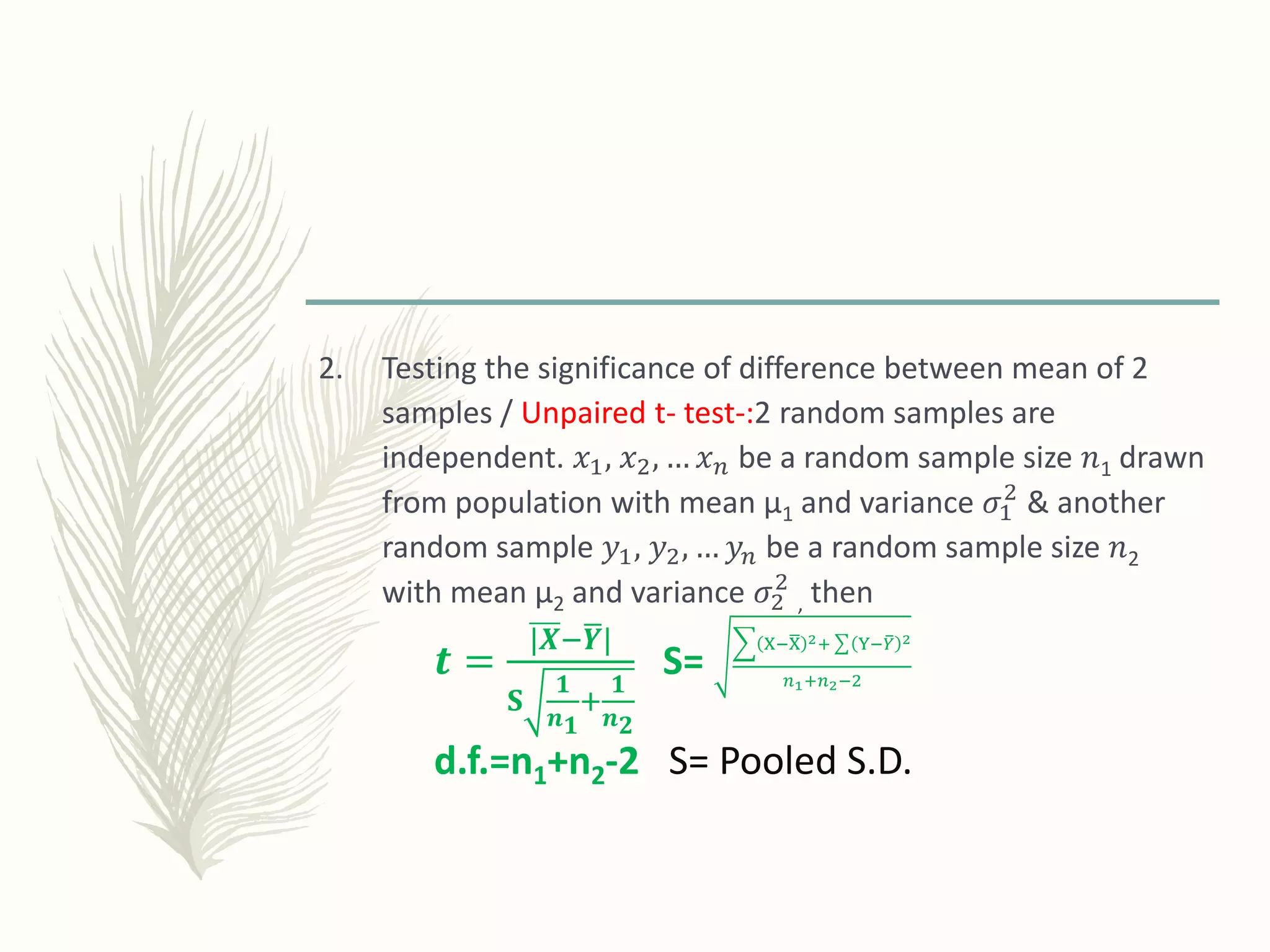
2. Testing the significance of difference between mean of 2
samples / Unpaired t- test-:2 random samples are
independent. 𝑥1, 𝑥2, … 𝑥 𝑛 be a random sample size 𝑛1 drawn
from population with mean µ1 and variance 𝜎1
2
& another
random sample 𝑦1, 𝑦2, … 𝑦𝑛 be a random sample size 𝑛2
with mean µ2 and variance 𝜎2
2
, then
𝒕 =
|𝑿− 𝒀|
𝐒
𝟏
𝒏 𝟏
+
𝟏
𝒏 𝟐
S=
X−X 2+ Y− 𝑌 2
𝑛1+𝑛2−2
d.f.=n1+n2-2 S= Pooled S.D.
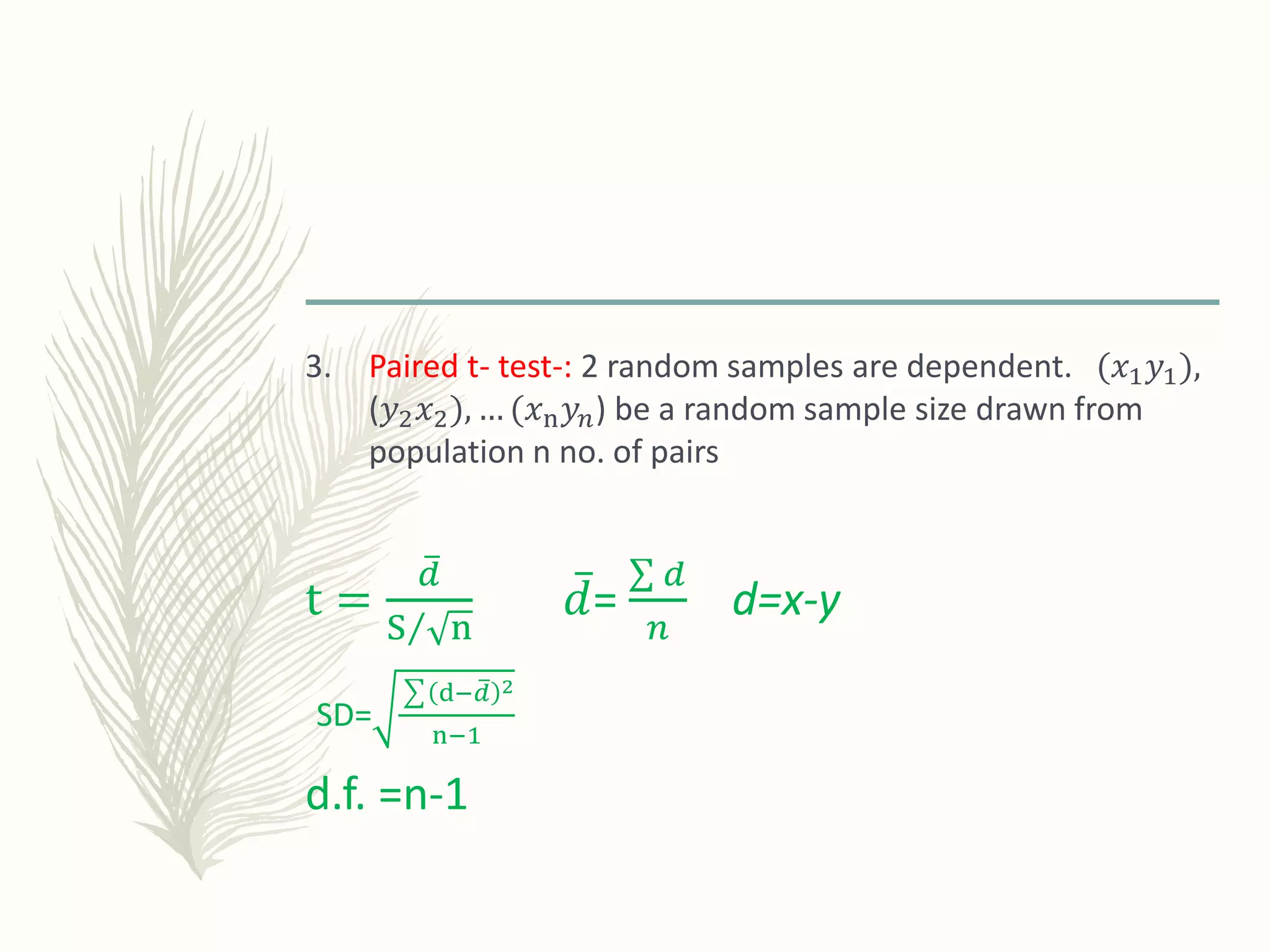
3. Paired t- test-: 2 random samples are dependent. (𝑥1 𝑦1),
(𝑦2 𝑥2), … (𝑥n 𝑦𝑛) be a random sample size drawn from
population n no. of pairs
t =
𝑑
S n
𝑑=
𝑑
𝑛
d=x-y
SD=
d− 𝑑 2
n−1
d.f. =n-1
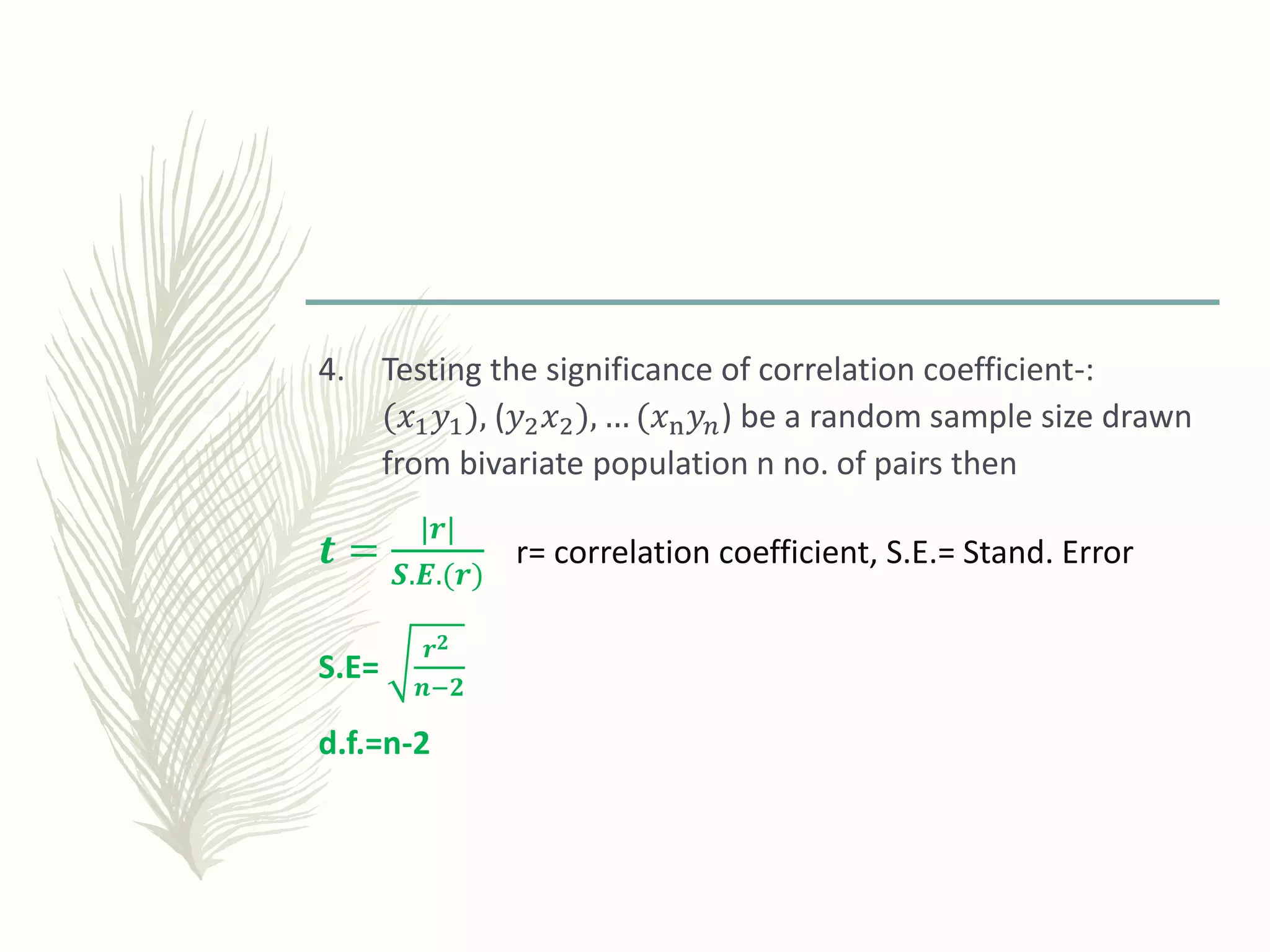
4. Testing the significance of correlation coefficient-:
(𝑥1 𝑦1), (𝑦2 𝑥2), … (𝑥n 𝑦𝑛) be a random sample size drawn
from bivariate population n no. of pairs then
𝒕 =
|𝒓|
𝑺.𝑬.(𝒓)
r= correlation coefficient, S.E.= Stand. Error
S.E=
𝒓 𝟐
𝒏−𝟐
d.f.=n-2
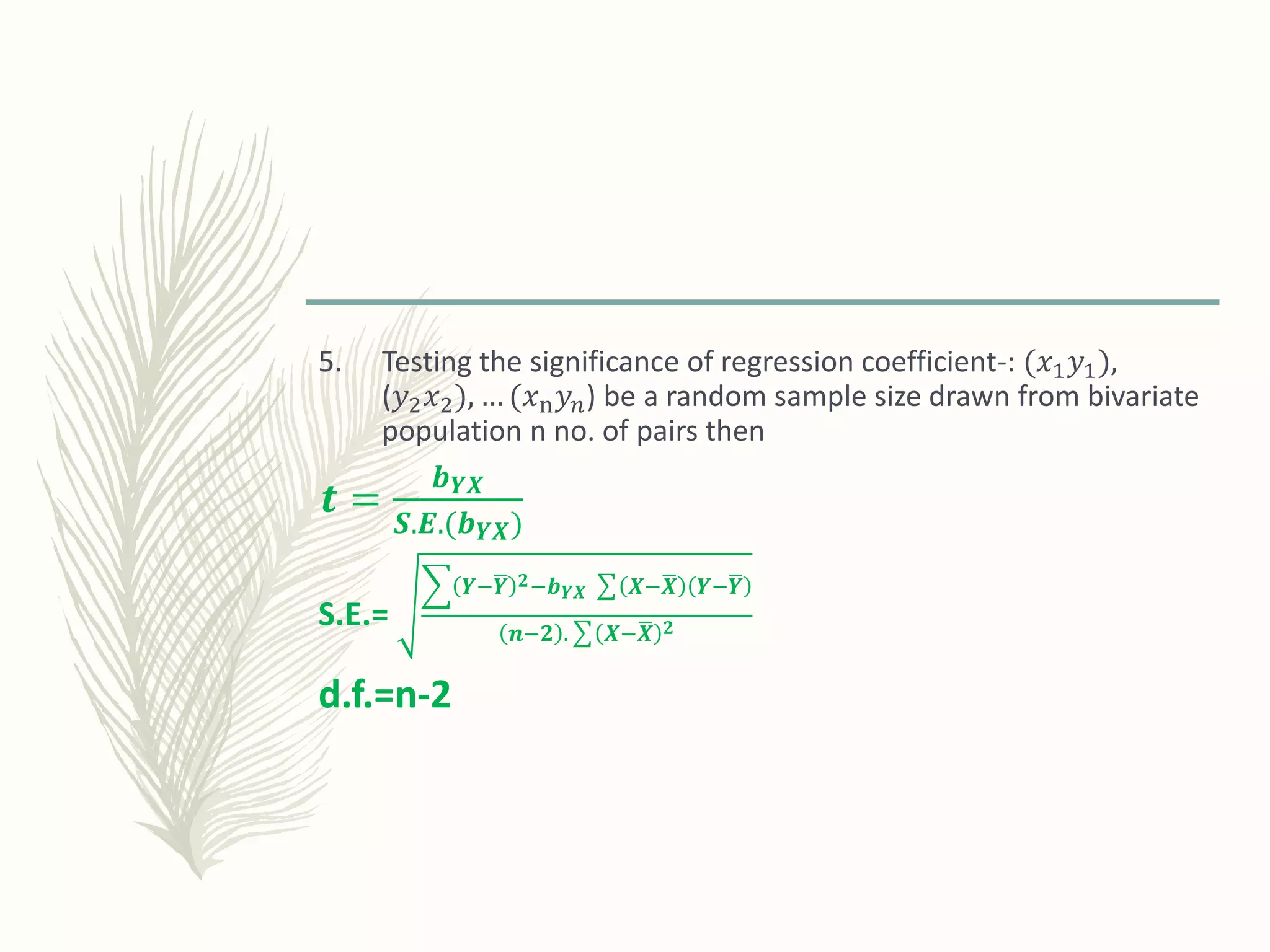
5. Testing the significance of regression coefficient-: (𝑥1 𝑦1),
(𝑦2 𝑥2), … (𝑥n 𝑦 𝑛) be a random sample size drawn from bivariate
population n no. of pairs then
𝒕 =
𝒃 𝒀𝑿
𝑺.𝑬.(𝒃 𝒀𝑿)
S.E.=
𝒀− 𝒀 𝟐−𝒃 𝒀𝑿 𝑿− 𝑿 𝒀− 𝒀
𝒏−𝟐 . 𝑿− 𝑿 𝟐
d.f.=n-2
Chi-square (𝜒2
)- test
– It is non para-metric test.
– Easy to compute and used without making assumptions, it
is distribution free test.
– Magnitude of difference between observed & expected
frequency under certain assumption
𝝌 𝟐=
𝐎−𝑬 𝟐
𝑬
≈ 𝝌 𝟐
𝒏−𝟏 𝒅𝒇
𝑂1, 𝑂2, … 𝑂𝑛 = observed frequency
𝐸1, 𝐸2, … 𝐸 𝑛 = expected frequency
Applications of 𝜒2
- test
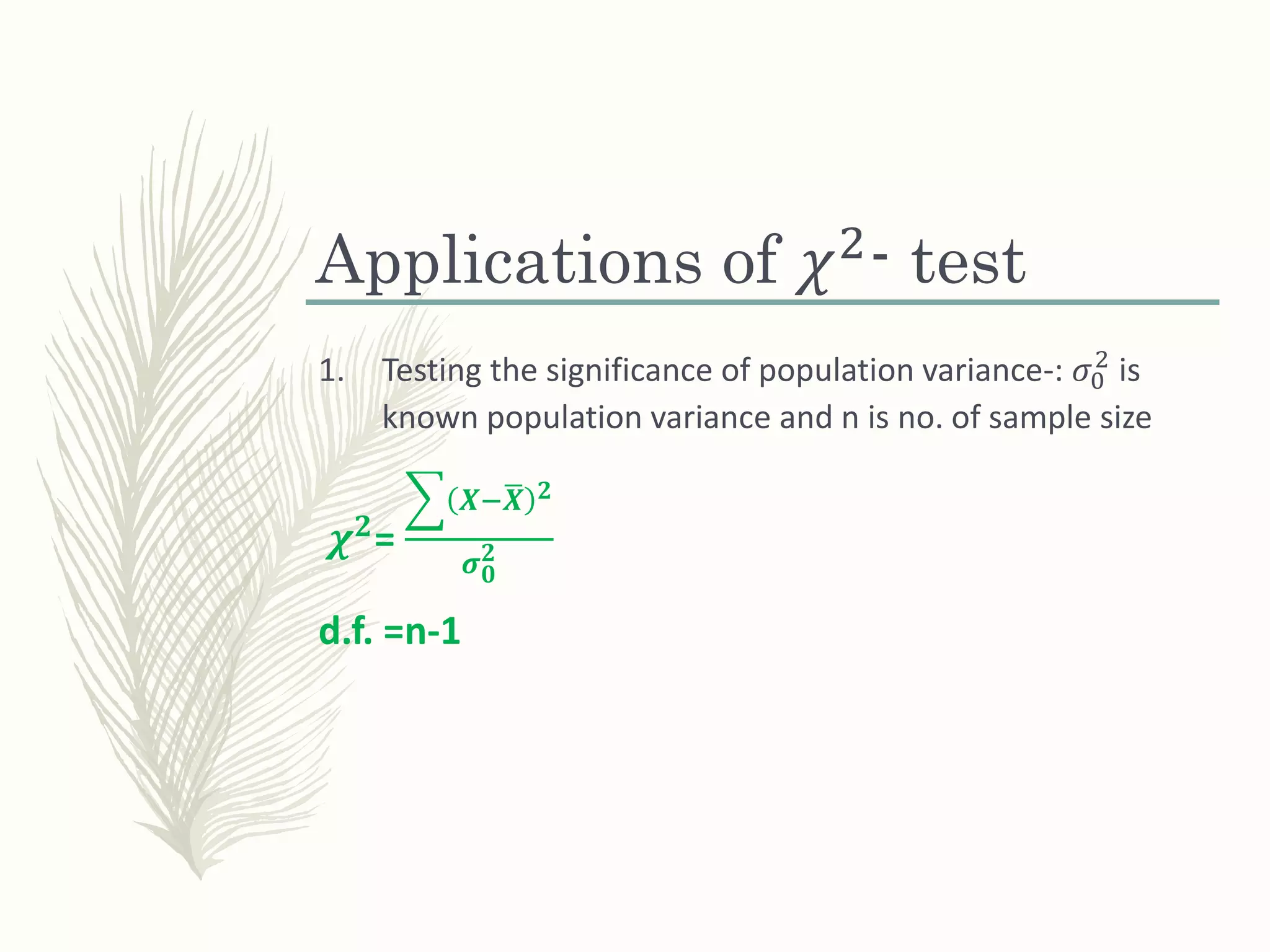
1. Testing the significance of population variance-: 𝜎0
2
is
known population variance and n is no. of sample size
𝝌 𝟐=
𝑿− 𝑿 𝟐
𝝈 𝟎
𝟐
d.f. =n-1
2. Testing the goodness of fit-:
𝜒2=
𝑂−𝐸 2
𝐸
E=
𝑂
𝑛
d.f.=n-1
3. Testing the independence of attribute/contingency test/test for
independence-: m rows & n columns = m*n contingency table. A
has m mutually exclusive categories 𝐴1, 𝐴2, … 𝐴 𝑚. B has n mutually
exclusive categories 𝐵1, 𝐵2, … 𝐵 𝑛.
contd...
AB 𝑩 𝟏 𝑩 𝟐 𝑩 𝒏 Total
𝐴1 AB 𝑩 𝟏 𝑩 𝟐 𝑩 𝒏 Total
𝐴1 𝑂11 𝑂12 𝑂1𝑛 𝑅1
𝐴2 𝐴2 𝑂21 𝑂22 𝑂2n 𝑅2
𝐴m 𝐴m 𝑂m1 𝑂m2 𝑂mn 𝑅m
Total Total 𝐶1 𝐶2 𝐶n N
C1 = sum of first column
R1 = sum of first row
N = sum of all rows
E(𝑶 𝟏𝟏)=
𝑹 𝟏 𝑪 𝟏
𝑵
, E(𝑶 𝟏𝟐)=
𝑹 𝟏 𝑪 𝟐
𝑵
, E(𝑶 𝟐𝟏)=
𝑹 𝟐 𝑪 𝟏
𝑵
E(𝑶 𝟏𝒏) = R1-[E(𝑶 𝟏𝟏)+ E(𝑶 𝟏𝟐)+…+E(𝑶 𝐧−𝟏)]
E(𝑶 𝐦𝟏) = C1-[E(𝑶 𝟏𝟏)+ E(𝑶 𝟐𝟏)+…+E(𝑶 𝐦−𝟏)]
d.f. = (row-1)(column-1) contd…
O E O-E 𝑶 − 𝑬 𝟐 𝐎 − 𝑬 𝟐
𝑬
𝑂11 E(𝑂11)
𝑂12 E(𝑂12)
𝑂mn E(𝑂mn) Total (Value of
𝜒2
)
4. Testing the independence of attribute in contingency table-:
Only 2 categories = 2 rows*2 columns then
Contd….
AB 𝑩 𝟏 𝑩 𝟐 Total
𝐴1 𝑂11(a) 𝑂12(b) 𝑅1
𝐴2 𝑂21(c) 𝑂12(d) 𝑅2
C1 C2 N
𝜒2=
𝐚𝐝−𝒃𝒄 𝟐 𝑵
𝑅1 𝑅2 𝐶1 𝐶2
d.f. = (row-1)(column-1)
d.f. = 1 always
 If any observed cell frequency is <5 then we used Yate’s
correction
 𝝌 𝟐
=
|𝐚𝐝−𝒃𝒄|−
𝑵
𝟐
𝟐
𝑵
𝑹 𝟏 𝑹 𝟐 𝑪 𝟏 𝑪 𝟐
F-Test
– The object of F-test is to find out whether the 2
independent estimates of population variance differs
significantly.
– It is a parametric test.
– There are 2 degree of freedoms.
𝐹1 =
𝑺 𝟏
𝟐
𝑺 𝟐
𝟐 , 𝑺 𝟏
𝟐
=
𝑿− 𝑿 𝟐
𝒏 𝟏−𝟏
, 𝑺 𝟐
𝟐
=
𝒀− 𝒀 𝟐
𝒏 𝟐−𝟏
Applications of F- test
1. Testing of significance of ratio of 2 variances-:
𝐹1 =
𝑺 𝟏
𝟐
𝑺 𝟐
𝟐
d.f. = n1-1 for numerator
d.f. = n2-2 for denominator
2. Testing the homogeneity of several means-: Significance
of difference amongst more than 2 sample means is
carried out at the same time and this technique is
known as analysis of variance (ANOVA).
Contd…
ANOVA
– When observations are classified on the basis of single
criteria from K random samples.
Sample no. Total
1 𝑌11 𝑌12 𝑌1𝑛1
𝑇1
2 𝑌21 𝑌22 𝑌2𝑛2
𝑇2
𝑘 𝑌𝑘𝑛1
𝑌𝑘𝑛2
𝑌𝑘𝑛 𝑘
𝑇k
Total G
– Correction factor C.F.=
𝐺2
𝑛
, G= Grand total n = n.k
– Total sum of sum of square TSS
– TSS = 𝛴𝑌ⅈ𝑗
2
− 𝐶. 𝐹. , 𝛴𝑌ⅈ𝑗
2
= Sum of square
– Sum of square due to assignable factor S.S.assign
– S.S.assign = (
𝑇1
2
𝑛1
+
𝑇2
2
𝑛2
+…+
𝑇𝑘
2
𝑛k
)- C.F.
– Sum of square due to non assignable factor S.S.Error
– S.S.Error= TSS- S.S.assign
– Preparation of ANOVA Table-:
– d.f.= k-1 for numerator & n-k for denominator
Source of
variation
d.f. S.S. M.S.S. F-value
B/t assign 𝑘 − 1 S1
𝑠1
𝑘−1
= V1
𝑉1
𝑉2
= F-value
Error 𝑛 − 𝑘 S2
𝑠1
𝑘−1
=V2
Total 𝑛 − 1 S

Test of hypothesis test of significance

  • 1.
    Test of hypothesis / Testof significance Submitted by-: Dr. Jayesh Vyas (M.V.Sc.)
  • 2.
    Test of Hypothesis/Test of significance – Procedure which enable us to decide whether the accept or reject hypothesis. – The test used to ascertain whether the difference between estimator & parameter or between two estimator are real or due to chance are called test of hypothesis.
  • 3.
    Terms used intesting a hypothesis – Null hypothesis(H0)-: Hypothesis which is tested for possible rejection, under the assumption that is true called H0. – Alternative hypothesis(H1)-: Hypothesis which is complementary to null hypothesis.
  • 4.
    Type of Errors AcceptH0 Reject H0 or accept H1 H0 is true Correct decision Type 1 error H0 is false Type 2 error Correct decision
  • 5.
    Level of significance(LOS) – We want to minimize the size of both types of errors, however with fixed size testing procedure, both the errors can’t be minimize simultaneously. – So, we keep the size or probability of commonly type 1 error, fixed at certain level called level of significance.
  • 6.
    – In biologicalexperiments LOS usually employed 5% or 1%. – If LOS is chosen 5% that means probability of accepting a true hypothesis is 95%. – The LOS also called size of rejection region or size of critical region.
  • 7.
    Degree of freedom(df) – It is no. of independent observation used in the making of statistics. – d.f. = total no. of observation (n) - no. of independent constraint (restriction) (k) – λ= n-k
  • 8.
    T-test – Developed byW. S. Gossett. – It is parametric test. – It is small sample test. – Suppose 𝑥1, 𝑥2, … 𝑥 𝑛 be a random sample size 𝑛 drawn from population with mean µ and variance 𝜎2 , then T- statistics defined as – 𝐭 = 𝐗−𝛍 𝐒 𝐧 𝑋= sample mean, S= SD of sample, n= no. of observation
  • 9.
    Applications of t-test 1.Test the significance of sample mean when population variance is unknown. 𝐭 = 𝐗−𝛍 𝐒 𝐧 SD= 𝐗− 𝐗 𝟐 𝐧−𝟏 d.f. =n-1
  • 10.
    2. Testing thesignificance of difference between mean of 2 samples / Unpaired t- test-:2 random samples are independent. 𝑥1, 𝑥2, … 𝑥 𝑛 be a random sample size 𝑛1 drawn from population with mean µ1 and variance 𝜎1 2 & another random sample 𝑦1, 𝑦2, … 𝑦𝑛 be a random sample size 𝑛2 with mean µ2 and variance 𝜎2 2 , then 𝒕 = |𝑿− 𝒀| 𝐒 𝟏 𝒏 𝟏 + 𝟏 𝒏 𝟐 S= X−X 2+ Y− 𝑌 2 𝑛1+𝑛2−2 d.f.=n1+n2-2 S= Pooled S.D.
  • 11.
    3. Paired t-test-: 2 random samples are dependent. (𝑥1 𝑦1), (𝑦2 𝑥2), … (𝑥n 𝑦𝑛) be a random sample size drawn from population n no. of pairs t = 𝑑 S n 𝑑= 𝑑 𝑛 d=x-y SD= d− 𝑑 2 n−1 d.f. =n-1
  • 12.
    4. Testing thesignificance of correlation coefficient-: (𝑥1 𝑦1), (𝑦2 𝑥2), … (𝑥n 𝑦𝑛) be a random sample size drawn from bivariate population n no. of pairs then 𝒕 = |𝒓| 𝑺.𝑬.(𝒓) r= correlation coefficient, S.E.= Stand. Error S.E= 𝒓 𝟐 𝒏−𝟐 d.f.=n-2
  • 13.
    5. Testing thesignificance of regression coefficient-: (𝑥1 𝑦1), (𝑦2 𝑥2), … (𝑥n 𝑦 𝑛) be a random sample size drawn from bivariate population n no. of pairs then 𝒕 = 𝒃 𝒀𝑿 𝑺.𝑬.(𝒃 𝒀𝑿) S.E.= 𝒀− 𝒀 𝟐−𝒃 𝒀𝑿 𝑿− 𝑿 𝒀− 𝒀 𝒏−𝟐 . 𝑿− 𝑿 𝟐 d.f.=n-2
  • 14.
    Chi-square (𝜒2 )- test –It is non para-metric test. – Easy to compute and used without making assumptions, it is distribution free test. – Magnitude of difference between observed & expected frequency under certain assumption 𝝌 𝟐= 𝐎−𝑬 𝟐 𝑬 ≈ 𝝌 𝟐 𝒏−𝟏 𝒅𝒇 𝑂1, 𝑂2, … 𝑂𝑛 = observed frequency 𝐸1, 𝐸2, … 𝐸 𝑛 = expected frequency
  • 15.
    Applications of 𝜒2 -test 1. Testing the significance of population variance-: 𝜎0 2 is known population variance and n is no. of sample size 𝝌 𝟐= 𝑿− 𝑿 𝟐 𝝈 𝟎 𝟐 d.f. =n-1
  • 16.
    2. Testing thegoodness of fit-: 𝜒2= 𝑂−𝐸 2 𝐸 E= 𝑂 𝑛 d.f.=n-1
  • 17.
    3. Testing theindependence of attribute/contingency test/test for independence-: m rows & n columns = m*n contingency table. A has m mutually exclusive categories 𝐴1, 𝐴2, … 𝐴 𝑚. B has n mutually exclusive categories 𝐵1, 𝐵2, … 𝐵 𝑛. contd... AB 𝑩 𝟏 𝑩 𝟐 𝑩 𝒏 Total 𝐴1 AB 𝑩 𝟏 𝑩 𝟐 𝑩 𝒏 Total 𝐴1 𝑂11 𝑂12 𝑂1𝑛 𝑅1 𝐴2 𝐴2 𝑂21 𝑂22 𝑂2n 𝑅2 𝐴m 𝐴m 𝑂m1 𝑂m2 𝑂mn 𝑅m Total Total 𝐶1 𝐶2 𝐶n N
  • 18.
    C1 = sumof first column R1 = sum of first row N = sum of all rows E(𝑶 𝟏𝟏)= 𝑹 𝟏 𝑪 𝟏 𝑵 , E(𝑶 𝟏𝟐)= 𝑹 𝟏 𝑪 𝟐 𝑵 , E(𝑶 𝟐𝟏)= 𝑹 𝟐 𝑪 𝟏 𝑵 E(𝑶 𝟏𝒏) = R1-[E(𝑶 𝟏𝟏)+ E(𝑶 𝟏𝟐)+…+E(𝑶 𝐧−𝟏)] E(𝑶 𝐦𝟏) = C1-[E(𝑶 𝟏𝟏)+ E(𝑶 𝟐𝟏)+…+E(𝑶 𝐦−𝟏)] d.f. = (row-1)(column-1) contd…
  • 19.
    O E O-E𝑶 − 𝑬 𝟐 𝐎 − 𝑬 𝟐 𝑬 𝑂11 E(𝑂11) 𝑂12 E(𝑂12) 𝑂mn E(𝑂mn) Total (Value of 𝜒2 )
  • 20.
    4. Testing theindependence of attribute in contingency table-: Only 2 categories = 2 rows*2 columns then Contd…. AB 𝑩 𝟏 𝑩 𝟐 Total 𝐴1 𝑂11(a) 𝑂12(b) 𝑅1 𝐴2 𝑂21(c) 𝑂12(d) 𝑅2 C1 C2 N
  • 21.
    𝜒2= 𝐚𝐝−𝒃𝒄 𝟐 𝑵 𝑅1𝑅2 𝐶1 𝐶2 d.f. = (row-1)(column-1) d.f. = 1 always  If any observed cell frequency is <5 then we used Yate’s correction  𝝌 𝟐 = |𝐚𝐝−𝒃𝒄|− 𝑵 𝟐 𝟐 𝑵 𝑹 𝟏 𝑹 𝟐 𝑪 𝟏 𝑪 𝟐
  • 22.
    F-Test – The objectof F-test is to find out whether the 2 independent estimates of population variance differs significantly. – It is a parametric test. – There are 2 degree of freedoms. 𝐹1 = 𝑺 𝟏 𝟐 𝑺 𝟐 𝟐 , 𝑺 𝟏 𝟐 = 𝑿− 𝑿 𝟐 𝒏 𝟏−𝟏 , 𝑺 𝟐 𝟐 = 𝒀− 𝒀 𝟐 𝒏 𝟐−𝟏
  • 23.
    Applications of F-test 1. Testing of significance of ratio of 2 variances-: 𝐹1 = 𝑺 𝟏 𝟐 𝑺 𝟐 𝟐 d.f. = n1-1 for numerator d.f. = n2-2 for denominator
  • 24.
    2. Testing thehomogeneity of several means-: Significance of difference amongst more than 2 sample means is carried out at the same time and this technique is known as analysis of variance (ANOVA). Contd…
  • 25.
    ANOVA – When observationsare classified on the basis of single criteria from K random samples. Sample no. Total 1 𝑌11 𝑌12 𝑌1𝑛1 𝑇1 2 𝑌21 𝑌22 𝑌2𝑛2 𝑇2 𝑘 𝑌𝑘𝑛1 𝑌𝑘𝑛2 𝑌𝑘𝑛 𝑘 𝑇k Total G
  • 26.
    – Correction factorC.F.= 𝐺2 𝑛 , G= Grand total n = n.k – Total sum of sum of square TSS – TSS = 𝛴𝑌ⅈ𝑗 2 − 𝐶. 𝐹. , 𝛴𝑌ⅈ𝑗 2 = Sum of square – Sum of square due to assignable factor S.S.assign – S.S.assign = ( 𝑇1 2 𝑛1 + 𝑇2 2 𝑛2 +…+ 𝑇𝑘 2 𝑛k )- C.F. – Sum of square due to non assignable factor S.S.Error – S.S.Error= TSS- S.S.assign
  • 27.
    – Preparation ofANOVA Table-: – d.f.= k-1 for numerator & n-k for denominator Source of variation d.f. S.S. M.S.S. F-value B/t assign 𝑘 − 1 S1 𝑠1 𝑘−1 = V1 𝑉1 𝑉2 = F-value Error 𝑛 − 𝑘 S2 𝑠1 𝑘−1 =V2 Total 𝑛 − 1 S