Dr. Jayesh Vyas
M.V. Sc. (Animal Genetics and Breeding)
 Infectious diseases of livestock are most costly
and hazardous problem facing the Agri-food
industry
 Adversely affect animal production and economics
by increasing the cost of production and
decreasing the production rate
(Bishop et al., 2002)
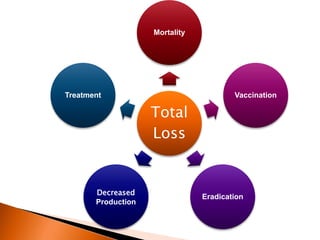
Total
Loss
Mortality
Vaccination
Eradication
Decreased
Production
Treatment
 Resistance refers to the ability of a host to resist
infection
 Tolerance signifies a condition in which the host is
infected by the pathogen but displays very limited
adverse effects
 The natural selection for host resistance increases the
chance of fixation of genes conferring tolerance
(Roy et al., 2000)
 Genetic changes are permanent and consistent once established
 Less chance of development drug resistance parasites
 Possibility of broad spectrum effects
 No need for purchased inputs once the effect is established
 Diversified disease management strategies can be developed
(FAO, 1999)
 Economical cost of the disease is reasonably high
 Consumers fear for a product because of antibiotic
residue or non-treatable communicable diseases
 Diseases for which neither vaccines nor
therapeutics have been found
 Microbial resistance, selection for disease
resistance may be logical
 Identification of phenotype for disease resistance is difficult
 Disease diagnosis is costly and time consuming
 It is more complicated than selecting for production traits
 Development of highly resistant animals to one specific
pathogen may make the animals more susceptible to
another pathogen
 Resistance to infections can be
determined at three genetic levels
(I) Species
(II) Breed
(III) Individual animal genetic variation
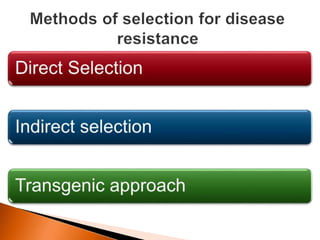
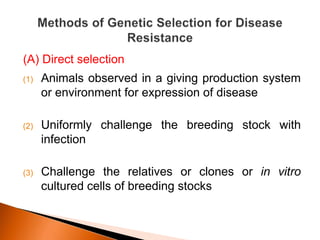
(A) Direct selection
(1) Animals observed in a giving production system
or environment for expression of disease
(2) Uniformly challenge the breeding stock with
infection
(3) Challenge the relatives or clones or in vitro
cultured cells of breeding stocks
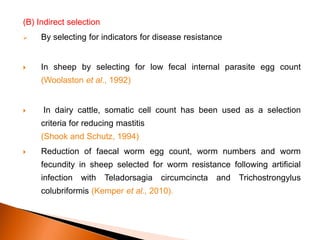
(B) Indirect selection
 By selecting for indicators for disease resistance
 In sheep by selecting for low fecal internal parasite egg count
(Woolaston et al., 1992)
 In dairy cattle, somatic cell count has been used as a selection
criteria for reducing mastitis
(Shook and Schutz, 1994)
 Reduction of faecal worm egg count, worm numbers and worm
fecundity in sheep selected for worm resistance following artificial
infection with Teladorsagia circumcincta and Trichostrongylus
colubriformis (Kemper et al., 2010).
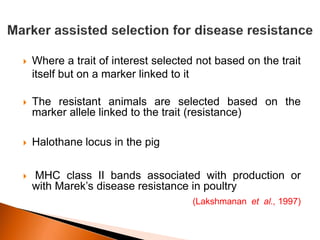
 Where a trait of interest selected not based on the trait
itself but on a marker linked to it
 The resistant animals are selected based on the
marker allele linked to the trait (resistance)
 Halothane locus in the pig
 MHC class II bands associated with production or
with Marek’s disease resistance in poultry
(Lakshmanan et al., 1997)
 Phenotypic markers:
◦ XL1 protein of saliva in case of bloat
◦ Fecal egg count in case of helmenthic diseases
◦ Ig level for inflammatory response
◦ somatic cell count for mastitis
 Genetic marker: RFLPs, RAPDs, AFLP and
micro-satellite markers for resistance against specific
infection
 For effective selection, indicator traits must be
I. Heritable
II. Accurate to measure
III. Affordable
IV. Highly genetically correlated with resistance to the disease or
diseases of interest
(Wilkie and Mallard, 1998)
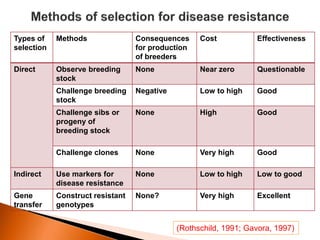
Types of
selection
Methods Consequences
for production
of breeders
Cost Effectiveness
Direct Observe breeding
stock
None Near zero Questionable
Challenge breeding
stock
Negative Low to high Good
Challenge sibs or
progeny of
breeding stock
None High Good
Challenge clones None Very high Good
Indirect Use markers for
disease resistance
None Low to high Low to good
Gene
transfer
Construct resistant
genotypes
None? Very high Excellent
(Rothschild, 1991; Gavora, 1997)
 Studies in swine have indicated that selection
for immune responsiveness can improve
disease resistance to other diseases while, at
the same time, increasing susceptibility to others
 Challenging an animal with an antigen or
vaccine and measuring antibody response or
production, has been useful in poultry (Lamont
et al., 2003) and swine (Mallard et al., 1992)
 Immune responsiveness would be a useful
indicator of disease resistance in cattle
(Hernandez et al.,2003)
 Selection for too high immune response might be
deleterious to animals.
 The increased resistance to Salmonella in pigs
might increase the frequency of autoimmune
diseases (Edfors-Lilja and Walgreen, 2000)
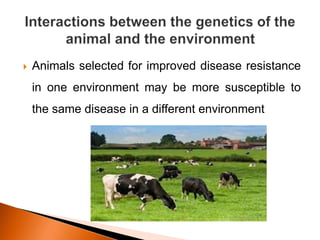
 Animals selected for improved disease resistance
in one environment may be more susceptible to
the same disease in a different environment
 Introducing a gene into a particular region by
breed substitution is one of the earliest applied
methods
 Introduction of N’Dama cattle, associated with
resistance to trypanosomiasis, in different regions
of Africa
(Leteren, D. and Kimani, 2006 and Mattioli et al., 1998)
 Brahmans cattle breeds were introduced in
Northern Australia by crossbreeding and
backcrossing into British-breed cattle
(Farquharson et al., 2003), because of their
superior parasite resistance and heat tolerance
(Frisch and Vercoe, 1984)
 Another method can be within-breed genetic
selection. This is generally a much slower method
than breed substitution or crossbreeding, but it is
less disruptive on traditional farming methods and
results from selection are cumulative over time.
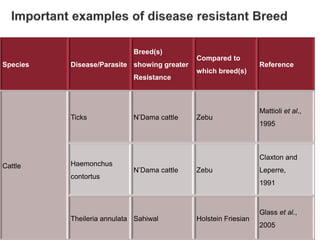
Species Disease/Parasite
Breed(s)
showing greater
Resistance
Compared to
which breed(s)
Reference
Cattle
Ticks N’Dama cattle Zebu
Mattioli et al.,
1995
Haemonchus
contortus
N’Dama cattle Zebu
Claxton and
Leperre,
1991
Theileria annulata Sahiwal Holstein Friesian
Glass et al.,
2005
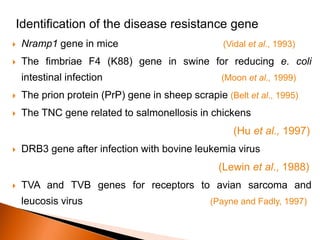
Identification of the disease resistance gene
 Nramp1 gene in mice (Vidal et al., 1993)
 The fimbriae F4 (K88) gene in swine for reducing e. coli
intestinal infection (Moon et al., 1999)
 The prion protein (PrP) gene in sheep scrapie (Belt et al., 1995)
 The TNC gene related to salmonellosis in chickens
(Hu et al., 1997)
 DRB3 gene after infection with bovine leukemia virus
(Lewin et al., 1988)
 TVA and TVB genes for receptors to avian sarcoma and
leucosis virus (Payne and Fadly, 1997)
 Nramp1 has been linked with resistance to
brucellosis (Harmon et al., 1989), tuberculosis,
and salmonellosis (Qureshi et al., 1996)
 Homologues for Nramp1 have been identified,
sequenced and/or mapped in chickens, swine,
and sheep (Adams and Templeton, 1998)
 MHC genes were some of the first mapped and sequenced genes
related to disease resistance
 In dairy cattle, the bovine MHC complex has been linked to
disease resistance of economically important traits
(Batra et al.,1989)
 MHC gene complex has been associated with resistance to
infectious diseases in cattle (Weigel et al., 1990; Kelm et al., 1998;
Sharif et al., 1998; Starkenburg et al., 1997), in chickens (Lamont,
1998), in pigs (Rothschild et al., 2000), and in sheep (Nagaoka et
al., 1999)
 Selection for disease resistance will be disease
dependent
 Although it may be difficult to select for animals
resistant to a wide range of diseases, it may be
possible to breed or identify animals that are
genetically more responsive to anti-viral vaccines or
other therapies
 Genetic selection will not solve all of our livestock
disease problems. Therefore, management, nutrition,
vaccination, culling, therapeutic treatment, stress
reduction practices and other measures must
accompany genetic approaches to reduce the impact
of livestock disease
 Resistance is useful for improving fitness of
animal some amount of natural selection seemed
to be acting against it. As resistance traits have
negative genetic correlation with other traits (e.g.
production traits) a major possibility is that
resistance genes are subject to an equilibrium
frequency before complete fixation.
 To find the best method of breeding for disease
resistant animals, animal breeders need the input
of epidemiologists, clinicians (for accurate
identification of resistant animals), ecologists (for
study of co evolutionary mechanism of host and
pathogen), immunologists (for study of
mechanisms of resistance) mathematicians (for
study of significance of different techniques).
Selection to disease resistance

Selection to disease resistance

  • 1.
    Dr. Jayesh Vyas M.V.Sc. (Animal Genetics and Breeding)
  • 2.
     Infectious diseasesof livestock are most costly and hazardous problem facing the Agri-food industry  Adversely affect animal production and economics by increasing the cost of production and decreasing the production rate (Bishop et al., 2002)
  • 3.
  • 4.
     Resistance refersto the ability of a host to resist infection  Tolerance signifies a condition in which the host is infected by the pathogen but displays very limited adverse effects  The natural selection for host resistance increases the chance of fixation of genes conferring tolerance (Roy et al., 2000)
  • 5.
     Genetic changesare permanent and consistent once established  Less chance of development drug resistance parasites  Possibility of broad spectrum effects  No need for purchased inputs once the effect is established  Diversified disease management strategies can be developed (FAO, 1999)
  • 6.
     Economical costof the disease is reasonably high  Consumers fear for a product because of antibiotic residue or non-treatable communicable diseases  Diseases for which neither vaccines nor therapeutics have been found  Microbial resistance, selection for disease resistance may be logical
  • 7.
     Identification ofphenotype for disease resistance is difficult  Disease diagnosis is costly and time consuming  It is more complicated than selecting for production traits  Development of highly resistant animals to one specific pathogen may make the animals more susceptible to another pathogen
  • 8.
     Resistance toinfections can be determined at three genetic levels (I) Species (II) Breed (III) Individual animal genetic variation
  • 10.
    (A) Direct selection (1)Animals observed in a giving production system or environment for expression of disease (2) Uniformly challenge the breeding stock with infection (3) Challenge the relatives or clones or in vitro cultured cells of breeding stocks
  • 11.
    (B) Indirect selection By selecting for indicators for disease resistance  In sheep by selecting for low fecal internal parasite egg count (Woolaston et al., 1992)  In dairy cattle, somatic cell count has been used as a selection criteria for reducing mastitis (Shook and Schutz, 1994)  Reduction of faecal worm egg count, worm numbers and worm fecundity in sheep selected for worm resistance following artificial infection with Teladorsagia circumcincta and Trichostrongylus colubriformis (Kemper et al., 2010).
  • 12.
     Where atrait of interest selected not based on the trait itself but on a marker linked to it  The resistant animals are selected based on the marker allele linked to the trait (resistance)  Halothane locus in the pig  MHC class II bands associated with production or with Marek’s disease resistance in poultry (Lakshmanan et al., 1997)
  • 13.
     Phenotypic markers: ◦XL1 protein of saliva in case of bloat ◦ Fecal egg count in case of helmenthic diseases ◦ Ig level for inflammatory response ◦ somatic cell count for mastitis  Genetic marker: RFLPs, RAPDs, AFLP and micro-satellite markers for resistance against specific infection
  • 14.
     For effectiveselection, indicator traits must be I. Heritable II. Accurate to measure III. Affordable IV. Highly genetically correlated with resistance to the disease or diseases of interest (Wilkie and Mallard, 1998)
  • 15.
    Types of selection Methods Consequences forproduction of breeders Cost Effectiveness Direct Observe breeding stock None Near zero Questionable Challenge breeding stock Negative Low to high Good Challenge sibs or progeny of breeding stock None High Good Challenge clones None Very high Good Indirect Use markers for disease resistance None Low to high Low to good Gene transfer Construct resistant genotypes None? Very high Excellent (Rothschild, 1991; Gavora, 1997)
  • 16.
     Studies inswine have indicated that selection for immune responsiveness can improve disease resistance to other diseases while, at the same time, increasing susceptibility to others  Challenging an animal with an antigen or vaccine and measuring antibody response or production, has been useful in poultry (Lamont et al., 2003) and swine (Mallard et al., 1992)
  • 17.
     Immune responsivenesswould be a useful indicator of disease resistance in cattle (Hernandez et al.,2003)  Selection for too high immune response might be deleterious to animals.  The increased resistance to Salmonella in pigs might increase the frequency of autoimmune diseases (Edfors-Lilja and Walgreen, 2000)
  • 18.
     Animals selectedfor improved disease resistance in one environment may be more susceptible to the same disease in a different environment
  • 19.
     Introducing agene into a particular region by breed substitution is one of the earliest applied methods  Introduction of N’Dama cattle, associated with resistance to trypanosomiasis, in different regions of Africa (Leteren, D. and Kimani, 2006 and Mattioli et al., 1998)
  • 20.
     Brahmans cattlebreeds were introduced in Northern Australia by crossbreeding and backcrossing into British-breed cattle (Farquharson et al., 2003), because of their superior parasite resistance and heat tolerance (Frisch and Vercoe, 1984)
  • 21.
     Another methodcan be within-breed genetic selection. This is generally a much slower method than breed substitution or crossbreeding, but it is less disruptive on traditional farming methods and results from selection are cumulative over time.
  • 22.
    Species Disease/Parasite Breed(s) showing greater Resistance Comparedto which breed(s) Reference Cattle Ticks N’Dama cattle Zebu Mattioli et al., 1995 Haemonchus contortus N’Dama cattle Zebu Claxton and Leperre, 1991 Theileria annulata Sahiwal Holstein Friesian Glass et al., 2005
  • 23.
    Identification of thedisease resistance gene  Nramp1 gene in mice (Vidal et al., 1993)  The fimbriae F4 (K88) gene in swine for reducing e. coli intestinal infection (Moon et al., 1999)  The prion protein (PrP) gene in sheep scrapie (Belt et al., 1995)  The TNC gene related to salmonellosis in chickens (Hu et al., 1997)  DRB3 gene after infection with bovine leukemia virus (Lewin et al., 1988)  TVA and TVB genes for receptors to avian sarcoma and leucosis virus (Payne and Fadly, 1997)
  • 24.
     Nramp1 hasbeen linked with resistance to brucellosis (Harmon et al., 1989), tuberculosis, and salmonellosis (Qureshi et al., 1996)  Homologues for Nramp1 have been identified, sequenced and/or mapped in chickens, swine, and sheep (Adams and Templeton, 1998)
  • 25.
     MHC geneswere some of the first mapped and sequenced genes related to disease resistance  In dairy cattle, the bovine MHC complex has been linked to disease resistance of economically important traits (Batra et al.,1989)  MHC gene complex has been associated with resistance to infectious diseases in cattle (Weigel et al., 1990; Kelm et al., 1998; Sharif et al., 1998; Starkenburg et al., 1997), in chickens (Lamont, 1998), in pigs (Rothschild et al., 2000), and in sheep (Nagaoka et al., 1999)
  • 26.
     Selection fordisease resistance will be disease dependent  Although it may be difficult to select for animals resistant to a wide range of diseases, it may be possible to breed or identify animals that are genetically more responsive to anti-viral vaccines or other therapies  Genetic selection will not solve all of our livestock disease problems. Therefore, management, nutrition, vaccination, culling, therapeutic treatment, stress reduction practices and other measures must accompany genetic approaches to reduce the impact of livestock disease
  • 27.
     Resistance isuseful for improving fitness of animal some amount of natural selection seemed to be acting against it. As resistance traits have negative genetic correlation with other traits (e.g. production traits) a major possibility is that resistance genes are subject to an equilibrium frequency before complete fixation.
  • 28.
     To findthe best method of breeding for disease resistant animals, animal breeders need the input of epidemiologists, clinicians (for accurate identification of resistant animals), ecologists (for study of co evolutionary mechanism of host and pathogen), immunologists (for study of mechanisms of resistance) mathematicians (for study of significance of different techniques).