Progeny Testing
and
Sire Evaluation
Dr. Jayesh Vyas
M.V. Sc. (Animal Genetics and Breeding)
Introduction
• Progeny Testing is a method for accurately
evaluating and selecting top bulls and using
them to produce future bulls
• The parents of progeny with higher
performance for desired traits are selected for
future breeding
• The progeny test is needed most for traits
which cannot be expressed in one sex as in
milk and fat production in dairy cattle, egg
production in poultry, prolificacy in swine etc
• The superiority of the progeny test is greatest
for traits which are least hereditary
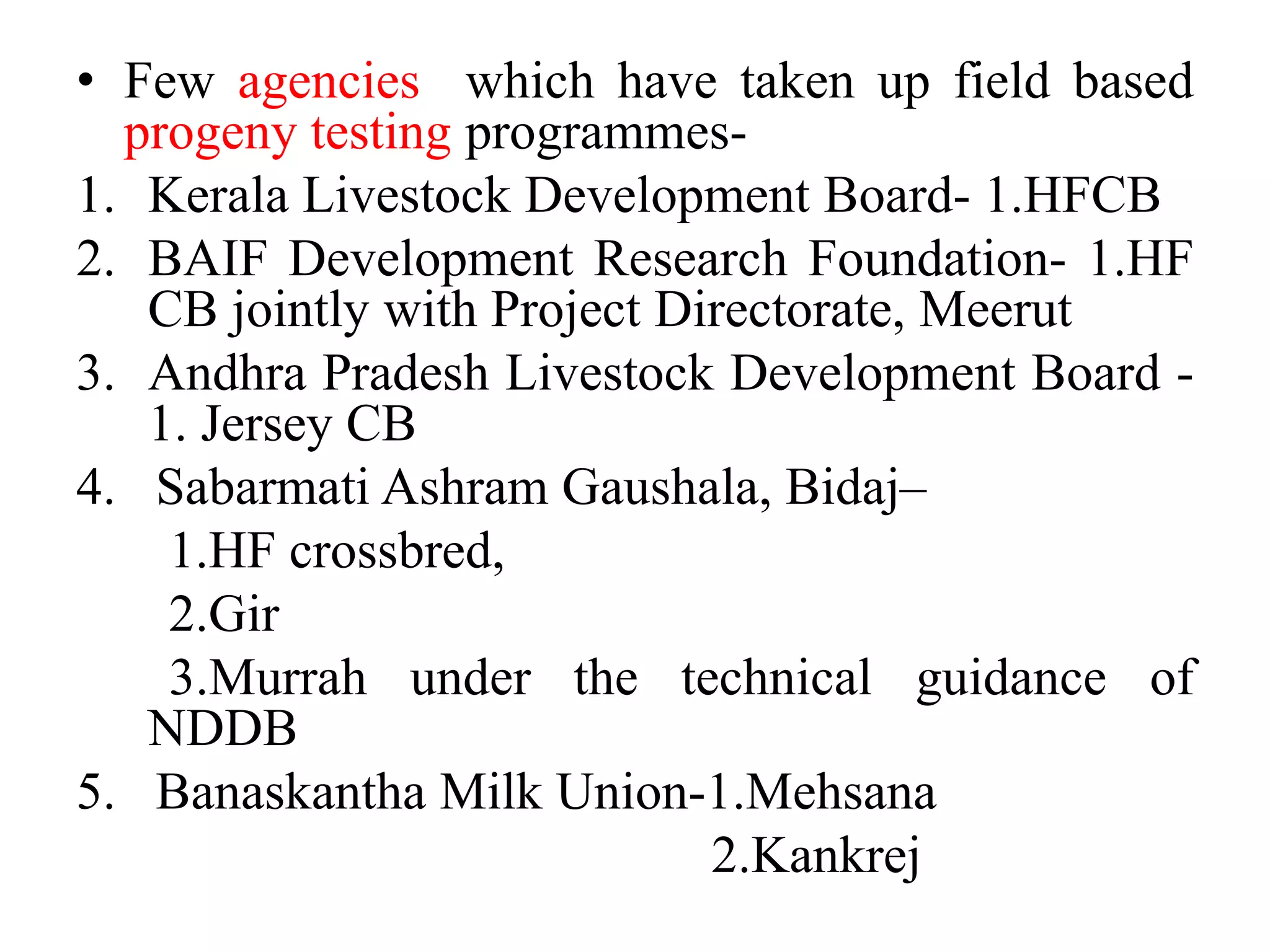
• Few agencies which have taken up field based
progeny testing programmes-
1. Kerala Livestock Development Board- 1.HFCB
2. BAIF Development Research Foundation- 1.HF
CB jointly with Project Directorate, Meerut
3. Andhra Pradesh Livestock Development Board -
1. Jersey CB
4. Sabarmati Ashram Gaushala, Bidaj–
1.HF crossbred,
2.Gir
3.Murrah under the technical guidance of
NDDB
5. Banaskantha Milk Union-1.Mehsana
2.Kankrej
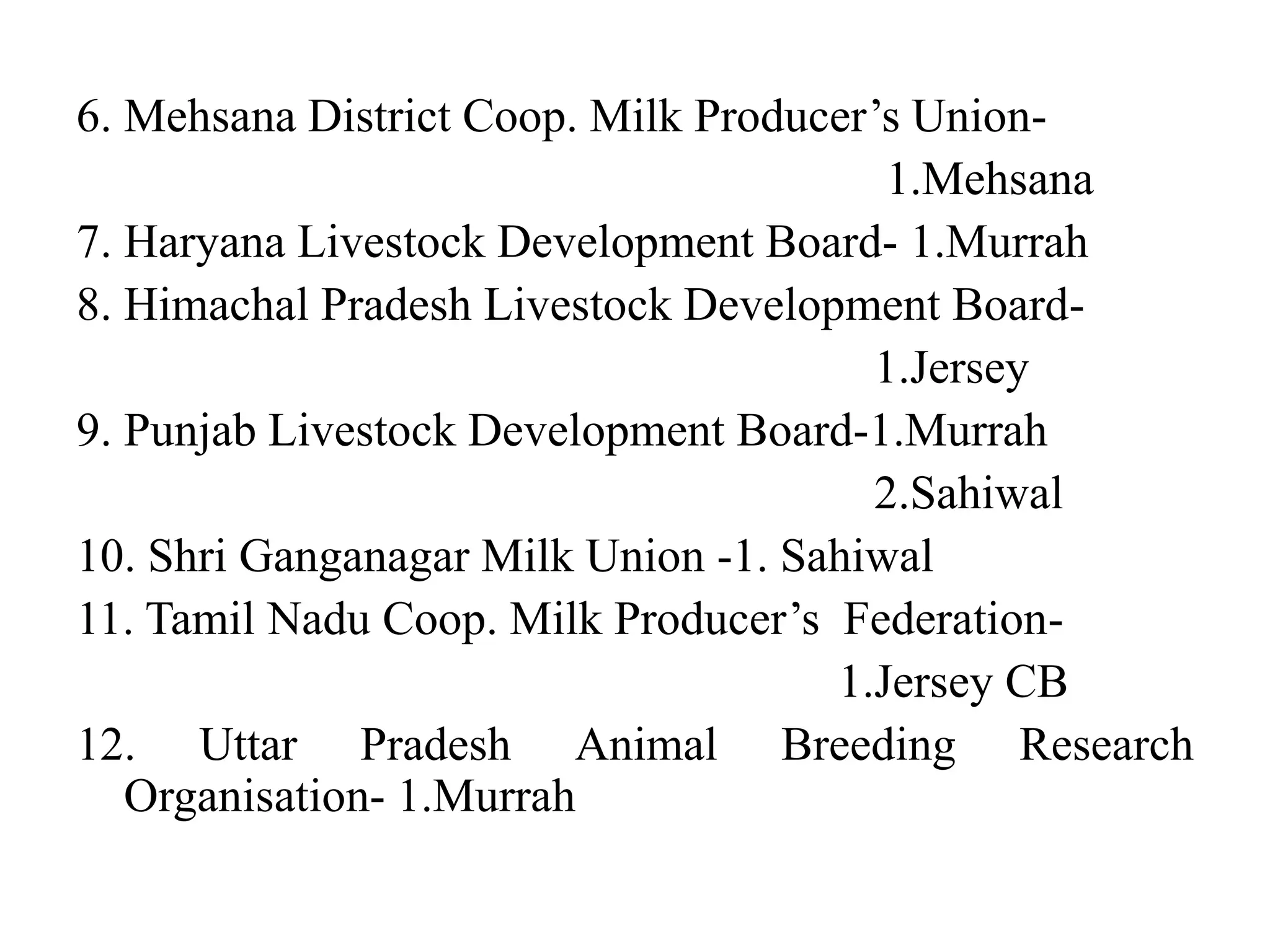
6. Mehsana District Coop. Milk Producer’s Union-
1.Mehsana
7. Haryana Livestock Development Board- 1.Murrah
8. Himachal Pradesh Livestock Development Board-
1.Jersey
9. Punjab Livestock Development Board-1.Murrah
2.Sahiwal
10. Shri Ganganagar Milk Union -1. Sahiwal
11. Tamil Nadu Coop. Milk Producer’s Federation-
1.Jersey CB
12. Uttar Pradesh Animal Breeding Research
Organisation- 1.Murrah
Prerequisites PT project
• The main prerequisites are that the agency should
have: -
a. Identified an area having a sizeable breedable female
bovine population of the proposed breed in a compact
area
b. Either a network of mobile AI technicians or tie up
arrangement with an established AI service provider to
carry out test AIs in the identified area
c. Village level infrastructure and exclusive manpower
to implement and supervise the project
d. Semen Station
e. Long-term financial commitment
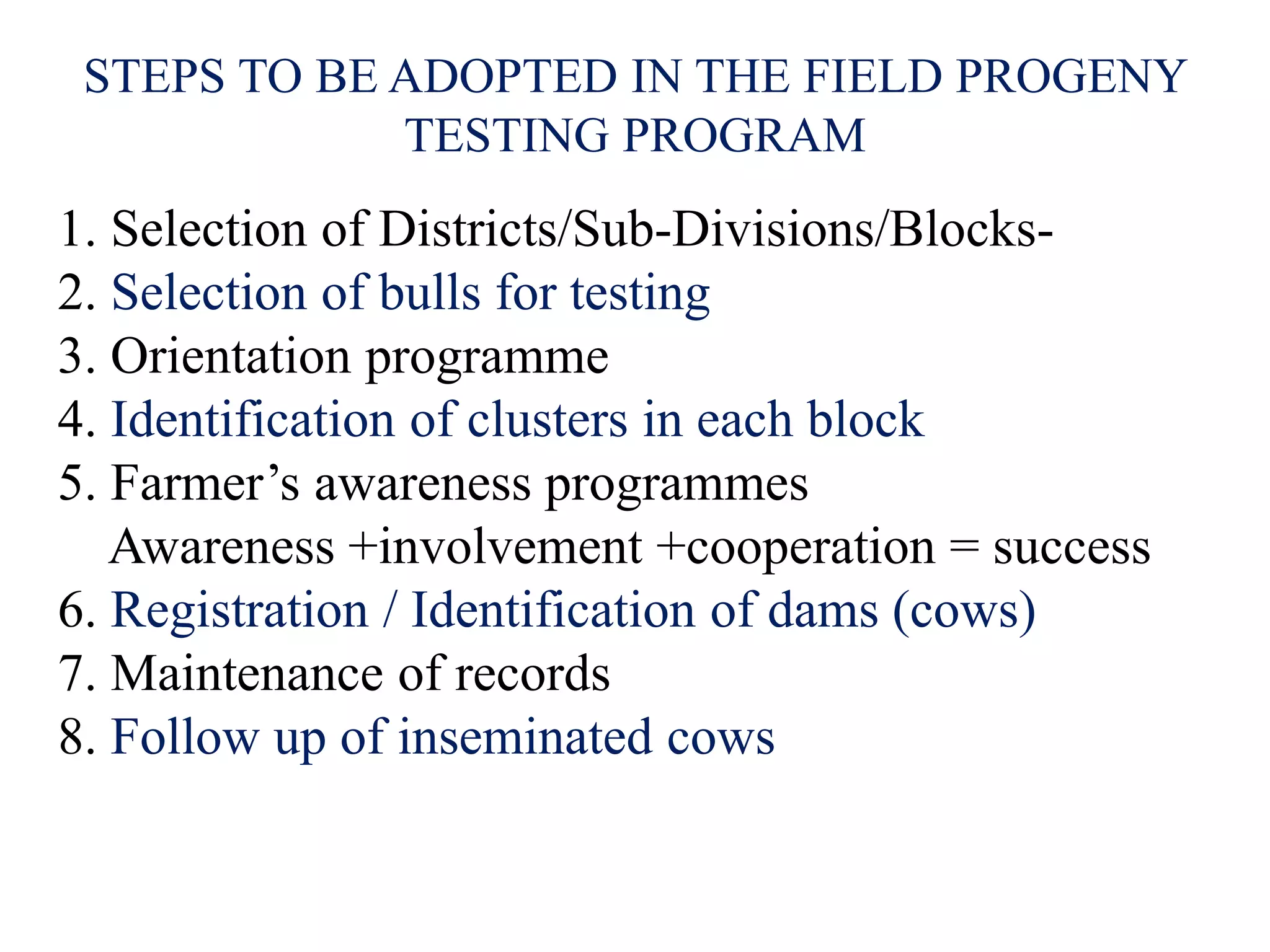
STEPS TO BE ADOPTED IN THE FIELD PROGENY
TESTING PROGRAM
1. Selection of Districts/Sub-Divisions/Blocks-
2. Selection of bulls for testing
3. Orientation programme
4. Identification of clusters in each block
5. Farmer’s awareness programmes
Awareness +involvement +cooperation = success
6. Registration / Identification of dams (cows)
7. Maintenance of records
8. Follow up of inseminated cows
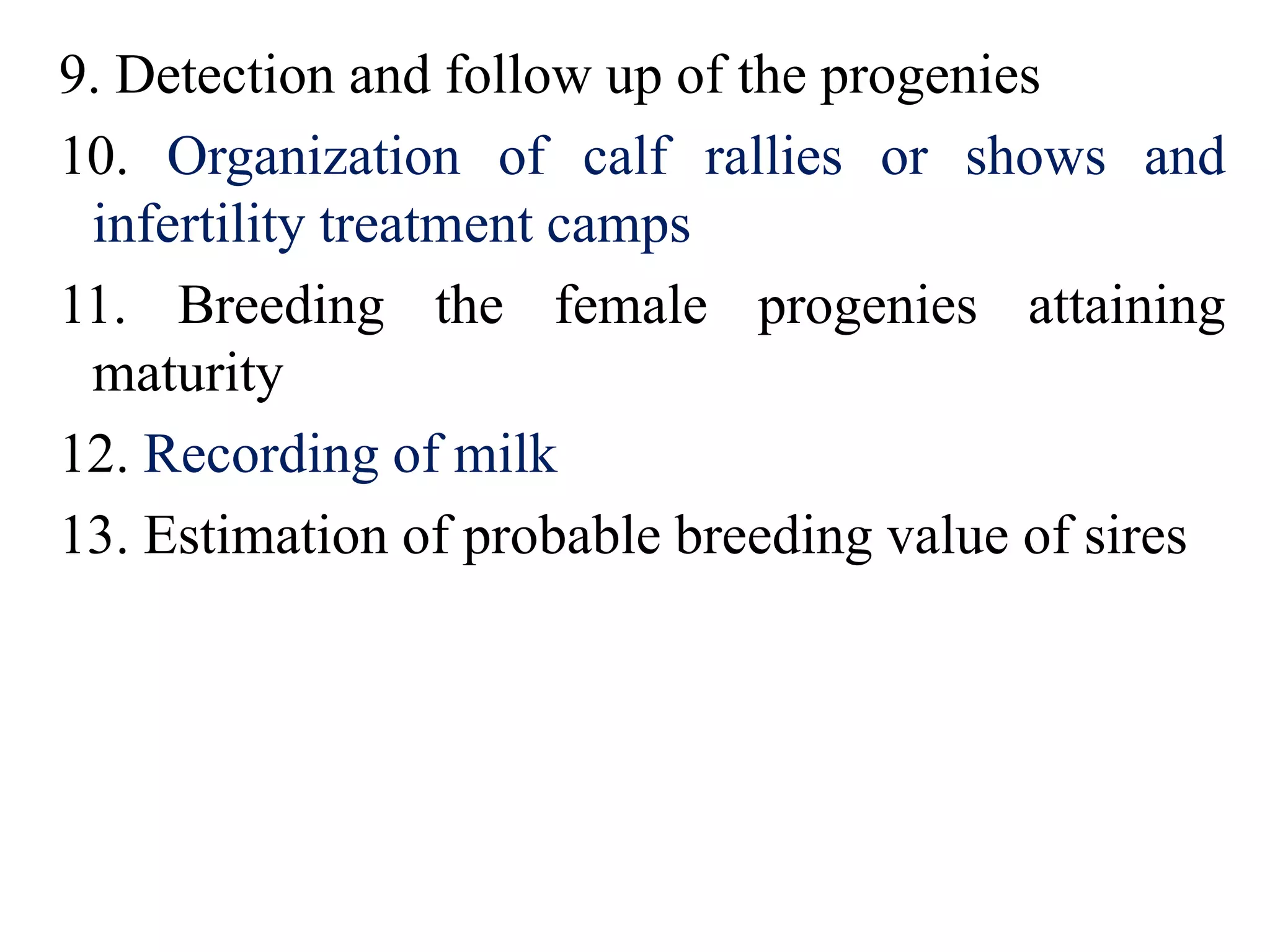
9. Detection and follow up of the progenies
10. Organization of calf rallies or shows and
infertility treatment camps
11. Breeding the female progenies attaining
maturity
12. Recording of milk
13. Estimation of probable breeding value of sires
SIRE EVALUATION
• Sire evaluation can be formulated as a process of
prediction of future progeny of a sire produced by
mating with specified females and making their records
in some specified environment(Henderson)
• The result of P.T. are expressed in the form of an index
which is the index of the genetic worth of the sire and
such an index is known as sire index
• Based on sire index a numerical value is obtained
which indicates the production ability of the sire
• Since a number of sires are progeny tested, it requires
to rank all sires for their genetic worth so as to select
the best sire
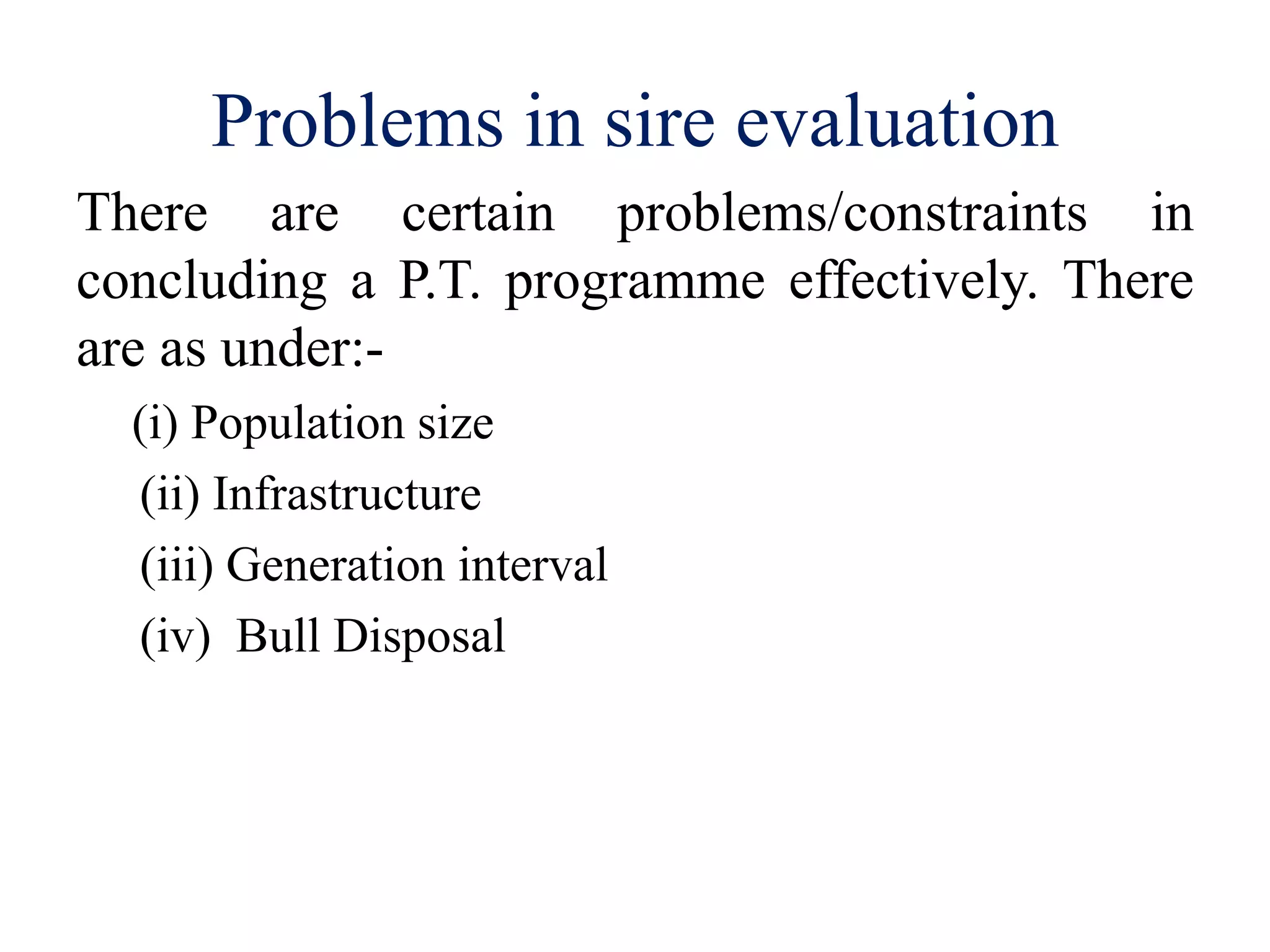
Problems in sire evaluation
There are certain problems/constraints in
concluding a P.T. programme effectively. There
are as under:-
(i) Population size
(ii) Infrastructure
(iii) Generation interval
(iv) Bull Disposal
Methods of indexing sires
1. SIMPLE DAUGHTER AVERAGE INDEX:-
• The simplest way to evaluate a bull is by his
daughter’s production alone (Edward, 1932)
• Simplest measure in a single herd under same
environment
SI = Di
where,
Di = Average of all daughter of a sire under test
• This index when used for ranking sires would be
subject to bias if the levels of production of dams
allotted to different sires were unequal
2.EQUIPARENT / INTERMEDIATE / DAIRY BULL INDEX /
YAPP’S INDEX
• Proposed by Hansson in 1913
• It is also known as Yapp’s index(Yapp, 1925) and Mount Hope
Index( First used, 1928)
• This index (Yapp, 1925) is based on the principle that the two
parents contribute equally to the genetic make up of the progeny
• This index makes adjustment for the variation in production level
of the dam
SI = 2D – M =D+(D-M)
where,
D = average yield of daughters of the sire
M = average yield of dams mated to the sire
• In Yapp’s formula, the potential transmitting ability can be
expressed in terms of 4% fat corrected milk
• This index overestimates the breeding value of a sire mated to set
of dams inferior on the average and underestimates if dams
happen to be superior on the average to the general level of herd
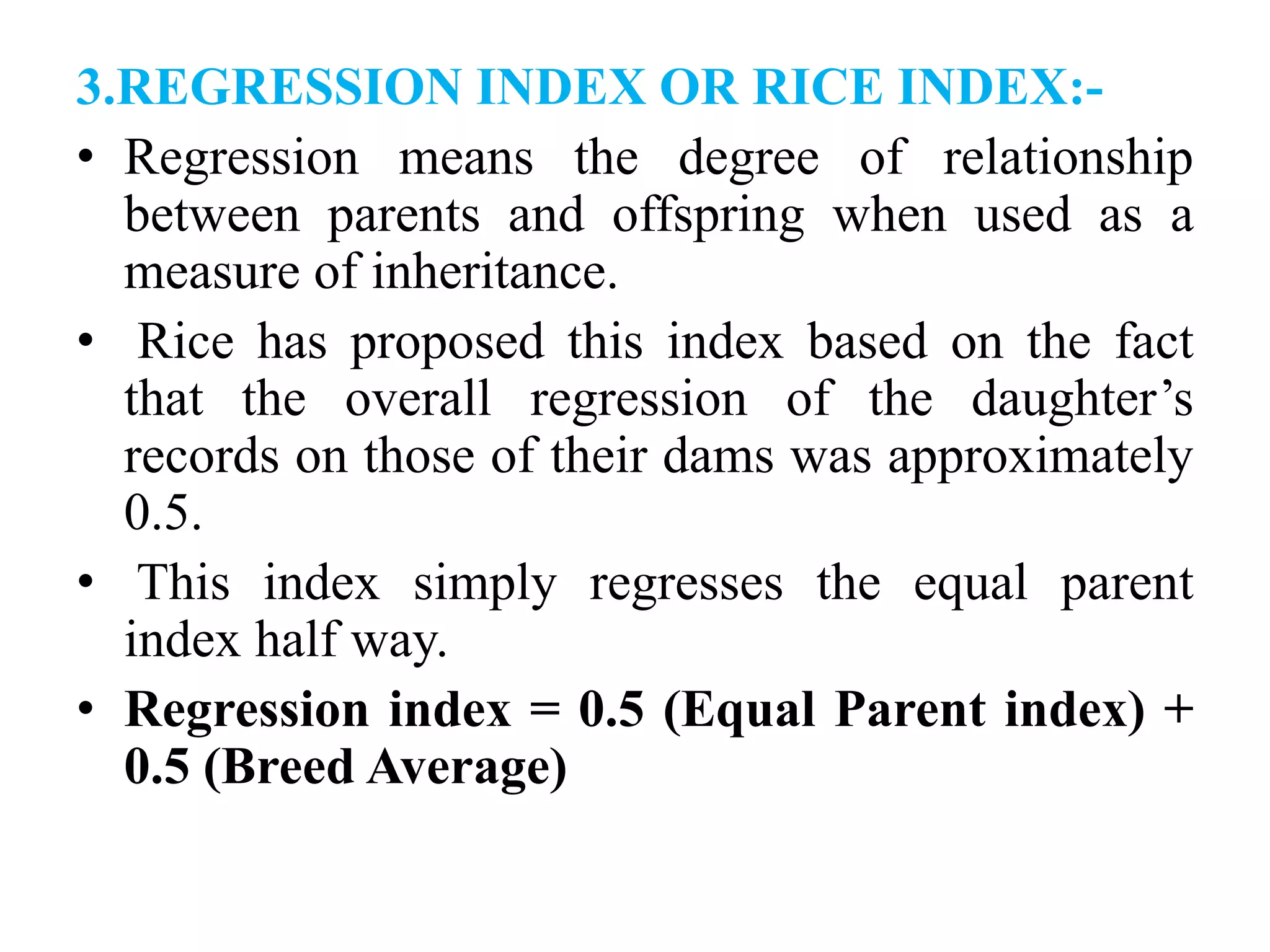
3.REGRESSION INDEX OR RICE INDEX:-
• Regression means the degree of relationship
between parents and offspring when used as a
measure of inheritance.
• Rice has proposed this index based on the fact
that the overall regression of the daughter’s
records on those of their dams was approximately
0.5.
• This index simply regresses the equal parent
index half way.
• Regression index = 0.5 (Equal Parent index) +
0.5 (Breed Average)
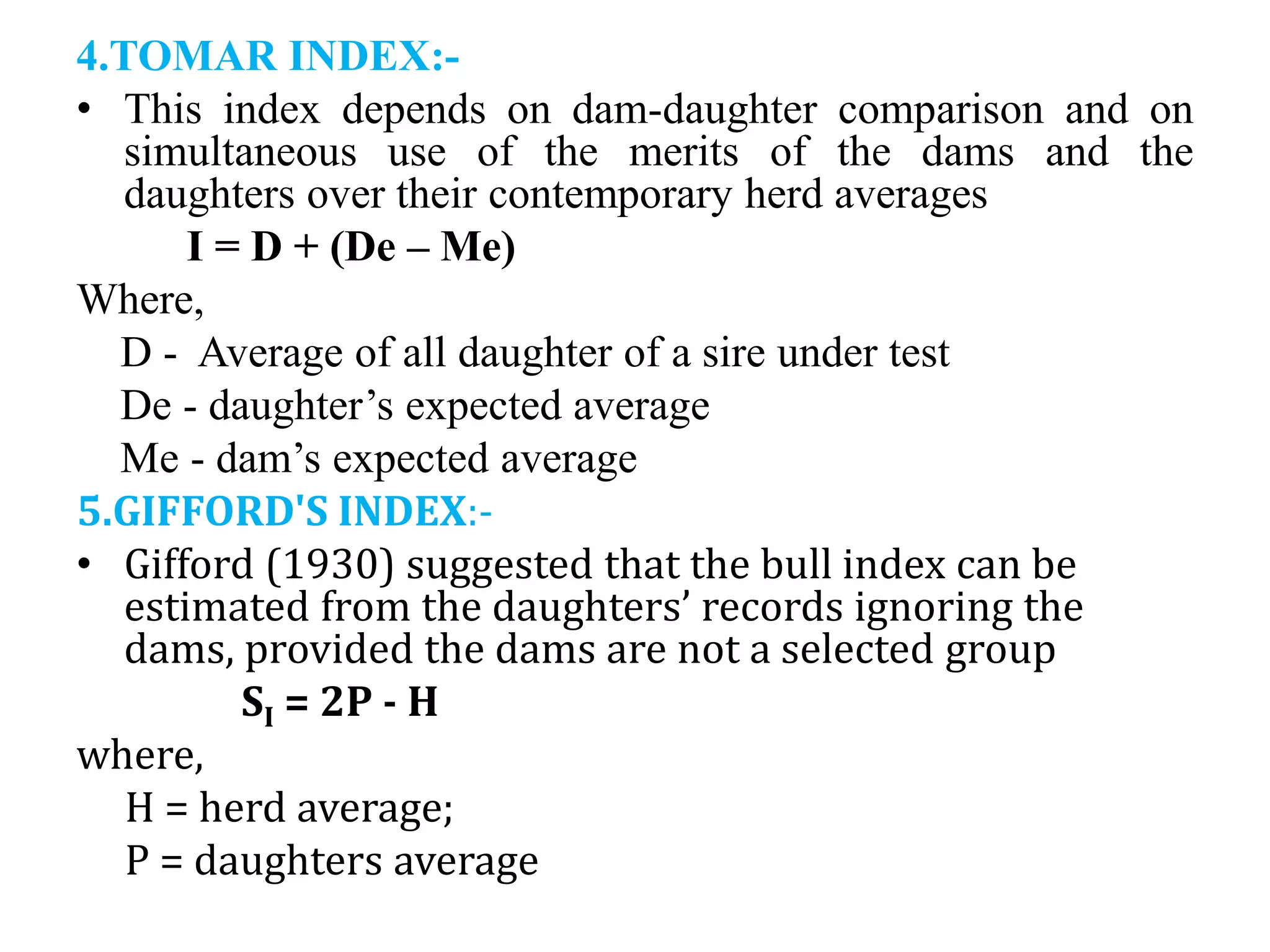
4.TOMAR INDEX:-
• This index depends on dam-daughter comparison and on
simultaneous use of the merits of the dams and the
daughters over their contemporary herd averages
I = D + (De – Me)
Where,
D - Average of all daughter of a sire under test
De - daughter’s expected average
Me - dam’s expected average
5.GIFFORD'S INDEX:-
• Gifford (1930) suggested that the bull index can be
estimated from the daughters’ records ignoring the
dams, provided the dams are not a selected group
SI = 2P - H
where,
H = herd average;
P = daughters average
6.CORRECTED DAUGHTER AVERAGE INDEX /
KRISHNA'S INDEX
• This index (Krishnan, 1956) corrects the daughters’ average
for the influence of different production levels of dams sired
by different bulls on the basis of regression of daughters’
records on dams.
• The term “b(M - A)” appearing in the index is correction for
the genetic superiority or inferiority of a set of dams allotted
to the sire over the herd average
SI = D – b (M – H) = d - 0.5 h2 (M- H)
where,
D = daughter’s average;
M = dam’s average
H = herd average
b = regression coefficient of daughter’s yield on dam’s yield
7.Contemporary comparison or stable mate comaperison:-
Searle (1964) – compared the daughter records with their herd mates in the
same year
The sire’s merit was estimated as –
S = H + 0.5 h2 (D-H) n/ 1+(n-1)0.25 h2
8. HEIZER'S INDEX:-
• This index is used to determine the transmitting ability of individual
bulls with regard to milk production
• This method is based on progeny selection
Y = 3 / 8 X + 3 / 4 I + 1 / 4 B
Where,
Y - daughter’s average production
X - dam’s average production
I - sire’s index
B - Breed or Herd average
9.DAIRY SEARCH INDEX / SUNDARESAN INDEX :-
• Sundaresan (1965) gave two methods one for sire
evaluation at farm level and another for key-village
• The farm method takes dam-daughter records in to
consideration
SI = H + n / (n + 12) (D – CD) – b (M – CM)
• For key-village level the dam’s record is not available so, he
modified the formula as
SI = H+ n / (n + 12) (D – CD)
where,
H= herd average
n = number of daughters per sire
D = average of daughters
CD = average of contemporaries of daughters;
b = intra-sire regression of daughters on dam;
M = average of dams
CM = average of contemporaries of dams
10. CONTEMPORARY DAUGHTER AVERAGE
INDEX:-
• The herd mate or contemporary comparison reduce the
environmental variation due to herd, year and season
• The value was based on the comparison of average of the
daughters of the bull with average of the contemporary
daughters of the same group but sired by different bulls
• The difference between the two averages was weighted for
the number of heifers in each sire group
• The contemporary group will allow effective adjustment of
major environment effects
SI = H+ {n / n + k} (D - C)
where,
n = number of daughters
C = average of daughter’s contemporaries
k = ratio of error variance to sire variance
11.HERD-MATE COMPARISON:-
• This method (Henderson and Carter, 1957) compares
each cow’s record with the records of other cows
milking in the same herd at the same time
• The herd, year and season variations account for about
50% of the total variation in milk production. This
method eliminates the herd-year-season variation from
the estimate of the sire index
PD = [(ni / (ni + 20)] {Di - 0.9 (HMi – H) – H}
where,
PD = predicted difference
ni = number of daughters at the ith herd-mate level
Di = average of the daughters at the ith herd-mate level
HMi = average of the herd-mates at ith herd-mate level
12.Maximum Likelihood method and REML :-
• The least square method minimizes the error
variance whereas the maximum likelihood
(chance) method estimates the parameters by
maximizing the logarithm of the likelihood
function
• The likelihood function is the likelihood of
simultaneous occurrence of observation and is
generally the product of density function of the
observations (variables)
• The ML estimates are biased because no account
is taken of the degree of freedom in estimating the
variance components
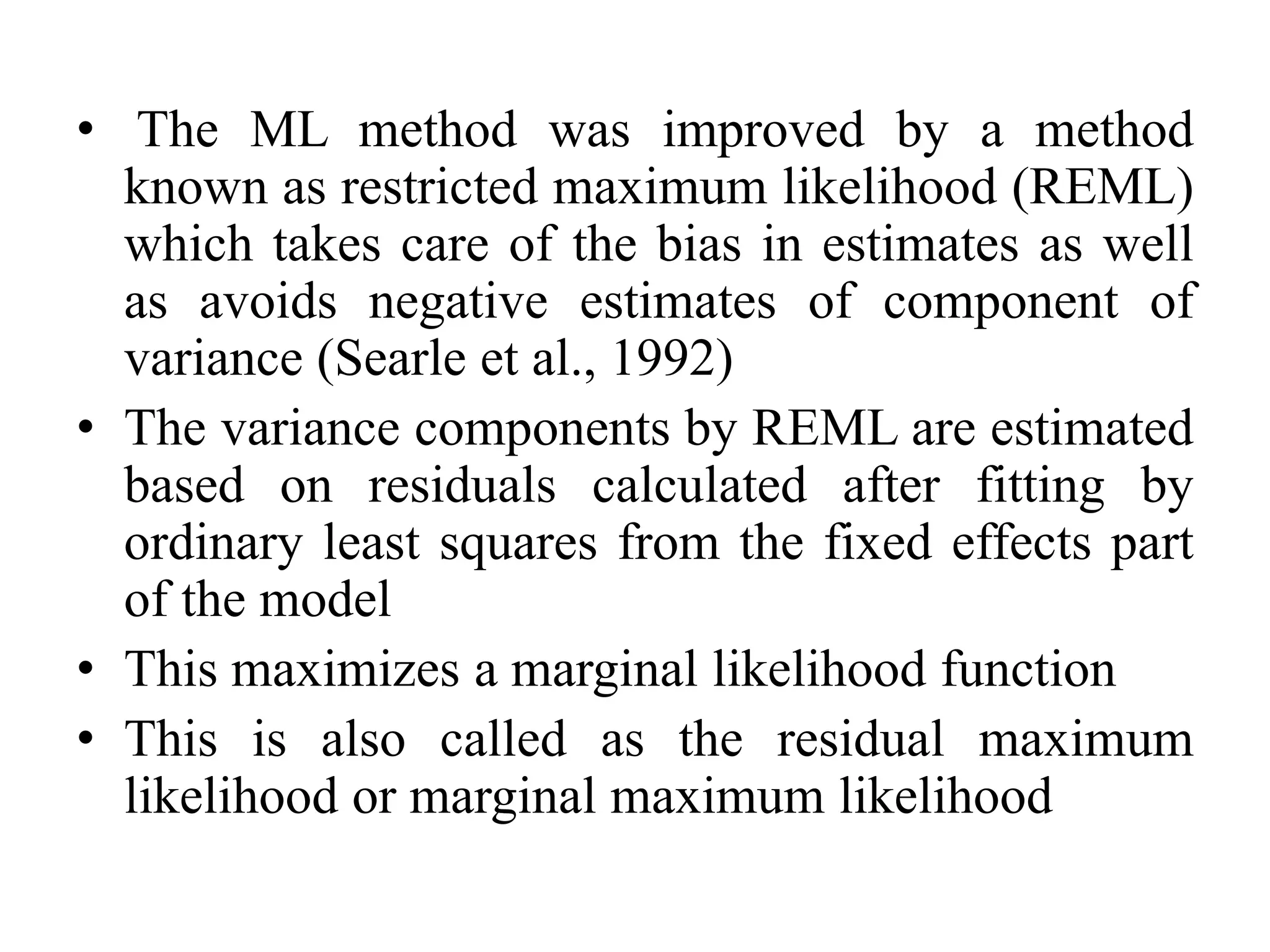
• The ML method was improved by a method
known as restricted maximum likelihood (REML)
which takes care of the bias in estimates as well
as avoids negative estimates of component of
variance (Searle et al., 1992)
• The variance components by REML are estimated
based on residuals calculated after fitting by
ordinary least squares from the fixed effects part
of the model
• This maximizes a marginal likelihood function
• This is also called as the residual maximum
likelihood or marginal maximum likelihood
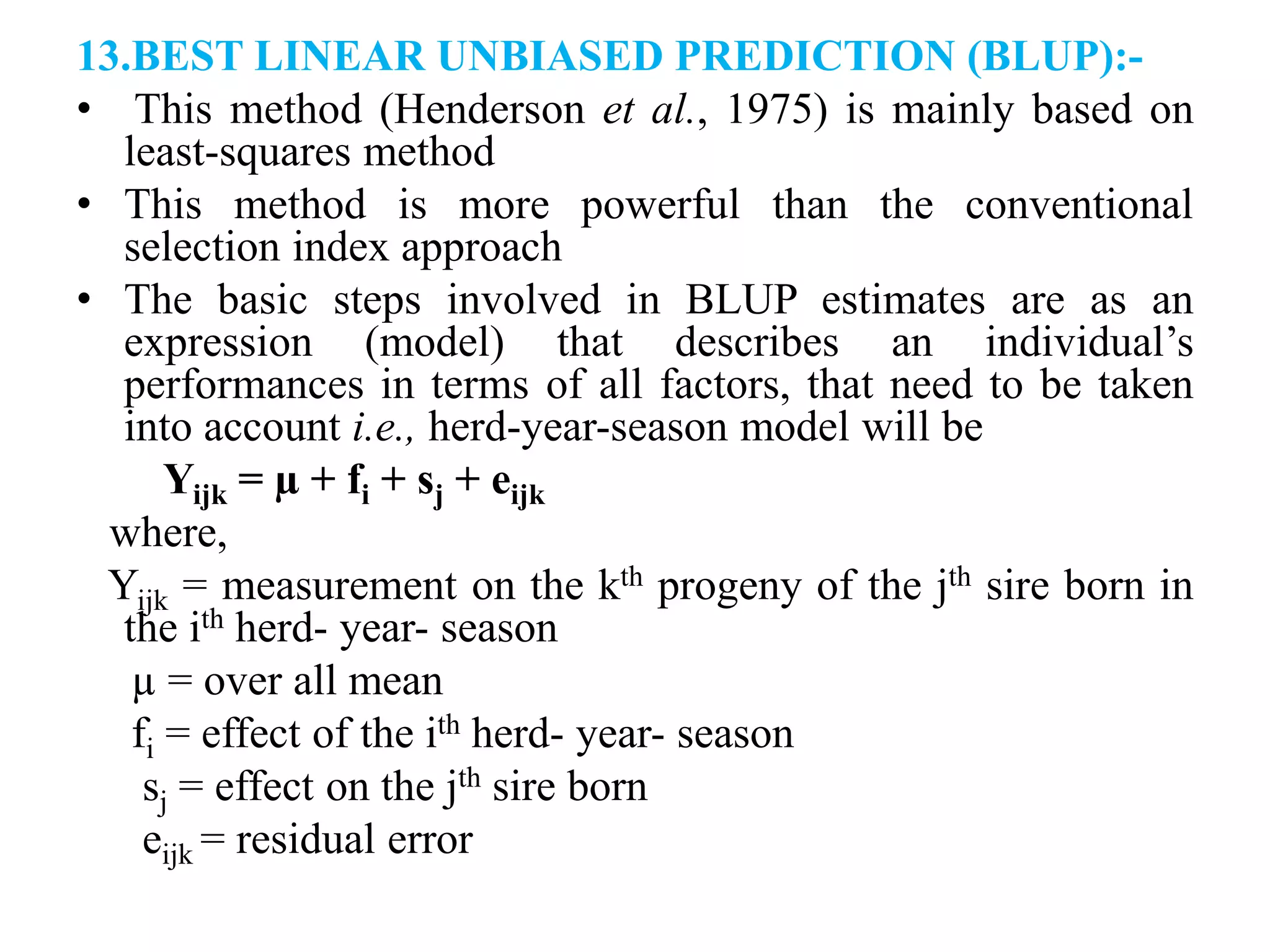
13.BEST LINEAR UNBIASED PREDICTION (BLUP):-
• This method (Henderson et al., 1975) is mainly based on
least-squares method
• This method is more powerful than the conventional
selection index approach
• The basic steps involved in BLUP estimates are as an
expression (model) that describes an individual’s
performances in terms of all factors, that need to be taken
into account i.e., herd-year-season model will be
Yijk = µ + fi + sj + eijk
where,
Yijk = measurement on the kth progeny of the jth sire born in
the ith herd- year- season
µ = over all mean
fi = effect of the ith herd- year- season
sj = effect on the jth sire born
eijk = residual error
14. Other methods for multi herds:-
• Some methods for evaluation of sires used in
more than one herd have also been proposed
These are-
1. Stable-Mate Daughter Average Index,
2. Contemporary Daughter Average Index and
3. Corrected Stable-Mate Daughter Average
Index.
Advantages of PT
1. The PT is a better method for sex limited
traits, the trait with low h2 and slaughter traits
2. Useful for testing any recessive allele
3. Increased selection intensity
4. Its accuracy increased with increase in
progeny number
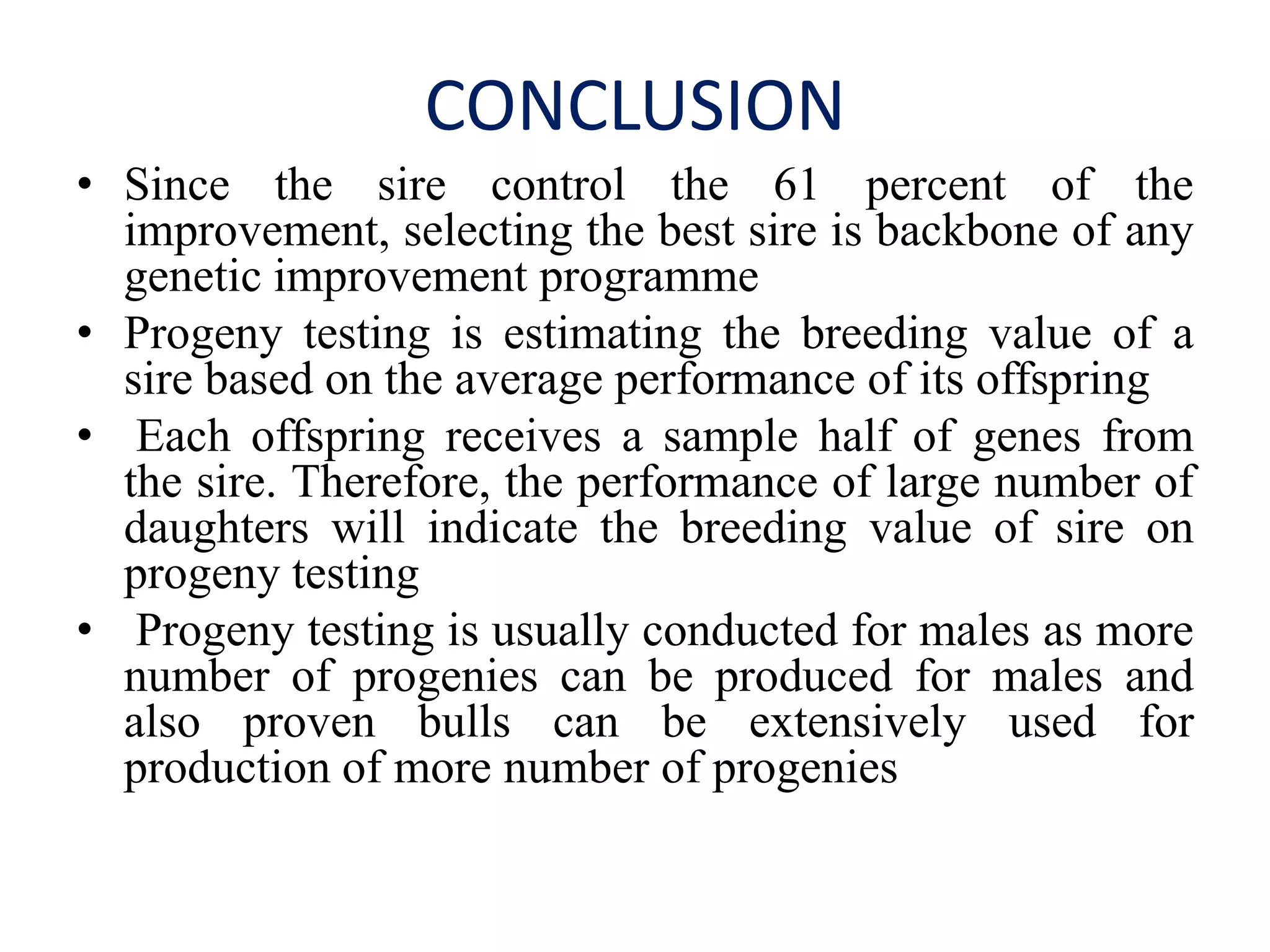
Limitation of PT
1. The time and cost required is the main
limitation
2. It increases the generation interval. Due to
larger generation interval the genetic gain per
year is low
3. PT is effective on adequate no. of progeny
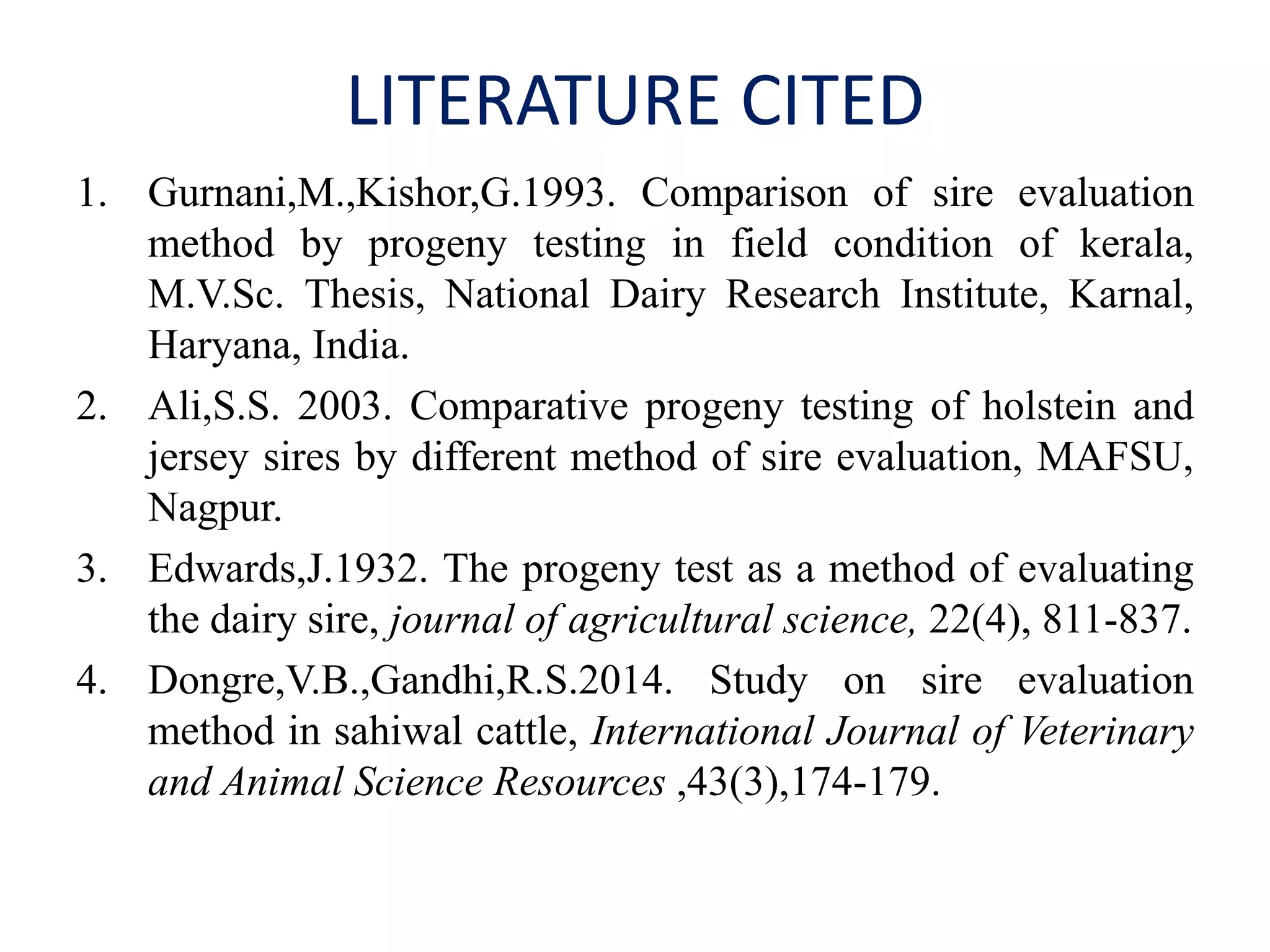
CONCLUSION
• Since the sire control the 61 percent of the
improvement, selecting the best sire is backbone of any
genetic improvement programme
• Progeny testing is estimating the breeding value of a
sire based on the average performance of its offspring
• Each offspring receives a sample half of genes from
the sire. Therefore, the performance of large number of
daughters will indicate the breeding value of sire on
progeny testing
• Progeny testing is usually conducted for males as more
number of progenies can be produced for males and
also proven bulls can be extensively used for
production of more number of progenies
• The primary selection of the bulls is based on the
sibs’ average. The bulls with highest averages are
selected and included in the progeny testing.
• Then the bulls are used on many females to
produce many progenies.
• The performances of progenies are then studied
to estimate the breeding value of each bull.
• It is the best way of determining the genetic
makeup of an individual.
• The genetic principle behind progeny testing is
that the more the number of progeny are tested
the greater the accuracy of assessment of the
parents, since the errors in sampling are reduced.
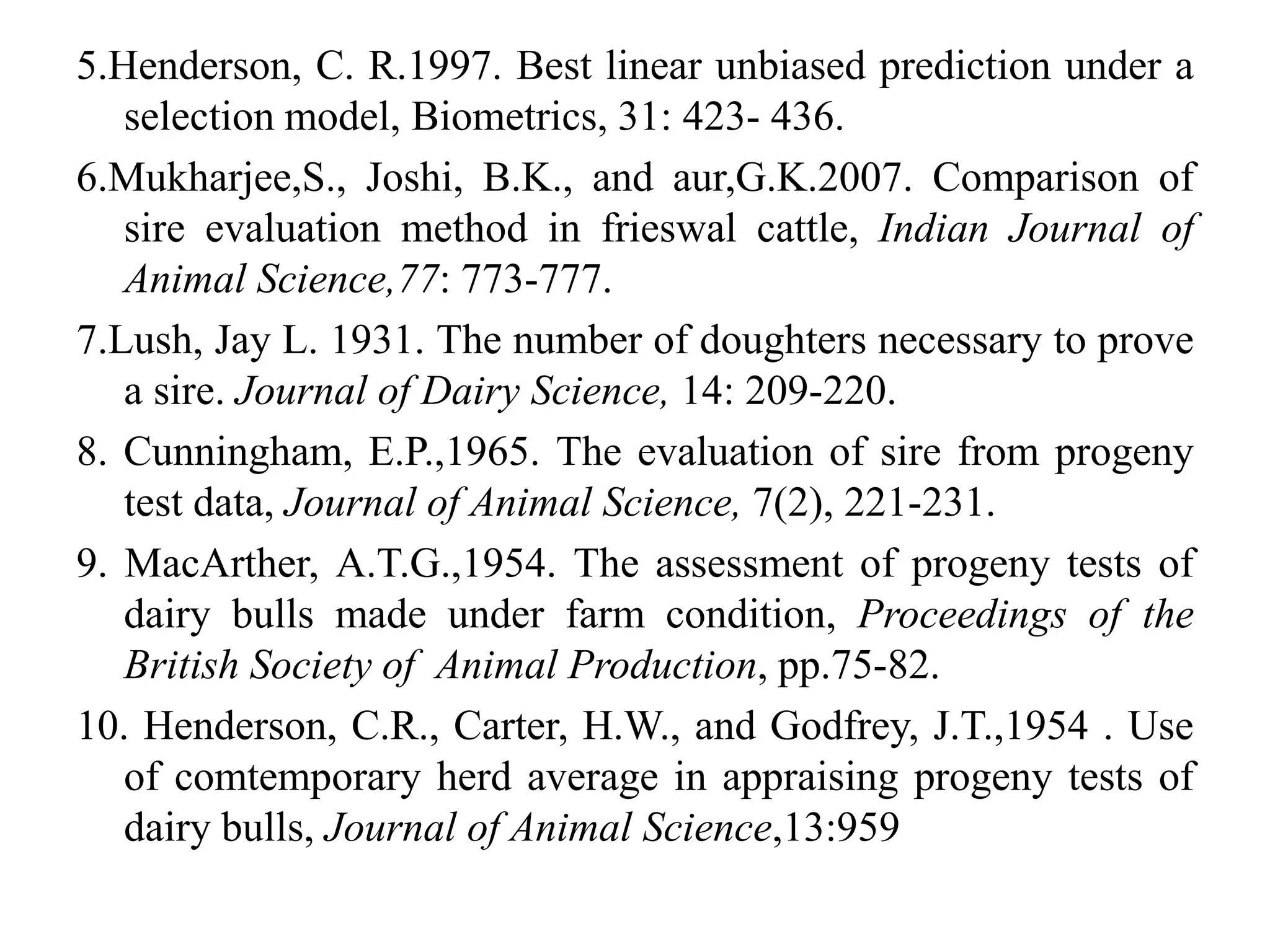
LITERATURE CITED
1. Gurnani,M.,Kishor,G.1993. Comparison of sire evaluation
method by progeny testing in field condition of kerala,
M.V.Sc. Thesis, National Dairy Research Institute, Karnal,
Haryana, India.
2. Ali,S.S. 2003. Comparative progeny testing of holstein and
jersey sires by different method of sire evaluation, MAFSU,
Nagpur.
3. Edwards,J.1932. The progeny test as a method of evaluating
the dairy sire, journal of agricultural science, 22(4), 811-837.
4. Dongre,V.B.,Gandhi,R.S.2014. Study on sire evaluation
method in sahiwal cattle, International Journal of Veterinary
and Animal Science Resources ,43(3),174-179.
5.Henderson, C. R.1997. Best linear unbiased prediction under a
selection model, Biometrics, 31: 423- 436.
6.Mukharjee,S., Joshi, B.K., and aur,G.K.2007. Comparison of
sire evaluation method in frieswal cattle, Indian Journal of
Animal Science,77: 773-777.
7.Lush, Jay L. 1931. The number of doughters necessary to prove
a sire. Journal of Dairy Science, 14: 209-220.
8. Cunningham, E.P.,1965. The evaluation of sire from progeny
test data, Journal of Animal Science, 7(2), 221-231.
9. MacArther, A.T.G.,1954. The assessment of progeny tests of
dairy bulls made under farm condition, Proceedings of the
British Society of Animal Production, pp.75-82.
10. Henderson, C.R., Carter, H.W., and Godfrey, J.T.,1954 . Use
of comtemporary herd average in appraising progeny tests of
dairy bulls, Journal of Animal Science,13:959
11. Henderson ,C.R.1937. Sire evaluation and genetic
trands, Journal of Animal Science, pag.10-41 .
12. Chaudhari, J.D.,Gupta, J.P., Pandey, D.P., Shah,
R.R.2018. Effectiveness of various sire evaluation
method in ranking Mehsana bulls based on FL305MY
and TMY under field progeny testing programme, Indian
Journal of Animal Sciences, 88(12), 1419-1421.
13. Chaudhari, P.N., Upadhyay,M.R.,Patel,A.C.,Patel, S.B.,
and Rank, D. R. 2015. A comparison of different methods
of sire evaluation for production and reproduction traits of
Murrah graded buffaloes, Indian Journal of Dairy
Science, 68: 259-265.
14. DHAD. 2009. Minimum Standards for Progeny Testing.
15. Harvey,W.R.1979. Accuracy of simplified regressed
least –squares(SRLS) BULP method for ranking of sires,
Journal of Animal Genetics and Breeding, 1:7-19.
THANK YOU

Progeny testing

  • 1.
    Progeny Testing and Sire Evaluation Dr.Jayesh Vyas M.V. Sc. (Animal Genetics and Breeding)
  • 2.
    Introduction • Progeny Testingis a method for accurately evaluating and selecting top bulls and using them to produce future bulls • The parents of progeny with higher performance for desired traits are selected for future breeding
  • 3.
    • The progenytest is needed most for traits which cannot be expressed in one sex as in milk and fat production in dairy cattle, egg production in poultry, prolificacy in swine etc • The superiority of the progeny test is greatest for traits which are least hereditary
  • 4.
    • Few agencieswhich have taken up field based progeny testing programmes- 1. Kerala Livestock Development Board- 1.HFCB 2. BAIF Development Research Foundation- 1.HF CB jointly with Project Directorate, Meerut 3. Andhra Pradesh Livestock Development Board - 1. Jersey CB 4. Sabarmati Ashram Gaushala, Bidaj– 1.HF crossbred, 2.Gir 3.Murrah under the technical guidance of NDDB 5. Banaskantha Milk Union-1.Mehsana 2.Kankrej
  • 5.
    6. Mehsana DistrictCoop. Milk Producer’s Union- 1.Mehsana 7. Haryana Livestock Development Board- 1.Murrah 8. Himachal Pradesh Livestock Development Board- 1.Jersey 9. Punjab Livestock Development Board-1.Murrah 2.Sahiwal 10. Shri Ganganagar Milk Union -1. Sahiwal 11. Tamil Nadu Coop. Milk Producer’s Federation- 1.Jersey CB 12. Uttar Pradesh Animal Breeding Research Organisation- 1.Murrah
  • 6.
    Prerequisites PT project •The main prerequisites are that the agency should have: - a. Identified an area having a sizeable breedable female bovine population of the proposed breed in a compact area b. Either a network of mobile AI technicians or tie up arrangement with an established AI service provider to carry out test AIs in the identified area c. Village level infrastructure and exclusive manpower to implement and supervise the project d. Semen Station e. Long-term financial commitment
  • 7.
    STEPS TO BEADOPTED IN THE FIELD PROGENY TESTING PROGRAM 1. Selection of Districts/Sub-Divisions/Blocks- 2. Selection of bulls for testing 3. Orientation programme 4. Identification of clusters in each block 5. Farmer’s awareness programmes Awareness +involvement +cooperation = success 6. Registration / Identification of dams (cows) 7. Maintenance of records 8. Follow up of inseminated cows
  • 8.
    9. Detection andfollow up of the progenies 10. Organization of calf rallies or shows and infertility treatment camps 11. Breeding the female progenies attaining maturity 12. Recording of milk 13. Estimation of probable breeding value of sires
  • 10.
    SIRE EVALUATION • Sireevaluation can be formulated as a process of prediction of future progeny of a sire produced by mating with specified females and making their records in some specified environment(Henderson) • The result of P.T. are expressed in the form of an index which is the index of the genetic worth of the sire and such an index is known as sire index • Based on sire index a numerical value is obtained which indicates the production ability of the sire • Since a number of sires are progeny tested, it requires to rank all sires for their genetic worth so as to select the best sire
  • 11.
    Problems in sireevaluation There are certain problems/constraints in concluding a P.T. programme effectively. There are as under:- (i) Population size (ii) Infrastructure (iii) Generation interval (iv) Bull Disposal
  • 12.
    Methods of indexingsires 1. SIMPLE DAUGHTER AVERAGE INDEX:- • The simplest way to evaluate a bull is by his daughter’s production alone (Edward, 1932) • Simplest measure in a single herd under same environment SI = Di where, Di = Average of all daughter of a sire under test • This index when used for ranking sires would be subject to bias if the levels of production of dams allotted to different sires were unequal
  • 13.
    2.EQUIPARENT / INTERMEDIATE/ DAIRY BULL INDEX / YAPP’S INDEX • Proposed by Hansson in 1913 • It is also known as Yapp’s index(Yapp, 1925) and Mount Hope Index( First used, 1928) • This index (Yapp, 1925) is based on the principle that the two parents contribute equally to the genetic make up of the progeny • This index makes adjustment for the variation in production level of the dam SI = 2D – M =D+(D-M) where, D = average yield of daughters of the sire M = average yield of dams mated to the sire • In Yapp’s formula, the potential transmitting ability can be expressed in terms of 4% fat corrected milk • This index overestimates the breeding value of a sire mated to set of dams inferior on the average and underestimates if dams happen to be superior on the average to the general level of herd
  • 14.
    3.REGRESSION INDEX ORRICE INDEX:- • Regression means the degree of relationship between parents and offspring when used as a measure of inheritance. • Rice has proposed this index based on the fact that the overall regression of the daughter’s records on those of their dams was approximately 0.5. • This index simply regresses the equal parent index half way. • Regression index = 0.5 (Equal Parent index) + 0.5 (Breed Average)
  • 15.
    4.TOMAR INDEX:- • Thisindex depends on dam-daughter comparison and on simultaneous use of the merits of the dams and the daughters over their contemporary herd averages I = D + (De – Me) Where, D - Average of all daughter of a sire under test De - daughter’s expected average Me - dam’s expected average 5.GIFFORD'S INDEX:- • Gifford (1930) suggested that the bull index can be estimated from the daughters’ records ignoring the dams, provided the dams are not a selected group SI = 2P - H where, H = herd average; P = daughters average
  • 16.
    6.CORRECTED DAUGHTER AVERAGEINDEX / KRISHNA'S INDEX • This index (Krishnan, 1956) corrects the daughters’ average for the influence of different production levels of dams sired by different bulls on the basis of regression of daughters’ records on dams. • The term “b(M - A)” appearing in the index is correction for the genetic superiority or inferiority of a set of dams allotted to the sire over the herd average SI = D – b (M – H) = d - 0.5 h2 (M- H) where, D = daughter’s average; M = dam’s average H = herd average b = regression coefficient of daughter’s yield on dam’s yield
  • 17.
    7.Contemporary comparison orstable mate comaperison:- Searle (1964) – compared the daughter records with their herd mates in the same year The sire’s merit was estimated as – S = H + 0.5 h2 (D-H) n/ 1+(n-1)0.25 h2 8. HEIZER'S INDEX:- • This index is used to determine the transmitting ability of individual bulls with regard to milk production • This method is based on progeny selection Y = 3 / 8 X + 3 / 4 I + 1 / 4 B Where, Y - daughter’s average production X - dam’s average production I - sire’s index B - Breed or Herd average
  • 18.
    9.DAIRY SEARCH INDEX/ SUNDARESAN INDEX :- • Sundaresan (1965) gave two methods one for sire evaluation at farm level and another for key-village • The farm method takes dam-daughter records in to consideration SI = H + n / (n + 12) (D – CD) – b (M – CM) • For key-village level the dam’s record is not available so, he modified the formula as SI = H+ n / (n + 12) (D – CD) where, H= herd average n = number of daughters per sire D = average of daughters CD = average of contemporaries of daughters; b = intra-sire regression of daughters on dam; M = average of dams CM = average of contemporaries of dams
  • 19.
    10. CONTEMPORARY DAUGHTERAVERAGE INDEX:- • The herd mate or contemporary comparison reduce the environmental variation due to herd, year and season • The value was based on the comparison of average of the daughters of the bull with average of the contemporary daughters of the same group but sired by different bulls • The difference between the two averages was weighted for the number of heifers in each sire group • The contemporary group will allow effective adjustment of major environment effects SI = H+ {n / n + k} (D - C) where, n = number of daughters C = average of daughter’s contemporaries k = ratio of error variance to sire variance
  • 20.
    11.HERD-MATE COMPARISON:- • Thismethod (Henderson and Carter, 1957) compares each cow’s record with the records of other cows milking in the same herd at the same time • The herd, year and season variations account for about 50% of the total variation in milk production. This method eliminates the herd-year-season variation from the estimate of the sire index PD = [(ni / (ni + 20)] {Di - 0.9 (HMi – H) – H} where, PD = predicted difference ni = number of daughters at the ith herd-mate level Di = average of the daughters at the ith herd-mate level HMi = average of the herd-mates at ith herd-mate level
  • 21.
    12.Maximum Likelihood methodand REML :- • The least square method minimizes the error variance whereas the maximum likelihood (chance) method estimates the parameters by maximizing the logarithm of the likelihood function • The likelihood function is the likelihood of simultaneous occurrence of observation and is generally the product of density function of the observations (variables) • The ML estimates are biased because no account is taken of the degree of freedom in estimating the variance components
  • 22.
    • The MLmethod was improved by a method known as restricted maximum likelihood (REML) which takes care of the bias in estimates as well as avoids negative estimates of component of variance (Searle et al., 1992) • The variance components by REML are estimated based on residuals calculated after fitting by ordinary least squares from the fixed effects part of the model • This maximizes a marginal likelihood function • This is also called as the residual maximum likelihood or marginal maximum likelihood
  • 23.
    13.BEST LINEAR UNBIASEDPREDICTION (BLUP):- • This method (Henderson et al., 1975) is mainly based on least-squares method • This method is more powerful than the conventional selection index approach • The basic steps involved in BLUP estimates are as an expression (model) that describes an individual’s performances in terms of all factors, that need to be taken into account i.e., herd-year-season model will be Yijk = µ + fi + sj + eijk where, Yijk = measurement on the kth progeny of the jth sire born in the ith herd- year- season µ = over all mean fi = effect of the ith herd- year- season sj = effect on the jth sire born eijk = residual error
  • 24.
    14. Other methodsfor multi herds:- • Some methods for evaluation of sires used in more than one herd have also been proposed These are- 1. Stable-Mate Daughter Average Index, 2. Contemporary Daughter Average Index and 3. Corrected Stable-Mate Daughter Average Index.
  • 25.
    Advantages of PT 1.The PT is a better method for sex limited traits, the trait with low h2 and slaughter traits 2. Useful for testing any recessive allele 3. Increased selection intensity 4. Its accuracy increased with increase in progeny number
  • 26.
    Limitation of PT 1.The time and cost required is the main limitation 2. It increases the generation interval. Due to larger generation interval the genetic gain per year is low 3. PT is effective on adequate no. of progeny
  • 27.
    CONCLUSION • Since thesire control the 61 percent of the improvement, selecting the best sire is backbone of any genetic improvement programme • Progeny testing is estimating the breeding value of a sire based on the average performance of its offspring • Each offspring receives a sample half of genes from the sire. Therefore, the performance of large number of daughters will indicate the breeding value of sire on progeny testing • Progeny testing is usually conducted for males as more number of progenies can be produced for males and also proven bulls can be extensively used for production of more number of progenies
  • 28.
    • The primaryselection of the bulls is based on the sibs’ average. The bulls with highest averages are selected and included in the progeny testing. • Then the bulls are used on many females to produce many progenies. • The performances of progenies are then studied to estimate the breeding value of each bull. • It is the best way of determining the genetic makeup of an individual. • The genetic principle behind progeny testing is that the more the number of progeny are tested the greater the accuracy of assessment of the parents, since the errors in sampling are reduced.
  • 29.
    LITERATURE CITED 1. Gurnani,M.,Kishor,G.1993.Comparison of sire evaluation method by progeny testing in field condition of kerala, M.V.Sc. Thesis, National Dairy Research Institute, Karnal, Haryana, India. 2. Ali,S.S. 2003. Comparative progeny testing of holstein and jersey sires by different method of sire evaluation, MAFSU, Nagpur. 3. Edwards,J.1932. The progeny test as a method of evaluating the dairy sire, journal of agricultural science, 22(4), 811-837. 4. Dongre,V.B.,Gandhi,R.S.2014. Study on sire evaluation method in sahiwal cattle, International Journal of Veterinary and Animal Science Resources ,43(3),174-179.
  • 30.
    5.Henderson, C. R.1997.Best linear unbiased prediction under a selection model, Biometrics, 31: 423- 436. 6.Mukharjee,S., Joshi, B.K., and aur,G.K.2007. Comparison of sire evaluation method in frieswal cattle, Indian Journal of Animal Science,77: 773-777. 7.Lush, Jay L. 1931. The number of doughters necessary to prove a sire. Journal of Dairy Science, 14: 209-220. 8. Cunningham, E.P.,1965. The evaluation of sire from progeny test data, Journal of Animal Science, 7(2), 221-231. 9. MacArther, A.T.G.,1954. The assessment of progeny tests of dairy bulls made under farm condition, Proceedings of the British Society of Animal Production, pp.75-82. 10. Henderson, C.R., Carter, H.W., and Godfrey, J.T.,1954 . Use of comtemporary herd average in appraising progeny tests of dairy bulls, Journal of Animal Science,13:959
  • 31.
    11. Henderson ,C.R.1937.Sire evaluation and genetic trands, Journal of Animal Science, pag.10-41 . 12. Chaudhari, J.D.,Gupta, J.P., Pandey, D.P., Shah, R.R.2018. Effectiveness of various sire evaluation method in ranking Mehsana bulls based on FL305MY and TMY under field progeny testing programme, Indian Journal of Animal Sciences, 88(12), 1419-1421. 13. Chaudhari, P.N., Upadhyay,M.R.,Patel,A.C.,Patel, S.B., and Rank, D. R. 2015. A comparison of different methods of sire evaluation for production and reproduction traits of Murrah graded buffaloes, Indian Journal of Dairy Science, 68: 259-265. 14. DHAD. 2009. Minimum Standards for Progeny Testing. 15. Harvey,W.R.1979. Accuracy of simplified regressed least –squares(SRLS) BULP method for ranking of sires, Journal of Animal Genetics and Breeding, 1:7-19.
  • 32.