What is a Case Study?
Case study is a qualitative
research approach in which
researchers focus on a unit of
study known as a bounded system.
Case Study Definitions
 Case study is not a methodological choice but a
choice of what is to be studied. (Stake)
 An investigation of phenomenon that occurs
within a specific context. (Miles & Huberman)
 Case study is a research strategy that is an all-
encompassing method covering design, data
collection techniques, and specific approaches to
data analysis. (Yin)
Case Study is
 A qualitative approach to studying a
phenomenon
 Focus on a unit of study, or a bounded
system
 Not a methodological choice but a choice of
what to study
 An all-encompassing research method
When to Use the Case Study Research
Approach
A case study research method is
appropriate when the researcher wants
to answer a descriptive question such
as what happened? Or an explanatory
question how and why did something
happen?
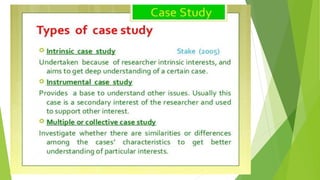
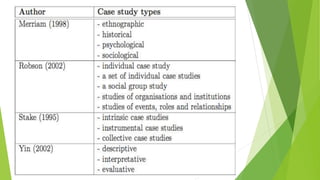
Types of Case Study
There are three types of case study
commonly accepted.
1. Intrinsic Case Study
2. Single Instrumental Case Study
3. Multiple Collective Case Study
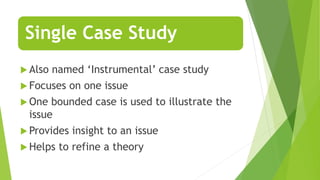
Single Case Study
 Also named ‘Instrumental’ case study
 Focuses on one issue
 One bounded case is used to illustrate the
issue
 Provides insight to an issue
 Helps to refine a theory
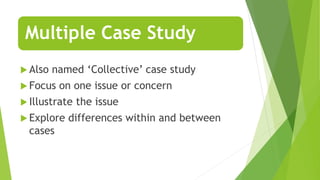
Multiple Case Study
 Also named ‘Collective’ case study
 Focus on one issue or concern
 Illustrate the issue
 Explore differences within and between
cases
Intrinsic Case Study
 Focuses on the case itself
 The case presents an unusual or unique
situation
 Try to better understand the case
Characteristics of Case Study Research
Particularistic
Descriptive
Heuristic
Particularistic Phenomenon
A case study researcher may
specifically choose a particular
instance of phenomenon under
investigation to understand a specific
problem that occurs in everyday
practice.
Descriptive Phenomenon
Descriptive phenomenon means
that the end result of the case
study, the narrative, includes
‘thick description’ of the
phenomenon, including many
variables and analyses of the
interactions.
Heuristic Phenomenon
Heuristic refers to the fact that
case studies ‘illuminate the
readers’ understanding of the
phenomenon under study’ beyond
the readers’ original knowledge.
Case Study in Terms of Disciplines
Anthropology
History
Psychology
Sociology
How to Apply Case Study Research
 Think through the different types and purposes of case study and the
origins from which each stems. This should strengthen how you justify
the type you choose.
 Decide what kind of case study you will conduct for what purpose and
what issues and questions it will help you address.
 Demonstrate and awareness of any potential difficulties you might
encounter and how you address these in your research.
 Do not spend too much time arguing why you have not chosen other
research approaches. This may be helpful to a degree. However, the
more important point is to present a convincing argument for why
case study is most appropriate for your research topic.
Designing a Case Study Research
 Determine the Research question
 Define the case under study
 Determine the role of theory development in case
selection.
 Determine the theoritical and conceptual framework of
the case study.
 Determine whether a single case study, a multiple case
study or a collective case study is appropriate.
Sample Selection
 Qualitative Approach
 Purposive Sampling
 Viability
Screening Procedure
 Review documents about the proposed case study site to
determine whether or not it is an appropiate choice
 Conduct informal interviews of key participants in the
study to determine their willingness to participate in the
study and to ensure that hey fully understand the nature
of their commitment.
 Determine whether the case study participants have the
necessary experience and knowledge of the phenomenon
under investigation and the ability to provide information.
Data Collection Techniques
Enquiring
Experiencing
Examining
Cross Site Analysis Strategies
 Unordered Meta Matrix
 Site Ordered Descriptive Matrix
 Site Ordered Predictor Outcome Matrix
 Time Ordered Meta Matrix
 Scatterplot
 Site Ordered Effects Matrix
 Causal Models
Cross Site Analysis Strategies
Unordered Meta Matrix: is a data
management tool that enables the
case study researcher to assemble
master charts with descriptive
data from each site on one large
sheet of paper.
Cross Site Analysis Strategies
Site Ordered Descriptive Matrix:
sites are ordered in a variable of
interest so that the researcher can
see differences.
Cross Site Analysis Strategies
Site Ordered Predictor Outcome
Matrix: moves the case study
researcher from working
descriptively/deductively to a more
explanatory/interpretive mode.
Time Ordered Meta Matrix
Time Ordered Meta Matrix extends
the cross site data analysis to
include chronology as an
organizing variable.
Time Ordered Meta Matrix
 Time Ordered Meta Matrix
Scatterplots
A scatter plot (Chambers 1983)
reveals relationships or association
between two variables. Such
relationships manifest themselves
by any non-random structure in
the plot.
Cross Site Analysis Strategies
 Scatterplots
Cross Site Analysis Strategies
Site Ordered Effects Matrix is used
by case study researchers to sort
through the research sites and to
display probable cause and effect
relations.
Cross Site Analysis Strategies
Casual Models extend the case study
analysis and assist the case study
researcher to identify how things go
together.
Strengths
 Case study enables the experience to be studied and interpreted in
depth.
 Case study is flexible.
 Case studies are inaccessible in language, audiences directly observe
events and accidents.
 Case study is useful for understanding and exploring the process.
 Case study has dynamics of change, especially in ‘real life settings’.
 Case study has the potential to engage participants in the study.
 Case study can include a range of methods, whatever is most
appropriate in understanding the case.
 It can explain how and why things happen.
Potential Limitations
 The subjectivity of the researcher is an inevitable part of
the frame.
 Audiences cannot capture the reality as lived.
 There are a number of ways to make inferences from a
case or cases that are applicable to other contexts.
 The findings are dependant on that very unique subject.
Case Study Examples
Genie
the Feral Child
https://www.youtube.com/watch?v=YQNBSPY4QUc
Case Study Examples
 Jill Price – The woman who
can never forget
https://www.youtube.com/watch?v=SoxsMMV538U
For your further studies;
http://casestudyhelp.com/
References
Stake, R. E. (1995). The art of case study research. Thousand Oaks, CA: Sage.
Yin, R. K. (2003). Case study research: Design and methods (3rd Ed.). Thousand Oaks, CA: Sage.
Gerring, J. (2005) Case Study Research. New York: Cambridge University Press.
https://wikis.tamu.edu/download/attachments/16974757/Figure+2.png?version=1&modification
Date=1289873138000
http://www.qualitative-research.net/index.php/fqs/article/view/334/729
https://www.cmu.edu/teaching/designteach/design/instructionalstrategies/casestudies.html
http://busn8018researchblog-xwchan.blogspot.com.tr/
http://psych.answers.com/studies/famous-psychology-case-studies
Bilkent University
Cirruculum and
Instruction
2015
Aslı Tuğçe GÜLER

Case study method in research

  • 2.
    What is aCase Study? Case study is a qualitative research approach in which researchers focus on a unit of study known as a bounded system.
  • 3.
    Case Study Definitions Case study is not a methodological choice but a choice of what is to be studied. (Stake)  An investigation of phenomenon that occurs within a specific context. (Miles & Huberman)  Case study is a research strategy that is an all- encompassing method covering design, data collection techniques, and specific approaches to data analysis. (Yin)
  • 4.
    Case Study is A qualitative approach to studying a phenomenon  Focus on a unit of study, or a bounded system  Not a methodological choice but a choice of what to study  An all-encompassing research method
  • 5.
    When to Usethe Case Study Research Approach A case study research method is appropriate when the researcher wants to answer a descriptive question such as what happened? Or an explanatory question how and why did something happen?
  • 6.
    Types of CaseStudy There are three types of case study commonly accepted. 1. Intrinsic Case Study 2. Single Instrumental Case Study 3. Multiple Collective Case Study
  • 9.
    Single Case Study Also named ‘Instrumental’ case study  Focuses on one issue  One bounded case is used to illustrate the issue  Provides insight to an issue  Helps to refine a theory
  • 10.
    Multiple Case Study Also named ‘Collective’ case study  Focus on one issue or concern  Illustrate the issue  Explore differences within and between cases
  • 11.
    Intrinsic Case Study Focuses on the case itself  The case presents an unusual or unique situation  Try to better understand the case
  • 12.
    Characteristics of CaseStudy Research Particularistic Descriptive Heuristic
  • 13.
    Particularistic Phenomenon A casestudy researcher may specifically choose a particular instance of phenomenon under investigation to understand a specific problem that occurs in everyday practice.
  • 14.
    Descriptive Phenomenon Descriptive phenomenonmeans that the end result of the case study, the narrative, includes ‘thick description’ of the phenomenon, including many variables and analyses of the interactions.
  • 15.
    Heuristic Phenomenon Heuristic refersto the fact that case studies ‘illuminate the readers’ understanding of the phenomenon under study’ beyond the readers’ original knowledge.

  • 16.

    Case Study inTerms of Disciplines Anthropology History Psychology Sociology
  • 17.
    How to ApplyCase Study Research  Think through the different types and purposes of case study and the origins from which each stems. This should strengthen how you justify the type you choose.  Decide what kind of case study you will conduct for what purpose and what issues and questions it will help you address.  Demonstrate and awareness of any potential difficulties you might encounter and how you address these in your research.  Do not spend too much time arguing why you have not chosen other research approaches. This may be helpful to a degree. However, the more important point is to present a convincing argument for why case study is most appropriate for your research topic.
  • 19.
    Designing a CaseStudy Research  Determine the Research question  Define the case under study  Determine the role of theory development in case selection.  Determine the theoritical and conceptual framework of the case study.  Determine whether a single case study, a multiple case study or a collective case study is appropriate.
  • 20.
    Sample Selection  QualitativeApproach  Purposive Sampling  Viability
  • 21.
    Screening Procedure  Reviewdocuments about the proposed case study site to determine whether or not it is an appropiate choice  Conduct informal interviews of key participants in the study to determine their willingness to participate in the study and to ensure that hey fully understand the nature of their commitment.  Determine whether the case study participants have the necessary experience and knowledge of the phenomenon under investigation and the ability to provide information.
  • 22.
  • 24.
    Cross Site AnalysisStrategies  Unordered Meta Matrix  Site Ordered Descriptive Matrix  Site Ordered Predictor Outcome Matrix  Time Ordered Meta Matrix  Scatterplot  Site Ordered Effects Matrix  Causal Models
  • 25.
    Cross Site AnalysisStrategies Unordered Meta Matrix: is a data management tool that enables the case study researcher to assemble master charts with descriptive data from each site on one large sheet of paper.
  • 26.
    Cross Site AnalysisStrategies Site Ordered Descriptive Matrix: sites are ordered in a variable of interest so that the researcher can see differences.
  • 27.
    Cross Site AnalysisStrategies Site Ordered Predictor Outcome Matrix: moves the case study researcher from working descriptively/deductively to a more explanatory/interpretive mode.
  • 28.
    Time Ordered MetaMatrix Time Ordered Meta Matrix extends the cross site data analysis to include chronology as an organizing variable.
  • 29.
    Time Ordered MetaMatrix  Time Ordered Meta Matrix
  • 30.
    Scatterplots A scatter plot(Chambers 1983) reveals relationships or association between two variables. Such relationships manifest themselves by any non-random structure in the plot.
  • 31.
    Cross Site AnalysisStrategies  Scatterplots
  • 32.
    Cross Site AnalysisStrategies Site Ordered Effects Matrix is used by case study researchers to sort through the research sites and to display probable cause and effect relations.
  • 33.
    Cross Site AnalysisStrategies Casual Models extend the case study analysis and assist the case study researcher to identify how things go together.
  • 34.
    Strengths  Case studyenables the experience to be studied and interpreted in depth.  Case study is flexible.  Case studies are inaccessible in language, audiences directly observe events and accidents.  Case study is useful for understanding and exploring the process.  Case study has dynamics of change, especially in ‘real life settings’.  Case study has the potential to engage participants in the study.  Case study can include a range of methods, whatever is most appropriate in understanding the case.  It can explain how and why things happen.
  • 35.
    Potential Limitations  Thesubjectivity of the researcher is an inevitable part of the frame.  Audiences cannot capture the reality as lived.  There are a number of ways to make inferences from a case or cases that are applicable to other contexts.  The findings are dependant on that very unique subject.
  • 36.
    Case Study Examples Genie theFeral Child https://www.youtube.com/watch?v=YQNBSPY4QUc
  • 37.
    Case Study Examples Jill Price – The woman who can never forget https://www.youtube.com/watch?v=SoxsMMV538U
  • 38.
    For your furtherstudies; http://casestudyhelp.com/
  • 39.
    References Stake, R. E.(1995). The art of case study research. Thousand Oaks, CA: Sage. Yin, R. K. (2003). Case study research: Design and methods (3rd Ed.). Thousand Oaks, CA: Sage. Gerring, J. (2005) Case Study Research. New York: Cambridge University Press. https://wikis.tamu.edu/download/attachments/16974757/Figure+2.png?version=1&modification Date=1289873138000 http://www.qualitative-research.net/index.php/fqs/article/view/334/729 https://www.cmu.edu/teaching/designteach/design/instructionalstrategies/casestudies.html http://busn8018researchblog-xwchan.blogspot.com.tr/ http://psych.answers.com/studies/famous-psychology-case-studies http://psych.answers.com/studies/famous-psychology-case-studies
  • 40.