Semantics
Semantic transfer and its
implications for vocabulary
teaching in a second language
Author
Nan Jiang 2004
Department of Applied Linguistics
Georgia State University
Atlanta/GA
Former Study - 2002
■ The first study was done on Chinese students.
■ It was done on a particular set of materials on a particular group.
■ Materials and design were not neat and clear sufficiently.
Literature Review
■ Consensus: Vocabulary acquisiton is at least as important
as syntax acquisiton in studying L2.
■ Word Retention
■ The studies are descriptive and model-free
Questions to Find Answers
■ How lexical knowledge is represented in the learners’
mind?
■ What stages does a word go through before it becomes an
integrated part of the learner’s lexicon?
■ What is involved in the form-meaning mapping process?
Grounded Hypotheses
Psycholinguistic
Model of Adult
L2 Vocabulary
Acquisiton
Semantic
Transfer
Hypothesis
Pscyholinguistic Model of Adult L2
Vocabulary Acquisition
■ Adults can learn vocabulary way better than children do.
■ They already have a well-established conceptual and lexical system.
■ Most L2 words have a correspondent concept and translation in
adult’s L1.
■ Semantic fossilization plays a great role on errors.
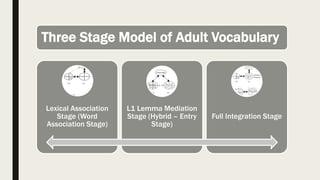
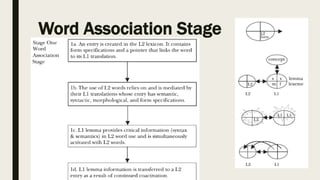
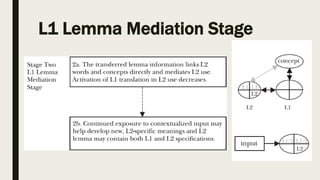
Three Stage Model of Adult Vocabulary
Lexical Association
Stage (Word
Association Stage)
L1 Lemma Mediation
Stage (Hybrid – Entry
Stage)
Full Integration Stage
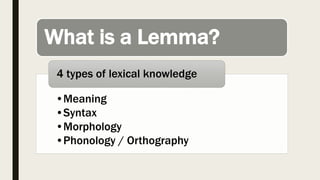
What is a Lemma?
•Meaning
•Syntax
•Morphology
•Phonology / Orthography
4 types of lexical knowledge
What is a Lemma?
Word Association Stage
L1 Lemma Mediation Stage
Full Integration Stage
The Semantic Transfer Hypothesis
■ Same Translation Effect
■ Different Translation Effect
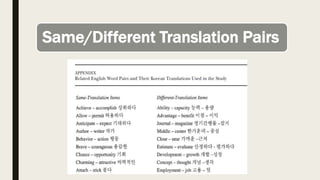
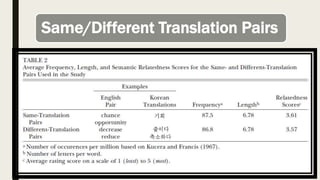
Same/Different Translation Pairs
Present Study 2004
It has 3 main purposes.
1. Replication of the first same-translation effect study.
2. To provide confirmation for the same-translation effect
study by using a cleaner desing.
3. To explore pedagogical implications of findings. (To have a
new path for vocabulary teaching in L2)
Methodology
■ Korean ESL students were presented with a list of random English
word pairs.
■ The English word pairs were related or unrelated in meaning.
■ The learners were asked to judge if the pairs were related in
meaning.
Participants
■ 15 Korean-English bilinguals (5 Females, 10 Males)
■ 15 English Native Speakers
■ All but 1 are under graduate students at Auburn University.
■ English speakers were also students and staff from the same
instutition.
■ None of the English speakers reported knowing Korean.
Language Background of Participants
Materials and Design
■ An initial list of 130 English word pairs was generated by English-
Korean bilingual speaker.
■ The Word pairs were all related in meaning.
■ Some shared the same Korean translation and the others did not.
■ A randomized 260 English words were given to 3 Korean-English
bilinguals and asked to provide the first Korean translation.
■ The two sets of words given to 3 native speakers of English and
asked to rate degrees of semantic relatedness on a scale of 1 to 5.
■ 32 pairs of words were chosen from each set.
Materials and Desing
■ These pairs were matched for frequency, word length, and degree of
semantic relatedness.
■ In addition to these 64 related Word pairs, 64 related English words
were also constructed with similar length and frequency.
■ These pairs were needed in order for the test to elicit both positive
and negative responses.
■ Both related and unrelated words randomized.
Same/Different Translation Pairs
Procedure
■ The participants were tested individually.
■ They were instructed to judge as quickly and accurately as they could
whether two words are related in meaning.
■ All participants received the same 128 related and unrelated items
but the presentation order of these words was randomized.
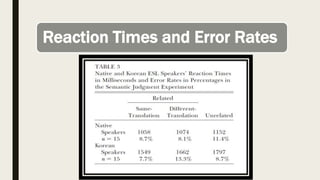
Reaction Times and Error Rates
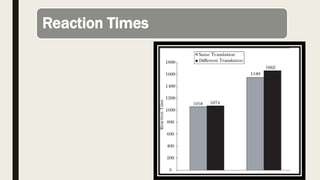
Reaction Times
Results
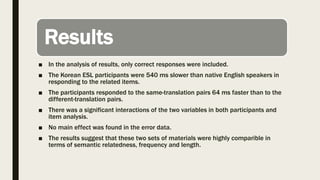
■ In the analysis of results, only correct responses were included.
■ The Korean ESL participants were 540 ms slower than native English speakers in
responding to the related items.
■ The participants responded to the same-translation pairs 64 ms faster than to the
different-translation pairs.
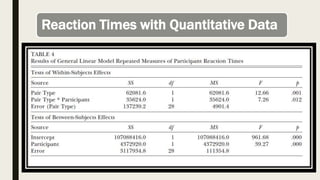
■ There was a significant interactions of the two variables in both participants and
item analysis.
■ No main effect was found in the error data.
■ The results suggest that these two sets of materials were highly comparible in
terms of semantic relatedness, frequency and length.
Reaction Times with Quantitative Data
Discussion
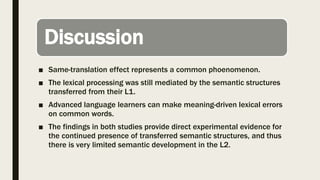
■ Same-translation effect represents a common phoenomenon.
■ The lexical processing was still mediated by the semantic structures
transferred from their L1.
■ Advanced language learners can make meaning-driven lexical errors
on common words.
■ The findings in both studies provide direct experimental evidence for
the continued presence of transferred semantic structures, and thus
there is very limited semantic development in the L2.
Semantic Autonomy
■ The ultimate goal of L2 learning is to develop a linguistic
and semantic means that can function as an autonomous
system.
■ Autonomy is important in terms of developing an idiomatic,
accurate and fluent expressions of one’s ideas.
■ Semantic transfer is illustrated in L2 learning but the
development and integration of L2 specific semantic
meanings should not be taken for granted.
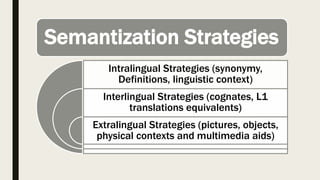
Semantization Strategies
Intralingual Strategies (synonymy,
Definitions, linguistic context)
Interlingual Strategies (cognates, L1
translations equivalents)
Extralingual Strategies (pictures, objects,
physical contexts and multimedia aids)
Overcoming Semantic Fossilization
■ Variety of vocabulary instruction techniques
■ Instructional materials that specifically highlight the
semantic differences of problem words.
■ Meaning-focused pedagogical activities.
■ Sufficient contextualized input and interactions.
Software
■ http://www.u.arizona.edu/~kforster/dmdx/download.htm
Thank you.
Curriculum and Instruction
ASLI TUĞÇE GÜLER
December 2015
Semantic Transfer & L2 Vocabulary Acquisition

Semantic Transfer & L2 Vocabulary Acquisition

  • 2.
    Semantics Semantic transfer andits implications for vocabulary teaching in a second language
  • 3.
    Author Nan Jiang 2004 Departmentof Applied Linguistics Georgia State University Atlanta/GA
  • 4.
    Former Study -2002 ■ The first study was done on Chinese students. ■ It was done on a particular set of materials on a particular group. ■ Materials and design were not neat and clear sufficiently.
  • 5.
    Literature Review ■ Consensus:Vocabulary acquisiton is at least as important as syntax acquisiton in studying L2. ■ Word Retention ■ The studies are descriptive and model-free
  • 6.
    Questions to FindAnswers ■ How lexical knowledge is represented in the learners’ mind? ■ What stages does a word go through before it becomes an integrated part of the learner’s lexicon? ■ What is involved in the form-meaning mapping process?
  • 7.
    Grounded Hypotheses Psycholinguistic Model ofAdult L2 Vocabulary Acquisiton Semantic Transfer Hypothesis
  • 8.
    Pscyholinguistic Model ofAdult L2 Vocabulary Acquisition ■ Adults can learn vocabulary way better than children do. ■ They already have a well-established conceptual and lexical system. ■ Most L2 words have a correspondent concept and translation in adult’s L1. ■ Semantic fossilization plays a great role on errors.
  • 9.
    Three Stage Modelof Adult Vocabulary Lexical Association Stage (Word Association Stage) L1 Lemma Mediation Stage (Hybrid – Entry Stage) Full Integration Stage
  • 10.
    What is aLemma? •Meaning •Syntax •Morphology •Phonology / Orthography 4 types of lexical knowledge
  • 11.
    What is aLemma?
  • 12.
  • 13.
  • 14.
  • 15.
    The Semantic TransferHypothesis ■ Same Translation Effect ■ Different Translation Effect
  • 16.
  • 17.
    Present Study 2004 Ithas 3 main purposes. 1. Replication of the first same-translation effect study. 2. To provide confirmation for the same-translation effect study by using a cleaner desing. 3. To explore pedagogical implications of findings. (To have a new path for vocabulary teaching in L2)
  • 18.
    Methodology ■ Korean ESLstudents were presented with a list of random English word pairs. ■ The English word pairs were related or unrelated in meaning. ■ The learners were asked to judge if the pairs were related in meaning.
  • 19.
    Participants ■ 15 Korean-Englishbilinguals (5 Females, 10 Males) ■ 15 English Native Speakers ■ All but 1 are under graduate students at Auburn University. ■ English speakers were also students and staff from the same instutition. ■ None of the English speakers reported knowing Korean.
  • 20.
  • 21.
    Materials and Design ■An initial list of 130 English word pairs was generated by English- Korean bilingual speaker. ■ The Word pairs were all related in meaning. ■ Some shared the same Korean translation and the others did not. ■ A randomized 260 English words were given to 3 Korean-English bilinguals and asked to provide the first Korean translation. ■ The two sets of words given to 3 native speakers of English and asked to rate degrees of semantic relatedness on a scale of 1 to 5. ■ 32 pairs of words were chosen from each set.
  • 22.
    Materials and Desing ■These pairs were matched for frequency, word length, and degree of semantic relatedness. ■ In addition to these 64 related Word pairs, 64 related English words were also constructed with similar length and frequency. ■ These pairs were needed in order for the test to elicit both positive and negative responses. ■ Both related and unrelated words randomized.
  • 23.
  • 24.
    Procedure ■ The participantswere tested individually. ■ They were instructed to judge as quickly and accurately as they could whether two words are related in meaning. ■ All participants received the same 128 related and unrelated items but the presentation order of these words was randomized.
  • 25.
    Reaction Times andError Rates
  • 26.
  • 27.
    Results ■ In theanalysis of results, only correct responses were included. ■ The Korean ESL participants were 540 ms slower than native English speakers in responding to the related items. ■ The participants responded to the same-translation pairs 64 ms faster than to the different-translation pairs. ■ There was a significant interactions of the two variables in both participants and item analysis. ■ No main effect was found in the error data. ■ The results suggest that these two sets of materials were highly comparible in terms of semantic relatedness, frequency and length.
  • 28.
    Reaction Times withQuantitative Data
  • 29.
    Discussion ■ Same-translation effectrepresents a common phoenomenon. ■ The lexical processing was still mediated by the semantic structures transferred from their L1. ■ Advanced language learners can make meaning-driven lexical errors on common words. ■ The findings in both studies provide direct experimental evidence for the continued presence of transferred semantic structures, and thus there is very limited semantic development in the L2.
  • 30.
    Semantic Autonomy ■ Theultimate goal of L2 learning is to develop a linguistic and semantic means that can function as an autonomous system. ■ Autonomy is important in terms of developing an idiomatic, accurate and fluent expressions of one’s ideas. ■ Semantic transfer is illustrated in L2 learning but the development and integration of L2 specific semantic meanings should not be taken for granted.
  • 31.
    Semantization Strategies Intralingual Strategies(synonymy, Definitions, linguistic context) Interlingual Strategies (cognates, L1 translations equivalents) Extralingual Strategies (pictures, objects, physical contexts and multimedia aids)
  • 32.
    Overcoming Semantic Fossilization ■Variety of vocabulary instruction techniques ■ Instructional materials that specifically highlight the semantic differences of problem words. ■ Meaning-focused pedagogical activities. ■ Sufficient contextualized input and interactions.
  • 33.
  • 34.
    Thank you. Curriculum andInstruction ASLI TUĞÇE GÜLER December 2015