TEST DEVELOPMENT AND
EVALUATION (6462)
NEED, SCOPE AND KINDS OF TESTS
Department of Secondary Teacher Education
ALLAMA IQBAL OPEN UNIVERSITY, ISLAMABAD
OBJECTIVES OF THE UNIT
After studying this unit, the students will have ability to demonstrate.
• understand and describe the purpose, need and scope of tests.
• elaborate the concept of testing.
• understands the types of tests and their role in educational measurement.
• identify the significance of objective and subjective type tests.
• describe the role of renowned tests and their use of educational field.
2.1 PURPOSE, NEED AND SCOPE OF TEST
 Tests are very useful device for making better admission in educational institutions. Tests
affect the performance and task of teachers.
 It is fact that teaching learning process is incomplete if teacher have not used properly this
effective device because he cannot measure the performance of students without this
device.
 Teachers use tests to assess the effectiveness of teaching learning process and take remedial
steps for improving his teaching. It is very effective tool in the hand of teacher.
 These tests are very useful for student placement because results of selection tests indicate
the student proper level and place in institution.
 It can provide fruitful result for teachers concerning students’ performance.
 Instructional objectives can be achieved only when teachers involve the students in teaching
learning process and interact with them in class effectively.
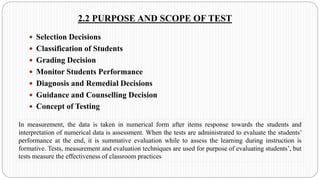
2.2 PURPOSE AND SCOPE OF TEST
 Selection Decisions
 Classification of Students
 Grading Decision
 Monitor Students Performance
 Diagnosis and Remedial Decisions
 Guidance and Counselling Decision
 Concept of Testing
In measurement, the data is taken in numerical form after items response towards the students and
interpretation of numerical data is assessment. When the tests are administrated to evaluate the students’
performance at the end, it is summative evaluation while to assess the learning during instruction is
formative. Tests, measurement and evaluation techniques are used for purpose of evaluating students’, but
tests measure the effectiveness of classroom practices
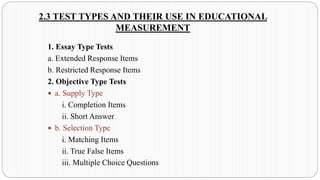
2.3 TEST TYPES AND THEIR USE IN EDUCATIONAL
MEASUREMENT
1. Essay Type Tests
a. Extended Response Items
b. Restricted Response Items
2. Objective Type Tests
 a. Supply Type
i. Completion Items
ii. Short Answer
 b. Selection Type
i. Matching Items
ii. True False Items
iii. Multiple Choice Questions
2.3 TEST TYPES AND THEIR USE IN EDUCATIONAL
MEASUREMENT
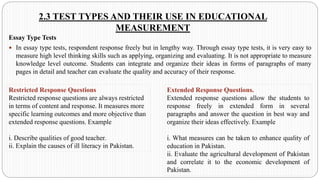
Essay Type Tests
 In essay type tests, respondent response freely but in lengthy way. Through essay type tests, it is very easy to
measure high level thinking skills such as applying, organizing and evaluating. It is not appropriate to measure
knowledge level outcome. Students can integrate and organize their ideas in forms of paragraphs of many
pages in detail and teacher can evaluate the quality and accuracy of their response.
Restricted Response Questions
Restricted response questions are always restricted
in terms of content and response. It measures more
specific learning outcomes and more objective than
extended response questions. Example
i. Describe qualities of good teacher.
ii. Explain the causes of ill literacy in Pakistan.
Extended Response Questions.
Extended response questions allow the students to
response freely in extended form in several
paragraphs and answer the question in best way and
organize their ideas effectively. Example
i. What measures can be taken to enhance quality of
education in Pakistan.
ii. Evaluate the agricultural development of Pakistan
and correlate it to the economic development of
Pakistan.
2.3 TEST TYPES AND THEIR USE IN EDUCATIONAL
MEASUREMENT
Objective Type Tests
• MCQs
• True/Falls
• Matching Columns
• Fill in the blanks/Completion
• MCQs
• True/Falls
• Matching Columns
• Fill in the blanks/Completion
Characteristics Merits Limitations
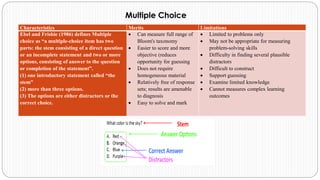
Ebel and Frisbie (1986) defines Multiple
choice as “a multiple-choice item has two
parts: the stem consisting of a direct question
or an incomplete statement and two or more
options, consisting of answer to the question
or completion of the statement”.
(1) one introductory statement called “the
stem”
(2) more than three options.
(3) The options are either distractors or the
correct choice.
• Can measure full range of
Bloom's taxonomy
• Easier to score and more
objective (reduces
opportunity for guessing
• Does not require
homogeneous material
• Relatively free of response
sets; results are amenable
to diagnosis
• Easy to solve and mark
• Limited to problems only
• May not be appropriate for measuring
problem-solving skills
• Difficulty in finding several plausible
distractors
• Difficult to construct
• Support guessing
• Examine limited knowledge
• Cannot measures complex learning
outcomes
Multiple Choice
Characteristics Merits Limitations
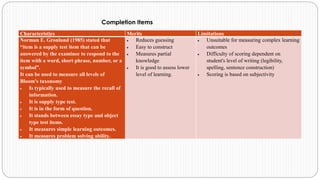
Norman E. Gronlund (1985) stated that
“item is a supply test item that can be
answered by the examinee to respond to the
item with a word, short phrase, number, or a
symbol”.
It can be used to measure all levels of
Bloom's taxonomy
• Is typically used to measure the recall of
information.
• It is supply type test.
• It is in the form of question.
• It stands between essay type and object
type test items.
• It measures simple learning outcomes.
• It measures problem solving ability.
• Reduces guessing
• Easy to construct
• Measures partial
knowledge
• It is good to assess lower
level of learning.
• Unsuitable for measuring complex learning
outcomes
• Difficulty of scoring dependent on
student's level of writing (legibility,
spelling, sentence construction)
• Scoring is based on subjectivity
Completion Items
Characteristics Merits Limitations
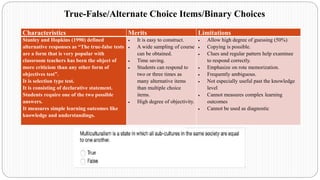
Stanley and Hopkins (1990) defined
alternative responses as “The true-false tests
are a form that is very popular with
classroom teachers has been the object of
more criticism than any other form of
objectives test”.
It is selection type test.
It is consisting of declarative statement.
Students require one of the two possible
answers.
It measures simple learning outcomes like
knowledge and understandings.
• It is easy to construct.
• A wide sampling of course
can be obtained.
• Time saving.
• Students can respond to
two or three times as
many alternative items
than multiple choice
items.
• High degree of objectivity.
• Allow high degree of guessing (50%)
• Copying is possible.
• Clues and regular pattern help examinee
to respond correctly.
• Emphasize on rote memorization.
• Frequently ambiguous.
• Not especially useful past the knowledge
level
• Cannot measures complex learning
outcomes
• Cannot be used as diagnostic
True-False/Alternate Choice Items/Binary Choices
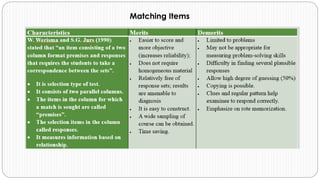
Matching Items
2.4 SIGNIFICANCE OF OBJECTIVE AND SUBJECTIVE TYPE TESTS
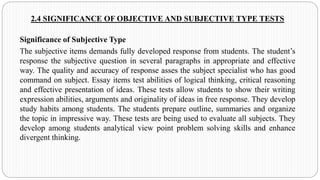
Significance of Subjective Type
The subjective items demands fully developed response from students. The student’s
response the subjective question in several paragraphs in appropriate and effective
way. The quality and accuracy of response asses the subject specialist who has good
command on subject. Essay items test abilities of logical thinking, critical reasoning
and effective presentation of ideas. These tests allow students to show their writing
expression abilities, arguments and originality of ideas in free response. They develop
study habits among students. The students prepare outline, summaries and organize
the topic in impressive way. These tests are being used to evaluate all subjects. They
develop among students analytical view point problem solving skills and enhance
divergent thinking.
2.4 SIGNIFICANCE OF OBJECTIVE AND SUBJECTIVE TYPE TESTS
 Significance of Objective Type
An effective assessment is essential part of education system. In present era, the
significance of objective type test in daily assessment is prime element of educational
institutions. Assessment provides valid information about student’s performance and
necessary measures are being taken after results of the tests. The success of good
teaching, overall quality of good teaching and reputation of institution can be judged
possible when you have reliable data of student’s performance and objective type tests
provide objective and authentic information of student’s achievement. This information is
correct because biases of examiner have no space in scoring. Even untrained person can
assess accurately with the help of already prepared key. So objective type tests provide
clear and unambiguous scoring criteria.
2.5 EXAMPLE OF RENOWNED TESTS AND THEIR USE
 Scholastic Assessment Test (SAT)
It is a standardized test widely used for college admission in United States. It was first used in 1926 but its name
and scoring criteria have changed several times. The test is prepared to know the students placement and
readiness for college. SAT consists of three major sections; critical reasoning, mathematics and writing. It
measures literacy and writing skills to achieve success academically in colleges. SAT assess how test taker
analyse and solve the problems skills that they learn in school that they need in college.
 Graduate Record Examinations (GRE)
GRE is the most popular test that is used to take admission in most graduate schools in United States. It was
prepared and administrated by the Educational Testing Service in 1949. It measures verbal reasoning,
quantitative reasoning, analytical writing and critical thinking skills that have been acquired over long period of
time and that are not entirely based on specific field of study outside of the GRE itself. The importance of GRE
is vital and it is used to selection of students in universities.
 IOWA Tests of Basic Skills
This is standardized test known as IOWA test. It was designed and developed in 1935 and it is helpful in
improving student instruction. For many years, it has been being used to asses’ students’ performance in United
States. School participate in these tests annually and improve their program. It has been revised in 2011-2012 for
improvement in school.
Department of Secondary Teacher Education
ALLAMA IQBAL OPEN UNIVERSITY, ISLAMABAD
Dr. Hina Jalal
hinansari23@gmail.com

TEST DEVELOPMENT AND EVALUATION (6462)

  • 1.
    TEST DEVELOPMENT AND EVALUATION(6462) NEED, SCOPE AND KINDS OF TESTS Department of Secondary Teacher Education ALLAMA IQBAL OPEN UNIVERSITY, ISLAMABAD
  • 2.
    OBJECTIVES OF THEUNIT After studying this unit, the students will have ability to demonstrate. • understand and describe the purpose, need and scope of tests. • elaborate the concept of testing. • understands the types of tests and their role in educational measurement. • identify the significance of objective and subjective type tests. • describe the role of renowned tests and their use of educational field.
  • 3.
    2.1 PURPOSE, NEEDAND SCOPE OF TEST  Tests are very useful device for making better admission in educational institutions. Tests affect the performance and task of teachers.  It is fact that teaching learning process is incomplete if teacher have not used properly this effective device because he cannot measure the performance of students without this device.  Teachers use tests to assess the effectiveness of teaching learning process and take remedial steps for improving his teaching. It is very effective tool in the hand of teacher.  These tests are very useful for student placement because results of selection tests indicate the student proper level and place in institution.  It can provide fruitful result for teachers concerning students’ performance.  Instructional objectives can be achieved only when teachers involve the students in teaching learning process and interact with them in class effectively.
  • 4.
    2.2 PURPOSE ANDSCOPE OF TEST  Selection Decisions  Classification of Students  Grading Decision  Monitor Students Performance  Diagnosis and Remedial Decisions  Guidance and Counselling Decision  Concept of Testing In measurement, the data is taken in numerical form after items response towards the students and interpretation of numerical data is assessment. When the tests are administrated to evaluate the students’ performance at the end, it is summative evaluation while to assess the learning during instruction is formative. Tests, measurement and evaluation techniques are used for purpose of evaluating students’, but tests measure the effectiveness of classroom practices
  • 5.
    2.3 TEST TYPESAND THEIR USE IN EDUCATIONAL MEASUREMENT 1. Essay Type Tests a. Extended Response Items b. Restricted Response Items 2. Objective Type Tests  a. Supply Type i. Completion Items ii. Short Answer  b. Selection Type i. Matching Items ii. True False Items iii. Multiple Choice Questions
  • 6.
    2.3 TEST TYPESAND THEIR USE IN EDUCATIONAL MEASUREMENT Essay Type Tests  In essay type tests, respondent response freely but in lengthy way. Through essay type tests, it is very easy to measure high level thinking skills such as applying, organizing and evaluating. It is not appropriate to measure knowledge level outcome. Students can integrate and organize their ideas in forms of paragraphs of many pages in detail and teacher can evaluate the quality and accuracy of their response. Restricted Response Questions Restricted response questions are always restricted in terms of content and response. It measures more specific learning outcomes and more objective than extended response questions. Example i. Describe qualities of good teacher. ii. Explain the causes of ill literacy in Pakistan. Extended Response Questions. Extended response questions allow the students to response freely in extended form in several paragraphs and answer the question in best way and organize their ideas effectively. Example i. What measures can be taken to enhance quality of education in Pakistan. ii. Evaluate the agricultural development of Pakistan and correlate it to the economic development of Pakistan.
  • 7.
    2.3 TEST TYPESAND THEIR USE IN EDUCATIONAL MEASUREMENT Objective Type Tests • MCQs • True/Falls • Matching Columns • Fill in the blanks/Completion • MCQs • True/Falls • Matching Columns • Fill in the blanks/Completion
  • 8.
    Characteristics Merits Limitations Ebeland Frisbie (1986) defines Multiple choice as “a multiple-choice item has two parts: the stem consisting of a direct question or an incomplete statement and two or more options, consisting of answer to the question or completion of the statement”. (1) one introductory statement called “the stem” (2) more than three options. (3) The options are either distractors or the correct choice. • Can measure full range of Bloom's taxonomy • Easier to score and more objective (reduces opportunity for guessing • Does not require homogeneous material • Relatively free of response sets; results are amenable to diagnosis • Easy to solve and mark • Limited to problems only • May not be appropriate for measuring problem-solving skills • Difficulty in finding several plausible distractors • Difficult to construct • Support guessing • Examine limited knowledge • Cannot measures complex learning outcomes Multiple Choice
  • 9.
    Characteristics Merits Limitations NormanE. Gronlund (1985) stated that “item is a supply test item that can be answered by the examinee to respond to the item with a word, short phrase, number, or a symbol”. It can be used to measure all levels of Bloom's taxonomy • Is typically used to measure the recall of information. • It is supply type test. • It is in the form of question. • It stands between essay type and object type test items. • It measures simple learning outcomes. • It measures problem solving ability. • Reduces guessing • Easy to construct • Measures partial knowledge • It is good to assess lower level of learning. • Unsuitable for measuring complex learning outcomes • Difficulty of scoring dependent on student's level of writing (legibility, spelling, sentence construction) • Scoring is based on subjectivity Completion Items
  • 10.
    Characteristics Merits Limitations Stanleyand Hopkins (1990) defined alternative responses as “The true-false tests are a form that is very popular with classroom teachers has been the object of more criticism than any other form of objectives test”. It is selection type test. It is consisting of declarative statement. Students require one of the two possible answers. It measures simple learning outcomes like knowledge and understandings. • It is easy to construct. • A wide sampling of course can be obtained. • Time saving. • Students can respond to two or three times as many alternative items than multiple choice items. • High degree of objectivity. • Allow high degree of guessing (50%) • Copying is possible. • Clues and regular pattern help examinee to respond correctly. • Emphasize on rote memorization. • Frequently ambiguous. • Not especially useful past the knowledge level • Cannot measures complex learning outcomes • Cannot be used as diagnostic True-False/Alternate Choice Items/Binary Choices
  • 11.
  • 12.
    2.4 SIGNIFICANCE OFOBJECTIVE AND SUBJECTIVE TYPE TESTS Significance of Subjective Type The subjective items demands fully developed response from students. The student’s response the subjective question in several paragraphs in appropriate and effective way. The quality and accuracy of response asses the subject specialist who has good command on subject. Essay items test abilities of logical thinking, critical reasoning and effective presentation of ideas. These tests allow students to show their writing expression abilities, arguments and originality of ideas in free response. They develop study habits among students. The students prepare outline, summaries and organize the topic in impressive way. These tests are being used to evaluate all subjects. They develop among students analytical view point problem solving skills and enhance divergent thinking.
  • 13.
    2.4 SIGNIFICANCE OFOBJECTIVE AND SUBJECTIVE TYPE TESTS  Significance of Objective Type An effective assessment is essential part of education system. In present era, the significance of objective type test in daily assessment is prime element of educational institutions. Assessment provides valid information about student’s performance and necessary measures are being taken after results of the tests. The success of good teaching, overall quality of good teaching and reputation of institution can be judged possible when you have reliable data of student’s performance and objective type tests provide objective and authentic information of student’s achievement. This information is correct because biases of examiner have no space in scoring. Even untrained person can assess accurately with the help of already prepared key. So objective type tests provide clear and unambiguous scoring criteria.
  • 14.
    2.5 EXAMPLE OFRENOWNED TESTS AND THEIR USE  Scholastic Assessment Test (SAT) It is a standardized test widely used for college admission in United States. It was first used in 1926 but its name and scoring criteria have changed several times. The test is prepared to know the students placement and readiness for college. SAT consists of three major sections; critical reasoning, mathematics and writing. It measures literacy and writing skills to achieve success academically in colleges. SAT assess how test taker analyse and solve the problems skills that they learn in school that they need in college.  Graduate Record Examinations (GRE) GRE is the most popular test that is used to take admission in most graduate schools in United States. It was prepared and administrated by the Educational Testing Service in 1949. It measures verbal reasoning, quantitative reasoning, analytical writing and critical thinking skills that have been acquired over long period of time and that are not entirely based on specific field of study outside of the GRE itself. The importance of GRE is vital and it is used to selection of students in universities.  IOWA Tests of Basic Skills This is standardized test known as IOWA test. It was designed and developed in 1935 and it is helpful in improving student instruction. For many years, it has been being used to asses’ students’ performance in United States. School participate in these tests annually and improve their program. It has been revised in 2011-2012 for improvement in school.
  • 15.
    Department of SecondaryTeacher Education ALLAMA IQBAL OPEN UNIVERSITY, ISLAMABAD Dr. Hina Jalal hinansari23@gmail.com