Group 7
          Group’s members:
           Nguyễn Thị Thanh Thiện
           Nguyễn Thị Dạ Thảo
           Nguyễn Thị Hiệp
           Huỳnh Thị Hạnh
           Nguyễn Thị Hoài Như
           Trần Thị Mỹ Min
1. Definition
2. Types of oral test
3. How to design an oral test
4. Marking scheme
5. Advantages and disadvantages
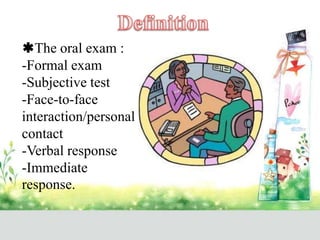
The oral exam :
-Formal exam
-Subjective test
-Face-to-face
interaction/personal
contact
-Verbal response
-Immediate
response.
- Posing questions to students in spoken
form.
- Students must then answer questions as
appropriate, from material they have
studied in preparation for the exam.
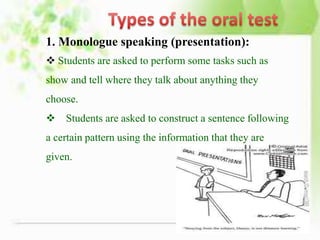
1. Monologue speaking (presentation):
 Students are asked to perform some tasks such as
show and tell where they talk about anything they
choose.
 Students are asked to construct a sentence following
a certain pattern using the information that they are
given.
Topic: Elderly people.
  Increased life expectancy means that there are more elderly
people than ever before. Organize these prompts before you
talk to the examiners about the topic for 4-6 minutes:
Suggestion:
- The role of the elderly in today’s society
- Retirement and free time
- Residential versus home care
You have up to 10 minutes to prepare your talk. You can take
notes or make a brief plan of what you are going to say. Talk
to the examiners for about 4-6 minutes. You can use your
notes during your talk, but you cannot read them aloud. Your
production will be recorded.
In another type of monologue test, a situation is given
but no guidance is given as how to respond, and the
students can respond freely.
E.g:
a. Your friend has been tired a lot recently. What do
you say to her? (Maybe you should be getting more
rest.)
b.You have been served coffee in a restaurant but you
haven't been given any cream or sugar, and you would
like some. What do you say to the server? (Could I
have some cream and sugar?
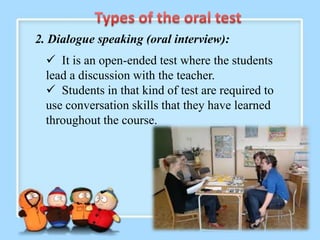
2. Dialogue speaking (oral interview):
   It is an open-ended test where the students
  lead a discussion with the teacher.
   Students in that kind of test are required to
  use conversation skills that they have learned
  throughout the course.
3. Multilogue speaking (discussion & debate)

The discussions are student-generated, and
students are put into groups where as a group, they
decide on a topic they feel would be of interest for
the rest of the classroom.
 For example : One student acts the part of a police
officer, another a bus conductor, a third a bus- driver, a fourth
a passenger hurrying to visit a sick friend in hospital, and a
fifth a bystander who wants to be helpful. The passenger
hurries to get on the bus and tell him that the bus is full and
that he must get off. The passenger can see an empty seat and
he begins to argue. The bus is now in the middle of the road
and is a danger to other traffic. Act the roles given.
Design an oral test
Step 1: Setting the scene
1. Identifying the purposes of speaking assessment: Do we
 want reliability or validity?
2. Testers base on the students’ performance and ability/ level in
English during the course to prepare tasks and standards as
well as instructional objectives and activities that should meet
learners’ needs.
3. Deciding whether or not to make an audio or video recording
of student’s performance.
4. Deciding when and how to provide learners with feedback.
Design an oral test
Step 2: Designing Speaking Test :
  1. Components in testing: pronunciation, grammar, vocabulary,
  fluency, accuracy, listening comprehension, appropriateness,
  etc.
  2. Preparing a series of questions on a wide range of topic :
  family, home, school, hobbies, sports, books, films, weekends,
  holidays, health, careers, traffic, etc.
  3. Using clear, brief and helpful instructions.
Design an oral test
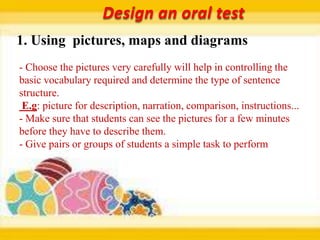
1. Using pictures, maps and diagrams
- Choose the pictures very carefully will help in controlling the
basic vocabulary required and determine the type of sentence
structure.
 E.g: picture for description, narration, comparison, instructions...
- Make sure that students can see the pictures for a few minutes
before they have to describe them.
- Give pairs or groups of students a simple task to perform
Design an oral test
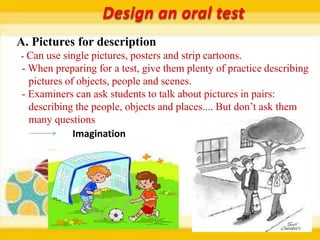
A. Pictures for description
- Can use single pictures, posters and strip cartoons.
 - When preparing for a test, give them plenty of practice describing
   pictures of objects, people and scenes.
 - Examiners can ask students to talk about pictures in pairs:
   describing the people, objects and places.... But don’t ask them
   many questions
              Imagination
Design an oral test
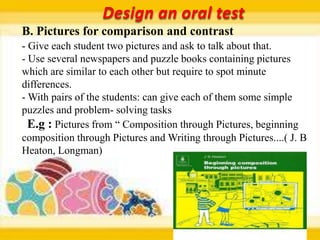
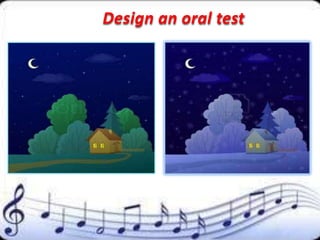
B. Pictures for comparison and contrast
- Give each student two pictures and ask to talk about that.
- Use several newspapers and puzzle books containing pictures
which are similar to each other but require to spot minute
differences.
- With pairs of the students: can give each of them some simple
puzzles and problem- solving tasks
  E.g : Pictures from “ Composition through Pictures, beginning
composition through Pictures and Writing through Pictures....( J. B
Heaton, Longman)
Design an oral test
Design an oral test
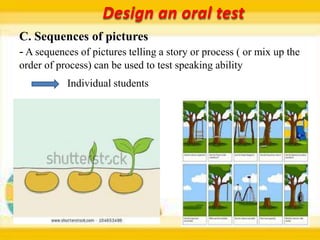
C. Sequences of pictures
- A sequences of pictures telling a story or process ( or mix up the
order of process) can be used to test speaking ability
           Individual students
Design an oral test
2. The short talk:
-Vague subjects or subjects about which an individual student
knows very little or should be avoided.
E.g: “Should countries spend huge sums of money on space
exploration?”
     “Do demonstrations serve any useful purpose?”
     “Do people ever really learn anything from the mistakes
they make?”
When scoring
students’
performances, the
examiners should
concentrate on what
individual students
are doing with the
target language and
how they are using it
to achieve their
purpose.
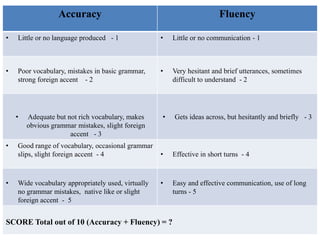
Accuracy                                               Fluency

•   Little or no language produced - 1              •   Little or no communication - 1


•   Poor vocabulary, mistakes in basic grammar,     •   Very hesitant and brief utterances, sometimes
    strong foreign accent - 2                           difficult to understand - 2


    •   Adequate but not rich vocabulary, makes     •   Gets ideas across, but hesitantly and briefly - 3
        obvious grammar mistakes, slight foreign
                      accent - 3
•   Good range of vocabulary, occasional grammar
    slips, slight foreign accent - 4                •   Effective in short turns - 4


•   Wide vocabulary appropriately used, virtually   •   Easy and effective communication, use of long
    no grammar mistakes, native like or slight          turns - 5
    foreign accent - 5


SCORE Total out of 10 (Accuracy + Fluency) = ?
1. Direct personal contact with candidates
opportunity to take mitigating circumstances into
account
2. Flexibility in moving from candidates strong
points to weak areas.
3. Requires the candidate to formulate his own
replies without clues.
4. Opportunity to question the candidate about
how to arrive answer.
5. Ability to test depth and breadth of candidates
thinking process and logic of arguments.
6. Opportunity for simultaneous assessment by
two examiner.
1. Difficult to evaluate so many things at once( grammar,
vocabulary, pronunciation...).
2. Difficult to choose what criteria in evaluating oral
communication.
3. It is rather time consuming, particularly if taped scored later.
4. Lack standardization
5. Lack objectivity and reproducibility of results (halo effect)
6. Permit favoritism and possible abuse of contact
7. Suffer from undue influence or irrelevant factors
The oral test must be a true assessment of
spoken abilities, rather than an indication of how
well a student can read a passage in English, or
can produce well-memorized responses that have
little meaning for him/her.
In a well-designed written exam, the examiner has
decided in advance what set of knowledge and skills is to
be tested.

Oral test

  • 1.
    Group 7 Group’s members: Nguyễn Thị Thanh Thiện Nguyễn Thị Dạ Thảo Nguyễn Thị Hiệp Huỳnh Thị Hạnh Nguyễn Thị Hoài Như Trần Thị Mỹ Min
  • 2.
    1. Definition 2. Typesof oral test 3. How to design an oral test 4. Marking scheme 5. Advantages and disadvantages
  • 3.
    The oral exam: -Formal exam -Subjective test -Face-to-face interaction/personal contact -Verbal response -Immediate response.
  • 4.
    - Posing questionsto students in spoken form. - Students must then answer questions as appropriate, from material they have studied in preparation for the exam.
  • 5.
    1. Monologue speaking(presentation):  Students are asked to perform some tasks such as show and tell where they talk about anything they choose.  Students are asked to construct a sentence following a certain pattern using the information that they are given.
  • 6.
    Topic: Elderly people. Increased life expectancy means that there are more elderly people than ever before. Organize these prompts before you talk to the examiners about the topic for 4-6 minutes: Suggestion: - The role of the elderly in today’s society - Retirement and free time - Residential versus home care You have up to 10 minutes to prepare your talk. You can take notes or make a brief plan of what you are going to say. Talk to the examiners for about 4-6 minutes. You can use your notes during your talk, but you cannot read them aloud. Your production will be recorded.
  • 7.
    In another typeof monologue test, a situation is given but no guidance is given as how to respond, and the students can respond freely. E.g: a. Your friend has been tired a lot recently. What do you say to her? (Maybe you should be getting more rest.) b.You have been served coffee in a restaurant but you haven't been given any cream or sugar, and you would like some. What do you say to the server? (Could I have some cream and sugar?
  • 8.
    2. Dialogue speaking(oral interview):  It is an open-ended test where the students lead a discussion with the teacher.  Students in that kind of test are required to use conversation skills that they have learned throughout the course.
  • 9.
    3. Multilogue speaking(discussion & debate) The discussions are student-generated, and students are put into groups where as a group, they decide on a topic they feel would be of interest for the rest of the classroom.
  • 10.
     For example: One student acts the part of a police officer, another a bus conductor, a third a bus- driver, a fourth a passenger hurrying to visit a sick friend in hospital, and a fifth a bystander who wants to be helpful. The passenger hurries to get on the bus and tell him that the bus is full and that he must get off. The passenger can see an empty seat and he begins to argue. The bus is now in the middle of the road and is a danger to other traffic. Act the roles given.
  • 11.
    Design an oraltest Step 1: Setting the scene 1. Identifying the purposes of speaking assessment: Do we want reliability or validity? 2. Testers base on the students’ performance and ability/ level in English during the course to prepare tasks and standards as well as instructional objectives and activities that should meet learners’ needs. 3. Deciding whether or not to make an audio or video recording of student’s performance. 4. Deciding when and how to provide learners with feedback.
  • 12.
    Design an oraltest Step 2: Designing Speaking Test : 1. Components in testing: pronunciation, grammar, vocabulary, fluency, accuracy, listening comprehension, appropriateness, etc. 2. Preparing a series of questions on a wide range of topic : family, home, school, hobbies, sports, books, films, weekends, holidays, health, careers, traffic, etc. 3. Using clear, brief and helpful instructions.
  • 13.
    Design an oraltest 1. Using pictures, maps and diagrams - Choose the pictures very carefully will help in controlling the basic vocabulary required and determine the type of sentence structure. E.g: picture for description, narration, comparison, instructions... - Make sure that students can see the pictures for a few minutes before they have to describe them. - Give pairs or groups of students a simple task to perform
  • 14.
    Design an oraltest A. Pictures for description - Can use single pictures, posters and strip cartoons. - When preparing for a test, give them plenty of practice describing pictures of objects, people and scenes. - Examiners can ask students to talk about pictures in pairs: describing the people, objects and places.... But don’t ask them many questions Imagination
  • 15.
    Design an oraltest B. Pictures for comparison and contrast - Give each student two pictures and ask to talk about that. - Use several newspapers and puzzle books containing pictures which are similar to each other but require to spot minute differences. - With pairs of the students: can give each of them some simple puzzles and problem- solving tasks E.g : Pictures from “ Composition through Pictures, beginning composition through Pictures and Writing through Pictures....( J. B Heaton, Longman)
  • 17.
  • 18.
    Design an oraltest C. Sequences of pictures - A sequences of pictures telling a story or process ( or mix up the order of process) can be used to test speaking ability Individual students
  • 19.
    Design an oraltest 2. The short talk: -Vague subjects or subjects about which an individual student knows very little or should be avoided. E.g: “Should countries spend huge sums of money on space exploration?” “Do demonstrations serve any useful purpose?” “Do people ever really learn anything from the mistakes they make?”
  • 20.
    When scoring students’ performances, the examinersshould concentrate on what individual students are doing with the target language and how they are using it to achieve their purpose.
  • 21.
    Accuracy Fluency • Little or no language produced - 1 • Little or no communication - 1 • Poor vocabulary, mistakes in basic grammar, • Very hesitant and brief utterances, sometimes strong foreign accent - 2 difficult to understand - 2 • Adequate but not rich vocabulary, makes • Gets ideas across, but hesitantly and briefly - 3 obvious grammar mistakes, slight foreign accent - 3 • Good range of vocabulary, occasional grammar slips, slight foreign accent - 4 • Effective in short turns - 4 • Wide vocabulary appropriately used, virtually • Easy and effective communication, use of long no grammar mistakes, native like or slight turns - 5 foreign accent - 5 SCORE Total out of 10 (Accuracy + Fluency) = ?
  • 22.
    1. Direct personalcontact with candidates opportunity to take mitigating circumstances into account 2. Flexibility in moving from candidates strong points to weak areas. 3. Requires the candidate to formulate his own replies without clues. 4. Opportunity to question the candidate about how to arrive answer. 5. Ability to test depth and breadth of candidates thinking process and logic of arguments. 6. Opportunity for simultaneous assessment by two examiner.
  • 23.
    1. Difficult toevaluate so many things at once( grammar, vocabulary, pronunciation...). 2. Difficult to choose what criteria in evaluating oral communication. 3. It is rather time consuming, particularly if taped scored later. 4. Lack standardization 5. Lack objectivity and reproducibility of results (halo effect) 6. Permit favoritism and possible abuse of contact 7. Suffer from undue influence or irrelevant factors
  • 25.
    The oral testmust be a true assessment of spoken abilities, rather than an indication of how well a student can read a passage in English, or can produce well-memorized responses that have little meaning for him/her. In a well-designed written exam, the examiner has decided in advance what set of knowledge and skills is to be tested.