Venezuela Teachers of English to Speakers of Other Languages 
Instituto Universitario de Tecnología Superior de Oriente 
VenTESOL Region 3 (Anzoátegui, Nueva Esparta, Sucre)
Objectives 
 To define teacher assessment. 
 To describe teacher assesment at Venezuelan 
educational institutions. 
 To prove the importance of teacher assessment in ELT. 
 To present the foundations, standards and different 
ways of teacher assessment. 
 To show the results of a research based on the 
assessment of EFL teacher trainees.
Assessment or Evaluation? 
 Assessment is classroom research to provide useful 
feedback for the improvement of teaching and 
learning. Assessment is feedback from the student to 
the instructor about the student’s learning. 
 Evaluation uses methods and measures to judge 
student learning and understanding of the material 
for purposes of grading and reporting. Evaluation is 
feedback from the instructor to the student about the 
student’s learning.
Assessment 
 Assessment is an ongoing process that encompasses a 
much wider domain. Whenever a student responds to 
a question, offers a comment, or tries out a new word 
or structure, the teacher subconsciously makes an 
assessment of the student's performance. (H. D. 
Brown, 2003). 
 Teacher assessment: the core purpose of teacher 
assessment should be to strengthen the knowledge, 
skills, dispositions, and classroom practices of 
professional educators. (National Education 
Association, 2003)
Venezuelan Case 
 Schools and high schools. 
 Universities. 
 Language schools.
Why Teacher Assessment?
Benefits of Teacher Assessment 
 Reflection on teacher performance. 
 Improvement of teacher performance. 
 Improvement of their students’ learning. 
 It permits teachers to learn from their colleagues 
(Teachers helping teachers). 
 It permits teachers to learn from their students.
Types of Teacher Assessment 
 Observation. 
 Surveys. 
 Tests. 
 File. 
 Self-Assessment.
Modality 
 Summative Assessment: aims to measure, or 
summarize, what a student has grasped, and typically 
occurs at the end of a course or unit of instruction. (H. 
D. Brown, 2003). 
 Formative assessment: evaluating students in the 
process of forming their competencies and skills with 
the goal of helping them to continue that growth 
process. (H. D. Brown. 2003).
What to Assess? 
Teacher Assessment 
Teaching Capacity Emotionality Responsibility Interpersonal 
communication 
Teacher Performance
Capacities 
 Teaching capacity: knowledge about the language or 
subject, knowledge and practice of their teaching such 
as planning, assessment, use of resources, etc. 
 Emotionality: professional vocation, self-steem, 
level satisfaction with their labors, etc. 
 Responsibility: attendance and puctuality. 
 Interpersonal communication: level of concern 
about their students’ problems and learning, 
communication with their co-workers.
What’s the best way? 
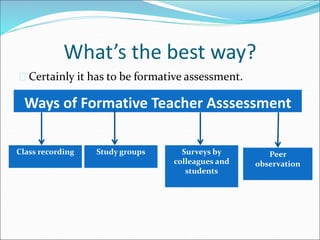
 Certainly it has to be formative assessment. 
Ways of Formative Teacher Asssessment 
Class recording Study groups Surveys by 
colleagues and 
students 
Peer 
observation
Class recording
Study groups
Surveys
Peer Observation 
Shaping the Way We Teach English Module 13, Peer 
Observation in Teaching Practices[1].wmv
Peer Observation
Personal Experiences at IUTSO 
Peer observation has been an effective experience of 
sharing knowledge. I have had the chance to be given 
the commitment as a colleague to expand the passion 
for teaching and learning EFL. Definitely, I have been 
able to see my improvement and it is confirmed by the 
most challenging audience (my students). I am so 
grateful and I share the passion. Karly Lozada, July 
2014.
Teacher Training and Teacher 
Assessment
Research 
 Title: Evaluación de los Aprendizajes en la Enseñanza 
del Inglés como Lengua Extranjera (Assessment in 
TEFL). 
 The problem: 
1. Poor EFL assessment practice. 
2. Poor knowledge of how to use assessment 
instruments. 
3. Lack of validity and realibity. 
4. Poor teacher training on assessment.
Research 
 Objectives: 
General Objective: To measure the basic theoretical 
knowledges of students of EFL on assessment at Instituto 
Pedagógico de Maturín (IPM). 
Specific objectives: 
1. To grade EFL students’ performance at IPM on 
theoretical knowledges about EFL assessment. 
2. To demonstrate the perspectives of IPM EFL teachers 
about EFL teacher training on assessment. 
3. To give recommendations addressed to improving 
teacher training on EFL assessment.
Research 
 Methodology: 
1. Descriptive and field research. 
2. Population: EFL students at UPEL-IPM. 
3. Sample: 14 students and 8 teachers 
4. Instruments: a test and a survey. 
- Test: a test of 20 questions (multiple choice).
The Results (UPEL Maturín) 
Grades Frequency % 
14 1 7.1 
12 1 7.1 
10 1 7.1 
8 4 28.6 
7 5 35.7 
6 2 14.3 
Average: 8 out of 20 pts.
The Results (UPEL Maracay) 
Grades Frequency % 
19 1 7.14 
18 2 14.28 
14 2 14.28 
13 2 14.28 
10 2 14.28 
9 1 7.14 
8 1 7.14 
6 2 14.28 
2 1 7.14 
Average: 11,4 out of 20 pts.
Why? 
UPEL Maracay EFL students have a good teacher 
training on EFL assessment: 
- MEPILE I. 
- MEPILE II. 
UPEL Maturín EFL students have a poor teacher 
training on EFL asessment: 
- Methodology and Evaluation: 
Content taught: 80% on methodology and 20% on 
assessment, but most of the time 100 % methodology 
and 0% on assessment.
Assessment on Teacher Training 
 Teacher assessment does not only allow teachers in 
service to improve or develop their skills, capacities or 
competences, it also allows to improve the teacher 
training of pre-service teachers (teacher trainees) . 
It provides data that can be considered in order to 
evaluate the curriculum of the career or the syllabus of 
a subject.
Conclusions 
 To allow teacher development is important to assess 
teacher performance in a way that is meaningful, that 
is, formative assessment. 
 Teachers must look for different alternatives of teacher 
assessment despite the system does not provide them 
one. 
 Teacher assesment also permits to analyze and 
evaluate the curriculumof EFL teacher training. 
 Teacher assessment is a good way of reflection. 
 If teachers develop their performance, their student 
will or may improve theirs, too.
Quotes to Ponder 
 “More can be done to improve education by improving 
the effectiveness of teachers than by any other single 
factor.”Wright, Horn and Sanders, 1997. 
 “We all need people who give us feedback, that’s how 
we improve.” Bill Gates.
Thanks for your attention! 
http://ventesol.ning.com 
Facebook: VenTESOL Anzoátegui 
Twitter: @ventesol 
Email: region3.ventesol@gmail.com

Teacher Assessment: A Formative Path to Teacher Development

  • 1.
    Venezuela Teachers ofEnglish to Speakers of Other Languages Instituto Universitario de Tecnología Superior de Oriente VenTESOL Region 3 (Anzoátegui, Nueva Esparta, Sucre)
  • 2.
    Objectives  Todefine teacher assessment.  To describe teacher assesment at Venezuelan educational institutions.  To prove the importance of teacher assessment in ELT.  To present the foundations, standards and different ways of teacher assessment.  To show the results of a research based on the assessment of EFL teacher trainees.
  • 3.
    Assessment or Evaluation?  Assessment is classroom research to provide useful feedback for the improvement of teaching and learning. Assessment is feedback from the student to the instructor about the student’s learning.  Evaluation uses methods and measures to judge student learning and understanding of the material for purposes of grading and reporting. Evaluation is feedback from the instructor to the student about the student’s learning.
  • 4.
    Assessment  Assessmentis an ongoing process that encompasses a much wider domain. Whenever a student responds to a question, offers a comment, or tries out a new word or structure, the teacher subconsciously makes an assessment of the student's performance. (H. D. Brown, 2003).  Teacher assessment: the core purpose of teacher assessment should be to strengthen the knowledge, skills, dispositions, and classroom practices of professional educators. (National Education Association, 2003)
  • 5.
    Venezuelan Case Schools and high schools.  Universities.  Language schools.
  • 7.
  • 8.
    Benefits of TeacherAssessment  Reflection on teacher performance.  Improvement of teacher performance.  Improvement of their students’ learning.  It permits teachers to learn from their colleagues (Teachers helping teachers).  It permits teachers to learn from their students.
  • 9.
    Types of TeacherAssessment  Observation.  Surveys.  Tests.  File.  Self-Assessment.
  • 10.
    Modality  SummativeAssessment: aims to measure, or summarize, what a student has grasped, and typically occurs at the end of a course or unit of instruction. (H. D. Brown, 2003).  Formative assessment: evaluating students in the process of forming their competencies and skills with the goal of helping them to continue that growth process. (H. D. Brown. 2003).
  • 11.
    What to Assess? Teacher Assessment Teaching Capacity Emotionality Responsibility Interpersonal communication Teacher Performance
  • 12.
    Capacities  Teachingcapacity: knowledge about the language or subject, knowledge and practice of their teaching such as planning, assessment, use of resources, etc.  Emotionality: professional vocation, self-steem, level satisfaction with their labors, etc.  Responsibility: attendance and puctuality.  Interpersonal communication: level of concern about their students’ problems and learning, communication with their co-workers.
  • 13.
    What’s the bestway?  Certainly it has to be formative assessment. Ways of Formative Teacher Asssessment Class recording Study groups Surveys by colleagues and students Peer observation
  • 14.
  • 15.
  • 16.
  • 17.
    Peer Observation Shapingthe Way We Teach English Module 13, Peer Observation in Teaching Practices[1].wmv
  • 18.
  • 19.
    Personal Experiences atIUTSO Peer observation has been an effective experience of sharing knowledge. I have had the chance to be given the commitment as a colleague to expand the passion for teaching and learning EFL. Definitely, I have been able to see my improvement and it is confirmed by the most challenging audience (my students). I am so grateful and I share the passion. Karly Lozada, July 2014.
  • 20.
    Teacher Training andTeacher Assessment
  • 21.
    Research  Title:Evaluación de los Aprendizajes en la Enseñanza del Inglés como Lengua Extranjera (Assessment in TEFL).  The problem: 1. Poor EFL assessment practice. 2. Poor knowledge of how to use assessment instruments. 3. Lack of validity and realibity. 4. Poor teacher training on assessment.
  • 22.
    Research  Objectives: General Objective: To measure the basic theoretical knowledges of students of EFL on assessment at Instituto Pedagógico de Maturín (IPM). Specific objectives: 1. To grade EFL students’ performance at IPM on theoretical knowledges about EFL assessment. 2. To demonstrate the perspectives of IPM EFL teachers about EFL teacher training on assessment. 3. To give recommendations addressed to improving teacher training on EFL assessment.
  • 23.
    Research  Methodology: 1. Descriptive and field research. 2. Population: EFL students at UPEL-IPM. 3. Sample: 14 students and 8 teachers 4. Instruments: a test and a survey. - Test: a test of 20 questions (multiple choice).
  • 24.
    The Results (UPELMaturín) Grades Frequency % 14 1 7.1 12 1 7.1 10 1 7.1 8 4 28.6 7 5 35.7 6 2 14.3 Average: 8 out of 20 pts.
  • 25.
    The Results (UPELMaracay) Grades Frequency % 19 1 7.14 18 2 14.28 14 2 14.28 13 2 14.28 10 2 14.28 9 1 7.14 8 1 7.14 6 2 14.28 2 1 7.14 Average: 11,4 out of 20 pts.
  • 26.
    Why? UPEL MaracayEFL students have a good teacher training on EFL assessment: - MEPILE I. - MEPILE II. UPEL Maturín EFL students have a poor teacher training on EFL asessment: - Methodology and Evaluation: Content taught: 80% on methodology and 20% on assessment, but most of the time 100 % methodology and 0% on assessment.
  • 27.
    Assessment on TeacherTraining  Teacher assessment does not only allow teachers in service to improve or develop their skills, capacities or competences, it also allows to improve the teacher training of pre-service teachers (teacher trainees) . It provides data that can be considered in order to evaluate the curriculum of the career or the syllabus of a subject.
  • 28.
    Conclusions  Toallow teacher development is important to assess teacher performance in a way that is meaningful, that is, formative assessment.  Teachers must look for different alternatives of teacher assessment despite the system does not provide them one.  Teacher assesment also permits to analyze and evaluate the curriculumof EFL teacher training.  Teacher assessment is a good way of reflection.  If teachers develop their performance, their student will or may improve theirs, too.
  • 29.
    Quotes to Ponder  “More can be done to improve education by improving the effectiveness of teachers than by any other single factor.”Wright, Horn and Sanders, 1997.  “We all need people who give us feedback, that’s how we improve.” Bill Gates.
  • 30.
    Thanks for yourattention! http://ventesol.ning.com Facebook: VenTESOL Anzoátegui Twitter: @ventesol Email: region3.ventesol@gmail.com

Editor's Notes