More on Assessment : an in-depth look at formative  and reflective assessment by Carrie Abood
The Purposes of Assessment To diagnose students’ strengths and  weaknesses To monitor students’ progress To assign grades To determine the teacher’s effectiveness from Popham’s  Classroom Assessment:  What Teachers Need to Know Traditional and Fundamental Roles of Assessment
The Purposes of Assessment To influence public perceptions of  educational effectiveness To help evaluate teachers To improve instructional intentions from Popham’s  Classroom Assessment:  What Teachers Need to Know Three New Roles for Assessment in Today’s Education
Assessment “Rumors” Rumor:  assessment is all about test-giving Truth:  test-giving is only one of many, many  ways to assess learning Rumor:  assessment is always formal Truth:  insight about a student’s learning can  be found anytime you look for it Rumor:  assessment is separate from curriculum Truth:  curriculum design and assessment  should be closely tied to learning goals from Tomlinson’s “Learning to Love Assessment”
Assessment “Rumors” con’t. Rumor:  assessment is “the end” for a teacher Truth:  studying assessment (what worked,  what didn’t) is the beginning of better instruction Rumor:  assessment is about finding weaknesses Truth:  assessment can be used to also  accentuate student positives Rumor:  assessment is only for the teacher Truth:  assessment can be used to teach  students self-monitoring and self-modifying from Tomlinson’s “Learning to Love Assessment”
Formative Assessment What is formative assessment?  Hire “… a self-reflective process that intends to promote student attainment” --  Terry Crooks “… the bidirectional process between teacher and student to enhance, recognize and respond to the learning.”  -- Cowie and Bell “…  a diagnostic use of assessment to provide feedback to teachers and students over the course of instruction.”  -- Carol Boston “… assessments conducted during learning to promote, not merely judge or grade, student success.”  -- Rick Stiggins
Formative Assessment The  Differences  between Formative and  Summative Assessment The results of  summative assessments  are used to make judgments on a student, measure program effectiveness, or determine whether a school has made yearly progress. Summative assessment  is the assessment  of  learning. Summative assessment  typically documents how much learning has occurred at one point in time; its purpose is to measure the level of a student, school, or program success. from Chappuis and Chappuis, “The Best Value in Formative Assessment”
Formative Assessment from Chappuis and Chappuis, “The Best Value in Formative Assessment” The  Differences  between Formative and  Summative Assessment On the other hand,  formative assessment  gives information during the process of instruction, before the summative assessment. Both the teacher and student use  formative assessment  results to make decisions about future learning. Formative assessment  is an ongoing process that involves more than frequent testing.  Formative assessment  is the assessment  for  learning.
Formative Assessment Why state assessments are summative from Chappuis and Chappuis, “The Best Value in Formative Assessment” *The purpose of state assessments is to provide data to compare schools and districts.  *The results of state/standardized tests are communicated to teachers and students in ways that are difficult to interpret and understand.  *Results are often delivered several months after giving the tests.  *These types of tests cannot contribute much to the day-to-day instruction or help determine future learning goals of individual students.
Formative Assessment Why state assessments are summative from Chappuis and Chappuis, “The Best Value in Formative Assessment” Benchmark exams are often purchased by a school district in order to measure their school’s progress toward state or district goals.  This type of assessment is NOT automatically formative.  Why? Although this type of state assessment is created for mid-year feedback, most administrators and teachers do not use the information formatively.  Most teachers administer the benchmark, report the results, and continue on with previously planned instruction.
Formative Assessment from Chappuis and Chappuis, “The Best Value in Formative Assessment” How does formative assessment support  learning? Teachers can adapt instruction on the basis of evidence, making changes and improvements that will yield immediate benefits to student learning. Students can use evidence of their current progress to actively manage and adjust their own learning.
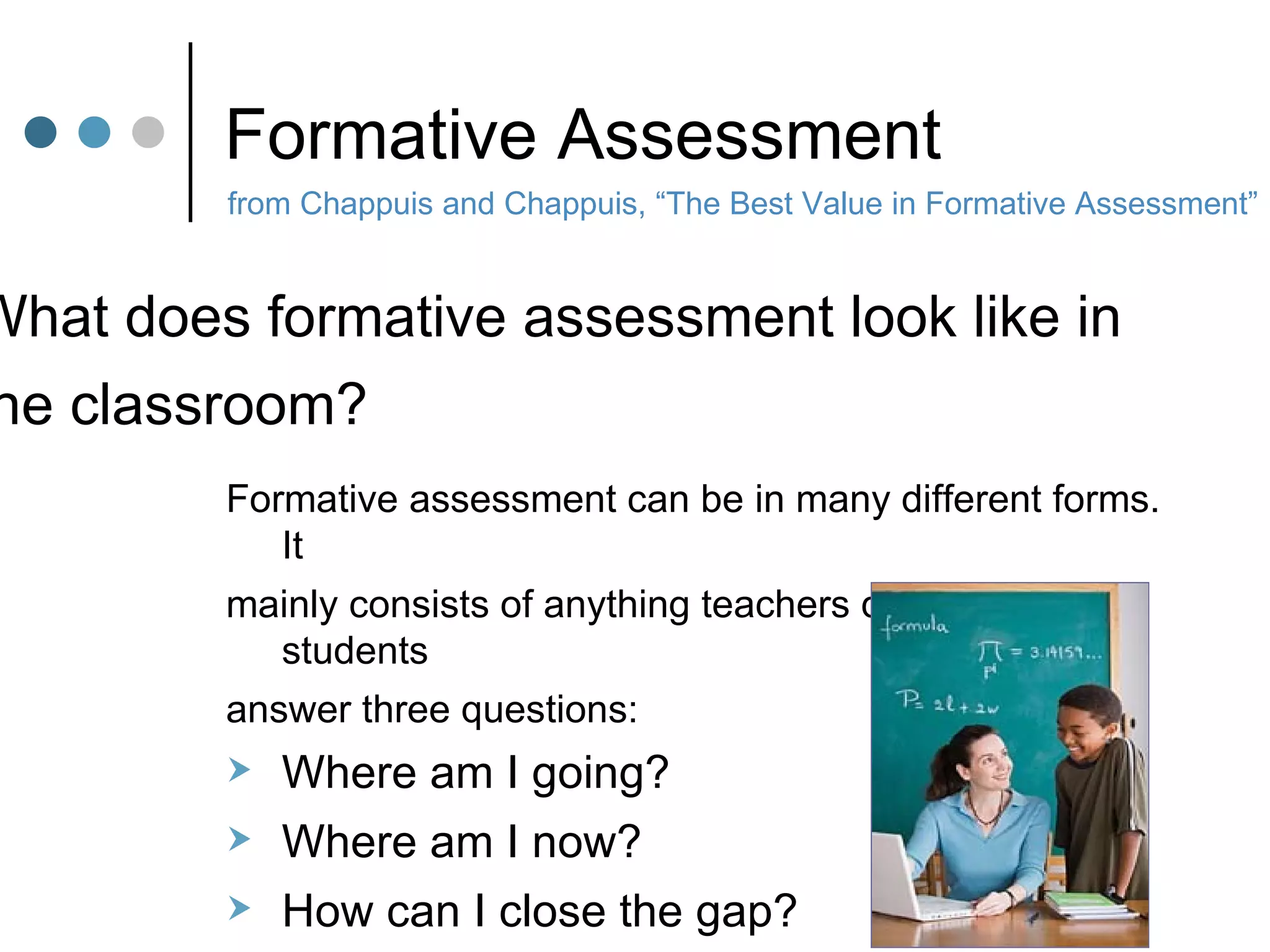
Formative Assessment Formative assessment can be in many different forms.  It  mainly consists of anything teachers do to help students  answer three questions: Where am I going? Where am I now? How can I close the gap? from Chappuis and Chappuis, “The Best Value in Formative Assessment” What does formative assessment look like in  the classroom?
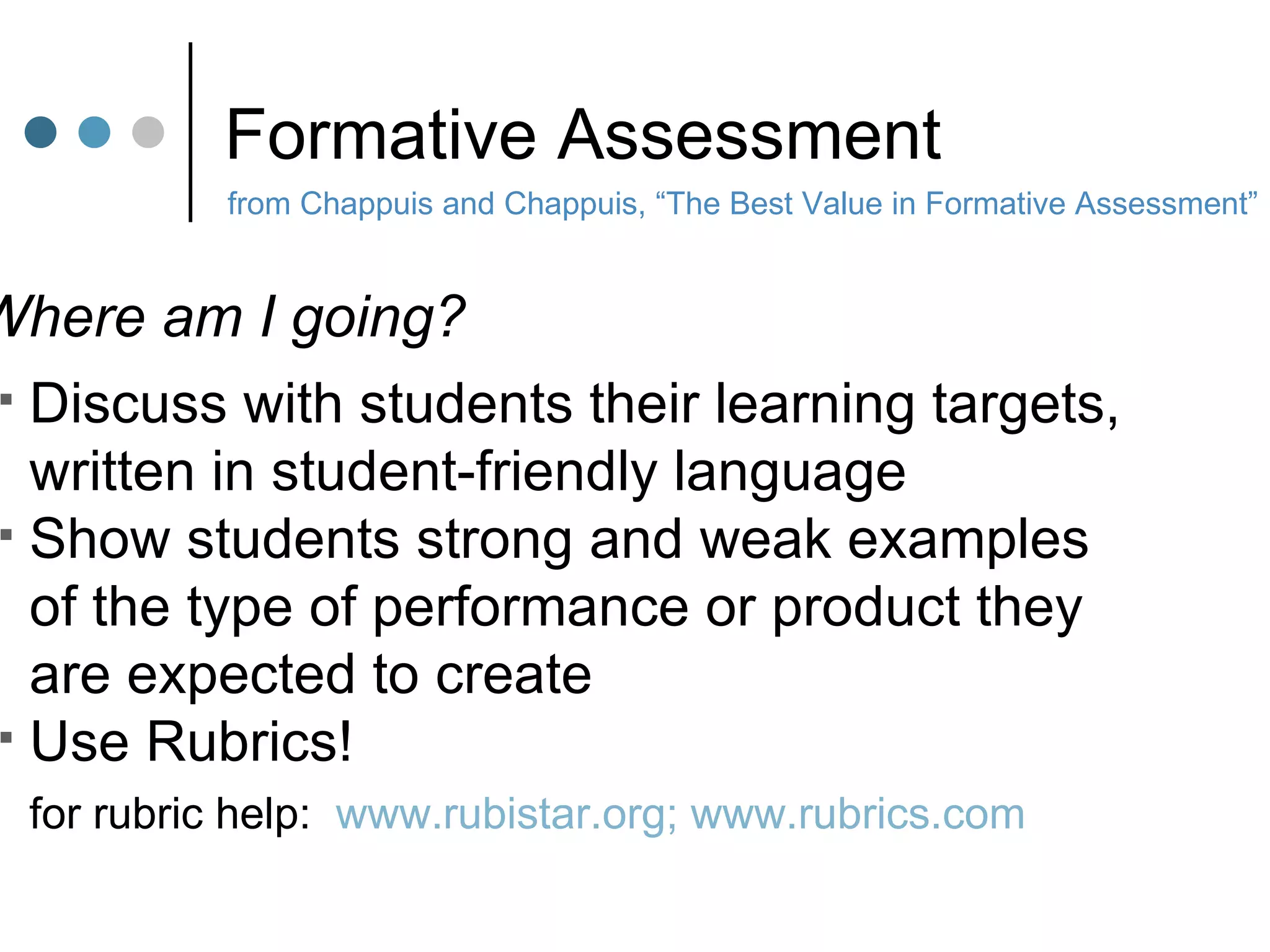
Formative Assessment from Chappuis and Chappuis, “The Best Value in Formative Assessment” Where am I going? Discuss with students their learning targets,  written in student-friendly language Show students strong and weak examples of the type of performance or product they  are expected to create Use Rubrics! for rubric help:  www.rubistar.org; www.rubrics.com
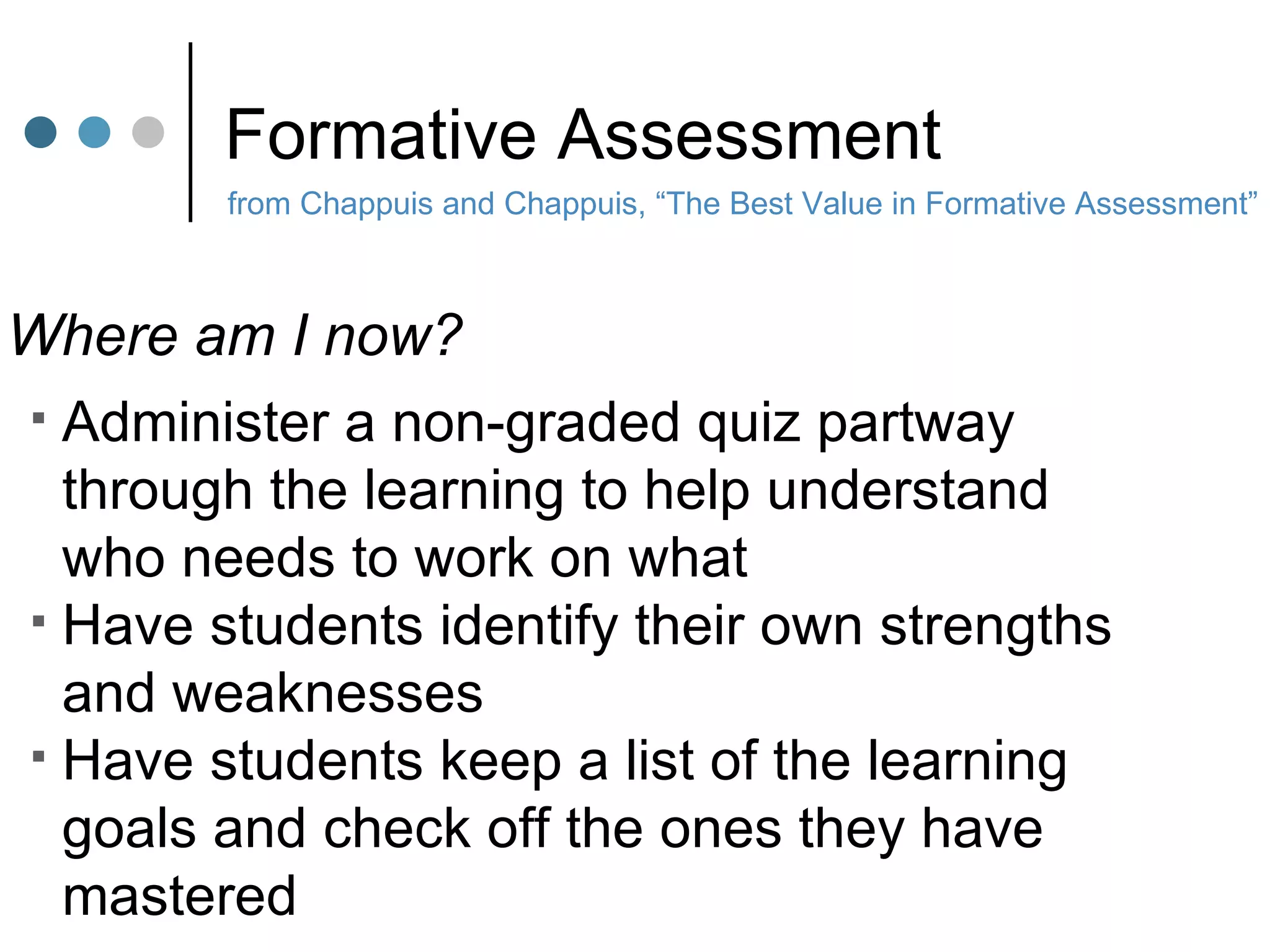
Formative Assessment from Chappuis and Chappuis, “The Best Value in Formative Assessment” Where am I now? Administer a non-graded quiz partway  through the learning to help understand who needs to work on what Have students identify their own strengths and weaknesses Have students keep a list of the learning goals and check off the ones they have  mastered
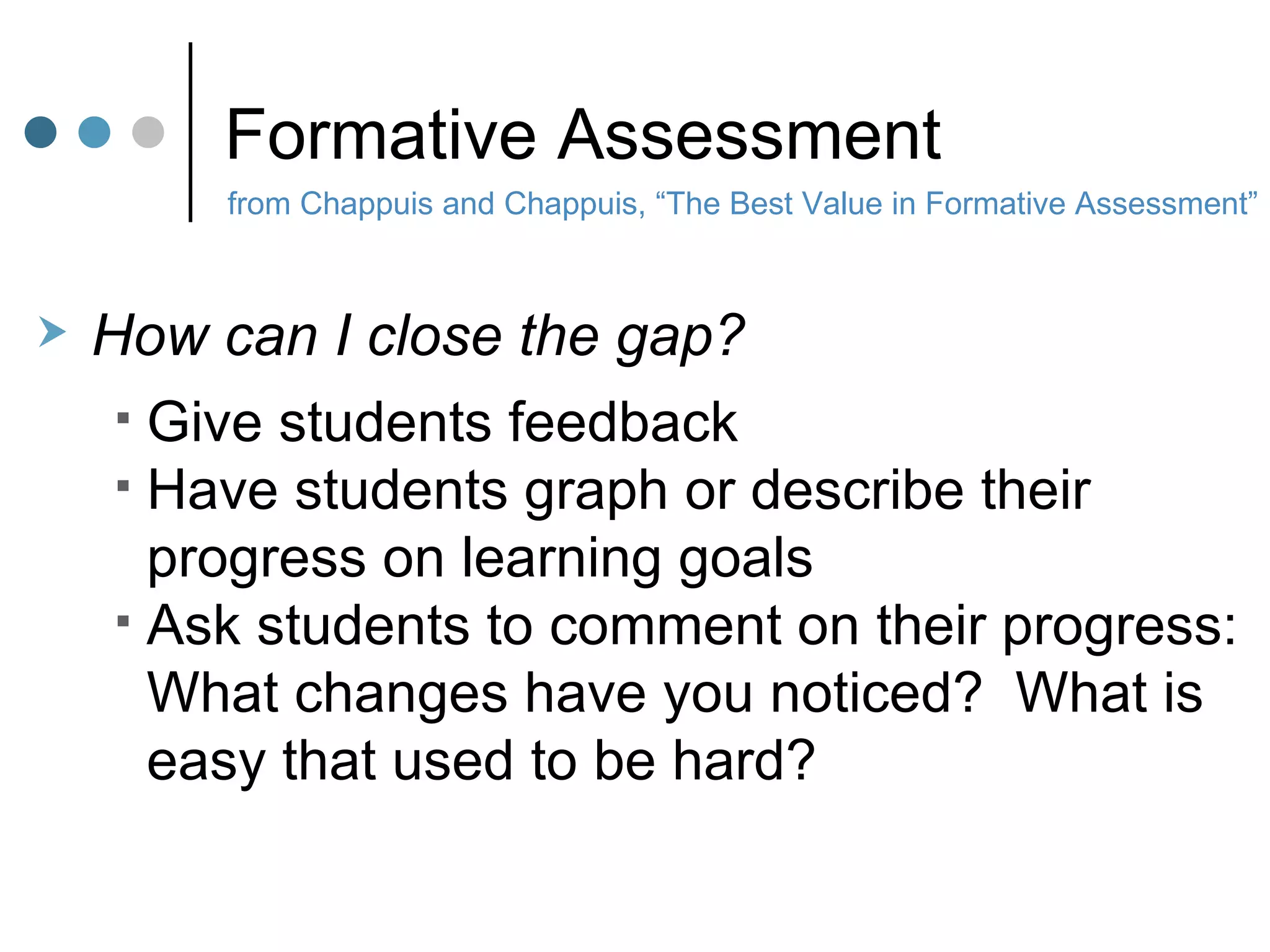
Formative Assessment from Chappuis and Chappuis, “The Best Value in Formative Assessment” How can I close the gap? Give students feedback Have students graph or describe their  progress on learning goals Ask students to comment on their progress: What changes have you noticed?  What is easy that used to be hard?
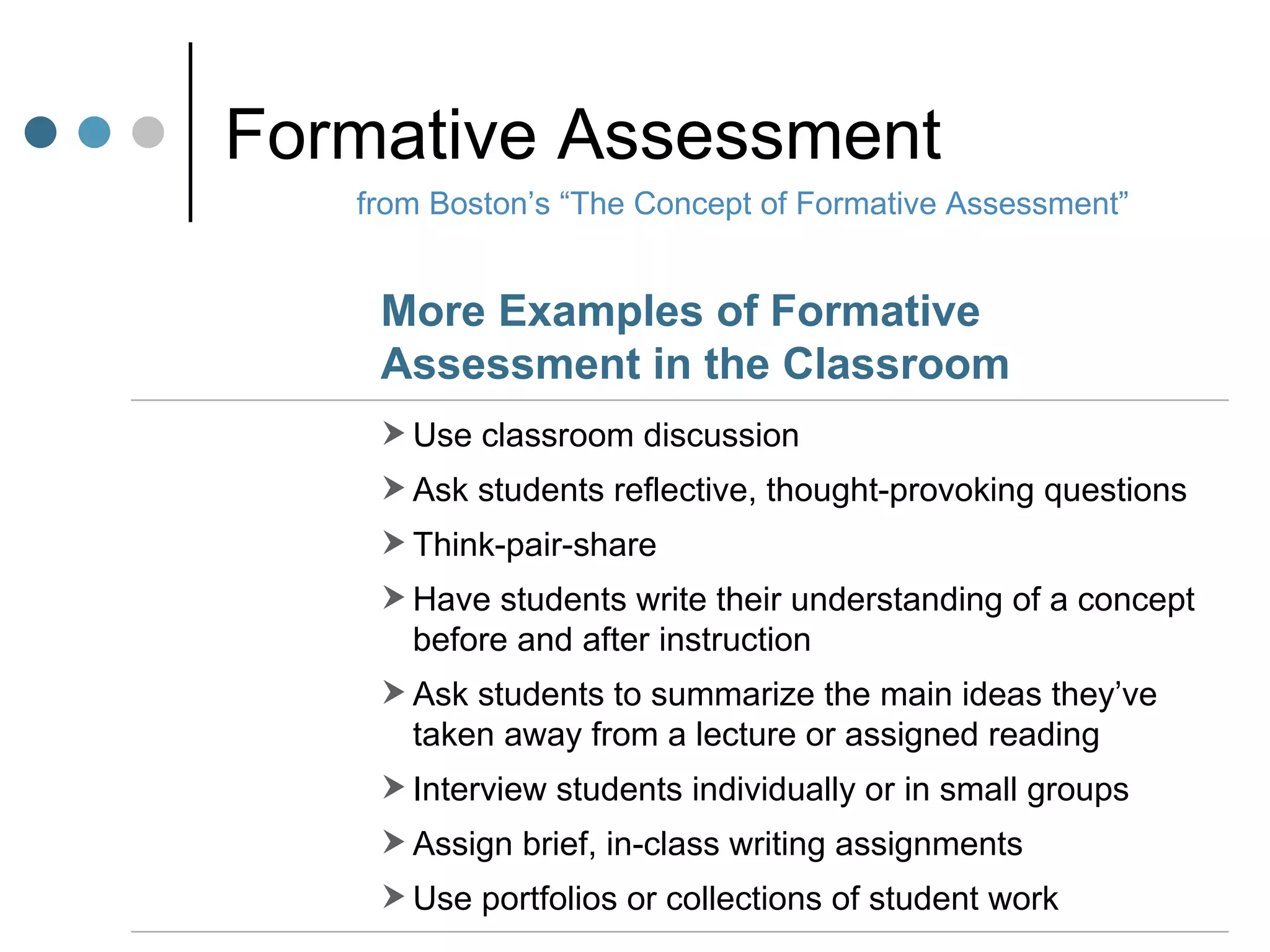
Formative Assessment from Boston’s “The Concept of Formative Assessment” Use classroom discussion Ask students reflective, thought-provoking questions Think-pair-share Have students write their understanding of a concept before and after instruction Ask students to summarize the main ideas they’ve taken away from a lecture or assigned reading Interview students individually or in small groups Assign brief, in-class writing assignments Use portfolios or collections of student work More Examples of Formative Assessment in the Classroom
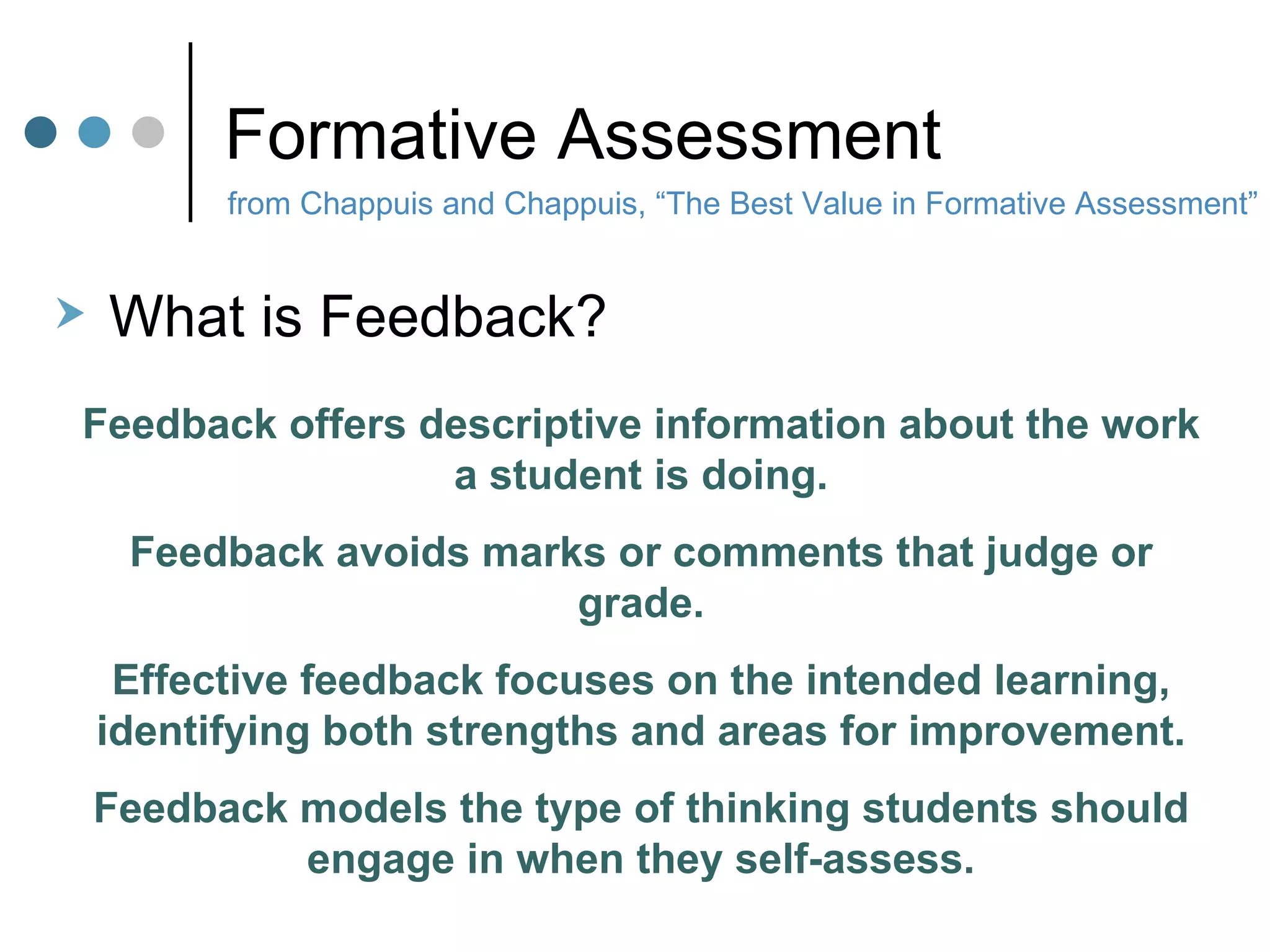
Formative Assessment from Chappuis and Chappuis, “The Best Value in Formative Assessment” What is Feedback? Feedback offers descriptive information about the work a student is doing. Feedback avoids marks or comments that judge or grade. Effective feedback focuses on the intended learning, identifying both strengths and areas for improvement. Feedback models the type of thinking students should engage in when they self-assess.
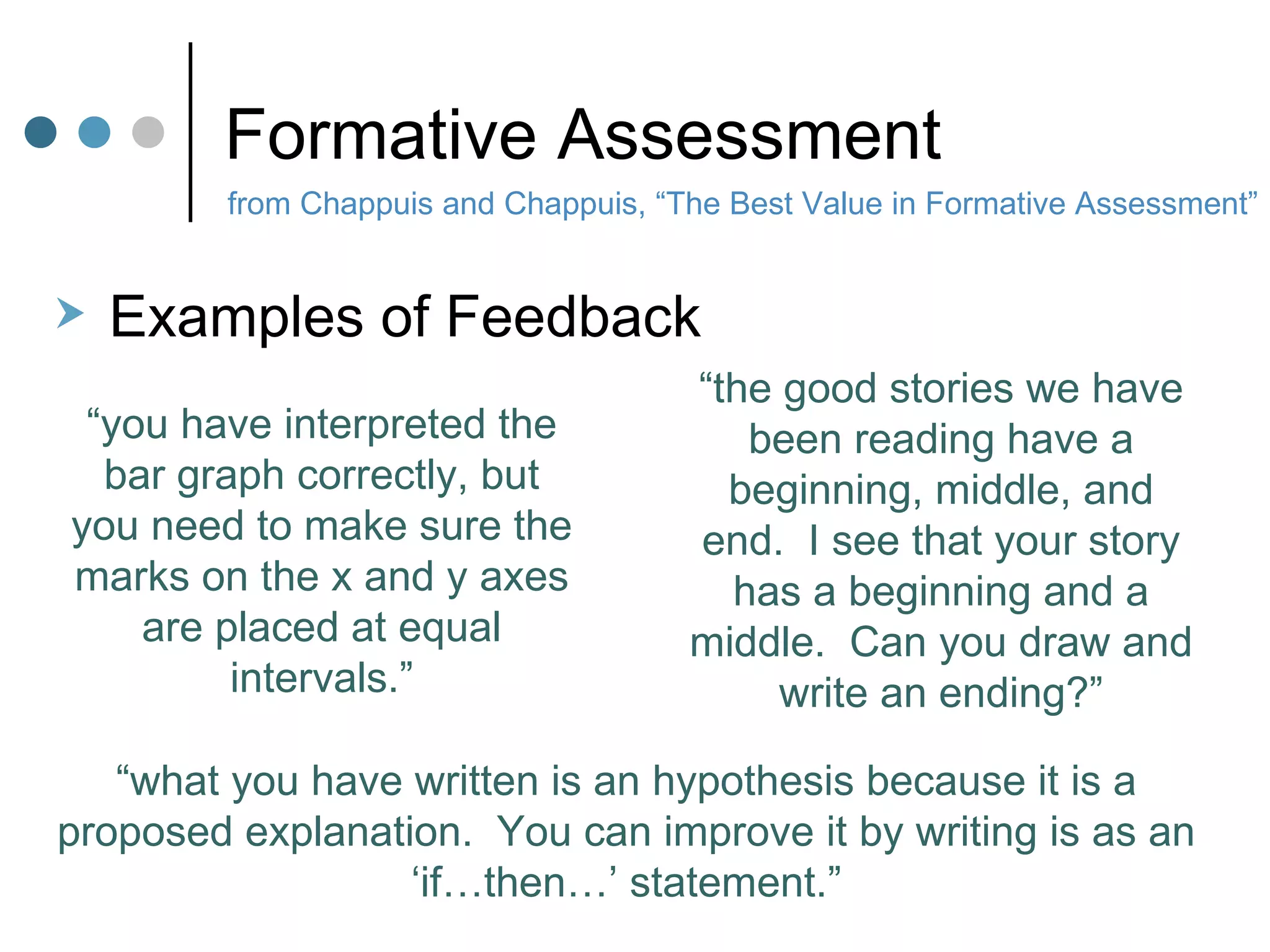
Formative Assessment from Chappuis and Chappuis, “The Best Value in Formative Assessment” Examples of Feedback “ you have interpreted the bar graph correctly, but you need to make sure the marks on the x and y axes are placed at equal intervals.” “ the good stories we have been reading have a beginning, middle, and end.  I see that your story has a beginning and a middle.  Can you draw and write an ending?” “ what you have written is an hypothesis because it is a proposed explanation.  You can improve it by writing is as an ‘if…then…’ statement.”
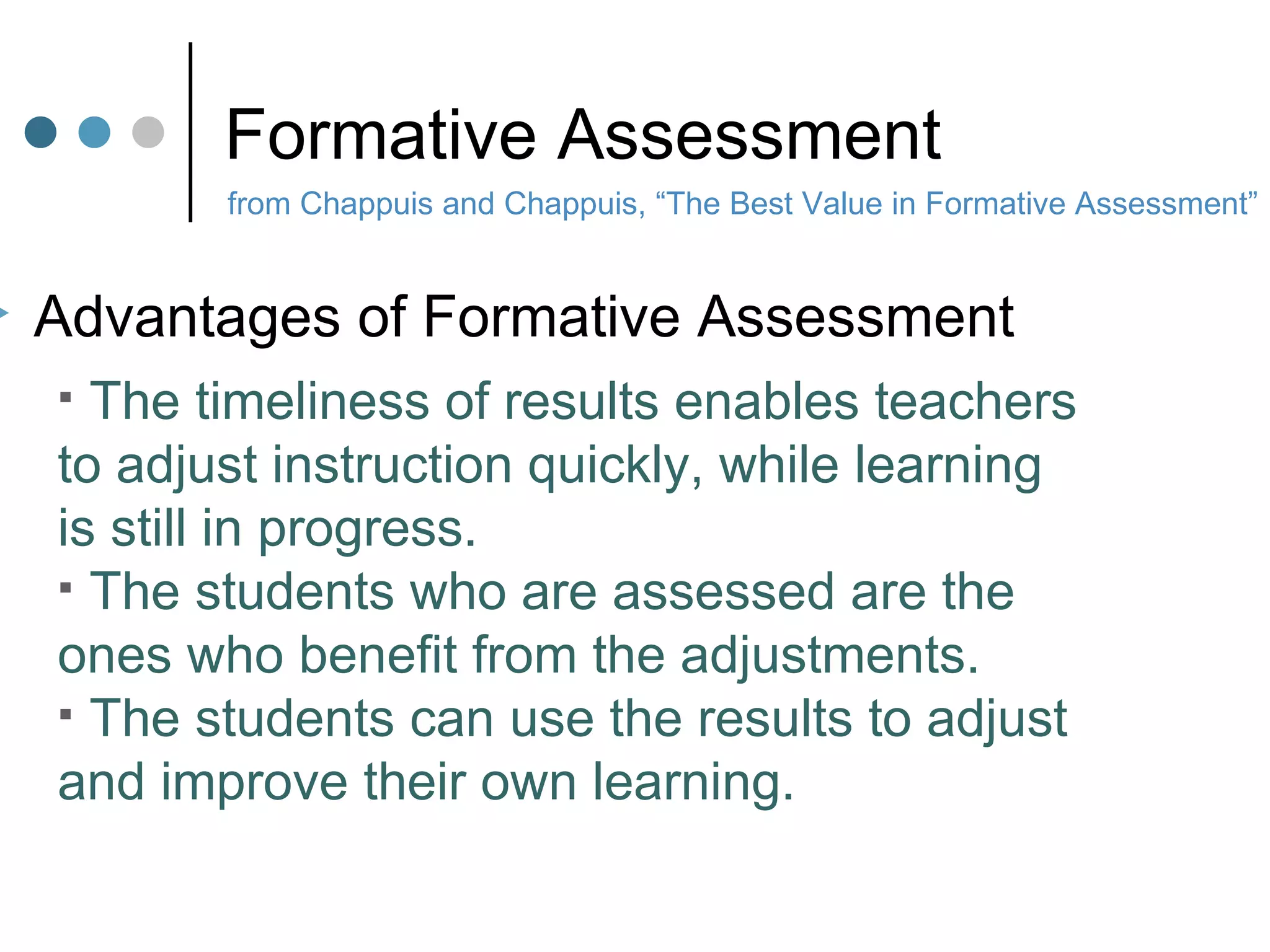
Formative Assessment from Chappuis and Chappuis, “The Best Value in Formative Assessment” Advantages of Formative Assessment The timeliness of results enables teachers to adjust instruction quickly, while learning is still in progress. The students who are assessed are the  ones who benefit from the adjustments. The students can use the results to adjust and improve their own learning.
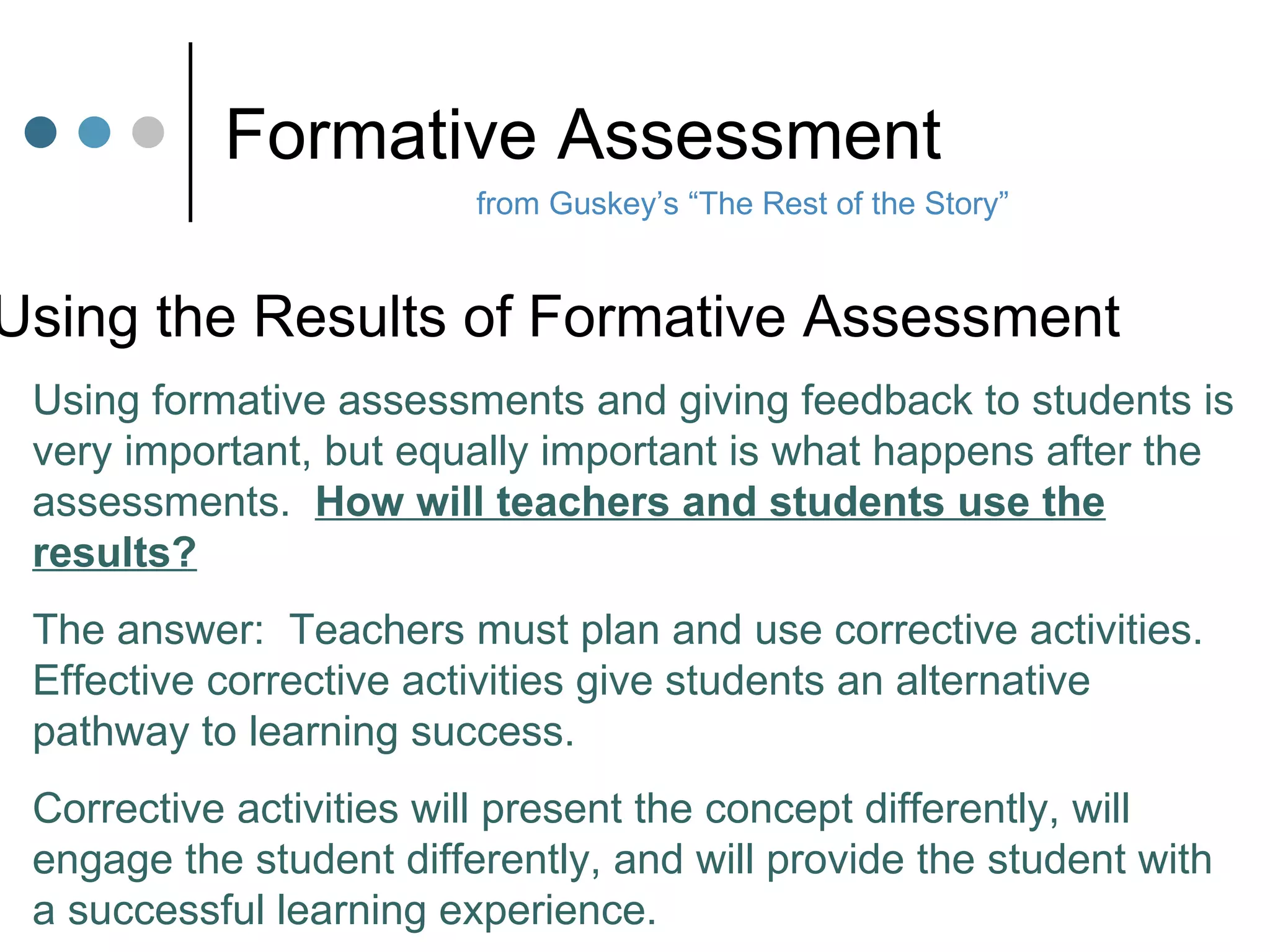
Formative Assessment from Guskey’s “The Rest of the Story” Using the Results of Formative Assessment Using formative assessments and giving feedback to students is very important, but equally important is what happens after the assessments.  How will teachers and students use the results? The answer:  Teachers must plan and use corrective activities.  Effective corrective activities give students an alternative pathway to learning success. Corrective activities will present the concept differently, will engage the student differently, and will provide the student with a successful learning experience.
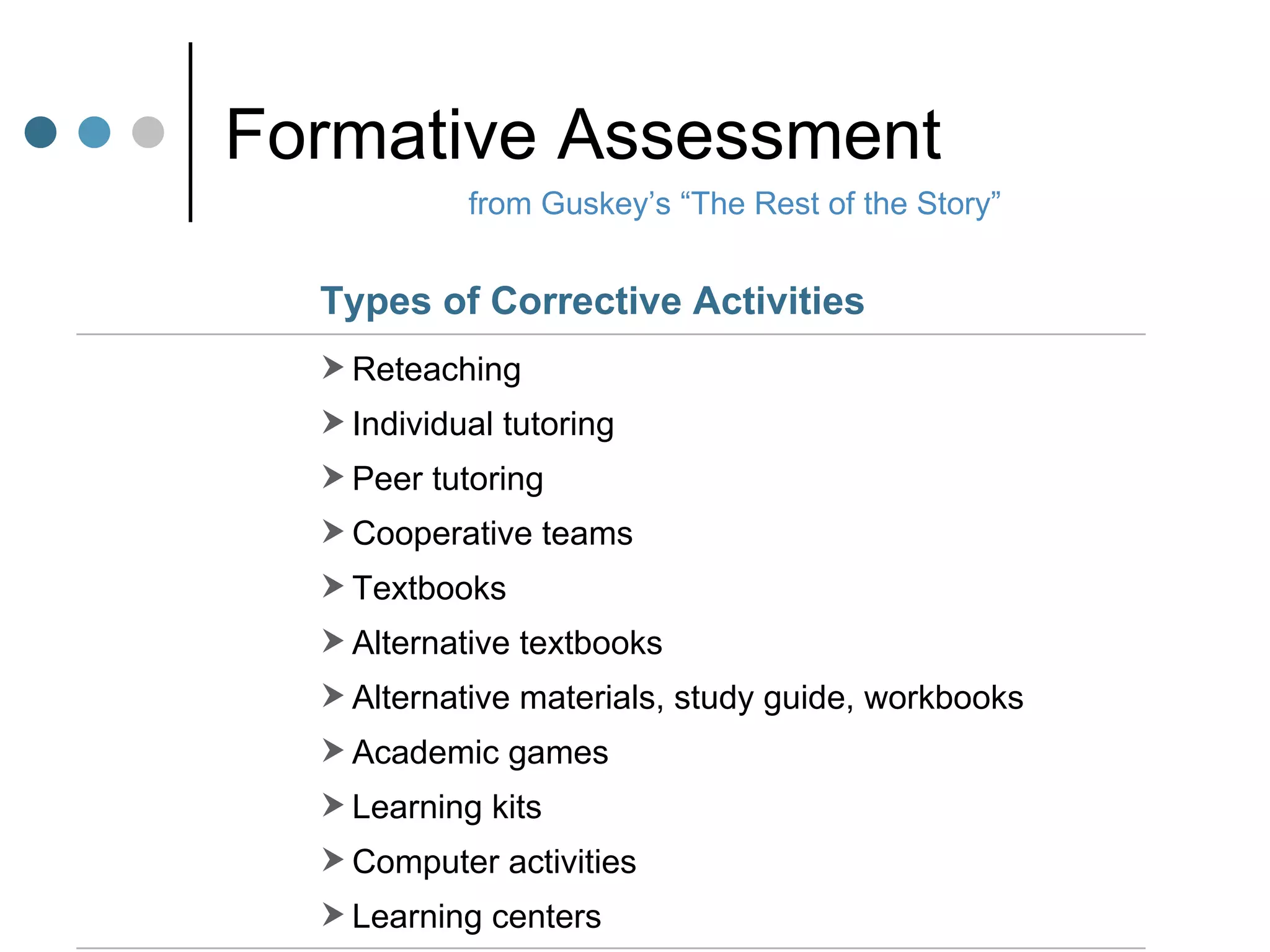
Formative Assessment from Guskey’s “The Rest of the Story” Reteaching Individual tutoring Peer tutoring Cooperative teams Textbooks Alternative textbooks Alternative materials, study guide, workbooks Academic games Learning kits Computer activities Learning centers Types of Corrective Activities
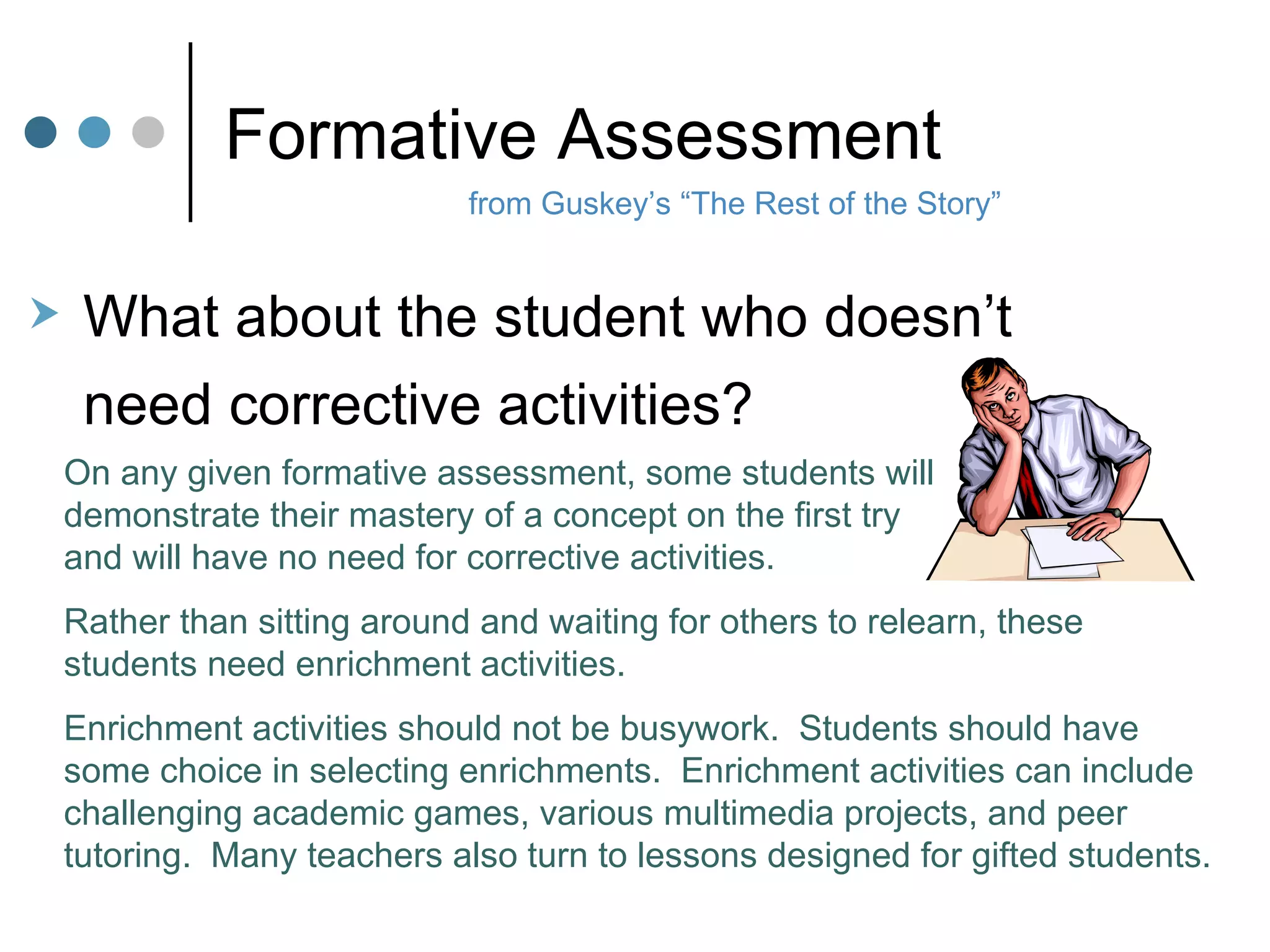
Formative Assessment from Guskey’s “The Rest of the Story” What about the student who doesn’t  need corrective activities? On any given formative assessment, some students will  demonstrate their mastery of a concept on the first try  and will have no need for corrective activities.  Rather than sitting around and waiting for others to relearn, these students need enrichment activities. Enrichment activities should not be busywork.  Students should have some choice in selecting enrichments.  Enrichment activities can include challenging academic games, various multimedia projects, and peer tutoring.  Many teachers also turn to lessons designed for gifted students.
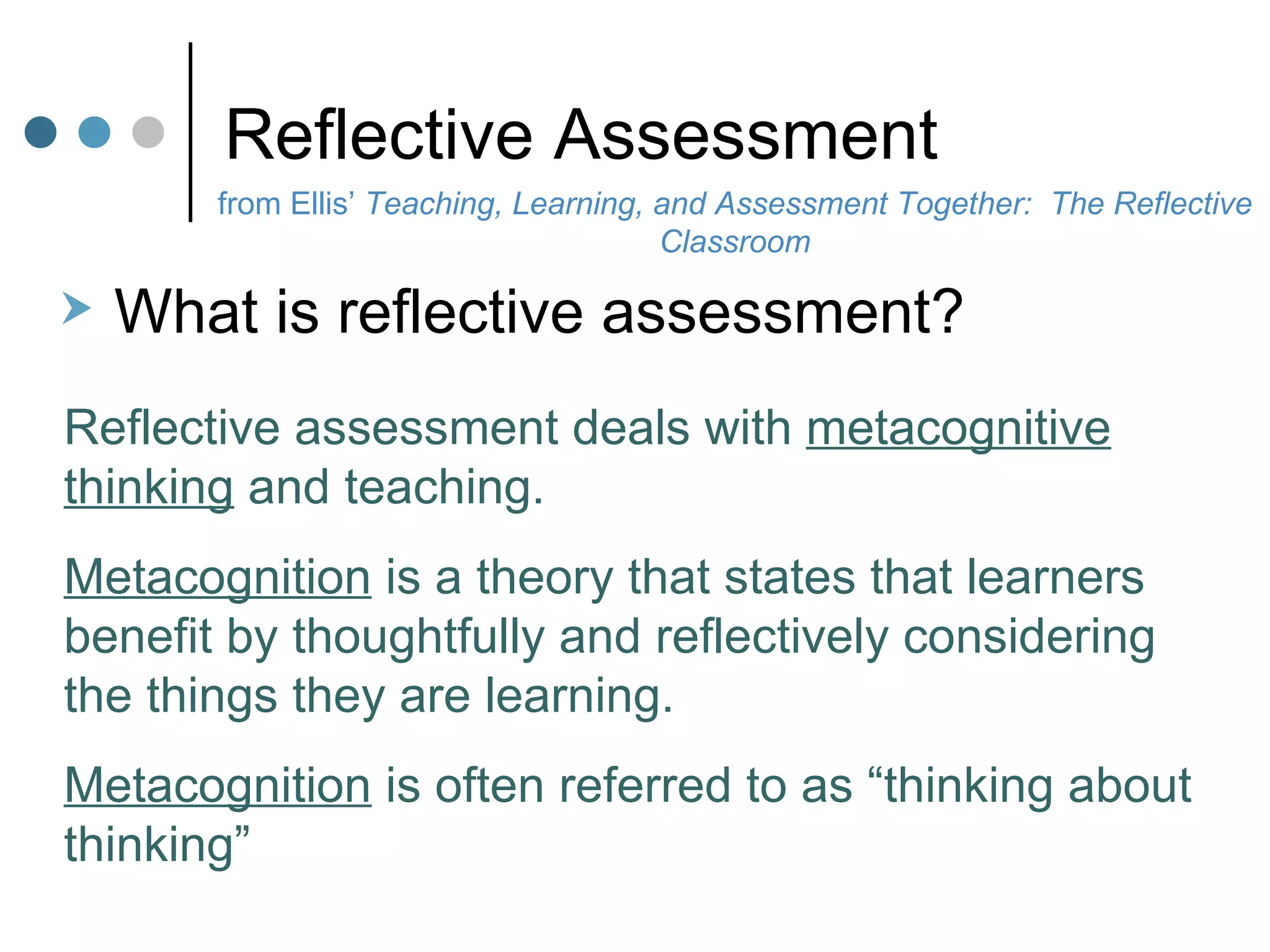
Reflective Assessment What is reflective assessment?  Reflective assessment deals with  metacognitive thinking  and teaching. Metacognition  is a theory that states that learners benefit by thoughtfully and reflectively considering the things they are learning.  Metacognition  is often referred to as “thinking about thinking” from Ellis’  Teaching, Learning, and Assessment Together:  The Reflective Classroom
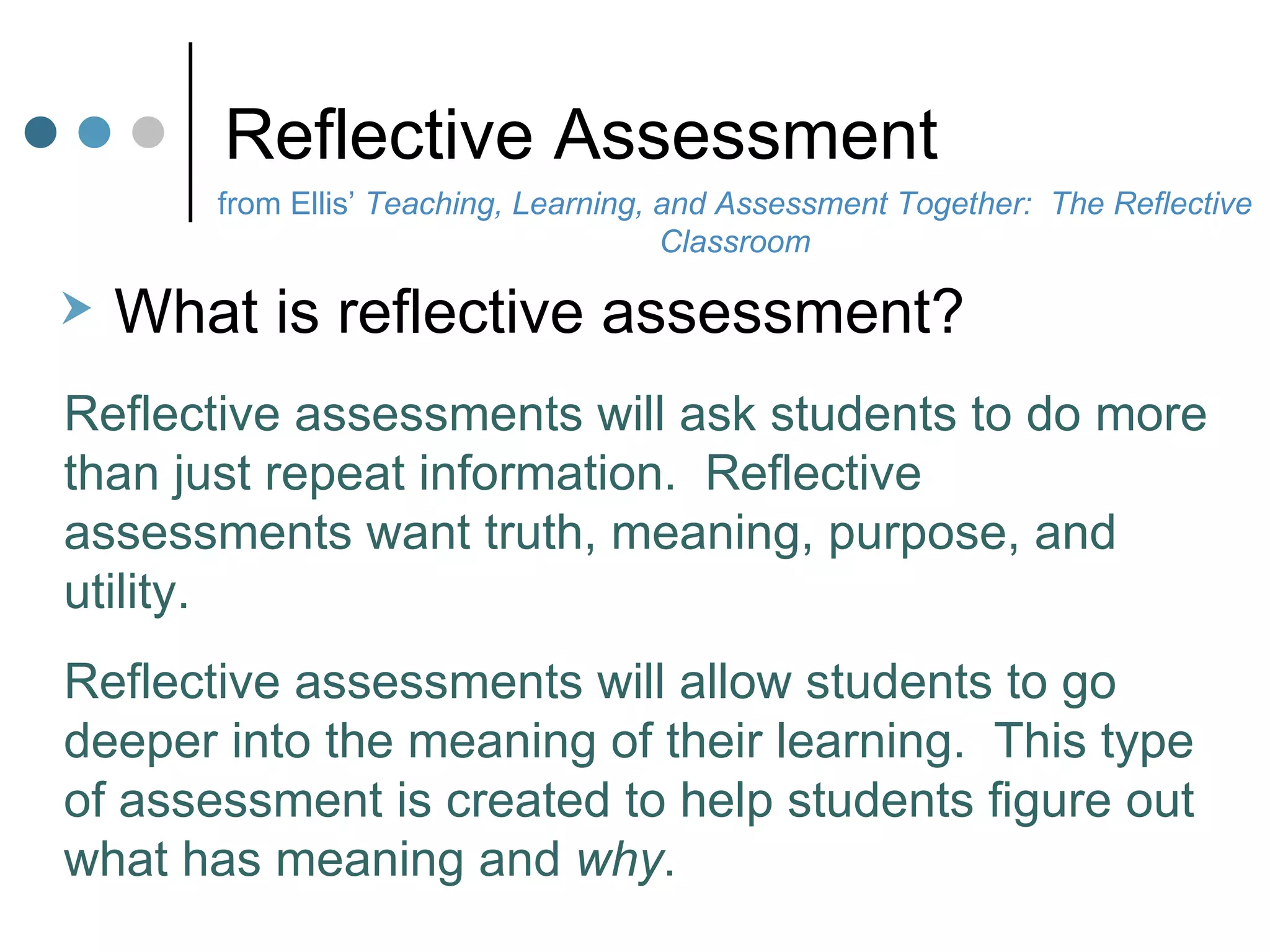
Reflective Assessment from Ellis’  Teaching, Learning, and Assessment Together:  The Reflective Classroom What is reflective assessment?  Reflective assessments will ask students to do more than just repeat information.  Reflective assessments want truth, meaning, purpose, and utility. Reflective assessments will allow students to go deeper into the meaning of their learning.  This type of assessment is created to help students figure out what has meaning and  why .
Reflective Assessment from Ellis’  Teaching, Learning, and Assessment Together:  The Reflective Classroom What is reflective assessment?  “ If your classroom were to become a place where time is given to reflect, to think, and to analyze, how would it be different?  What would happen is you decided to “cover” less ground and spent more time treating a few selected issues in depth?  To what extent do you think you would be willing to turn over much of the responsibility for the assessment of academic achievement and the quality of classroom life to your students?  What would happen if you did?”  -- Arthur Ellis, p. 4
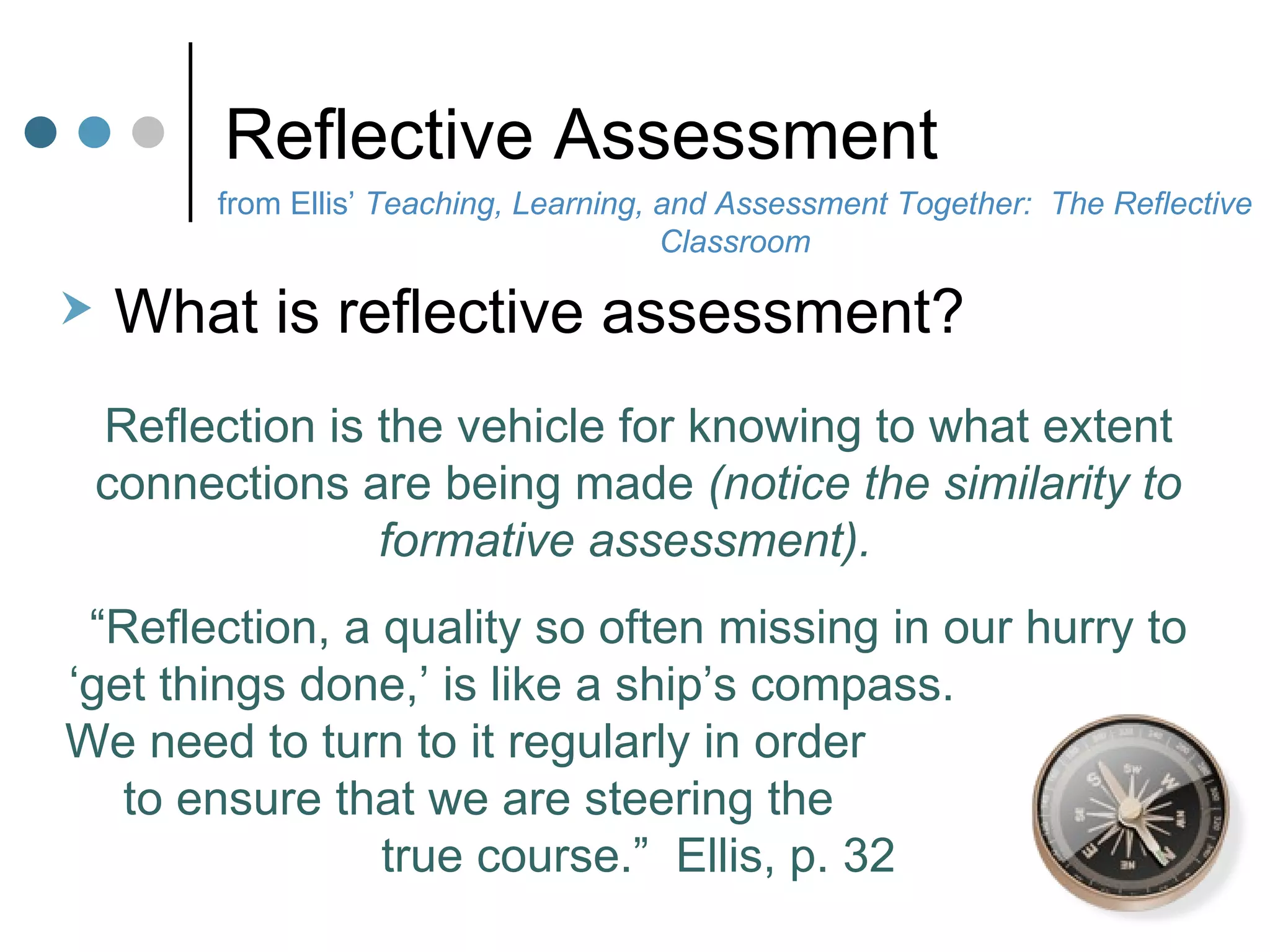
Reflective Assessment from Ellis’  Teaching, Learning, and Assessment Together:  The Reflective Classroom What is reflective assessment?  Reflection is the vehicle for knowing to what extent connections are being made  (notice the similarity to formative assessment).   “ Reflection, a quality so often missing in our hurry to ‘get things done,’ is like a ship’s compass.  We need to turn to it regularly in order  to ensure that we are steering the  true course.”  Ellis, p. 32
Reflective Assessment Class 1:  They excitedly entered the museum running.  After some time, this same group came back to the front, still at high speed.  They put their coats on left the building.  One child exclaimed that she saw every exhibit in the museum!  Obviously, they were in a hurry, but they did manage to “cover it all.” Class 2:  They and their teacher are in no hurry.  They all gathered around several exhibits of ancient pottery.  Each child had a sketch pad and pencil.  They took careful drawings of what they viewed.  This group of students did not manage to see every exhibit at the museum. A Field Trip to the Museum… Which class is the  reflective  classroom?  “ All experiences teach us something, but only experiences of  quality teach us something worthwhile.” from Ellis’  Teaching, Learning, and Assessment Together:  The Reflective Classroom
Reflective Assessment Perspectives on Reflective Thinking Practices Metacognition:  Through reflection, a student becomes aware of his own knowledge; he cannot monitor or regulate his own cognitive strategies if he is not aware of what those strategies are.  Problem Solving:  John Dewey and Kitchener both proposed that individuals engage in reflection when they encounter problems with uncertain answers-when no authority figure has an answer, when they believe no one answer is correct, and when the solution cannot be derived by formal logic.  The Philosophical Mind:  Reflective thinking requires continual evaluation of beliefs and assumptions against other interpretations.  An individual engages in reflective thinking to "perceive the state of her own mind."  The Arts:  The mind of the perceiver of art engages in reflective thinking.  from Ellis’  Teaching, Learning, and Assessment Together:  The Reflective Classroom
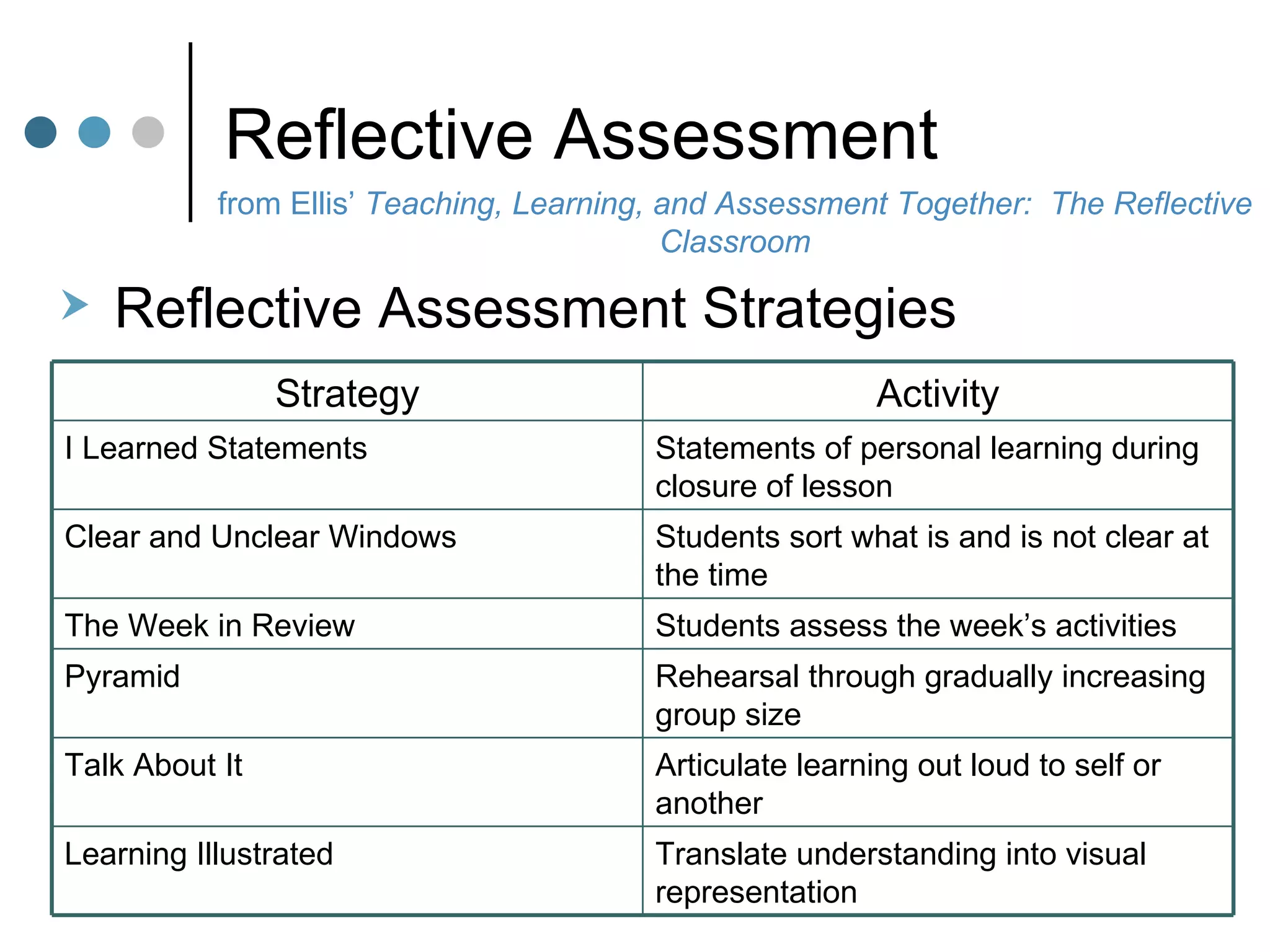
Reflective Assessment from Ellis’  Teaching, Learning, and Assessment Together:  The Reflective Classroom Reflective Assessment Strategies Translate understanding into visual representation Learning Illustrated Articulate learning out loud to self or another Talk About It Rehearsal through gradually increasing group size Pyramid Students assess the week’s activities The Week in Review Students sort what is and is not clear at the time Clear and Unclear Windows Statements of personal learning during closure of lesson I Learned Statements Activity Strategy
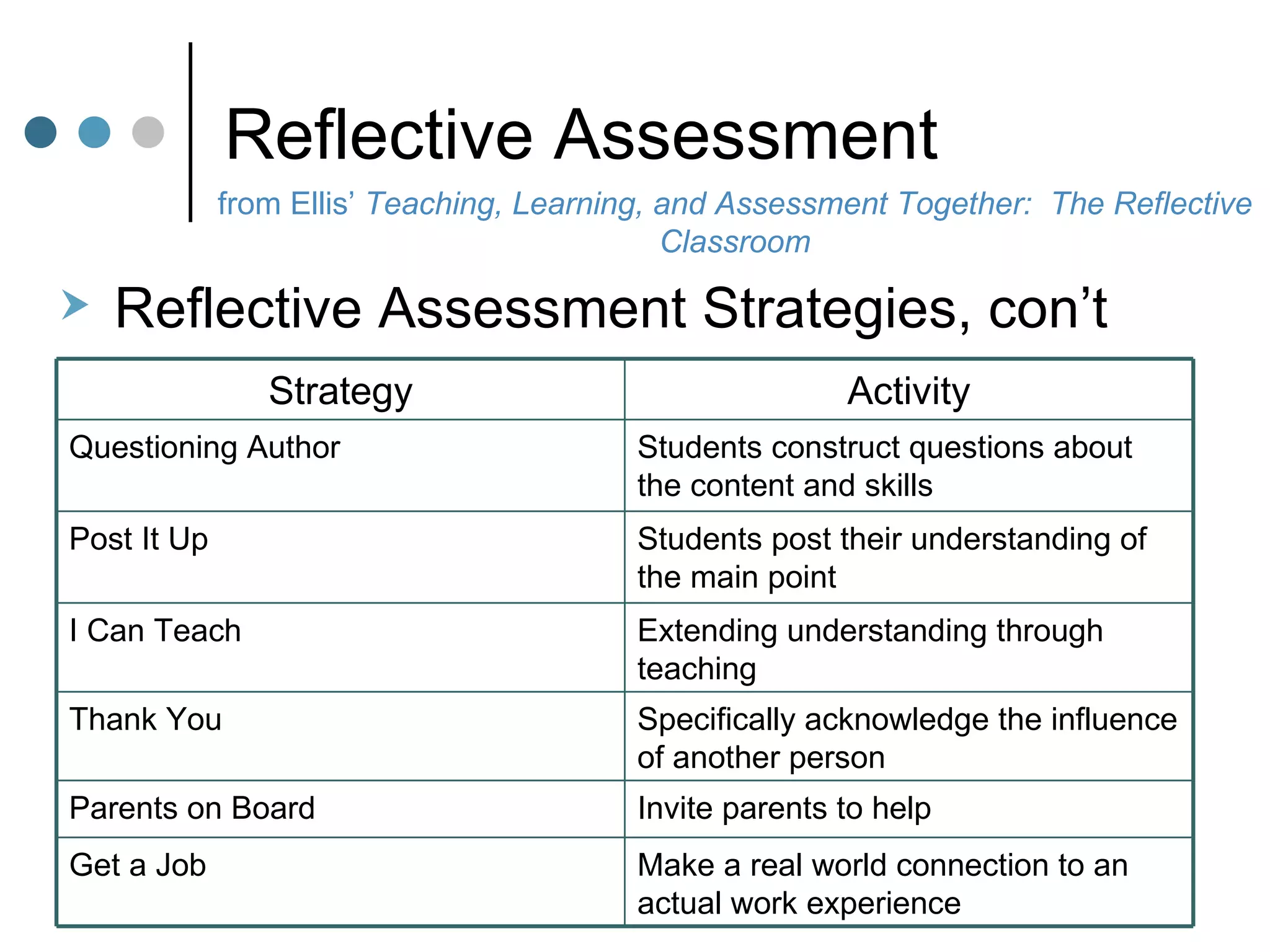
Reflective Assessment from Ellis’  Teaching, Learning, and Assessment Together:  The Reflective Classroom Reflective Assessment Strategies, con’t Make a real world connection to an actual work experience Get a Job Invite parents to help Parents on Board Specifically acknowledge the influence of another person Thank You Extending understanding through teaching I Can Teach Students post their understanding of the main point Post It Up Students construct questions about the content and skills Questioning Author Activity Strategy
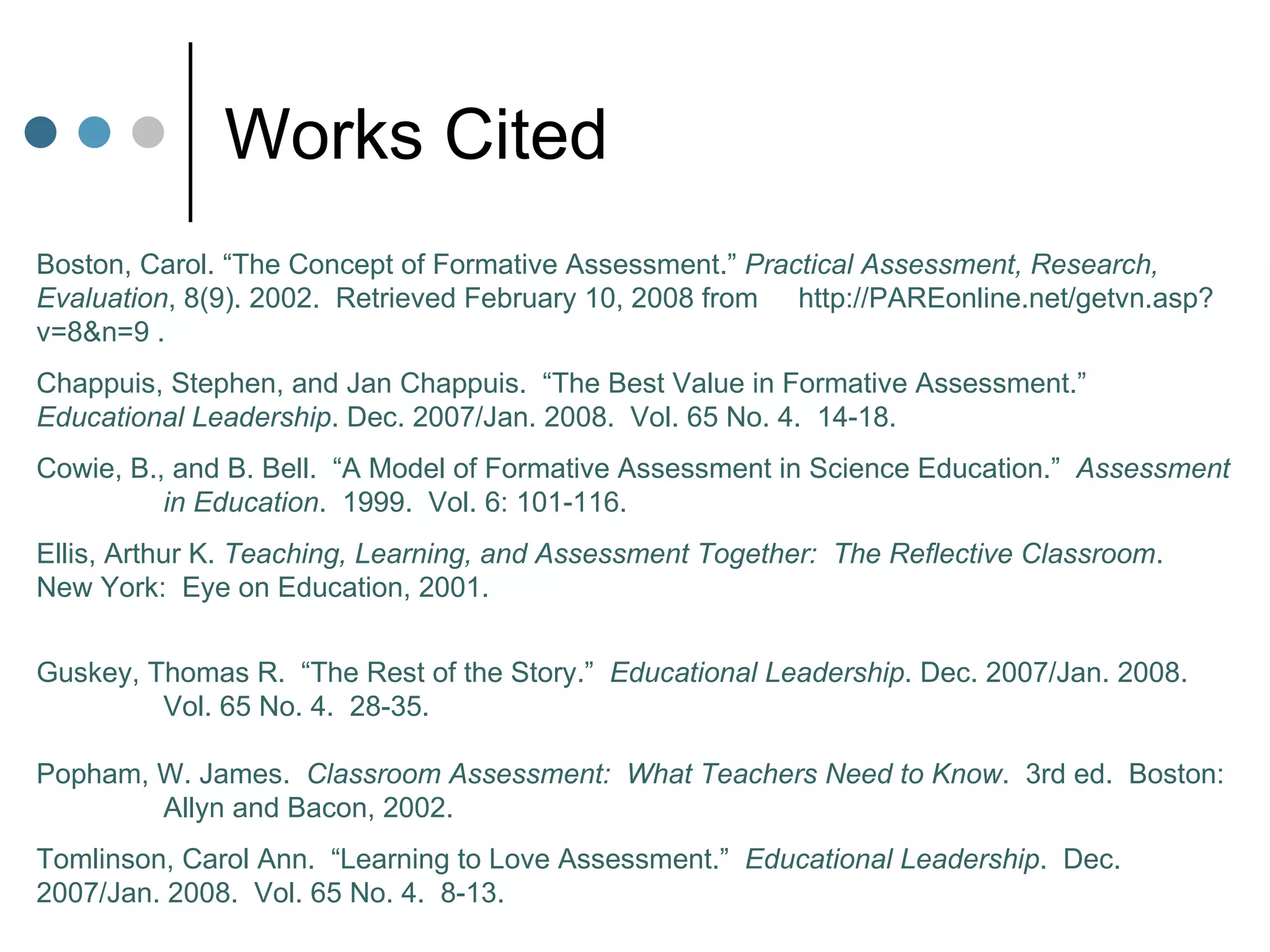
Works Cited Boston, Carol. “The Concept of Formative Assessment.”  Practical Assessment, Research,  Evaluation , 8(9). 2002.  Retrieved February 10, 2008 from  http://PAREonline.net/getvn.asp?v=8&n=9 .  Chappuis, Stephen, and Jan Chappuis.  “The Best Value in Formative Assessment.”  Educational Leadership . Dec. 2007/Jan. 2008.  Vol. 65 No. 4.  14-18. Cowie, B., and B. Bell.  “A Model of Formative Assessment in Science Education.”  Assessment  in Education .  1999.  Vol. 6: 101-116. Ellis, Arthur K.  Teaching, Learning, and Assessment Together:  The Reflective Classroom .  New York:  Eye on Education, 2001. Guskey, Thomas R.  “The Rest of the Story.”  Educational Leadership . Dec. 2007/Jan. 2008.  Vol. 65 No. 4.  28-35. Popham, W. James.  Classroom Assessment:  What Teachers Need to Know .  3rd ed.  Boston:  Allyn and Bacon, 2002. Tomlinson, Carol Ann.  “Learning to Love Assessment.”  Educational Leadership .  Dec.  2007/Jan. 2008.  Vol. 65 No. 4.  8-13.

Assessment

  • 1.
    More on Assessment: an in-depth look at formative and reflective assessment by Carrie Abood
  • 2.
    The Purposes ofAssessment To diagnose students’ strengths and weaknesses To monitor students’ progress To assign grades To determine the teacher’s effectiveness from Popham’s Classroom Assessment: What Teachers Need to Know Traditional and Fundamental Roles of Assessment
  • 3.
    The Purposes ofAssessment To influence public perceptions of educational effectiveness To help evaluate teachers To improve instructional intentions from Popham’s Classroom Assessment: What Teachers Need to Know Three New Roles for Assessment in Today’s Education
  • 4.
    Assessment “Rumors” Rumor: assessment is all about test-giving Truth: test-giving is only one of many, many ways to assess learning Rumor: assessment is always formal Truth: insight about a student’s learning can be found anytime you look for it Rumor: assessment is separate from curriculum Truth: curriculum design and assessment should be closely tied to learning goals from Tomlinson’s “Learning to Love Assessment”
  • 5.
    Assessment “Rumors” con’t.Rumor: assessment is “the end” for a teacher Truth: studying assessment (what worked, what didn’t) is the beginning of better instruction Rumor: assessment is about finding weaknesses Truth: assessment can be used to also accentuate student positives Rumor: assessment is only for the teacher Truth: assessment can be used to teach students self-monitoring and self-modifying from Tomlinson’s “Learning to Love Assessment”
  • 6.
    Formative Assessment Whatis formative assessment? Hire “… a self-reflective process that intends to promote student attainment” -- Terry Crooks “… the bidirectional process between teacher and student to enhance, recognize and respond to the learning.” -- Cowie and Bell “… a diagnostic use of assessment to provide feedback to teachers and students over the course of instruction.” -- Carol Boston “… assessments conducted during learning to promote, not merely judge or grade, student success.” -- Rick Stiggins
  • 7.
    Formative Assessment The Differences between Formative and Summative Assessment The results of summative assessments are used to make judgments on a student, measure program effectiveness, or determine whether a school has made yearly progress. Summative assessment is the assessment of learning. Summative assessment typically documents how much learning has occurred at one point in time; its purpose is to measure the level of a student, school, or program success. from Chappuis and Chappuis, “The Best Value in Formative Assessment”
  • 8.
    Formative Assessment fromChappuis and Chappuis, “The Best Value in Formative Assessment” The Differences between Formative and Summative Assessment On the other hand, formative assessment gives information during the process of instruction, before the summative assessment. Both the teacher and student use formative assessment results to make decisions about future learning. Formative assessment is an ongoing process that involves more than frequent testing. Formative assessment is the assessment for learning.
  • 9.
    Formative Assessment Whystate assessments are summative from Chappuis and Chappuis, “The Best Value in Formative Assessment” *The purpose of state assessments is to provide data to compare schools and districts. *The results of state/standardized tests are communicated to teachers and students in ways that are difficult to interpret and understand. *Results are often delivered several months after giving the tests. *These types of tests cannot contribute much to the day-to-day instruction or help determine future learning goals of individual students.
  • 10.
    Formative Assessment Whystate assessments are summative from Chappuis and Chappuis, “The Best Value in Formative Assessment” Benchmark exams are often purchased by a school district in order to measure their school’s progress toward state or district goals. This type of assessment is NOT automatically formative. Why? Although this type of state assessment is created for mid-year feedback, most administrators and teachers do not use the information formatively. Most teachers administer the benchmark, report the results, and continue on with previously planned instruction.
  • 11.
    Formative Assessment fromChappuis and Chappuis, “The Best Value in Formative Assessment” How does formative assessment support learning? Teachers can adapt instruction on the basis of evidence, making changes and improvements that will yield immediate benefits to student learning. Students can use evidence of their current progress to actively manage and adjust their own learning.
  • 12.
    Formative Assessment Formativeassessment can be in many different forms. It mainly consists of anything teachers do to help students answer three questions: Where am I going? Where am I now? How can I close the gap? from Chappuis and Chappuis, “The Best Value in Formative Assessment” What does formative assessment look like in the classroom?
  • 13.
    Formative Assessment fromChappuis and Chappuis, “The Best Value in Formative Assessment” Where am I going? Discuss with students their learning targets, written in student-friendly language Show students strong and weak examples of the type of performance or product they are expected to create Use Rubrics! for rubric help: www.rubistar.org; www.rubrics.com
  • 14.
    Formative Assessment fromChappuis and Chappuis, “The Best Value in Formative Assessment” Where am I now? Administer a non-graded quiz partway through the learning to help understand who needs to work on what Have students identify their own strengths and weaknesses Have students keep a list of the learning goals and check off the ones they have mastered
  • 15.
    Formative Assessment fromChappuis and Chappuis, “The Best Value in Formative Assessment” How can I close the gap? Give students feedback Have students graph or describe their progress on learning goals Ask students to comment on their progress: What changes have you noticed? What is easy that used to be hard?
  • 16.
    Formative Assessment fromBoston’s “The Concept of Formative Assessment” Use classroom discussion Ask students reflective, thought-provoking questions Think-pair-share Have students write their understanding of a concept before and after instruction Ask students to summarize the main ideas they’ve taken away from a lecture or assigned reading Interview students individually or in small groups Assign brief, in-class writing assignments Use portfolios or collections of student work More Examples of Formative Assessment in the Classroom
  • 17.
    Formative Assessment fromChappuis and Chappuis, “The Best Value in Formative Assessment” What is Feedback? Feedback offers descriptive information about the work a student is doing. Feedback avoids marks or comments that judge or grade. Effective feedback focuses on the intended learning, identifying both strengths and areas for improvement. Feedback models the type of thinking students should engage in when they self-assess.
  • 18.
    Formative Assessment fromChappuis and Chappuis, “The Best Value in Formative Assessment” Examples of Feedback “ you have interpreted the bar graph correctly, but you need to make sure the marks on the x and y axes are placed at equal intervals.” “ the good stories we have been reading have a beginning, middle, and end. I see that your story has a beginning and a middle. Can you draw and write an ending?” “ what you have written is an hypothesis because it is a proposed explanation. You can improve it by writing is as an ‘if…then…’ statement.”
  • 19.
    Formative Assessment fromChappuis and Chappuis, “The Best Value in Formative Assessment” Advantages of Formative Assessment The timeliness of results enables teachers to adjust instruction quickly, while learning is still in progress. The students who are assessed are the ones who benefit from the adjustments. The students can use the results to adjust and improve their own learning.
  • 20.
    Formative Assessment fromGuskey’s “The Rest of the Story” Using the Results of Formative Assessment Using formative assessments and giving feedback to students is very important, but equally important is what happens after the assessments. How will teachers and students use the results? The answer: Teachers must plan and use corrective activities. Effective corrective activities give students an alternative pathway to learning success. Corrective activities will present the concept differently, will engage the student differently, and will provide the student with a successful learning experience.
  • 21.
    Formative Assessment fromGuskey’s “The Rest of the Story” Reteaching Individual tutoring Peer tutoring Cooperative teams Textbooks Alternative textbooks Alternative materials, study guide, workbooks Academic games Learning kits Computer activities Learning centers Types of Corrective Activities
  • 22.
    Formative Assessment fromGuskey’s “The Rest of the Story” What about the student who doesn’t need corrective activities? On any given formative assessment, some students will demonstrate their mastery of a concept on the first try and will have no need for corrective activities. Rather than sitting around and waiting for others to relearn, these students need enrichment activities. Enrichment activities should not be busywork. Students should have some choice in selecting enrichments. Enrichment activities can include challenging academic games, various multimedia projects, and peer tutoring. Many teachers also turn to lessons designed for gifted students.
  • 23.
    Reflective Assessment Whatis reflective assessment? Reflective assessment deals with metacognitive thinking and teaching. Metacognition is a theory that states that learners benefit by thoughtfully and reflectively considering the things they are learning. Metacognition is often referred to as “thinking about thinking” from Ellis’ Teaching, Learning, and Assessment Together: The Reflective Classroom
  • 24.
    Reflective Assessment fromEllis’ Teaching, Learning, and Assessment Together: The Reflective Classroom What is reflective assessment? Reflective assessments will ask students to do more than just repeat information. Reflective assessments want truth, meaning, purpose, and utility. Reflective assessments will allow students to go deeper into the meaning of their learning. This type of assessment is created to help students figure out what has meaning and why .
  • 25.
    Reflective Assessment fromEllis’ Teaching, Learning, and Assessment Together: The Reflective Classroom What is reflective assessment? “ If your classroom were to become a place where time is given to reflect, to think, and to analyze, how would it be different? What would happen is you decided to “cover” less ground and spent more time treating a few selected issues in depth? To what extent do you think you would be willing to turn over much of the responsibility for the assessment of academic achievement and the quality of classroom life to your students? What would happen if you did?” -- Arthur Ellis, p. 4
  • 26.
    Reflective Assessment fromEllis’ Teaching, Learning, and Assessment Together: The Reflective Classroom What is reflective assessment? Reflection is the vehicle for knowing to what extent connections are being made (notice the similarity to formative assessment). “ Reflection, a quality so often missing in our hurry to ‘get things done,’ is like a ship’s compass. We need to turn to it regularly in order to ensure that we are steering the true course.” Ellis, p. 32
  • 27.
    Reflective Assessment Class1: They excitedly entered the museum running. After some time, this same group came back to the front, still at high speed. They put their coats on left the building. One child exclaimed that she saw every exhibit in the museum! Obviously, they were in a hurry, but they did manage to “cover it all.” Class 2: They and their teacher are in no hurry. They all gathered around several exhibits of ancient pottery. Each child had a sketch pad and pencil. They took careful drawings of what they viewed. This group of students did not manage to see every exhibit at the museum. A Field Trip to the Museum… Which class is the reflective classroom? “ All experiences teach us something, but only experiences of quality teach us something worthwhile.” from Ellis’ Teaching, Learning, and Assessment Together: The Reflective Classroom
  • 28.
    Reflective Assessment Perspectiveson Reflective Thinking Practices Metacognition: Through reflection, a student becomes aware of his own knowledge; he cannot monitor or regulate his own cognitive strategies if he is not aware of what those strategies are. Problem Solving: John Dewey and Kitchener both proposed that individuals engage in reflection when they encounter problems with uncertain answers-when no authority figure has an answer, when they believe no one answer is correct, and when the solution cannot be derived by formal logic. The Philosophical Mind: Reflective thinking requires continual evaluation of beliefs and assumptions against other interpretations. An individual engages in reflective thinking to "perceive the state of her own mind." The Arts: The mind of the perceiver of art engages in reflective thinking. from Ellis’ Teaching, Learning, and Assessment Together: The Reflective Classroom
  • 29.
    Reflective Assessment fromEllis’ Teaching, Learning, and Assessment Together: The Reflective Classroom Reflective Assessment Strategies Translate understanding into visual representation Learning Illustrated Articulate learning out loud to self or another Talk About It Rehearsal through gradually increasing group size Pyramid Students assess the week’s activities The Week in Review Students sort what is and is not clear at the time Clear and Unclear Windows Statements of personal learning during closure of lesson I Learned Statements Activity Strategy
  • 30.
    Reflective Assessment fromEllis’ Teaching, Learning, and Assessment Together: The Reflective Classroom Reflective Assessment Strategies, con’t Make a real world connection to an actual work experience Get a Job Invite parents to help Parents on Board Specifically acknowledge the influence of another person Thank You Extending understanding through teaching I Can Teach Students post their understanding of the main point Post It Up Students construct questions about the content and skills Questioning Author Activity Strategy
  • 31.
    Works Cited Boston,Carol. “The Concept of Formative Assessment.” Practical Assessment, Research, Evaluation , 8(9). 2002. Retrieved February 10, 2008 from http://PAREonline.net/getvn.asp?v=8&n=9 . Chappuis, Stephen, and Jan Chappuis. “The Best Value in Formative Assessment.” Educational Leadership . Dec. 2007/Jan. 2008. Vol. 65 No. 4. 14-18. Cowie, B., and B. Bell. “A Model of Formative Assessment in Science Education.” Assessment in Education . 1999. Vol. 6: 101-116. Ellis, Arthur K. Teaching, Learning, and Assessment Together: The Reflective Classroom . New York: Eye on Education, 2001. Guskey, Thomas R. “The Rest of the Story.” Educational Leadership . Dec. 2007/Jan. 2008. Vol. 65 No. 4. 28-35. Popham, W. James. Classroom Assessment: What Teachers Need to Know . 3rd ed. Boston: Allyn and Bacon, 2002. Tomlinson, Carol Ann. “Learning to Love Assessment.” Educational Leadership . Dec. 2007/Jan. 2008. Vol. 65 No. 4. 8-13.