Basic Concepts in Assessment
“The best way to assess yourself is to base the assessment on the product you
produce daily.”
- Sunday Adelaja
LEARNING OUTCOMES
PRETEST
I. Direction: Read the options and statements carefully and encircle the letter of your answer.
1. What is a classroom assessment?
a. The collection, evaluation, and use of information to help teachers make decisions that im-
prove student learning.
b. The collection, evaluation, and use of information to help teachers make decisions that
decrease student learning.
c. An interpretation of what has been gathered through measurement.
d. A judgment of student behavior
2. The four essential components to implementing classroom assessments are:
a. Purpose, measurement, evaluation and use
b. Purpose, measurement, performance standards, and use.
c. Purpose, measurement, criteria and use.
d. Purpose, performance standards, criteria and evaluation.
3. Which of the following is not a reason for doing classroom assessments?
a.To diagnose students’ strengths and weaknesses.
b.To assign grades.
c.To assign grades based on behavior.
d.To provide feedback for students.
4. This is defined as the process by which traits, characteristics, or behaviors are differentiated.
a.Measurement
b.Interpretation
c.Criteria
d.Evaluation
5. Teachers’ professional judgments play a large role in
a.Measurement
b.Evaluation
c.Performance standards
d.Criteria
1
At the end of this module, you should be able to:
a. differentiate assessment, measurement, evaluation, testing and test;
b. create test questions regarding the basic concepts in assessment; and
c. appreciate the importance of classroom assessment.
2
CONTENT
ASSESSMENT
 the process of documenting (usually in measurable terms) knowledge, skills, attitudes, and beliefs
 it can focus on the individual learner, the learning community (class, workshop, or other organized
group of learners), the institution, or the educational system as a whole (granularity)
 involves a review of evidence of learning such as journal entries, written work, portfolios, skill
demonstrations, and performance in learning activities, test result and rubrics ratings which cover a
period of time and should reveal the progress of students in the competencies.
 the collection, analysis and interpretation of data based on (test) performance.
1. Assessment of curricular offerings
2. Assessment of school programs
3. Assessment of instructional materials
4. Assessment of instructional facilities
5. Assessment of teachers and professors
6. Assessment of students
7. Assessment of graduates
8. Assessment of school managers
9. Assessment of extension
SCOPES OF ASSESSMENT
FUNCTIONS OF ASSESSMENT
1. Measures students’ achievements
Through testing and assessment, students’ achievements can be determined whether they have
reached the goals of the learning tasks or not.
2. Evaluates instruction and teaching strategies
Results of test can determine whether instruction and teaching strategies are effective or ineffective.
Usually, if the test results are high, the instructions and teaching strategies are effective. Otherwise, it is
not.
3. Assesses lessons to be re-taught
If teaching is ineffective as evidenced by the poor test results, item analysis comes in. Items with 49
percent and below difficulty need to be re-taught.
4. Evaluates school’s programs
Assessment evaluates school’s programs if they are relevant, realistic, and responsive to the needs
of the society.
5. Motivates learning
Upon knowing the results of achievement test, the student’s enthusiasm is aroused if he gets high
score. Otherwise, if his score is low, he strives hard to get higher score in the next examination.
6. Predicts success or failure
Success or failure of students is predicted through assessment of their learning.
7. Diagnoses the nature of difficulties
Weaknesses of the students can be determined through assessment of their learning. Diagnostic
tests can identify the areas where students need more focus.
8. Evaluates teachers’ performance
Performance of teachers are determined through assessment of students’ learning.
9. Evaluates school’s facilities and resources
Adequacy of schools’ facilities and resources, are determined through assessment of students’
learning. If students attain high percentage passing score in national exams then it may correspond to the
institution having adequate facilities and resources.
10. Evaluates school managers performance
Assessment evaluates school managers performance. The result of the schools’ accreditation lies
on the performance of school managers.
3
MEASUREMENT
 the process of quantifying an individual’s achievement, personality, and attitudes among others by
means of appropriate measuring instruments.
 part of the educational evaluation process whereby some tools or instruments are used to provide a
quantitative description of the progress of students towards desirable educational goals.
 a process of quantifying or assigning number to the individual’s intelligence, personality, attitude and
values and achievement of the student.
EVALUATION
 refers to the process of judging the quality of what is good and what is desirable
 the process of gathering and interpreting evidence regarding the problems and progress of individuals
in achieving desirable educational goals.
CHIEF PURPOSE OF EVALUATION
- The improvement of the individual learner.
OTHER PURPOSES OF EVALUATION
- To maintain standard
- To select students
- To motivate learning
- To guide learning
- To furnish instruction
- To appraise educational instrumentalities
TESTING
 one of the different methods used to measure the level of scoring and interpretation of the procedures
designed to get information about the extent of the performance of the students.
 the administration of test and use of test results to determine whether the learners can be promoted or
not.
TEST
 a formal and systematic instrument, usually paper and pencil procedure designed to assess the quality,
ability, skill or knowledge of the student by giving a set of question in uniform manner.
1. Intelligence test
This test measures the intelligent quotient (IQ) of an individual as genius, very superior, high
average, average, low average, borderline or mentally defective.
2. Personality test
This test measures the ways in which the individual’s interest with other individuals or in terms of the
roles an individual has assigned to himself and how he adopts in the society.
3. Aptitude test
This test is a predictive measure of a person’s likelihood of benefit from instruction or experience in
a given field.
4. Prognostic test
This test forecasts how well a person may do in a certain school subject or work.
5. Performance test
This test is a measure which often makes use of accomplishing the learning task involving minimum
accomplishment or none at all.
6. Diagnostic test
This test identifies the weaknesses of an individual’s achievement in any field which serves as basis
for remedial instruction.
7. Achievement test
This test measures how much the students attain the learning tasks. For example, NAT (National
Achievement Test)
KINDS OF TESTS
4
8. Preference test
This test is a measure of vocational or academic interest of an individual or aesthetic decision by
forcing the examinee to make force options between members of paired or grouped items.
9. Scale test
This test is a series of items arranged in the order of difficulty. An example of this kind of test is the
Binet-Simon Scale.
10. Speed test
This test measures the speed and accuracy of the examinee within the time imposed. It is also called
the alertness test.
11. Power test
This test is made up of series of items arranged from easiest to the most difficult.
12. Standardized test
This test provides exact procedures in controlling the method of administration and scoring with norms
and data concerning the reliability and validity of the test.
13. Teacher-made test
This test is prepared by classroom teachers based on the contents stated in the syllabi and the
lessons taken by the students
14. Placement test
This test is used to measure the job an applicant should fill in the school setting and the grade or year
level the student should be enrolled after quitting from school.
LEARNING ACTIVITIES
I. Direction: Identify the term being described. Write your answers in the space provided for each
number.
_________________________1. It is the process of making judgments based on criteria and evidence.
_________________________2. It the method of describing, collecting, recording, scoring and
interpreting information about learning.
_________________________3. It refers to the process by which the attributes or dimensions of some
physical objects are determined with the exception of IQ or attitudes.
_________________________4. It is the administration of test and use of test results to determine if
learners can be promoted or not.
_________________________5. It is a formal and systematic instrument, usually paper and pencil
procedure.
_________________________6. This test forecasts how well a person may do in a certain school subject
or work.
_________________________7. A test that helps the teacher identify problems or difficulties encountered
by students during instruction.
_________________________8. This test requires a time limit for the test taker to answer all items with
the same degree of difficulty.
_________________________9. It assesses the underlying ability of test takers by giving them sufficient
time while answering questions arranged in an increasing order of difficulty.
_________________________10. This test is a measure which often makes use of accomplishing the
learning task involving minimum accomplishment or none at all.
II. Direction: Create your own/original 5-item questions based on the lecture given. Provide an answer
key.
ASSESSMENT
5
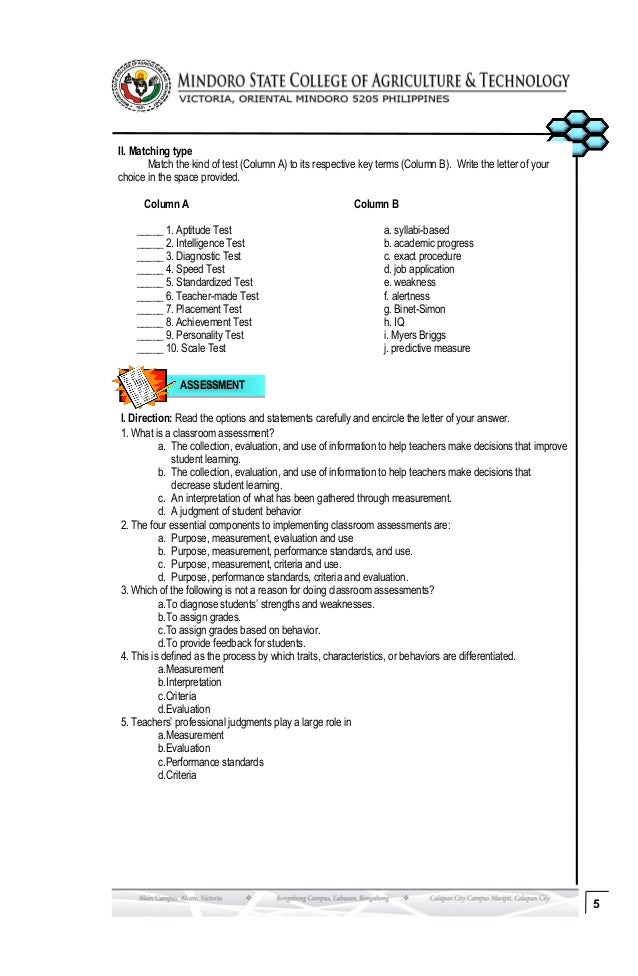
II. Matching type
Match the kind of test (Column A) to its respective key terms (Column B). Write the letter of your
choice in the space provided.
Column A Column B
_____ 1. Aptitude Test a. syllabi-based
_____ 2. Intelligence Test b. academic progress
_____ 3. Diagnostic Test c. exact procedure
_____ 4. Speed Test d. job application
_____ 5. Standardized Test e. weakness
_____ 6. Teacher-made Test f. alertness
_____ 7. Placement Test g. Binet-Simon
_____ 8. Achievement Test h. IQ
_____ 9. Personality Test i. Myers Briggs
_____ 10. Scale Test j. predictive measure
I. Direction: Read the options and statements carefully and encircle the letter of your answer.
1. What is a classroom assessment?
a. The collection, evaluation, and use of information to help teachers make decisions that improve
student learning.
b. The collection, evaluation, and use of information to help teachers make decisions that
decrease student learning.
c. An interpretation of what has been gathered through measurement.
d. A judgment of student behavior
2. The four essential components to implementing classroom assessments are:
a. Purpose, measurement, evaluation and use
b. Purpose, measurement, performance standards, and use.
c. Purpose, measurement, criteria and use.
d. Purpose, performance standards, criteria and evaluation.
3. Which of the following is not a reason for doing classroom assessments?
a.To diagnose students’ strengths and weaknesses.
b.To assign grades.
c.To assign grades based on behavior.
d.To provide feedback for students.
4. This is defined as the process by which traits, characteristics, or behaviors are differentiated.
a.Measurement
b.Interpretation
c.Criteria
d.Evaluation
5. Teachers’ professional judgments play a large role in
a.Measurement
b.Evaluation
c.Performance standards
d.Criteria
6
REFERENCES
Books
1. Navarro, R. Santos, R. and Corpuz, B. (2019). Assessment of Learning 1 4th Ed. Lorimar Publishing,
Inc: Quezon City
2. Navarro, R. Santos, R. and Corpuz, B. (2012). Assessment of Learning Outcomes 2nd Ed. Lorimar
Publishing, Inc: Quezon City
3. Gabuyo, Y. (2012). Assessment of Learning 1 Textbook and Reviewer, Rex Book Store, Inc.: Manila
4. Buendicho, F. (2010). Assessment of Student Learning 1. Rex Book Store, Inc.: Manila
5. Calmorin, L. (2011). Assessment of Student Learning 1. Rex Book Store, Inc.: Manila
Websites
 https://www.igi-global.com/dictionary/teachers-portfolios/9113
 https://www.slideshare.net/JoeriGene/assessment-of-student-learning-1
 https://www.slideshare.net/acanonigo/principles-of-high-quality-assessment
 https://www.slideshare.net/Eaicz12/development-of-classroom-assessment-tools
 https://www.slideshare.net/Mart101296/development-of-assessment-tools-51750947?
next_slideshow=1
 https://www.slideshare.net/energeticarun/item-analysis-16082143
 https://www.britannica.com/science/psychological-testing/Test-norms
 https://www.slideshare.net/RonaldQuileste/item-analysis-discrimination-and-difficulty-index?
next_slideshow=1
 https://www.slideshare.net/ricajoypontilar/interpretation-of-assessment-results?next_slideshow=1
 https://www.slideshare.net/ebonitejohnchristoper/tabular-and-graphical-presentation-of-data
 https://www.slideshare.net/RonaLapaa/utilization-reporting-test-results
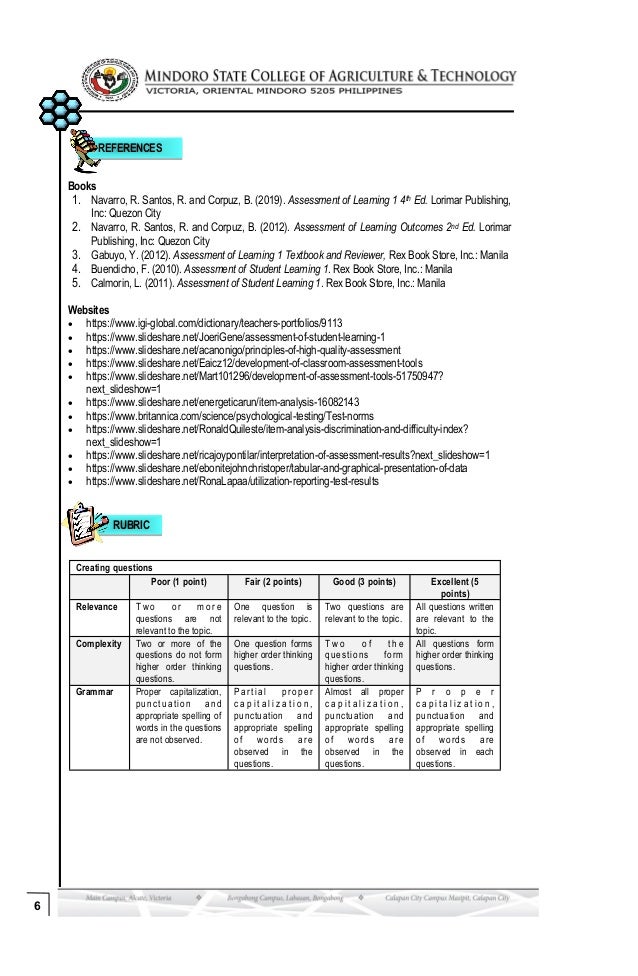
RUBRIC
Creating questions
Poor (1 point) Fair (2 points) Good (3 points) Excellent (5
points)
Relevance T w o o r m o r e
questions are not
relevant to the topic.
One question is
relevant to the topic.
Two questions are
relevant to the topic.
All questions written
are relevant to the
topic.
Complexity Two or more of the
questions do not form
higher order thinking
questions.
One question forms
higher order thinking
questions.
T w o o f t h e
questions form
higher order thinking
questions.
All questions form
higher order thinking
questions.
Grammar Proper capitalization,
punctuation and
appropriate spelling of
words in the questions
are not observed.
Partial proper
c a p i t a l i z a t i o n ,
punctuation and
appropriate spelling
of words are
observed in the
questions.
Almost all proper
c a p i t a l i z a t i o n ,
punctuation and
appropriate spelling
of words are
observed in the
questions.
P r o p e r
c a p i t a l i z a t i o n ,
punctuation and
appropriate spelling
of words are
observed in each
questions.

Module 1

  • 1.
    Basic Concepts inAssessment “The best way to assess yourself is to base the assessment on the product you produce daily.” - Sunday Adelaja LEARNING OUTCOMES PRETEST I. Direction: Read the options and statements carefully and encircle the letter of your answer. 1. What is a classroom assessment? a. The collection, evaluation, and use of information to help teachers make decisions that im- prove student learning. b. The collection, evaluation, and use of information to help teachers make decisions that decrease student learning. c. An interpretation of what has been gathered through measurement. d. A judgment of student behavior 2. The four essential components to implementing classroom assessments are: a. Purpose, measurement, evaluation and use b. Purpose, measurement, performance standards, and use. c. Purpose, measurement, criteria and use. d. Purpose, performance standards, criteria and evaluation. 3. Which of the following is not a reason for doing classroom assessments? a.To diagnose students’ strengths and weaknesses. b.To assign grades. c.To assign grades based on behavior. d.To provide feedback for students. 4. This is defined as the process by which traits, characteristics, or behaviors are differentiated. a.Measurement b.Interpretation c.Criteria d.Evaluation 5. Teachers’ professional judgments play a large role in a.Measurement b.Evaluation c.Performance standards d.Criteria 1 At the end of this module, you should be able to: a. differentiate assessment, measurement, evaluation, testing and test; b. create test questions regarding the basic concepts in assessment; and c. appreciate the importance of classroom assessment.
  • 2.
    2 CONTENT ASSESSMENT  the processof documenting (usually in measurable terms) knowledge, skills, attitudes, and beliefs  it can focus on the individual learner, the learning community (class, workshop, or other organized group of learners), the institution, or the educational system as a whole (granularity)  involves a review of evidence of learning such as journal entries, written work, portfolios, skill demonstrations, and performance in learning activities, test result and rubrics ratings which cover a period of time and should reveal the progress of students in the competencies.  the collection, analysis and interpretation of data based on (test) performance. 1. Assessment of curricular offerings 2. Assessment of school programs 3. Assessment of instructional materials 4. Assessment of instructional facilities 5. Assessment of teachers and professors 6. Assessment of students 7. Assessment of graduates 8. Assessment of school managers 9. Assessment of extension SCOPES OF ASSESSMENT FUNCTIONS OF ASSESSMENT 1. Measures students’ achievements Through testing and assessment, students’ achievements can be determined whether they have reached the goals of the learning tasks or not. 2. Evaluates instruction and teaching strategies Results of test can determine whether instruction and teaching strategies are effective or ineffective. Usually, if the test results are high, the instructions and teaching strategies are effective. Otherwise, it is not. 3. Assesses lessons to be re-taught If teaching is ineffective as evidenced by the poor test results, item analysis comes in. Items with 49 percent and below difficulty need to be re-taught. 4. Evaluates school’s programs Assessment evaluates school’s programs if they are relevant, realistic, and responsive to the needs of the society. 5. Motivates learning Upon knowing the results of achievement test, the student’s enthusiasm is aroused if he gets high score. Otherwise, if his score is low, he strives hard to get higher score in the next examination. 6. Predicts success or failure Success or failure of students is predicted through assessment of their learning. 7. Diagnoses the nature of difficulties Weaknesses of the students can be determined through assessment of their learning. Diagnostic tests can identify the areas where students need more focus. 8. Evaluates teachers’ performance Performance of teachers are determined through assessment of students’ learning. 9. Evaluates school’s facilities and resources Adequacy of schools’ facilities and resources, are determined through assessment of students’ learning. If students attain high percentage passing score in national exams then it may correspond to the institution having adequate facilities and resources. 10. Evaluates school managers performance Assessment evaluates school managers performance. The result of the schools’ accreditation lies on the performance of school managers.
  • 3.
    3 MEASUREMENT  the processof quantifying an individual’s achievement, personality, and attitudes among others by means of appropriate measuring instruments.  part of the educational evaluation process whereby some tools or instruments are used to provide a quantitative description of the progress of students towards desirable educational goals.  a process of quantifying or assigning number to the individual’s intelligence, personality, attitude and values and achievement of the student. EVALUATION  refers to the process of judging the quality of what is good and what is desirable  the process of gathering and interpreting evidence regarding the problems and progress of individuals in achieving desirable educational goals. CHIEF PURPOSE OF EVALUATION - The improvement of the individual learner. OTHER PURPOSES OF EVALUATION - To maintain standard - To select students - To motivate learning - To guide learning - To furnish instruction - To appraise educational instrumentalities TESTING  one of the different methods used to measure the level of scoring and interpretation of the procedures designed to get information about the extent of the performance of the students.  the administration of test and use of test results to determine whether the learners can be promoted or not. TEST  a formal and systematic instrument, usually paper and pencil procedure designed to assess the quality, ability, skill or knowledge of the student by giving a set of question in uniform manner. 1. Intelligence test This test measures the intelligent quotient (IQ) of an individual as genius, very superior, high average, average, low average, borderline or mentally defective. 2. Personality test This test measures the ways in which the individual’s interest with other individuals or in terms of the roles an individual has assigned to himself and how he adopts in the society. 3. Aptitude test This test is a predictive measure of a person’s likelihood of benefit from instruction or experience in a given field. 4. Prognostic test This test forecasts how well a person may do in a certain school subject or work. 5. Performance test This test is a measure which often makes use of accomplishing the learning task involving minimum accomplishment or none at all. 6. Diagnostic test This test identifies the weaknesses of an individual’s achievement in any field which serves as basis for remedial instruction. 7. Achievement test This test measures how much the students attain the learning tasks. For example, NAT (National Achievement Test) KINDS OF TESTS
  • 4.
    4 8. Preference test Thistest is a measure of vocational or academic interest of an individual or aesthetic decision by forcing the examinee to make force options between members of paired or grouped items. 9. Scale test This test is a series of items arranged in the order of difficulty. An example of this kind of test is the Binet-Simon Scale. 10. Speed test This test measures the speed and accuracy of the examinee within the time imposed. It is also called the alertness test. 11. Power test This test is made up of series of items arranged from easiest to the most difficult. 12. Standardized test This test provides exact procedures in controlling the method of administration and scoring with norms and data concerning the reliability and validity of the test. 13. Teacher-made test This test is prepared by classroom teachers based on the contents stated in the syllabi and the lessons taken by the students 14. Placement test This test is used to measure the job an applicant should fill in the school setting and the grade or year level the student should be enrolled after quitting from school. LEARNING ACTIVITIES I. Direction: Identify the term being described. Write your answers in the space provided for each number. _________________________1. It is the process of making judgments based on criteria and evidence. _________________________2. It the method of describing, collecting, recording, scoring and interpreting information about learning. _________________________3. It refers to the process by which the attributes or dimensions of some physical objects are determined with the exception of IQ or attitudes. _________________________4. It is the administration of test and use of test results to determine if learners can be promoted or not. _________________________5. It is a formal and systematic instrument, usually paper and pencil procedure. _________________________6. This test forecasts how well a person may do in a certain school subject or work. _________________________7. A test that helps the teacher identify problems or difficulties encountered by students during instruction. _________________________8. This test requires a time limit for the test taker to answer all items with the same degree of difficulty. _________________________9. It assesses the underlying ability of test takers by giving them sufficient time while answering questions arranged in an increasing order of difficulty. _________________________10. This test is a measure which often makes use of accomplishing the learning task involving minimum accomplishment or none at all. II. Direction: Create your own/original 5-item questions based on the lecture given. Provide an answer key.
  • 5.
    ASSESSMENT 5 II. Matching type Matchthe kind of test (Column A) to its respective key terms (Column B). Write the letter of your choice in the space provided. Column A Column B _____ 1. Aptitude Test a. syllabi-based _____ 2. Intelligence Test b. academic progress _____ 3. Diagnostic Test c. exact procedure _____ 4. Speed Test d. job application _____ 5. Standardized Test e. weakness _____ 6. Teacher-made Test f. alertness _____ 7. Placement Test g. Binet-Simon _____ 8. Achievement Test h. IQ _____ 9. Personality Test i. Myers Briggs _____ 10. Scale Test j. predictive measure I. Direction: Read the options and statements carefully and encircle the letter of your answer. 1. What is a classroom assessment? a. The collection, evaluation, and use of information to help teachers make decisions that improve student learning. b. The collection, evaluation, and use of information to help teachers make decisions that decrease student learning. c. An interpretation of what has been gathered through measurement. d. A judgment of student behavior 2. The four essential components to implementing classroom assessments are: a. Purpose, measurement, evaluation and use b. Purpose, measurement, performance standards, and use. c. Purpose, measurement, criteria and use. d. Purpose, performance standards, criteria and evaluation. 3. Which of the following is not a reason for doing classroom assessments? a.To diagnose students’ strengths and weaknesses. b.To assign grades. c.To assign grades based on behavior. d.To provide feedback for students. 4. This is defined as the process by which traits, characteristics, or behaviors are differentiated. a.Measurement b.Interpretation c.Criteria d.Evaluation 5. Teachers’ professional judgments play a large role in a.Measurement b.Evaluation c.Performance standards d.Criteria
  • 6.
    6 REFERENCES Books 1. Navarro, R.Santos, R. and Corpuz, B. (2019). Assessment of Learning 1 4th Ed. Lorimar Publishing, Inc: Quezon City 2. Navarro, R. Santos, R. and Corpuz, B. (2012). Assessment of Learning Outcomes 2nd Ed. Lorimar Publishing, Inc: Quezon City 3. Gabuyo, Y. (2012). Assessment of Learning 1 Textbook and Reviewer, Rex Book Store, Inc.: Manila 4. Buendicho, F. (2010). Assessment of Student Learning 1. Rex Book Store, Inc.: Manila 5. Calmorin, L. (2011). Assessment of Student Learning 1. Rex Book Store, Inc.: Manila Websites  https://www.igi-global.com/dictionary/teachers-portfolios/9113  https://www.slideshare.net/JoeriGene/assessment-of-student-learning-1  https://www.slideshare.net/acanonigo/principles-of-high-quality-assessment  https://www.slideshare.net/Eaicz12/development-of-classroom-assessment-tools  https://www.slideshare.net/Mart101296/development-of-assessment-tools-51750947? next_slideshow=1  https://www.slideshare.net/energeticarun/item-analysis-16082143  https://www.britannica.com/science/psychological-testing/Test-norms  https://www.slideshare.net/RonaldQuileste/item-analysis-discrimination-and-difficulty-index? next_slideshow=1  https://www.slideshare.net/ricajoypontilar/interpretation-of-assessment-results?next_slideshow=1  https://www.slideshare.net/ebonitejohnchristoper/tabular-and-graphical-presentation-of-data  https://www.slideshare.net/RonaLapaa/utilization-reporting-test-results RUBRIC Creating questions Poor (1 point) Fair (2 points) Good (3 points) Excellent (5 points) Relevance T w o o r m o r e questions are not relevant to the topic. One question is relevant to the topic. Two questions are relevant to the topic. All questions written are relevant to the topic. Complexity Two or more of the questions do not form higher order thinking questions. One question forms higher order thinking questions. T w o o f t h e questions form higher order thinking questions. All questions form higher order thinking questions. Grammar Proper capitalization, punctuation and appropriate spelling of words in the questions are not observed. Partial proper c a p i t a l i z a t i o n , punctuation and appropriate spelling of words are observed in the questions. Almost all proper c a p i t a l i z a t i o n , punctuation and appropriate spelling of words are observed in the questions. P r o p e r c a p i t a l i z a t i o n , punctuation and appropriate spelling of words are observed in each questions.