Accommodation
Theory
Accommodation
Theory
Communication Accommodation Theory (CAT) is
a theory of language use that seeks to examine
the attitudes, motivation, intentions, and
identities that mediate between objective social
and contextual variables and an individual’s
language use (Jones et al., 1999).
CAT was developed by Giles et al. (1973) to
explain the cognitive and affective processes
underlying speech convergence, divergence, or
maintenance.
Major
assumptions of
the theory
 While communicating there will be similarity and difference in
the speech and behaviour. The characteristics that people exhibit
are based on our experiences and the cultural backgrounds that
we grew up in.
 A conversation is evaluated by understanding the perception of
the speech and behaviour of the other. Through evaluation
people decide to accommodate and fit in.
 The social status and belonging is determined by language and
behaviours. While people communicate, they tend to
accommodate the behaviours of those who are in the higher
social status than them.
 Norms guide the accommodation process which varies in the
degree of appropriateness. Norms define the behaviours of
people, and they are expected to act accordingly.
Taken from: https://www.communicationtheory.org/communication-accommodation-theory/
Suppose
speaker A
wishes to gain
speaker B’s
approval
A then
1. Samples B’s speech and
(i) draws inferences as to the personality
characteristics of B (or at least the characteristics
which B wishes to project as being his)
(ii) assumes that B values and approves of such
characteristics
(iii) assumes that B will approve of him (A) to the
extent that he (A) displays similar characteristics
2. Chooses from his speech repertoire patterns of
speech which project characteristics of which B is
assumed to approve.
Giles et al. (1973)
Bilingual
Accommodation
(Giles et al.,
1973)
French Canadian (FC) stimulus speaker provided a message
to bilingual English Canadians (EC) in either French (no
accommodation), a mixture of French and English (partial
accommodation), or English (full accommodation)
FC was perceived more favorably in terms and
considerateness and of his effort to bridge the cultural gap
the more he accommodated to the EC listeners.
When the opportunity to return a communication to their
FC partner, subjects who were spoken to in English
accommodated most.
Such patterns are in evidence when the roles of the two
ethnolinguistic groups are reversed (Simard, Taylor, & Giles,
1976).
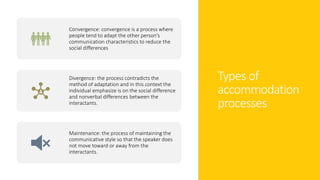
Types of
accommodation
processes
Convergence: convergence is a process where
people tend to adapt the other person’s
communication characteristics to reduce the
social differences
Divergence: the process contradicts the
method of adaptation and in this context the
individual emphasize is on the social difference
and nonverbal differences between the
interactants.
Maintenance: the process of maintaining the
communicative style so that the speaker does
not move toward or away from the
interactants.
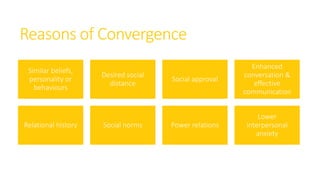
Reasons of Convergence
Similar beliefs,
personality or
behaviours
Desired social
distance
Social approval
Enhanced
conversation &
effective
communication
Relational history Social norms Power relations
Lower
interpersonal
anxiety
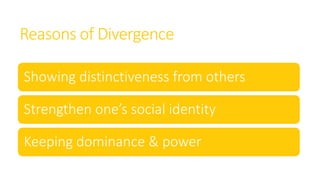
Reasons of Divergence
Showing distinctiveness from others
Strengthen one’s social identity
Keeping dominance & power
When do you
think we can
observe instances
of convergence &
divergence in a
speech?
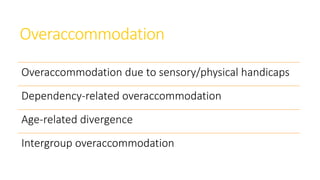
Overaccommodation
Overaccommodation due to sensory/physical handicaps
Dependency-related overaccommodation
Age-related divergence
Intergroup overaccommodation
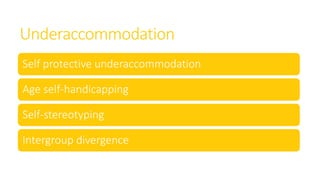
Underaccommodation
Self protective underaccommodation
Age self-handicapping
Self-stereotyping
Intergroup divergence
The
Expanded
Version of
the Theory
 Includes a number of conversation strategies
 Provides a model for the overall
communication process
Coupland et al. (1988) also added additional
processes:
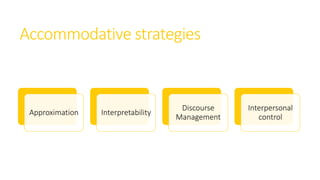
approximation
interpretability
discourse management
interpersonal control
Accommodative strategies
Approximation Interpretability
Discourse
Management
Interpersonal
control
Accommodative
Strategies
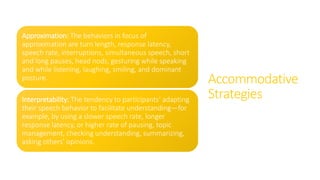
Approximation: The behaviors in focus of
approximation are turn length, response latency,
speech rate, interruptions, simultaneous speech, short
and long pauses, head nods, gesturing while speaking
and while listening, laughing, smiling, and dominant
posture.
Interpretability: The tendency to participants’ adapting
their speech behavior to facilitate understanding—for
example, by using a slower speech rate, longer
response latency, or higher rate of pausing, topic
management, checking understanding, summarizing,
asking others’ opinions.
Accommodative Strategies
Discourse Management: This diverse set of discursive options facilitates a
partner’s own contribution to ongoing talk and includes who makes decisions
about the discourse and what decisions are made.
Field refers to the ideational content of the talk
Tenor focuses on the management of interpersonal position and face
Mode relates to the procedures used for structuring
Accommodative
Strategies
Interpersonal control: Focuses on the role relations
between conversational partners. These strategies
either increase or decrease the discretion of the
other person to change roles (Gallois et al., 1988).
Interpersonal control can be positive when it allows
people the freedom to leave roles or it is implicated
in a shared group identity, by keeping a person in
role.
On the other hand, interpersonal control can be
negative. Interactants can use linguistic devices to
place a person in a role and control the person.
Gallois et al. (1995)
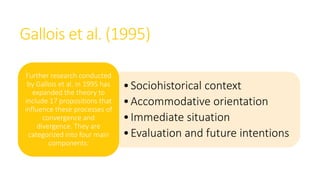
•Sociohistorical context
•Accommodative orientation
•Immediate situation
•Evaluation and future intentions
Further research conducted
by Gallois et al. in 1995 has
expanded the theory to
include 17 propositions that
influence these processes of
convergence and
divergence. They are
categorized into four main
components:
References
Acton, E. K., & Potts, C. (2014). That straight talk: Sarah Palin and the sociolinguistics of demonstratives. Journal of
Sociolinguistics, 18(1), 3–31. https://doi.org/10.1111/josl.12062
Cavallaro, F., Seilhamer, M. F., Chee F. Y. T., & Ng, C. B. (2016). Overaccommodation in a Singopore eldercare facility.
Journal of Multilingual and Multicultural Development, 37(8), 817-831.
https://doi.org/10.1080/01434632.2016.1142553
Coupland, N., Coupland, J., Giles, H., & Henwood, K. (1988). Accommodating the elderly: Invoking and extending a
theory. Language in Society, 17(1), 1-41. https://doi.org/10.1017/S0047404500012574
Gallois, C., Giles, H., Jones, E., Cargile, A. C., & Ota, H. (1995). Accommodating intercultural encounters:
Elaborations and extensions.
Giles, H., & Coupland, N. (1991). Language, context and consequences. Cole Publishing.
Giles, H., & Powesland, P. (1997). Accommodation Theory. In N. Coupland & A. Jarowski (Eds.), Sociolinguistics: A
Reader (1st ed., pp. 232-239). Macmillan Education. https://doi.org/10.1007/978-1-349-25582-5_19
Jones, E., Gallois, C., Callan,V., & Barker, M. (1999). Strategies of accommodation: Development of a coding system
for conversational interaction. Journal of Language and Social Psychology, 18(2), 123-152.
https://doi.org/10.1177/0261927X99018002001
Mougeon, R., & Rehner, M. (2015). Stylistic and discursive functions of French negative particle ne in an
educational context. Journal of Sociolinguistics, 19(5), 585–611. https://doi.org/10.1111/josl.12164
https://www.communicationtheory.org/communication-accommodation-theory/

Accommodation Theory in Sytlistic

  • 1.
  • 2.
    Accommodation Theory Communication Accommodation Theory(CAT) is a theory of language use that seeks to examine the attitudes, motivation, intentions, and identities that mediate between objective social and contextual variables and an individual’s language use (Jones et al., 1999). CAT was developed by Giles et al. (1973) to explain the cognitive and affective processes underlying speech convergence, divergence, or maintenance.
  • 3.
    Major assumptions of the theory While communicating there will be similarity and difference in the speech and behaviour. The characteristics that people exhibit are based on our experiences and the cultural backgrounds that we grew up in.  A conversation is evaluated by understanding the perception of the speech and behaviour of the other. Through evaluation people decide to accommodate and fit in.  The social status and belonging is determined by language and behaviours. While people communicate, they tend to accommodate the behaviours of those who are in the higher social status than them.  Norms guide the accommodation process which varies in the degree of appropriateness. Norms define the behaviours of people, and they are expected to act accordingly. Taken from: https://www.communicationtheory.org/communication-accommodation-theory/
  • 4.
    Suppose speaker A wishes togain speaker B’s approval A then 1. Samples B’s speech and (i) draws inferences as to the personality characteristics of B (or at least the characteristics which B wishes to project as being his) (ii) assumes that B values and approves of such characteristics (iii) assumes that B will approve of him (A) to the extent that he (A) displays similar characteristics 2. Chooses from his speech repertoire patterns of speech which project characteristics of which B is assumed to approve. Giles et al. (1973)
  • 5.
    Bilingual Accommodation (Giles et al., 1973) FrenchCanadian (FC) stimulus speaker provided a message to bilingual English Canadians (EC) in either French (no accommodation), a mixture of French and English (partial accommodation), or English (full accommodation) FC was perceived more favorably in terms and considerateness and of his effort to bridge the cultural gap the more he accommodated to the EC listeners. When the opportunity to return a communication to their FC partner, subjects who were spoken to in English accommodated most. Such patterns are in evidence when the roles of the two ethnolinguistic groups are reversed (Simard, Taylor, & Giles, 1976).
  • 6.
    Types of accommodation processes Convergence: convergenceis a process where people tend to adapt the other person’s communication characteristics to reduce the social differences Divergence: the process contradicts the method of adaptation and in this context the individual emphasize is on the social difference and nonverbal differences between the interactants. Maintenance: the process of maintaining the communicative style so that the speaker does not move toward or away from the interactants.
  • 7.
    Reasons of Convergence Similarbeliefs, personality or behaviours Desired social distance Social approval Enhanced conversation & effective communication Relational history Social norms Power relations Lower interpersonal anxiety
  • 8.
    Reasons of Divergence Showingdistinctiveness from others Strengthen one’s social identity Keeping dominance & power
  • 9.
    When do you thinkwe can observe instances of convergence & divergence in a speech?
  • 10.
    Overaccommodation Overaccommodation due tosensory/physical handicaps Dependency-related overaccommodation Age-related divergence Intergroup overaccommodation
  • 11.
    Underaccommodation Self protective underaccommodation Ageself-handicapping Self-stereotyping Intergroup divergence
  • 12.
    The Expanded Version of the Theory Includes a number of conversation strategies  Provides a model for the overall communication process Coupland et al. (1988) also added additional processes: approximation interpretability discourse management interpersonal control
  • 13.
  • 14.
    Accommodative Strategies Approximation: The behaviorsin focus of approximation are turn length, response latency, speech rate, interruptions, simultaneous speech, short and long pauses, head nods, gesturing while speaking and while listening, laughing, smiling, and dominant posture. Interpretability: The tendency to participants’ adapting their speech behavior to facilitate understanding—for example, by using a slower speech rate, longer response latency, or higher rate of pausing, topic management, checking understanding, summarizing, asking others’ opinions.
  • 15.
    Accommodative Strategies Discourse Management:This diverse set of discursive options facilitates a partner’s own contribution to ongoing talk and includes who makes decisions about the discourse and what decisions are made. Field refers to the ideational content of the talk Tenor focuses on the management of interpersonal position and face Mode relates to the procedures used for structuring
  • 16.
    Accommodative Strategies Interpersonal control: Focuseson the role relations between conversational partners. These strategies either increase or decrease the discretion of the other person to change roles (Gallois et al., 1988). Interpersonal control can be positive when it allows people the freedom to leave roles or it is implicated in a shared group identity, by keeping a person in role. On the other hand, interpersonal control can be negative. Interactants can use linguistic devices to place a person in a role and control the person.
  • 17.
    Gallois et al.(1995) •Sociohistorical context •Accommodative orientation •Immediate situation •Evaluation and future intentions Further research conducted by Gallois et al. in 1995 has expanded the theory to include 17 propositions that influence these processes of convergence and divergence. They are categorized into four main components:
  • 18.
    References Acton, E. K.,& Potts, C. (2014). That straight talk: Sarah Palin and the sociolinguistics of demonstratives. Journal of Sociolinguistics, 18(1), 3–31. https://doi.org/10.1111/josl.12062 Cavallaro, F., Seilhamer, M. F., Chee F. Y. T., & Ng, C. B. (2016). Overaccommodation in a Singopore eldercare facility. Journal of Multilingual and Multicultural Development, 37(8), 817-831. https://doi.org/10.1080/01434632.2016.1142553 Coupland, N., Coupland, J., Giles, H., & Henwood, K. (1988). Accommodating the elderly: Invoking and extending a theory. Language in Society, 17(1), 1-41. https://doi.org/10.1017/S0047404500012574 Gallois, C., Giles, H., Jones, E., Cargile, A. C., & Ota, H. (1995). Accommodating intercultural encounters: Elaborations and extensions. Giles, H., & Coupland, N. (1991). Language, context and consequences. Cole Publishing. Giles, H., & Powesland, P. (1997). Accommodation Theory. In N. Coupland & A. Jarowski (Eds.), Sociolinguistics: A Reader (1st ed., pp. 232-239). Macmillan Education. https://doi.org/10.1007/978-1-349-25582-5_19 Jones, E., Gallois, C., Callan,V., & Barker, M. (1999). Strategies of accommodation: Development of a coding system for conversational interaction. Journal of Language and Social Psychology, 18(2), 123-152. https://doi.org/10.1177/0261927X99018002001 Mougeon, R., & Rehner, M. (2015). Stylistic and discursive functions of French negative particle ne in an educational context. Journal of Sociolinguistics, 19(5), 585–611. https://doi.org/10.1111/josl.12164 https://www.communicationtheory.org/communication-accommodation-theory/