Module Two
Unit Three
Assessment in learning
Session Objectives
At the end of this session, a candidate will be able
to:-
• Define concepts of assessment
• differentiate between summative and formative
assessment
• state clearly the why, when, how and by whom
of assessment
• Evaluate students using a variety of assessment
techniques
Concepts of assessment
A. Quiz:- unplanned type of assessment
B. Test - planned set of questions to be
answered by students.
C. Measurement: - a procedure for assigning
numbers (scores) to students performance.
• Test is an instrument to collect information
about students’ behaviors whereas
measurement is the assignment of numerical
value to the results of a test or other
assessment techniques.
D. Assessment :- is the process of obtaining
information about students performance.
All tests are assessments but all assessments
are not tests.
E. Evaluation:-the process of making a value
judgment or decision about the worth of
some one or something.
Evaluation as the comparison of what is measured
against some defined criteria and to determine
• whether it has been achieved,
• whether it is appropriate,
• whether it is good,
• whether it is reasonable,
• whether it is valid and so forth
Evaluation= quantitative description + qualitative b/hr +
value judgment
Types of Assessment
A. Placement Assessment:- concerned with the
student’s entry behavior before the beginning
of instruction.
- teachers use a variety of instruments such as
readiness tests, aptitude tests, pretests on
course objectives
- placing students in the proper position in the
instructional sequence
B. Diagnostic Evaluation
Deals with identifying underlying causes of
learning problems in order to formulate a specific
plan for remedial action
C. Formative assessment
used to provide ongoing feedback to the teacher and
student regarding success and failure during
instruction
Conducted throughout the instruction
Techniques:- oral questioning, observation,
assignment, class and home works, quizzes
D. Summative assessment
- Conducted at the end of instruction
- Used to determine how well students have
attained the instructional objectives
- to grade , certify students
- to evaluate teacher effectiveness
- Techniques:- projects, tests, mid and final
examinations,
Formative Vs Summative assessment
Continuous assessment
• Is an on-going, diagnostic, classroom based
process that uses a variety of assessment
tools to measure learner performance.
• is carried out on an on-going basis while
students are actually working their way
through a course or major unit.
• assess each stage of a course as soon after it
has been completed as possible, or while the
work is actually being carried out.
Purposes of Continuous Assessment
• To assist student learning
• To identify students strengths and weaknesses
• To assess the effectiveness of a particular
instructional strategy
• To assess and improve the effectiveness of
curriculum programs
• To assess and improve teaching effectiveness
• To provide data that assist in decision making
• To communicate with and involve parents
Techniques of Continuous Assessment
• On-going self assessment by students
self-rating of the extent to which they have
achieved specific learning outcomes
• Tests:-
a regular series of short tests , quizzes,
short written papers based on objective
• Assignments
involve preparing and presenting seminar papers,
carrying out mini-projects of various types, carrying
out literature surveys
• Accumulation of portfolios
building up collections of completed assignments,
the collection of 'best work', the compilation of
representative work, or individually designed
profiles.
• Peer Assessment; the assessment of the work of
others of equal status and power
• Group work; when individuals work
collaboratively to produce a piece of work
Making Feedback more Effective
should be - constructive,
- encouraging,
- honest,
- supportive;
- frequent
- timely
Test Construction
Test construction is not a haphazard activity. It requires
careful planning. Appropriate planning involves careful
consideration of large number of factors.
• The first step in test construction is to determine the
purpose of test.
• the next step is that the teacher has to specify or
outline the content of the course or unit that would be
covered by the test.
• Use table of specification or test blue print
Is valid measure of the instructional objectives and
course content.
• Table of specification is a two- way chart
that relates the two major components of
educational objective: the content element
and the behavior element.
• provides greater assurance that the test will
measure the instructional objectives and
course content in a balanced manner
• Proper weighing will make it possible to
construct a test which measures a
representative sample.
Content
(Topics)
Instructional objectives
40%
Knowledge
25% Comprehension 15%
Application
10%
Analysis
5%
Synthesis
5%
Evaluation
100%
Total
Physical
properties
2 16 10 6 4 2 40
Chemical
properties
3 6 5 3 2 1 20
Preparation 1 8 5 3 2 1 20
Uses 1 8 5 3 2 1 20
Total no of
items
7 38 25 15 10 5 100
Contents
Instructional Objectives
Total Percent
Knowledge Comprehension Application Analysis Synthesis Evaluation
Air pressure
2 2 1 1 - - 6
24%
Wind
1 1 1 1 - - 4
16%
Temperature
2 2 1 1 - 1 7
28%
Rainfall
1 2 1 - 1 - 5
20%
Clouds
1 1 - 1 - - 3
12%
Total
7 8 4 4 1 1 25
Percent
28% 32% 16% 16% 4% 4%
100%
General considerations in preparing relevant
items for a classroom test:-
i. Matching Items to intended Outcomes
fitting each test item as possible as to the intended
outcomes
ii. Obtaining a Representative Sample
To keep the balance or to construct representative
test items and learning out comes we must use table
of specification.
iii. proper level of difficulty
According to this principle all items in the test should
not be so simple that all students give the answer;
shouldn’t be so difficult that all students miss the
answer.
Iv. Eliminating Irrelevant Barriers to the
Answer
• Eliminate any extraneous factors that might
prevent the pupil from responding. Such as
- The sentence structure is very complex
- The vocabulary too difficult
- The type of response called for too vague.
- Ambiguous statements
- Unclear instructions
v. Avoid unnecessary clues to the answer
student obtains the correct answer only if he/she has obtained the
desired learning outcomes.
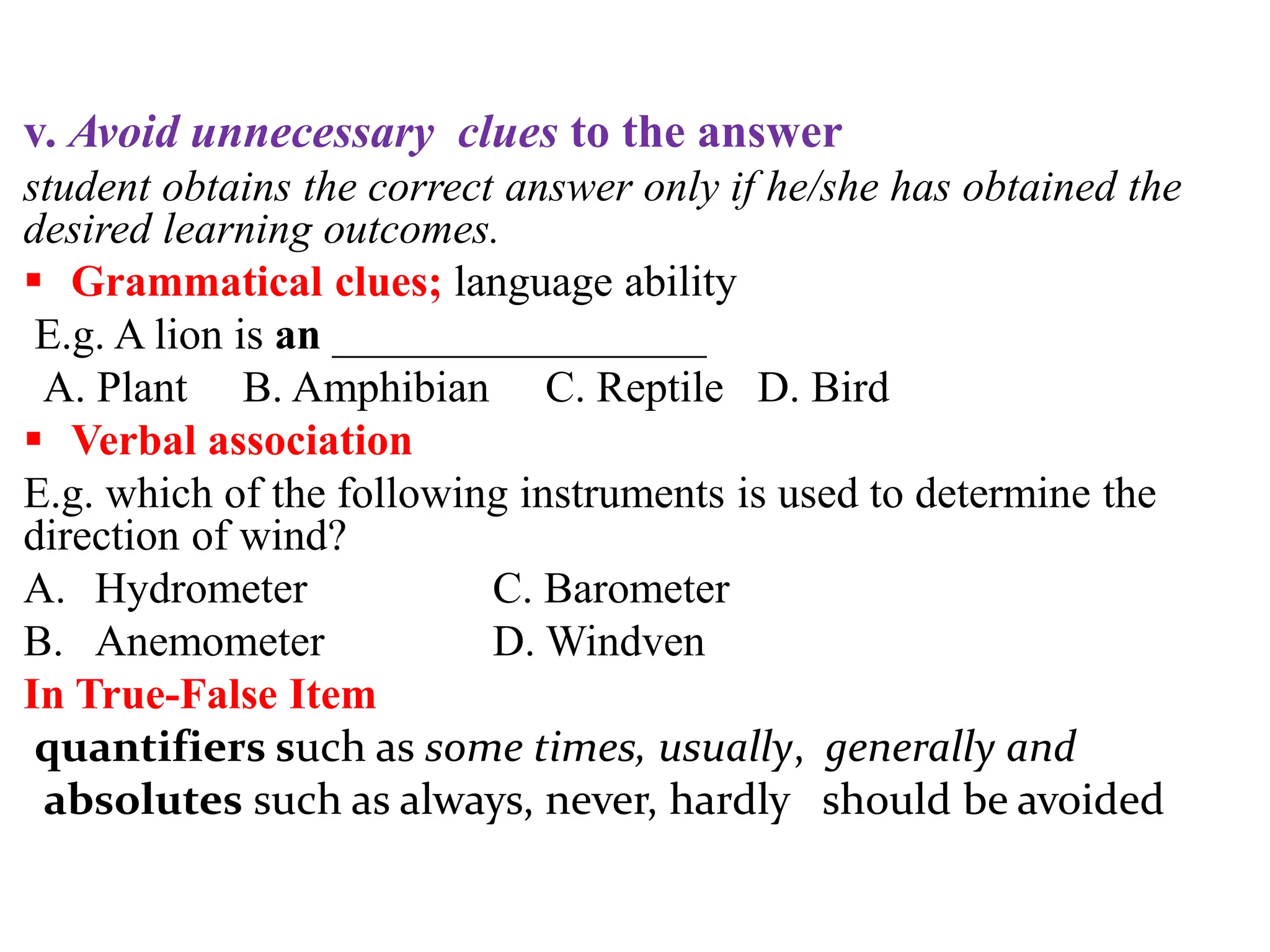
 Grammatical clues; language ability
E.g. A lion is an _________________
A. Plant B. Amphibian C. Reptile D. Bird
 Verbal association
E.g. which of the following instruments is used to determine the
direction of wind?
A. Hydrometer C. Barometer
B. Anemometer D. Windven
In True-False Item
quantifiers such as some times, usually, generally and
absolutes such as always, never, hardly should be avoided
• The length of the correct response
students may select the alternatives that contain a
longer or shorter length than others.
Pattern of the correct answer
identifiable way such as DCB, DCB and DCB,
TFTFTF ; TT FF TT
DCBA DCBA BB CC DD AA
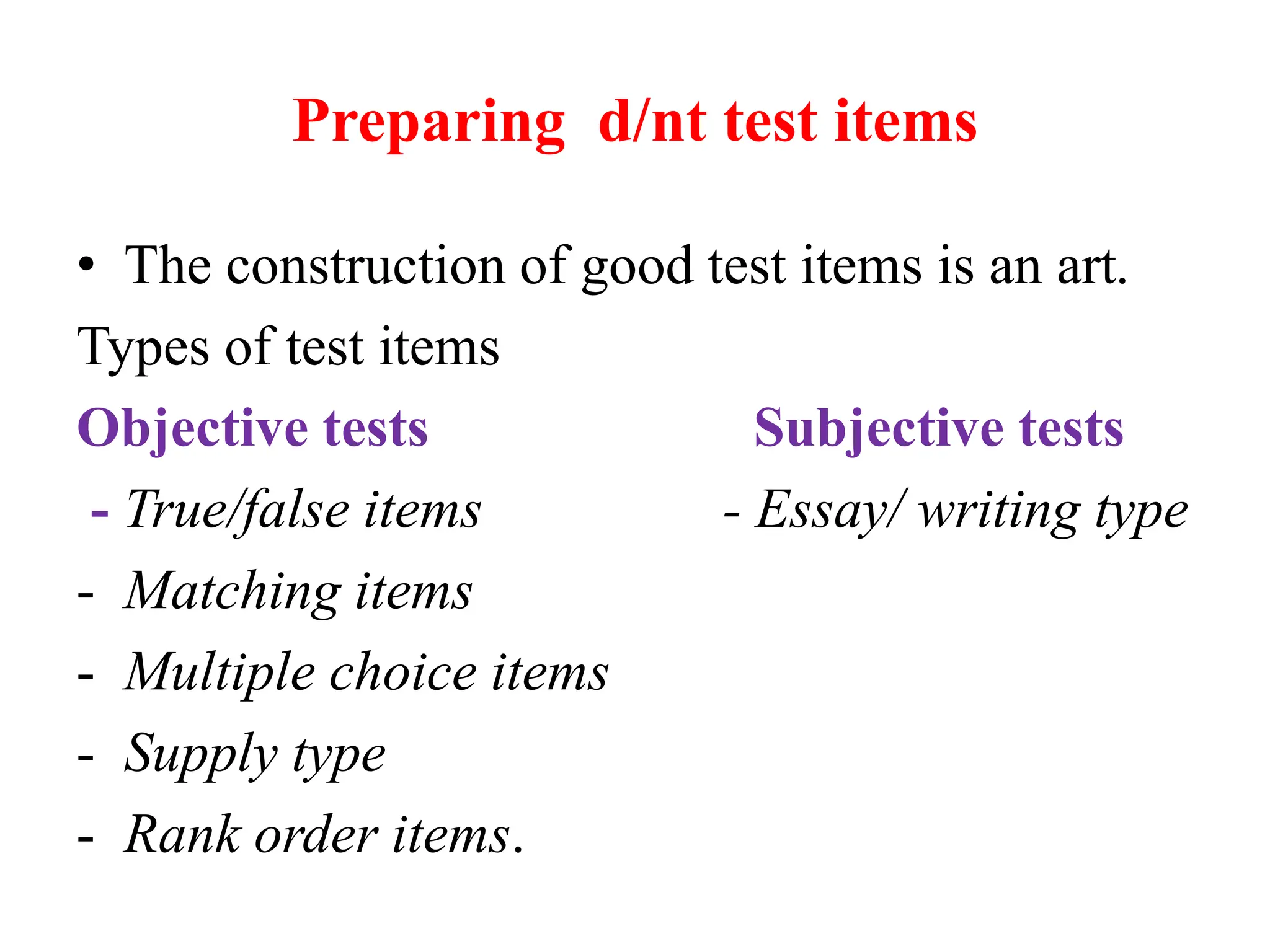
Preparing d/nt test items
• The construction of good test items is an art.
Types of test items
Objective tests Subjective tests
- True/false items - Essay/ writing type
- Matching items
- Multiple choice items
- Supply type
- Rank order items.
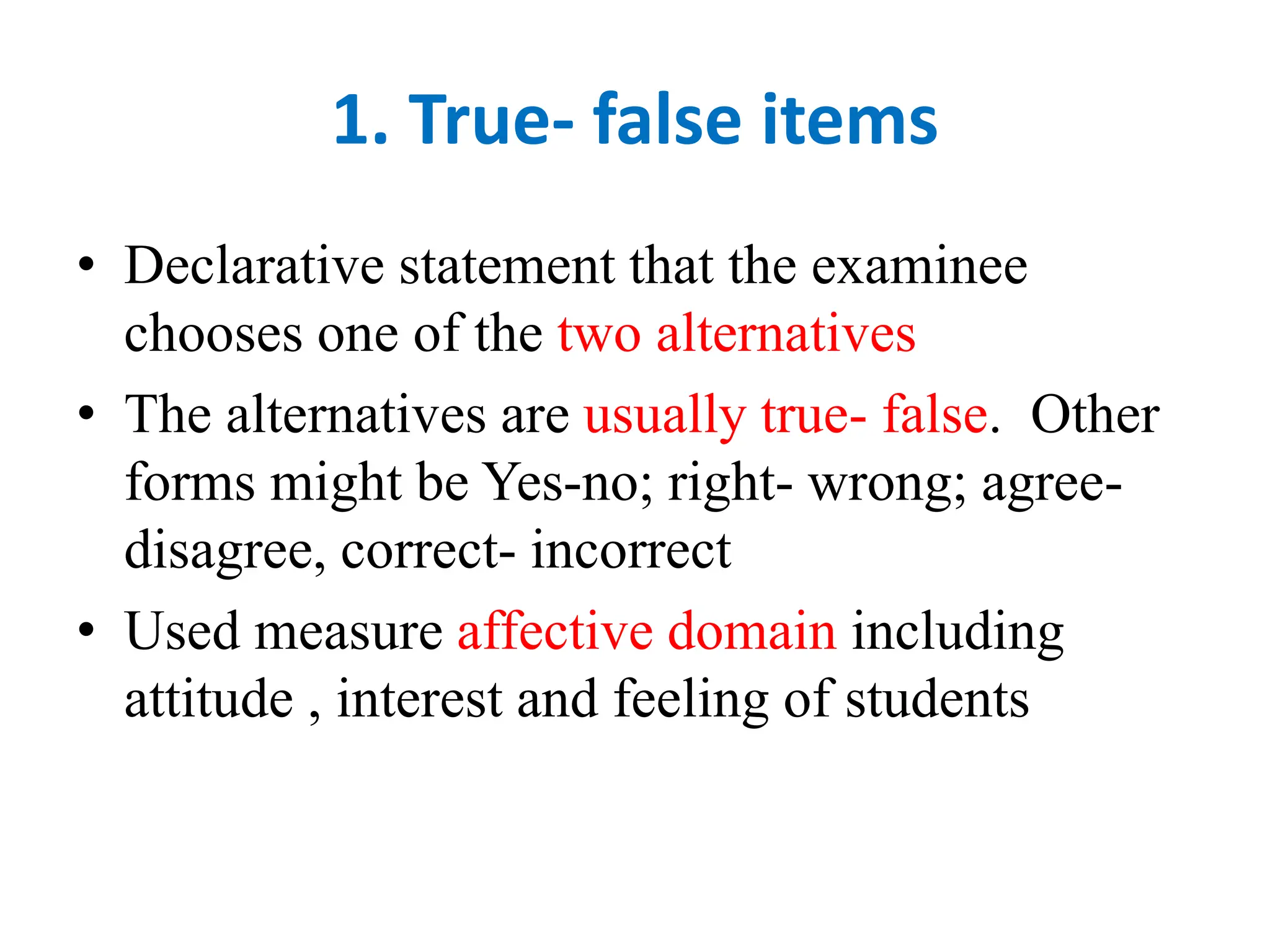
1. True- false items
• Declarative statement that the examinee
chooses one of the two alternatives
• The alternatives are usually true- false. Other
forms might be Yes-no; right- wrong; agree-
disagree, correct- incorrect
• Used measure affective domain including
attitude , interest and feeling of students
Suggestions for constructing
True/False items
Avoid using specific determiners such as always,
never, might, may, only, hardly, necessarily, all.
Poor: all of the lakes in Ethiopia are formed by
volcano
Good: the lakes in rift valley were formed by
volcano.
Construct statement which is absolutely true or false
Avoid the use of negative statements, and particularly
double negatives
Do not directly take statements out of text books
 Make the length of the statement consistent
Avoid including two ideas in one statement
When using opinion, the source should be
mentioned.
students should not be asked to write ‘T’s and ‘F’s
some other letters and words in place of True or
False.
Include approximately the same number of true and
false ones.
- The statement should not be all true or all
false (40_60%).
2. Matching Exercise
Suggestion for constructing good matching items
Keep the set of statements in a single matching
exercise homogeneous
The direction should clearly specify the basis for
matching stimuli and response.
Matching exercises should be completed on a
single page
Keep the number of premises and response
unequal
Keep statements in response column short & put
them in some logical order
• Longer words and phrases should be listed in
the left column and shorter words and phrases
should be listed in the right column.
Activity :- Choose content from your field of
study and construct matching exercise based on
suggestion given.
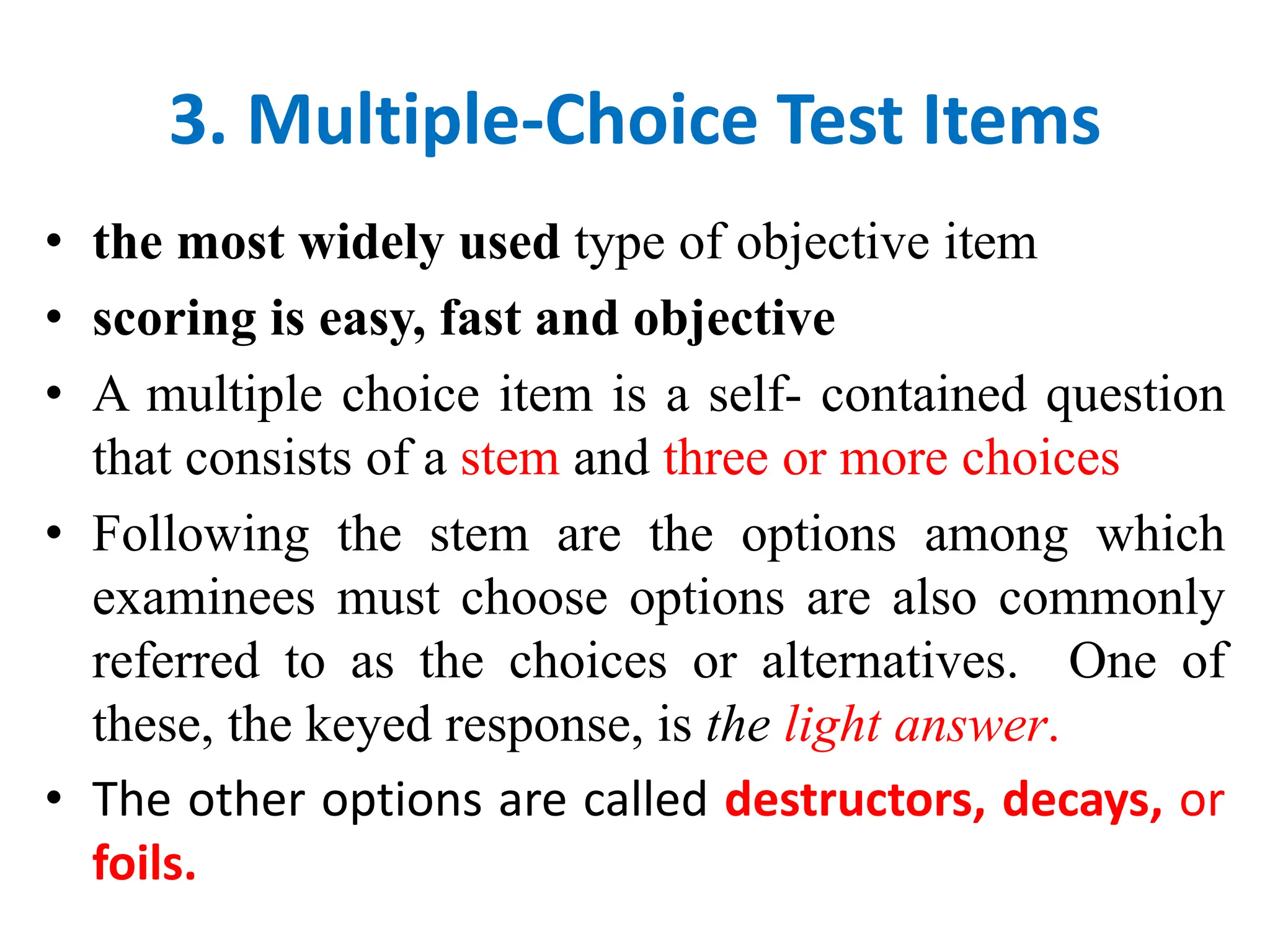
3. Multiple-Choice Test Items
• the most widely used type of objective item
• scoring is easy, fast and objective
• A multiple choice item is a self- contained question
that consists of a stem and three or more choices
• Following the stem are the options among which
examinees must choose options are also commonly
referred to as the choices or alternatives. One of
these, the keyed response, is the light answer.
• The other options are called destructors, decays, or
foils.
• The most common multiple- choice item
formats are correct answer and best answers
varieties
• The correct answer in which one option is
clearly right and the rest are absolutely wrong
• The best answer item instructs examinee to
select then one best answer to each question
• Measures sophisticated thinking skills
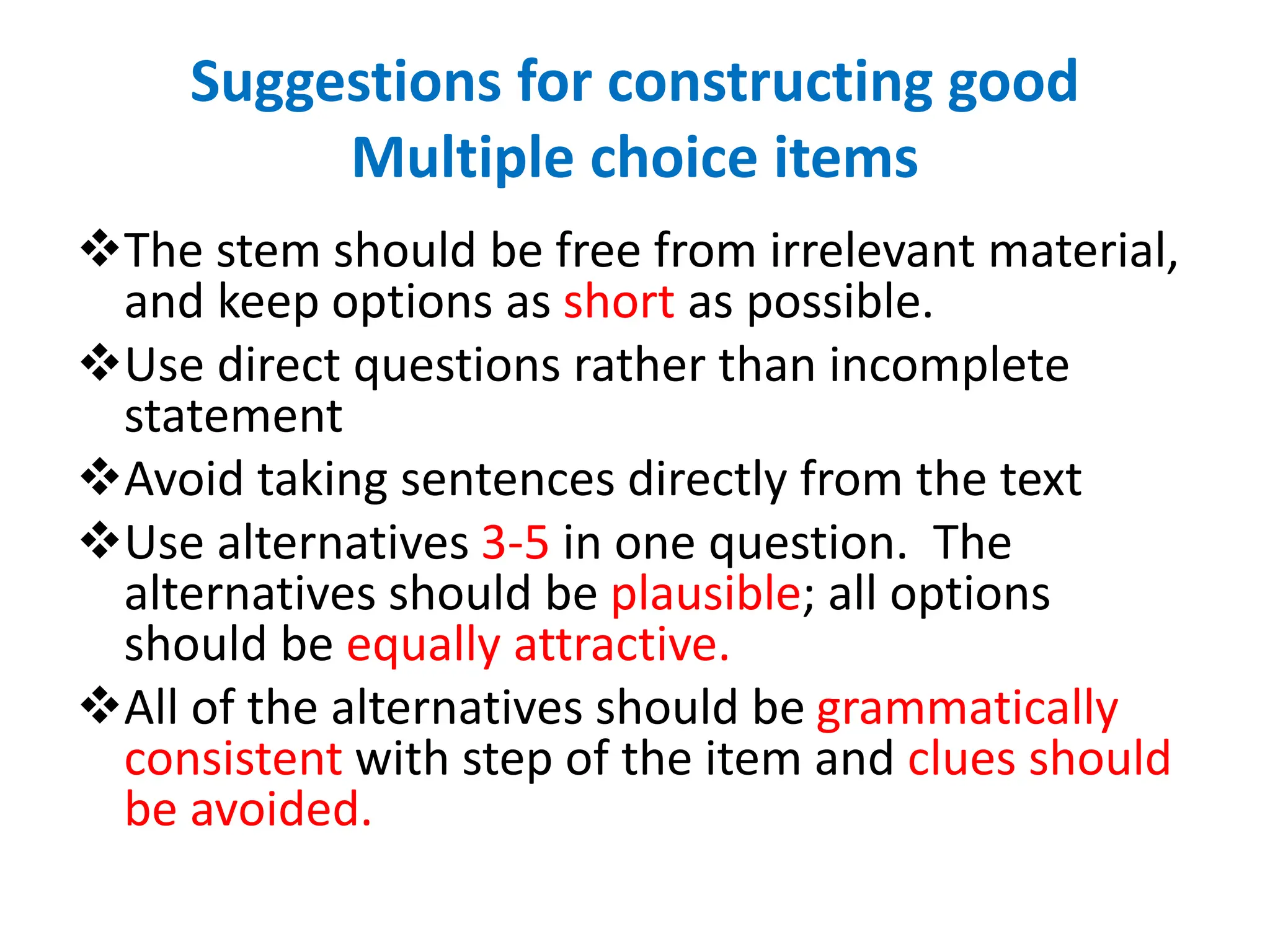
Suggestions for constructing good
Multiple choice items
The stem should be free from irrelevant material,
and keep options as short as possible.
Use direct questions rather than incomplete
statement
Avoid taking sentences directly from the text
Use alternatives 3-5 in one question. The
alternatives should be plausible; all options
should be equally attractive.
All of the alternatives should be grammatically
consistent with step of the item and clues should
be avoided.
 The correct answer should be of the same
length as options.
Use “None of the above” and “ all of the
above ” sparingly.
Activity
Choose content from your field of study and
construct 10 multiple choice items based on
suggestion given
4. Supply Items
• Supply items are generally of two types. These
are simple direct question and completion items
Suggestions for constructing supply items
Require short, definite and clear-cut answers
E.g. Shakespeare wrote a book entitled ______.
The blanks should be at or near the end of the
statement .
Do not use so many blanks.
E.g.
Poor ___ observed great diversity in ___in the ___
Good: who was given credit for the early
development of the theory?
Each blank in all items should be the same length
Avoid clues such as (a), (an)
E.g. Poor: when an animal eats plants, it is
said to be an ___
Better: When an animal eats plants, it is
said to be a/an _______
Do not take a statement directly from a text book
Words or phrases omitted should not be trivial
words or phrases.
E.g. Omo river ___to Turkana. poor
Omo river flows to ___lake. better
5. Essay test
• used to measure these learning out comes that
can not be measured by objective test items.
a. the ability to recall, organize, and integrate
ideas
b. the ability to express on self in writing.
c. the ability to identify interpretation and
application of data.
Essay questions are sub- divided into two major types.
i. Extended response: examinee is not restricted
E.g. Compare developments during the reign
of Hailesilassie & Derg?
ii. Restricted response: the student is more limited
in the form and scope of his answer
E.g. Describe rule that demonstrate the
application of the law of supply and demand in
about a half page. Do not use the examples used in
class.
Suggestions for Constructing Essay
Questions
• Give adequate time and thought to prepare essay
questions.
• Use words that give directions such as define,
list out line, describe, compare, illustrate,
classify, give, reasons, summarize etc.
• Do not start essay questions with words such as
“who”, “what” , “list
• Do not provide optional questions
• Adapt the length of response and the complexity
of the question to the maturity level of the
student.
Scoring of Essay test
• Use the scoring method that is appropriate.
There are two methods of scoring essay tests
A. Analytical Method: point scoring method in
which the teacher prepares model answer
before he/she starts scoring.
B. Global rating (holistic) method:- teacher
makes a single over all judgment of the quality
of the answer
Suggestions for scoring Essay test
• Prepare a scoring key or model answer and the
number of points given for each question
• Take care of irrelevant factors such as
legibility of handwriting , spelling errors,
sentence structures, punctuation and neatness
• Score the answers without looking at the
students’ name
• Be consistent in your scoring
• Write comments on the paper
• The mechanics of expression should be judged
separately from what the students writes.
Suggestions for administering a
classroom test
 Do not talk unnecessarily before the test.
 Keep interruptions minimum
 Avoid giving hints to pupils who ask about individual
item
 Discourage cheating
- special seating arrangements
- careful supervision
 Go to the cheater and warn him/her privately
Move around the examination room occasionally
Keep own eyes on every examine
Avoid any form of intimidations that can disturb
examinees
The End !!
Thank you!!!
HDP Assessment  (1).pptxmmmmmmmmmmmmmmmm

HDP Assessment (1).pptxmmmmmmmmmmmmmmmm

  • 1.
  • 2.
    Session Objectives At theend of this session, a candidate will be able to:- • Define concepts of assessment • differentiate between summative and formative assessment • state clearly the why, when, how and by whom of assessment • Evaluate students using a variety of assessment techniques
  • 3.
    Concepts of assessment A.Quiz:- unplanned type of assessment B. Test - planned set of questions to be answered by students. C. Measurement: - a procedure for assigning numbers (scores) to students performance. • Test is an instrument to collect information about students’ behaviors whereas measurement is the assignment of numerical value to the results of a test or other assessment techniques.
  • 4.
    D. Assessment :-is the process of obtaining information about students performance. All tests are assessments but all assessments are not tests. E. Evaluation:-the process of making a value judgment or decision about the worth of some one or something.
  • 5.
    Evaluation as thecomparison of what is measured against some defined criteria and to determine • whether it has been achieved, • whether it is appropriate, • whether it is good, • whether it is reasonable, • whether it is valid and so forth Evaluation= quantitative description + qualitative b/hr + value judgment
  • 6.
    Types of Assessment A.Placement Assessment:- concerned with the student’s entry behavior before the beginning of instruction. - teachers use a variety of instruments such as readiness tests, aptitude tests, pretests on course objectives - placing students in the proper position in the instructional sequence
  • 7.
    B. Diagnostic Evaluation Dealswith identifying underlying causes of learning problems in order to formulate a specific plan for remedial action C. Formative assessment used to provide ongoing feedback to the teacher and student regarding success and failure during instruction Conducted throughout the instruction Techniques:- oral questioning, observation, assignment, class and home works, quizzes
  • 8.
    D. Summative assessment -Conducted at the end of instruction - Used to determine how well students have attained the instructional objectives - to grade , certify students - to evaluate teacher effectiveness - Techniques:- projects, tests, mid and final examinations,
  • 9.
  • 10.
    Continuous assessment • Isan on-going, diagnostic, classroom based process that uses a variety of assessment tools to measure learner performance. • is carried out on an on-going basis while students are actually working their way through a course or major unit. • assess each stage of a course as soon after it has been completed as possible, or while the work is actually being carried out.
  • 11.
    Purposes of ContinuousAssessment • To assist student learning • To identify students strengths and weaknesses • To assess the effectiveness of a particular instructional strategy • To assess and improve the effectiveness of curriculum programs • To assess and improve teaching effectiveness • To provide data that assist in decision making • To communicate with and involve parents
  • 12.
    Techniques of ContinuousAssessment • On-going self assessment by students self-rating of the extent to which they have achieved specific learning outcomes • Tests:- a regular series of short tests , quizzes, short written papers based on objective • Assignments involve preparing and presenting seminar papers, carrying out mini-projects of various types, carrying out literature surveys
  • 13.
    • Accumulation ofportfolios building up collections of completed assignments, the collection of 'best work', the compilation of representative work, or individually designed profiles. • Peer Assessment; the assessment of the work of others of equal status and power • Group work; when individuals work collaboratively to produce a piece of work
  • 14.
    Making Feedback moreEffective should be - constructive, - encouraging, - honest, - supportive; - frequent - timely
  • 15.
    Test Construction Test constructionis not a haphazard activity. It requires careful planning. Appropriate planning involves careful consideration of large number of factors. • The first step in test construction is to determine the purpose of test. • the next step is that the teacher has to specify or outline the content of the course or unit that would be covered by the test. • Use table of specification or test blue print Is valid measure of the instructional objectives and course content.
  • 16.
    • Table ofspecification is a two- way chart that relates the two major components of educational objective: the content element and the behavior element. • provides greater assurance that the test will measure the instructional objectives and course content in a balanced manner • Proper weighing will make it possible to construct a test which measures a representative sample.
  • 17.
    Content (Topics) Instructional objectives 40% Knowledge 25% Comprehension15% Application 10% Analysis 5% Synthesis 5% Evaluation 100% Total Physical properties 2 16 10 6 4 2 40 Chemical properties 3 6 5 3 2 1 20 Preparation 1 8 5 3 2 1 20 Uses 1 8 5 3 2 1 20 Total no of items 7 38 25 15 10 5 100
  • 18.
    Contents Instructional Objectives Total Percent KnowledgeComprehension Application Analysis Synthesis Evaluation Air pressure 2 2 1 1 - - 6 24% Wind 1 1 1 1 - - 4 16% Temperature 2 2 1 1 - 1 7 28% Rainfall 1 2 1 - 1 - 5 20% Clouds 1 1 - 1 - - 3 12% Total 7 8 4 4 1 1 25 Percent 28% 32% 16% 16% 4% 4% 100%
  • 19.
    General considerations inpreparing relevant items for a classroom test:- i. Matching Items to intended Outcomes fitting each test item as possible as to the intended outcomes ii. Obtaining a Representative Sample To keep the balance or to construct representative test items and learning out comes we must use table of specification. iii. proper level of difficulty According to this principle all items in the test should not be so simple that all students give the answer; shouldn’t be so difficult that all students miss the answer.
  • 20.
    Iv. Eliminating IrrelevantBarriers to the Answer • Eliminate any extraneous factors that might prevent the pupil from responding. Such as - The sentence structure is very complex - The vocabulary too difficult - The type of response called for too vague. - Ambiguous statements - Unclear instructions
  • 21.
    v. Avoid unnecessaryclues to the answer student obtains the correct answer only if he/she has obtained the desired learning outcomes.  Grammatical clues; language ability E.g. A lion is an _________________ A. Plant B. Amphibian C. Reptile D. Bird  Verbal association E.g. which of the following instruments is used to determine the direction of wind? A. Hydrometer C. Barometer B. Anemometer D. Windven In True-False Item quantifiers such as some times, usually, generally and absolutes such as always, never, hardly should be avoided
  • 22.
    • The lengthof the correct response students may select the alternatives that contain a longer or shorter length than others. Pattern of the correct answer identifiable way such as DCB, DCB and DCB, TFTFTF ; TT FF TT DCBA DCBA BB CC DD AA
  • 23.
    Preparing d/nt testitems • The construction of good test items is an art. Types of test items Objective tests Subjective tests - True/false items - Essay/ writing type - Matching items - Multiple choice items - Supply type - Rank order items.
  • 24.
    1. True- falseitems • Declarative statement that the examinee chooses one of the two alternatives • The alternatives are usually true- false. Other forms might be Yes-no; right- wrong; agree- disagree, correct- incorrect • Used measure affective domain including attitude , interest and feeling of students
  • 25.
    Suggestions for constructing True/Falseitems Avoid using specific determiners such as always, never, might, may, only, hardly, necessarily, all. Poor: all of the lakes in Ethiopia are formed by volcano Good: the lakes in rift valley were formed by volcano. Construct statement which is absolutely true or false Avoid the use of negative statements, and particularly double negatives Do not directly take statements out of text books
  • 26.
     Make thelength of the statement consistent Avoid including two ideas in one statement When using opinion, the source should be mentioned. students should not be asked to write ‘T’s and ‘F’s some other letters and words in place of True or False. Include approximately the same number of true and false ones. - The statement should not be all true or all false (40_60%).
  • 27.
    2. Matching Exercise Suggestionfor constructing good matching items Keep the set of statements in a single matching exercise homogeneous The direction should clearly specify the basis for matching stimuli and response. Matching exercises should be completed on a single page Keep the number of premises and response unequal Keep statements in response column short & put them in some logical order
  • 28.
    • Longer wordsand phrases should be listed in the left column and shorter words and phrases should be listed in the right column. Activity :- Choose content from your field of study and construct matching exercise based on suggestion given.
  • 29.
    3. Multiple-Choice TestItems • the most widely used type of objective item • scoring is easy, fast and objective • A multiple choice item is a self- contained question that consists of a stem and three or more choices • Following the stem are the options among which examinees must choose options are also commonly referred to as the choices or alternatives. One of these, the keyed response, is the light answer. • The other options are called destructors, decays, or foils.
  • 30.
    • The mostcommon multiple- choice item formats are correct answer and best answers varieties • The correct answer in which one option is clearly right and the rest are absolutely wrong • The best answer item instructs examinee to select then one best answer to each question • Measures sophisticated thinking skills
  • 31.
    Suggestions for constructinggood Multiple choice items The stem should be free from irrelevant material, and keep options as short as possible. Use direct questions rather than incomplete statement Avoid taking sentences directly from the text Use alternatives 3-5 in one question. The alternatives should be plausible; all options should be equally attractive. All of the alternatives should be grammatically consistent with step of the item and clues should be avoided.
  • 32.
     The correctanswer should be of the same length as options. Use “None of the above” and “ all of the above ” sparingly. Activity Choose content from your field of study and construct 10 multiple choice items based on suggestion given
  • 33.
    4. Supply Items •Supply items are generally of two types. These are simple direct question and completion items Suggestions for constructing supply items Require short, definite and clear-cut answers E.g. Shakespeare wrote a book entitled ______. The blanks should be at or near the end of the statement . Do not use so many blanks. E.g. Poor ___ observed great diversity in ___in the ___ Good: who was given credit for the early development of the theory?
  • 34.
    Each blank inall items should be the same length Avoid clues such as (a), (an) E.g. Poor: when an animal eats plants, it is said to be an ___ Better: When an animal eats plants, it is said to be a/an _______ Do not take a statement directly from a text book Words or phrases omitted should not be trivial words or phrases. E.g. Omo river ___to Turkana. poor Omo river flows to ___lake. better
  • 35.
    5. Essay test •used to measure these learning out comes that can not be measured by objective test items. a. the ability to recall, organize, and integrate ideas b. the ability to express on self in writing. c. the ability to identify interpretation and application of data.
  • 36.
    Essay questions aresub- divided into two major types. i. Extended response: examinee is not restricted E.g. Compare developments during the reign of Hailesilassie & Derg? ii. Restricted response: the student is more limited in the form and scope of his answer E.g. Describe rule that demonstrate the application of the law of supply and demand in about a half page. Do not use the examples used in class.
  • 37.
    Suggestions for ConstructingEssay Questions • Give adequate time and thought to prepare essay questions. • Use words that give directions such as define, list out line, describe, compare, illustrate, classify, give, reasons, summarize etc. • Do not start essay questions with words such as “who”, “what” , “list • Do not provide optional questions • Adapt the length of response and the complexity of the question to the maturity level of the student.
  • 38.
    Scoring of Essaytest • Use the scoring method that is appropriate. There are two methods of scoring essay tests A. Analytical Method: point scoring method in which the teacher prepares model answer before he/she starts scoring. B. Global rating (holistic) method:- teacher makes a single over all judgment of the quality of the answer
  • 39.
    Suggestions for scoringEssay test • Prepare a scoring key or model answer and the number of points given for each question • Take care of irrelevant factors such as legibility of handwriting , spelling errors, sentence structures, punctuation and neatness • Score the answers without looking at the students’ name • Be consistent in your scoring • Write comments on the paper • The mechanics of expression should be judged separately from what the students writes.
  • 40.
    Suggestions for administeringa classroom test  Do not talk unnecessarily before the test.  Keep interruptions minimum  Avoid giving hints to pupils who ask about individual item  Discourage cheating - special seating arrangements - careful supervision  Go to the cheater and warn him/her privately Move around the examination room occasionally Keep own eyes on every examine Avoid any form of intimidations that can disturb examinees
  • 41.