TELETHERAPY DOSAGE DATA- II
KILOVOLTAGE RADIATION
OUTPUT VALUES
- Surface doses were limiting factor in treatment with
kilovoltage radiations
- The standard reference point for dosage statements is
at the centre of the field on the surface
- Surface output: The exposure rate (R) at any point in an
irradiated material is made up of two components –
- 1) Primary radiation( directly from the tube)
- 2) Scattered radiation ( from the irradiated material)
PRIMARY RADIATION
 The exposure rate of primary radiation depends
on
- The amount of radiation generated at the target of
the Xray tube
- The volume and type of material it has to pass
through to reach the surface
- The distance of the surface from the target
I - Tube current in milliamperes
E – Applied kilovoltage
Z – Target atomic number
SCATTERED RADIATION
 The exposure rate of the scattered radiation will
always be directly proportional to exposure rate of
the primary radiation
 Percentage scatter: The exposure rate of the
scattered radiation expressed as a percentage of
the primary exposure rate which is producing the
scatter
 For a point on the surface its called as
percentage back scatter
 Depends on the size and shape of the Xray field
and radiation quality
 BEAM DIMENSIONS:
- Percentage back scatter does not vary in direct
proportion with beam size ( The scattered radiation
generated in outer parts of an irradiated zone
suffers more attenuation in reaching the reference
point)
- Saturation value: Point where a further increase in
beam size produces practically no increase in the
scattered radiation reaching the centre.
- Beam shape – Percentage backscatter is same for
circle and square of the same area but lesser for
rectangle of the same area
RADIATION QUALITY
 The likelihood of radiation being scattered (
Scatter attenuation coefficient) decreases as
the energy of radiation increases
 The steady fall in the percentage backscatter is
expected at the higher quality end (Megavoltage
radiation) due to relative reduction in the amount
of scattered radiation
 At lower energies what is unexpected is the
marked falling off of scattered radiation
SCATTER VERSUS RADIATION
QUALITY
 It is not only the scatter caused by the primary
radiation but by any radiation that has to be
taken into account (for large and rectangular
beams)
 The greater amount of scattering of the lower
energy radiations is due to its much lower
penetrating power
 The magnitude of the total scattered radiation
depends on contributing volume and how much
radiation is scattered per volume at low energies
 At higher energies, the percentage backscatter
depends entirely on the amount of scatter
produced only and so it decreases steadily with
increasing energy
S.S.D
 Percentage backscatter is independent of S.S.D
except for very short values
SCATTER GENERATED BY A
BEAM-
COLLIMATION APPLICATOR
 Beam defining devices like diaphragms and
applicators may add scattered radiation to the
beam which will be a contributory factor in the
variation of tube output
 How the magnitude of scattered radiation varies
with beam size and shape can be determined
only by measurements
 With a well designed system the contribution of
scattered radiation will be small but will vary from
one equipment to another
 Output calibration measurements of one
equipment can seldom be applied to another
 The surface is not the ideal place for making
output calibration measurements
POSITION IN THE BEAM
 The reason for the falling off of scattered radiation
towards the beam edge is that this edge is further
away from much of the beam than is the centre ,
therefore scattered radiation reaching the edge has
generally suffered more attenuation
 The primary exposure rate is smaller at the edge
than at the centre of the field because of the inverse
square law. The magnitude of the effect depends on
beam size being much greater for larger beams
 There is considerable amount of scattered
radiation beyond the geometric edges of the
beam ( in the region receiving no primary
radiation)
Clinical implication: Organs and tissues outside
the
geometric beam may well be exposed to
amounts of
radiation that are not negligible
 While in the plane at right angles to the electron
stream the Xray emission is symmetrical on
either side of the central axis, but in the plane of
the stream more radiation emerges from the
target side of the central axis of the beam than
SUMMARY OF OUTPUT
 Primary exposure rate depends on
1) Tube current
2) Tube kilovoltage
3) S.S.D
4) Any added filter
5) Tube wall thickness and material
6) Target material
7) Voltage wave form
 Percentage backscatter depends on
1) Size of the beam
2) Shape of the beam
3) Quality of radiation
4) Design and detail of collimation
Depth dose data
 Percentage depth dose = Absorbed dose at the point x 100
Absorbed dose at the surface
 Absorbed dose rate at any point = Exposure rate at that point X
Exposure to absorbed dose conversion factor ( roentgen to rad)
 Percentage depth dose = Exposure rate at the point X 100
Output
Factors influencing percentage depth
dose values
1) Depth of that point below the surface
- The greater the depth the smaller the percentage
depth dose(D)
- Explained by inverse square law and increasing
attenuation suffered with increasing thickness
2) Beam dimensions
- Steady increase in D though not linear as area increases
- Smaller values of D for rectangular than square or circular
beams
3) Radiation quality
- Penetrating power of the radiation
- D increases with increasing half value layer
- Magnitude of increase affected by scattered radiation.
Therefore more pronounced for small beams
- Not very efficient to increase PDD values by increasing
filtration
So for greater PDD values, higher radiation energies are
needed
To achieve this radiotherapy turned from kilovoltage range
to
megavoltage range
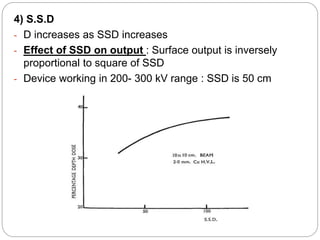
4) S.S.D
- D increases as SSD increases
- Effect of SSD on output : Surface output is inversely
proportional to square of SSD
- Device working in 200- 300 kV range : SSD is 50 cm
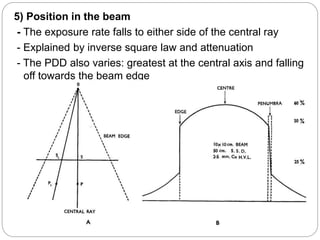
5) Position in the beam
- The exposure rate falls to either side of the central ray
- Explained by inverse square law and attenuation
- The PDD also varies: greatest at the central axis and falling
off towards the beam edge
ISODOSE CURVES
Definition :
 Lines joining the points of equal Percentage
Depth Dose (PDD).
 The curves are usually drawn at regular intervals
of absorbed dose
 Expressed as a percentage of the dose at a
reference point.
ISODOSE CHARTS :
 Contour maps of dosage distribution in and
around the beam
which consists of a family of isodose curves
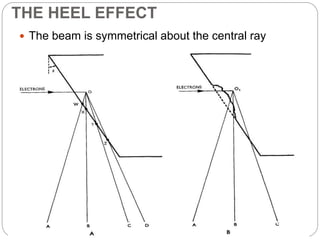
THE HEEL EFFECT
 The beam is symmetrical about the central ray
 Any falling off in output should prompt a
distribution check since it may result from ‘pitting’
which may upset the distribution resulting in
asymmetrical distribution
 Routine checks of radiation distribution should be
done periodically ‘ in air’ to ensure that
satisfactory conditions are maintained or to
detect any changes
MEGAVOLTAGE RADIATIONS
 > 1 MV
 Greater penetrating power
 Smaller scattering
 Scatter occurs in ‘forward’ direction
 Difference in ionization by the electrons
 Difference in spatial distribution between the
kilovoltage (primary electrons in all directions)
and megavoltage radiations( primary
electrons in forward direction)
 IONIZATION:
- The effect of X-radiation are produced by ionizations
and excitations produced in turn by electrons
liberated when photons interact with matter
- Kilovoltage radiations liberate electrons which
travel only a fraction of a millimetre in tissue ,
water, air . So the exposure at a point is a
direct measure of the absorbed dose at that point
- In Megavoltage radiations , electrons liberated
travel 1 mm to 8 cm before being brought to rest.
Because of the BRAGG
EFFECT the electrons produce most of their
ionization towards
the final end of their track. Here the absorbed dose
at any point
 Central axis depth dose values
- Most striking difference between kilovoltage and
megavoltage radiation is the pattern of their
respective absorbed dose variation with depth
- ‘The Build up’
 The total ionization at any place will be the
sum of all the effects shown and numbers
representing this are given at the foot of the
above diagram
 The build up is the same for all depths greater
than 4 mm
 In practice the ionization decreases beyond
the peak of the build-up because of the effects
of the inverse –square law and photon
attenuation
 The electrons ejected by megavoltage photons
travel predominantly ‘forward’ and there is an
increase of ionization along their tracks towards
the end of their range
 ‘Build up ‘ effect is counterbalanced by any
scattered radiation travelling in the opposite
direction( as its electrons are ejected towards the
surface), so this build up effect is not seen in kV
radiation
 In megavoltage radiation ‘build up’ occurs
because there is minimal scattered radiation
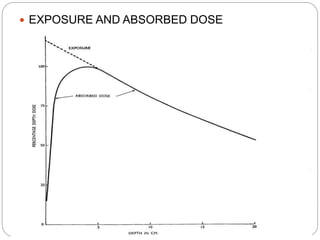
 EXPOSURE AND ABSORBED DOSE
• Exposure which is a function of the beam is
maximum at the surface and falls steadily with
depth because of the joint influence of the inverse
square law and beam attenuation
• Beyond the peak of the build up, Exposure and
absorbed dose vary in the same way
• At these depths exposure (roentgen) can be
directly converted into absorbed dose(Rad) as for
lower voltage radiations
 DOSAGE REFERENCE POINT
- Not on the phantom surface
- At a depth of the maximum of the depth dose
curve
OUTPUT
• Filtration effect is negligible in megavoltage
radiations unlike kilovoltage radiations
• Transmission type target is always used in
high energy tubes because Xrays are
mainly produced in the forward direction.
Therefore it undergoes inherent filtration
before emerging out of the tube
• Output is independent of field shape and
size because of minimal scattered radiation
PERCENTAGE DEPTH DOSE
VALUES
 Generating voltage
 S.S.D
 Beam size and shape
 Depth
 Position in the beam
 Isodose charts
Generating voltage
S.S.D
 Directly proportional like in Kv radiations but change
is greater
 The smaller the scatter , the greater the influence of
S.S.D on percentage depth doses
 Much greater S.S.D values are used for
megavoltage radiations
 For eg, with 4 M.V apparatus 100 cm S.S.D is used
BEAM SIZE AND SHAPE
 MV beams PDD is almost independent of beam size and
shape due to minimal scatter
DEPTH
 -Slower rate of decrease with depth
POSITION IN THE BEAM
 Beam flattening filter or compensator is
necessary in MV radiations to eliminate the
rapid variation of primary exposure rate
across the beam
 Compensators help in minimising the
exposure variation across megavoltage fields
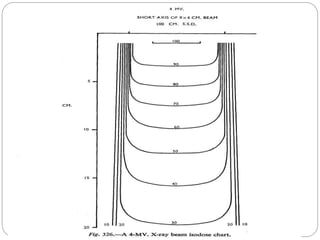
ISODOSE CHARTS
 Striking difference with kV radiation – Much
smaller limits of scattered radiation outside
the geometric limits of the beam AND
smaller changes in PDD across the beam at
any depth
 Flatter isodose curves are the result of the
beam flattening compensators whose
efficiency at considerable depths is due to the
reduced scatter for high energy radiation
THANK
YOU

Teletherapy dosage data ii

  • 1.
  • 2.
    KILOVOLTAGE RADIATION OUTPUT VALUES -Surface doses were limiting factor in treatment with kilovoltage radiations - The standard reference point for dosage statements is at the centre of the field on the surface - Surface output: The exposure rate (R) at any point in an irradiated material is made up of two components – - 1) Primary radiation( directly from the tube) - 2) Scattered radiation ( from the irradiated material)
  • 3.
    PRIMARY RADIATION  Theexposure rate of primary radiation depends on - The amount of radiation generated at the target of the Xray tube - The volume and type of material it has to pass through to reach the surface - The distance of the surface from the target I - Tube current in milliamperes E – Applied kilovoltage Z – Target atomic number
  • 4.
    SCATTERED RADIATION  Theexposure rate of the scattered radiation will always be directly proportional to exposure rate of the primary radiation  Percentage scatter: The exposure rate of the scattered radiation expressed as a percentage of the primary exposure rate which is producing the scatter  For a point on the surface its called as percentage back scatter  Depends on the size and shape of the Xray field and radiation quality
  • 6.
     BEAM DIMENSIONS: -Percentage back scatter does not vary in direct proportion with beam size ( The scattered radiation generated in outer parts of an irradiated zone suffers more attenuation in reaching the reference point) - Saturation value: Point where a further increase in beam size produces practically no increase in the scattered radiation reaching the centre. - Beam shape – Percentage backscatter is same for circle and square of the same area but lesser for rectangle of the same area
  • 9.
  • 10.
     The likelihoodof radiation being scattered ( Scatter attenuation coefficient) decreases as the energy of radiation increases  The steady fall in the percentage backscatter is expected at the higher quality end (Megavoltage radiation) due to relative reduction in the amount of scattered radiation  At lower energies what is unexpected is the marked falling off of scattered radiation
  • 11.
  • 12.
     It isnot only the scatter caused by the primary radiation but by any radiation that has to be taken into account (for large and rectangular beams)  The greater amount of scattering of the lower energy radiations is due to its much lower penetrating power  The magnitude of the total scattered radiation depends on contributing volume and how much radiation is scattered per volume at low energies  At higher energies, the percentage backscatter depends entirely on the amount of scatter produced only and so it decreases steadily with increasing energy
  • 13.
    S.S.D  Percentage backscatteris independent of S.S.D except for very short values
  • 14.
    SCATTER GENERATED BYA BEAM- COLLIMATION APPLICATOR
  • 15.
     Beam definingdevices like diaphragms and applicators may add scattered radiation to the beam which will be a contributory factor in the variation of tube output  How the magnitude of scattered radiation varies with beam size and shape can be determined only by measurements  With a well designed system the contribution of scattered radiation will be small but will vary from one equipment to another  Output calibration measurements of one equipment can seldom be applied to another  The surface is not the ideal place for making output calibration measurements
  • 16.
  • 17.
     The reasonfor the falling off of scattered radiation towards the beam edge is that this edge is further away from much of the beam than is the centre , therefore scattered radiation reaching the edge has generally suffered more attenuation  The primary exposure rate is smaller at the edge than at the centre of the field because of the inverse square law. The magnitude of the effect depends on beam size being much greater for larger beams
  • 18.
     There isconsiderable amount of scattered radiation beyond the geometric edges of the beam ( in the region receiving no primary radiation) Clinical implication: Organs and tissues outside the geometric beam may well be exposed to amounts of radiation that are not negligible  While in the plane at right angles to the electron stream the Xray emission is symmetrical on either side of the central axis, but in the plane of the stream more radiation emerges from the target side of the central axis of the beam than
  • 19.
    SUMMARY OF OUTPUT Primary exposure rate depends on 1) Tube current 2) Tube kilovoltage 3) S.S.D 4) Any added filter 5) Tube wall thickness and material 6) Target material 7) Voltage wave form
  • 20.
     Percentage backscatterdepends on 1) Size of the beam 2) Shape of the beam 3) Quality of radiation 4) Design and detail of collimation
  • 21.
    Depth dose data Percentage depth dose = Absorbed dose at the point x 100 Absorbed dose at the surface  Absorbed dose rate at any point = Exposure rate at that point X Exposure to absorbed dose conversion factor ( roentgen to rad)  Percentage depth dose = Exposure rate at the point X 100 Output
  • 22.
    Factors influencing percentagedepth dose values 1) Depth of that point below the surface - The greater the depth the smaller the percentage depth dose(D) - Explained by inverse square law and increasing attenuation suffered with increasing thickness
  • 23.
    2) Beam dimensions -Steady increase in D though not linear as area increases - Smaller values of D for rectangular than square or circular beams
  • 24.
    3) Radiation quality -Penetrating power of the radiation - D increases with increasing half value layer - Magnitude of increase affected by scattered radiation. Therefore more pronounced for small beams - Not very efficient to increase PDD values by increasing filtration So for greater PDD values, higher radiation energies are needed To achieve this radiotherapy turned from kilovoltage range to megavoltage range
  • 25.
    4) S.S.D - Dincreases as SSD increases - Effect of SSD on output : Surface output is inversely proportional to square of SSD - Device working in 200- 300 kV range : SSD is 50 cm
  • 28.
    5) Position inthe beam - The exposure rate falls to either side of the central ray - Explained by inverse square law and attenuation - The PDD also varies: greatest at the central axis and falling off towards the beam edge
  • 29.
    ISODOSE CURVES Definition : Lines joining the points of equal Percentage Depth Dose (PDD).  The curves are usually drawn at regular intervals of absorbed dose  Expressed as a percentage of the dose at a reference point. ISODOSE CHARTS :  Contour maps of dosage distribution in and around the beam which consists of a family of isodose curves
  • 32.
    THE HEEL EFFECT The beam is symmetrical about the central ray
  • 33.
     Any fallingoff in output should prompt a distribution check since it may result from ‘pitting’ which may upset the distribution resulting in asymmetrical distribution  Routine checks of radiation distribution should be done periodically ‘ in air’ to ensure that satisfactory conditions are maintained or to detect any changes
  • 34.
    MEGAVOLTAGE RADIATIONS  >1 MV  Greater penetrating power  Smaller scattering  Scatter occurs in ‘forward’ direction  Difference in ionization by the electrons  Difference in spatial distribution between the kilovoltage (primary electrons in all directions) and megavoltage radiations( primary electrons in forward direction)
  • 35.
     IONIZATION: - Theeffect of X-radiation are produced by ionizations and excitations produced in turn by electrons liberated when photons interact with matter - Kilovoltage radiations liberate electrons which travel only a fraction of a millimetre in tissue , water, air . So the exposure at a point is a direct measure of the absorbed dose at that point - In Megavoltage radiations , electrons liberated travel 1 mm to 8 cm before being brought to rest. Because of the BRAGG EFFECT the electrons produce most of their ionization towards the final end of their track. Here the absorbed dose at any point
  • 36.
     Central axisdepth dose values - Most striking difference between kilovoltage and megavoltage radiation is the pattern of their respective absorbed dose variation with depth - ‘The Build up’
  • 38.
     The totalionization at any place will be the sum of all the effects shown and numbers representing this are given at the foot of the above diagram  The build up is the same for all depths greater than 4 mm  In practice the ionization decreases beyond the peak of the build-up because of the effects of the inverse –square law and photon attenuation
  • 39.
     The electronsejected by megavoltage photons travel predominantly ‘forward’ and there is an increase of ionization along their tracks towards the end of their range  ‘Build up ‘ effect is counterbalanced by any scattered radiation travelling in the opposite direction( as its electrons are ejected towards the surface), so this build up effect is not seen in kV radiation  In megavoltage radiation ‘build up’ occurs because there is minimal scattered radiation
  • 40.
     EXPOSURE ANDABSORBED DOSE
  • 41.
    • Exposure whichis a function of the beam is maximum at the surface and falls steadily with depth because of the joint influence of the inverse square law and beam attenuation • Beyond the peak of the build up, Exposure and absorbed dose vary in the same way • At these depths exposure (roentgen) can be directly converted into absorbed dose(Rad) as for lower voltage radiations  DOSAGE REFERENCE POINT - Not on the phantom surface - At a depth of the maximum of the depth dose curve
  • 42.
    OUTPUT • Filtration effectis negligible in megavoltage radiations unlike kilovoltage radiations • Transmission type target is always used in high energy tubes because Xrays are mainly produced in the forward direction. Therefore it undergoes inherent filtration before emerging out of the tube • Output is independent of field shape and size because of minimal scattered radiation
  • 43.
    PERCENTAGE DEPTH DOSE VALUES Generating voltage  S.S.D  Beam size and shape  Depth  Position in the beam  Isodose charts
  • 44.
  • 45.
    S.S.D  Directly proportionallike in Kv radiations but change is greater  The smaller the scatter , the greater the influence of S.S.D on percentage depth doses  Much greater S.S.D values are used for megavoltage radiations  For eg, with 4 M.V apparatus 100 cm S.S.D is used BEAM SIZE AND SHAPE  MV beams PDD is almost independent of beam size and shape due to minimal scatter DEPTH  -Slower rate of decrease with depth
  • 46.
  • 47.
     Beam flatteningfilter or compensator is necessary in MV radiations to eliminate the rapid variation of primary exposure rate across the beam  Compensators help in minimising the exposure variation across megavoltage fields
  • 48.
    ISODOSE CHARTS  Strikingdifference with kV radiation – Much smaller limits of scattered radiation outside the geometric limits of the beam AND smaller changes in PDD across the beam at any depth  Flatter isodose curves are the result of the beam flattening compensators whose efficiency at considerable depths is due to the reduced scatter for high energy radiation
  • 50.