4D Radiotherapy Paul Keall Virginia Commonwealth University
Outline Medical rationale Basic science and technology State-of-the-art Future needs, directions and opportunities Advice …
Medical rationale What is the purpose of your research?
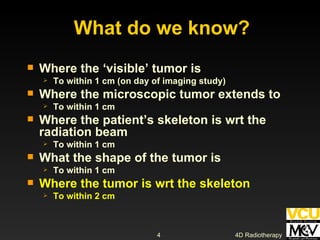
What do we know? Where the ‘visible’ tumor is To within 1 cm (on day of imaging study) Where the microscopic tumor extends to To within 1 cm Where the patient’s skeleton is wrt the radiation beam To within 1 cm What the shape of the tumor is To within 1 cm Where the tumor is wrt the skeleton To within 2 cm
What can we do about it? Reduce the uncertainties Improved/functional imaging Ongoing commitment to education Daily 2D/3D imaging Monte Carlo dose calculation/optimization Intrafraction motion Develop methods to account for residual uncertainties Incorporate uncertainties into planning process Probabilistic planning Online planning
Why 4D? Chemo-response GI motion Inter-observer  differences Tumor growth Tumor shrinkage Tumor spread Reoxygenation Repair Repopulation Redistribution Vascular growth Weight loss Cardiac motion Hormone response Diet Bladder filling Rectal filling Intra-observer differences Skeletal motion Respiratory motion Weight gain Respiratory motion
Respiratory motion affects: All tumor sites in the thorax and abdomen Lung cancer alone: 173 770 new cases in 2004 (ACS) 160 440 deaths (28% of cancer deaths) 15% five-year survival Evidence of tumor dose response 50%/30 month LPFS at 85 Gy (Martel  et al ) Strong evidence of lung dose response (many 100+ patient studies)
Problems of respiratory motion in radiotherapy
The tumor moves with time
Distorted images, incorrect anatomical positions, volumes or shapes   Conventional   With gated imaging Keall  et al  Aust Phys  Eng Sci Med 2002 Tumor
Treatment Planning: Large margins are added to the clinical target volume Increases normal tissue dose and limits target dose PTV CTV Conventional  With gating CTV PTV
IMRT Delivery: Interplay between anatomy and MLC leaf motion leads to motion artifacts Dose Position Planned dose Delivered   dose
Basic science and technology What is the underlying scientific/technological basis of your research?
“ The explicit inclusion of the temporal changes in anatomy during the imaging, planning and delivery of radiotherapy”  What is 4D radiotherapy? 4D Radiotherapy Panel ASTRO 2003
The 4D radiotherapy process 4D Radiotherapy 4D CT Imaging 4D Treatment Planning 4D Treatment Delivery Acquisition of a sequence of CT image sets over consecutive phases of a breathing cycle The explicit inclusion of the temporal changes in anatomy during the imaging, planning and delivery of radiotherapy Designing treatment plans on CT image sets obtained for each phase of the breathing cycle   Continuous delivery of the 4D treatment plans throughout the breathing cycle
4D Radiotherapy I: 4D CT Imaging
4D CT imaging
4D CT images Vedam  et al  PMB  2003 48:45-62 8 respiratory phases Peak inhale Early inhale Mid inhale End inhale Peak exhale Early exhale Mid exhale Late exhale
 
4D Radiotherapy II: 4D Planning
4D Planning Flow Chart Acquire 4D CT Define anatomy Create/adjust treatment plan Evaluate dose distribution 1 4 3 2 Proceed to treatment 6 … Plan acceptable? No Yes Deformable  registration … Automated planning … Deformable  registration 5
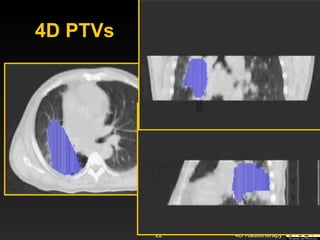
4D PTVs
BEVs 3D BEV 4D BEV
3D (solid) vs 4D (dashed) DVHs
4D Radiotherapy III: 4D Delivery
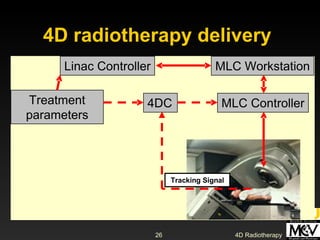
4D radiotherapy delivery
MLC leaf motion  3D    4D Keall  et al  PMB  2001 46:1-10
MLC leaf motion  3D IMRT   4D IMRT
Tracking motion perpendicular and parallel to the MLC
Finite response time- need motion prediction
Respiratory motion causes problems during the imaging, planning and treatment stages of radiotherapy Several methods have been proposed to address respiratory motion 4D radiotherapy has some advantages over existing methods There are still many unanswered questions … 4D radiotherapy summary
State-of-the-art How does your research fit into the overall scheme of medical research?
Respiratory motion solutions Breath-hold techniques (ABC/DIBH) Uncomfortable for patients, limited applicability (MSKCC:  7/13 patients) Increases treatment time (MSKCC:  17 to 33 minutes for conventional RT) Respiratory gating Residual motion within  gating window Increases treatment time Baseline shift 4D Radiotherapy Hardware/Software  complexity
Future needs, directions and opportunities What is currently limiting your research or what change in direction do you anticipate in the future?
Limitations Ethics/IRB Length of grant review cycles Industry support We need them unless resource and time unlimited Why isn’t my project the highest priority? Distractions
Directions Incorporate recent scientific and technical developments  Greater scope More general More scientifically rigorous Integrate with concurrent internal and external programs
Opportunities Many problems to solve Many different ways to solve problems
NCI Roadmap A focus on the following initiatives will move the work of NCI through the process of discovery, development, and delivery toward the goal of eliminating suffering and death from cancer by 2015 …
Advice
1999 $4500 VCU faculty grant-in-aid 2001 $20 000 ACS Inst. Research Grant 2002 $1.5 million NCI grant 2003 $400 000 industrial grant 2003 Co-I $1 million NCI grant 2004 Consultant $1 million NCI grant 2004 Co-I STTR … How did you get started?
Why get a grant? Promotion Tenure Independence Invitations Staff Resources Travel Intangibles
What advice can you give? Write early Write often Work hard Work smart Think broadly Good luck
And get a great team! Ted Chung  Rohini George Sarang Joshi Vijay Kini Radhe Mohan Jeffrey Siebers Sastry Vedam Krishni  Wijesooriya Jeffrey Williamson ACS NIH MDACC MGH Philips Medical Systems Standard Imaging UNC Varian Medical Systems
Another great team!

4D Radiotherapy

  • 1.
    4D Radiotherapy PaulKeall Virginia Commonwealth University
  • 2.
    Outline Medical rationaleBasic science and technology State-of-the-art Future needs, directions and opportunities Advice …
  • 3.
    Medical rationale Whatis the purpose of your research?
  • 4.
    What do weknow? Where the ‘visible’ tumor is To within 1 cm (on day of imaging study) Where the microscopic tumor extends to To within 1 cm Where the patient’s skeleton is wrt the radiation beam To within 1 cm What the shape of the tumor is To within 1 cm Where the tumor is wrt the skeleton To within 2 cm
  • 5.
    What can wedo about it? Reduce the uncertainties Improved/functional imaging Ongoing commitment to education Daily 2D/3D imaging Monte Carlo dose calculation/optimization Intrafraction motion Develop methods to account for residual uncertainties Incorporate uncertainties into planning process Probabilistic planning Online planning
  • 6.
    Why 4D? Chemo-responseGI motion Inter-observer differences Tumor growth Tumor shrinkage Tumor spread Reoxygenation Repair Repopulation Redistribution Vascular growth Weight loss Cardiac motion Hormone response Diet Bladder filling Rectal filling Intra-observer differences Skeletal motion Respiratory motion Weight gain Respiratory motion
  • 7.
    Respiratory motion affects:All tumor sites in the thorax and abdomen Lung cancer alone: 173 770 new cases in 2004 (ACS) 160 440 deaths (28% of cancer deaths) 15% five-year survival Evidence of tumor dose response 50%/30 month LPFS at 85 Gy (Martel et al ) Strong evidence of lung dose response (many 100+ patient studies)
  • 8.
    Problems of respiratorymotion in radiotherapy
  • 9.
    The tumor moveswith time
  • 10.
    Distorted images, incorrectanatomical positions, volumes or shapes Conventional With gated imaging Keall et al Aust Phys Eng Sci Med 2002 Tumor
  • 11.
    Treatment Planning: Largemargins are added to the clinical target volume Increases normal tissue dose and limits target dose PTV CTV Conventional With gating CTV PTV
  • 12.
    IMRT Delivery: Interplaybetween anatomy and MLC leaf motion leads to motion artifacts Dose Position Planned dose Delivered dose
  • 13.
    Basic science andtechnology What is the underlying scientific/technological basis of your research?
  • 14.
    “ The explicitinclusion of the temporal changes in anatomy during the imaging, planning and delivery of radiotherapy” What is 4D radiotherapy? 4D Radiotherapy Panel ASTRO 2003
  • 15.
    The 4D radiotherapyprocess 4D Radiotherapy 4D CT Imaging 4D Treatment Planning 4D Treatment Delivery Acquisition of a sequence of CT image sets over consecutive phases of a breathing cycle The explicit inclusion of the temporal changes in anatomy during the imaging, planning and delivery of radiotherapy Designing treatment plans on CT image sets obtained for each phase of the breathing cycle Continuous delivery of the 4D treatment plans throughout the breathing cycle
  • 16.
    4D Radiotherapy I:4D CT Imaging
  • 17.
  • 18.
    4D CT imagesVedam et al PMB 2003 48:45-62 8 respiratory phases Peak inhale Early inhale Mid inhale End inhale Peak exhale Early exhale Mid exhale Late exhale
  • 19.
  • 20.
  • 21.
    4D Planning FlowChart Acquire 4D CT Define anatomy Create/adjust treatment plan Evaluate dose distribution 1 4 3 2 Proceed to treatment 6 … Plan acceptable? No Yes Deformable registration … Automated planning … Deformable registration 5
  • 22.
  • 23.
  • 24.
    3D (solid) vs4D (dashed) DVHs
  • 25.
  • 26.
  • 27.
    MLC leaf motion 3D 4D Keall et al PMB 2001 46:1-10
  • 28.
    MLC leaf motion 3D IMRT 4D IMRT
  • 29.
    Tracking motion perpendicularand parallel to the MLC
  • 30.
    Finite response time-need motion prediction
  • 31.
    Respiratory motion causesproblems during the imaging, planning and treatment stages of radiotherapy Several methods have been proposed to address respiratory motion 4D radiotherapy has some advantages over existing methods There are still many unanswered questions … 4D radiotherapy summary
  • 32.
    State-of-the-art How doesyour research fit into the overall scheme of medical research?
  • 33.
    Respiratory motion solutionsBreath-hold techniques (ABC/DIBH) Uncomfortable for patients, limited applicability (MSKCC: 7/13 patients) Increases treatment time (MSKCC: 17 to 33 minutes for conventional RT) Respiratory gating Residual motion within gating window Increases treatment time Baseline shift 4D Radiotherapy Hardware/Software complexity
  • 34.
    Future needs, directionsand opportunities What is currently limiting your research or what change in direction do you anticipate in the future?
  • 35.
    Limitations Ethics/IRB Lengthof grant review cycles Industry support We need them unless resource and time unlimited Why isn’t my project the highest priority? Distractions
  • 36.
    Directions Incorporate recentscientific and technical developments Greater scope More general More scientifically rigorous Integrate with concurrent internal and external programs
  • 37.
    Opportunities Many problemsto solve Many different ways to solve problems
  • 38.
    NCI Roadmap Afocus on the following initiatives will move the work of NCI through the process of discovery, development, and delivery toward the goal of eliminating suffering and death from cancer by 2015 …
  • 39.
  • 40.
    1999 $4500 VCUfaculty grant-in-aid 2001 $20 000 ACS Inst. Research Grant 2002 $1.5 million NCI grant 2003 $400 000 industrial grant 2003 Co-I $1 million NCI grant 2004 Consultant $1 million NCI grant 2004 Co-I STTR … How did you get started?
  • 41.
    Why get agrant? Promotion Tenure Independence Invitations Staff Resources Travel Intangibles
  • 42.
    What advice canyou give? Write early Write often Work hard Work smart Think broadly Good luck
  • 43.
    And get agreat team! Ted Chung Rohini George Sarang Joshi Vijay Kini Radhe Mohan Jeffrey Siebers Sastry Vedam Krishni Wijesooriya Jeffrey Williamson ACS NIH MDACC MGH Philips Medical Systems Standard Imaging UNC Varian Medical Systems
  • 44.