Radiographic
Photography
Dr Hussein Ahmed Hassan
Invisible X-ray image
1.
2.

Formation
Characteristics
X-ray tube

Plot of incident x-ray
beam intensity

Object
Invisible x-ray
image

Plot of transmitted x-ray
beam intensity
Invisible x-ray image
kV mA Sec FFD
E

B
B1

EM

E B1

Supporting tissue (m)
B2

E B2

T2

T1

ET1

EM

T3

Air
Invisible
X-ray
image
consists
of
different xray
intensities

ET2
ET3

EA
Characteristics





Subject contrast
Sharpness
Noise
Resolution
Subject contrast




The difference in the x-ray intensities
transmitted through the subject
It is the shortened form of the radiation
contrast of the subject

Causes of subject contrast
Differential attenuation
 Scattered radiation

Differential attenuation




Differential attenuation is the result of the
attenuation caused by Photoelectric
absorption and Compton scattering.
Depends on
 Thickness of the anatomical structure
 Effective atomic number of the body tissues
 Physical density of the body tissues
 Presence of radiological contrast medium
 X-ray tube kilovoltage employed
 X-ray beam filtration
Effective atomic number & Subject
contrast




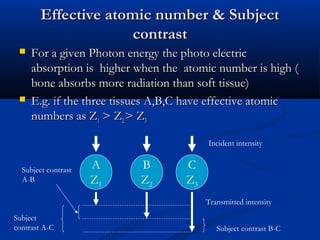
For a given Photon energy the photo electric
absorption is higher when the atomic number is high (
bone absorbs more radiation than soft tissue)
E.g. if the three tissues A,B,C have effective atomic
numbers as Z1 > Z2 > Z3
Incident intensity

Subject contrast
A-B

A
Z1

B
Z2

C
Z3
Transmitted intensity

Subject
contrast A-C

Subject contrast B-C
X-ray tube kilovoltage & subject
contrast





Photo electric absorption predominates at low
kilovoltages, therefore at low kilovoltages the
subject contrast is high, and when the
kilovoltage is increased the subject contrast tend
to be reduced.
At high kilovoltages approaching 150kV the
contrast is mainly caused by the compton effect
which mainly depends on the density difference
of the anatomical structures.
kV & subject contrast
Low kV
E
Supporting tissue (m)

B
B1

EM

B2

E B1

E B2

T2

T1

ET1

EM

T3

Air

Higher
differen
ces

ET2
ET3

EA
kV & subject contrast
High kV
E

B
B1

EM

E B1

Supporting tissue (m)
B2

E B2

T1

ET1 EM

T2

T3

Air
Lower
differen
ces

ET2

ET3

EA
X-ray beam filtration & Subject
contrast




Filtration reduces the low energy components of
the x-ray beam. Hence increasing the filtration
has the effect of increasing the effective photon
energy of the beam. This influences the
photoelectric absorption in a similar way as
increasing the tube kilovoltage.
Therefore increasing the filtration will decrease
the subject contrast
Scattered radiation & subject
contrast

Scattered
radiation

Primary beam
Scattered radiation & subject
contrast






When the primary beam from x-ray tube
interacts with matter scattered radiation is
produced.
Scattered radiation travels in different paths
from the primary beam and will reduce the
subject contrast of the invisible x-ray image.
Not only the subject contrast but it will reduce
the signal to noise ratio also.
Scatter reduces the subject contrast
E

B
B1

EM

E B1

Supporting tissue (m)
B2

E B2

T1

ET1 EM

T2

ET2

T3

ET3

Air
Scatter
Lowers
the
differen
ces
EA
How to minimize the effect of scatter
on subject contrast?


Reduce the amount of scatter produced at the object
(patient) by:
Collimating the primary beam
 Reducing the proportion of forward scatter using low kV
 Reducing the tissue thickness
 Avoiding other sources of scatter, such as bucky tray




Protecting the image receptor by
Use of secondary radiation grid
 Employing an air gap

Use of grid

Lead strips
Radiolucent inter-space

Image receptor
Employing Air gap
Image plane 1
Object

Image plane 2

atter
Sc

Air gap
Percentage of oblique ray reaching the image
receptor plane is reduced at image plane 2
Sharpness of Invisible x-ray image




The sharpness is determined first by the
geometry of image formation
The size of the source of radiation is of primary
concerned
Infinite size (Point source)
 Finite size ( larger than a point)




When the size of the x-ray source (Focus) is
large the sharpness of the image is less
Image Geometry
Point source

Image plane

Finite source

Unsharpness (penumbra)
Distance across image plane

mt a s yar- x f o yti s net nI
i

t a s yar- x f o yti s net nI

Intensity distribution at previous
situations

U

U

Distance across image plane
Geometric unsharpness




The formation of unsharpness due to a penumbra
is a direct consequence of the finite size of the xray source.
This form of unsharpness is known as Geometric
unsharpness (UG)

It can be shown that
focal spot size x object-image distance
Geometric = ------------------------------------------Unsharpness
focus-object distance

Evaluation of Geometric
unsharpness
Source

A

B

Triangles OAB & OCD are similar.
AB/CD = OB/OC
Re-arranging
Object

CD = AB x OC/OB

O

UG = focal size x OFD/FOB
Image plane

C

D
Factors governing geometric
unsharpness


Focal spot size




Object image (film) distance




Small focus gives minimum geometric unsharpness
Shorter OFD gives less geometric unsharpness

Focus to object ( Focal film) distance
Longer the FFD lesser the geometric unsharpness
 Increase the FFD when OFD cannot be reduced, to
minimize the geometric unsharpness




Edge penetration
Focal spot size & Geometric
unsharpness





Unsharpness increases, when apparent focal area
increases
Apparent (effective) focal area = Actual focal
area x Sine of target angle
Therefore Unsharpness increases when target
angle increases for a given actual focal spot size
Geometric Unsharpness can be reduced by
using small focus but that reduces the maximum
tube loading capacity
Apparent (effective) focal area = Actual focal area x
Sine of target angle





This is due to the shape
of the object
The edges of the object
absorb less amount of
radiation and the
absorption increases
towards the centre
This creates a intensity
gradient producing
inherent unsharpness

f o yti s net nI

Unsharpness due to Edge
penetration

Distance across image plane
Movement unsharpness






Voluntary & involuntary movement of the
organs or body parts or the patient as a whole
will cause changes in the pattern of x-ray
intensities forming the invisible x-ray image
This changes are referred to as movement
unshrpness : UM
If they occur during image recording they will
produce unsharpness in the final image
Noise in the invisible x-ray image




The kinds of noise present in the invisible x-ray
image are
Fog due to scatter radiation
Quantum noise – presence of less number of
photons in the invisible x-ray image, making the
identification of gaps between individual
photons and finally making the recorded image
looks grainy.


Quantum noise can be avoided by using adequate
exposure factors producing high enough x-ray
intensity
Resolution of invisible x-ray image


The resolution depends on
contrast,
 sharpness and
 noise.




We must try to obtain maximum resolution at
this stage because the resolution becomes less
and less in the next stages of image production
Conclusion






It is important to know the details of production
and characteristics of the invisible x-ray image
because;
If the invisible x-ray image is of poor quality, it
is extremely difficult to produce an adequate
standard of final visible image.
It is during the production of the invisible x-ray
image that the radiographer has the greatest
scope for control of image quality, particularly in
conventional radiography.

Invisible x ray-image

  • 1.
  • 2.
  • 3.
    X-ray tube Plot ofincident x-ray beam intensity Object Invisible x-ray image Plot of transmitted x-ray beam intensity
  • 4.
    Invisible x-ray image kVmA Sec FFD E B B1 EM E B1 Supporting tissue (m) B2 E B2 T2 T1 ET1 EM T3 Air Invisible X-ray image consists of different xray intensities ET2 ET3 EA
  • 5.
  • 6.
    Subject contrast   The differencein the x-ray intensities transmitted through the subject It is the shortened form of the radiation contrast of the subject Causes of subject contrast Differential attenuation  Scattered radiation 
  • 7.
    Differential attenuation   Differential attenuationis the result of the attenuation caused by Photoelectric absorption and Compton scattering. Depends on  Thickness of the anatomical structure  Effective atomic number of the body tissues  Physical density of the body tissues  Presence of radiological contrast medium  X-ray tube kilovoltage employed  X-ray beam filtration
  • 8.
    Effective atomic number& Subject contrast   For a given Photon energy the photo electric absorption is higher when the atomic number is high ( bone absorbs more radiation than soft tissue) E.g. if the three tissues A,B,C have effective atomic numbers as Z1 > Z2 > Z3 Incident intensity Subject contrast A-B A Z1 B Z2 C Z3 Transmitted intensity Subject contrast A-C Subject contrast B-C
  • 9.
    X-ray tube kilovoltage& subject contrast   Photo electric absorption predominates at low kilovoltages, therefore at low kilovoltages the subject contrast is high, and when the kilovoltage is increased the subject contrast tend to be reduced. At high kilovoltages approaching 150kV the contrast is mainly caused by the compton effect which mainly depends on the density difference of the anatomical structures.
  • 10.
    kV & subjectcontrast Low kV E Supporting tissue (m) B B1 EM B2 E B1 E B2 T2 T1 ET1 EM T3 Air Higher differen ces ET2 ET3 EA
  • 11.
    kV & subjectcontrast High kV E B B1 EM E B1 Supporting tissue (m) B2 E B2 T1 ET1 EM T2 T3 Air Lower differen ces ET2 ET3 EA
  • 12.
    X-ray beam filtration& Subject contrast   Filtration reduces the low energy components of the x-ray beam. Hence increasing the filtration has the effect of increasing the effective photon energy of the beam. This influences the photoelectric absorption in a similar way as increasing the tube kilovoltage. Therefore increasing the filtration will decrease the subject contrast
  • 13.
    Scattered radiation &subject contrast Scattered radiation Primary beam
  • 14.
    Scattered radiation &subject contrast    When the primary beam from x-ray tube interacts with matter scattered radiation is produced. Scattered radiation travels in different paths from the primary beam and will reduce the subject contrast of the invisible x-ray image. Not only the subject contrast but it will reduce the signal to noise ratio also.
  • 15.
    Scatter reduces thesubject contrast E B B1 EM E B1 Supporting tissue (m) B2 E B2 T1 ET1 EM T2 ET2 T3 ET3 Air Scatter Lowers the differen ces EA
  • 16.
    How to minimizethe effect of scatter on subject contrast?  Reduce the amount of scatter produced at the object (patient) by: Collimating the primary beam  Reducing the proportion of forward scatter using low kV  Reducing the tissue thickness  Avoiding other sources of scatter, such as bucky tray   Protecting the image receptor by Use of secondary radiation grid  Employing an air gap 
  • 17.
    Use of grid Leadstrips Radiolucent inter-space Image receptor
  • 18.
    Employing Air gap Imageplane 1 Object Image plane 2 atter Sc Air gap Percentage of oblique ray reaching the image receptor plane is reduced at image plane 2
  • 19.
    Sharpness of Invisiblex-ray image   The sharpness is determined first by the geometry of image formation The size of the source of radiation is of primary concerned Infinite size (Point source)  Finite size ( larger than a point)   When the size of the x-ray source (Focus) is large the sharpness of the image is less
  • 20.
    Image Geometry Point source Imageplane Finite source Unsharpness (penumbra)
  • 21.
    Distance across imageplane mt a s yar- x f o yti s net nI i t a s yar- x f o yti s net nI Intensity distribution at previous situations U U Distance across image plane
  • 22.
    Geometric unsharpness   The formationof unsharpness due to a penumbra is a direct consequence of the finite size of the xray source. This form of unsharpness is known as Geometric unsharpness (UG) It can be shown that focal spot size x object-image distance Geometric = ------------------------------------------Unsharpness focus-object distance 
  • 23.
    Evaluation of Geometric unsharpness Source A B TrianglesOAB & OCD are similar. AB/CD = OB/OC Re-arranging Object CD = AB x OC/OB O UG = focal size x OFD/FOB Image plane C D
  • 24.
    Factors governing geometric unsharpness  Focalspot size   Object image (film) distance   Small focus gives minimum geometric unsharpness Shorter OFD gives less geometric unsharpness Focus to object ( Focal film) distance Longer the FFD lesser the geometric unsharpness  Increase the FFD when OFD cannot be reduced, to minimize the geometric unsharpness   Edge penetration
  • 25.
    Focal spot size& Geometric unsharpness     Unsharpness increases, when apparent focal area increases Apparent (effective) focal area = Actual focal area x Sine of target angle Therefore Unsharpness increases when target angle increases for a given actual focal spot size Geometric Unsharpness can be reduced by using small focus but that reduces the maximum tube loading capacity
  • 26.
    Apparent (effective) focalarea = Actual focal area x Sine of target angle
  • 27.
       This is dueto the shape of the object The edges of the object absorb less amount of radiation and the absorption increases towards the centre This creates a intensity gradient producing inherent unsharpness f o yti s net nI Unsharpness due to Edge penetration Distance across image plane
  • 28.
    Movement unsharpness    Voluntary &involuntary movement of the organs or body parts or the patient as a whole will cause changes in the pattern of x-ray intensities forming the invisible x-ray image This changes are referred to as movement unshrpness : UM If they occur during image recording they will produce unsharpness in the final image
  • 29.
    Noise in theinvisible x-ray image    The kinds of noise present in the invisible x-ray image are Fog due to scatter radiation Quantum noise – presence of less number of photons in the invisible x-ray image, making the identification of gaps between individual photons and finally making the recorded image looks grainy.  Quantum noise can be avoided by using adequate exposure factors producing high enough x-ray intensity
  • 30.
    Resolution of invisiblex-ray image  The resolution depends on contrast,  sharpness and  noise.   We must try to obtain maximum resolution at this stage because the resolution becomes less and less in the next stages of image production
  • 31.
    Conclusion    It is importantto know the details of production and characteristics of the invisible x-ray image because; If the invisible x-ray image is of poor quality, it is extremely difficult to produce an adequate standard of final visible image. It is during the production of the invisible x-ray image that the radiographer has the greatest scope for control of image quality, particularly in conventional radiography.