TELETHERAPY  &  BRACHYTHERAPY  IN CARCINOMA CERVIX
INTRODUCTION Cervical cancer is the commonest gynecological malignancy in India. Squamous cell carcinoma - 80%  Adenocarcinomas  - 20%
INTRODUCTION Carcinoma of the cervix metastasizes in predictable sequential manner The cervix drains into the para cervical L.N. and subsequently to the internal and external iliac nodes, including the obturator nodes.  The pelvic lymphatic drains into the common iliac and the para-aortic lymph nodes.
INTRODUCTION Cervical cancers are clinically staged.  The FIGO staging system is the most widely used  The cornerstone of the system is a thorough careful pelvic examination, often done under general anesthesia. Adjuncts to the pelvic examination include either an IVP or CT scan with IV contrast to determine whether there is ureteral obstruction and hydronephrosis. Additionally, a chest X-ray is usually part of the initial workup.
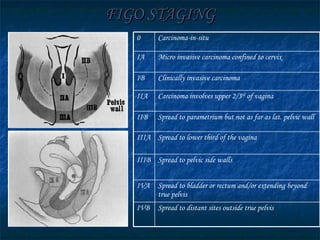
FIGO STAGING Carcinoma-in-situ 0 Spread to bladder or rectum and/or extending beyond true pelvis IVA Spread to lower third of the vagina IIIA Spread to pelvic side walls IIIB Spread to parametrium but not as far as lat. pelvic wall IIB Spread to distant sites outside true pelvis IVB Carcinoma involves upper 2/3 rd  of vagina IIA Clinically invasive carcinoma IB Micro invasive carcinoma confined to cervix IA
PRINCIPLE OF MANAGEMENT These are sq. cell ca. that are moderately sensitive to radn. Hence rad n  plays an important role in management of carcinoma cervix. Predictable pattern of spread helps in designing radn portals.  Since tolerance of Cx is very high hence high dose can be delivered. Aim is to deliver curative dose of around  Early stage - 80 - 85Gy to point A Advanced stage - 85-90Gy to point A But this dose can’t be delivered by EBRT because of presence of dose limiting structures like bladder & rectum in the beam path. Hence to achieve tumor control rad n  is delivered by combined technique of EBRT & Brachytherapy.
PRINCIPLE OF MANAGEMENT The cervical cancer has two components Central component -  Disease confined to cervix , vagina & medial parametria- best treated by brachytherapy Peripheral component -  Disease involving lateral parametria & lymph nodes-best treated by EBRT& brachytherapy as boost
PRINCIPLE OF MANAGEMENT Patients with stage IA ca cx  are managed by radical hysterectomy alone.  If inoperable, then dose of approx.80 Gy is delivered by brachytherapy alone Patients with stage IB may be managed by a radical hysterectomy alone if the tumor is <4 cm in size with no other adverse features.  Stage IB with tumor > 4 cm, and all patients with stage IIA, IIB, IIIA, IIIB, and IVA are managed with EBRT with concurrent chemotherapy and Brachytherapy.
PRINCIPLE OF MANAGEMENT The relative proportion of EBRT increases with increasing tumor bulk and stage Early stage - Brachytherapy is given simultaneously or as sandwich with EBRT  Advanced stage – EBRT is given prior to Brachytherapy. This allows  tumour shrinkage  leads to a technically superior Brachytherapy application and  radiobiological advantage  with better tumour oxygenation and therefore more radio sensitivity as the tumour involutes. Indications for EBRT prior to brachytherapy Bulky cervical lesions or tumors beyond stage IIA  Exophytic, bleeding tumors; Tumors with necrosis or infection; or Parametrial involvement.
INDICTIONS FOR POST-OP RT Two or more positive pelvic lymph nodes Patients with negative nodes who have microscopic positive or close (<3 mm) margins of resection Deep stromal invasion Vascular/lymphatic permeation.
EBRT Parallel opposed  AP/PA field  i.e. two field technique. Four field box technique Parallel opposed portals with midline shield when more dose is delivered by I/C BT Parallel opposed portals AP/PA with pt. in Frog leg position in case of vaginal involvment. This position opens up skin folds in groin region which is otherwise susceptible  to skin reactions
TARGET VOLUME Principle is to treat primary tumour with the first echelon group of lymph nodes to maximize tumour control Includes  primary tumour  Pelvic lymph nodes upto common iliac L.N. ( paracervical, parametrial, internal iliac, external iliac, presacral, sacral and the obturator L.N.)  & adequate margin for microscopic spread and set up uncertainties
POSITIONING & IMMOBILIZATION Pt. is treated in supine position as it is most comfortable & reproducible position. Pt. may be positioned using knee wedge to relaxes lower back making pt. more comfortable.
MANUAL MARKINGS Anterior field centre is 3 cm above the pubic tubercle  Post field center is 5 cm above tip of coccyx field size is either a square field of 15 x 15cm or rectangle of 14x16cm lateral field centre is 8 cm above table top   field  size is 15 x 10cm Radiographs should be taken to verify the field
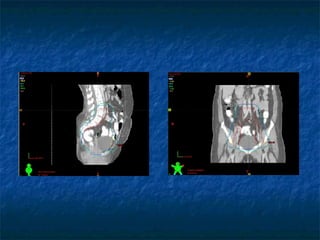
SIMULATION Pt. is given oral barium one hour prior to simulation procedure to locate small bowel w.r.t. treatment portal. Portals should be shaped to minimize small bowel within irradiated vol. Pt. is made to lie supine on simulator couch with arms folded over chest. A contrast enhanced vaginal cylinder is inserted in vagina & a rectal tube is inserted in rectum for later insertion of rectal contrast. The ant. field is set while the position is viewed in fluoroscopy.
SIMULATION Isocentric treatment is preferred & isocenter is set at pt.’s middepth or at the vaginal marker. Without moving couch/pt. gantry is turned 90 °  on either side. While viewing in fluoroscopy ant. & post. margins of lateral fields are set by lowering or raising couch. The superior & inferior margins remain same as that of ant. Portal. Orthogonal radiographs are taken for later comparison with portal image/films.
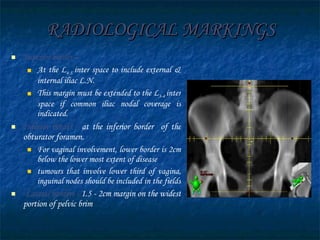
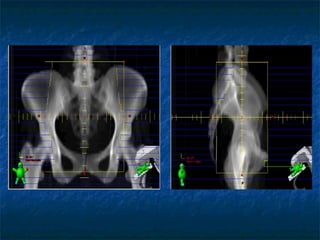
RADIOLOGICAL MARKINGS Superior border – At the L 4-5  inter space to include external & internal iliac L.N.  This margin must be extended to the L 3-4  inter space if common iliac nodal coverage is indicated. Inferior border -  at the inferior border  of the obturator foramen. For vaginal involvement, lower border is 2cm below the lower most extent of disease tumours that involve lower third of vagina, inguinal nodes should be included in the fields Lateral borders -  1.5 - 2cm margin on the widest portion of pelvic brim
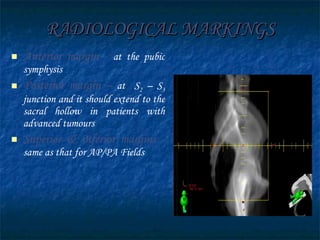
RADIOLOGICAL MARKINGS Anterior margin -   at the pubic symphysis Posterior margin –   at  S 2  – S 3  junction and it should extend to the sacral hollow in patients with advanced tumours  Superior & inferior margins -   same as that for AP/PA Fields
 
 
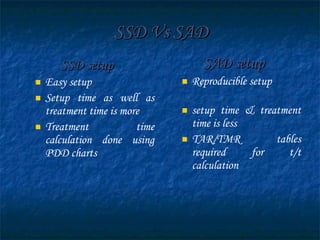
SSD Vs SAD SSD setup Easy setup Setup time as well as treatment time is more Treatment time calculation done using PDD charts SAD setup Reproducible setup  setup time & treatment time is less TAR/TMR tables required for t/t calculation
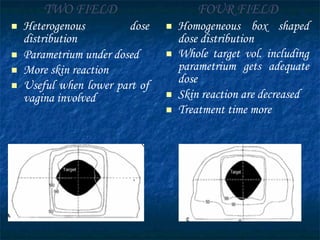
TWO FIELD Heterogenous dose distribution Parametrium under dosed More skin reaction Useful when lower part of vagina involved FOUR FIELD Homogeneous box shaped dose distribution Whole target vol. including parametrium gets adequate dose Skin reaction are decreased Treatment time more
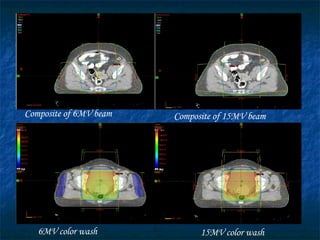
BEAM ENERGY Because of the thickness of the pelvis, high-energy photon beams (10 MV or higher) are especially suited for this treatment. They decrease the dose of radiation delivered to the peripheral normal tissues (particularly bladder and rectum)  provide a more homogeneous dose distribution in the central pelvis. avoid subcutaneous fibrosis
Composite of 6MV beam 6MV color wash Composite of 15MV beam 15MV color wash
TIME DOSE & FRACTIONATION 50Gy/25#/5wks with 2Gy/# In PGI 46Gy/23#/4.3wks ( 2Gy/#) More dose is delivered by I/C to achieve better tumor control
MIDLINE SHIELDING When more dose is delivered by Brachytherapy then EBRT is delivered with the parallel opposed AP/PA ports (two fields) with midline shielding  Done to shield rectum & bladder. Shielding should be designed carefully to try to achieve matching with the intracavitary dosimetry Midline shielding can be rectangular or wedge  shaped block.
PARAAROTIC L.N. IRRADIATION For Para-aortic node involvement, pelvis & para-arotic L.N. should be treated as contiguous extended field with parallel opposed AP/PA fields. Or the para - aortic L.N. and the pelvis are irradiated  through separate portals   In this case, a gap calculation b/w the pelvic and para-aortic portals must be done to avoid overlap and excessive dose to the small intestines.  The upper margin of the field is at the T 12  - L 1  interspace and the lower margin at L 4  – L 5   while width of field is set to include transverse processes of spine. An IVU should be done to delineate kidneys
PARAMETRIAL BOOST   If  parametrial tumor persists after delivery of 50 -60Gy is then boost dose of 10 Gy/5#s may be delivered with reduced AP/PA portals with superior border at mid SI joint. The central shield should be used to shield the bladder and rectum.
ROLE OF 3-D CRT & IMRT Ensures better tumor control. Lesser dose to normal tissue resulting in less late term complications. Potential reduction in acute toxicity & better radiation tolerance.
PALLIATIVE RT Pt . of stage 4B or recurrent carcinoma require palliation  Aim is to relieve pt. from pain & bleeding For vaginal bleeding single I/C insertion is given delivering a dose of 6000mgh( 55Gy to point A) If pt. has previously received radn then prescribed dose is lower(4000 -5000mgh) EBRT may be delivered by two field or four field technique 26Gy in 13#s  Or  single dose of 8-10 Gy that can be repeated seeing response at an interval of 3-4wks
BRACHYTHERAPY Brachytherapy is a type of radiation treatment in which small,  encapsulated  radioactive sources are arranged in a geometric fashion in & around tumour ADV. It delivers  very high dose of radiation to tumor Sparing normal tissue Dose delivered in short duration.
TYPES OF BT Depending on methods of source loading : Pre loading : The applicator is preloaded and contains radioactive sources at the time of placement into the patient After loading : The applicator is placed first into the target position and the radioactive sources are loaded later, either  manual after loading or  remote after loading
TYPES OF BT Depending on dose rate there are four types of delivery modes of I/C Brachytherapy Low Dose Rate (LDR)  : 0.4–2 Gy /hr Medium Dose Rate (MDR)  :2-12Gy/hr   High Dose Rate (HDR)  : >12Gy/hr Pulsed Dose Rate (PDR)  :  pulses of around 1Gy/hr
BRACHYTHERAPY Brachytherapy plays vital role in treatment of ca cx. & is mainly applied as an intracavitary procedure in selected cases complemented by interstitial implants . It consists of positioning specially designed applicators bearing sealed radioactive sources into a body cavity in close proximity to the target tissue. I/C applications are temporary that are left in the patient for a specified time to deliver prescribed dose.
WHY I/C BRACHYTHERAPY Uterine cx. is ideally suited for I/C brachy therapy because High tolerance of  cervix ,uterus & vagina It is accessible organ hence Brachytherapy can be practised with ease.  The endocervical canal & vaginal vault form a suitable vehicle to carry rigid applicators with radioactive sources. These applicators can be used with minor modifications in all pts.
ADV. OF I/C BRACHYTHERAPY High dose of radiation is delivered in shortest time. Cervix receives  20,000 – 25000 cGys.  Uterus receives  20,000- 30000 cGys Vagina receives  10,000 cGys.  such high doses can’t be delivered by any technique of EBRT. Best long term control is achieved  Sharp Fall off of dose and hence less dose to the normal structure.  Less late radiation morbidity . Preservation of normal anatomy. Better sexual functional life.
HISTORY 1898 :  Discovery of Radium by Marie Curie in Paris.  1903 : Margaret Cleaves, a  New York physician described  inserting Radium into the Uterine cavity of a patient with Ca Cervix.  1908 :  I/C brachytherapy started in Vienna  1910 :  I/C brachytherapy started in Stockholm 1912 :  I/C brachytherapy started at Paris.  1930 :  Todd & Meredith developed Manchester system in U.K.
DOSIMETRIC SYSTEMS The historical dosimetric systems were developed when computer treatment planning and dose computations were not available Term ‘system’ specifies a set of rules for  Geometrical arrangement of a specific set of radio isotopes in a specialised applicator  To obtain suitable dose distributions over the volume to be treated .  It specifies treatment in terms of the dose, time and administration A specified set of tables to allow, reproducible and easy calculation in most of the encountered clinical scenarios.  A system ensures safety and is based on clinical  experience.
STOCKHOLM SYSTEM Fractionated (2-3 #s) course over a period of one month. For a period of 22 hours each.  Separated by 1-3wks This system used Intravaginal boxes made up of silver or gold  The intrauterine tube made up of flexible rubber. These were not fixed together Unequal loading of Radium 30 to 90 mg of Radium was placed inside the uterus While 60 - 80 mg were placed inside the vagina. A total dose of 6500 -7100 mg -hrs was prescribed out of which 4500 mg Ra was contributed by the vaginal box. (dose rate-110R/hr)
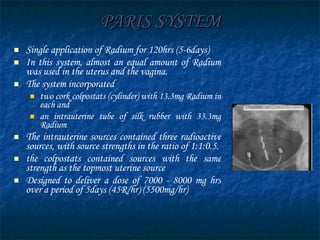
PARIS SYSTEM Single application of Radium for 120hrs (5-6days) In this system, almost an equal amount of Radium was used in the uterus and the vagina. The system incorporated  two cork colpostats (cylinder) with 13.3mg Radium in each and  an intrauterine tube of silk rubber with 33.3mg Radium The intrauterine sources contained three radioactive sources, with source strengths in the ratio of 1:1:0.5.  the colpostats contained sources with the same strength as the topmost uterine source Designed to deliver a dose of 7000 - 8000 mg hrs over a period of 5days (45R/hr) (5500mg/hr)
DOSE SPECIFICATION Done in mg-hr i.e. simple mathematical product of mg of Radium times the duration (in hours) of the implant. It was easy to use. The dose prescription was entirely empirical due to the lack of  knowledge about the biological effects of radiation on the normal tissues and the tumor  understanding about the dose, dose distribution and the duration of treatment. Only applicable when both tandem & ovoids are used & sources are loaded in a rigidly prescribed manner.

FALLACIES Long treatment time, discomfort to the patient Dose prescription method was empirical. Both systems specified dose in mg-hour. Does not give any information about dose distribution. When used in conjunction with EBRT, overall radiation treatment can’t be adequately defined Dose specification method lacks the information on  Source arrangement Position of tandem relative to the ovoids Packing of the applicators Tumour  size, and  Patient anatomy. With the use of this dose prescription method dose to important anatomical targets could not be quantified adequately. Ignored the importance of tolerance of different critical organs to radiation.
MANCHESTER SYSTEM   The Manchester system is one of the oldest & extensively used systems in the world. Developed by Todd & Meredith in 1930 & was in clinical use by 1932. This system was initially developed for radium tubes, but was easily adapted to different afterloading systems.
MANCHESTER SYSTEM Manchester system was based on following principles: To define the treatment in terms of dose to a point. To be acceptable this point should have following criteria : It should be  anatomically comparable from patient to patient. Should be in a region where the dosage is not highly sensitive to small alteration in applicator position. Should be in position that allows correlation of dose with clinical effects To design a set of applicators and their loading   (with a given amount of radium), which would give the same dose rate irrespective of the combination of applicators used. To formulate a set of rules regarding the activity, relationship & positioning   of the radium sources in the tandem & vaginal ovoids to achieve desired dose rate.
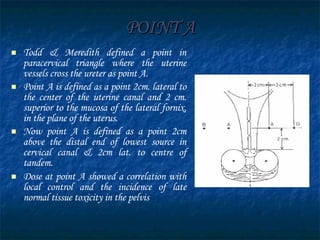
POINT A Todd & Meredith defined a point in paracervical triangle where the uterine vessels cross the ureter as point A. Point A is defined as a point 2cm. lateral to the center of the uterine canal and 2 cm. superior to the mucosa of the lateral fornix, in the plane of the uterus. Now point A is defined as a point 2cm above the distal end of lowest source in cervical canal & 2cm lat. to centre of tandem. Dose at point A showed a correlation with local control and the incidence of late normal tissue toxicity in the pelvis
POINT A Although point A is defined in relation to important anatomic structures, these can’t be visualized on a radiograph. It is therefore necessary to develop some convention by which position of point A can be determined on radiograph. The keel is placed at the external os. It serves as important reference point as it can be visualized on radiograph.
POINT B Point B is defined 2cm above external os & 5 cm laterally to midline  Represents dose to the pelvic wall, obturator L.N. The dose at point B is approx. 25 -30% of the dose at point A. Dose to point B, depends little on the geometric distribution of radium, but on the total amount of radium used
DOSE LIMITING STRUCTURES Bladder Rectum Vaginal mucosa Rectovaginal septum No more than 40% of total dose at point A could be delivered safely through the vaginal mucosa.  The rectal dose should be 80% or less of the dose at point A; this rectal dose can usually be achieved by careful packing.
MANCHESTER SYSTEM In this system, the dose distributions were not calculated for individual patients.  Applications outside the standard variations were corrected for, but the majority of patients had applicators in place for a standard time.  The Manchester system was a time system based on the use of standard applicators
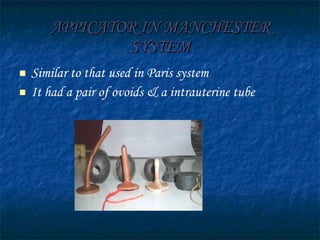
APPICATOR IN MANCHESTER SYSTEM Similar to that used in Paris system It had a pair of ovoids & a intrauterine tube
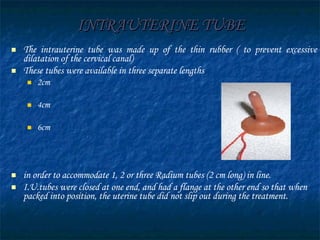
INTRAUTERINE TUBE The intrauterine tube was made up of the thin rubber ( to prevent excessive dilatation of the cervical canal)  These tubes were available in three separate lengths 2cm 4cm 6cm in order to accommodate 1, 2 or three Radium tubes (2 cm   long) in line.  I.U.tubes were closed at one end, and had a flange at the other end so that when packed into position, the uterine tube did not slip out during the treatment.
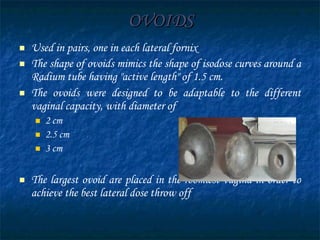
OVOIDS Used in pairs, one in each lateral fornix The shape of ovoids mimics the shape of isodose curves around a Radium tube having &quot;active length&quot; of 1.5 cm. The ovoids were designed to be adaptable to the different vaginal capacity, with diameter of 2 cm 2.5 cm 3 cm The largest ovoid are placed in the roomiest vagina in order to achieve the best lateral dose throw off
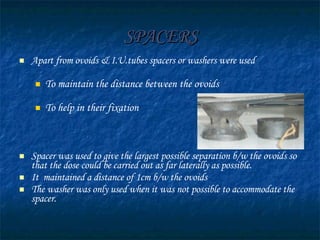
SPACERS Apart from ovoids & I.U.tubes spacers or washers were used  To maintain the distance between the ovoids To help in their fixation  Spacer was used to give the largest possible separation b/w the ovoids so that the dose could be carried out as far laterally as possible.  It  maintained a distance of 1cm b/w the ovoids The washer was only used when it was not possible to accommodate the spacer.
PACKING Manchester applicators do not incorporate rectal shielding.  Hence  gauze is packed firmly and carefully behind the ovoids, anteriorly b/w the ovoids and the base of the bladder, and around the applicator tubes down to the level of the introitus   The amount of packing   should be such that at least 1.5 cm separation is achieved b/w ovoids and vaginal mucosa. Packing helps to  keep the applicators in position to reduce dose to bladder and anterior rectal wall.
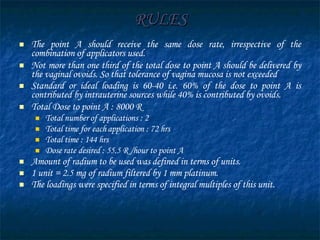
RULES The point A should receive the same dose rate, irrespective of the combination of applicators used. Not more than one third of the total dose to point A should be delivered by the vaginal ovoids. So that tolerance of vagina mucosa is not exceeded  Standard or ideal loading is 60-40 i.e. 60% of the dose to point A is contributed by intrauterine sources while 40% is contributed by ovoids. Total Dose to point A : 8000 R Total number of applications : 2 Total time for each application : 72 hrs Total time : 144 hrs Dose rate desired : 55.5 R /hour to point A Amount of radium to be used was defined in terms of units.  1 unit = 2.5 mg of radium filtered by 1 mm platinum.  The loadings were specified in terms of integral multiples of this unit.
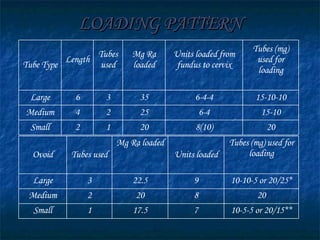
LOADING PATTERN Tube Type Length Tubes used Mg Ra loaded Units loaded from fundus to cervix Tubes (mg) used for loading Large 6 3 35 6-4-4 15-10-10 Medium 4 2 25 6-4 15-10 Small 2 1 20 8(10) 20 Ovoid Tubes used Mg Ra loaded Units loaded Tubes (mg) used for loading Large 3 22.5 9 10-10-5 or 20/25* Medium 2 20 8 20 Small 1 17.5 7 10-5-5 or 20/15**
LOADING PATTERN Total dose at point A using different combinations of I.U tube & ovoids : Large tube with large ovoid and washer : 57.5 R Large tube with large ovoid and spacer: 56.9 R Large tube with small ovoid and washer: 57.6 R Medium tube with small ovoids and spacer: 57.3 R The variations were thus within 1.5% range.
ICRU SYSTEM   For reliable and relevant comparison of different methods and their clinical results ICRU38 recommends a common terminology for prescribing recording and reporting I/C Brachytherapy applications. The ICRU recommends a system of dose specification that relates the dose distribution to the target volume, instead of the dose to a specific point  The dose is prescribed as the value of an isodose surface that just surrounds the target volume.
ICRU REPORTING Description of technique Time dose pattern (application duration) Description of reference volume Dose at reference points
Description of the Technique Minimum information should include the  orthogonal radiographs of the application. Source used (radionuclide, reference air kerma rate, shape and size of source, and filtration) applicator type Loading pattern Simulation of linear source for point or moving sources Applicator geometry (rigidity, tandem curvature, vaginal uterine connection, source geometry, shielding material) Total reference air Kerma - proposed to introduce international units into the Brachytherapy reporting.
DOSE AT REFERENCE POINTS The dose to bladder and rectum depends on the distribution of sources in a given application. The maximum dose to bladder and rectum should be less than 80% of the dose to point A The localization of bladder and rectum can be performed using radiographs taken with contrast media in the bladder and rectum.
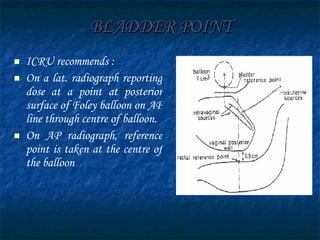
BLADDER POINT ICRU recommends :  On a lat. radiograph reporting dose at a point at posterior surface of Foley balloon on AP line through centre of balloon. On AP radiograph, reference point is taken at the centre of the balloon
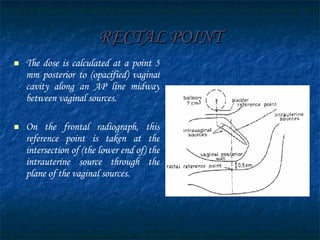
RECTAL POINT The dose is calculated at a point 5 mm posterior to (opacified) vaginal cavity along an AP line midway between vaginal sources. On the frontal radiograph, this reference point is taken at the intersection of (the lower end of) the intrauterine source through the plane of the vaginal sources.
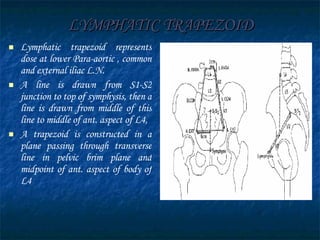
LYMPHATIC TRAPEZOID Lymphatic trapezoid represents dose at lower Para-aortic , common and external iliac L.N. A line is drawn from S1-S2 junction to top of symphysis, then a line is drawn from middle of this line to middle of ant. aspect of L4, A trapezoid is constructed in a plane passing through transverse line in pelvic brim plane and midpoint of ant. aspect of body of L4
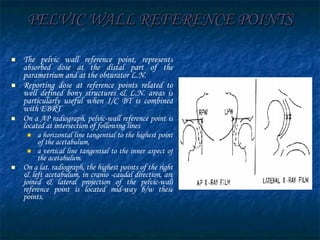
PELVIC WALL REFERENCE POINTS The pelvic wall reference point, represents absorbed dose at the distal part of the parametrium and at the obturator L.N. Reporting dose at reference points related to well defined bony structures & L.N. areas is particularly useful when I/C BT is combined with EBRT On a AP radiograph, pelvic-wall reference point is located at intersection of following lines a horizontal line tangential to the highest point of the acetabulum, a vertical line tangential to the inner aspect of the acetabulum. On a lat. radiograph, the highest points of the right & left acetabulum, in cranio -caudal direction, are joined & lateral projection of the pelvic-wall reference point is located mid-way b/w these points.
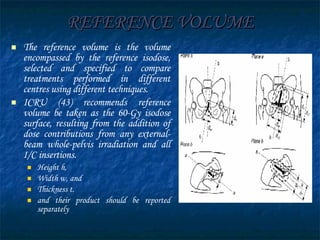
REFERENCE VOLUME The reference volume is the volume encompassed by the reference isodose, selected and specified to compare treatments performed in different centres using different techniques. ICRU (43) recommends  reference volume be taken as the 60-Gy isodose surface, resulting from the addition of dose contributions from any external-beam whole-pelvis irradiation and all I/C insertions.   Height h,  Width w, and Thickness t.  and  their product  should be reported separately
TREATED VOLUME The Treated Volume is the pear and banana shape volume that received (at least) the dose selected and specified by the radiation oncologist to achieve the purpose of the treatment e.g. tumour eradication or palliation, within the limits of acceptable complications
IRRADIATED VOLUME The irradiated volume is the volume, surrounding the treated volume, encompassed by a lower isodose to be specified, e.g., 90 – 50% of the dose defining the treated volume.  Reporting irradiated volumes is useful for interpretation of side effects outside the treated volume and for purpose of comparison.
APPLICATORS Applicators are small-caliber tubes that are inserted into body cavities to hold the brachytherapy sources in clinically defined configurations, or loading patterns. The applicators include  A tandem to be inserted into the uterus  with different lengths that allow for adaptation according to the individual anatomy (with a fixed uterine flange)  and angled at varying degrees to the line of the vaginal component (0°,15°,30°,45° )  The deliberate angle in the tube draws the uterus, in most patients, into a central position in the pelvis away from the pouch of Douglas, the sigmoid colon, and the anterior rectal wall. Two ovoids, to be positioned in the vaginal vault abutting the cervix.
APPLICATORS Applicators used to insert intracavitary sources in the uterus and vagina included Rubber catheters and ovoids developed by French researchers,  Metallic tandems and plaques designed in Sweden Thin rubber  tandems and ovoids of the Manchester system. Fletcher (1953) designed a preloadable colpostat, which Suit et al. (1963) modified and made after loading
APPLICATORS IDEAL CHARACTERISTICS   of applicators It should have a fixed geometry. It should be made of rigid material as fixed & rigid applicators attain and hold better geometry of the insertions Lightweight (ideally 50- 60gm but should not be more than 100gm) for the patient's comfort capable of easy sterilization.  Applicators should be of inert material that is not adversely affected by exposure to gamma radiation. There should be minimal attenuation of gamma rays by the walls of the applicators i.e. it should not produce its own characteristic radiations Vaginal ovoids should be perpendicular to the long axis of vagina to avoid more dose to rectum and bladder. I.U. tube should be angulated
FLATCHER APPICATOR Based on Manchester System Stainless steel  Cylindrical ovoid Bladder and rectal shields Preloaded but modified by Suit for afterloaing Disadv. Presence of shielding lead to uncertainty in dosimetry. Cylindrical caps lead to nonuniform doses to vaginal mucosa. Fletcher - Suit- Delclos applicator for afterloading with Ir-192
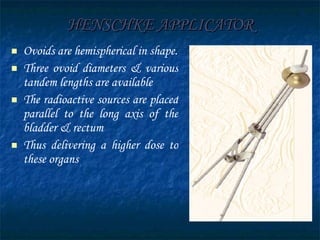
HENSCHKE APPLICATOR Ovoids are hemispherical in shape. Three ovoid diameters & various tandem lengths are available The radioactive sources are placed parallel to the long axis of the bladder & rectum  Thus delivering a higher dose to these organs
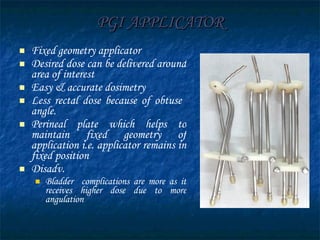
PGI APPLICATOR Fixed geometry applicator Desired dose can be delivered around area of interest Easy & accurate dosimetry Less rectal dose because of obtuse  angle. Perineal plate which helps to maintain fixed geometry of application i.e. applicator remains in fixed position Disadv. Bladder  complications are more as it receives higher dose due to more angulation
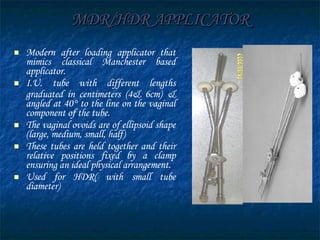
MDR/HDR APPLICATOR Modern after loading applicator that mimics classical Manchester based applicator. I.U. tube with different lengths graduated in centimeters (4& 6cm)   & angled at 40° to the line on the vaginal component of the tube. The vaginal ovoids are of ellipsoid shape (large, medium, small, half) These tubes are held together and their relative positions fixed by a clamp ensuring an ideal physical arrangement. Used for HDR( with small tube diameter)
MOULDED APPLICATOR The molded applicators represent the most individualized approach of treatment
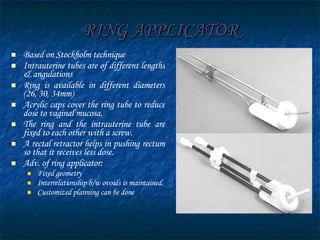
RING APPLICATOR Based on Stockholm technique Intrauterine tubes are of different lengths & angulations Ring is available in different diameters (26, 30, 34mm) Acrylic caps cover the ring tube to reduce dose to vaginal mucosa.  The ring and the intrauterine tube are fixed to each other with a screw.  A rectal retractor helps in pushing rectum so that it receives less dose. Adv. of ring applicator: Fixed geometry Interrelationship b/w ovoids is maintained. Customized planning can be done
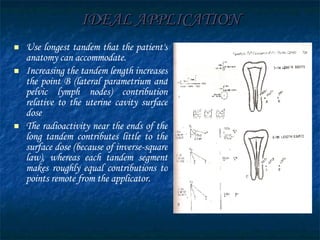
IDEAL APPLICATION Use longest tandem that the patient's anatomy can accommodate. Increasing the tandem length increases the point B (lateral parametrium and pelvic lymph nodes) contribution relative to the uterine cavity surface dose The radioactivity near the ends of the long tandem contributes little to the surface dose (because of inverse-square law), whereas each tandem segment makes roughly equal contributions to points remote from the applicator.
IDEAL APPLICATION Colpostats /ovoids with largest clinically indicated  dia. should be used to deliver highest tumor dose at depth, for a given mucosal dose.  As colpostat diameter increases from 2 to 3 cm, the vaginal surface dose decreases by 35% relative to the dose 2 cm from the applicator surface; This is simply a consequence of increasing the source-to-surface distance.  The geometry of the insertion must prevent under dosing around the cervix; Sufficient dose must be delivered to the Para cervical areas; and Tolerance of vaginal mucosa, bladder and rectum must be respected.
IDEAL APPLICATION Optimal placement of the applicators in the uterus and vagina. Optimal placement of the radioactive sources in applicators Pear-shaped dose distribution -high dose to the cervical and paracervical tissues; reduced dose to the bladder and rectum
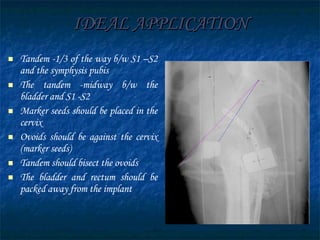
IDEAL APPLICATION Tandem -1/3 of the way b/w S1 –S2 and the symphysis pubis The tandem -midway b/w the bladder and S1 -S2 Marker seeds should be placed in the cervix Ovoids should be against the cervix (marker seeds) Tandem should bisect the ovoids The bladder and rectum should be packed away from the implant
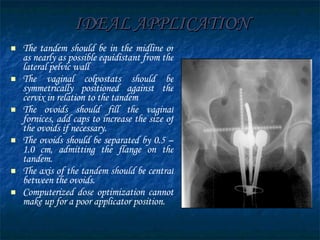
IDEAL APPLICATION The tandem should be in the midline or as nearly as possible equidistant from the lateral pelvic wall The vaginal colpostats should be symmetrically positioned against the cervix in relation to the tandem The ovoids should fill the vaginal fornices, add caps to increase the size of the ovoids if necessary. The ovoids should be separated by 0.5 –1.0 cm, admitting the flange on the tandem. The axis of the tandem should be central between the ovoids. Computerized dose optimization cannot make up for a poor applicator position.
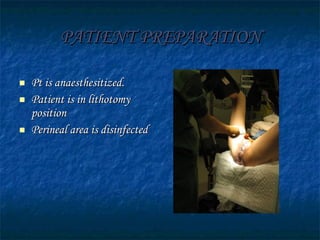
PATIENT PREPARATION Pt is anaesthesitized. Patient is in lithotomy position Perineal area is disinfected
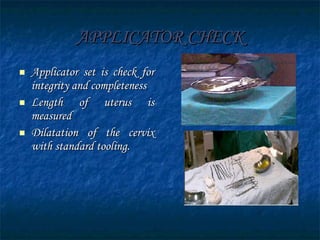
APPLICATOR CHECK Applicator set is check for integrity and completeness Length of uterus is measured Dilatation of the cervix with standard tooling.
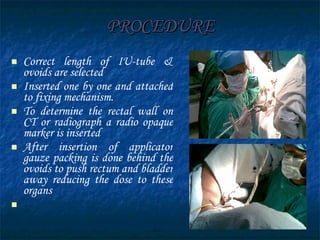
PROCEDURE Correct length of IU-tube & ovoids are selected  Inserted one by one and attached to fixing mechanism. To determine the rectal wall on CT or radiograph a radio opaque marker is inserted After insertion of applicator gauze packing is done behind the ovoids to push rectum and bladder away reducing the dose to these organs
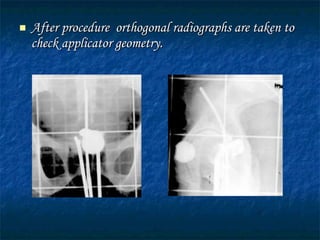
After procedure  orthogonal radiographs are taken to check applicator geometry.
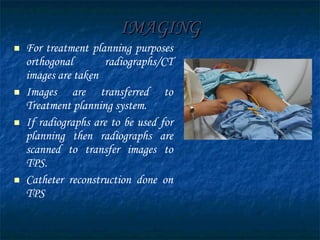
IMAGING For treatment planning purposes orthogonal radiographs/CT images are taken Images are transferred to Treatment planning system. If radiographs are to be used for planning then radiographs are scanned to transfer images to TPS. Catheter reconstruction done on TPS
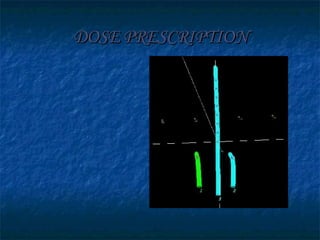
DOSE PRESCRIPTION
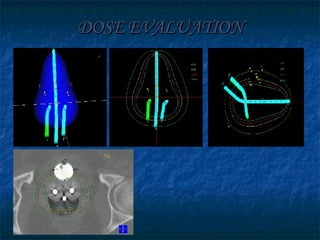
DOSE EVALUATION
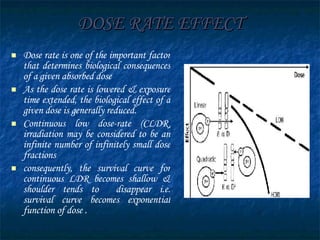
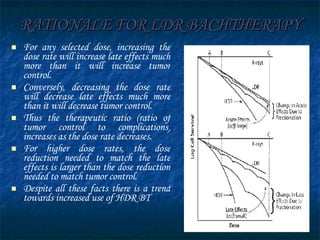
DOSE RATE EFFECT Dose rate is one of the important factor that determines biological consequences of a given absorbed dose  As the dose rate is lowered & exposure time extended, the biological effect of a given dose is generally reduced. Continuous low dose-rate (CLDR) irradiation may be considered to be an infinite number of infinitely small dose fractions  consequently, the survival curve for continuous LDR becomes shallow & shoulder tends to  disappear i.e. survival curve becomes exponential function of dose .
RATIONALE FOR LDR BACHTHERAPY For any selected dose, increasing the dose rate will increase late effects much more than it will increase tumor control. Conversely, decreasing the dose rate will decrease late effects much more than it will decrease tumor control.  Thus the therapeutic ratio (ratio of tumor control to complications) increases as the dose rate decreases. For higher dose rates, the dose reduction needed to match the late effects is larger than the dose reduction needed to match tumor control. Despite all these facts there is a trend towards increased use of HDR BT
In I/C BT equivalent HDR regimens can be achieved without loss of therapeutic ratio.  Because the rad n  dose that produces unwanted late effects is significantly less than treatment dose (75% of prescribed dose) As OAR( rectum & bladder) are some distance away from Brachytherapy sources.  Corrections  LDR – MDR -  33% reduction HDR – HDR -  50% reduction
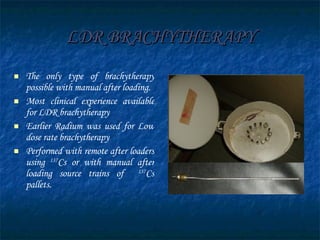
LDR BRACHYTHERAPY The only type of brachytherapy possible with manual after loading. Most clinical experience available for LDR brachytherapy Earlier Radium was used for Low dose rate brachytherapy Performed with remote after loaders using  137 Cs or with manual after loading source trains of  137 Cs pallets.
ADV. OF LDR Long history of use Ability to predict rate of late complications Radio biologically superior as  Improves chances of catching tumors in sensitive phase of cell cycle Favorable dose-rate effect on repair of normal tissues Infrequent replacement and calibration of sources because of long isotope half-life
MDR Used to have adv of both LDR & HDR Since dose rate correction was not used so it lead to lot of complication However in PGI two consecutive studies led to incorporation of a 33% dose rate reduction-probably only reported clinical data with use of MDR Availability of microselectron HDR with miniature Ir-192 source & resultant smaller applicators with the attendant adv of better packing lead to more wide spread adoption of HDR.
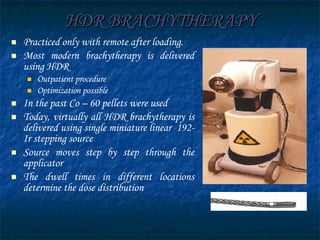
HDR BRACHYTHERAPY Practiced only with remote after loading. Most modern brachytherapy is delivered using HDR Outpatient procedure Optimization possible In the past Co – 60 pellets were used Today, virtually all HDR brachytherapy is delivered using single miniature linear  192-Ir stepping source Source moves step by step through the applicator The dwell times in different locations determine the dose distribution

HDR During a treatment, the source is driven out of the HDR unit, remotely. Source steps through pre-determined treatment/dwell positions within each treatment catheter, Stopping at each dwell position for a pre-calculated length of time i.e. dwell time, to deliver the planned treatment dose distribution. This type of stepping source HDR unit helps to achieve optimized dose distribution for the treatment.
ADV. OF HDR Out patient procedure Pt.is not confined to bed for hours or days during irradiation No indwelling catheters or vaginal packing Geometry easily maintained during treatment Ability to treat greater patient loads (high output of patients on each machine)  Optimization of dose distribution by altering the dwell times of the source at different locations
PDR BRACHYTHERAPY PDR technology was developed at the beginning of the 90's  Unit has a similar design as HDR, however the activity is smaller (around 1Ci instead of 10Ci) Stepping source operation - same optimization possible as in HDR Treatment over same time as LDR treatment  The biologic effect mimics LDR, and the dose optimization mimics HDR.   In-patient treatment: hospitalization required Source steps out for about 10 minutes per hour and then retracts. Repeats this every hour to deliver mini fractions (‘pulses’) of about 1Gy
PDR Advantages Complication rate profile more similar to that of LDR  Between fractions, patient is not radioactive, allowing for near continuous nursing care during treatment Radiation protection Disadvantages Long term results not available
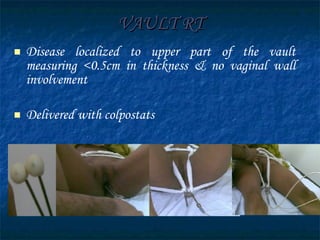
VAULT RT Disease localized to upper part of the vault measuring <0.5cm in thickness & no vaginal wall involvement Delivered with colpostats
VAGINAL CYLINDERS If there is vaginal wall involvement or if there is parametrial invasion then after EBRT vaginal cylinders are used. Now a days if lower 1/3 rd  of vagina is involved then vaginal cylinders are not used as tolerance of lower vagina is less (60-70Gy) Disadv. Of vaginal cylinders : Only depth of 0.5cm can be treated safely. Rectal & bladder doses are higher Because of anisotropy there is  reduced dose to vaginal cuff.
INTERSTITIAL IMPLANTATION The aim of this technique is to tailor the dose of irradiation to the anatomy of the patient with a better target volume coverage. Originally, interstitial implants were performed with free-hand placement of the radioactive needles.  The development of transperineal or transvaginal templates resulted in a better needle positioning.
INTERSTITIAL IMPLANTATION Indications : Pt. of ca cx with Distorted anatomy Narrow vagina & obliterated fornices When os / uterine canal can’t be identified. Extensive paravaginal (>0.5cm) or distal vaginal involvement when parametrial extent of the tumor cannot be encompassed by standard intracavitary brachytherapy. patients with a recurrence inside an area previously irradiated restricting the use of further external irradiation Post op vault recurrence
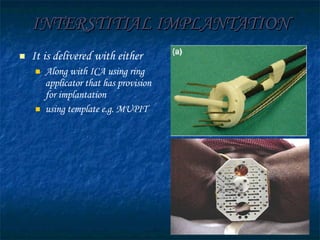
INTERSTITIAL IMPLANTATION It is delivered with either   Along with ICA using ring applicator that has provision for implantation using template e.g. MUPIT
SEQUELAE   Acute reactions: Diarrhoea , Nausea , abdominal cramping, rectal discomfort, & occasionally rectal bleeding Fatigue ,weakness , Dysuria, frequency, nocturia   Erythema and dry or moist desquamation may develop in the perineum or intergluteal fold.  Late reactions: Haemorrhage, rectal ulceration ,rectovaginal fistulae, rectal strictures,proctitis Small bowel obstruction or perforation Vesicovaginal fistulae,cystitis
CONCLUSION Radiation plays an important role in management of carcinoma cervix both in the form of EBRT & Brachytherapy & is only mode of treatment in advanced cases.  Both of the components are important; however, successful outcome of treatment depends on skilled use of I/C Brachytherapy  Traditional method of low dose rate I/C Brachytheapy is being replaced by modern high dose rate Brachytherapy Most of clinical experience is available with low dose rate Brachytherapy  Comparison of modern Brachytherary is still done with clinical results of low dose rate Brachytherapy.
This is easy to understand in terms of the repair of chromosome damage.  The linear component of cell damage will be unaffected by dose rate since the two chromosome breaks that interact to form a lethal lesion are caused by a single electron track.  The quadratic component, however, is caused by two separate electron tracks; if there is a long time interval b/w the passage of two electron tracks, then the damage caused by the first may be repaired before the second arrives.
Cell killing by radiation is due largely to aberrations caused by breaks in two chromosomes.  The dose–response curve for  HDR  irradiation is linear-quadratic i.e. the two breaks may be caused by the same electron (dominant at low doses) or by two different electrons (dominant at higher doses).  For  LDR  irradiation where radiation is delivered over a protracted period, the principal mechanism of cell killing is by the single electron. Consequently, the LDR survival curve is an extension of the low-dose region of the HDR survival curve
THANKYOU

Teletherapy & Brachytherapy Techniques In Ca

  • 1.
    TELETHERAPY & BRACHYTHERAPY IN CARCINOMA CERVIX
  • 2.
    INTRODUCTION Cervical canceris the commonest gynecological malignancy in India. Squamous cell carcinoma - 80% Adenocarcinomas - 20%
  • 3.
    INTRODUCTION Carcinoma ofthe cervix metastasizes in predictable sequential manner The cervix drains into the para cervical L.N. and subsequently to the internal and external iliac nodes, including the obturator nodes. The pelvic lymphatic drains into the common iliac and the para-aortic lymph nodes.
  • 4.
    INTRODUCTION Cervical cancersare clinically staged. The FIGO staging system is the most widely used The cornerstone of the system is a thorough careful pelvic examination, often done under general anesthesia. Adjuncts to the pelvic examination include either an IVP or CT scan with IV contrast to determine whether there is ureteral obstruction and hydronephrosis. Additionally, a chest X-ray is usually part of the initial workup.
  • 5.
    FIGO STAGING Carcinoma-in-situ0 Spread to bladder or rectum and/or extending beyond true pelvis IVA Spread to lower third of the vagina IIIA Spread to pelvic side walls IIIB Spread to parametrium but not as far as lat. pelvic wall IIB Spread to distant sites outside true pelvis IVB Carcinoma involves upper 2/3 rd of vagina IIA Clinically invasive carcinoma IB Micro invasive carcinoma confined to cervix IA
  • 6.
    PRINCIPLE OF MANAGEMENTThese are sq. cell ca. that are moderately sensitive to radn. Hence rad n plays an important role in management of carcinoma cervix. Predictable pattern of spread helps in designing radn portals. Since tolerance of Cx is very high hence high dose can be delivered. Aim is to deliver curative dose of around Early stage - 80 - 85Gy to point A Advanced stage - 85-90Gy to point A But this dose can’t be delivered by EBRT because of presence of dose limiting structures like bladder & rectum in the beam path. Hence to achieve tumor control rad n is delivered by combined technique of EBRT & Brachytherapy.
  • 7.
    PRINCIPLE OF MANAGEMENTThe cervical cancer has two components Central component - Disease confined to cervix , vagina & medial parametria- best treated by brachytherapy Peripheral component - Disease involving lateral parametria & lymph nodes-best treated by EBRT& brachytherapy as boost
  • 8.
    PRINCIPLE OF MANAGEMENTPatients with stage IA ca cx are managed by radical hysterectomy alone. If inoperable, then dose of approx.80 Gy is delivered by brachytherapy alone Patients with stage IB may be managed by a radical hysterectomy alone if the tumor is <4 cm in size with no other adverse features. Stage IB with tumor > 4 cm, and all patients with stage IIA, IIB, IIIA, IIIB, and IVA are managed with EBRT with concurrent chemotherapy and Brachytherapy.
  • 9.
    PRINCIPLE OF MANAGEMENTThe relative proportion of EBRT increases with increasing tumor bulk and stage Early stage - Brachytherapy is given simultaneously or as sandwich with EBRT Advanced stage – EBRT is given prior to Brachytherapy. This allows tumour shrinkage leads to a technically superior Brachytherapy application and radiobiological advantage with better tumour oxygenation and therefore more radio sensitivity as the tumour involutes. Indications for EBRT prior to brachytherapy Bulky cervical lesions or tumors beyond stage IIA Exophytic, bleeding tumors; Tumors with necrosis or infection; or Parametrial involvement.
  • 10.
    INDICTIONS FOR POST-OPRT Two or more positive pelvic lymph nodes Patients with negative nodes who have microscopic positive or close (<3 mm) margins of resection Deep stromal invasion Vascular/lymphatic permeation.
  • 11.
    EBRT Parallel opposed AP/PA field i.e. two field technique. Four field box technique Parallel opposed portals with midline shield when more dose is delivered by I/C BT Parallel opposed portals AP/PA with pt. in Frog leg position in case of vaginal involvment. This position opens up skin folds in groin region which is otherwise susceptible to skin reactions
  • 12.
    TARGET VOLUME Principleis to treat primary tumour with the first echelon group of lymph nodes to maximize tumour control Includes primary tumour Pelvic lymph nodes upto common iliac L.N. ( paracervical, parametrial, internal iliac, external iliac, presacral, sacral and the obturator L.N.) & adequate margin for microscopic spread and set up uncertainties
  • 13.
    POSITIONING & IMMOBILIZATIONPt. is treated in supine position as it is most comfortable & reproducible position. Pt. may be positioned using knee wedge to relaxes lower back making pt. more comfortable.
  • 14.
    MANUAL MARKINGS Anteriorfield centre is 3 cm above the pubic tubercle Post field center is 5 cm above tip of coccyx field size is either a square field of 15 x 15cm or rectangle of 14x16cm lateral field centre is 8 cm above table top field size is 15 x 10cm Radiographs should be taken to verify the field
  • 15.
    SIMULATION Pt. isgiven oral barium one hour prior to simulation procedure to locate small bowel w.r.t. treatment portal. Portals should be shaped to minimize small bowel within irradiated vol. Pt. is made to lie supine on simulator couch with arms folded over chest. A contrast enhanced vaginal cylinder is inserted in vagina & a rectal tube is inserted in rectum for later insertion of rectal contrast. The ant. field is set while the position is viewed in fluoroscopy.
  • 16.
    SIMULATION Isocentric treatmentis preferred & isocenter is set at pt.’s middepth or at the vaginal marker. Without moving couch/pt. gantry is turned 90 ° on either side. While viewing in fluoroscopy ant. & post. margins of lateral fields are set by lowering or raising couch. The superior & inferior margins remain same as that of ant. Portal. Orthogonal radiographs are taken for later comparison with portal image/films.
  • 17.
    RADIOLOGICAL MARKINGS Superiorborder – At the L 4-5 inter space to include external & internal iliac L.N. This margin must be extended to the L 3-4 inter space if common iliac nodal coverage is indicated. Inferior border - at the inferior border of the obturator foramen. For vaginal involvement, lower border is 2cm below the lower most extent of disease tumours that involve lower third of vagina, inguinal nodes should be included in the fields Lateral borders - 1.5 - 2cm margin on the widest portion of pelvic brim
  • 18.
    RADIOLOGICAL MARKINGS Anteriormargin - at the pubic symphysis Posterior margin – at S 2 – S 3 junction and it should extend to the sacral hollow in patients with advanced tumours Superior & inferior margins - same as that for AP/PA Fields
  • 19.
  • 20.
  • 21.
    SSD Vs SADSSD setup Easy setup Setup time as well as treatment time is more Treatment time calculation done using PDD charts SAD setup Reproducible setup setup time & treatment time is less TAR/TMR tables required for t/t calculation
  • 22.
    TWO FIELD Heterogenousdose distribution Parametrium under dosed More skin reaction Useful when lower part of vagina involved FOUR FIELD Homogeneous box shaped dose distribution Whole target vol. including parametrium gets adequate dose Skin reaction are decreased Treatment time more
  • 23.
    BEAM ENERGY Becauseof the thickness of the pelvis, high-energy photon beams (10 MV or higher) are especially suited for this treatment. They decrease the dose of radiation delivered to the peripheral normal tissues (particularly bladder and rectum) provide a more homogeneous dose distribution in the central pelvis. avoid subcutaneous fibrosis
  • 24.
    Composite of 6MVbeam 6MV color wash Composite of 15MV beam 15MV color wash
  • 25.
    TIME DOSE &FRACTIONATION 50Gy/25#/5wks with 2Gy/# In PGI 46Gy/23#/4.3wks ( 2Gy/#) More dose is delivered by I/C to achieve better tumor control
  • 26.
    MIDLINE SHIELDING Whenmore dose is delivered by Brachytherapy then EBRT is delivered with the parallel opposed AP/PA ports (two fields) with midline shielding Done to shield rectum & bladder. Shielding should be designed carefully to try to achieve matching with the intracavitary dosimetry Midline shielding can be rectangular or wedge shaped block.
  • 27.
    PARAAROTIC L.N. IRRADIATIONFor Para-aortic node involvement, pelvis & para-arotic L.N. should be treated as contiguous extended field with parallel opposed AP/PA fields. Or the para - aortic L.N. and the pelvis are irradiated through separate portals In this case, a gap calculation b/w the pelvic and para-aortic portals must be done to avoid overlap and excessive dose to the small intestines. The upper margin of the field is at the T 12 - L 1 interspace and the lower margin at L 4 – L 5 while width of field is set to include transverse processes of spine. An IVU should be done to delineate kidneys
  • 28.
    PARAMETRIAL BOOST If parametrial tumor persists after delivery of 50 -60Gy is then boost dose of 10 Gy/5#s may be delivered with reduced AP/PA portals with superior border at mid SI joint. The central shield should be used to shield the bladder and rectum.
  • 29.
    ROLE OF 3-DCRT & IMRT Ensures better tumor control. Lesser dose to normal tissue resulting in less late term complications. Potential reduction in acute toxicity & better radiation tolerance.
  • 30.
    PALLIATIVE RT Pt. of stage 4B or recurrent carcinoma require palliation Aim is to relieve pt. from pain & bleeding For vaginal bleeding single I/C insertion is given delivering a dose of 6000mgh( 55Gy to point A) If pt. has previously received radn then prescribed dose is lower(4000 -5000mgh) EBRT may be delivered by two field or four field technique 26Gy in 13#s Or single dose of 8-10 Gy that can be repeated seeing response at an interval of 3-4wks
  • 31.
    BRACHYTHERAPY Brachytherapy isa type of radiation treatment in which small, encapsulated radioactive sources are arranged in a geometric fashion in & around tumour ADV. It delivers very high dose of radiation to tumor Sparing normal tissue Dose delivered in short duration.
  • 32.
    TYPES OF BTDepending on methods of source loading : Pre loading : The applicator is preloaded and contains radioactive sources at the time of placement into the patient After loading : The applicator is placed first into the target position and the radioactive sources are loaded later, either manual after loading or remote after loading
  • 33.
    TYPES OF BTDepending on dose rate there are four types of delivery modes of I/C Brachytherapy Low Dose Rate (LDR) : 0.4–2 Gy /hr Medium Dose Rate (MDR) :2-12Gy/hr High Dose Rate (HDR) : >12Gy/hr Pulsed Dose Rate (PDR) : pulses of around 1Gy/hr
  • 34.
    BRACHYTHERAPY Brachytherapy playsvital role in treatment of ca cx. & is mainly applied as an intracavitary procedure in selected cases complemented by interstitial implants . It consists of positioning specially designed applicators bearing sealed radioactive sources into a body cavity in close proximity to the target tissue. I/C applications are temporary that are left in the patient for a specified time to deliver prescribed dose.
  • 35.
    WHY I/C BRACHYTHERAPYUterine cx. is ideally suited for I/C brachy therapy because High tolerance of cervix ,uterus & vagina It is accessible organ hence Brachytherapy can be practised with ease. The endocervical canal & vaginal vault form a suitable vehicle to carry rigid applicators with radioactive sources. These applicators can be used with minor modifications in all pts.
  • 36.
    ADV. OF I/CBRACHYTHERAPY High dose of radiation is delivered in shortest time. Cervix receives 20,000 – 25000 cGys. Uterus receives 20,000- 30000 cGys Vagina receives 10,000 cGys. such high doses can’t be delivered by any technique of EBRT. Best long term control is achieved Sharp Fall off of dose and hence less dose to the normal structure. Less late radiation morbidity . Preservation of normal anatomy. Better sexual functional life.
  • 37.
    HISTORY 1898 : Discovery of Radium by Marie Curie in Paris. 1903 : Margaret Cleaves, a New York physician described inserting Radium into the Uterine cavity of a patient with Ca Cervix. 1908 : I/C brachytherapy started in Vienna 1910 : I/C brachytherapy started in Stockholm 1912 : I/C brachytherapy started at Paris. 1930 : Todd & Meredith developed Manchester system in U.K.
  • 38.
    DOSIMETRIC SYSTEMS Thehistorical dosimetric systems were developed when computer treatment planning and dose computations were not available Term ‘system’ specifies a set of rules for Geometrical arrangement of a specific set of radio isotopes in a specialised applicator To obtain suitable dose distributions over the volume to be treated . It specifies treatment in terms of the dose, time and administration A specified set of tables to allow, reproducible and easy calculation in most of the encountered clinical scenarios. A system ensures safety and is based on clinical experience.
  • 39.
    STOCKHOLM SYSTEM Fractionated(2-3 #s) course over a period of one month. For a period of 22 hours each. Separated by 1-3wks This system used Intravaginal boxes made up of silver or gold The intrauterine tube made up of flexible rubber. These were not fixed together Unequal loading of Radium 30 to 90 mg of Radium was placed inside the uterus While 60 - 80 mg were placed inside the vagina. A total dose of 6500 -7100 mg -hrs was prescribed out of which 4500 mg Ra was contributed by the vaginal box. (dose rate-110R/hr)
  • 40.
    PARIS SYSTEM Singleapplication of Radium for 120hrs (5-6days) In this system, almost an equal amount of Radium was used in the uterus and the vagina. The system incorporated two cork colpostats (cylinder) with 13.3mg Radium in each and an intrauterine tube of silk rubber with 33.3mg Radium The intrauterine sources contained three radioactive sources, with source strengths in the ratio of 1:1:0.5. the colpostats contained sources with the same strength as the topmost uterine source Designed to deliver a dose of 7000 - 8000 mg hrs over a period of 5days (45R/hr) (5500mg/hr)
  • 41.
    DOSE SPECIFICATION Donein mg-hr i.e. simple mathematical product of mg of Radium times the duration (in hours) of the implant. It was easy to use. The dose prescription was entirely empirical due to the lack of knowledge about the biological effects of radiation on the normal tissues and the tumor understanding about the dose, dose distribution and the duration of treatment. Only applicable when both tandem & ovoids are used & sources are loaded in a rigidly prescribed manner.
  • 42.
    FALLACIES Long treatmenttime, discomfort to the patient Dose prescription method was empirical. Both systems specified dose in mg-hour. Does not give any information about dose distribution. When used in conjunction with EBRT, overall radiation treatment can’t be adequately defined Dose specification method lacks the information on Source arrangement Position of tandem relative to the ovoids Packing of the applicators Tumour size, and Patient anatomy. With the use of this dose prescription method dose to important anatomical targets could not be quantified adequately. Ignored the importance of tolerance of different critical organs to radiation.
  • 43.
    MANCHESTER SYSTEM The Manchester system is one of the oldest & extensively used systems in the world. Developed by Todd & Meredith in 1930 & was in clinical use by 1932. This system was initially developed for radium tubes, but was easily adapted to different afterloading systems.
  • 44.
    MANCHESTER SYSTEM Manchestersystem was based on following principles: To define the treatment in terms of dose to a point. To be acceptable this point should have following criteria : It should be anatomically comparable from patient to patient. Should be in a region where the dosage is not highly sensitive to small alteration in applicator position. Should be in position that allows correlation of dose with clinical effects To design a set of applicators and their loading (with a given amount of radium), which would give the same dose rate irrespective of the combination of applicators used. To formulate a set of rules regarding the activity, relationship & positioning of the radium sources in the tandem & vaginal ovoids to achieve desired dose rate.
  • 45.
    POINT A Todd& Meredith defined a point in paracervical triangle where the uterine vessels cross the ureter as point A. Point A is defined as a point 2cm. lateral to the center of the uterine canal and 2 cm. superior to the mucosa of the lateral fornix, in the plane of the uterus. Now point A is defined as a point 2cm above the distal end of lowest source in cervical canal & 2cm lat. to centre of tandem. Dose at point A showed a correlation with local control and the incidence of late normal tissue toxicity in the pelvis
  • 46.
    POINT A Althoughpoint A is defined in relation to important anatomic structures, these can’t be visualized on a radiograph. It is therefore necessary to develop some convention by which position of point A can be determined on radiograph. The keel is placed at the external os. It serves as important reference point as it can be visualized on radiograph.
  • 47.
    POINT B PointB is defined 2cm above external os & 5 cm laterally to midline Represents dose to the pelvic wall, obturator L.N. The dose at point B is approx. 25 -30% of the dose at point A. Dose to point B, depends little on the geometric distribution of radium, but on the total amount of radium used
  • 48.
    DOSE LIMITING STRUCTURESBladder Rectum Vaginal mucosa Rectovaginal septum No more than 40% of total dose at point A could be delivered safely through the vaginal mucosa. The rectal dose should be 80% or less of the dose at point A; this rectal dose can usually be achieved by careful packing.
  • 49.
    MANCHESTER SYSTEM Inthis system, the dose distributions were not calculated for individual patients. Applications outside the standard variations were corrected for, but the majority of patients had applicators in place for a standard time. The Manchester system was a time system based on the use of standard applicators
  • 50.
    APPICATOR IN MANCHESTERSYSTEM Similar to that used in Paris system It had a pair of ovoids & a intrauterine tube
  • 51.
    INTRAUTERINE TUBE Theintrauterine tube was made up of the thin rubber ( to prevent excessive dilatation of the cervical canal) These tubes were available in three separate lengths 2cm 4cm 6cm in order to accommodate 1, 2 or three Radium tubes (2 cm long) in line. I.U.tubes were closed at one end, and had a flange at the other end so that when packed into position, the uterine tube did not slip out during the treatment.
  • 52.
    OVOIDS Used inpairs, one in each lateral fornix The shape of ovoids mimics the shape of isodose curves around a Radium tube having &quot;active length&quot; of 1.5 cm. The ovoids were designed to be adaptable to the different vaginal capacity, with diameter of 2 cm 2.5 cm 3 cm The largest ovoid are placed in the roomiest vagina in order to achieve the best lateral dose throw off
  • 53.
    SPACERS Apart fromovoids & I.U.tubes spacers or washers were used To maintain the distance between the ovoids To help in their fixation Spacer was used to give the largest possible separation b/w the ovoids so that the dose could be carried out as far laterally as possible. It maintained a distance of 1cm b/w the ovoids The washer was only used when it was not possible to accommodate the spacer.
  • 54.
    PACKING Manchester applicatorsdo not incorporate rectal shielding. Hence gauze is packed firmly and carefully behind the ovoids, anteriorly b/w the ovoids and the base of the bladder, and around the applicator tubes down to the level of the introitus The amount of packing should be such that at least 1.5 cm separation is achieved b/w ovoids and vaginal mucosa. Packing helps to keep the applicators in position to reduce dose to bladder and anterior rectal wall.
  • 55.
    RULES The pointA should receive the same dose rate, irrespective of the combination of applicators used. Not more than one third of the total dose to point A should be delivered by the vaginal ovoids. So that tolerance of vagina mucosa is not exceeded Standard or ideal loading is 60-40 i.e. 60% of the dose to point A is contributed by intrauterine sources while 40% is contributed by ovoids. Total Dose to point A : 8000 R Total number of applications : 2 Total time for each application : 72 hrs Total time : 144 hrs Dose rate desired : 55.5 R /hour to point A Amount of radium to be used was defined in terms of units. 1 unit = 2.5 mg of radium filtered by 1 mm platinum. The loadings were specified in terms of integral multiples of this unit.
  • 56.
    LOADING PATTERN TubeType Length Tubes used Mg Ra loaded Units loaded from fundus to cervix Tubes (mg) used for loading Large 6 3 35 6-4-4 15-10-10 Medium 4 2 25 6-4 15-10 Small 2 1 20 8(10) 20 Ovoid Tubes used Mg Ra loaded Units loaded Tubes (mg) used for loading Large 3 22.5 9 10-10-5 or 20/25* Medium 2 20 8 20 Small 1 17.5 7 10-5-5 or 20/15**
  • 57.
    LOADING PATTERN Totaldose at point A using different combinations of I.U tube & ovoids : Large tube with large ovoid and washer : 57.5 R Large tube with large ovoid and spacer: 56.9 R Large tube with small ovoid and washer: 57.6 R Medium tube with small ovoids and spacer: 57.3 R The variations were thus within 1.5% range.
  • 58.
    ICRU SYSTEM For reliable and relevant comparison of different methods and their clinical results ICRU38 recommends a common terminology for prescribing recording and reporting I/C Brachytherapy applications. The ICRU recommends a system of dose specification that relates the dose distribution to the target volume, instead of the dose to a specific point The dose is prescribed as the value of an isodose surface that just surrounds the target volume.
  • 59.
    ICRU REPORTING Descriptionof technique Time dose pattern (application duration) Description of reference volume Dose at reference points
  • 60.
    Description of theTechnique Minimum information should include the orthogonal radiographs of the application. Source used (radionuclide, reference air kerma rate, shape and size of source, and filtration) applicator type Loading pattern Simulation of linear source for point or moving sources Applicator geometry (rigidity, tandem curvature, vaginal uterine connection, source geometry, shielding material) Total reference air Kerma - proposed to introduce international units into the Brachytherapy reporting.
  • 61.
    DOSE AT REFERENCEPOINTS The dose to bladder and rectum depends on the distribution of sources in a given application. The maximum dose to bladder and rectum should be less than 80% of the dose to point A The localization of bladder and rectum can be performed using radiographs taken with contrast media in the bladder and rectum.
  • 62.
    BLADDER POINT ICRUrecommends : On a lat. radiograph reporting dose at a point at posterior surface of Foley balloon on AP line through centre of balloon. On AP radiograph, reference point is taken at the centre of the balloon
  • 63.
    RECTAL POINT Thedose is calculated at a point 5 mm posterior to (opacified) vaginal cavity along an AP line midway between vaginal sources. On the frontal radiograph, this reference point is taken at the intersection of (the lower end of) the intrauterine source through the plane of the vaginal sources.
  • 64.
    LYMPHATIC TRAPEZOID Lymphatictrapezoid represents dose at lower Para-aortic , common and external iliac L.N. A line is drawn from S1-S2 junction to top of symphysis, then a line is drawn from middle of this line to middle of ant. aspect of L4, A trapezoid is constructed in a plane passing through transverse line in pelvic brim plane and midpoint of ant. aspect of body of L4
  • 65.
    PELVIC WALL REFERENCEPOINTS The pelvic wall reference point, represents absorbed dose at the distal part of the parametrium and at the obturator L.N. Reporting dose at reference points related to well defined bony structures & L.N. areas is particularly useful when I/C BT is combined with EBRT On a AP radiograph, pelvic-wall reference point is located at intersection of following lines a horizontal line tangential to the highest point of the acetabulum, a vertical line tangential to the inner aspect of the acetabulum. On a lat. radiograph, the highest points of the right & left acetabulum, in cranio -caudal direction, are joined & lateral projection of the pelvic-wall reference point is located mid-way b/w these points.
  • 66.
    REFERENCE VOLUME Thereference volume is the volume encompassed by the reference isodose, selected and specified to compare treatments performed in different centres using different techniques. ICRU (43) recommends reference volume be taken as the 60-Gy isodose surface, resulting from the addition of dose contributions from any external-beam whole-pelvis irradiation and all I/C insertions. Height h, Width w, and Thickness t. and their product should be reported separately
  • 67.
    TREATED VOLUME TheTreated Volume is the pear and banana shape volume that received (at least) the dose selected and specified by the radiation oncologist to achieve the purpose of the treatment e.g. tumour eradication or palliation, within the limits of acceptable complications
  • 68.
    IRRADIATED VOLUME Theirradiated volume is the volume, surrounding the treated volume, encompassed by a lower isodose to be specified, e.g., 90 – 50% of the dose defining the treated volume. Reporting irradiated volumes is useful for interpretation of side effects outside the treated volume and for purpose of comparison.
  • 69.
    APPLICATORS Applicators aresmall-caliber tubes that are inserted into body cavities to hold the brachytherapy sources in clinically defined configurations, or loading patterns. The applicators include A tandem to be inserted into the uterus with different lengths that allow for adaptation according to the individual anatomy (with a fixed uterine flange) and angled at varying degrees to the line of the vaginal component (0°,15°,30°,45° ) The deliberate angle in the tube draws the uterus, in most patients, into a central position in the pelvis away from the pouch of Douglas, the sigmoid colon, and the anterior rectal wall. Two ovoids, to be positioned in the vaginal vault abutting the cervix.
  • 70.
    APPLICATORS Applicators usedto insert intracavitary sources in the uterus and vagina included Rubber catheters and ovoids developed by French researchers, Metallic tandems and plaques designed in Sweden Thin rubber tandems and ovoids of the Manchester system. Fletcher (1953) designed a preloadable colpostat, which Suit et al. (1963) modified and made after loading
  • 71.
    APPLICATORS IDEAL CHARACTERISTICS of applicators It should have a fixed geometry. It should be made of rigid material as fixed & rigid applicators attain and hold better geometry of the insertions Lightweight (ideally 50- 60gm but should not be more than 100gm) for the patient's comfort capable of easy sterilization. Applicators should be of inert material that is not adversely affected by exposure to gamma radiation. There should be minimal attenuation of gamma rays by the walls of the applicators i.e. it should not produce its own characteristic radiations Vaginal ovoids should be perpendicular to the long axis of vagina to avoid more dose to rectum and bladder. I.U. tube should be angulated
  • 72.
    FLATCHER APPICATOR Basedon Manchester System Stainless steel Cylindrical ovoid Bladder and rectal shields Preloaded but modified by Suit for afterloaing Disadv. Presence of shielding lead to uncertainty in dosimetry. Cylindrical caps lead to nonuniform doses to vaginal mucosa. Fletcher - Suit- Delclos applicator for afterloading with Ir-192
  • 73.
    HENSCHKE APPLICATOR Ovoidsare hemispherical in shape. Three ovoid diameters & various tandem lengths are available The radioactive sources are placed parallel to the long axis of the bladder & rectum Thus delivering a higher dose to these organs
  • 74.
    PGI APPLICATOR Fixedgeometry applicator Desired dose can be delivered around area of interest Easy & accurate dosimetry Less rectal dose because of obtuse angle. Perineal plate which helps to maintain fixed geometry of application i.e. applicator remains in fixed position Disadv. Bladder complications are more as it receives higher dose due to more angulation
  • 75.
    MDR/HDR APPLICATOR Modernafter loading applicator that mimics classical Manchester based applicator. I.U. tube with different lengths graduated in centimeters (4& 6cm) & angled at 40° to the line on the vaginal component of the tube. The vaginal ovoids are of ellipsoid shape (large, medium, small, half) These tubes are held together and their relative positions fixed by a clamp ensuring an ideal physical arrangement. Used for HDR( with small tube diameter)
  • 76.
    MOULDED APPLICATOR Themolded applicators represent the most individualized approach of treatment
  • 77.
    RING APPLICATOR Basedon Stockholm technique Intrauterine tubes are of different lengths & angulations Ring is available in different diameters (26, 30, 34mm) Acrylic caps cover the ring tube to reduce dose to vaginal mucosa. The ring and the intrauterine tube are fixed to each other with a screw. A rectal retractor helps in pushing rectum so that it receives less dose. Adv. of ring applicator: Fixed geometry Interrelationship b/w ovoids is maintained. Customized planning can be done
  • 78.
    IDEAL APPLICATION Uselongest tandem that the patient's anatomy can accommodate. Increasing the tandem length increases the point B (lateral parametrium and pelvic lymph nodes) contribution relative to the uterine cavity surface dose The radioactivity near the ends of the long tandem contributes little to the surface dose (because of inverse-square law), whereas each tandem segment makes roughly equal contributions to points remote from the applicator.
  • 79.
    IDEAL APPLICATION Colpostats/ovoids with largest clinically indicated dia. should be used to deliver highest tumor dose at depth, for a given mucosal dose. As colpostat diameter increases from 2 to 3 cm, the vaginal surface dose decreases by 35% relative to the dose 2 cm from the applicator surface; This is simply a consequence of increasing the source-to-surface distance. The geometry of the insertion must prevent under dosing around the cervix; Sufficient dose must be delivered to the Para cervical areas; and Tolerance of vaginal mucosa, bladder and rectum must be respected.
  • 80.
    IDEAL APPLICATION Optimalplacement of the applicators in the uterus and vagina. Optimal placement of the radioactive sources in applicators Pear-shaped dose distribution -high dose to the cervical and paracervical tissues; reduced dose to the bladder and rectum
  • 81.
    IDEAL APPLICATION Tandem-1/3 of the way b/w S1 –S2 and the symphysis pubis The tandem -midway b/w the bladder and S1 -S2 Marker seeds should be placed in the cervix Ovoids should be against the cervix (marker seeds) Tandem should bisect the ovoids The bladder and rectum should be packed away from the implant
  • 82.
    IDEAL APPLICATION Thetandem should be in the midline or as nearly as possible equidistant from the lateral pelvic wall The vaginal colpostats should be symmetrically positioned against the cervix in relation to the tandem The ovoids should fill the vaginal fornices, add caps to increase the size of the ovoids if necessary. The ovoids should be separated by 0.5 –1.0 cm, admitting the flange on the tandem. The axis of the tandem should be central between the ovoids. Computerized dose optimization cannot make up for a poor applicator position.
  • 83.
    PATIENT PREPARATION Ptis anaesthesitized. Patient is in lithotomy position Perineal area is disinfected
  • 84.
    APPLICATOR CHECK Applicatorset is check for integrity and completeness Length of uterus is measured Dilatation of the cervix with standard tooling.
  • 85.
    PROCEDURE Correct lengthof IU-tube & ovoids are selected Inserted one by one and attached to fixing mechanism. To determine the rectal wall on CT or radiograph a radio opaque marker is inserted After insertion of applicator gauze packing is done behind the ovoids to push rectum and bladder away reducing the dose to these organs
  • 86.
    After procedure orthogonal radiographs are taken to check applicator geometry.
  • 87.
    IMAGING For treatmentplanning purposes orthogonal radiographs/CT images are taken Images are transferred to Treatment planning system. If radiographs are to be used for planning then radiographs are scanned to transfer images to TPS. Catheter reconstruction done on TPS
  • 88.
  • 89.
  • 90.
    DOSE RATE EFFECTDose rate is one of the important factor that determines biological consequences of a given absorbed dose As the dose rate is lowered & exposure time extended, the biological effect of a given dose is generally reduced. Continuous low dose-rate (CLDR) irradiation may be considered to be an infinite number of infinitely small dose fractions consequently, the survival curve for continuous LDR becomes shallow & shoulder tends to disappear i.e. survival curve becomes exponential function of dose .
  • 91.
    RATIONALE FOR LDRBACHTHERAPY For any selected dose, increasing the dose rate will increase late effects much more than it will increase tumor control. Conversely, decreasing the dose rate will decrease late effects much more than it will decrease tumor control. Thus the therapeutic ratio (ratio of tumor control to complications) increases as the dose rate decreases. For higher dose rates, the dose reduction needed to match the late effects is larger than the dose reduction needed to match tumor control. Despite all these facts there is a trend towards increased use of HDR BT
  • 92.
    In I/C BTequivalent HDR regimens can be achieved without loss of therapeutic ratio. Because the rad n dose that produces unwanted late effects is significantly less than treatment dose (75% of prescribed dose) As OAR( rectum & bladder) are some distance away from Brachytherapy sources. Corrections LDR – MDR - 33% reduction HDR – HDR - 50% reduction
  • 93.
    LDR BRACHYTHERAPY Theonly type of brachytherapy possible with manual after loading. Most clinical experience available for LDR brachytherapy Earlier Radium was used for Low dose rate brachytherapy Performed with remote after loaders using 137 Cs or with manual after loading source trains of 137 Cs pallets.
  • 94.
    ADV. OF LDRLong history of use Ability to predict rate of late complications Radio biologically superior as Improves chances of catching tumors in sensitive phase of cell cycle Favorable dose-rate effect on repair of normal tissues Infrequent replacement and calibration of sources because of long isotope half-life
  • 95.
    MDR Used tohave adv of both LDR & HDR Since dose rate correction was not used so it lead to lot of complication However in PGI two consecutive studies led to incorporation of a 33% dose rate reduction-probably only reported clinical data with use of MDR Availability of microselectron HDR with miniature Ir-192 source & resultant smaller applicators with the attendant adv of better packing lead to more wide spread adoption of HDR.
  • 96.
    HDR BRACHYTHERAPY Practicedonly with remote after loading. Most modern brachytherapy is delivered using HDR Outpatient procedure Optimization possible In the past Co – 60 pellets were used Today, virtually all HDR brachytherapy is delivered using single miniature linear 192-Ir stepping source Source moves step by step through the applicator The dwell times in different locations determine the dose distribution
  • 97.
    HDR During atreatment, the source is driven out of the HDR unit, remotely. Source steps through pre-determined treatment/dwell positions within each treatment catheter, Stopping at each dwell position for a pre-calculated length of time i.e. dwell time, to deliver the planned treatment dose distribution. This type of stepping source HDR unit helps to achieve optimized dose distribution for the treatment.
  • 98.
    ADV. OF HDROut patient procedure Pt.is not confined to bed for hours or days during irradiation No indwelling catheters or vaginal packing Geometry easily maintained during treatment Ability to treat greater patient loads (high output of patients on each machine) Optimization of dose distribution by altering the dwell times of the source at different locations
  • 99.
    PDR BRACHYTHERAPY PDRtechnology was developed at the beginning of the 90's Unit has a similar design as HDR, however the activity is smaller (around 1Ci instead of 10Ci) Stepping source operation - same optimization possible as in HDR Treatment over same time as LDR treatment The biologic effect mimics LDR, and the dose optimization mimics HDR. In-patient treatment: hospitalization required Source steps out for about 10 minutes per hour and then retracts. Repeats this every hour to deliver mini fractions (‘pulses’) of about 1Gy
  • 100.
    PDR Advantages Complicationrate profile more similar to that of LDR Between fractions, patient is not radioactive, allowing for near continuous nursing care during treatment Radiation protection Disadvantages Long term results not available
  • 101.
    VAULT RT Diseaselocalized to upper part of the vault measuring <0.5cm in thickness & no vaginal wall involvement Delivered with colpostats
  • 102.
    VAGINAL CYLINDERS Ifthere is vaginal wall involvement or if there is parametrial invasion then after EBRT vaginal cylinders are used. Now a days if lower 1/3 rd of vagina is involved then vaginal cylinders are not used as tolerance of lower vagina is less (60-70Gy) Disadv. Of vaginal cylinders : Only depth of 0.5cm can be treated safely. Rectal & bladder doses are higher Because of anisotropy there is reduced dose to vaginal cuff.
  • 103.
    INTERSTITIAL IMPLANTATION Theaim of this technique is to tailor the dose of irradiation to the anatomy of the patient with a better target volume coverage. Originally, interstitial implants were performed with free-hand placement of the radioactive needles. The development of transperineal or transvaginal templates resulted in a better needle positioning.
  • 104.
    INTERSTITIAL IMPLANTATION Indications: Pt. of ca cx with Distorted anatomy Narrow vagina & obliterated fornices When os / uterine canal can’t be identified. Extensive paravaginal (>0.5cm) or distal vaginal involvement when parametrial extent of the tumor cannot be encompassed by standard intracavitary brachytherapy. patients with a recurrence inside an area previously irradiated restricting the use of further external irradiation Post op vault recurrence
  • 105.
    INTERSTITIAL IMPLANTATION Itis delivered with either Along with ICA using ring applicator that has provision for implantation using template e.g. MUPIT
  • 106.
    SEQUELAE Acute reactions: Diarrhoea , Nausea , abdominal cramping, rectal discomfort, & occasionally rectal bleeding Fatigue ,weakness , Dysuria, frequency, nocturia Erythema and dry or moist desquamation may develop in the perineum or intergluteal fold. Late reactions: Haemorrhage, rectal ulceration ,rectovaginal fistulae, rectal strictures,proctitis Small bowel obstruction or perforation Vesicovaginal fistulae,cystitis
  • 107.
    CONCLUSION Radiation playsan important role in management of carcinoma cervix both in the form of EBRT & Brachytherapy & is only mode of treatment in advanced cases. Both of the components are important; however, successful outcome of treatment depends on skilled use of I/C Brachytherapy Traditional method of low dose rate I/C Brachytheapy is being replaced by modern high dose rate Brachytherapy Most of clinical experience is available with low dose rate Brachytherapy Comparison of modern Brachytherary is still done with clinical results of low dose rate Brachytherapy.
  • 108.
    This is easyto understand in terms of the repair of chromosome damage. The linear component of cell damage will be unaffected by dose rate since the two chromosome breaks that interact to form a lethal lesion are caused by a single electron track. The quadratic component, however, is caused by two separate electron tracks; if there is a long time interval b/w the passage of two electron tracks, then the damage caused by the first may be repaired before the second arrives.
  • 109.
    Cell killing byradiation is due largely to aberrations caused by breaks in two chromosomes. The dose–response curve for HDR irradiation is linear-quadratic i.e. the two breaks may be caused by the same electron (dominant at low doses) or by two different electrons (dominant at higher doses). For LDR irradiation where radiation is delivered over a protracted period, the principal mechanism of cell killing is by the single electron. Consequently, the LDR survival curve is an extension of the low-dose region of the HDR survival curve
  • 110.