11 October 2014
Outline 
 SRS and SBRT 
 History of SRS 
 Recent advances in SRS and SBRT 
 Advantage of Flattening Filter Free(FFF) beam 
 Characteristic of Flattening Filter Free beam 
 Recommendation of AERB  AAPM TG 101
Introduction 
Stereotactic Radiosurgery (SRS) 
– SRS is a precise and focused delivery of a single, high dose 
of irradiation to a small and critically located intracranial 
volume while sparing normal structure 
Stereotactic Body Radiation Therapy (SBRT) 
– SBRT is a treatment procedure similar to SRS, except that 
it deals extra-cranial radiosurgery
SRS and SBRT Definition 
1. High doses of radiation via multiple beams 
2. Limited number of treatment session (1-5) 
3. Image guided treatment (CT, PET, MRI) 
4. Computer assisted robotic delivery 
5. Real time respiratory motion accommodation
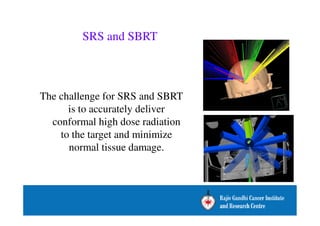
SRS and SBRT 
The challenge for SRS and SBRT 
is to accurately deliver 
conformal high dose radiation 
to the target and minimize 
normal tissue damage.
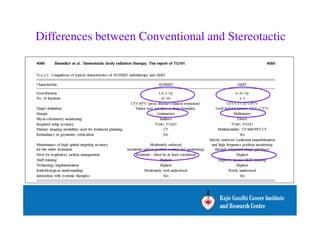
Differences between Conventional and Stereotactic
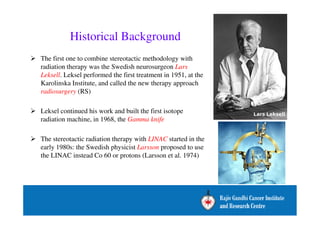
Historical Background 
 The first one to combine stereotactic methodology with 
radiation therapy was the Swedish neurosurgeon Lars 
Leksell. Leksel performed the first treatment in 1951, at the 
Karolinska Institute, and called the new therapy approach 
radiosurgery (RS) 
 Leksel continued his work and built the first isotope 
radiation machine, in 1968, the Gamma knife 
 The stereotactic radiation therapy with LINAC started in the 
early 1980s: the Swedish physicist Larsson proposed to use 
the LINAC instead Co 60 or protons (Larsson et al. 1974)
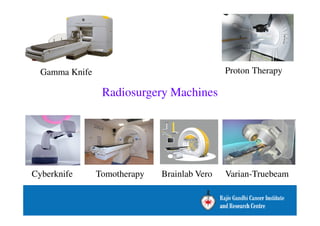
Gamma Knife Proton Therapy 
Radiosurgery Machines 
Cyberknife Tomotherapy Brainlab Vero Varian-Truebeam
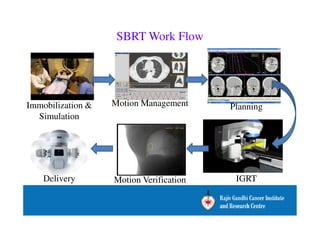
SBRT Work Flow 
Immobilization  
Simulation 
Motion Management Planning 
Delivery Motion Verification IGRT
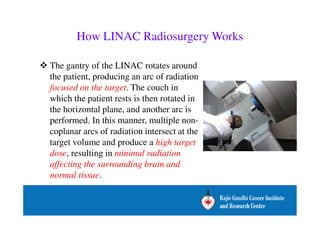
How LINAC Radiosurgery Works 
 The gantry of the LINAC rotates around 
the patient, producing an arc of radiation 
focused on the target. The couch in 
which the patient rests is then rotated in 
the horizontal plane, and another arc is 
performed. In this manner, multiple non-coplanar 
arcs of radiation intersect at the 
target volume and produce a high target 
dose, resulting in minimal radiation 
affecting the surrounding brain and 
normal tissue.
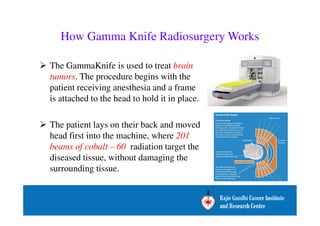
How Gamma Knife Radiosurgery Works 
 The GammaKnife is used to treat brain 
tumors. The procedure begins with the 
patient receiving anesthesia and a frame 
is attached to the head to hold it in place. 
 The patient lays on their back and moved 
head first into the machine, where 201 
beams of cobalt – 60 radiation target the 
diseased tissue, without damaging the 
surrounding tissue.
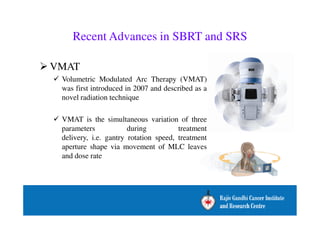
Recent Advances in SBRT and SRS 
VMAT 
 Volumetric Modulated Arc Therapy (VMAT) 
was first introduced in 2007 and described as a 
novel radiation technique 
 VMAT is the simultaneous variation of three 
parameters during treatment 
delivery, i.e. gantry rotation speed, treatment 
aperture shape via movement of MLC leaves 
and dose rate
Recent Advances in SBRT and SRS 
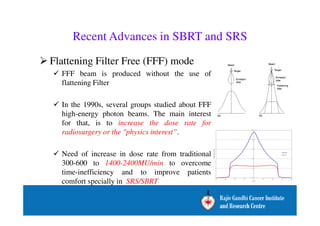
Flattening Filter Free (FFF) mode 
 FFF beam is produced without the use of 
flattening Filter 
 In the 1990s, several groups studied about FFF 
high-energy photon beams. The main interest 
for that, is to increase the dose rate for 
radiosurgery or the physics interest”. 
 Need of increase in dose rate from traditional 
300-600 to 1400-2400MU/min to overcome 
time-inefficiency and to improve patients 
comfort specially in SRS/SBRT
Dosimetric advantages of FFF beams 
 FFF has increased dose rate, e.g., 1400 MU/min for 6 MV, 
2400 MU/min for 10 MV. 
 FFF beams have less variation of off-axis beam hardening. 
 FFF has less photon head scatter and thus less field size 
dependence. 
 FFF has less leakage outside of beam collimation
Potential advantages of FFF beams 
 Fast treatment for Stereotactic Radiotherapy (SRT) and SRT 
plans between FB and FFF beams should be similar for small 
fields. 
 FFF is especially useful for SBRT, where respiration controlled 
treatment delivery is compromised by the large number of MU 
to delivery high fraction doses. 
 Patient beam on time can be reduced for IMRT
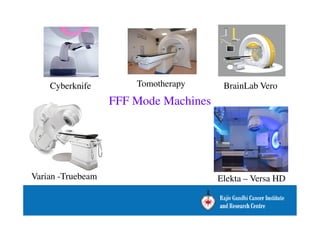
Cyberknife Tomotherapy BrainLab Vero 
FFF Mode Machines 
Varian -Truebeam Elekta – Versa HD
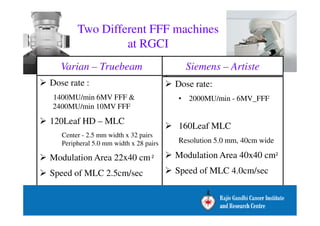
Two Different FFF machines 
at RGCI 
Varian – Truebeam 
 Dose rate : 
1400MU/min 6MV FFF  
2400MU/min 10MV FFF 
Siemens – Artiste 
 Dose rate: 
• 2000MU/min - 6MV_FFF 
 120Leaf HD – MLC 
Center - 2.5 mm width x 32 pairs 
Peripheral 5.0 mm width x 28 pairs 
 Modulation Area 22x40 cm2 
 Speed of MLC 2.5cm/sec 
 160Leaf MLC 
Resolution 5.0 mm, 40cm wide 
 Modulation Area 40x40 cm2 
 Speed of MLC 4.0cm/sec
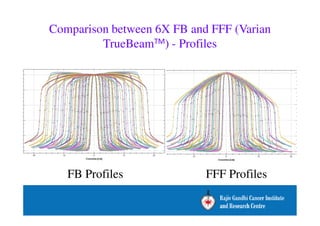
Comparison between 6X FB and FFF (Varian 

TrueBeamTM) - Profiles 
FB Profiles FFF Profiles
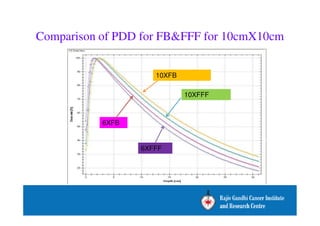
Comparison of PDD for FBFFF for 10cmX10cm 
10XFB 
10XFFF 
6XFFF 
6XFB
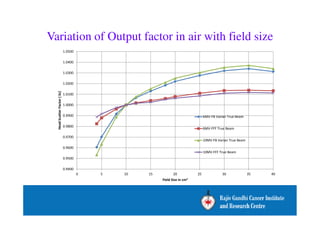
Variation of Output factor in air with field size 
1.0500 
1.0400 
1.0300 
1.0200 
1.0100 
1.0000 
Head Scatter Factor ( Sc) 
0.9900 
0.9800 
0.9700 
0.9600 
0.9500 
0.9400 
0 5 10 15 20 25 30 35 40 
Field Size in cm2 
6MV-FB Varian True Beam 
6MV-FFF True Beam 
10MV-FB Varian True Beam 
10MV-FFF True Beam
Dosimetry concern of FFF 
• Due to the above changes, the Dosimetric parameters like field size 
definition, beam quality, surface dose, off axis ratio (OAR), flatness, 
symmetry, degree of un-flatness, penumbra and depth dose profiles differs 
from standard Linac with Flat beam. 
• There is no international standard/acceptance test protocol available for 
FFF beam, AERB constituted a Task Group to evolve the acceptance 
criteria for FFF beam
AERB Recommendations for FFF 
Treatment should be 
implemented with TPS 
through Record  Verify 
system, Manual 
planning and calculation 
shall not be adopted in 
clinical use of FFF 
beam.
AERB Recommendations for FFF 
Measurements should cover 
 Beam Energy: 
TPR20/10 for 10 cm x 10 cm Field Size for all FFF energies 
 Surface dose: 
10cm x 10cm and 20cm x 20cm compared with the corresponding 
nominal flat beam energy 
 OAR 
At ±3 cm from central axis at the depth of 10 cm for 10 cm x 10 cm 
collimator setting shall be measured for all available FFF energies 
– 
•
AERB Recommendations for FFF 
 Depth dose profiles 
Dose profile for field size 5cm x 5cm, 10cm x 10cm and 20cm x 
20cm at depth of Dmax and 10cm shall be recorded for all available 
energies 
FS 10 cm x 10 cm, the Dosimetric parameters such as field size, 
penumbra, flatness, symmetry shall be measured and evaluated the 
methods applied for flat beam 
If flatness is  ± 3%, the evaluation criteria of unflattend beam shall 
be adopted
AERB Recommendations for FFF 
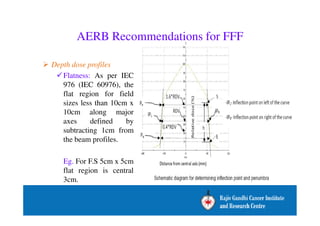
 Depth dose profiles 
Flatness: As per IEC 
976 (IEC 60976), the 
flat region for field 
sizes less than 10cm x 
10cm along major 
axes defined by 
subtracting 1cm from 
the beam profiles. 
Eg. For F.S 5cm x 5cm 
flat region is central 
3cm.
AERB Recommendations for FFF 
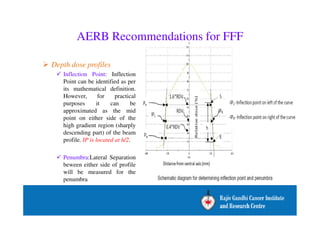
 Depth dose profiles 
 Inflection Point: Inflection 
Point can be identified as per 
its mathematical definition. 
However, for practical 
purposes it can be 
approximated as the mid 
point on either side of the 
high gradient region (sharply 
descending part) of the beam 
profile. IP is located at h/2. 
 Penumbra:Lateral Separation 
beween either side of profile 
will be measured for the 
penumbra
AERB Recommendations for FFF 
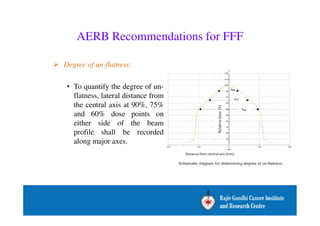
 Degree of un-flatness: 
• To quantify the degree of un-flatness, 
lateral distance from 
the central axis at 90%, 75% 
and 60% dose points on 
either side of the beam 
profile shall be recorded 
along major axes.
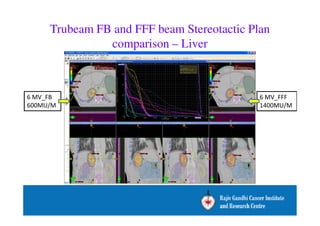
Trubeam FB and FFF beam Stereotactic Plan 
comparison – Liver 
6 MV_FFF 
1400MU/M 
6 MV_FB 
600MU/M
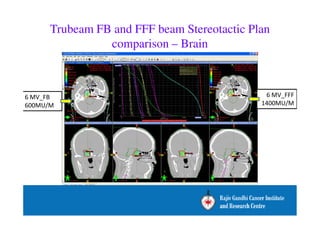
Trubeam FB and FFF beam Stereotactic Plan 
comparison – Brain 
6 MV_FB 
600MU/M 
6 MV_FFF 
1400MU/M
Comparison of FFF and FB for SBRT 
Similar Dose distribution and DVH for FB and FFF 
Treatment plan strategies are similar between FB and 
FFF beams since the beam profile are similar for field 
size  4 cm
AAPM TG 101 Recommendation for SBRT 
 SBRT Patient Selection Criteria: 
 When appropriate protocols are not available, clinicians must decide 
whether they will treat patients in accordance with published guidelines 
or develop new SBRT guidelines. At a minimum, an institutional 
treatment protocol or set of guidelines should be developed by 
radiation oncologists and physicists. 
 Simulation imaging: 
 The simulation study should cover the target and all organs at risk to 
obtain geometric and Dosimetric information for the treatment setup 
 Slice thickness:  3 mm near clinically important organs
AAPM TG 101 Recommendation for SBRT 
 Planning Recommendation: 
 The adequacy of target margins i.e., GTV, CTV, ITV, in SBRT should 
be based on from information in the current literature available 
 Dose Calculation Algorithm: 
 Algorithms that account for 3D scatter integration such as convolution/superposition 
have been found to perform adequately in most clinical situations, including in many 
cases circumstances where there is a loss of electronic equilibrium such as the lung tissue 
interface or tumor margin in low-density medium. 
 Calculation algorithms accounting for better photon and electron transport such as Monte 
Carlo would be ideal for the most demanding circumstances, such as a small lesion 
entirely surrounded by a low-density medium.
AAPM TG 101 Recommendation for SBRT 
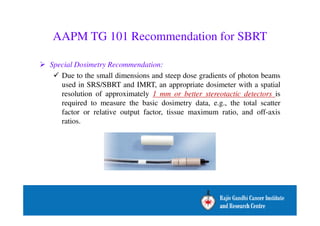
 Special Dosimetry Recommendation: 
 Due to the small dimensions and steep dose gradients of photon beams 
used in SRS/SBRT and IMRT, an appropriate dosimeter with a spatial 
resolution of approximately 1 mm or better stereotactic detectors is 
required to measure the basic dosimetry data, e.g., the total scatter 
factor or relative output factor, tissue maximum ratio, and off-axis 
ratios.
Accuracy of SRS  SBRT depends on 
 Linac Mechanical – Iso 
 Accuracy of SRS frame  Immobilization 
 Positional accuracy 
 Dosimetry accuracy
Conclusions 
 Advanced treatment techniques such as SBRT and IMRT have stimulated 
interest in FFF beam, which provides higher dose rate, and reduced head 
scatter, leaf transmission, and head radiation leakage. 
 Clinical utilities of FFF beam include a treatment time reduction for SRT, 
SBRT, and IMRT. 
 More studies are needed for FFF beam to specify and quantify the clinical 
advantages, especially with respect to treatment plan quality and quality 
assurance.
Conclusions 
 Several aspects related to standardization, dosimetry, treatment planning, 
and optimization need to be addressed in more detail in order to facilitate 
the clinical implementation of FFF beams.
Our Publications  Abstracts of FFF beam 
 “Comparison of Head Scatter Factor for 6MV and 10MV flattened (FB) and 
Unflattened (FFF) Photon Beam using indigenously Designed Columnar Mini 
Phantom” 
– Journal of Medical Physics, July-September 2014 
 A Comparison of Out-Of-Field Dose and Its Constituent Components for 6MV 
Flattened and 7MV Unflattened 
– AAPM 55th Annual Meeting - 2013 
 Comparison of the Depth Dose in the Build-Up Region and Surface Dose for 6MV 
Flattened and 7MV 
– AAPM 55th Annual Meeting - 2013 
 Scatter Factors Comparison of 6MV Flattened and 7MV Unflattened Beams 
– AAPM 54th Annual Meeting - 2012 
 Effect of Surface Dose and Depth of Maximum Dose with Physical Wedge Filters 
for 6MV Flattened and 7MV 
– AAPM 54th Annual Meeting - 2012
Our Medical Physics team 
Dr. Girigesh Yadav 
Mr. Manindra Mishra 
Mr. T. Suresh 
Mr. Lalit Kumar 
Mr. Pavan Singh

SRS & SBRT - Unflattened Beam

  • 1.
  • 2.
    Outline SRSand SBRT History of SRS Recent advances in SRS and SBRT Advantage of Flattening Filter Free(FFF) beam Characteristic of Flattening Filter Free beam Recommendation of AERB AAPM TG 101
  • 3.
    Introduction Stereotactic Radiosurgery(SRS) – SRS is a precise and focused delivery of a single, high dose of irradiation to a small and critically located intracranial volume while sparing normal structure Stereotactic Body Radiation Therapy (SBRT) – SBRT is a treatment procedure similar to SRS, except that it deals extra-cranial radiosurgery
  • 4.
    SRS and SBRTDefinition 1. High doses of radiation via multiple beams 2. Limited number of treatment session (1-5) 3. Image guided treatment (CT, PET, MRI) 4. Computer assisted robotic delivery 5. Real time respiratory motion accommodation
  • 5.
    SRS and SBRT The challenge for SRS and SBRT is to accurately deliver conformal high dose radiation to the target and minimize normal tissue damage.
  • 6.
  • 7.
    Historical Background The first one to combine stereotactic methodology with radiation therapy was the Swedish neurosurgeon Lars Leksell. Leksel performed the first treatment in 1951, at the Karolinska Institute, and called the new therapy approach radiosurgery (RS) Leksel continued his work and built the first isotope radiation machine, in 1968, the Gamma knife The stereotactic radiation therapy with LINAC started in the early 1980s: the Swedish physicist Larsson proposed to use the LINAC instead Co 60 or protons (Larsson et al. 1974)
  • 8.
    Gamma Knife ProtonTherapy Radiosurgery Machines Cyberknife Tomotherapy Brainlab Vero Varian-Truebeam
  • 9.
    SBRT Work Flow Immobilization Simulation Motion Management Planning Delivery Motion Verification IGRT
  • 10.
    How LINAC RadiosurgeryWorks The gantry of the LINAC rotates around the patient, producing an arc of radiation focused on the target. The couch in which the patient rests is then rotated in the horizontal plane, and another arc is performed. In this manner, multiple non-coplanar arcs of radiation intersect at the target volume and produce a high target dose, resulting in minimal radiation affecting the surrounding brain and normal tissue.
  • 11.
    How Gamma KnifeRadiosurgery Works The GammaKnife is used to treat brain tumors. The procedure begins with the patient receiving anesthesia and a frame is attached to the head to hold it in place. The patient lays on their back and moved head first into the machine, where 201 beams of cobalt – 60 radiation target the diseased tissue, without damaging the surrounding tissue.
  • 12.
    Recent Advances inSBRT and SRS VMAT Volumetric Modulated Arc Therapy (VMAT) was first introduced in 2007 and described as a novel radiation technique VMAT is the simultaneous variation of three parameters during treatment delivery, i.e. gantry rotation speed, treatment aperture shape via movement of MLC leaves and dose rate
  • 13.
    Recent Advances inSBRT and SRS Flattening Filter Free (FFF) mode FFF beam is produced without the use of flattening Filter In the 1990s, several groups studied about FFF high-energy photon beams. The main interest for that, is to increase the dose rate for radiosurgery or the physics interest”. Need of increase in dose rate from traditional 300-600 to 1400-2400MU/min to overcome time-inefficiency and to improve patients comfort specially in SRS/SBRT
  • 14.
    Dosimetric advantages ofFFF beams FFF has increased dose rate, e.g., 1400 MU/min for 6 MV, 2400 MU/min for 10 MV. FFF beams have less variation of off-axis beam hardening. FFF has less photon head scatter and thus less field size dependence. FFF has less leakage outside of beam collimation
  • 15.
    Potential advantages ofFFF beams Fast treatment for Stereotactic Radiotherapy (SRT) and SRT plans between FB and FFF beams should be similar for small fields. FFF is especially useful for SBRT, where respiration controlled treatment delivery is compromised by the large number of MU to delivery high fraction doses. Patient beam on time can be reduced for IMRT
  • 16.
    Cyberknife Tomotherapy BrainLabVero FFF Mode Machines Varian -Truebeam Elekta – Versa HD
  • 17.
    Two Different FFFmachines at RGCI Varian – Truebeam Dose rate : 1400MU/min 6MV FFF 2400MU/min 10MV FFF Siemens – Artiste Dose rate: • 2000MU/min - 6MV_FFF 120Leaf HD – MLC Center - 2.5 mm width x 32 pairs Peripheral 5.0 mm width x 28 pairs Modulation Area 22x40 cm2 Speed of MLC 2.5cm/sec 160Leaf MLC Resolution 5.0 mm, 40cm wide Modulation Area 40x40 cm2 Speed of MLC 4.0cm/sec
  • 18.
    Comparison between 6XFB and FFF (Varian TrueBeamTM) - Profiles FB Profiles FFF Profiles
  • 19.
    Comparison of PDDfor FBFFF for 10cmX10cm 10XFB 10XFFF 6XFFF 6XFB
  • 20.
    Variation of Outputfactor in air with field size 1.0500 1.0400 1.0300 1.0200 1.0100 1.0000 Head Scatter Factor ( Sc) 0.9900 0.9800 0.9700 0.9600 0.9500 0.9400 0 5 10 15 20 25 30 35 40 Field Size in cm2 6MV-FB Varian True Beam 6MV-FFF True Beam 10MV-FB Varian True Beam 10MV-FFF True Beam
  • 21.
    Dosimetry concern ofFFF • Due to the above changes, the Dosimetric parameters like field size definition, beam quality, surface dose, off axis ratio (OAR), flatness, symmetry, degree of un-flatness, penumbra and depth dose profiles differs from standard Linac with Flat beam. • There is no international standard/acceptance test protocol available for FFF beam, AERB constituted a Task Group to evolve the acceptance criteria for FFF beam
  • 22.
    AERB Recommendations forFFF Treatment should be implemented with TPS through Record Verify system, Manual planning and calculation shall not be adopted in clinical use of FFF beam.
  • 23.
    AERB Recommendations forFFF Measurements should cover Beam Energy: TPR20/10 for 10 cm x 10 cm Field Size for all FFF energies Surface dose: 10cm x 10cm and 20cm x 20cm compared with the corresponding nominal flat beam energy OAR At ±3 cm from central axis at the depth of 10 cm for 10 cm x 10 cm collimator setting shall be measured for all available FFF energies – •
  • 24.
    AERB Recommendations forFFF Depth dose profiles Dose profile for field size 5cm x 5cm, 10cm x 10cm and 20cm x 20cm at depth of Dmax and 10cm shall be recorded for all available energies FS 10 cm x 10 cm, the Dosimetric parameters such as field size, penumbra, flatness, symmetry shall be measured and evaluated the methods applied for flat beam If flatness is ± 3%, the evaluation criteria of unflattend beam shall be adopted
  • 25.
    AERB Recommendations forFFF Depth dose profiles Flatness: As per IEC 976 (IEC 60976), the flat region for field sizes less than 10cm x 10cm along major axes defined by subtracting 1cm from the beam profiles. Eg. For F.S 5cm x 5cm flat region is central 3cm.
  • 26.
    AERB Recommendations forFFF Depth dose profiles Inflection Point: Inflection Point can be identified as per its mathematical definition. However, for practical purposes it can be approximated as the mid point on either side of the high gradient region (sharply descending part) of the beam profile. IP is located at h/2. Penumbra:Lateral Separation beween either side of profile will be measured for the penumbra
  • 27.
    AERB Recommendations forFFF Degree of un-flatness: • To quantify the degree of un-flatness, lateral distance from the central axis at 90%, 75% and 60% dose points on either side of the beam profile shall be recorded along major axes.
  • 28.
    Trubeam FB andFFF beam Stereotactic Plan comparison – Liver 6 MV_FFF 1400MU/M 6 MV_FB 600MU/M
  • 29.
    Trubeam FB andFFF beam Stereotactic Plan comparison – Brain 6 MV_FB 600MU/M 6 MV_FFF 1400MU/M
  • 30.
    Comparison of FFFand FB for SBRT Similar Dose distribution and DVH for FB and FFF Treatment plan strategies are similar between FB and FFF beams since the beam profile are similar for field size 4 cm
  • 31.
    AAPM TG 101Recommendation for SBRT SBRT Patient Selection Criteria: When appropriate protocols are not available, clinicians must decide whether they will treat patients in accordance with published guidelines or develop new SBRT guidelines. At a minimum, an institutional treatment protocol or set of guidelines should be developed by radiation oncologists and physicists. Simulation imaging: The simulation study should cover the target and all organs at risk to obtain geometric and Dosimetric information for the treatment setup Slice thickness: 3 mm near clinically important organs
  • 32.
    AAPM TG 101Recommendation for SBRT Planning Recommendation: The adequacy of target margins i.e., GTV, CTV, ITV, in SBRT should be based on from information in the current literature available Dose Calculation Algorithm: Algorithms that account for 3D scatter integration such as convolution/superposition have been found to perform adequately in most clinical situations, including in many cases circumstances where there is a loss of electronic equilibrium such as the lung tissue interface or tumor margin in low-density medium. Calculation algorithms accounting for better photon and electron transport such as Monte Carlo would be ideal for the most demanding circumstances, such as a small lesion entirely surrounded by a low-density medium.
  • 33.
    AAPM TG 101Recommendation for SBRT Special Dosimetry Recommendation: Due to the small dimensions and steep dose gradients of photon beams used in SRS/SBRT and IMRT, an appropriate dosimeter with a spatial resolution of approximately 1 mm or better stereotactic detectors is required to measure the basic dosimetry data, e.g., the total scatter factor or relative output factor, tissue maximum ratio, and off-axis ratios.
  • 34.
    Accuracy of SRS SBRT depends on Linac Mechanical – Iso Accuracy of SRS frame Immobilization Positional accuracy Dosimetry accuracy
  • 35.
    Conclusions Advancedtreatment techniques such as SBRT and IMRT have stimulated interest in FFF beam, which provides higher dose rate, and reduced head scatter, leaf transmission, and head radiation leakage. Clinical utilities of FFF beam include a treatment time reduction for SRT, SBRT, and IMRT. More studies are needed for FFF beam to specify and quantify the clinical advantages, especially with respect to treatment plan quality and quality assurance.
  • 36.
    Conclusions Severalaspects related to standardization, dosimetry, treatment planning, and optimization need to be addressed in more detail in order to facilitate the clinical implementation of FFF beams.
  • 37.
    Our Publications Abstracts of FFF beam “Comparison of Head Scatter Factor for 6MV and 10MV flattened (FB) and Unflattened (FFF) Photon Beam using indigenously Designed Columnar Mini Phantom” – Journal of Medical Physics, July-September 2014 A Comparison of Out-Of-Field Dose and Its Constituent Components for 6MV Flattened and 7MV Unflattened – AAPM 55th Annual Meeting - 2013 Comparison of the Depth Dose in the Build-Up Region and Surface Dose for 6MV Flattened and 7MV – AAPM 55th Annual Meeting - 2013 Scatter Factors Comparison of 6MV Flattened and 7MV Unflattened Beams – AAPM 54th Annual Meeting - 2012 Effect of Surface Dose and Depth of Maximum Dose with Physical Wedge Filters for 6MV Flattened and 7MV – AAPM 54th Annual Meeting - 2012
  • 38.
    Our Medical Physicsteam Dr. Girigesh Yadav Mr. Manindra Mishra Mr. T. Suresh Mr. Lalit Kumar Mr. Pavan Singh