CT-to-TPS-to-verification
summary of simulation process
Vibha Chaswal, Ph.D.
Know the co-ordinate system TPS
uses

Patient co-ordinate system (not
used in Pinnacle)

CT co-ordinate system
Image data on acquisition on CT
• Image request form: Patient positioned using
lap lasers (ct bb’s on lap lasers)
• Immobilization devices marked
• Orientation and technique (protocol) selected
in CT
• Topogram acquisition
• CT scan acquisition
• Dicom images send to TPS and archive
TPS processes
• Image data imported
• Scanning information verified ( patient position,
orientation)
• CT bb’s are localized w.r.t. CT room lasers co-ordinate
system
• ROIs are contoured and isocenter is defined w.r.t machine
co-ordinate system
• Shifts from ct-bb’s to isocenter are given w.r.t treatment
table (up/down, L/R, in/out)
• Segmentation, TP (beams, blocks, dose) and DRRs
generated (set-up and field)
• Transfer TP to record and verify (LEX), DRRs to machine
(coherence)
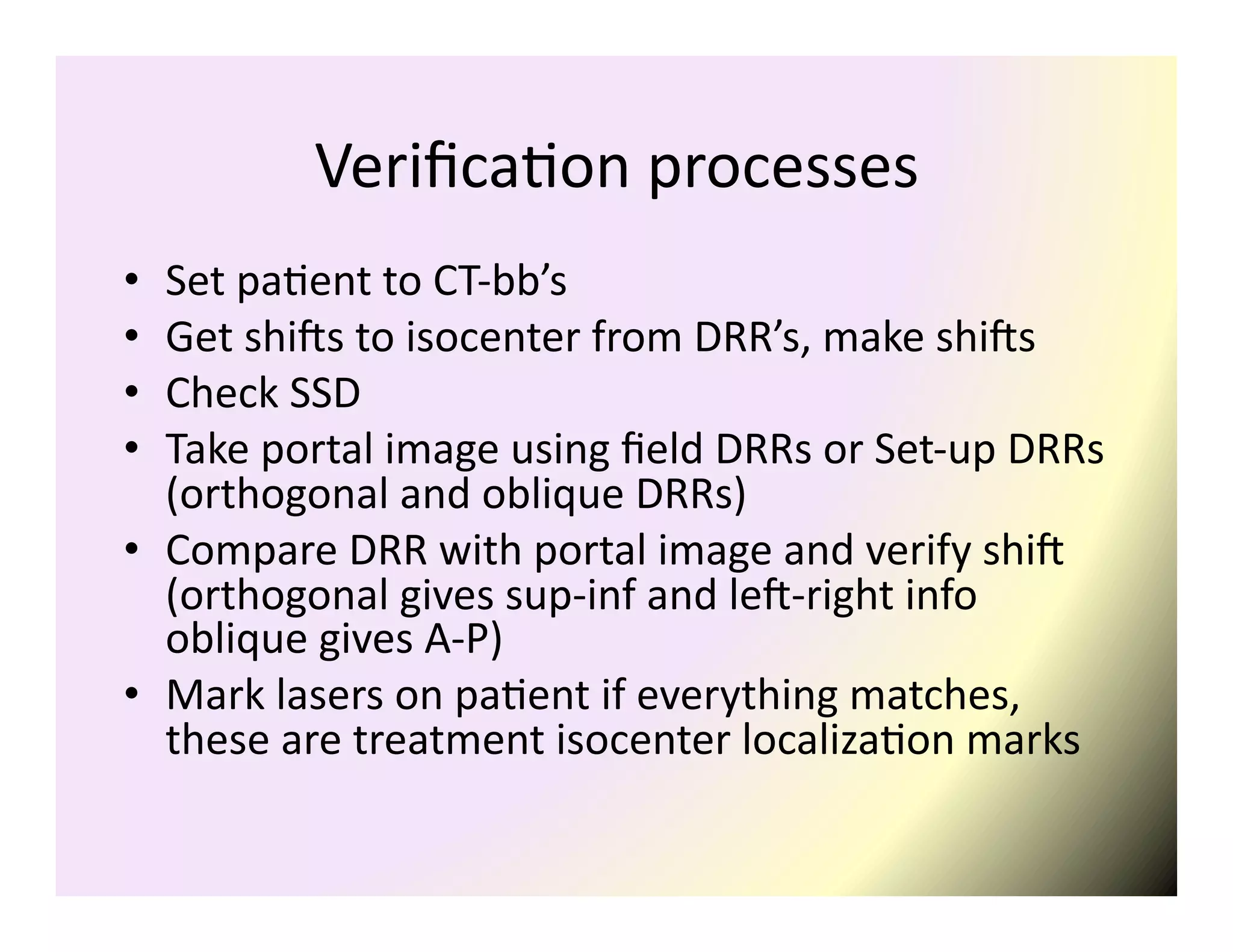
Verification processes
•
•
•
•

Set patient to CT-bb’s
Get shifts to isocenter from DRR’s, make shifts
Check SSD
Take portal image using field DRRs or Set-up
DRRs (orthogonal and oblique DRRs)
• Compare DRR with portal image and verify shift
(orthogonal gives sup-inf and left-right info
oblique gives A-P)
• Mark lasers on patient if everything matches,
these are treatment isocenter localization marks
• Bite-block – physicist verifies the physical
positioning of bite-block before CT scan,
radiocam localization no ct bb’s
• Cone-beam – Cone beam field with CT image
and segmented structures sent to machine,
MVCT image compared with the help of bony
land-marks and contours
Thank You!
Thank You!

Radiotherapy Treatment Simulation

  • 1.
  • 2.
    Know the co-ordinatesystem TPS uses Patient co-ordinate system (not used in Pinnacle) CT co-ordinate system
  • 4.
    Image data onacquisition on CT • Image request form: Patient positioned using lap lasers (ct bb’s on lap lasers) • Immobilization devices marked • Orientation and technique (protocol) selected in CT • Topogram acquisition • CT scan acquisition • Dicom images send to TPS and archive
  • 5.
    TPS processes • Imagedata imported • Scanning information verified ( patient position, orientation) • CT bb’s are localized w.r.t. CT room lasers co-ordinate system • ROIs are contoured and isocenter is defined w.r.t machine co-ordinate system • Shifts from ct-bb’s to isocenter are given w.r.t treatment table (up/down, L/R, in/out) • Segmentation, TP (beams, blocks, dose) and DRRs generated (set-up and field) • Transfer TP to record and verify (LEX), DRRs to machine (coherence)
  • 6.
    Verification processes • • • • Set patientto CT-bb’s Get shifts to isocenter from DRR’s, make shifts Check SSD Take portal image using field DRRs or Set-up DRRs (orthogonal and oblique DRRs) • Compare DRR with portal image and verify shift (orthogonal gives sup-inf and left-right info oblique gives A-P) • Mark lasers on patient if everything matches, these are treatment isocenter localization marks
  • 8.
    • Bite-block –physicist verifies the physical positioning of bite-block before CT scan, radiocam localization no ct bb’s • Cone-beam – Cone beam field with CT image and segmented structures sent to machine, MVCT image compared with the help of bony land-marks and contours
  • 9.
  • 10.