Isotopic Teletherapy Machines


                  DR ARNAB BOSE
                  Dept. of Radiotherapy
                  NRS Medical College, Kolkata

                                                 1
 Treatment machines incorporating γ ray sources for
use in external beam radiotherapy are called
isotopic teletherapy machines.

 For use in external beam radiotherapy, γ rays are
obtained from specially designed and built sources that
contain a suitable, artificially produced radioactive material.
The parent source material undergoes a β decay,
resulting in excited daughter nuclei that attain ground
state through emission of γ rays (γ decay).

                                                            2
 The important characteristics of radioisotopes in
external beam radiotherapy are:

1.   High γ ray energy
2.   High specific activity
3.   Relatively long half-life
4.   Large specific air kerma rate constant( ΓAKR )
5.   Must be available in large quantities


                                                      3
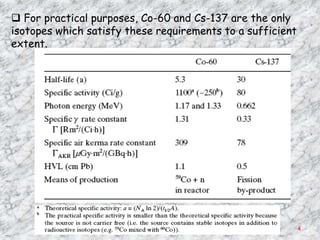
 For practical purposes, Co-60 and Cs-137 are the only
isotopes which satisfy these requirements to a sufficient
extent.


                                                            4
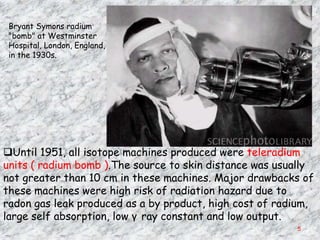
Bryant Symons radium
 "bomb" at Westminster
 Hospital, London, England,
 in the 1930s.


Until 1951, all isotope machines produced were teleradium
units ( radium bomb ).The source to skin distance was usually
not greater than 10 cm in these machines. Major drawbacks of
these machines were high risk of radiation hazard due to
radon gas leak produced as a by product, high cost of radium,
large self absorption, low γ ray constant and low output.
                                                         5
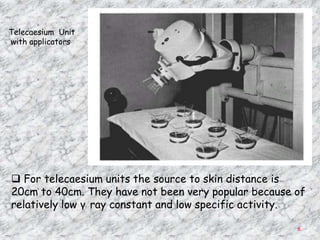
Telecaesium Unit
with applicators


 For telecaesium units the source to skin distance is
20cm to 40cm. They have not been very popular because of
relatively low γ ray constant and low specific activity.

                                                      6
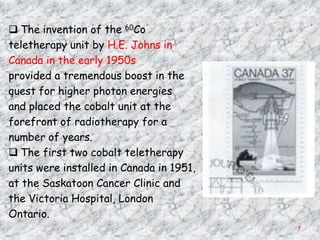
 The invention of the 60Co
teletherapy unit by H.E. Johns in
Canada in the early 1950s
provided a tremendous boost in the
quest for higher photon energies
and placed the cobalt unit at the
forefront of radiotherapy for a
number of years.
 The first two cobalt teletherapy
units were installed in Canada in 1951,
at the Saskatoon Cancer Clinic and
the Victoria Hospital, London
Ontario.
                                          7
 The development of nuclear reactors in the late 1940s
made possible the production of small 60Co sources with
specific activities (in Curies per gram) high enough to
produce clinically acceptable dose rates of more than 1 Gray
(Gy) per minute at a typical treatment distance of 80 cm
from the source.

 These machines quickly became the standard of
radiotherapy because of their simplicity of design and
operation, low cost, and availability.


                                                         8
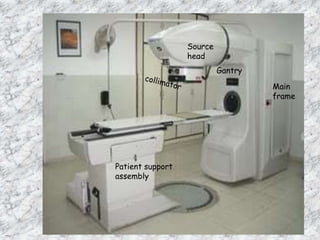
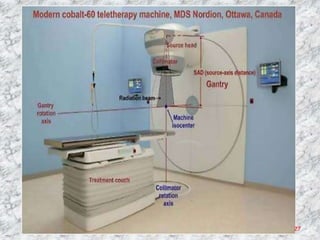
 The main components of a teletherapy machine are:

1. a radioactive source;
2. a source housing, including beam collimator and source
   movement mechanism;
3. a gantry and stand in isocentric machines or a housing
   support assembly in stand-alone machines;
4. a patient support assembly; and
5. a machine console.


                                                            9
Source
                  head
                           Gantry

                                    Main
                                    frame


Patient support
assembly


                                        10
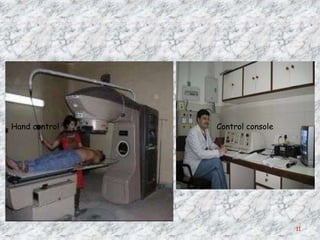
Hand control   Control console


                                 11
Source

 Natural cobalt is a hard, stable, bluish-gray, easily
breakable metal. Its atoms contain 27 protons, 32 neutrons,
and 27 electrons.

 Non-radioactive cobalt can be found mixed with various
minerals in nature, and has been used to impart a blue color
to glass and ceramics for thousands of years.

 The well-known isotope of cobalt is unstable radioactive
Co-60. This isotope was discovered by Glenn Seaborg
and John Livingood at California Berkeley University in
1930.


                                                          12
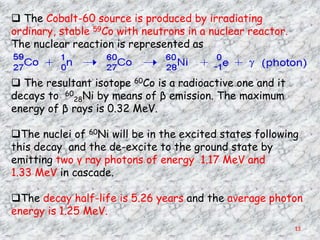
 The Cobalt-60 source is produced by irradiating
ordinary, stable 59Co with neutrons in a nuclear reactor.
The nuclear reaction is represented as


 The resultant isotope 60Co is a radioactive one and it
decays to 6028Ni by means of β emission. The maximum
energy of β rays is 0.32 MeV.

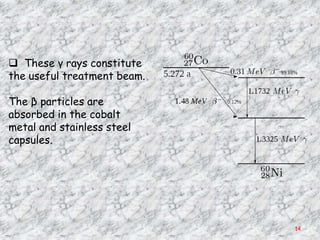
The nuclei of 60Ni will be in the excited states following
this decay and the de-excite to the ground state by
emitting two γ ray photons of energy 1.17 MeV and
1.33 MeV in cascade.

The decay half-life is 5.26 years and the average photon
energy is 1.25 MeV.
                                                            13
 These γ rays constitute
the useful treatment beam.

The β particles are
absorbed in the cobalt
metal and stainless steel
capsules.


                             14
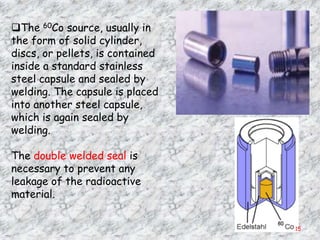
The 60Co source, usually in
the form of solid cylinder,
discs, or pellets, is contained
inside a standard stainless
steel capsule and sealed by
welding. The capsule is placed
into another steel capsule,
which is again sealed by
welding.

The double welded seal is
necessary to prevent any
leakage of the radioactive
material.


                                  15
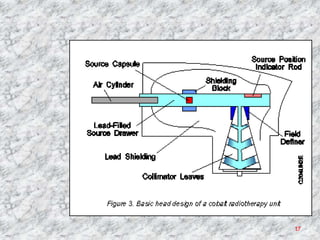
Source Housing
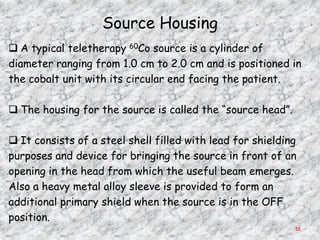
 A typical teletherapy 60Co source is a cylinder of
diameter ranging from 1.0 cm to 2.0 cm and is positioned in
the cobalt unit with its circular end facing the patient.

 The housing for the source is called the ―source head‖.

 It consists of a steel shell filled with lead for shielding
purposes and device for bringing the source in front of an
opening in the head from which the useful beam emerges.
Also a heavy metal alloy sleeve is provided to form an
additional primary shield when the source is in the OFF
position.
                                                            16
17
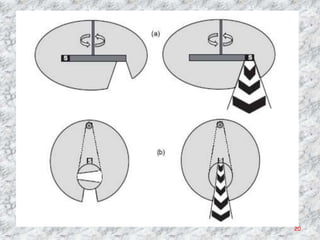
 A number of methods have been developed for moving
 the source from OFF position to ON position-

1. Source mounted on a rotating wheel inside the source
   head to carry the source from OFF to On position

2. Source mounted on a heavy metal drawer is moved
   horizontally by pneumatic system through a hole running
   through the source head. In the ON position the source
   faces the aperture for the treatment beam and in the
   OFF position the source moves to its shielded location
   and the light source mounted on the same drawer
   occupies the ON position of the source.
                                                       18
3. Mercury is allowed to flow into a container immediately
   below the source to shut OFF the beam.

4. Source is fixed in front of the aperture and the beam
   can be turned ON and OFF by a shutter consisting of
   heavy metal jaws.


                                                        19
20
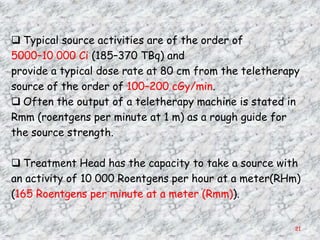
 Typical source activities are of the order of
5000–10 000 Ci (185–370 TBq) and
provide a typical dose rate at 80 cm from the teletherapy
source of the order of 100–200 cGy/min.
 Often the output of a teletherapy machine is stated in
Rmm (roentgens per minute at 1 m) as a rough guide for
the source strength.

 Treatment Head has the capacity to take a source with
an activity of 10 000 Roentgens per hour at a meter(RHm)
(165 Roentgens per minute at a meter (Rmm)).


                                                        21
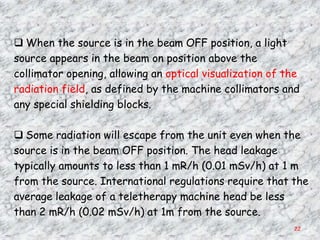
 When the source is in the beam OFF position, a light
source appears in the beam on position above the
collimator opening, allowing an optical visualization of the
radiation field, as defined by the machine collimators and
any special shielding blocks.

 Some radiation will escape from the unit even when the
source is in the beam OFF position. The head leakage
typically amounts to less than 1 mR/h (0.01 mSv/h) at 1 m
from the source. International regulations require that the
average leakage of a teletherapy machine head be less
than 2 mR/h (0.02 mSv/h) at 1m from the source.
                                                          22
Collimators
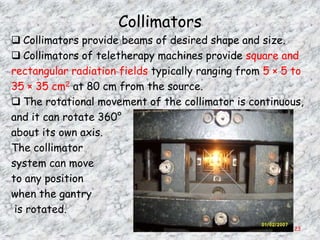
 Collimators provide beams of desired shape and size.
 Collimators of teletherapy machines provide square and
rectangular radiation fields typically ranging from 5 × 5 to
35 × 35 cm2 at 80 cm from the source.
 The rotational movement of the collimator is continuous,
and it can rotate 360°
about its own axis.
The collimator
system can move
to any position
when the gantry
 is rotated.
                                                          23
Gantry
 The gantry can rotate by 360°. The rotational movement
of the gantry is motorized and controlled in two directions
continuously; its rotation speed can be adjusted.

 Teletherapy machines are most often mounted
isocentrically, allowing the beam to rotate about the
patient at a fixed SAD. They can be used either as fixed
field machines or rotation units.

 Modern teletherapy machines have
SADs of 80 or 100 cm.
                                                        24
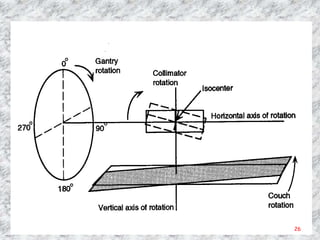
The axis of rotation of the three structures:
Gantry
Collimator
Couch
coincide at a point known as the Isocenter.

 Isocentric Mounting
1.   Enhances accuracy.
2.   Allows faster setup and is more accurate than older
     non isocentrically mounted machines.
3.   Makes setup transfer easy from the simulator to the
     treatment machine.
                                                      25
26
27
Patient Support Assembly
 Treatment Bed has motorized movements
1.   Horizontal
2.   Vertical
3.   Lateral
4.   Table Top - 90o rotation to each side
5.   Base - 110o rotation to each side

 Bedtop size   l x w cm (in)   -   235 x 46 (93x 18)

 Patient weight capacity   kg (lb) -    136 (300)


                                                        28
Control Console
 Control Console is situated outside the bunker
 Interlocks present on the console for
1.      Air Pressure
2.      Door
3.      Head Lock -Treatment Head has a swivel movement
                 of +/- 180o
4.     OFF Shield
5.    Treatment Mode
6.    Wedge Filter
7.    Tray Interlock
8.    Timer
                                                    29
 Timer
      The prescribed target dose is delivered with the help
of two treatment timers:
       Primary Timer - the primary timer actually controls
                     the treatment time.
       Secondary Timer - accounts for the source
                      movement from OFF to ON
                      position and again to OFF
                      position (shutter error).

 Source ON/OFF Indicator –
      Red- ON     Green- OFF            Amber- TRANSIT
                                                       30
Treatment Beam

 Cobalt-60 ( 60Co) can be produced by placing cobalt-59
in a strong neutron field, the nucleus absorbing a neutron
to form 60Co. As soon as it is formed 60Co starts to undergo
radioactive decay to nickel-60 with a half -life of 5.26 yrs.

 The emissions are
a β−particle with an energy of 0.31MeV(max) and
two γ rays with energies of 1.17 MeV and 1.33 MeV.


                                                          31
 These γ rays constitute the useful treatment beam.

 The β particles are absorbed in the cobalt metal and the
stainless steel capsules resulting in the emission of
bremsstrahlung x-rays and a small amount of characteristic
x-rays.

 However these x-rays of average energy 0.1 MeV do
not contribute appreciably to the dose in the patient
because they are strongly attenuated in the material of the
source and the capsule.

                                                        32
 The lower energy γ rays produced by the interaction of
the primary γ radiation with the source itself, the
surrounding capsule, the source housing and the collimator
system are also contaminants of the treatment beam.

 The scattered components of the beam contribute
significantly ( approx. 10% ) to the total intensity of the
beam.


                                                              33
 Electrons are also produced by these interactions and
constitute electron contamination of the photon beam.

 Electron contamination can reverse the skin sparing
effects of cobalt60 treatment beam, if severe.

 Electron contamination is greater for
very short diaphragm to skin distances and
for large field sizes.


                                                          34
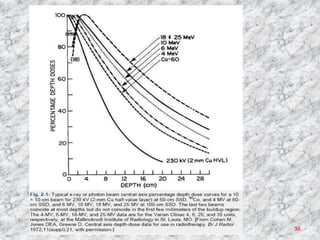
 Beam characteristics for photon beam energy
        60Co, SSD = 80 cm


1. Depth of maximum dose = 0.5 cm
2. Increased penetration (10-cm PDD = 55%)
3. Beam edge not as well defined—penumbra due to source
   size
4. Dose outside beam low because most scattering is in
   forward direction
5. Isodose curvature increases as the field size increases

                                                        35
36
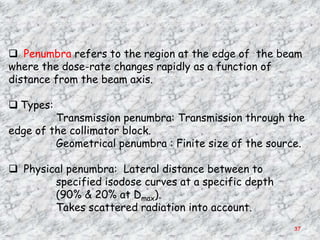
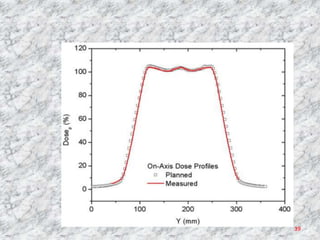
 Penumbra refers to the region at the edge of the beam
where the dose-rate changes rapidly as a function of
distance from the beam axis.

 Types:
         Transmission penumbra: Transmission through the
edge of the collimator block.
         Geometrical penumbra : Finite size of the source.

 Physical penumbra: Lateral distance between to
        specified isodose curves at a specific depth
        (90% & 20% at Dmax).
        Takes scattered radiation into account.
                                                       37
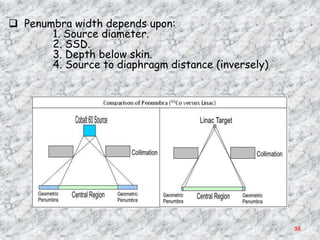
 Penumbra width depends upon:
       1. Source diameter.
       2. SSD.
       3. Depth below skin.
       4. Source to diaphragm distance (inversely)


                                                     38
39
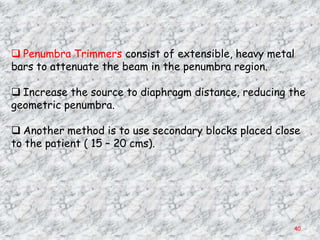
 Penumbra Trimmers consist of extensible, heavy metal
bars to attenuate the beam in the penumbra region.

 Increase the source to diaphragm distance, reducing the
geometric penumbra.

 Another method is to use secondary blocks placed close
to the patient ( 15 – 20 cms).


                                                      40
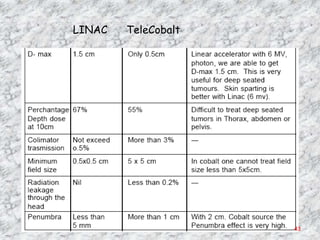
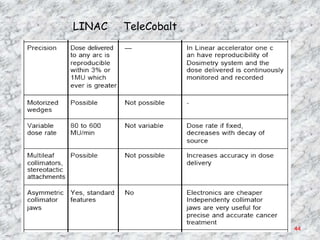
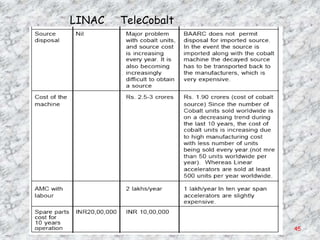
Comparison with Linear Accelerator

 Several arguments have been put forward both for and
against Cobalt Units as well as Linear accelerators.

 These arguments relate to physics, clinical advantages
and more importantly, the cost consideration.


                                                           41
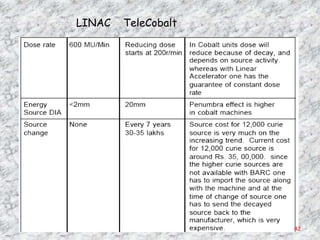
LINAC   TeleCobalt


                     42
LINAC   TeleCobalt


                     43
LINAC   TeleCobalt


                     44
LINAC   TeleCobalt


                     45
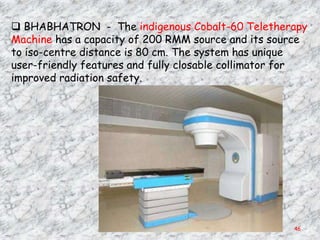
 BHABHATRON - The indigenous Cobalt-60 Teletherapy
Machine has a capacity of 200 RMM source and its source
to iso-centre distance is 80 cm. The system has unique
user-friendly features and fully closable collimator for
improved radiation safety.


                                                     46
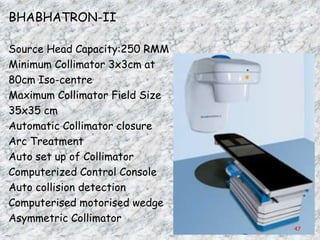
BHABHATRON-II

Source Head Capacity:250 RMM
Minimum Collimator 3x3cm at
80cm Iso-centre
Maximum Collimator Field Size
35x35 cm
Automatic Collimator closure
Arc Treatment
Auto set up of Collimator
Computerized Control Console
Auto collision detection
Computerised motorised wedge
Asymmetric Collimator
                                47

Isotopic Teletherapy Machines

  • 1.
    Isotopic Teletherapy Machines DR ARNAB BOSE Dept. of Radiotherapy NRS Medical College, Kolkata 1
  • 2.
     Treatment machinesincorporating γ ray sources for use in external beam radiotherapy are called isotopic teletherapy machines.  For use in external beam radiotherapy, γ rays are obtained from specially designed and built sources that contain a suitable, artificially produced radioactive material. The parent source material undergoes a β decay, resulting in excited daughter nuclei that attain ground state through emission of γ rays (γ decay). 2
  • 3.
     The importantcharacteristics of radioisotopes in external beam radiotherapy are: 1. High γ ray energy 2. High specific activity 3. Relatively long half-life 4. Large specific air kerma rate constant( ΓAKR ) 5. Must be available in large quantities 3
  • 4.
     For practicalpurposes, Co-60 and Cs-137 are the only isotopes which satisfy these requirements to a sufficient extent. 4
  • 5.
    Bryant Symons radium "bomb" at Westminster Hospital, London, England, in the 1930s. Until 1951, all isotope machines produced were teleradium units ( radium bomb ).The source to skin distance was usually not greater than 10 cm in these machines. Major drawbacks of these machines were high risk of radiation hazard due to radon gas leak produced as a by product, high cost of radium, large self absorption, low γ ray constant and low output. 5
  • 6.
    Telecaesium Unit with applicators For telecaesium units the source to skin distance is 20cm to 40cm. They have not been very popular because of relatively low γ ray constant and low specific activity. 6
  • 7.
     The inventionof the 60Co teletherapy unit by H.E. Johns in Canada in the early 1950s provided a tremendous boost in the quest for higher photon energies and placed the cobalt unit at the forefront of radiotherapy for a number of years.  The first two cobalt teletherapy units were installed in Canada in 1951, at the Saskatoon Cancer Clinic and the Victoria Hospital, London Ontario. 7
  • 8.
     The developmentof nuclear reactors in the late 1940s made possible the production of small 60Co sources with specific activities (in Curies per gram) high enough to produce clinically acceptable dose rates of more than 1 Gray (Gy) per minute at a typical treatment distance of 80 cm from the source.  These machines quickly became the standard of radiotherapy because of their simplicity of design and operation, low cost, and availability. 8
  • 9.
     The maincomponents of a teletherapy machine are: 1. a radioactive source; 2. a source housing, including beam collimator and source movement mechanism; 3. a gantry and stand in isocentric machines or a housing support assembly in stand-alone machines; 4. a patient support assembly; and 5. a machine console. 9
  • 10.
    Source head Gantry Main frame Patient support assembly 10
  • 11.
    Hand control Control console 11
  • 12.
    Source  Natural cobaltis a hard, stable, bluish-gray, easily breakable metal. Its atoms contain 27 protons, 32 neutrons, and 27 electrons.  Non-radioactive cobalt can be found mixed with various minerals in nature, and has been used to impart a blue color to glass and ceramics for thousands of years.  The well-known isotope of cobalt is unstable radioactive Co-60. This isotope was discovered by Glenn Seaborg and John Livingood at California Berkeley University in 1930. 12
  • 13.
     The Cobalt-60source is produced by irradiating ordinary, stable 59Co with neutrons in a nuclear reactor. The nuclear reaction is represented as  The resultant isotope 60Co is a radioactive one and it decays to 6028Ni by means of β emission. The maximum energy of β rays is 0.32 MeV. The nuclei of 60Ni will be in the excited states following this decay and the de-excite to the ground state by emitting two γ ray photons of energy 1.17 MeV and 1.33 MeV in cascade. The decay half-life is 5.26 years and the average photon energy is 1.25 MeV. 13
  • 14.
     These γrays constitute the useful treatment beam. The β particles are absorbed in the cobalt metal and stainless steel capsules. 14
  • 15.
    The 60Co source,usually in the form of solid cylinder, discs, or pellets, is contained inside a standard stainless steel capsule and sealed by welding. The capsule is placed into another steel capsule, which is again sealed by welding. The double welded seal is necessary to prevent any leakage of the radioactive material. 15
  • 16.
    Source Housing  Atypical teletherapy 60Co source is a cylinder of diameter ranging from 1.0 cm to 2.0 cm and is positioned in the cobalt unit with its circular end facing the patient.  The housing for the source is called the ―source head‖.  It consists of a steel shell filled with lead for shielding purposes and device for bringing the source in front of an opening in the head from which the useful beam emerges. Also a heavy metal alloy sleeve is provided to form an additional primary shield when the source is in the OFF position. 16
  • 17.
  • 18.
     A numberof methods have been developed for moving the source from OFF position to ON position- 1. Source mounted on a rotating wheel inside the source head to carry the source from OFF to On position 2. Source mounted on a heavy metal drawer is moved horizontally by pneumatic system through a hole running through the source head. In the ON position the source faces the aperture for the treatment beam and in the OFF position the source moves to its shielded location and the light source mounted on the same drawer occupies the ON position of the source. 18
  • 19.
    3. Mercury isallowed to flow into a container immediately below the source to shut OFF the beam. 4. Source is fixed in front of the aperture and the beam can be turned ON and OFF by a shutter consisting of heavy metal jaws. 19
  • 20.
  • 21.
     Typical sourceactivities are of the order of 5000–10 000 Ci (185–370 TBq) and provide a typical dose rate at 80 cm from the teletherapy source of the order of 100–200 cGy/min.  Often the output of a teletherapy machine is stated in Rmm (roentgens per minute at 1 m) as a rough guide for the source strength.  Treatment Head has the capacity to take a source with an activity of 10 000 Roentgens per hour at a meter(RHm) (165 Roentgens per minute at a meter (Rmm)). 21
  • 22.
     When thesource is in the beam OFF position, a light source appears in the beam on position above the collimator opening, allowing an optical visualization of the radiation field, as defined by the machine collimators and any special shielding blocks.  Some radiation will escape from the unit even when the source is in the beam OFF position. The head leakage typically amounts to less than 1 mR/h (0.01 mSv/h) at 1 m from the source. International regulations require that the average leakage of a teletherapy machine head be less than 2 mR/h (0.02 mSv/h) at 1m from the source. 22
  • 23.
    Collimators  Collimators providebeams of desired shape and size.  Collimators of teletherapy machines provide square and rectangular radiation fields typically ranging from 5 × 5 to 35 × 35 cm2 at 80 cm from the source.  The rotational movement of the collimator is continuous, and it can rotate 360° about its own axis. The collimator system can move to any position when the gantry is rotated. 23
  • 24.
    Gantry  The gantrycan rotate by 360°. The rotational movement of the gantry is motorized and controlled in two directions continuously; its rotation speed can be adjusted.  Teletherapy machines are most often mounted isocentrically, allowing the beam to rotate about the patient at a fixed SAD. They can be used either as fixed field machines or rotation units.  Modern teletherapy machines have SADs of 80 or 100 cm. 24
  • 25.
    The axis ofrotation of the three structures: Gantry Collimator Couch coincide at a point known as the Isocenter.  Isocentric Mounting 1. Enhances accuracy. 2. Allows faster setup and is more accurate than older non isocentrically mounted machines. 3. Makes setup transfer easy from the simulator to the treatment machine. 25
  • 26.
  • 27.
  • 28.
    Patient Support Assembly Treatment Bed has motorized movements 1. Horizontal 2. Vertical 3. Lateral 4. Table Top - 90o rotation to each side 5. Base - 110o rotation to each side  Bedtop size l x w cm (in) - 235 x 46 (93x 18)  Patient weight capacity kg (lb) - 136 (300) 28
  • 29.
    Control Console  ControlConsole is situated outside the bunker  Interlocks present on the console for 1. Air Pressure 2. Door 3. Head Lock -Treatment Head has a swivel movement of +/- 180o 4. OFF Shield 5. Treatment Mode 6. Wedge Filter 7. Tray Interlock 8. Timer 29
  • 30.
     Timer The prescribed target dose is delivered with the help of two treatment timers: Primary Timer - the primary timer actually controls the treatment time. Secondary Timer - accounts for the source movement from OFF to ON position and again to OFF position (shutter error).  Source ON/OFF Indicator – Red- ON Green- OFF Amber- TRANSIT 30
  • 31.
    Treatment Beam  Cobalt-60( 60Co) can be produced by placing cobalt-59 in a strong neutron field, the nucleus absorbing a neutron to form 60Co. As soon as it is formed 60Co starts to undergo radioactive decay to nickel-60 with a half -life of 5.26 yrs.  The emissions are a β−particle with an energy of 0.31MeV(max) and two γ rays with energies of 1.17 MeV and 1.33 MeV. 31
  • 32.
     These γrays constitute the useful treatment beam.  The β particles are absorbed in the cobalt metal and the stainless steel capsules resulting in the emission of bremsstrahlung x-rays and a small amount of characteristic x-rays.  However these x-rays of average energy 0.1 MeV do not contribute appreciably to the dose in the patient because they are strongly attenuated in the material of the source and the capsule. 32
  • 33.
     The lowerenergy γ rays produced by the interaction of the primary γ radiation with the source itself, the surrounding capsule, the source housing and the collimator system are also contaminants of the treatment beam.  The scattered components of the beam contribute significantly ( approx. 10% ) to the total intensity of the beam. 33
  • 34.
     Electrons arealso produced by these interactions and constitute electron contamination of the photon beam.  Electron contamination can reverse the skin sparing effects of cobalt60 treatment beam, if severe.  Electron contamination is greater for very short diaphragm to skin distances and for large field sizes. 34
  • 35.
     Beam characteristicsfor photon beam energy 60Co, SSD = 80 cm 1. Depth of maximum dose = 0.5 cm 2. Increased penetration (10-cm PDD = 55%) 3. Beam edge not as well defined—penumbra due to source size 4. Dose outside beam low because most scattering is in forward direction 5. Isodose curvature increases as the field size increases 35
  • 36.
  • 37.
     Penumbra refersto the region at the edge of the beam where the dose-rate changes rapidly as a function of distance from the beam axis.  Types: Transmission penumbra: Transmission through the edge of the collimator block. Geometrical penumbra : Finite size of the source.  Physical penumbra: Lateral distance between to specified isodose curves at a specific depth (90% & 20% at Dmax). Takes scattered radiation into account. 37
  • 38.
     Penumbra widthdepends upon: 1. Source diameter. 2. SSD. 3. Depth below skin. 4. Source to diaphragm distance (inversely) 38
  • 39.
  • 40.
     Penumbra Trimmersconsist of extensible, heavy metal bars to attenuate the beam in the penumbra region.  Increase the source to diaphragm distance, reducing the geometric penumbra.  Another method is to use secondary blocks placed close to the patient ( 15 – 20 cms). 40
  • 41.
    Comparison with LinearAccelerator  Several arguments have been put forward both for and against Cobalt Units as well as Linear accelerators.  These arguments relate to physics, clinical advantages and more importantly, the cost consideration. 41
  • 42.
    LINAC TeleCobalt 42
  • 43.
    LINAC TeleCobalt 43
  • 44.
    LINAC TeleCobalt 44
  • 45.
    LINAC TeleCobalt 45
  • 46.
     BHABHATRON -The indigenous Cobalt-60 Teletherapy Machine has a capacity of 200 RMM source and its source to iso-centre distance is 80 cm. The system has unique user-friendly features and fully closable collimator for improved radiation safety. 46
  • 47.
    BHABHATRON-II Source Head Capacity:250RMM Minimum Collimator 3x3cm at 80cm Iso-centre Maximum Collimator Field Size 35x35 cm Automatic Collimator closure Arc Treatment Auto set up of Collimator Computerized Control Console Auto collision detection Computerised motorised wedge Asymmetric Collimator 47