Beam Modification devices in Radiotherapy Moderator: Prof. S.C. Sharma  Head Of Department  Department of Radiotherapy PGIMER
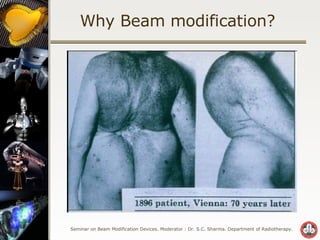
Why Beam modification?
Introduction Defined as  desirable  modification in the  spatial  distribution of radiation - within the patient - by insertion of any material in the beam path.
Types of beam modification  There are four main types of beam modification: Shielding : To eliminate radiation dose to some special parts of the zone at which the beam is directed. Compensation : To allow  normal  dose distribution data to be applied to the treated zone, when the beam enters a or obliquely through the body or where different types of tissues are present. Wedge filtration : Where a special tilt in isodose curves is obtained. Flattening : Where the spatial distribution of the natural beam is altered by reducing the central exposure rate relative to the peripheral.
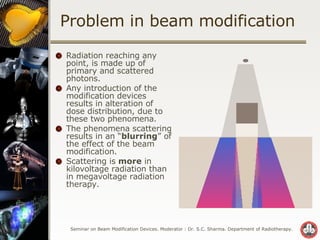
Problem in beam modification Radiation reaching any point, is made up of primary and scattered photons. Any introduction of the modification devices results in alteration of dose distribution, due to these two phenomena. The phenomena scattering results in an “ blurring ” of the effect of the beam modification. Scattering is  more  in kilovoltage radiation than in megavoltage radiation therapy.
Types of beam modification devices Field blocking and shaping devices: Shielding blocks. Custom blocks.  Asymmetrical jaws. Multileaf collimators. Compensators. Beam spoilers Wedge filters. Beam flattening filters. Bolus Breast cone. Penumbra trimmers. Electron beam modification
Shielding Since radiation attenuation is exponential and because of scattering,  complete  shielding can never be achieved. The aims of shielding are: To protect critical organs. Avoid unnecessary irradiation to surrounding normal tissue. Matching adjacent fields .
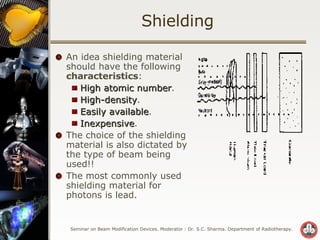
Shielding An idea shielding material should have the following  characteristics : High atomic number . High-density . Easily available . Inexpensive . The choice of the shielding material is also dictated by the type of beam being used!! The most commonly used shielding material for photons is lead.
Shielding The  thickness  used depends upon the energy of the radiation. For practical purposes, the shielding material which reduces beam transmission to  5%  of its original is considered acceptable. The term  half value-layer  is a convenient expression for the attenuation produced by any material. Half-value layer is defined as the  thickness  of material, which will reduce the intensity of the primary beam by 50%.
Shielding The number of  HVL (n)  required is given by the following expression: 1/2 n  = 5%  or  0.05  Thus,  2 n  = 1/0.05   = 20   OR,  n log 2 = log 20 . n =  4.32 The relationship holds true, only for  mono energetic  x-ray beams. Practically thickness of lead between  4.5 - 5 half-value layers  results in 5% or less of primary beam transmission.
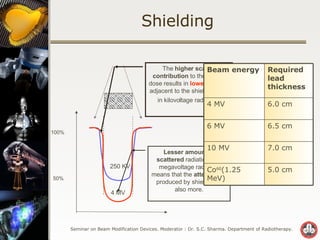
Shielding 250 KV 4 MV Lesser amount of scattered  radiation with megavoltage radiation means that the  attenuation  produced by shielding is also more. The  higher scatter contribution  to the overall dose results in  lower dosage  adjacent to the shielded area in kilovoltage radiation . 100% 50% 5.0 cm Co 60 (1.25 MeV) 7.0 cm 10 MV 6.5 cm 6 MV 6.0 cm 4 MV Required lead thickness Beam energy
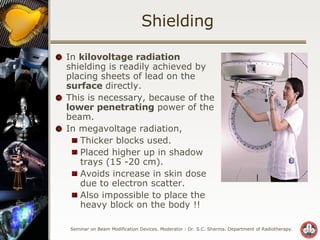
Shielding In  kilovoltage radiation  shielding is readily achieved by placing sheets of lead on the  surface  directly.  This is necessary, because of the  lower penetrating  power of the beam. In megavoltage radiation, Thicker blocks used. Placed higher up in shadow trays (15 -20 cm). Avoids increase in skin dose due to electron scatter. Also impossible to place the heavy block on the body !!
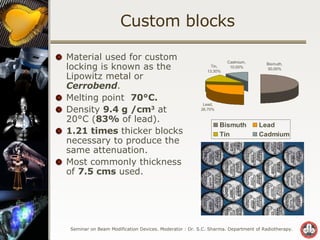
Custom blocks Material used for custom locking is known as the Lipowitz metal or  Cerrobend . Melting point  70°C. Density  9.4 g /cm 3  at 20°C ( 83%  of lead). 1.21 times  thicker blocks necessary to produce the same attenuation. Most commonly thickness of  7.5 cms  used.
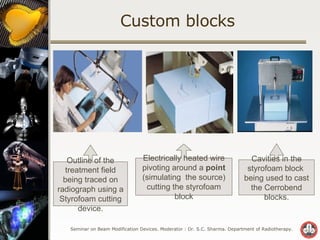
Custom blocks Outline of the treatment field being traced on radiograph using a Styrofoam cutting device. Electrically heated wire pivoting around a  point  (simulating  the source) cutting the styrofoam block Cavities in the styrofoam block  being used to cast the Cerrobend blocks.
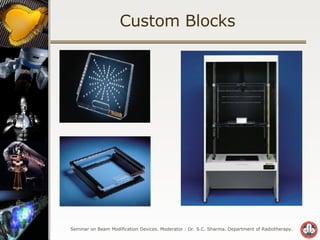
Custom Blocks
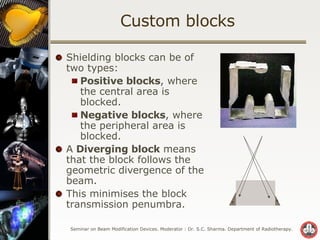
Custom blocks Shielding blocks can be of two types: Positive blocks , where the central area is blocked. Negative blocks , where the peripheral area is blocked. A  Diverging block  means that the block follows the geometric divergence of the beam.  This minimises the block transmission penumbra.
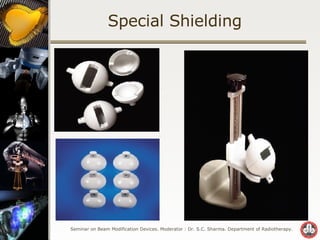
Special Shielding
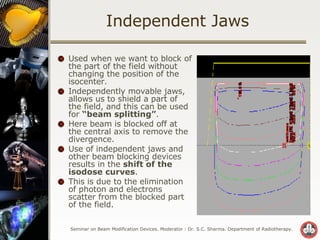
Independent Jaws Used when we want to block of the part of the field without changing the position of the isocenter. Independently movable jaws, allows us to shield a part of the field, and this can be used for  “beam splitting” . Here beam is blocked off at the central axis to remove the divergence.  Use of independent jaws and other beam blocking devices results in the  shift of the isodose curves . This is due to the elimination of photon and electrons scatter from the blocked part of the field.
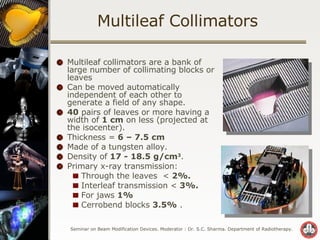
Multileaf Collimators Multileaf collimators are a bank of  large number of collimating blocks or leaves Can be moved automatically independent of each other to generate a field of any shape. 40  pairs of leaves or more having a width of  1 cm  on less (projected at the isocenter). Thickness =  6 – 7.5 cm Made of a tungsten alloy.  Density of  17 - 18.5 g/cm 3 . Primary x-ray transmission: Through the leaves  <  2%. Interleaf transmission <  3%. For jaws  1%   Cerrobend blocks  3.5%  .
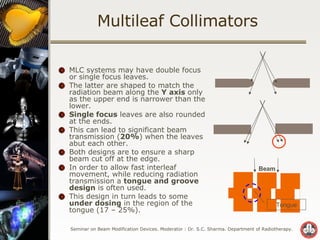
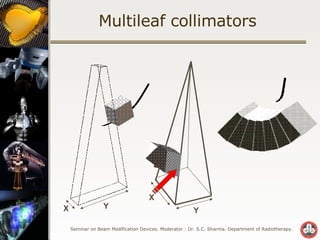
Multileaf Collimators MLC systems may have double focus or single focus leaves. The latter are shaped to match the radiation beam along the  Y axis  only as the upper end is narrower than the lower.  Single focus  leaves are also rounded at the ends. This can lead to significant beam transmission ( 20% ) when the leaves abut each other. Both designs are to ensure a sharp beam cut off at the edge. In order to allow fast interleaf movement, while reducing radiation transmission a  tongue and groove design  is often used. This design in turn leads to some  under dosing  in the region of the tongue (17 – 25%). Tongue Beam
Multileaf collimators Y X Y X
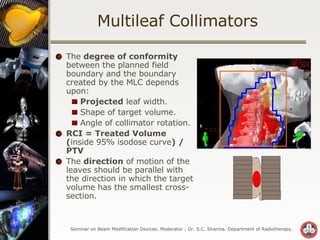
Multileaf Collimators The  degree of conformity  between the planned field boundary and the boundary created by the MLC depends upon: Projected  leaf width. Shape of target volume. Angle of collimator rotation. RCI = Treated Volume ( inside 95% isodose curve ) / PTV The  direction  of motion of the leaves should be parallel with the direction in which the target volume has the smallest cross-section.
Multileaf Collimators The  advantages  are: Time  for shaping and inserting of custom blocks is not required. The hardening of beam, scattered radiation, and increase in skin doses and doses outside the field, as seen with  physical compensators  is avoided. Automation  of reshaping and modulation of beam intensity in IMRT. MLCs can also be used to as  dynamic wedges  and  electronic compensators  (2D). The  disadvantages  are: Island blocking  is not possible. Because the physical penumbra is  larger  than that produced by Cerrobend blocks treatment of smaller fields is difficult, as is the shielding of critical structures, near the field. The  jagged  boundary of the field makes matching difficult. Practically  smaller  fields are used because MLC carriages and secondary jaws don’t move during IMRT delivery making matching of fields necessary.
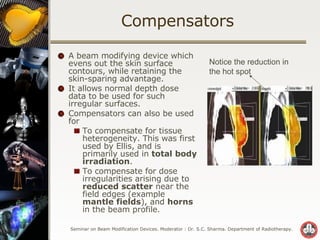
Compensators A beam modifying device which evens out the skin surface contours, while retaining the skin-sparing advantage. It allows normal depth dose data to be used for such irregular surfaces. Compensators can also be used for  To compensate for tissue heterogeneity. This was first used by Ellis, and is primarily used in  total body irradiation . To compensate for dose irregularities arising due to  reduced scatter  near the field edges (example  mantle fields ), and  horns  in the beam profile. Notice the reduction in the hot spot
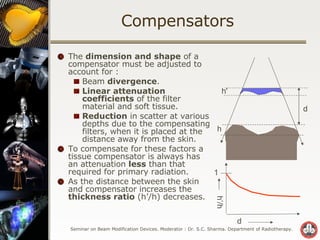
Compensators The  dimension and shape  of a compensator must be adjusted to account for : Beam  divergence . Linear attenuation coefficients  of the filter material and soft tissue. Reduction  in scatter at various depths due to the compensating filters, when it is placed at the distance away from the skin. To compensate for these factors a tissue compensator is always has an attenuation  less  than that required for primary radiation. As the distance between the skin and compensator increases the  thickness ratio  (h’/h) decreases. h' h d d h’/h 1
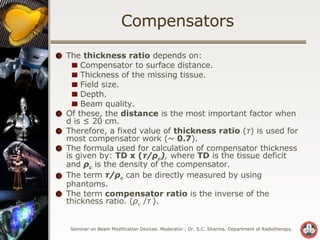
Compensators The  thickness ratio  depends on: Compensator to surface distance. Thickness of the missing tissue. Field size. Depth. Beam quality. Of these, the  distance  is the most important factor when d is ≤ 20 cm. Therefore, a fixed value of  thickness ratio  ( τ ) is used for most compensator work (~  0.7 ). The formula used for calculation of compensator thickness is given by:  TD x ( τ / ρ c ) ,  where  TD  is the tissue deficit and  ρ c  is the density of the compensator. The term  τ / ρ c  can be directly measured by using phantoms. The term  compensator ratio  is the inverse of the thickness ratio. ( ρ c  / τ   ).
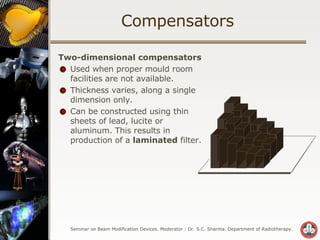
Compensators Two-dimensional compensators Used when proper mould room facilities are not available. Thickness varies, along a single dimension only. Can be constructed using thin sheets of lead, lucite or aluminum. This results in production of a  laminated  filter.
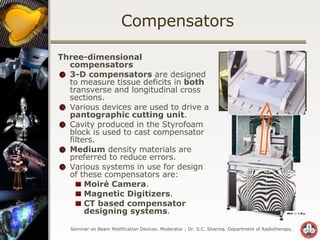
Compensators Three-dimensional  compensators 3-D compensators  are designed to measure tissue deficits in  both  transverse and longitudinal cross sections. Various devices are used to drive a  pantographic cutting unit . Cavity produced in the Styrofoam block is used to cast compensator filters. Medium  density materials are preferred to reduce errors. Various systems in use for design of these compensators are: Moiré Camera . Magnetic Digitizers . CT based compensator designing systems .
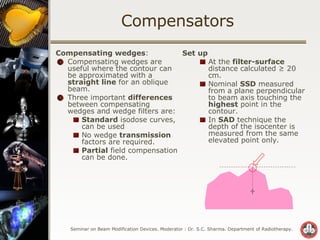
Compensators Compensating wedges : Compensating wedges are useful where the contour can be approximated with a  straight line  for an oblique beam. Three important  differences  between compensating wedges and wedge filters are: Standard  isodose curves, can be used  No wedge  transmission  factors are required. Partial  field compensation can be done. Set up At the  filter-surface  distance calculated ≥ 20 cm.  Nominal  SSD  measured from a plane perpendicular to beam axis touching the  highest  point in the contour. In  SAD  technique the depth of the isocenter is measured from the same elevated point only.
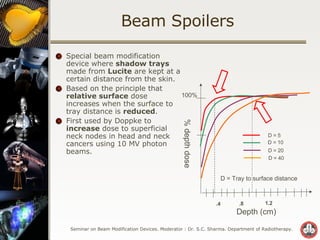
Beam Spoilers Special beam modification device where  shadow trays  made from  Lucite  are kept at a certain distance from the skin. Based on the principle that  relative surface  dose increases when the surface to tray distance is  reduced .  First used by Doppke to  increase  dose to superficial neck nodes in head and neck cancers using 10 MV photon beams. % depth dose Depth (cm) D = 5 D = 10 D = 20 D = 40 D = Tray to surface distance .4 .8 1.2 100%
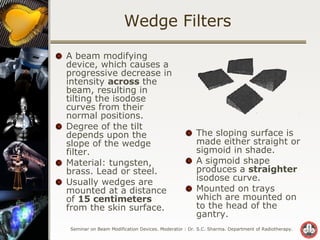
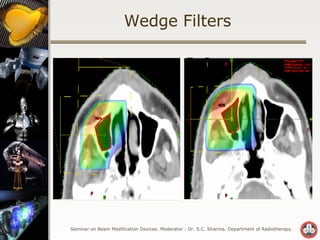
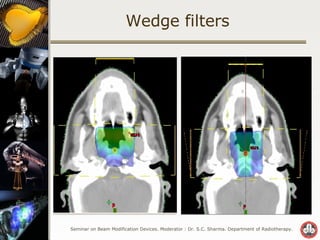
Wedge Filters A beam modifying device, which causes a progressive decrease in intensity  across  the beam, resulting in tilting the isodose curves from their normal positions. Degree of the tilt depends upon the slope of the wedge filter. Material: tungsten, brass. Lead or steel. Usually wedges are mounted at a distance of  15 centimeters  from the skin surface. The sloping surface is made either straight or sigmoid in shade. A sigmoid shape produces a  straighter  isodose curve. Mounted on trays which are mounted on to the head of the gantry.
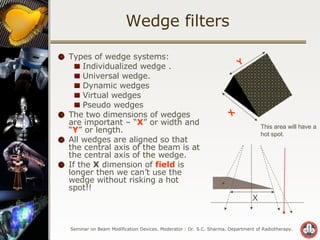
Wedge filters Types of wedge systems: Individualized wedge . Universal wedge. Dynamic wedges Virtual wedges  Pseudo wedges The two dimensions of wedges are important – “ X ” or width and “ Y ” or length. All wedges are aligned so that the central axis of the beam is at the central axis of the wedge. If the  X  dimension of  field  is longer then we can’t use the wedge without risking a hot spot!! X X Y This area will have a hot spot.
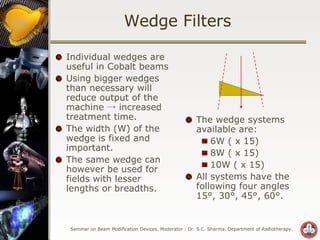
Wedge Filters Individual wedges are useful in Cobalt beams  Using bigger wedges than necessary will reduce output of the machine -> increased treatment time. The width (W) of the wedge is fixed and important.  The same wedge can however be used for fields with lesser lengths or breadths.  The wedge systems available are: 6W ( x 15) 8W ( x 15) 10W ( x 15) All systems have the following four angles 15°, 30°, 45°, 60°.
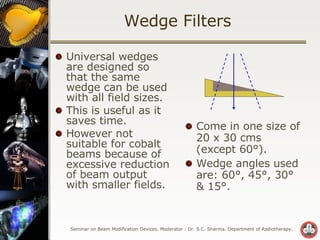
Wedge Filters Universal wedges are designed so that the same wedge can be used with all field sizes. This is useful as it saves time. However not suitable for cobalt beams because of excessive reduction of beam output  with smaller fields. Come in one size of 20 x 30 cms  (except 60°). Wedge angles used are: 60°, 45°, 30° & 15°.
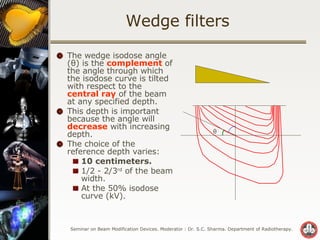
Wedge filters The wedge isodose angle ( θ ) is the  complement   of the angle through which the isodose curve is tilted with respect to the  central ray  of the beam at any specified depth. This depth is important because the angle will  decrease  with increasing depth. The choice of the reference depth varies: 10 centimeters. 1/2 - 2/3 rd  of the beam width. At the 50% isodose curve (kV). θ
Wedge filters The presence of the wedge  decreases  output of the machine. WTF = Dose with the wedge/ Dose without the wedge (at a point in the phantom, along the central axis of the beam). Usually measured at a suitable depth  below  the D max  usually 5 -10 cms! This minimises the error in calculation of PDD. The resultant reduction in output results in an  increase  in the treatment time.
Wedge filters In some isodose charts used in cobalt machines the wedge transmission factor is already incorporated, and no further correction is necessary. Use of wedge will result in a preferential  hardening  - more pronounced in case of linear accelerators. This is because the Co 60 beam is monoenergetic . For  small  depths (<10 cms) most of the calculation parameters however remain unchanged.  At larger depths however, the PDD can be altered specially in case of linear accelerator beams.
Wedge Filters
Wedge filters
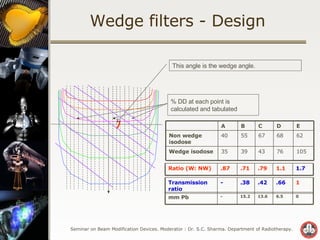
Wedge filters - Design This angle is the wedge angle. % DD at each point is calculated and tabulated A B C D E 105 76 43 39 35 Wedge isodose 62 68 67 55 40 Non wedge isodose E D C B A 1.7 1.1 .79 .71 .87 Ratio (W: NW) 1 .66 .42 .38 - Transmission ratio 0 6.5 13.6 15.2 - mm Pb
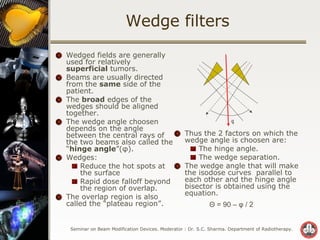
Wedge filters Wedged fields are generally used for relatively  superficial  tumors. Beams are usually directed from the  same  side of the patient. The  broad  edges of the wedges should be aligned together. The wedge angle choosen depends on the angle between the central rays of the two beams also called the “ hinge angle ”( φ ). Wedges: Reduce the hot spots at the surface  Rapid dose falloff beyond the region of overlap. The overlap region is also called the “plateau region”. Thus the 2 factors on which the wedge angle is choosen are: The hinge angle. The wedge separation.  The wedge angle that will make the isodose curves  parallel to each other and the hinge angle bisector is obtained using the equation.  φ Θ  = 90 –  φ  / 2
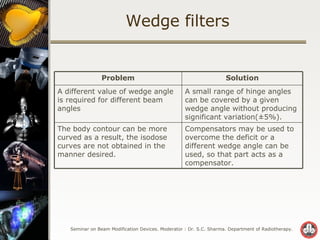
Wedge filters Compensators may be used to overcome the deficit or a different wedge angle can be used, so that part acts as a compensator. The body contour can be more curved as a result, the isodose curves are not obtained in the manner desired. A small range of hinge angles can be covered by a given wedge angle without producing significant variation(±5%). A different value of wedge angle is required for different beam angles Solution Problem
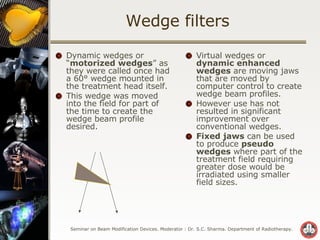
Wedge filters Dynamic wedges or “ motorized wedges ” as they were called once had a 60° wedge mounted in the treatment head itself. This wedge was moved into the field for part of the time to create the wedge beam profile desired. Virtual wedges or  dynamic enhanced wedges  are moving jaws that are moved by computer control to create wedge beam profiles. However use has not resulted in significant improvement over conventional wedges.  Fixed jaws  can be used to produce  pseudo wedges  where part of the treatment field requiring greater dose would be irradiated using smaller field sizes.
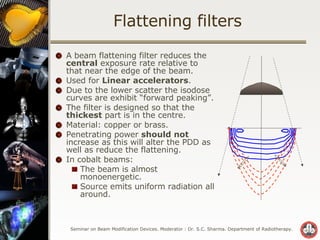
Flattening filters A beam flattening filter reduces the  central  exposure rate relative to that near the edge of the beam. Used for  Linear accelerators . Due to the lower scatter the isodose curves are exhibit “forward peaking”. The filter is designed so that the  thickest  part is in the centre. Material: copper or brass. Penetrating power  should not  increase as this will alter the PDD as well as reduce the flattening. In cobalt beams: The beam is almost monoenergetic. Source emits uniform radiation all around.
Flattening filters The beam flatness is specified at  10 centimeters . The extent of flatness should be  ± 3%  along the central axis of the beam at 10 centimeters. Should cover  80%  or more of the field, or reach closer than one centimeter from the edge. There is usually over flattening of isodoses, near the surface. This results in production of “ horns ” or hot spots. No point parallel to the surface should receive a dose  > 107%  of the central axis dose. Because of the thinner outer rim, the  average  beam energy is lower at the periphery as compared to the centre
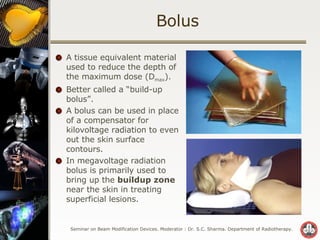
Bolus A tissue equivalent material used to reduce the depth of the maximum dose (D max ). Better called a “build-up bolus”. A bolus can be used in place of a compensator for kilovoltage radiation to even out the skin surface contours. In megavoltage radiation bolus is primarily used to bring up the  buildup zone  near the skin in treating superficial lesions.
Bolus The thickness of the bolus used varies according to the energy of the radiation. In megavoltage radiation: Co 60  : 2 - 3 mm 6 MV  : 7- 8 mm 10 MV  : 12 - 14 mm 25 MV : 18 - 20 mm Properties of an ideal bolus: Same electron density and atomic number. Pliable to conform to surface. Usual specific gravity is 1.02 -1.03
Bolus Commonly used materials are: Cotton soaked with  water . Paraffin wax. Other materials that have been used: Mix- D (wax, polyethylene, mag oxide) Temex rubber (rubber) Lincolnshire bolus (sugar and mag carbonate in form of spheres) Spiers Bolus (rice flour and soda bicarb) Commercial materials: Superflab : Thick and doesn't undergo elastic deformation. Made of synthetic oil gel. Superstuff : Add water to powder to get a pliable gelatin like material. Bolx Sheets : Gel enclosed in plastic sheet.
Breast Cone A beam modifying and directing device used for a tangential fields therapy. Advantages: Directs  beam to the central axis of the area of interest, where a tangential beam is applied to a curved surface. Helps position, the patient with an accurate  SSD . Endplate provides  compensation , enhances surface dose and presses down the tissue. Effective  shielding  of lungs.
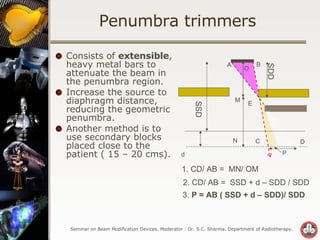
Penumbra trimmers Refers to the region at the edge of  the beam where the  dose-rate changes rapidly as a function of distance from the beam axis. Types: Transmission penumbra : Transmission through the edge of the collimator block. Geometrical penumbra  : Finite size of the source. Physical penumbra : Lateral distance between to specified isodose curves at a specific depth (90% & 20% at D max ).  Takes scattered radiation into account. Penumbra width depends upon: Source diameter. SSD. Depth below skin. Source to diaphragm distance (inversely)
Penumbra trimmers Consists of  extensible , heavy metal bars to attenuate the beam in the penumbra region. Increase the source to diaphragm distance, reducing the geometric penumbra. Another method is to use secondary blocks placed close to the patient ( 15 – 20 cms). 3.  P = AB ( SSD + d – SDD)/ SDD d B 1. CD/ AB =  MN/ OM C D A E P O M N A 2. CD/ AB =  SSD + d – SDD / SDD SSD SDD
Electron beams  Electron field shaping is done using lead cutouts. For a low-energy electrons (<10 MeV), sheets of lead, less than 6 mm thickness are used. The lead sheet can be placed  directly  on the skin surface. Shields can also be supported at the end of the treatment cone if too heavy at the cost of greater inaccuracies. Design is  easier , because the size is same as that of the field on the patients skin.
Electron Beam To avoid variation in output and electron scatter, jaws cannot be used to collimate electron beams. An electron beam cone is therefore used to provide the collimation. A primary collimator is provided close to source – defines the maximum field size. A secondary collimator, near the patient defines the treatment field.
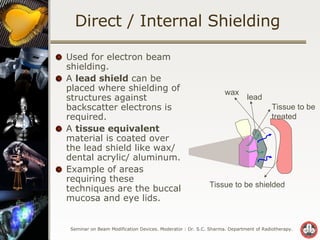
Direct / Internal Shielding Used for electron beam shielding. A  lead shield  can be placed where shielding of structures against backscatter electrons is required. A  tissue equivalent  material is coated over the lead shield like wax/ dental acrylic/ aluminum.  Example of areas requiring these techniques are the buccal mucosa and eye lids. lead wax Tissue to be shielded Tissue to be treated
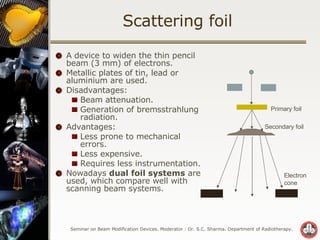
Scattering foil A device to widen the thin pencil beam (3 mm) of electrons. Metallic plates of tin, lead or aluminium are used. Disadvantages: Beam attenuation. Generation of bremsstrahlung radiation. Advantages: Less prone to mechanical errors. Less expensive. Requires less instrumentation. Nowadays  dual foil systems  are used, which compare well with scanning beam systems. Primary foil Secondary foil Electron cone
Conclusion Beam modification increases conformity allowing a higher dose delivery to the target, while sparing more of normal tissue simultaneously. Megavoltage radiotherapy is better suited for most forms of beam modification due to it’s favourable scatter profile. However any beam modification necessitates a close scrutiny of every phase of the planning and treatment process. The price of safety in radiotherapy is an eternal vigilance  .
Thank You

Beam Modification in Radiotherapy

  • 1.
    Beam Modification devicesin Radiotherapy Moderator: Prof. S.C. Sharma Head Of Department Department of Radiotherapy PGIMER
  • 2.
  • 3.
    Introduction Defined as desirable modification in the spatial distribution of radiation - within the patient - by insertion of any material in the beam path.
  • 4.
    Types of beammodification There are four main types of beam modification: Shielding : To eliminate radiation dose to some special parts of the zone at which the beam is directed. Compensation : To allow normal dose distribution data to be applied to the treated zone, when the beam enters a or obliquely through the body or where different types of tissues are present. Wedge filtration : Where a special tilt in isodose curves is obtained. Flattening : Where the spatial distribution of the natural beam is altered by reducing the central exposure rate relative to the peripheral.
  • 5.
    Problem in beammodification Radiation reaching any point, is made up of primary and scattered photons. Any introduction of the modification devices results in alteration of dose distribution, due to these two phenomena. The phenomena scattering results in an “ blurring ” of the effect of the beam modification. Scattering is more in kilovoltage radiation than in megavoltage radiation therapy.
  • 6.
    Types of beammodification devices Field blocking and shaping devices: Shielding blocks. Custom blocks. Asymmetrical jaws. Multileaf collimators. Compensators. Beam spoilers Wedge filters. Beam flattening filters. Bolus Breast cone. Penumbra trimmers. Electron beam modification
  • 7.
    Shielding Since radiationattenuation is exponential and because of scattering, complete shielding can never be achieved. The aims of shielding are: To protect critical organs. Avoid unnecessary irradiation to surrounding normal tissue. Matching adjacent fields .
  • 8.
    Shielding An ideashielding material should have the following characteristics : High atomic number . High-density . Easily available . Inexpensive . The choice of the shielding material is also dictated by the type of beam being used!! The most commonly used shielding material for photons is lead.
  • 9.
    Shielding The thickness used depends upon the energy of the radiation. For practical purposes, the shielding material which reduces beam transmission to 5% of its original is considered acceptable. The term half value-layer is a convenient expression for the attenuation produced by any material. Half-value layer is defined as the thickness of material, which will reduce the intensity of the primary beam by 50%.
  • 10.
    Shielding The numberof HVL (n) required is given by the following expression: 1/2 n = 5% or 0.05 Thus, 2 n = 1/0.05 = 20 OR, n log 2 = log 20 . n = 4.32 The relationship holds true, only for mono energetic x-ray beams. Practically thickness of lead between 4.5 - 5 half-value layers results in 5% or less of primary beam transmission.
  • 11.
    Shielding 250 KV4 MV Lesser amount of scattered radiation with megavoltage radiation means that the attenuation produced by shielding is also more. The higher scatter contribution to the overall dose results in lower dosage adjacent to the shielded area in kilovoltage radiation . 100% 50% 5.0 cm Co 60 (1.25 MeV) 7.0 cm 10 MV 6.5 cm 6 MV 6.0 cm 4 MV Required lead thickness Beam energy
  • 12.
    Shielding In kilovoltage radiation shielding is readily achieved by placing sheets of lead on the surface directly. This is necessary, because of the lower penetrating power of the beam. In megavoltage radiation, Thicker blocks used. Placed higher up in shadow trays (15 -20 cm). Avoids increase in skin dose due to electron scatter. Also impossible to place the heavy block on the body !!
  • 13.
    Custom blocks Materialused for custom locking is known as the Lipowitz metal or Cerrobend . Melting point 70°C. Density 9.4 g /cm 3 at 20°C ( 83% of lead). 1.21 times thicker blocks necessary to produce the same attenuation. Most commonly thickness of 7.5 cms used.
  • 14.
    Custom blocks Outlineof the treatment field being traced on radiograph using a Styrofoam cutting device. Electrically heated wire pivoting around a point (simulating the source) cutting the styrofoam block Cavities in the styrofoam block being used to cast the Cerrobend blocks.
  • 15.
  • 16.
    Custom blocks Shieldingblocks can be of two types: Positive blocks , where the central area is blocked. Negative blocks , where the peripheral area is blocked. A Diverging block means that the block follows the geometric divergence of the beam. This minimises the block transmission penumbra.
  • 17.
  • 18.
    Independent Jaws Usedwhen we want to block of the part of the field without changing the position of the isocenter. Independently movable jaws, allows us to shield a part of the field, and this can be used for “beam splitting” . Here beam is blocked off at the central axis to remove the divergence. Use of independent jaws and other beam blocking devices results in the shift of the isodose curves . This is due to the elimination of photon and electrons scatter from the blocked part of the field.
  • 19.
    Multileaf Collimators Multileafcollimators are a bank of large number of collimating blocks or leaves Can be moved automatically independent of each other to generate a field of any shape. 40 pairs of leaves or more having a width of 1 cm on less (projected at the isocenter). Thickness = 6 – 7.5 cm Made of a tungsten alloy. Density of 17 - 18.5 g/cm 3 . Primary x-ray transmission: Through the leaves < 2%. Interleaf transmission < 3%. For jaws 1% Cerrobend blocks 3.5% .
  • 20.
    Multileaf Collimators MLCsystems may have double focus or single focus leaves. The latter are shaped to match the radiation beam along the Y axis only as the upper end is narrower than the lower. Single focus leaves are also rounded at the ends. This can lead to significant beam transmission ( 20% ) when the leaves abut each other. Both designs are to ensure a sharp beam cut off at the edge. In order to allow fast interleaf movement, while reducing radiation transmission a tongue and groove design is often used. This design in turn leads to some under dosing in the region of the tongue (17 – 25%). Tongue Beam
  • 21.
  • 22.
    Multileaf Collimators The degree of conformity between the planned field boundary and the boundary created by the MLC depends upon: Projected leaf width. Shape of target volume. Angle of collimator rotation. RCI = Treated Volume ( inside 95% isodose curve ) / PTV The direction of motion of the leaves should be parallel with the direction in which the target volume has the smallest cross-section.
  • 23.
    Multileaf Collimators The advantages are: Time for shaping and inserting of custom blocks is not required. The hardening of beam, scattered radiation, and increase in skin doses and doses outside the field, as seen with physical compensators is avoided. Automation of reshaping and modulation of beam intensity in IMRT. MLCs can also be used to as dynamic wedges and electronic compensators (2D). The disadvantages are: Island blocking is not possible. Because the physical penumbra is larger than that produced by Cerrobend blocks treatment of smaller fields is difficult, as is the shielding of critical structures, near the field. The jagged boundary of the field makes matching difficult. Practically smaller fields are used because MLC carriages and secondary jaws don’t move during IMRT delivery making matching of fields necessary.
  • 24.
    Compensators A beammodifying device which evens out the skin surface contours, while retaining the skin-sparing advantage. It allows normal depth dose data to be used for such irregular surfaces. Compensators can also be used for To compensate for tissue heterogeneity. This was first used by Ellis, and is primarily used in total body irradiation . To compensate for dose irregularities arising due to reduced scatter near the field edges (example mantle fields ), and horns in the beam profile. Notice the reduction in the hot spot
  • 25.
    Compensators The dimension and shape of a compensator must be adjusted to account for : Beam divergence . Linear attenuation coefficients of the filter material and soft tissue. Reduction in scatter at various depths due to the compensating filters, when it is placed at the distance away from the skin. To compensate for these factors a tissue compensator is always has an attenuation less than that required for primary radiation. As the distance between the skin and compensator increases the thickness ratio (h’/h) decreases. h' h d d h’/h 1
  • 26.
    Compensators The thickness ratio depends on: Compensator to surface distance. Thickness of the missing tissue. Field size. Depth. Beam quality. Of these, the distance is the most important factor when d is ≤ 20 cm. Therefore, a fixed value of thickness ratio ( τ ) is used for most compensator work (~ 0.7 ). The formula used for calculation of compensator thickness is given by: TD x ( τ / ρ c ) , where TD is the tissue deficit and ρ c is the density of the compensator. The term τ / ρ c can be directly measured by using phantoms. The term compensator ratio is the inverse of the thickness ratio. ( ρ c / τ ).
  • 27.
    Compensators Two-dimensional compensatorsUsed when proper mould room facilities are not available. Thickness varies, along a single dimension only. Can be constructed using thin sheets of lead, lucite or aluminum. This results in production of a laminated filter.
  • 28.
    Compensators Three-dimensional compensators 3-D compensators are designed to measure tissue deficits in both transverse and longitudinal cross sections. Various devices are used to drive a pantographic cutting unit . Cavity produced in the Styrofoam block is used to cast compensator filters. Medium density materials are preferred to reduce errors. Various systems in use for design of these compensators are: Moiré Camera . Magnetic Digitizers . CT based compensator designing systems .
  • 29.
    Compensators Compensating wedges: Compensating wedges are useful where the contour can be approximated with a straight line for an oblique beam. Three important differences between compensating wedges and wedge filters are: Standard isodose curves, can be used No wedge transmission factors are required. Partial field compensation can be done. Set up At the filter-surface distance calculated ≥ 20 cm. Nominal SSD measured from a plane perpendicular to beam axis touching the highest point in the contour. In SAD technique the depth of the isocenter is measured from the same elevated point only.
  • 30.
    Beam Spoilers Specialbeam modification device where shadow trays made from Lucite are kept at a certain distance from the skin. Based on the principle that relative surface dose increases when the surface to tray distance is reduced . First used by Doppke to increase dose to superficial neck nodes in head and neck cancers using 10 MV photon beams. % depth dose Depth (cm) D = 5 D = 10 D = 20 D = 40 D = Tray to surface distance .4 .8 1.2 100%
  • 31.
    Wedge Filters Abeam modifying device, which causes a progressive decrease in intensity across the beam, resulting in tilting the isodose curves from their normal positions. Degree of the tilt depends upon the slope of the wedge filter. Material: tungsten, brass. Lead or steel. Usually wedges are mounted at a distance of 15 centimeters from the skin surface. The sloping surface is made either straight or sigmoid in shade. A sigmoid shape produces a straighter isodose curve. Mounted on trays which are mounted on to the head of the gantry.
  • 32.
    Wedge filters Typesof wedge systems: Individualized wedge . Universal wedge. Dynamic wedges Virtual wedges Pseudo wedges The two dimensions of wedges are important – “ X ” or width and “ Y ” or length. All wedges are aligned so that the central axis of the beam is at the central axis of the wedge. If the X dimension of field is longer then we can’t use the wedge without risking a hot spot!! X X Y This area will have a hot spot.
  • 33.
    Wedge Filters Individualwedges are useful in Cobalt beams Using bigger wedges than necessary will reduce output of the machine -> increased treatment time. The width (W) of the wedge is fixed and important. The same wedge can however be used for fields with lesser lengths or breadths. The wedge systems available are: 6W ( x 15) 8W ( x 15) 10W ( x 15) All systems have the following four angles 15°, 30°, 45°, 60°.
  • 34.
    Wedge Filters Universalwedges are designed so that the same wedge can be used with all field sizes. This is useful as it saves time. However not suitable for cobalt beams because of excessive reduction of beam output with smaller fields. Come in one size of 20 x 30 cms (except 60°). Wedge angles used are: 60°, 45°, 30° & 15°.
  • 35.
    Wedge filters Thewedge isodose angle ( θ ) is the complement of the angle through which the isodose curve is tilted with respect to the central ray of the beam at any specified depth. This depth is important because the angle will decrease with increasing depth. The choice of the reference depth varies: 10 centimeters. 1/2 - 2/3 rd of the beam width. At the 50% isodose curve (kV). θ
  • 36.
    Wedge filters Thepresence of the wedge decreases output of the machine. WTF = Dose with the wedge/ Dose without the wedge (at a point in the phantom, along the central axis of the beam). Usually measured at a suitable depth below the D max usually 5 -10 cms! This minimises the error in calculation of PDD. The resultant reduction in output results in an increase in the treatment time.
  • 37.
    Wedge filters Insome isodose charts used in cobalt machines the wedge transmission factor is already incorporated, and no further correction is necessary. Use of wedge will result in a preferential hardening - more pronounced in case of linear accelerators. This is because the Co 60 beam is monoenergetic . For small depths (<10 cms) most of the calculation parameters however remain unchanged. At larger depths however, the PDD can be altered specially in case of linear accelerator beams.
  • 38.
  • 39.
  • 40.
    Wedge filters -Design This angle is the wedge angle. % DD at each point is calculated and tabulated A B C D E 105 76 43 39 35 Wedge isodose 62 68 67 55 40 Non wedge isodose E D C B A 1.7 1.1 .79 .71 .87 Ratio (W: NW) 1 .66 .42 .38 - Transmission ratio 0 6.5 13.6 15.2 - mm Pb
  • 41.
    Wedge filters Wedgedfields are generally used for relatively superficial tumors. Beams are usually directed from the same side of the patient. The broad edges of the wedges should be aligned together. The wedge angle choosen depends on the angle between the central rays of the two beams also called the “ hinge angle ”( φ ). Wedges: Reduce the hot spots at the surface Rapid dose falloff beyond the region of overlap. The overlap region is also called the “plateau region”. Thus the 2 factors on which the wedge angle is choosen are: The hinge angle. The wedge separation. The wedge angle that will make the isodose curves parallel to each other and the hinge angle bisector is obtained using the equation. φ Θ = 90 – φ / 2
  • 42.
    Wedge filters Compensatorsmay be used to overcome the deficit or a different wedge angle can be used, so that part acts as a compensator. The body contour can be more curved as a result, the isodose curves are not obtained in the manner desired. A small range of hinge angles can be covered by a given wedge angle without producing significant variation(±5%). A different value of wedge angle is required for different beam angles Solution Problem
  • 43.
    Wedge filters Dynamicwedges or “ motorized wedges ” as they were called once had a 60° wedge mounted in the treatment head itself. This wedge was moved into the field for part of the time to create the wedge beam profile desired. Virtual wedges or dynamic enhanced wedges are moving jaws that are moved by computer control to create wedge beam profiles. However use has not resulted in significant improvement over conventional wedges. Fixed jaws can be used to produce pseudo wedges where part of the treatment field requiring greater dose would be irradiated using smaller field sizes.
  • 44.
    Flattening filters Abeam flattening filter reduces the central exposure rate relative to that near the edge of the beam. Used for Linear accelerators . Due to the lower scatter the isodose curves are exhibit “forward peaking”. The filter is designed so that the thickest part is in the centre. Material: copper or brass. Penetrating power should not increase as this will alter the PDD as well as reduce the flattening. In cobalt beams: The beam is almost monoenergetic. Source emits uniform radiation all around.
  • 45.
    Flattening filters Thebeam flatness is specified at 10 centimeters . The extent of flatness should be ± 3% along the central axis of the beam at 10 centimeters. Should cover 80% or more of the field, or reach closer than one centimeter from the edge. There is usually over flattening of isodoses, near the surface. This results in production of “ horns ” or hot spots. No point parallel to the surface should receive a dose > 107% of the central axis dose. Because of the thinner outer rim, the average beam energy is lower at the periphery as compared to the centre
  • 46.
    Bolus A tissueequivalent material used to reduce the depth of the maximum dose (D max ). Better called a “build-up bolus”. A bolus can be used in place of a compensator for kilovoltage radiation to even out the skin surface contours. In megavoltage radiation bolus is primarily used to bring up the buildup zone near the skin in treating superficial lesions.
  • 47.
    Bolus The thicknessof the bolus used varies according to the energy of the radiation. In megavoltage radiation: Co 60 : 2 - 3 mm 6 MV : 7- 8 mm 10 MV : 12 - 14 mm 25 MV : 18 - 20 mm Properties of an ideal bolus: Same electron density and atomic number. Pliable to conform to surface. Usual specific gravity is 1.02 -1.03
  • 48.
    Bolus Commonly usedmaterials are: Cotton soaked with water . Paraffin wax. Other materials that have been used: Mix- D (wax, polyethylene, mag oxide) Temex rubber (rubber) Lincolnshire bolus (sugar and mag carbonate in form of spheres) Spiers Bolus (rice flour and soda bicarb) Commercial materials: Superflab : Thick and doesn't undergo elastic deformation. Made of synthetic oil gel. Superstuff : Add water to powder to get a pliable gelatin like material. Bolx Sheets : Gel enclosed in plastic sheet.
  • 49.
    Breast Cone Abeam modifying and directing device used for a tangential fields therapy. Advantages: Directs beam to the central axis of the area of interest, where a tangential beam is applied to a curved surface. Helps position, the patient with an accurate SSD . Endplate provides compensation , enhances surface dose and presses down the tissue. Effective shielding of lungs.
  • 50.
    Penumbra trimmers Refersto the region at the edge of the beam where the dose-rate changes rapidly as a function of distance from the beam axis. Types: Transmission penumbra : Transmission through the edge of the collimator block. Geometrical penumbra : Finite size of the source. Physical penumbra : Lateral distance between to specified isodose curves at a specific depth (90% & 20% at D max ). Takes scattered radiation into account. Penumbra width depends upon: Source diameter. SSD. Depth below skin. Source to diaphragm distance (inversely)
  • 51.
    Penumbra trimmers Consistsof extensible , heavy metal bars to attenuate the beam in the penumbra region. Increase the source to diaphragm distance, reducing the geometric penumbra. Another method is to use secondary blocks placed close to the patient ( 15 – 20 cms). 3. P = AB ( SSD + d – SDD)/ SDD d B 1. CD/ AB = MN/ OM C D A E P O M N A 2. CD/ AB = SSD + d – SDD / SDD SSD SDD
  • 52.
    Electron beams Electron field shaping is done using lead cutouts. For a low-energy electrons (<10 MeV), sheets of lead, less than 6 mm thickness are used. The lead sheet can be placed directly on the skin surface. Shields can also be supported at the end of the treatment cone if too heavy at the cost of greater inaccuracies. Design is easier , because the size is same as that of the field on the patients skin.
  • 53.
    Electron Beam Toavoid variation in output and electron scatter, jaws cannot be used to collimate electron beams. An electron beam cone is therefore used to provide the collimation. A primary collimator is provided close to source – defines the maximum field size. A secondary collimator, near the patient defines the treatment field.
  • 54.
    Direct / InternalShielding Used for electron beam shielding. A lead shield can be placed where shielding of structures against backscatter electrons is required. A tissue equivalent material is coated over the lead shield like wax/ dental acrylic/ aluminum. Example of areas requiring these techniques are the buccal mucosa and eye lids. lead wax Tissue to be shielded Tissue to be treated
  • 55.
    Scattering foil Adevice to widen the thin pencil beam (3 mm) of electrons. Metallic plates of tin, lead or aluminium are used. Disadvantages: Beam attenuation. Generation of bremsstrahlung radiation. Advantages: Less prone to mechanical errors. Less expensive. Requires less instrumentation. Nowadays dual foil systems are used, which compare well with scanning beam systems. Primary foil Secondary foil Electron cone
  • 56.
    Conclusion Beam modificationincreases conformity allowing a higher dose delivery to the target, while sparing more of normal tissue simultaneously. Megavoltage radiotherapy is better suited for most forms of beam modification due to it’s favourable scatter profile. However any beam modification necessitates a close scrutiny of every phase of the planning and treatment process. The price of safety in radiotherapy is an eternal vigilance .
  • 57.