ICRP 60 & 103
Recommendations
SABARI KUMAR P
II M.Sc. Radiation Physics
INTRODUCTION
Human society is deriving tremendous benefits out of various
application of radiation sources such as in medical and industrial fields
However, the work with radiation and radioactive sources involves the
risks of adverse health effects in the exposed individuals
The radiation effects are generally grouped into 2 categories:
Deterministic effects:
Definitely appear in the exposed individual, if radiation dose
received is above the respective threshold levels
Ex: 1 – 5 Gy radiation exposure results Skin – epilation & Gonads –
Temporary sterility
Stochastic Effects:
These effects are random or statistical nature, As such, there is
no threshold levels defined for these effects.
Ex: Hereditary, Cancer
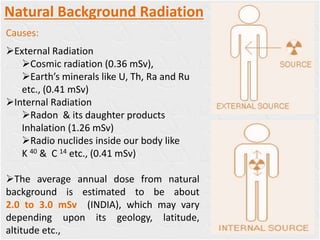
Causes:
External Radiation
Cosmic radiation (0.36 mSv),
Earth’s minerals like U, Th, Ra and Ru
etc., (0.41 mSv)
Internal Radiation
Radon & its daughter products
Inhalation (1.26 mSv)
Radio nuclides inside our body like
K 40 & C 14 etc., (0.41 mSv)
The average annual dose from natural
background is estimated to be about
2.0 to 3.0 mSv (INDIA), which may vary
depending upon its geology, latitude,
altitude etc.,
Natural Background Radiation
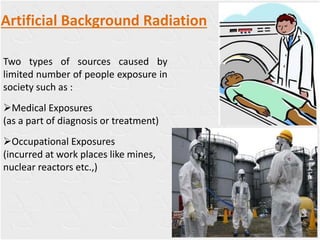
Artificial Background Radiation
Two types of sources caused by
limited number of people exposure in
society such as :
Medical Exposures
(as a part of diagnosis or treatment)
Occupational Exposures
(incurred at work places like mines,
nuclear reactors etc.,)
A committee was created by International Congress of Radiology in
1928 with the name as "International X-Ray & Radium Protection
Committee (IXRPC)” to assess the radiation exposures. In 1950, it was
renamed as "International Commission on Radiological Protection” (ICRP).
First recommendations were issued on 1928 as annual dose limit to
whole body is 1000 mSv which were aimed at the protection of medical
staff against occupational exposures.
Many recommendations have appeared later years subsequently
as Publication 1 (1958) to recent Publication 103(2007).
Over the evolution of these recommendations, the annual dose limit
has been reduced from 1000 mSv to 500 mSv in 1934 (for medicine), &
to 150 mSv in 1951, to 50mSv & 5 mSv in 1956 (for worker & general
public) . Finally reached to 1 mSv in 1985 for public and 20 mSv in 1991
for Occupational workers.
ICRP 26 (1977) introduced Tissue Weighting Factors to quantify the
radiation risk to individual organs
Commission Background & its recommendations
To provide an appropriate standard of protection for man
without unduly limiting the beneficial practices giving rise to radiation
exposures
Deterministic Effects
Radiation Protection aim to eliminate
Stochastic Effects
Radiation Protection aim to reduce
AIM
The human activities which increases the overall exposures to
radiation (by introducing whole new block of sources, pathways,
modifying existing source pathways ) are usually calls as Practices
The human activities which decreases the overall exposures to
radiation (by influencing the existing sources, modifying pathways or
reduce the no. of exposed individuals) are termed as Interventions
 The Steps needed to restrict the exposure of individual, either in
control of a practice (or) by implementing of intervention, can be taken
by applying action at any point in the network linking the sources to the
individuals
Practices Vs Interventions
 System of Radiation Protection is the name
given by the ICRP to the application of the
three basic principles of Radiation Protection
(no part should be taken in isolation)
 Justification of Practices
 Optimization of Protection
 Application of Dose limits
System of Radiation Protection
No practice shall be adopted unless its
introduction produces sufficient benefits to
exposed individual (or) society
It is not only applicable to new proposed
practice being introduced, but also existing
practices to be reviewed
Ex: Use of radiation in Medicine, Industrial
Agriculture & certain Research applications can
be justified
The use of radiation in Jewelry & children toy’s
can’t be justified
Justification of Practices
The magnitude of doses, the no. of
people exposed should all be kept
As Low As Reasonably Achievable
(ALARA), by taking economic and social
factors into account
Once practice has been justified and
adopted, it is necessary to consider how
best to use resources in reducing the
radiation risk to individuals and the
populations
It is essentially source related & should
first be applied at the design stage of any
project & carried out at the operational
level
Optimization of Protection
RISK
BENEFIT
All the relevant practice on any individual
should be subject to dose limits, in such a way
exposure should be restricted
The definition & choice of dose limits involve
social judgement
Dose limits are commonly specified in two
ways such as:
 Related to Occupational Exposures
Related to Potential Exposures
Application of Dose Limits
The BSS (International Basic Safety Standards for Protection against
Ionizing Radiation & for Safety of Radiation Sources) classified radiation
exposures into: (IAEA Safety Report: 115)
1. Normal Exposures (Magnitudes can be predictable)
 Occupational Exposures
 Medical Exposures
 Public Exposures
2. Potential Exposures
This are Probabilistic effects such as equipment failure, design
problem or operating errors etc., .
Types of Exposures
Basic Definition: Exposures incurred at work
Conventional Definition:
Any hazardous agent as including all exposures incurred at work
regardless of their sources
Updated Definition :
The exposures incurred at work as a result of situations that can
reasonably be regarded as being the responsibility of the operating
management
Excludes:
Exposures to Radon and handling of materials containing traces
of radio nuclides
Occupational Exposures
Dose Limits:
Commission has found use of three words to indicate the degree of
tolerability of an exposure
1. Unacceptable: exposure would be not accepted on any reasonable
basis in the normal operation of any practice
2.Tolerable: Exposures are not welcome but can reasonably be tolerated
3. Acceptable: Exposures can be accepted without further improvement
Thus dose limit is defined as a selected boundary b/w unacceptable
and tolerable levels
The dose limits are not seen as a target. These are specified only to
ensure the avoidance of deterministic effects
Occupational Exposures Contd……
Earlier, the dose limit was expressed as a life time dose received
uniformly over the working life and annual dose received every year of
work
Annual dose received in each year over a working life time of 47 years
(for external & short lived source exposures) & 50 years (for external &
long lived source exposures) had been considered
After considering practical difficulties related to application of life time
limits, such as dose limit application to short term working people,
Commission confined dose limit as in the form of the total dose
accumulated over a period of few years
Dose limit for Occupational workers is finalized ( in 1991) as 20mSv
per year averaged over five years with further provision of effective
dose should not exceed 50 mSv in any single year
Occupational Exposures Contd……
Application Occupational Exposure Dose limit
Whole body
Effective Dose
20 mSv/year
(averaged over defined period of 5 years, with
not more than 50 mSv in single year)
In INDIA, this provision is limited to 30 mSv
should not exceed in any single year
Parts of Body: Equivalent Dose
Lens of Eye 150 mSv/year
Skin
500 mSv/year
(Averaged over areas of no more than any 1 cm2 regardless of
the area exposed and nominal depth is 7.0mg/cm2)
Head & Feet 500 mSv/year
(Averaged over areas of the skin not exceeding 100 cm2)
Note: Eye lens & Skin will not necessarily be adequately protected by a limit on effective
dose. i.e. the effective dose contribution is negligible on these organs. Thus special
Equivalent dose limits have specified
For Occupational Women:
No special dose limits for occupational women in general i.e. As same
as that of men are applicable (which has given above table)
Once pregnancy has declared, special controls have to be consider to
avoid deterministic effects (Mental Retardation, Genetically disorders
and radiation injuries) in new born child
The effective dose limit for pregnant woman is as like as general public
1 mSv during remaining period of pregnancy
A supplementary equivalent dose limit, (external – 2 mSv at the
surface of abdomen remaining period of pregnancy & internal – 1/20
radio nuclides of the annual limits on intake), has been provided
Occupational Exposures Contd……
Special Consideration for Radon Exposure (or) handling of materials
containing tracers of radio nuclides:
In this case of above stated situation, the ICRP has retained an upper
value of 10 mSv effective dose for the annual dose reference level.
It reaffirms exposure levels, due to Radon and handling materials
contains radio active traces, at working environment > 10 mSv should
be considered part of occupational exposure, but not below this level.
( Optimization is however a requirement at all levels)
Occupational Exposures Contd……
Exposures incurred by individuals as part of their own medical
diagnosis or treatment, by individuals those knowingly helping patients
while diagnosis or treatment and by persons who involved in research
The principle of justification applied in below levels such as:
1. The use of exposure is accepted as doing more good than harm
2. The specified objective and procedure should be well defined
 As medical exposures are clearly justified and usually direct benefit to
exposed individual during diagnosis & treatment, less attention has
been given to the optimization of protection
Due to direct benefit of exposed individual, the commission
recommends that dose limits should not be applied to medical
exposures
Medical Exposures
Dose limits should not apply to patient
comforters & patient visitors ideally , because
they are voluntarily and knowingly helping the
patient)
However, the dose limit of any such patient
comforter or visitor should be constrained to less
than 5 mSv
The dose to children visiting patients who have
ingested radioactive materials should also be
constrained to less than 1 mSv
Medical Exposures Contd……
Exposures incurred by members of public from radiation sources
(excluding any occupational or medical exposures) & the normal
background radiation including exposure to authorized sources &
practices and from intervention situations
The control of public exposure in all normal situations is exercised by
the application of controls at the source
All most all public exposures are controlled by the procedures of
constrained optimization and the use of prescriptive limits
The intended emission of radio nuclides from installations (from mines
and waste disposal sites etc.,) are treated as Practices. Thus resulting
doses should be subject to the dose limits.
Public Exposures
Commission identified as two approaches to specify dose limits to
Public exposures.
1. Choosing dose limits as like as occupational limits – but judging
this point is much more difficult
2. No dose limits to public exposures – but natural background may
not be leave which contributes small health detriment.
Thus commission suggests that annual dose limit for general public
exposures should not above 1mSv/year. However, in special situation, a
higher value of 5mSv could be allowed in a single year and average over
5 years doesn’t exceed 1mSv
Public Exposures Contd……
Application Public Exposure Dose limit
Whole body
Effective Dose
1 mSv/year
(averaged over defined period of 5 years,
with not more than 5 mSv in single year)
Parts of Body: Equivalent Dose
Lens of Eye 15 mSv/year
Skin
50 mSv/year
(Averaged over areas of no more than any 1 cm2 regardless
of the area exposed and nominal depth is 7.0mg/cm2)
Head & Feet 50 mSv/year
(Averaged over areas of the skin not exceeding 100 cm2)
Note: Because of exposed individual’s wider range of sensitivity than
limited occupational population, the limits are arbitrarily reduced by a
factor of 10 than occupational workers
Not all exposures occur as forecast. There may be accidental
departures from the planned operating procedures (or) equipment
failure. They can’t predict in detail
Potential exposures need to be considered as part of assessment of
practices, but they may also lead to calls for interventions
Objectives of Radiation Protection:
1. Prevention - The reduction of probability of sequence of events that
may cause or increase radiation exposures
2. Mitigation - The limitation & reduction of exposures if any of these
sequences do occur
The simplest way of dealing with potential exposures of individuals is
to consider the overall individual probability of attributable death from
cancer rather than effective dose
Potential Exposures
The Probability of events leading to potential exposures can’t be
determined by observation. They are the result of some form of
probabilistic safety assessment
Sometimes potential exposures may occur in medical exposures
because of errors in dosimetry, equipment failures etc.,
As such the commission doesn’t yet recommend any specific value for
risk in this context.
Risk assessment is an essential part of radiation protection practice.
The U.K. Health and Safety Executive has published a simple guide to
the five steps of the risk assessment process (HSE 1998) that involves:
1. Identifying the hazards
2. Deciding on who might be harmed and how
3. Evaluating the risks & deciding whether the existing
precautions are adequate and need to be improved
4. Recording the findings
5. Reviewing the assessment and revising it if necessary
Potential Exposures Contd……
ICRP 60 recommendations have based on protection approach using
practices and interventions
ICRP 103 (2007) recommendations have based on exposure situations
such as – Planned, Emergency and Existing situation
Planned exposures encompass sources and situations that have been
considered within the ICPR’s previous recommendations for practices,
protections during the medical uses of radiation is also included in this.
ICRP 60 did not specify a particular phantom for calculation of
equivalent doses for organs.
ICRP 103 uses reference computational phantom which are made of
3D volume pixels, around 140 organs & tissues are defined which can be
used together with codes simulating the radiation transport and energy
deposition
New Recommendations : ICRP 103
ICRP103 provided detailed explanations of the bases for the choice of
WR values based on mixture of Science and Pragmatism
New Recommendations : ICRP 103
Contd……
Radiation Type Radiation Weighting
Factor (WR) based on
ICRP 103
Radiation Weighting Factor (WR)
based on ICRP 60
Photons, Electrons &
Muons
1 1
Protons & Charged
Pions
2 5
Alpha particles, fission
fragments, heavy ions
20 20
Neutrons Continuous function of
neutron energy
˂1 MeV 2.5+18.2 e-[ln(E)2]/6
1 to 50 MeV 5.0+17.0 e-[ln(2E)]2/6
˃50 MeV 2.5+3.25 e-[ln(0.04 E)2]/6
Note: WR for Neutron is a continuous function instead of step function
 WT have been changed & extended to a wider range of organs.
New Recommendations : ICRP 103
Contd……
ORGANS ICRP 30 (136) 1979 ICRP 60 (13) 1991 ICRP 103 (16) 2008
Gonads 0.25 0.20 0.08
Red Bone Marrow 0.12 0.12 0.12
colon - 0.12 0.12
Lung 0.12 0.12 0.12
Stomach - 0.12 0.12
Breast 0.15 0.05 0.12
Bladder - 0.05 0.04
Liver - 0.05 0.04
Oesophagus - 0.05 0.04
Thyroid 0.03 0.05 0.04
Skin - 0.01 0.01
Bone Surface 0.03 0.01 0.01
Salivary gland - - 0.01
Brain - - 0.01
Remaining body 0.30 0.05 0.12
ICRP 103 clearly prescribed the use of effective dose E:
1. E is calculated using reference values for reference person or
group not for an individuals
2. E should be used for planning of prospective situations
3. E should not be used for retrospective dose & risk assessments
of exposure of individuals
4. E should not be used for Epidemiological study
Where E usage is inappropriate, the use of relevant RBE, age/sex
related parameters for biological effects should be considered
ALI (Annual Limit on Intake) remains a useful concept but ICRP doesn’t
give ALI values
New Recommendations : ICRP 103
Contd……
Issue on Eye & Skin Dose limits:
The limitation of exposure to skin automatically safeguards the eye
(but exception in localized high energy beta irradiations of the eye).
Thus ICRP task group reviewing that current eye dose limit is too high.
If the eye dose limit were to be reduced, the monitoring of external
doses using Skin as a surrogate for the eye may not longer be strictly
defensible.
Therefore it seems premature to discard these particular quantities.
New Recommendations : ICRP 103
Contd……
The estimated risk of heritable effects is currently 6 – 8 times lower in
ICRP 60 (evaluation over two generations rather than many generations)
The estimates of cancer risk attributable to radiation exposure have
not greatly changed in the past 17 years and continue to be largely
based on Life Span Study (LSS) of survivors following the atomic
bombing in Japan.
The Risk models used for calculation of tissue weighting factors are
based on the ratio of Excess Relative Risk (ERR) & Excess Absolute Risk
(EAR)
New Recommendations : ICRP 103
Contd……
Description ICRP 103 ICRP 60
ERR : EAR
0 : 100 for Breast & Bone
Marrow
50 : 50 for all
organs
100:0 for Thyroid & Skin
30:70 for Lung
50:50 for all other organs
The current risk estimates are based on the assumption that risks are
given by a linear quadratic function of dose
f(D) = (α1D+α2D2) exp-(β1D+β2D2)
Where
f(D) - the risk estimate at dose D,
α1 & α2 - coefficients of the linear and quadratic terms for
the induction of stochastic effects
β1 & β2 - terms representing cell killing at higher doses
The probability of injury or harm (detriment)per unit equivalent dose
is called the risk coefficients arising from risk factor
New Recommendations : ICRP 103
Contd……
Detriment adjusted stochastic risk (10-2 Sv-1 )
Cancer Heritable effects Total
ICRP 103 ICRP 60 ICRP 103 ICRP 60 ICRP 103 ICRP 60
Whole Population 5.5 6.0 0.2 1.3 5.7 7.3
Workers 4.1 4.8 0.1 0.8 4.2 5.6
External Exposures can easily be controlled
by adopting the three fundamental methods,
namely
1. Time : Limit the exposure time
2. Distance : Use Inverse Square Law
3. Shielding : Attenuate the Beam
Protection from External Exposures
As time is directly proportional to exposure
Minimize the time spent near the Radiation source
As exposure is inversely proportional to square of distance
if distance doubles then dose will be 1/4 of original
Maximize the distance from the Radiation source
Shielding reduces the amount of Radiation dose to the worker
Different materials shield a worker from the different types of
radiation
Make use available shield
Protection from External Exposures
Minimization of contamination by:
Use of protective clothing
Avoid of eat, drink and smoke in contaminated area
Proper checking before leaving any contaminated area
Protection from Internal Exposures
The main practical responsibilities fall on the designers and equipment
operators to implement the commission’s recommendations
The total implementation of this recommendations have been set out
as a sequence of stages:
1) Allocation of responsibility
2) Basic recommendations of commissions
3) Requirements of regulatory agencies
4) Management requirements
5) Validation performance
 The primary responsibility for achieving and maintaining a satisfactory
control of radiation exposures rests squarely on the management bodies
of the institutions conducting the operations giving rise to the exposure
Implementation of Recommendations
Requirements, operating instructions, regulatory approvals and
licenses and other administrative things are not only enough but also
everyone , in an undertaking, should regard protection and accident
prevention as integral parts of their every day functions
The recommendations of the commission are intended to provide a
useful basis from which to derive the necessary regulatory requirements
These one also provide guidance to the operating managements
One of the important national & international need is to provide
adequate resources for the education and training of future professional
and technical staff in radiation protection.
One feature of the regulation of practices is the use of source related
constraints to be applied to the optimization of protection
Implementation of Recommendations
Contd……
Implementation of Recommendations
The regulation in the context of potential exposure is that of
establishing a duty on the operating management to conduct
assessments of the expected frequency and possible consequences of
events such as accidents and major errors of design & operation
The management requirements covers such aspects as
Choice of radiation sources
Use of shielding and distance to reduce radiation fields
Restrictions of time spent in the proximity of sources
Use of containment
Release of radio active materials into work & public
Layout of plant & equipment and Plans for dealing with accidents
Contd……
Implementation of Recommendations
The measurement or assessment of doses is fundamental practice to
Radiation Protection which can be accomplished by:
 Dosimetry in Occupational exposures
 Dosimetry in Medical exposure
 Dosimetry in Public exposure
All the Organizations concerned with Radiation Protection should have
a duty of keeping of Records.
Contd……
The establishment of safety based
attitude in everyone concerned with all
the operations from design to de-
commissioning is ultimate motto of
radiation protection program
THANKYOU for
YOUR ATTENTION…
Public means from 0 age to lifetime end , that’s why to reduce the
effect of radiation on all these people, ICRP specified dose limits as 1
mSv which is limit to fetus
Occupational workers age is specified as 17 or 18 age. So these age
limit is little radio resistive. And also occupational worker are specified
that they are paid workers
Pregnant woman abdomen level on surface is 2 mSv. Then at fetus it
will become 1 mSv.
Wt is high means tissue is more sensitive to radiation
Reduced eye limit to occupational worker is 20 mSv as per ICRP
Linear No Threshold
Annual limit on Intake
Derived Air Ratio

Icrp60

  • 1.
    ICRP 60 &103 Recommendations SABARI KUMAR P II M.Sc. Radiation Physics
  • 2.
    INTRODUCTION Human society isderiving tremendous benefits out of various application of radiation sources such as in medical and industrial fields However, the work with radiation and radioactive sources involves the risks of adverse health effects in the exposed individuals The radiation effects are generally grouped into 2 categories: Deterministic effects: Definitely appear in the exposed individual, if radiation dose received is above the respective threshold levels Ex: 1 – 5 Gy radiation exposure results Skin – epilation & Gonads – Temporary sterility Stochastic Effects: These effects are random or statistical nature, As such, there is no threshold levels defined for these effects. Ex: Hereditary, Cancer
  • 3.
    Causes: External Radiation Cosmic radiation(0.36 mSv), Earth’s minerals like U, Th, Ra and Ru etc., (0.41 mSv) Internal Radiation Radon & its daughter products Inhalation (1.26 mSv) Radio nuclides inside our body like K 40 & C 14 etc., (0.41 mSv) The average annual dose from natural background is estimated to be about 2.0 to 3.0 mSv (INDIA), which may vary depending upon its geology, latitude, altitude etc., Natural Background Radiation
  • 4.
    Artificial Background Radiation Twotypes of sources caused by limited number of people exposure in society such as : Medical Exposures (as a part of diagnosis or treatment) Occupational Exposures (incurred at work places like mines, nuclear reactors etc.,)
  • 5.
    A committee wascreated by International Congress of Radiology in 1928 with the name as "International X-Ray & Radium Protection Committee (IXRPC)” to assess the radiation exposures. In 1950, it was renamed as "International Commission on Radiological Protection” (ICRP). First recommendations were issued on 1928 as annual dose limit to whole body is 1000 mSv which were aimed at the protection of medical staff against occupational exposures. Many recommendations have appeared later years subsequently as Publication 1 (1958) to recent Publication 103(2007). Over the evolution of these recommendations, the annual dose limit has been reduced from 1000 mSv to 500 mSv in 1934 (for medicine), & to 150 mSv in 1951, to 50mSv & 5 mSv in 1956 (for worker & general public) . Finally reached to 1 mSv in 1985 for public and 20 mSv in 1991 for Occupational workers. ICRP 26 (1977) introduced Tissue Weighting Factors to quantify the radiation risk to individual organs Commission Background & its recommendations
  • 6.
    To provide anappropriate standard of protection for man without unduly limiting the beneficial practices giving rise to radiation exposures Deterministic Effects Radiation Protection aim to eliminate Stochastic Effects Radiation Protection aim to reduce AIM
  • 7.
    The human activitieswhich increases the overall exposures to radiation (by introducing whole new block of sources, pathways, modifying existing source pathways ) are usually calls as Practices The human activities which decreases the overall exposures to radiation (by influencing the existing sources, modifying pathways or reduce the no. of exposed individuals) are termed as Interventions  The Steps needed to restrict the exposure of individual, either in control of a practice (or) by implementing of intervention, can be taken by applying action at any point in the network linking the sources to the individuals Practices Vs Interventions
  • 8.
     System ofRadiation Protection is the name given by the ICRP to the application of the three basic principles of Radiation Protection (no part should be taken in isolation)  Justification of Practices  Optimization of Protection  Application of Dose limits System of Radiation Protection
  • 9.
    No practice shallbe adopted unless its introduction produces sufficient benefits to exposed individual (or) society It is not only applicable to new proposed practice being introduced, but also existing practices to be reviewed Ex: Use of radiation in Medicine, Industrial Agriculture & certain Research applications can be justified The use of radiation in Jewelry & children toy’s can’t be justified Justification of Practices
  • 10.
    The magnitude ofdoses, the no. of people exposed should all be kept As Low As Reasonably Achievable (ALARA), by taking economic and social factors into account Once practice has been justified and adopted, it is necessary to consider how best to use resources in reducing the radiation risk to individuals and the populations It is essentially source related & should first be applied at the design stage of any project & carried out at the operational level Optimization of Protection RISK BENEFIT
  • 11.
    All the relevantpractice on any individual should be subject to dose limits, in such a way exposure should be restricted The definition & choice of dose limits involve social judgement Dose limits are commonly specified in two ways such as:  Related to Occupational Exposures Related to Potential Exposures Application of Dose Limits
  • 12.
    The BSS (InternationalBasic Safety Standards for Protection against Ionizing Radiation & for Safety of Radiation Sources) classified radiation exposures into: (IAEA Safety Report: 115) 1. Normal Exposures (Magnitudes can be predictable)  Occupational Exposures  Medical Exposures  Public Exposures 2. Potential Exposures This are Probabilistic effects such as equipment failure, design problem or operating errors etc., . Types of Exposures
  • 13.
    Basic Definition: Exposuresincurred at work Conventional Definition: Any hazardous agent as including all exposures incurred at work regardless of their sources Updated Definition : The exposures incurred at work as a result of situations that can reasonably be regarded as being the responsibility of the operating management Excludes: Exposures to Radon and handling of materials containing traces of radio nuclides Occupational Exposures
  • 14.
    Dose Limits: Commission hasfound use of three words to indicate the degree of tolerability of an exposure 1. Unacceptable: exposure would be not accepted on any reasonable basis in the normal operation of any practice 2.Tolerable: Exposures are not welcome but can reasonably be tolerated 3. Acceptable: Exposures can be accepted without further improvement Thus dose limit is defined as a selected boundary b/w unacceptable and tolerable levels The dose limits are not seen as a target. These are specified only to ensure the avoidance of deterministic effects Occupational Exposures Contd……
  • 15.
    Earlier, the doselimit was expressed as a life time dose received uniformly over the working life and annual dose received every year of work Annual dose received in each year over a working life time of 47 years (for external & short lived source exposures) & 50 years (for external & long lived source exposures) had been considered After considering practical difficulties related to application of life time limits, such as dose limit application to short term working people, Commission confined dose limit as in the form of the total dose accumulated over a period of few years Dose limit for Occupational workers is finalized ( in 1991) as 20mSv per year averaged over five years with further provision of effective dose should not exceed 50 mSv in any single year Occupational Exposures Contd……
  • 16.
    Occupational Exposures Contd…… ApplicationOccupational Exposure Dose limit Whole body Effective Dose 20 mSv/year (averaged over defined period of 5 years, with not more than 50 mSv in single year) In INDIA, this provision is limited to 30 mSv should not exceed in any single year Parts of Body: Equivalent Dose Lens of Eye 150 mSv/year Skin 500 mSv/year (Averaged over areas of no more than any 1 cm2 regardless of the area exposed and nominal depth is 7.0mg/cm2) Head & Feet 500 mSv/year (Averaged over areas of the skin not exceeding 100 cm2) Note: Eye lens & Skin will not necessarily be adequately protected by a limit on effective dose. i.e. the effective dose contribution is negligible on these organs. Thus special Equivalent dose limits have specified
  • 17.
    For Occupational Women: Nospecial dose limits for occupational women in general i.e. As same as that of men are applicable (which has given above table) Once pregnancy has declared, special controls have to be consider to avoid deterministic effects (Mental Retardation, Genetically disorders and radiation injuries) in new born child The effective dose limit for pregnant woman is as like as general public 1 mSv during remaining period of pregnancy A supplementary equivalent dose limit, (external – 2 mSv at the surface of abdomen remaining period of pregnancy & internal – 1/20 radio nuclides of the annual limits on intake), has been provided Occupational Exposures Contd……
  • 18.
    Special Consideration forRadon Exposure (or) handling of materials containing tracers of radio nuclides: In this case of above stated situation, the ICRP has retained an upper value of 10 mSv effective dose for the annual dose reference level. It reaffirms exposure levels, due to Radon and handling materials contains radio active traces, at working environment > 10 mSv should be considered part of occupational exposure, but not below this level. ( Optimization is however a requirement at all levels) Occupational Exposures Contd……
  • 19.
    Exposures incurred byindividuals as part of their own medical diagnosis or treatment, by individuals those knowingly helping patients while diagnosis or treatment and by persons who involved in research The principle of justification applied in below levels such as: 1. The use of exposure is accepted as doing more good than harm 2. The specified objective and procedure should be well defined  As medical exposures are clearly justified and usually direct benefit to exposed individual during diagnosis & treatment, less attention has been given to the optimization of protection Due to direct benefit of exposed individual, the commission recommends that dose limits should not be applied to medical exposures Medical Exposures
  • 20.
    Dose limits shouldnot apply to patient comforters & patient visitors ideally , because they are voluntarily and knowingly helping the patient) However, the dose limit of any such patient comforter or visitor should be constrained to less than 5 mSv The dose to children visiting patients who have ingested radioactive materials should also be constrained to less than 1 mSv Medical Exposures Contd……
  • 21.
    Exposures incurred bymembers of public from radiation sources (excluding any occupational or medical exposures) & the normal background radiation including exposure to authorized sources & practices and from intervention situations The control of public exposure in all normal situations is exercised by the application of controls at the source All most all public exposures are controlled by the procedures of constrained optimization and the use of prescriptive limits The intended emission of radio nuclides from installations (from mines and waste disposal sites etc.,) are treated as Practices. Thus resulting doses should be subject to the dose limits. Public Exposures
  • 22.
    Commission identified astwo approaches to specify dose limits to Public exposures. 1. Choosing dose limits as like as occupational limits – but judging this point is much more difficult 2. No dose limits to public exposures – but natural background may not be leave which contributes small health detriment. Thus commission suggests that annual dose limit for general public exposures should not above 1mSv/year. However, in special situation, a higher value of 5mSv could be allowed in a single year and average over 5 years doesn’t exceed 1mSv Public Exposures Contd……
  • 23.
    Public Exposures Contd…… ApplicationPublic Exposure Dose limit Whole body Effective Dose 1 mSv/year (averaged over defined period of 5 years, with not more than 5 mSv in single year) Parts of Body: Equivalent Dose Lens of Eye 15 mSv/year Skin 50 mSv/year (Averaged over areas of no more than any 1 cm2 regardless of the area exposed and nominal depth is 7.0mg/cm2) Head & Feet 50 mSv/year (Averaged over areas of the skin not exceeding 100 cm2) Note: Because of exposed individual’s wider range of sensitivity than limited occupational population, the limits are arbitrarily reduced by a factor of 10 than occupational workers
  • 24.
    Not all exposuresoccur as forecast. There may be accidental departures from the planned operating procedures (or) equipment failure. They can’t predict in detail Potential exposures need to be considered as part of assessment of practices, but they may also lead to calls for interventions Objectives of Radiation Protection: 1. Prevention - The reduction of probability of sequence of events that may cause or increase radiation exposures 2. Mitigation - The limitation & reduction of exposures if any of these sequences do occur The simplest way of dealing with potential exposures of individuals is to consider the overall individual probability of attributable death from cancer rather than effective dose Potential Exposures
  • 25.
    The Probability ofevents leading to potential exposures can’t be determined by observation. They are the result of some form of probabilistic safety assessment Sometimes potential exposures may occur in medical exposures because of errors in dosimetry, equipment failures etc., As such the commission doesn’t yet recommend any specific value for risk in this context. Risk assessment is an essential part of radiation protection practice. The U.K. Health and Safety Executive has published a simple guide to the five steps of the risk assessment process (HSE 1998) that involves: 1. Identifying the hazards 2. Deciding on who might be harmed and how 3. Evaluating the risks & deciding whether the existing precautions are adequate and need to be improved 4. Recording the findings 5. Reviewing the assessment and revising it if necessary Potential Exposures Contd……
  • 26.
    ICRP 60 recommendationshave based on protection approach using practices and interventions ICRP 103 (2007) recommendations have based on exposure situations such as – Planned, Emergency and Existing situation Planned exposures encompass sources and situations that have been considered within the ICPR’s previous recommendations for practices, protections during the medical uses of radiation is also included in this. ICRP 60 did not specify a particular phantom for calculation of equivalent doses for organs. ICRP 103 uses reference computational phantom which are made of 3D volume pixels, around 140 organs & tissues are defined which can be used together with codes simulating the radiation transport and energy deposition New Recommendations : ICRP 103
  • 27.
    ICRP103 provided detailedexplanations of the bases for the choice of WR values based on mixture of Science and Pragmatism New Recommendations : ICRP 103 Contd…… Radiation Type Radiation Weighting Factor (WR) based on ICRP 103 Radiation Weighting Factor (WR) based on ICRP 60 Photons, Electrons & Muons 1 1 Protons & Charged Pions 2 5 Alpha particles, fission fragments, heavy ions 20 20 Neutrons Continuous function of neutron energy ˂1 MeV 2.5+18.2 e-[ln(E)2]/6 1 to 50 MeV 5.0+17.0 e-[ln(2E)]2/6 ˃50 MeV 2.5+3.25 e-[ln(0.04 E)2]/6 Note: WR for Neutron is a continuous function instead of step function
  • 28.
     WT havebeen changed & extended to a wider range of organs. New Recommendations : ICRP 103 Contd…… ORGANS ICRP 30 (136) 1979 ICRP 60 (13) 1991 ICRP 103 (16) 2008 Gonads 0.25 0.20 0.08 Red Bone Marrow 0.12 0.12 0.12 colon - 0.12 0.12 Lung 0.12 0.12 0.12 Stomach - 0.12 0.12 Breast 0.15 0.05 0.12 Bladder - 0.05 0.04 Liver - 0.05 0.04 Oesophagus - 0.05 0.04 Thyroid 0.03 0.05 0.04 Skin - 0.01 0.01 Bone Surface 0.03 0.01 0.01 Salivary gland - - 0.01 Brain - - 0.01 Remaining body 0.30 0.05 0.12
  • 29.
    ICRP 103 clearlyprescribed the use of effective dose E: 1. E is calculated using reference values for reference person or group not for an individuals 2. E should be used for planning of prospective situations 3. E should not be used for retrospective dose & risk assessments of exposure of individuals 4. E should not be used for Epidemiological study Where E usage is inappropriate, the use of relevant RBE, age/sex related parameters for biological effects should be considered ALI (Annual Limit on Intake) remains a useful concept but ICRP doesn’t give ALI values New Recommendations : ICRP 103 Contd……
  • 30.
    Issue on Eye& Skin Dose limits: The limitation of exposure to skin automatically safeguards the eye (but exception in localized high energy beta irradiations of the eye). Thus ICRP task group reviewing that current eye dose limit is too high. If the eye dose limit were to be reduced, the monitoring of external doses using Skin as a surrogate for the eye may not longer be strictly defensible. Therefore it seems premature to discard these particular quantities. New Recommendations : ICRP 103 Contd……
  • 31.
    The estimated riskof heritable effects is currently 6 – 8 times lower in ICRP 60 (evaluation over two generations rather than many generations) The estimates of cancer risk attributable to radiation exposure have not greatly changed in the past 17 years and continue to be largely based on Life Span Study (LSS) of survivors following the atomic bombing in Japan. The Risk models used for calculation of tissue weighting factors are based on the ratio of Excess Relative Risk (ERR) & Excess Absolute Risk (EAR) New Recommendations : ICRP 103 Contd…… Description ICRP 103 ICRP 60 ERR : EAR 0 : 100 for Breast & Bone Marrow 50 : 50 for all organs 100:0 for Thyroid & Skin 30:70 for Lung 50:50 for all other organs
  • 32.
    The current riskestimates are based on the assumption that risks are given by a linear quadratic function of dose f(D) = (α1D+α2D2) exp-(β1D+β2D2) Where f(D) - the risk estimate at dose D, α1 & α2 - coefficients of the linear and quadratic terms for the induction of stochastic effects β1 & β2 - terms representing cell killing at higher doses The probability of injury or harm (detriment)per unit equivalent dose is called the risk coefficients arising from risk factor New Recommendations : ICRP 103 Contd…… Detriment adjusted stochastic risk (10-2 Sv-1 ) Cancer Heritable effects Total ICRP 103 ICRP 60 ICRP 103 ICRP 60 ICRP 103 ICRP 60 Whole Population 5.5 6.0 0.2 1.3 5.7 7.3 Workers 4.1 4.8 0.1 0.8 4.2 5.6
  • 33.
    External Exposures caneasily be controlled by adopting the three fundamental methods, namely 1. Time : Limit the exposure time 2. Distance : Use Inverse Square Law 3. Shielding : Attenuate the Beam Protection from External Exposures
  • 34.
    As time isdirectly proportional to exposure Minimize the time spent near the Radiation source As exposure is inversely proportional to square of distance if distance doubles then dose will be 1/4 of original Maximize the distance from the Radiation source Shielding reduces the amount of Radiation dose to the worker Different materials shield a worker from the different types of radiation Make use available shield Protection from External Exposures
  • 35.
    Minimization of contaminationby: Use of protective clothing Avoid of eat, drink and smoke in contaminated area Proper checking before leaving any contaminated area Protection from Internal Exposures
  • 36.
    The main practicalresponsibilities fall on the designers and equipment operators to implement the commission’s recommendations The total implementation of this recommendations have been set out as a sequence of stages: 1) Allocation of responsibility 2) Basic recommendations of commissions 3) Requirements of regulatory agencies 4) Management requirements 5) Validation performance  The primary responsibility for achieving and maintaining a satisfactory control of radiation exposures rests squarely on the management bodies of the institutions conducting the operations giving rise to the exposure Implementation of Recommendations
  • 37.
    Requirements, operating instructions,regulatory approvals and licenses and other administrative things are not only enough but also everyone , in an undertaking, should regard protection and accident prevention as integral parts of their every day functions The recommendations of the commission are intended to provide a useful basis from which to derive the necessary regulatory requirements These one also provide guidance to the operating managements One of the important national & international need is to provide adequate resources for the education and training of future professional and technical staff in radiation protection. One feature of the regulation of practices is the use of source related constraints to be applied to the optimization of protection Implementation of Recommendations Contd……
  • 38.
    Implementation of Recommendations Theregulation in the context of potential exposure is that of establishing a duty on the operating management to conduct assessments of the expected frequency and possible consequences of events such as accidents and major errors of design & operation The management requirements covers such aspects as Choice of radiation sources Use of shielding and distance to reduce radiation fields Restrictions of time spent in the proximity of sources Use of containment Release of radio active materials into work & public Layout of plant & equipment and Plans for dealing with accidents Contd……
  • 39.
    Implementation of Recommendations Themeasurement or assessment of doses is fundamental practice to Radiation Protection which can be accomplished by:  Dosimetry in Occupational exposures  Dosimetry in Medical exposure  Dosimetry in Public exposure All the Organizations concerned with Radiation Protection should have a duty of keeping of Records. Contd……
  • 40.
    The establishment ofsafety based attitude in everyone concerned with all the operations from design to de- commissioning is ultimate motto of radiation protection program
  • 41.
  • 42.
    Public means from0 age to lifetime end , that’s why to reduce the effect of radiation on all these people, ICRP specified dose limits as 1 mSv which is limit to fetus Occupational workers age is specified as 17 or 18 age. So these age limit is little radio resistive. And also occupational worker are specified that they are paid workers Pregnant woman abdomen level on surface is 2 mSv. Then at fetus it will become 1 mSv. Wt is high means tissue is more sensitive to radiation Reduced eye limit to occupational worker is 20 mSv as per ICRP Linear No Threshold Annual limit on Intake Derived Air Ratio

Editor's Notes

  • #17 The restrictions on effective dose are sufficient to avoid deterministic effects in all most all body parts except eye and skin which will not necessarily be adequately protected by this limit. Thus special attention has taken about these. Skin is most complicated one that stochastic effects can occur at a whole body averaged exposure at a depth of 7.0mg/cm2. but at the same limit, some deterministic effects may also occur. Thus the effective dose limit can provide be sufficient limit on stochastic effects. But for deterministic effect avoid, special equivalent dose limit is required. The limit on skin exposure is automatically safe guard to eye also. This has been the case for many years and it is puzzling that the ICRP has decided only now to take this initiative. It is all the more puzzling since there is a possibility that the eye dose limit may be reduced in due course.