MANAGEMENT OF CA PANCREAS
Dr Sneha George
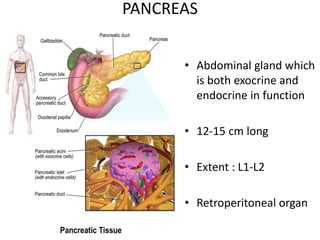
PANCREAS
โ€ข Abdominal gland which
is both exocrine and
endocrine in function
โ€ข 12-15 cm long
โ€ข Extent : L1-L2
โ€ข Retroperitoneal organ
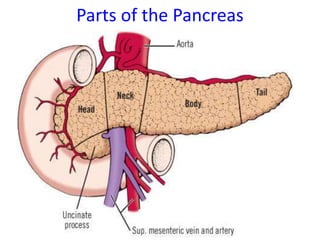
Parts of the Pancreas
INTRODUCTION
โ€ข 4th leading cause of cancer death
โ€ข Males > Females
โ€ข Risk factors โ€“ Smoking, chronic pancreatitis,
diabetes mellitus, H.pylori, chronic pancreatitis,
family history
โ€ข Pathology : Adenocarcinoma (MC)
โ€ข Spread by local extension, regional lymphatics
and distant metastasis ( liver, peritoneum, lung)
โ€ข 80% - metastatic disease at presentation
โ€ข Median survival : 8 - 14 months
DIAGNOSIS AND WORKUP
SYMPTOMS
Head, neck and uncinate
process of pancreas
โ€ข Obstructive jaundice
โ€ข Pruritus
โ€ข High coloured urine
โ€ข Clay coloured stools
โ€ข Steatorrhea
Body and tail of pancreas
โ€ข Vague pain abdomen and upper
back
โ€ข Jaundice โ€“ late manifestation
โ€ข Tail tumours - Left sided portal
hypertension , Upper GI bleed ,
Splenomegaly
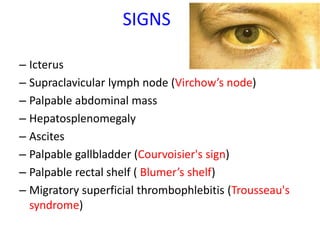
SIGNS
โ€“ Icterus
โ€“ Supraclavicular lymph node (Virchowโ€™s node)
โ€“ Palpable abdominal mass
โ€“ Hepatosplenomegaly
โ€“ Ascites
โ€“ Palpable gallbladder (Courvoisier's sign)
โ€“ Palpable rectal shelf ( Blumerโ€™s shelf)
โ€“ Migratory superficial thrombophlebitis (Trousseau's
syndrome)
WORKUP
โ€ข Imaging
- Abdominal USG
- CT scan
- EUS
- Laparoscopy
- MRI
- Upper GI Endoscopy
- ERCP & MRCP
- CT-guided biopsy.
โ€ข Laboratory investigations
โ€“ CBC
โ€“ PT/APTT
โ€“ LFT , RFT
โ€“ RBS
โ€“ CEA
โ€“ CA19-9
โ€“ Amylase
โ€“ Lipase
โ€“ LDH
โ€ข High-resolution pancreatic CT and EUS remain
the current standard for diagnosis and staging of
pancreatic malignancies.
โ€ข Staging laparoscopy - for intraperitoneal and
liver disease.
โ€ข MRI and PET-CT are emerging technologies that
require further investigation.
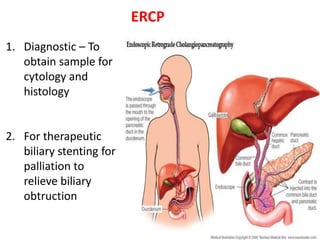
ERCP
1. Diagnostic โ€“ To
obtain sample for
cytology and
histology
2. For therapeutic
biliary stenting for
palliation to
relieve biliary
obtruction
Staging Laparoscopy
Advantages
โ€“ For visualizing smaller hepatic and peritoneal implants
โ€“ Avoids unnecessary laparotomies
โ€“ Facilitates peritoneal washings and biopsy
Indications
1. >3cm primary tumor
2. CA 19-9 > 100 U/L
3. In body or tail.
4. Equivocal findings of metastasis on CT
ROLE OF BIOPSY
โ€ข NCCN guidelines
โ€“ No need for biopsy in clearly resectable lesions
โ€“ Biopsy is needed in unresectable or metastatic
lesions prior to chemotherapy +/- radiotherapy
โ€“ Negative biopsy must be re-biopsied.
โ€“ Negative biopsies may be taken up for surgery if
borderline resectable.
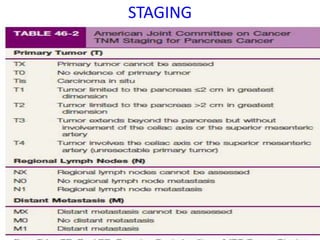
STAGING
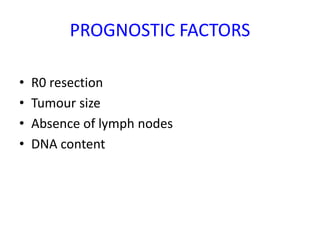
PROGNOSTIC FACTORS
โ€ข R0 resection
โ€ข Tumour size
โ€ข Absence of lymph nodes
โ€ข DNA content
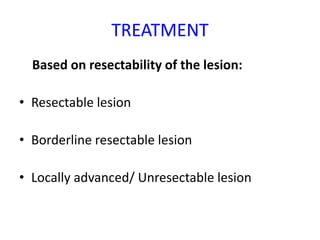
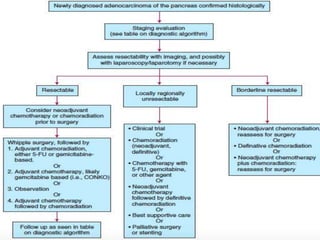
TREATMENT
Based on resectability of the lesion:
โ€ข Resectable lesion
โ€ข Borderline resectable lesion
โ€ข Locally advanced/ Unresectable lesion
TREATMENT MODALITIES
โ€ข Surgery
โ€ข Radiation therapy
โ€ข Chemotherapy
โ€ข Targeted therapy
SURGERY
โ€ข Indications: T1 , T2 , rarely T3
โ€ข 85% - not resectable
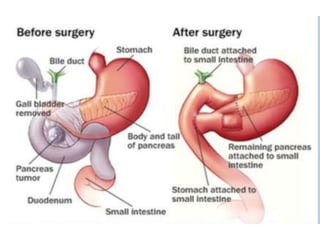
โ€ข Procedure : WHIPPLEโ€™S SURGERY
(Pancreatico โ€“ duodenectomy)
Includes en bloc resection of the duodenum, head of
the pancreas, immediate peripancreatic nodal tissue,
and the pylorus and antrum of the stomach.
โ€ข Extended lymphadenectomy currently has no
role in pancreas resections
โ€ข At least 15 draining lymph nodes must be
dissected.
โ€ข Tumours of body and tail ๏ƒ  Rarely present
early and hence rarely resectable.
Criteria for Unresectability
โ€ข Extrapancreatic involvement
โ€ข Encasement or occlusion of the superior
mesenteric vein or the SMV-portal vein
confluence.
โ€ข Direct involvement of the superior mesenteric
artery (SMA), inferior vena cava, aorta, or
celiac axis
Carcinoma Pancreas: Where does RT fit?
โ€ข Adjuvant RT +/- CT
โ€ข Neo-adjuvant RT + CT
โ€ข Palliative RT
โ€ข Intra-operative RT
โ€ข To reduce the high risk of local recurrence
ACT
โ€ข Modest improvement in survival rates
โ€ข NACT or CRT โ€“ Improves rates of resectability
WHY ADJUVANT / NEOADJUVANT THERAPY IN CA
PANCREAS?
CONSENSUS ON ADJUVANT TREATMENT
โ€ข Single agent chemo alone/ Chemo-RT are both
accepted.
โ€ข If single agent is used ๏ƒ  Gemcitabine is preferred to
infusional 5-FU.
โ€ข If Chemo-RT is planned ๏ƒ 
โ€ข Gemcitabine 1000 mg/m2 Day 1, 8, 15
โ€ข Followed by Infusional 5FU + RT
โ€“ 5FU โ€“ 250 mg/m2 C-IV daily with RT โ€“ 50.4 Gy/1.8
Gy/28 #s.
โ€ข Followed by Gemcitabine (same dose) every 4 weeks
for 3 โ€“ 5 cycles.
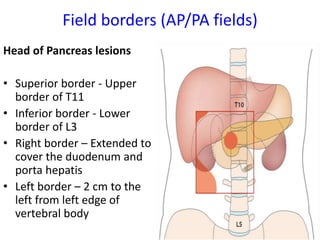
Field borders (AP/PA fields)
Head of Pancreas lesions
โ€ข Superior border - Upper
border of T11
โ€ข Inferior border - Lower
border of L3
โ€ข Right border โ€“ Extended to
cover the duodenum and
porta hepatis
โ€ข Left border โ€“ 2 cm to the
left from left edge of
vertebral body
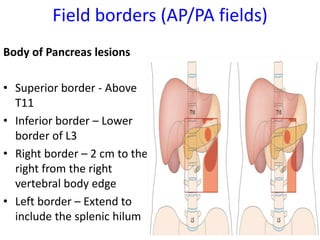
Field borders (AP/PA fields)
Body of Pancreas lesions
โ€ข Superior border - Above
T11
โ€ข Inferior border โ€“ Lower
border of L3
โ€ข Right border โ€“ 2 cm to the
right from the right
vertebral body edge
โ€ข Left border โ€“ Extend to
include the splenic hilum
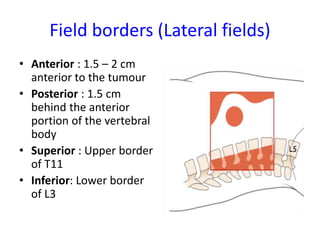
Field borders (Lateral fields)
โ€ข Anterior : 1.5 โ€“ 2 cm
anterior to the tumour
โ€ข Posterior : 1.5 cm
behind the anterior
portion of the vertebral
body
โ€ข Superior : Upper border
of T11
โ€ข Inferior: Lower border
of L3
Treatment Planning
โ€ข Position: Supine with arms above the head
โ€ข Immobilisation: Thermoplastic cast/ Aquaplast/
Wing board
โ€ข Contrast CT scan done
โ€ข Extent : Top of diaphragm till L4
โ€ข OARโ€™s - Small bowel, Liver, Stomach,
Kidneys, Spinal cord
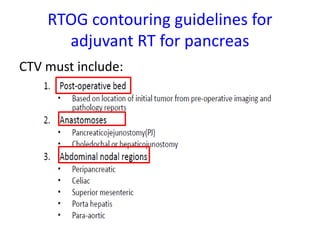
RTOG contouring guidelines for
adjuvant RT for pancreas
CTV must include:
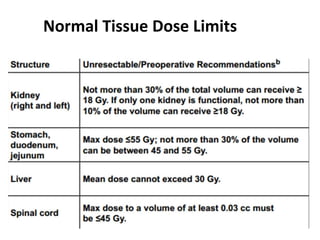
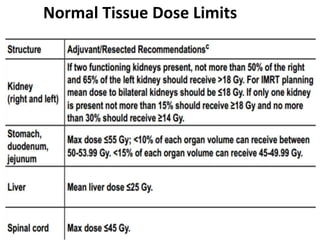
Normal Tissue Dose Limits
IMRT โ€“ INTENSITY MODULATED RADIOTHERAPY
โ€ข IMRT WILL ALLOW DOSE ESCALATION
WITHOUT INCREASING TOXICITY TO OAR
AND THEREBY IMPROVE LOCO REGIONAL
CONTROL.
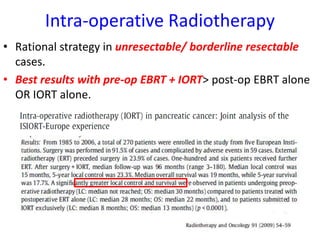
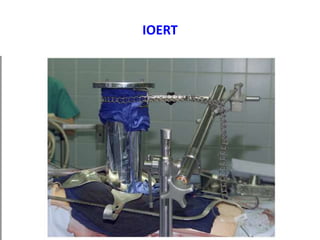
Intra-operative Radiotherapy
โ€ข Rational strategy in unresectable/ borderline resectable
cases.
โ€ข Best results with pre-op EBRT + IORT> post-op EBRT alone
OR IORT alone.
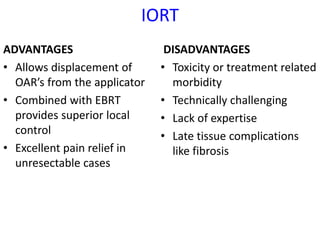
IORT
ADVANTAGES
โ€ข Allows displacement of
OARโ€™s from the applicator
โ€ข Combined with EBRT
provides superior local
control
โ€ข Excellent pain relief in
unresectable cases
DISADVANTAGES
โ€ข Toxicity or treatment related
morbidity
โ€ข Technically challenging
โ€ข Lack of expertise
โ€ข Late tissue complications
like fibrosis
IOERT
SBRT
โ€ข Stereotactic Body Radiation Therapy
โ€ข Higher dose per fraction in fewer no of
fractions
โ€ข Total dose : 25 โ€“ 30Gy in 4 โ€“ 5 F
โ€ข Higher dose to region of vessel encasement
โ€ข Advantages - Short duration , Efficacy,
Favourable toxicity
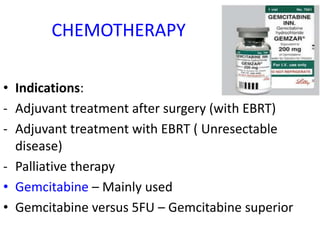
CHEMOTHERAPY
โ€ข Indications:
- Adjuvant treatment after surgery (with EBRT)
- Adjuvant treatment with EBRT ( Unresectable
disease)
- Palliative therapy
โ€ข Gemcitabine โ€“ Mainly used
โ€ข Gemcitabine versus 5FU โ€“ Gemcitabine superior
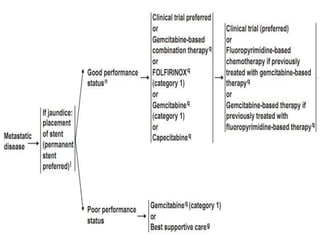
METASTATIC PANCREATIC CA
โ€ข OS without palliative chemo โ€“ 3-6 months
โ€ข OS with palliative chemo โ€“ 6-9 months
โ€ข OS benefit only in good prognosis pts
โ€“ ECOG 0 โ€“ 1
โ€“ Stenting done for jaundice
โ€“ Good pain management
โ€“ Adequate nutrition
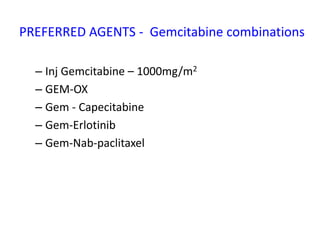
PREFERRED AGENTS - Gemcitabine combinations
โ€“ Inj Gemcitabine โ€“ 1000mg/m2
โ€“ GEM-OX
โ€“ Gem - Capecitabine
โ€“ Gem-Erlotinib
โ€“ Gem-Nab-paclitaxel
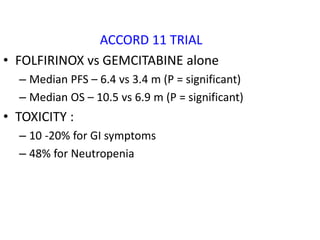
ACCORD 11 TRIAL
โ€ข FOLFIRINOX vs GEMCITABINE alone
โ€“ Median PFS โ€“ 6.4 vs 3.4 m (P = significant)
โ€“ Median OS โ€“ 10.5 vs 6.9 m (P = significant)
โ€ข TOXICITY :
โ€“ 10 -20% for GI symptoms
โ€“ 48% for Neutropenia
Chemotherapy for Metastatic
Pancreatic Cancer
โ€ข 5-FU
โ€ข Gemcitabine
โ€“ Median survival times versus 5-FU
โ€“ Survival rate at 12-months
โ€“ Toxicities
โ€“ Optimizing efficiency
Molecular Targeted Therapies
โ€ข Growth Factors are expressed at higher levels
in pancreatic cancer
โ€ข Erlotinib (100 mg OD): small molecule tyrosine
kinase inhibitor of the EGF receptor
โ€“ In combination with gemcitabine
โ€“ Side Effects
โ€“ Cost / Cost in Years of Life Gained (YLG)
โ€“ Single agent
โ€ข Cetuximab: EGFR monoclonal antibody
Molecular Targeted Therapies
โ€ข Bevacizumab: anti-VEGF (Vascular endothelial
growth factor) monoclonal antibody
โ€“ Bevacizumab + Gemcitabine (CALGB Trial)
โ€“ Bevacizumab + Gemcitabine + Erlotinib (AVITA)
โ€ข Sorafenib: inhibitor of Raf-1 and VEGF
receptor 2
โ€ข Future direction: VEGF Trap & Sunitinib
Immunotherapy
โ€ข Gemcitabine + Gastrin Vaccine (G17DT)
โ€ข Future
โ€“ Immunogenic telomerase peptides (TeloVac)
โ€“ Hopkins: Lethally irradiated allogenic pancreatic
tumor cells transfected with GM-CSF gene
โ€“ Listeria carrying mesothelin peptide
COMPLICATIONS
โ€ข Biliary obstruction
โ€ข Gastric outlet obstruction
โ€ข Pancreatic insufficiency
โ€ข Thromboembolic disease
โ€ข Severe abdominal pain
โ€ข Malnutrition
โ€ข Depression
Ca pancreas managment

Ca pancreas managment

  • 1.
    MANAGEMENT OF CAPANCREAS Dr Sneha George
  • 2.
    PANCREAS โ€ข Abdominal glandwhich is both exocrine and endocrine in function โ€ข 12-15 cm long โ€ข Extent : L1-L2 โ€ข Retroperitoneal organ
  • 3.
    Parts of thePancreas
  • 4.
    INTRODUCTION โ€ข 4th leadingcause of cancer death โ€ข Males > Females โ€ข Risk factors โ€“ Smoking, chronic pancreatitis, diabetes mellitus, H.pylori, chronic pancreatitis, family history โ€ข Pathology : Adenocarcinoma (MC) โ€ข Spread by local extension, regional lymphatics and distant metastasis ( liver, peritoneum, lung) โ€ข 80% - metastatic disease at presentation โ€ข Median survival : 8 - 14 months
  • 5.
  • 6.
    SYMPTOMS Head, neck anduncinate process of pancreas โ€ข Obstructive jaundice โ€ข Pruritus โ€ข High coloured urine โ€ข Clay coloured stools โ€ข Steatorrhea Body and tail of pancreas โ€ข Vague pain abdomen and upper back โ€ข Jaundice โ€“ late manifestation โ€ข Tail tumours - Left sided portal hypertension , Upper GI bleed , Splenomegaly
  • 7.
    SIGNS โ€“ Icterus โ€“ Supraclavicularlymph node (Virchowโ€™s node) โ€“ Palpable abdominal mass โ€“ Hepatosplenomegaly โ€“ Ascites โ€“ Palpable gallbladder (Courvoisier's sign) โ€“ Palpable rectal shelf ( Blumerโ€™s shelf) โ€“ Migratory superficial thrombophlebitis (Trousseau's syndrome)
  • 8.
    WORKUP โ€ข Imaging - AbdominalUSG - CT scan - EUS - Laparoscopy - MRI - Upper GI Endoscopy - ERCP & MRCP - CT-guided biopsy. โ€ข Laboratory investigations โ€“ CBC โ€“ PT/APTT โ€“ LFT , RFT โ€“ RBS โ€“ CEA โ€“ CA19-9 โ€“ Amylase โ€“ Lipase โ€“ LDH
  • 9.
    โ€ข High-resolution pancreaticCT and EUS remain the current standard for diagnosis and staging of pancreatic malignancies. โ€ข Staging laparoscopy - for intraperitoneal and liver disease. โ€ข MRI and PET-CT are emerging technologies that require further investigation.
  • 10.
    ERCP 1. Diagnostic โ€“To obtain sample for cytology and histology 2. For therapeutic biliary stenting for palliation to relieve biliary obtruction
  • 11.
    Staging Laparoscopy Advantages โ€“ Forvisualizing smaller hepatic and peritoneal implants โ€“ Avoids unnecessary laparotomies โ€“ Facilitates peritoneal washings and biopsy Indications 1. >3cm primary tumor 2. CA 19-9 > 100 U/L 3. In body or tail. 4. Equivocal findings of metastasis on CT
  • 12.
    ROLE OF BIOPSY โ€ขNCCN guidelines โ€“ No need for biopsy in clearly resectable lesions โ€“ Biopsy is needed in unresectable or metastatic lesions prior to chemotherapy +/- radiotherapy โ€“ Negative biopsy must be re-biopsied. โ€“ Negative biopsies may be taken up for surgery if borderline resectable.
  • 13.
  • 14.
    PROGNOSTIC FACTORS โ€ข R0resection โ€ข Tumour size โ€ข Absence of lymph nodes โ€ข DNA content
  • 15.
    TREATMENT Based on resectabilityof the lesion: โ€ข Resectable lesion โ€ข Borderline resectable lesion โ€ข Locally advanced/ Unresectable lesion
  • 17.
    TREATMENT MODALITIES โ€ข Surgery โ€ขRadiation therapy โ€ข Chemotherapy โ€ข Targeted therapy
  • 18.
    SURGERY โ€ข Indications: T1, T2 , rarely T3 โ€ข 85% - not resectable โ€ข Procedure : WHIPPLEโ€™S SURGERY (Pancreatico โ€“ duodenectomy) Includes en bloc resection of the duodenum, head of the pancreas, immediate peripancreatic nodal tissue, and the pylorus and antrum of the stomach.
  • 20.
    โ€ข Extended lymphadenectomycurrently has no role in pancreas resections โ€ข At least 15 draining lymph nodes must be dissected. โ€ข Tumours of body and tail ๏ƒ  Rarely present early and hence rarely resectable.
  • 21.
    Criteria for Unresectability โ€ขExtrapancreatic involvement โ€ข Encasement or occlusion of the superior mesenteric vein or the SMV-portal vein confluence. โ€ข Direct involvement of the superior mesenteric artery (SMA), inferior vena cava, aorta, or celiac axis
  • 22.
    Carcinoma Pancreas: Wheredoes RT fit? โ€ข Adjuvant RT +/- CT โ€ข Neo-adjuvant RT + CT โ€ข Palliative RT โ€ข Intra-operative RT
  • 23.
    โ€ข To reducethe high risk of local recurrence ACT โ€ข Modest improvement in survival rates โ€ข NACT or CRT โ€“ Improves rates of resectability WHY ADJUVANT / NEOADJUVANT THERAPY IN CA PANCREAS?
  • 24.
    CONSENSUS ON ADJUVANTTREATMENT โ€ข Single agent chemo alone/ Chemo-RT are both accepted. โ€ข If single agent is used ๏ƒ  Gemcitabine is preferred to infusional 5-FU. โ€ข If Chemo-RT is planned ๏ƒ  โ€ข Gemcitabine 1000 mg/m2 Day 1, 8, 15 โ€ข Followed by Infusional 5FU + RT โ€“ 5FU โ€“ 250 mg/m2 C-IV daily with RT โ€“ 50.4 Gy/1.8 Gy/28 #s. โ€ข Followed by Gemcitabine (same dose) every 4 weeks for 3 โ€“ 5 cycles.
  • 25.
    Field borders (AP/PAfields) Head of Pancreas lesions โ€ข Superior border - Upper border of T11 โ€ข Inferior border - Lower border of L3 โ€ข Right border โ€“ Extended to cover the duodenum and porta hepatis โ€ข Left border โ€“ 2 cm to the left from left edge of vertebral body
  • 26.
    Field borders (AP/PAfields) Body of Pancreas lesions โ€ข Superior border - Above T11 โ€ข Inferior border โ€“ Lower border of L3 โ€ข Right border โ€“ 2 cm to the right from the right vertebral body edge โ€ข Left border โ€“ Extend to include the splenic hilum
  • 27.
    Field borders (Lateralfields) โ€ข Anterior : 1.5 โ€“ 2 cm anterior to the tumour โ€ข Posterior : 1.5 cm behind the anterior portion of the vertebral body โ€ข Superior : Upper border of T11 โ€ข Inferior: Lower border of L3
  • 28.
    Treatment Planning โ€ข Position:Supine with arms above the head โ€ข Immobilisation: Thermoplastic cast/ Aquaplast/ Wing board โ€ข Contrast CT scan done โ€ข Extent : Top of diaphragm till L4 โ€ข OARโ€™s - Small bowel, Liver, Stomach, Kidneys, Spinal cord
  • 29.
    RTOG contouring guidelinesfor adjuvant RT for pancreas CTV must include:
  • 30.
  • 31.
  • 32.
    IMRT โ€“ INTENSITYMODULATED RADIOTHERAPY โ€ข IMRT WILL ALLOW DOSE ESCALATION WITHOUT INCREASING TOXICITY TO OAR AND THEREBY IMPROVE LOCO REGIONAL CONTROL.
  • 33.
    Intra-operative Radiotherapy โ€ข Rationalstrategy in unresectable/ borderline resectable cases. โ€ข Best results with pre-op EBRT + IORT> post-op EBRT alone OR IORT alone.
  • 34.
    IORT ADVANTAGES โ€ข Allows displacementof OARโ€™s from the applicator โ€ข Combined with EBRT provides superior local control โ€ข Excellent pain relief in unresectable cases DISADVANTAGES โ€ข Toxicity or treatment related morbidity โ€ข Technically challenging โ€ข Lack of expertise โ€ข Late tissue complications like fibrosis
  • 35.
  • 36.
    SBRT โ€ข Stereotactic BodyRadiation Therapy โ€ข Higher dose per fraction in fewer no of fractions โ€ข Total dose : 25 โ€“ 30Gy in 4 โ€“ 5 F โ€ข Higher dose to region of vessel encasement โ€ข Advantages - Short duration , Efficacy, Favourable toxicity
  • 37.
    CHEMOTHERAPY โ€ข Indications: - Adjuvanttreatment after surgery (with EBRT) - Adjuvant treatment with EBRT ( Unresectable disease) - Palliative therapy โ€ข Gemcitabine โ€“ Mainly used โ€ข Gemcitabine versus 5FU โ€“ Gemcitabine superior
  • 38.
    METASTATIC PANCREATIC CA โ€ขOS without palliative chemo โ€“ 3-6 months โ€ข OS with palliative chemo โ€“ 6-9 months โ€ข OS benefit only in good prognosis pts โ€“ ECOG 0 โ€“ 1 โ€“ Stenting done for jaundice โ€“ Good pain management โ€“ Adequate nutrition
  • 40.
    PREFERRED AGENTS -Gemcitabine combinations โ€“ Inj Gemcitabine โ€“ 1000mg/m2 โ€“ GEM-OX โ€“ Gem - Capecitabine โ€“ Gem-Erlotinib โ€“ Gem-Nab-paclitaxel
  • 41.
    ACCORD 11 TRIAL โ€ขFOLFIRINOX vs GEMCITABINE alone โ€“ Median PFS โ€“ 6.4 vs 3.4 m (P = significant) โ€“ Median OS โ€“ 10.5 vs 6.9 m (P = significant) โ€ข TOXICITY : โ€“ 10 -20% for GI symptoms โ€“ 48% for Neutropenia
  • 42.
    Chemotherapy for Metastatic PancreaticCancer โ€ข 5-FU โ€ข Gemcitabine โ€“ Median survival times versus 5-FU โ€“ Survival rate at 12-months โ€“ Toxicities โ€“ Optimizing efficiency
  • 43.
    Molecular Targeted Therapies โ€ขGrowth Factors are expressed at higher levels in pancreatic cancer โ€ข Erlotinib (100 mg OD): small molecule tyrosine kinase inhibitor of the EGF receptor โ€“ In combination with gemcitabine โ€“ Side Effects โ€“ Cost / Cost in Years of Life Gained (YLG) โ€“ Single agent โ€ข Cetuximab: EGFR monoclonal antibody
  • 44.
    Molecular Targeted Therapies โ€ขBevacizumab: anti-VEGF (Vascular endothelial growth factor) monoclonal antibody โ€“ Bevacizumab + Gemcitabine (CALGB Trial) โ€“ Bevacizumab + Gemcitabine + Erlotinib (AVITA) โ€ข Sorafenib: inhibitor of Raf-1 and VEGF receptor 2 โ€ข Future direction: VEGF Trap & Sunitinib
  • 45.
    Immunotherapy โ€ข Gemcitabine +Gastrin Vaccine (G17DT) โ€ข Future โ€“ Immunogenic telomerase peptides (TeloVac) โ€“ Hopkins: Lethally irradiated allogenic pancreatic tumor cells transfected with GM-CSF gene โ€“ Listeria carrying mesothelin peptide
  • 46.
    COMPLICATIONS โ€ข Biliary obstruction โ€ขGastric outlet obstruction โ€ข Pancreatic insufficiency โ€ข Thromboembolic disease โ€ข Severe abdominal pain โ€ข Malnutrition โ€ข Depression

Editor's Notes

  • #22ย As a general rule, pancreatic cancers are considered unresectable if any of the following are present [2] : 1. Extrapancreatic involvement, including extensive peripancreatic lymphatic involvement, and/or distant metastases. 2. Encasement or occlusion of the superior mesenteric vein (SMV), or the SMV-portal vein confluence. Some centers are revisiting this criterion and are demonstrating the feasibility of SMV reconstruction [3] . 3. Direct involvement of the superior mesenteric artery (SMA), inferior vena cava, aorta, or celiac axis, as defined by the absence of a fat plane between the low density tumor and these structures on CT scan.
  • #43ย The goal of systemic therapy for metastatic pancreatic cancer is to minimize disease-related symptoms and prolong survival. The superior survival outcomes achieved with 5-fluorouracil (5-FU)-based combinations compared with best supportive care (BSC) alone provided an initial validation of chemotherapy benefit for advanced pancreatic cancer patients. The median survival times associated with 5-FU were consistently in the 6-month range. However, in a meta-analysis, 5-FU combinations did not demonstrate a survival benefit when compared with 5-FU alone. Because of its favorable toxicity profile and modest ability to palliate typical pancreatic cancer symptoms, single-agent gemcitabine has been the global reference regimen for this disease since its approval in 1996. Gemcitabine is a deoxycytidine analogue structurally related to cytarabine (cytosine arabinoside) originally investigated for its antiviral effects. It is a prodrug that requires cellular uptake and intracellular phosphorylation (metabolites are active). Gemcitabine triphosphate competitively inhibits DNA chain elongation, leading to DNA fragmentation and cell death. The median survival times for gemcitabine and 5-FU patients were 5.65 and 4.41 months, respectively. The survival rate at 12months was 18%for gemcitabine patients and 2% for 5-FU patients. Myelosuppression is the main toxicity associated with gemcitabine. However, postmarketing surveillance has documented rare occurrences of acute lung, liver, and kidney injury. Therefore, gemcitabine-induced acute lung injury should be considered if new symptoms such as cough or dyspnea develop, and consistent monitoring of renal and hepatic function should be included in the follow-up of patients treated with gemcitabine. Gemcitabine is a renally cleared drug. One phase I evaluation study in patients with hepatic or renal dysfunction showed that patients with baseline hyperbilirubinemia were at risk for liver function deterioration with gemcitabine. AST/ALT raised makes no difference. Optimizing efficiency: Optimal dose and schedule of gemcitabine have not been identified. < 1 week intervals and infusion times > 60 minutes to increase uptake resulted in greater toxcitiy without clinical benefit. Fixed dose rate infusions showed a lot of promise in Phase II trials but failed to show statistical benefit in Phase III. Infusion rates are also limited because of the rate-limiting step in the phorphoylation intracellularly. Regular schedule is 1000mg/m2 over 30 minutes weekly.
  • #44ย Molecularly targeted agents have a solid preclinical rationale as treatment for advanced pancreatic cancer. However, with the exception of erlotinib, the completed phase III trials have not confirmed an important clinical benefit. The human epidermal growth factor receptor 1 (HER-1/EGFR) signaling cascade has been targeted for anticancer drug development because it is observed that overexpression in a high percentage of pancreatic cancers and its association with poor prognosis. Erlotinib, an orally available molecule, interrupts HER-1/EGFR signaling by inhibiting the tyrosine kinase integrated in the intracellular receptor domain. Based on a phase III randomized, placebo-controlled trial, erlotinib in combination with gemcitabine received U.S. Food and Drug Administration approval as treatment for chemotherapy-naรฏve locally advanced and metastatic pancreatic cancer in 2005. Median survival duration was 6.24 versus 5.91 months. 1 year survival advantage was 23% versus 17%. A review of toxicities may further discourage the use of gemcitabine plus erlotinib. Patients receiving erlotinib and gemcitabine experienced higher frequencies of rash (72%), diarrhea (56%), infection (43%), and stomatitis (23%), generally grade 1 or 2. Cost is a problem. The addition of erlotinib increases the costs of treating advanced pancreatic cancer by $12,156 wholesale or $16,613 retail per patient. Factoring in 0.4-month longer median survival time compared with gemcitabine alone, the addition of erlotinib costs $364,680 per YLG wholesale and $498,379 per YLG retail. In order to be cost-effective, even at the $100,000/YLG level, 6 months of erlotinib would have to be reduced to 20%of the current retail cost (i.e., to $18.52 per tablet). The minimal additional clinical benefit, side effects, and financial impact have discouraged patients and clinicians when deciding on the inclusion of erlotinib in combination with gemcitabine as palliative treatment for metastatic pancreatic cancer. Erlotinib as a single agent for treatment of chemotherapy-resistant pancreatic cancer is just beginning to be evaluated. Cetuximab is a monoclonal antibody that binds the extracellular domain of EGF receptor. In combination with gemcitabine median survival times were 6.5 months versus 6 months with gemcitabine alone.
  • #45ย Vascular endothelial growth factor (VEGF) plays a key role in the growth and metastasis of many tumors, including pancreatic cancer. Bevacizumab is a recombinant humanized anti-VEGF monoclonal antibody with clinical benefit in metastatic colon, breast, and non-small cell lung cancer. Double-blind trials showed median overall survival times to be 5.7 months for gemcitabine plus bevacizumab versus gemcitabine plug placebo. (CALGB Trial) The AVITA study was also a randomized, double-blind, placebo-controlled trial involving bevacizumab, gemcitabine, and erlotinib sponsored by Rouche. It failed to meet the primary endpoint for survival. Sorafenib is an inhibitor of RAF-1 and VEGF receptor 2. In combination with gemcitabine, no response was seen. Median survival time was 4 months and the 6 month survival rate was 23%. Antiangiogenesis will continue to be evaluated in pancreative cancer in randomized clinical trial by comparing gemcitabine with VEGF Trap (aflibercept) with gemcitabine. Aflibercept is a fusion protien made of human VEGF receptor extracellular domains fused to the Fc portion of human IgG. It is designed to bind and inactivate circulating VEGF. Another is Sunitinib which is an oral tyrosine kinase inhibitor for the VEGF receptor as well as platelet-derived growth factor being evaluated for 2nd line treatment.
  • #46ย Immunotherapy, defined in the context of clinical oncology, involves the stimulation of a patientโ€™s immune system to achieve antitumor activity. Nonspecific strategies include the use of exogenous immunostimulants or cytokines, the transfer of nonspecific immune effector cells, and the inhibition of immunosuppressive pathways. Alternatively, specific immunotherapeutic strategies strive to enhance the response to defined tumor antigens or induce antitumor antibody activity, often via vaccination. Gastrin was shown to demonstrate the necessary criteria for a potential immunotherapy target against pancreatic cancer. Gastrin receptors and precursor gastrin forms were shown to be broadly expressed, demonstrated in up to 90% of pancreatic cancer resection tissues. Also, gastrin demonstrated a possible pathogenic role, because in vivo gastrin had a proliferative effect on pancreatic cancer cells, and antigastrin antibodies raised against G17DT, an immunoconjugate of gastrin-17, inhibited the proliferation of pancreatic cancer cells. Early human studies were promising. However, randomized double-blind study of gemcitabine plus placebo versus gemcitabine plus G17FT did not demonstrate survival advantage. The combination resulted in median overall survival time of 178 days versus 201 days for gemcitabine plug placebo. Response was weaker in women. Immunogenic telomerase peptides have been characterized and a phase Iโ€“I/I study investigating the safety, tolerability, and immunogenicity of a telomerase peptide vaccination, GV1001. TeloVac Trial taking place in the UK. A phase III trial will occur in the US soon. Johns Hopkins has pioneered the development of lethally irradiated allogenic pancreatic tumor cells transfected with the GM-CSF gene as immunotherapy for pancreatic cancer. GM-CSF stimulated the immune response. First the vaccine was given and then patients were treated with 5-FU. Median survival time is approximately 26 months. Itโ€™s comparing favorably to adjuvant gemcitabine in phase III trials. Hopkins is also working on using attenuated Listeria carrying mesothelin peptide. The rational is that listeria is a very efficient bacteria at eliciting an immune response.