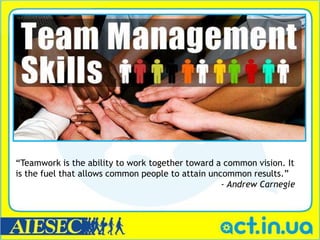
“Teamwork is the ability to work together toward a common vision. It
is the fuel that allows common people to attain uncommon results.”
                                                   - Andrew Carnegie
Today we will talk about:

1.Work in a team
2.Leading a team
What is a team?
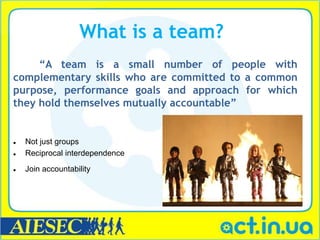
     ―A team is a small number of people with
complementary skills who are committed to a common
purpose, performance goals and approach for which
they hold themselves mutually accountable‖


   Not just groups
   Reciprocal interdependence
   Join accountability
What is a team?
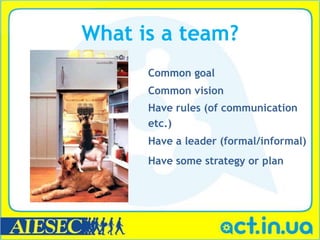
      Common goal
      Common vision
      Have rules (of communication
      etc.)
      Have a leader (formal/informal)
      Have some strategy or plan
TEAM
 Together
 Everyone
 Achieve
 More
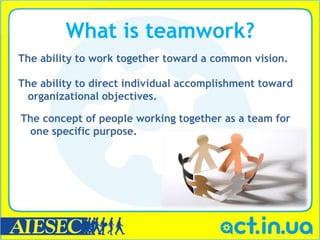
What is teamwork?
The ability to work together toward a common vision.

The ability to direct individual accomplishment toward
 organizational objectives.

The concept of people working together as a team for
 one specific purpose.
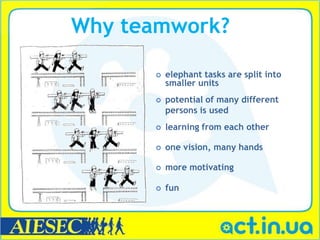
Why teamwork?

         elephant tasks are split into
          smaller units
         potential of many different
          persons is used
         learning from each other

         one vision, many hands

         more motivating

         fun
Let’s practice
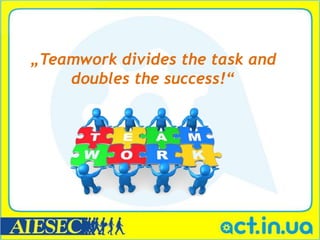
„Teamwork divides the task and
    doubles the success!“
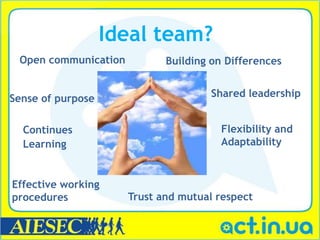
Ideal team?
 Open communication          Building on Differences


Sense of purpose                      Shared leadership


  Continues                             Flexibility and
  Learning                              Adaptability


Effective working
procedures            Trust and mutual respect
Teamwork — Necessary attitudes
  • Open         • Supportive
  • Trust        • Respect
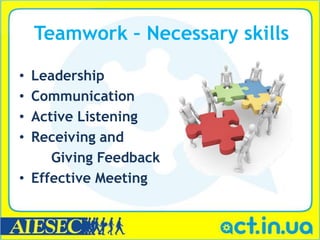
Teamwork – Necessary skills

• Leadership
• Communication
• Active Listening
• Receiving and
     Giving Feedback
• Effective Meeting
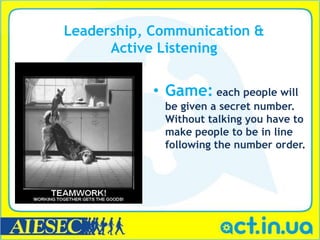
Leadership, Communication &
      Active Listening


            • Game: each people will
             be given a secret number.
             Without talking you have to
             make people to be in line
             following the number order.
Focus  effective teams are very clear about
 what they are doing at each phase of the
 problem solving and collaborative process
Climate −   positive, inclusive, focus on
    the issue (not on the person)
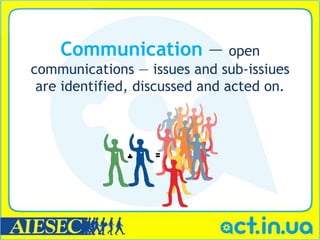
Communication —             open
communications — issues and sub-issiues
 are identified, discussed and acted on.
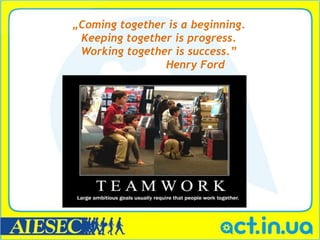
„Coming together is a beginning.
 Keeping together is progress.
 Working together is success.”
                Henry Ford
Video
TEAM LEADER XP
The first thing that you need to
know is… a little secret about you.

YOU HAVE A POWER AND AUTHORITY
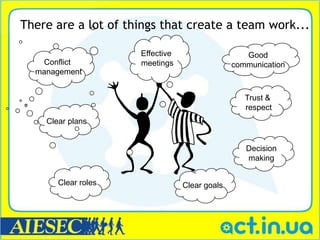
There are a lot of things that create a team work...

                     Effective                    Good
   Conflict          meetings                  communication
  management


                                                  Trust &
                                                  respect
    Clear plans


                                                  Decision
                                                  making


       Clear roles               Clear goals
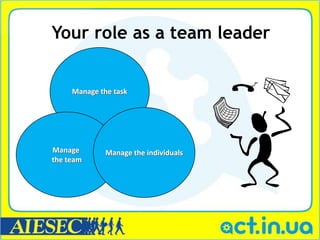
Your role as a team leader


     Manage the task


Manage        Manage the individuals
the team
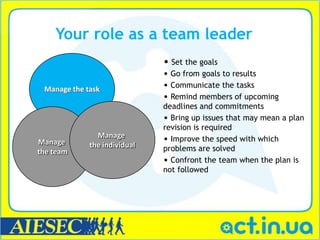
Your role as a team leader
                              • Set the goals
                              • Go from goals to results
 Manage the task              • Communicate the tasks
                              • Remind members of upcoming
                              deadlines and commitments
                              • Bring up issues that may mean a plan
                              revision is required
               Manage         • Improve the speed with which
Manage       the individual
the team                      problems are solved
                              • Confront the team when the plan is
                              not followed
Team management
1. Planning the team
2. Working with the team
3. Evaluation the team
The 1st step, and one that is often forgotten, is
  planning the team that you want to have.

Planning is very important in ensuring that you will
  have a successful team throughout your project.
Remember
      team structure should be:

    • Based on goals that you have
• Concrete with amount of team members
While thinking about structure of your
         team don`t forget about

• Positions
• Job Descriptions
• Benefits
(personal development)
Identify the strengths in your people!

  Some things you might want to consider when thinking
about what your people are good at include:
 • What have their successes been, and what were the
   conditions or behaviors that caused those successes?
 • What capabilities do you see in them that are unique?
 • What do you think they’re proud about in their lives, and
   about themselves?
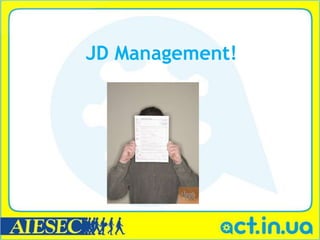
JD Management!
What you should remember about JD!

• understandable
• structured
• equal in volume of
  responsibilities between members
• Do not cross roles
Structure of JD should look like

•Role
•Responsibilities
•MoS
•Skills, competencies (development)
Decide the drivers of the team’s success !


Each team is successful
 for a different reason.

Why your team is going
   to be successful?
Some examples of drivers may include:


• Strong personal relationships between
  team members
• Excellent individuals who create
  individual achievements in their areas.
• A culture of celebrating successes
• A ton of ambition for achievements
Video
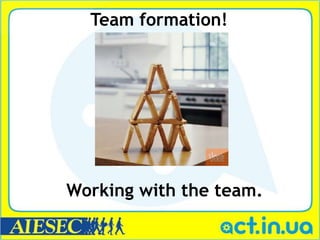
Team formation!


Working with the team.
Getting to know each other

    Be sure you’re allowing everyone to
connect, break the ice, and get to know one
another on both a personal and professional
level. There are countless exercises to do
this.
Setting a common vision

   It’s very important to have a vision of
what you want to achieve as a team.
This vision will guide your actions
throughout your teamwork in project
Whatever vision you create, make sure it
 meets the following criteria:
• It capitalizes on the strengths and passions
  of people in your team.
• The members of the team have an
  emotional connection to the vision, and are
  excited to make it become a reality.
• It is clear enough to provide direction and
  allow you to set more concrete goals on the
  basis of the vision.
Set team principles and standards
• weekly meetings
• reporting system
• teambuilding days
• feedback sessions
• rules during meetings
• rules in terms of your personal and
virtual communication etc.
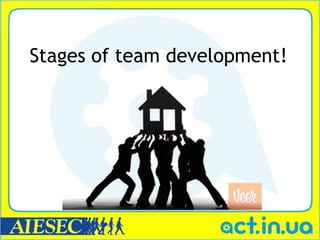
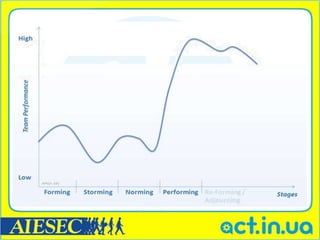
Stages of team development!
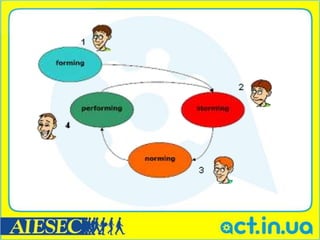
Forming - formalities are preserved and
 members are treated as strangers.
Storming - members start to communicate
  their feelings but probably still don`t view
  themselves as part of the team.
Norming - people feel part of the team
 and realize that they can achieve
 working if they accept other viewpoints.
Performing - the team works in an open
  and trusting atmosphere where flexibility
  is the key and hierarchy is of little
  importance
Effective meetings!
Don`t forget about importance of
    1st meeting of your team
 It should be:
                     • Unique one
 • Unforgettable
                   • Starting point
 • Motivational
                       • Inspiring
Agenda of 1st meeting can be like
              this one
 –Team intro & GTKEO
 – Team vision, goals, MoS, legacy
 – Team culture
 – Team rules
 – Roles & Responsibilities
 – Work flow (meetings, reports)
Important:
– Atmosphere
– Necessity
– Professionalism
– Expected outcome
To make meeting extremely
 effective:

 – Pre-meeting letter
 – Clear plan of meeting prepared
 – Outputs
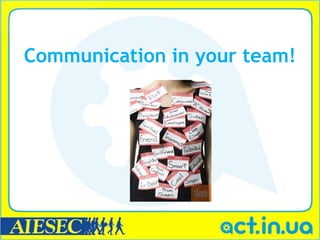
Communication in your team!
Use different channels

• Via meetings
                              • Online sharing

• Personal VS. Professional
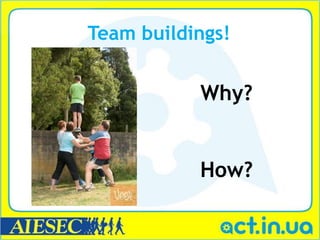
Team buildings!


           Why?


           How?
Motivation!
How can a
leader benefit
if he/she
motivates
members?
Team motivation
           • best team
      • contribution to project
        • Impact on society

Personal approach to members
           • member needs
           • member goals
            • members life
How to be a good motivator?!
1. Deliver all information to team
   members (what is behind your daily
   work)
2. Use your strengths
3. Be open
4. Role modeling attitude
Video
I think you will be
  best of the best
  team leaders !!!

  Good luck! =)
Thank you for attention!

Team management

  • 1.
    “Teamwork is theability to work together toward a common vision. It is the fuel that allows common people to attain uncommon results.” - Andrew Carnegie
  • 2.
    Today we willtalk about: 1.Work in a team 2.Leading a team
  • 3.
    What is ateam? ―A team is a small number of people with complementary skills who are committed to a common purpose, performance goals and approach for which they hold themselves mutually accountable‖  Not just groups  Reciprocal interdependence  Join accountability
  • 4.
    What is ateam? Common goal Common vision Have rules (of communication etc.) Have a leader (formal/informal) Have some strategy or plan
  • 5.
  • 6.
    What is teamwork? Theability to work together toward a common vision. The ability to direct individual accomplishment toward organizational objectives. The concept of people working together as a team for one specific purpose.

  • 7.
    Why teamwork?  elephant tasks are split into smaller units  potential of many different persons is used  learning from each other  one vision, many hands  more motivating  fun
  • 8.
  • 9.
    „Teamwork divides thetask and doubles the success!“
  • 10.
    Ideal team? Opencommunication Building on Differences Sense of purpose Shared leadership Continues Flexibility and Learning Adaptability Effective working procedures Trust and mutual respect
  • 11.
    Teamwork — Necessaryattitudes • Open • Supportive • Trust • Respect
  • 12.
    Teamwork – Necessaryskills • Leadership • Communication • Active Listening • Receiving and Giving Feedback • Effective Meeting
  • 13.
    Leadership, Communication & Active Listening • Game: each people will be given a secret number. Without talking you have to make people to be in line following the number order.
  • 14.
    Focus effectiveteams are very clear about what they are doing at each phase of the problem solving and collaborative process
  • 15.
    Climate − positive, inclusive, focus on the issue (not on the person)
  • 16.
    Communication — open communications — issues and sub-issiues are identified, discussed and acted on.
  • 17.
    „Coming together isa beginning. Keeping together is progress. Working together is success.” Henry Ford
  • 18.
  • 19.
  • 20.
    The first thingthat you need to know is… a little secret about you. YOU HAVE A POWER AND AUTHORITY
  • 21.
    There are alot of things that create a team work... Effective Good Conflict meetings communication management Trust & respect Clear plans Decision making Clear roles Clear goals
  • 22.
    Your role asa team leader Manage the task Manage Manage the individuals the team
  • 23.
    Your role asa team leader • Set the goals • Go from goals to results Manage the task • Communicate the tasks • Remind members of upcoming deadlines and commitments • Bring up issues that may mean a plan revision is required Manage • Improve the speed with which Manage the individual the team problems are solved • Confront the team when the plan is not followed
  • 24.
    Team management 1. Planningthe team 2. Working with the team 3. Evaluation the team
  • 25.
    The 1st step,and one that is often forgotten, is planning the team that you want to have. Planning is very important in ensuring that you will have a successful team throughout your project.
  • 26.
    Remember team structure should be: • Based on goals that you have • Concrete with amount of team members
  • 27.
    While thinking aboutstructure of your team don`t forget about • Positions • Job Descriptions • Benefits (personal development)
  • 28.
    Identify the strengthsin your people! Some things you might want to consider when thinking about what your people are good at include: • What have their successes been, and what were the conditions or behaviors that caused those successes? • What capabilities do you see in them that are unique? • What do you think they’re proud about in their lives, and about themselves?
  • 29.
  • 30.
    What you shouldremember about JD! • understandable • structured • equal in volume of responsibilities between members • Do not cross roles
  • 31.
    Structure of JDshould look like •Role •Responsibilities •MoS •Skills, competencies (development)
  • 32.
    Decide the driversof the team’s success ! Each team is successful for a different reason. Why your team is going to be successful?
  • 33.
    Some examples ofdrivers may include: • Strong personal relationships between team members • Excellent individuals who create individual achievements in their areas. • A culture of celebrating successes • A ton of ambition for achievements
  • 34.
  • 35.
  • 36.
    Getting to knoweach other Be sure you’re allowing everyone to connect, break the ice, and get to know one another on both a personal and professional level. There are countless exercises to do this.
  • 37.
    Setting a commonvision It’s very important to have a vision of what you want to achieve as a team. This vision will guide your actions throughout your teamwork in project
  • 38.
    Whatever vision youcreate, make sure it meets the following criteria: • It capitalizes on the strengths and passions of people in your team. • The members of the team have an emotional connection to the vision, and are excited to make it become a reality. • It is clear enough to provide direction and allow you to set more concrete goals on the basis of the vision.
  • 39.
    Set team principlesand standards • weekly meetings • reporting system • teambuilding days • feedback sessions • rules during meetings • rules in terms of your personal and virtual communication etc.
  • 40.
    Stages of teamdevelopment!
  • 41.
    Forming - formalitiesare preserved and members are treated as strangers.
  • 42.
    Storming - membersstart to communicate their feelings but probably still don`t view themselves as part of the team.
  • 43.
    Norming - peoplefeel part of the team and realize that they can achieve working if they accept other viewpoints.
  • 44.
    Performing - theteam works in an open and trusting atmosphere where flexibility is the key and hierarchy is of little importance
  • 47.
  • 48.
    Don`t forget aboutimportance of 1st meeting of your team It should be: • Unique one • Unforgettable • Starting point • Motivational • Inspiring
  • 49.
    Agenda of 1stmeeting can be like this one –Team intro & GTKEO – Team vision, goals, MoS, legacy – Team culture – Team rules – Roles & Responsibilities – Work flow (meetings, reports)
  • 50.
    Important: – Atmosphere – Necessity –Professionalism – Expected outcome
  • 51.
    To make meetingextremely effective: – Pre-meeting letter – Clear plan of meeting prepared – Outputs
  • 52.
  • 53.
    Use different channels •Via meetings • Online sharing • Personal VS. Professional
  • 54.
  • 55.
    Motivation! How can a leaderbenefit if he/she motivates members?
  • 56.
    Team motivation • best team • contribution to project • Impact on society Personal approach to members • member needs • member goals • members life
  • 57.
    How to bea good motivator?! 1. Deliver all information to team members (what is behind your daily work) 2. Use your strengths 3. Be open 4. Role modeling attitude
  • 58.
  • 59.
    I think youwill be best of the best team leaders !!! Good luck! =)
  • 60.
    Thank you forattention!