TEAM MANAGEMENT
Program Objectives  Understand the team concept.  Open lines of communication as a foundation.  Sharpen communication techniques and skills.  Learn techniques for building a better team.  Understand your style and role as a team leader.  Sharpen your team’s goal setting, motivation and  output/performance.  Understand team members and team dynamics.  Practice, discuss, and problem solve.
What is a team? “  A team is a number of persons associated together in work or activity: as a group on one side (as in football or debate).”  In other words, when one person cannot accomplish a job alone and several individuals must cooperate to fulfill a mission, you need a team. The better the cooperation, communication, and coordination among team members, the more efficient the team
Teamwork Is close cooperation between cross-trained employees who are familiar with a wide range of jobs in their organization  Team-building  Is high interaction among group members to increase trust and openness  What is team management? Team management  refers to techniques, processes and tools for organizing and coordinating a group of individuals working towards a common goal—i.e. a team.
The 4 C’s of top high-potential employees…  Competence  Character  Communication  Collaboration
Study of most important leadership skills  Must have superb communication skills.  Lead by example to demonstrate character and competence. Establish and maintain clear and meaningful vision.  Provide motivation to create ownership and accountability for results.  Clarify performance expectations.  Foster teamwork and collaboration.  Develop clear performance goals and metrics.
Why you need to be an expert at collaboration and teamwork:  You cannot succeed alone.  You need a team of the brightest people you can possibly find to help you.  You need to help the team work extremely well together.  You need the team to support you with enthusiasm, respect and trust.  But don’t take my word for it…
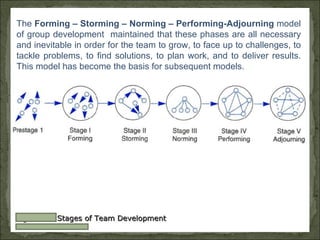
The 'Team Development Model', identified by ‘Bruce Tuckman’, offers a foundational definition of the stages teams go through during their lifecycle. Those stages are labeled  Forming Storming Norming  Performing Adjourning
The  Forming – Storming – Norming – Performing-Adjourning  model of group development  maintained that these phases are all necessary and inevitable in order for the team to grow, to face up to challenges, to tackle problems, to find solutions, to plan work, and to deliver results. This model has become the basis for subsequent models.
 
MANAGING THE TEAM Selection  - Analyzing Team roles  - Forming the Team  - Establishing Team goals  - Matching Team to Task  Bonding  - Establishing Team Trust  Development  - Balancing Skills within the Team  - Ways to formulate Goals  - Maximizing Team Performance  - Improving Team Efficiency
Optimizing Performance  - Maximizing Performance  - Team Dynamics  - Four Stages of Team Development  - Managing Tactics  - Resolving Conflicts  Assessment  - Project or Goal Check
Team Dynamics Team and group dynamics are influenced by many factors, such as  The larger context in which the team operates,  The organization,  The team identity itself, and  The mix of individuals within the team. The Context of the Team The country and geographic region form a larger culture in which the organization operates. All of these contribute to the economic, political, technical, and cultural climates in which the organization, the team, and the individuals operate. The Organization The kind of organization, such as business, or non-profit, along with the organizational culture will influence the team functioning just as much as the division of the organization such as sales, research, operations, etc.
The Team Identity Teams have an identity of their own. This identity stems from the interrelationship of the larger culture, the organizational culture, the team configuration, the nature of the work (purpose), and the qualities of the individuals. It is not the sum of the types, or preferences, or temperaments of the team members. The Individuals Within this mix of influences are the individual team members who likely have specific kinds of work to perform and specific roles on the team. Individual members influence the team dynamics as well, so much so that when the composition of the team changes, the team dynamics will change.
TEAM BUILDING Team building  refers to a wide range of activities, presented to businesses, schools, sports teams, religious or nonprofit organizations designed for improving team performance. Team building is pursued via a variety of practices, and can range from simple bonding exercises to complex simulations and multi-day team building retreats designed to develop a team (including group assessment and group-dynamic games), usually falling somewhere in between.
Reasons for team building Improving communication Making the workplace more enjoyable Motivating a team Getting to know each other Getting everyone "onto the same page", including goal setting Teaching the team self-regulation strategies Helping participants to learn more about themselves (strengths and weaknesses) Identifying and utilizing the strengths of team members Improving team productivity Practicing effective collaboration with team members
Types of team-building exercises Communication exercise This type of team building exercise is exactly what it sounds like. Communications exercises are problem solving activities that are geared towards improving communication skills. The issues teams encounter in these exercises are solved by communicating effectively with each other. •  Goal: Create an activity which highlights the importance of good communication in team performance and/or potential problems with communication. Problem-solving/decision-making exercise Problem-solving/decision-making exercises focus specifically on groups working together to solve difficult problems or make complex decisions. These exercises are some of the most common as they appear to have the most direct link to what employers want their teams to be able to do. •  Goal: Give team a problem in which the solution is not easily apparent or requires the team to come up with a creative solution
Planning/adaptability exercise These exercises focus on aspects of planning and being adaptable to change. These are important things for teams to be able to do when they are assigned complex tasks or decisions.  •  Goal: Show the importance of planning before implementing a solution Trust exercise A trust exercise involves engaging team members in a way that will induce trust between them. They are sometimes difficult exercises to implement as there are varying degrees of trust between individuals and varying degrees of individual comfort trusting others in general. •  Goal: Create trust between team members
Barriers to Team Building  Credibility of the project leader  Unclear project objectives  Changing goals and priorities  Lack of team definition and structure  Confusion about roles and responsibilities  Performance appraisals that fail to recognize teamwork  Excessive team size (Optimum size 7 – 25)
Group Intercommunication Formula  n ( n − 1) / 2  Examples  5 developers -> 5(5 − 1) / 2 = 10 channels of communication  10 developers -> 10(10 − 1) / 2 = 45 channels of communication  50 developers -> 50(50 − 1) / 2 = 1225 channels of communication
Common Characteristics of High Performing Teams  Goals are clearly defined and matched with measurable outcomes  Accurate effective 2-way communication  Leadership is shared and participation encouraged  Effective decision making and problem solving  Team identity and cohesiveness  Diverse backgrounds and experience Cooperation and collaboration  They share a common identity
Steven Covey’s 7 habits  Ca be applied to improve effectiveness on projects  Be proactive  Begin with the end in mind  Put first things first  Think win/win  Seek first to understand, then to be understood  Synergize  Sharpen the saw
Managing Teams  Project managers must lead their teams in performing various  project activities  1. After assessing team performance and related information, the project manager must decide:  -if changes should be requested to the project  -if corrective or preventive actions should be recommended  -if updates are needed to the project management plan or organizational process assets  2. Tools and techniques available to assist in managing project teams include:  -observation and conversation  -project performance appraisals  -conflict management  -issue logs
Develop your team  Be patient and kind with your team Fix the problem instead of blaming people  Establish regular, effective meetings  Allow time for teams to go through the basic team-building stages  Limit the size of work teams to five to twelve members  Plan some social activities to help project team members and other stakeholders  Stress team identity  Nurture team members and encourage them to help each other  Take additional actions to work with virtual team members
Know the conditions favorable for development of high performing teams Voluntary team membership  Continuous service on the team  Full-time assignment to the team  An organization culture of cooperation and trust  Members report only to the project manager  Functional areas are represented on the team  The project has a compelling objective  Members are in speaking distance of each other
Establishing a Team Identity Effective Use of Meetings Co-location of team members  Creation of project team name  Team rituals
Orchestrating the Decision-Making Process Problem Identification  Generating Alternatives  Reaching a Decision  Follow-up
Challenges of Managing Virtual Teams  Developing trust  -exchange of social information  -set clear roles for each team member  Developing effective patterns of communication  -include face-to-face if at all possible  -keep team members informed on how the overall project is going  -don’t let team members vanish  -establish a code of conduct to avoid delays  -establish clear norms and protocols for surfacing  -assumptions and conflicts
Why do people want to join teams?  Individual reasons  Security  Status  Self-esteem  Affiliation  Power  Goal achievement
Keys to Managing People  Psychologists and management theorists have devoted much research and thought to the field of managing people at work. Important areas related to project  management include (1) Motivation,  (2) Influence and power, and  (3) Effectiveness  Motivation Intrinsic motivation causes people to participate in an  activity for their own enjoyment  eg. read, gardening…  Extrinsic motivation causes people to do something for a  reward or to avoid a penalty  eg. homework


Common types of meeting include: Investigative Meeting, generally when conducting a pre-interview, exit interview or a meeting among the investigator and representative Work Meeting, which produces a product or intangible result such as a decision Staff meeting, typically a meeting between a manager and those that report to the manager Team meeting, a meeting among colleagues working on various aspects of a team project Ad-hoc meeting, a meeting called for a special purpose Management meeting, a meeting among managers
7. Board meeting, a meeting of the Board of directors of an organization 8. One-on-one meeting, between two individuals 9. Off-site meeting, also called "offsite retreat" and known as an Awayday meeting in the UK 10. Kickoff meeting, the first meeting with the project team and the client of the project to discuss the role of each team member 11. Pre-Bid Meeting, a meeting of various competitors and or contractors to visually inspect a jobsite for a future project.
Characteristics of Effective Meetings  The seating in the room is arranged so every person can see everyone else.  2. At the front of the room, equipment is provided to record ideas and decisions. An easel holding a newsprint flip chart (with felt-tipped markers for writing) is preferable, so the recorded data can be saved. A white board (with special felt-tipped markers) or a chalkboard and chalk can be used, but must be erased after the meeting.  3. An agenda for the meeting is presented, amended, and agreed on.  4. Time estimates are determined for each agenda item.  5. At least once or twice during the meeting, someone asks, "How are we doing in our process today? How can we be more productive?"
6. During the meeting, someone records the ideas generated and the decisions made. These data are prepared in handout form afterward and distributed to all concerned.  7. The meeting notes indicate who has agreed to do what before the next meeting, and by when.  8. Dates of future meetings (not just the next meeting) are set well in advance so people can make arrangements to attend.  9. Those in attendance consider whether anyone else should be involved in the decisions/future meetings and, if so, who.  10. At the end of the meeting, people review and confirm who will be doing what before the next
Review  Effective teams have common characteristics such as; size range, purpose, communication, leadership, cohesiveness, identity, diversity, and cooperation.  Traditional research suggests teams develop in 5-stage process ; forming, storming, norming, performing, and adjourning. Modern approach indicates growth occurs at project transition points.  Team development can be facilitated through training, personality indicators, social styles profiles, and reward systems.  PM’s can utilize people handling strategies from motivation theorists and other theorists such as; Maslow, Hertzberg, McClelland, McGregor and Covey …  Other areas of importance include; recruitment, maintenance, and conflict management of project teams.

Team management

  • 1.
  • 2.
    Program Objectives Understand the team concept. Open lines of communication as a foundation. Sharpen communication techniques and skills. Learn techniques for building a better team. Understand your style and role as a team leader. Sharpen your team’s goal setting, motivation and output/performance. Understand team members and team dynamics. Practice, discuss, and problem solve.
  • 3.
    What is ateam? “ A team is a number of persons associated together in work or activity: as a group on one side (as in football or debate).” In other words, when one person cannot accomplish a job alone and several individuals must cooperate to fulfill a mission, you need a team. The better the cooperation, communication, and coordination among team members, the more efficient the team
  • 4.
    Teamwork Is closecooperation between cross-trained employees who are familiar with a wide range of jobs in their organization Team-building Is high interaction among group members to increase trust and openness What is team management? Team management refers to techniques, processes and tools for organizing and coordinating a group of individuals working towards a common goal—i.e. a team.
  • 5.
    The 4 C’sof top high-potential employees… Competence Character Communication Collaboration
  • 6.
    Study of mostimportant leadership skills Must have superb communication skills. Lead by example to demonstrate character and competence. Establish and maintain clear and meaningful vision. Provide motivation to create ownership and accountability for results. Clarify performance expectations. Foster teamwork and collaboration. Develop clear performance goals and metrics.
  • 7.
    Why you needto be an expert at collaboration and teamwork: You cannot succeed alone. You need a team of the brightest people you can possibly find to help you. You need to help the team work extremely well together. You need the team to support you with enthusiasm, respect and trust. But don’t take my word for it…
  • 8.
    The 'Team DevelopmentModel', identified by ‘Bruce Tuckman’, offers a foundational definition of the stages teams go through during their lifecycle. Those stages are labeled Forming Storming Norming Performing Adjourning
  • 9.
    The Forming– Storming – Norming – Performing-Adjourning model of group development maintained that these phases are all necessary and inevitable in order for the team to grow, to face up to challenges, to tackle problems, to find solutions, to plan work, and to deliver results. This model has become the basis for subsequent models.
  • 10.
  • 11.
    MANAGING THE TEAMSelection - Analyzing Team roles - Forming the Team - Establishing Team goals - Matching Team to Task Bonding - Establishing Team Trust Development - Balancing Skills within the Team - Ways to formulate Goals - Maximizing Team Performance - Improving Team Efficiency
  • 12.
    Optimizing Performance - Maximizing Performance - Team Dynamics - Four Stages of Team Development - Managing Tactics - Resolving Conflicts Assessment - Project or Goal Check
  • 13.
    Team Dynamics Teamand group dynamics are influenced by many factors, such as The larger context in which the team operates, The organization, The team identity itself, and The mix of individuals within the team. The Context of the Team The country and geographic region form a larger culture in which the organization operates. All of these contribute to the economic, political, technical, and cultural climates in which the organization, the team, and the individuals operate. The Organization The kind of organization, such as business, or non-profit, along with the organizational culture will influence the team functioning just as much as the division of the organization such as sales, research, operations, etc.
  • 14.
    The Team IdentityTeams have an identity of their own. This identity stems from the interrelationship of the larger culture, the organizational culture, the team configuration, the nature of the work (purpose), and the qualities of the individuals. It is not the sum of the types, or preferences, or temperaments of the team members. The Individuals Within this mix of influences are the individual team members who likely have specific kinds of work to perform and specific roles on the team. Individual members influence the team dynamics as well, so much so that when the composition of the team changes, the team dynamics will change.
  • 15.
    TEAM BUILDING Teambuilding refers to a wide range of activities, presented to businesses, schools, sports teams, religious or nonprofit organizations designed for improving team performance. Team building is pursued via a variety of practices, and can range from simple bonding exercises to complex simulations and multi-day team building retreats designed to develop a team (including group assessment and group-dynamic games), usually falling somewhere in between.
  • 16.
    Reasons for teambuilding Improving communication Making the workplace more enjoyable Motivating a team Getting to know each other Getting everyone "onto the same page", including goal setting Teaching the team self-regulation strategies Helping participants to learn more about themselves (strengths and weaknesses) Identifying and utilizing the strengths of team members Improving team productivity Practicing effective collaboration with team members
  • 17.
    Types of team-buildingexercises Communication exercise This type of team building exercise is exactly what it sounds like. Communications exercises are problem solving activities that are geared towards improving communication skills. The issues teams encounter in these exercises are solved by communicating effectively with each other. • Goal: Create an activity which highlights the importance of good communication in team performance and/or potential problems with communication. Problem-solving/decision-making exercise Problem-solving/decision-making exercises focus specifically on groups working together to solve difficult problems or make complex decisions. These exercises are some of the most common as they appear to have the most direct link to what employers want their teams to be able to do. • Goal: Give team a problem in which the solution is not easily apparent or requires the team to come up with a creative solution
  • 18.
    Planning/adaptability exercise Theseexercises focus on aspects of planning and being adaptable to change. These are important things for teams to be able to do when they are assigned complex tasks or decisions. • Goal: Show the importance of planning before implementing a solution Trust exercise A trust exercise involves engaging team members in a way that will induce trust between them. They are sometimes difficult exercises to implement as there are varying degrees of trust between individuals and varying degrees of individual comfort trusting others in general. • Goal: Create trust between team members
  • 19.
    Barriers to TeamBuilding Credibility of the project leader Unclear project objectives Changing goals and priorities Lack of team definition and structure Confusion about roles and responsibilities Performance appraisals that fail to recognize teamwork Excessive team size (Optimum size 7 – 25)
  • 20.
    Group Intercommunication Formula n ( n − 1) / 2 Examples 5 developers -> 5(5 − 1) / 2 = 10 channels of communication 10 developers -> 10(10 − 1) / 2 = 45 channels of communication 50 developers -> 50(50 − 1) / 2 = 1225 channels of communication
  • 21.
    Common Characteristics ofHigh Performing Teams Goals are clearly defined and matched with measurable outcomes Accurate effective 2-way communication Leadership is shared and participation encouraged Effective decision making and problem solving Team identity and cohesiveness Diverse backgrounds and experience Cooperation and collaboration They share a common identity
  • 22.
    Steven Covey’s 7habits Ca be applied to improve effectiveness on projects Be proactive Begin with the end in mind Put first things first Think win/win Seek first to understand, then to be understood Synergize Sharpen the saw
  • 23.
    Managing Teams Project managers must lead their teams in performing various project activities 1. After assessing team performance and related information, the project manager must decide: -if changes should be requested to the project -if corrective or preventive actions should be recommended -if updates are needed to the project management plan or organizational process assets 2. Tools and techniques available to assist in managing project teams include: -observation and conversation -project performance appraisals -conflict management -issue logs
  • 24.
    Develop your team Be patient and kind with your team Fix the problem instead of blaming people Establish regular, effective meetings Allow time for teams to go through the basic team-building stages Limit the size of work teams to five to twelve members Plan some social activities to help project team members and other stakeholders Stress team identity Nurture team members and encourage them to help each other Take additional actions to work with virtual team members
  • 25.
    Know the conditionsfavorable for development of high performing teams Voluntary team membership Continuous service on the team Full-time assignment to the team An organization culture of cooperation and trust Members report only to the project manager Functional areas are represented on the team The project has a compelling objective Members are in speaking distance of each other
  • 26.
    Establishing a TeamIdentity Effective Use of Meetings Co-location of team members Creation of project team name Team rituals
  • 27.
    Orchestrating the Decision-MakingProcess Problem Identification Generating Alternatives Reaching a Decision Follow-up
  • 28.
    Challenges of ManagingVirtual Teams Developing trust -exchange of social information -set clear roles for each team member Developing effective patterns of communication -include face-to-face if at all possible -keep team members informed on how the overall project is going -don’t let team members vanish -establish a code of conduct to avoid delays -establish clear norms and protocols for surfacing -assumptions and conflicts
  • 29.
    Why do peoplewant to join teams? Individual reasons Security Status Self-esteem Affiliation Power Goal achievement
  • 30.
    Keys to ManagingPeople Psychologists and management theorists have devoted much research and thought to the field of managing people at work. Important areas related to project management include (1) Motivation, (2) Influence and power, and (3) Effectiveness Motivation Intrinsic motivation causes people to participate in an activity for their own enjoyment eg. read, gardening… Extrinsic motivation causes people to do something for a reward or to avoid a penalty eg. homework
  • 31.
  • 32.
  • 33.
  • 34.
  • 35.
    Common types ofmeeting include: Investigative Meeting, generally when conducting a pre-interview, exit interview or a meeting among the investigator and representative Work Meeting, which produces a product or intangible result such as a decision Staff meeting, typically a meeting between a manager and those that report to the manager Team meeting, a meeting among colleagues working on various aspects of a team project Ad-hoc meeting, a meeting called for a special purpose Management meeting, a meeting among managers
  • 36.
    7. Board meeting,a meeting of the Board of directors of an organization 8. One-on-one meeting, between two individuals 9. Off-site meeting, also called "offsite retreat" and known as an Awayday meeting in the UK 10. Kickoff meeting, the first meeting with the project team and the client of the project to discuss the role of each team member 11. Pre-Bid Meeting, a meeting of various competitors and or contractors to visually inspect a jobsite for a future project.
  • 37.
    Characteristics of EffectiveMeetings The seating in the room is arranged so every person can see everyone else. 2. At the front of the room, equipment is provided to record ideas and decisions. An easel holding a newsprint flip chart (with felt-tipped markers for writing) is preferable, so the recorded data can be saved. A white board (with special felt-tipped markers) or a chalkboard and chalk can be used, but must be erased after the meeting. 3. An agenda for the meeting is presented, amended, and agreed on. 4. Time estimates are determined for each agenda item. 5. At least once or twice during the meeting, someone asks, "How are we doing in our process today? How can we be more productive?"
  • 38.
    6. During themeeting, someone records the ideas generated and the decisions made. These data are prepared in handout form afterward and distributed to all concerned. 7. The meeting notes indicate who has agreed to do what before the next meeting, and by when. 8. Dates of future meetings (not just the next meeting) are set well in advance so people can make arrangements to attend. 9. Those in attendance consider whether anyone else should be involved in the decisions/future meetings and, if so, who. 10. At the end of the meeting, people review and confirm who will be doing what before the next
  • 39.
    Review Effectiveteams have common characteristics such as; size range, purpose, communication, leadership, cohesiveness, identity, diversity, and cooperation. Traditional research suggests teams develop in 5-stage process ; forming, storming, norming, performing, and adjourning. Modern approach indicates growth occurs at project transition points. Team development can be facilitated through training, personality indicators, social styles profiles, and reward systems. PM’s can utilize people handling strategies from motivation theorists and other theorists such as; Maslow, Hertzberg, McClelland, McGregor and Covey … Other areas of importance include; recruitment, maintenance, and conflict management of project teams.