A Presentation on Team and Team work Prepared by :    M. Ganesh Murugan
Teams typically outperform individuals. Teams use employee talents better. Teams are more flexible and responsive to changes in the environment. Teams facilitate employee involvement. Teams are an effective way to democratize an organization and increase motivation. Why Have Teams Become So Popular
Team A team comprises a group of people linked in a common purpose. Teams are especially appropriate for conducting tasks that are high in complexity and have many interdependent subtasks
Types of Teams  Generally fall into one of two primary groups: permanent teams and temporary teams. Here are some of the common types Task force A temporary team assembled to investigate a specific issue or problem. Problem solving team A temporary team assembled to solve a specific problem. Product design team A temporary team assembled to design a new product or service. Committee A temporary or permanent group of people assembled to act upon some matter. Quality circle (today also under various other names) A group of workers from the same functional area who meet regularly to uncover and solve work-related problems and seek work improvement opportunities.
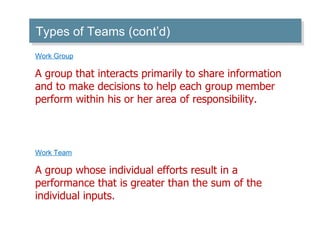
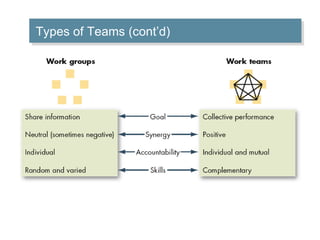
Work Group A group that interacts primarily to share information and to make decisions to help each group member perform within his or her area of responsibility. Work Team A group whose individual efforts result in a performance that is greater than the sum of the individual inputs. Types of Teams (cont’d)
Types of Teams (cont’d)
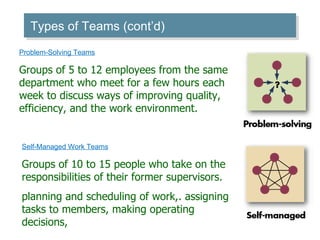
Types of Teams (cont’d) Problem-Solving Teams Groups of 5 to 12 employees from the same department who meet for a few hours each week to discuss ways of improving quality, efficiency, and the work environment. Self-Managed Work Teams Groups of 10 to 15 people who take on the responsibilities of their former supervisors. planning and scheduling of work,. assigning tasks to members, making operating decisions,
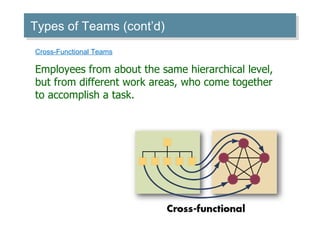
Types of Teams (cont’d) Cross-Functional Teams Employees from about the same hierarchical level, but from different work areas, who come together to accomplish a task.
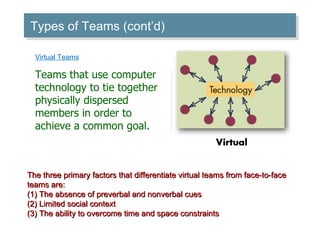
Types of Teams (cont’d) Virtual Teams Teams that use computer technology to tie together physically dispersed members in order to achieve a common goal. The three primary factors that differentiate virtual teams from face-to-face teams are: (1) The absence of preverbal and nonverbal cues (2) Limited social context (3) The ability to overcome time and space constraints
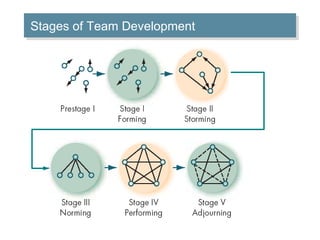
Stages of Team Development
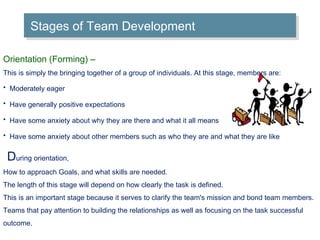
Stages of Team Development Orientation (Forming) –  This is simply the bringing together of a group of individuals. At this stage, members are: Moderately eager   Have generally positive expectations   Have some anxiety about why they are there and what it all means   Have some anxiety about other members such as who they are and what they are like   D uring orientation, How to approach Goals, and what skills are needed. The length of this stage will depend on how clearly the task is defined.  This is an important stage because it serves to clarify the team's mission and bond team members. Teams that pay attention to building the relationships as well as focusing on the task successful outcome.
Stages of Team Development Dissatisfaction (Storming) This stage is characterized by: argument  conflict  a dip in morale  It results from differences between initial expectations and the reality of the situation as perceived by the members. Members may have varying opinions of what the group was to do and how to accomplish it. Members are also beginning to confront the differences in their personalities and values, a condition that is present anytime strangers meet. Members may feel anger or frustration with the task or with other members or may even resent the presence of formal leadership. Generally, the dissatisfaction stage is relatively short. Some groups, however, may become stuck in this stage and continue to be both demoralized and relatively unproductive. In the worst cases, some groups never emerge from this stage and, if possible, disband in frustration.
Stages of Team Development Resolution (Norming) This stage in the group's development involves the: Resolving of issues  Setting up group processes  Setting of group policies, procedures, and values  Increasing production  Members are now resolving differences and clarifying the mission and roles. Members are less dissatisfied as in the previous stage because they are now learning more about each other and how they will work together. They are making progress toward their goals. They are developing tools to help them work better together such as a problem solving process, a code of conduct, a set of team values, and measurement indicators.  Member attitudes are characterized by decreasing animosities toward other members; feelings of cohesion, mutual respect, harmony, and trust; and a feeling of pleasure in accomplishing tasks. The work is characterized by slowly increasing production as skills develop. The group is developing into a team.
Stages of Team Development Production (Performing) The team is accomplishing work effectively. Production is high and the climate is positive. Member attitudes are characterized by positive feelings and eagerness to be part of the team. Members are confident about the outcome, enjoy open communication, exhibit high energy, and disagreement is welcome and handled without emotional conflict. Although work is being accomplished through all the stages, this stage reflects the work being accomplished most effectively.
Stages of Team Development Termination In the case of temporary teams such as task forces, design teams, and problem solving teams, a fifth stage reflects the ending of the process.  Depending on the team's success in accomplishing its task and how strongly the members have bonded, this stage may reflect either a sense of loss or relief. When a team ends, time should be spent addressing how it should be done to properly recognize the team's accomplishments.
Team Building Team building is any activity that builds and strengthens the team as a team. Spirit Enthusiasm Cohesiveness Camaraderie are vitally important.
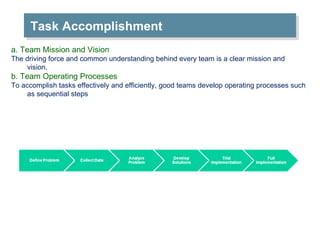
Task Accomplishment a. Team Mission and Vision The driving force and common understanding behind every team is a clear mission and vision. b. Team Operating Processes To accomplish tasks effectively and efficiently, good teams develop operating processes such as sequential steps
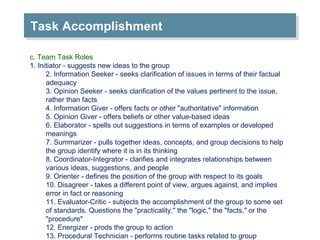
Task Accomplishment c. Team Task Roles 1. Initiator - suggests new ideas to the group 2. Information Seeker - seeks clarification of issues in terms of their factual adequacy 3. Opinion Seeker - seeks clarification of the values pertinent to the issue, rather than facts 4. Information Giver - offers facts or other "authoritative" information 5. Opinion Giver - offers beliefs or other value-based ideas 6. Elaborator - spells out suggestions in terms of examples or developed meanings 7. Summarizer - pulls together ideas, concepts, and group decisions to help the group identify where it is in its thinking 8. Coordinator-Integrator - clarifies and integrates relationships between various ideas, suggestions, and people 9. Orienter - defines the position of the group with respect to its goals 10. Disagreer - takes a different point of view, argues against, and implies error in fact or reasoning 11. Evaluator-Critic - subjects the accomplishment of the group to some set of standards. Questions the "practicality," the "logic," the "facts," or the "procedure" 12. Energizer - prods the group to action 13. Procedural Technician - performs routine tasks related to group functioning 14. Recorder - keeps a written record of the groups work
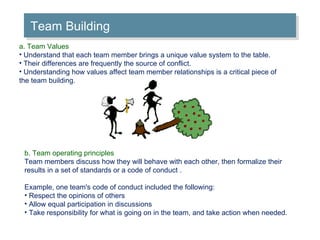
Team Building a. Team Values Understand that each team member brings a unique value system to the table. Their differences are frequently the source of conflict. Understanding how values affect team member relationships is a critical piece of the team building. b. Team operating principles Team members discuss how they will behave with each other, then formalize their results in a set of standards or a code of conduct . Example, one team's code of conduct included the following: Respect the opinions of others  Allow equal participation in discussions  Take responsibility for what is going on in the team, and take action when needed.
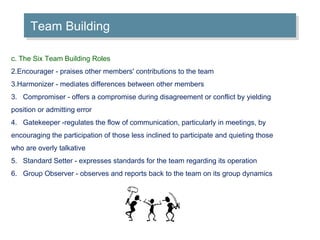
Team Building c. The Six Team Building Roles Encourager - praises other members' contributions to the team Harmonizer - mediates differences between other members 3.  Compromiser - offers a compromise during disagreement or conflict by yielding position or admitting error 4.  Gatekeeper -regulates the flow of communication, particularly in meetings, by encouraging the participation of those less inclined to participate and quieting those who are overly talkative 5.  Standard Setter - expresses standards for the team regarding its operation 6.  Group Observer - observes and reports back to the team on its group dynamics
Twelve Tips for Team Building Clear Expectations – Vision/Mission Context – Background – Why participation in Teams? Commitment – dedication – Service as valuable to Organization & Own  Competence – Capability – Knowledge  Charter – agreement – Assigned area of responsibility  Control – Freedom & Limitations  Collaboration – Team work Communication Creative Innovation Consequences – Accountable for rewards Coordination Cultural Change
Team Member Communicate Don't Blame Others Support Group Member's Ideas No Bragging – No Full of yourself Listen Actively Get Involved Coach, Don't Demonstrate Provide Constructive Criticism Try To Be Positive Value Your Group's Ideas
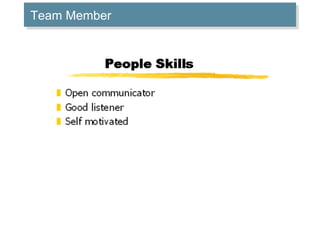
Team Member
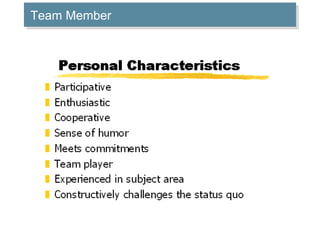
Team Member
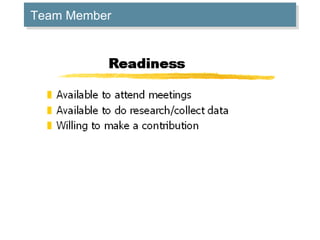
Team Member
Team Member
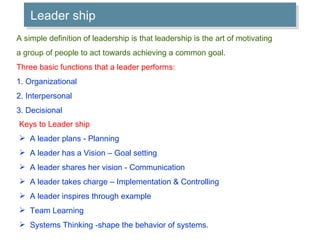
Leader ship A simple definition of leadership is that leadership is the art of motivating  a group of people to act towards achieving a common goal. Three basic functions that a leader performs: 1. Organizational 2. Interpersonal 3. Decisional Keys to Leader ship A leader plans - Planning A leader has a Vision – Goal setting A leader shares her vision - Communication A leader takes charge – Implementation & Controlling A leader inspires through example Team Learning Systems Thinking -shape the behavior of systems.
Characteristics Of Leadership 1. Authenticity  - Leadership begins and ends with genuineness/faithfullness. 2. Desire to Serve Others 3. Empowering People 4. Guided by Heart, passion and compassion –  Enthusiasiun, Eagerness, Kindness 5. Recognize their shortcomings 6. Lead with Purpose  "They lead with purpose, meaning and values." 7. Build Enduring Relationships  "They build enduring relationships with people." 8. Clear Where They Stand  "Others follow them because they know where they stand." 9. Refuse to Compromise  "When principles are tested, they refuse to compromise." 10. Develop Themselves 11. Leaders pull rather than push. 12. Leaders have a clear vision and communicate that vision. 13. Leaders work through teams and not through hierarchies. 14. Leaders possess a strong doss of self-esteem and positive attitude. 15. Leaders have a good grasp of self
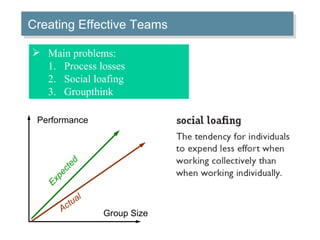
Creating Effective Teams Group Size Performance Expected Actual Main problems: Process losses Social loafing Groupthink
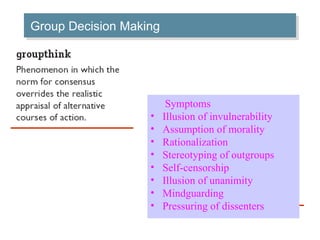
Group Decision Making   Symptoms Illusion of invulnerability Assumption of morality Rationalization Stereotyping of outgroups Self-censorship Illusion of unanimity Mindguarding Pressuring of dissenters

Updated Team And Team Work

  • 1.
    A Presentation onTeam and Team work Prepared by : M. Ganesh Murugan
  • 2.
    Teams typically outperformindividuals. Teams use employee talents better. Teams are more flexible and responsive to changes in the environment. Teams facilitate employee involvement. Teams are an effective way to democratize an organization and increase motivation. Why Have Teams Become So Popular
  • 3.
    Team A teamcomprises a group of people linked in a common purpose. Teams are especially appropriate for conducting tasks that are high in complexity and have many interdependent subtasks
  • 4.
    Types of Teams Generally fall into one of two primary groups: permanent teams and temporary teams. Here are some of the common types Task force A temporary team assembled to investigate a specific issue or problem. Problem solving team A temporary team assembled to solve a specific problem. Product design team A temporary team assembled to design a new product or service. Committee A temporary or permanent group of people assembled to act upon some matter. Quality circle (today also under various other names) A group of workers from the same functional area who meet regularly to uncover and solve work-related problems and seek work improvement opportunities.
  • 5.
    Work Group Agroup that interacts primarily to share information and to make decisions to help each group member perform within his or her area of responsibility. Work Team A group whose individual efforts result in a performance that is greater than the sum of the individual inputs. Types of Teams (cont’d)
  • 6.
    Types of Teams(cont’d)
  • 7.
    Types of Teams(cont’d) Problem-Solving Teams Groups of 5 to 12 employees from the same department who meet for a few hours each week to discuss ways of improving quality, efficiency, and the work environment. Self-Managed Work Teams Groups of 10 to 15 people who take on the responsibilities of their former supervisors. planning and scheduling of work,. assigning tasks to members, making operating decisions,
  • 8.
    Types of Teams(cont’d) Cross-Functional Teams Employees from about the same hierarchical level, but from different work areas, who come together to accomplish a task.
  • 9.
    Types of Teams(cont’d) Virtual Teams Teams that use computer technology to tie together physically dispersed members in order to achieve a common goal. The three primary factors that differentiate virtual teams from face-to-face teams are: (1) The absence of preverbal and nonverbal cues (2) Limited social context (3) The ability to overcome time and space constraints
  • 10.
    Stages of TeamDevelopment
  • 11.
    Stages of TeamDevelopment Orientation (Forming) – This is simply the bringing together of a group of individuals. At this stage, members are: Moderately eager Have generally positive expectations Have some anxiety about why they are there and what it all means Have some anxiety about other members such as who they are and what they are like D uring orientation, How to approach Goals, and what skills are needed. The length of this stage will depend on how clearly the task is defined. This is an important stage because it serves to clarify the team's mission and bond team members. Teams that pay attention to building the relationships as well as focusing on the task successful outcome.
  • 12.
    Stages of TeamDevelopment Dissatisfaction (Storming) This stage is characterized by: argument conflict a dip in morale It results from differences between initial expectations and the reality of the situation as perceived by the members. Members may have varying opinions of what the group was to do and how to accomplish it. Members are also beginning to confront the differences in their personalities and values, a condition that is present anytime strangers meet. Members may feel anger or frustration with the task or with other members or may even resent the presence of formal leadership. Generally, the dissatisfaction stage is relatively short. Some groups, however, may become stuck in this stage and continue to be both demoralized and relatively unproductive. In the worst cases, some groups never emerge from this stage and, if possible, disband in frustration.
  • 13.
    Stages of TeamDevelopment Resolution (Norming) This stage in the group's development involves the: Resolving of issues Setting up group processes Setting of group policies, procedures, and values Increasing production Members are now resolving differences and clarifying the mission and roles. Members are less dissatisfied as in the previous stage because they are now learning more about each other and how they will work together. They are making progress toward their goals. They are developing tools to help them work better together such as a problem solving process, a code of conduct, a set of team values, and measurement indicators.  Member attitudes are characterized by decreasing animosities toward other members; feelings of cohesion, mutual respect, harmony, and trust; and a feeling of pleasure in accomplishing tasks. The work is characterized by slowly increasing production as skills develop. The group is developing into a team.
  • 14.
    Stages of TeamDevelopment Production (Performing) The team is accomplishing work effectively. Production is high and the climate is positive. Member attitudes are characterized by positive feelings and eagerness to be part of the team. Members are confident about the outcome, enjoy open communication, exhibit high energy, and disagreement is welcome and handled without emotional conflict. Although work is being accomplished through all the stages, this stage reflects the work being accomplished most effectively.
  • 15.
    Stages of TeamDevelopment Termination In the case of temporary teams such as task forces, design teams, and problem solving teams, a fifth stage reflects the ending of the process.  Depending on the team's success in accomplishing its task and how strongly the members have bonded, this stage may reflect either a sense of loss or relief. When a team ends, time should be spent addressing how it should be done to properly recognize the team's accomplishments.
  • 16.
    Team Building Teambuilding is any activity that builds and strengthens the team as a team. Spirit Enthusiasm Cohesiveness Camaraderie are vitally important.
  • 17.
    Task Accomplishment a.Team Mission and Vision The driving force and common understanding behind every team is a clear mission and vision. b. Team Operating Processes To accomplish tasks effectively and efficiently, good teams develop operating processes such as sequential steps
  • 18.
    Task Accomplishment c.Team Task Roles 1. Initiator - suggests new ideas to the group 2. Information Seeker - seeks clarification of issues in terms of their factual adequacy 3. Opinion Seeker - seeks clarification of the values pertinent to the issue, rather than facts 4. Information Giver - offers facts or other "authoritative" information 5. Opinion Giver - offers beliefs or other value-based ideas 6. Elaborator - spells out suggestions in terms of examples or developed meanings 7. Summarizer - pulls together ideas, concepts, and group decisions to help the group identify where it is in its thinking 8. Coordinator-Integrator - clarifies and integrates relationships between various ideas, suggestions, and people 9. Orienter - defines the position of the group with respect to its goals 10. Disagreer - takes a different point of view, argues against, and implies error in fact or reasoning 11. Evaluator-Critic - subjects the accomplishment of the group to some set of standards. Questions the "practicality," the "logic," the "facts," or the "procedure" 12. Energizer - prods the group to action 13. Procedural Technician - performs routine tasks related to group functioning 14. Recorder - keeps a written record of the groups work
  • 19.
    Team Building a.Team Values Understand that each team member brings a unique value system to the table. Their differences are frequently the source of conflict. Understanding how values affect team member relationships is a critical piece of the team building. b. Team operating principles Team members discuss how they will behave with each other, then formalize their results in a set of standards or a code of conduct . Example, one team's code of conduct included the following: Respect the opinions of others Allow equal participation in discussions Take responsibility for what is going on in the team, and take action when needed.
  • 20.
    Team Building c.The Six Team Building Roles Encourager - praises other members' contributions to the team Harmonizer - mediates differences between other members 3. Compromiser - offers a compromise during disagreement or conflict by yielding position or admitting error 4. Gatekeeper -regulates the flow of communication, particularly in meetings, by encouraging the participation of those less inclined to participate and quieting those who are overly talkative 5. Standard Setter - expresses standards for the team regarding its operation 6. Group Observer - observes and reports back to the team on its group dynamics
  • 21.
    Twelve Tips forTeam Building Clear Expectations – Vision/Mission Context – Background – Why participation in Teams? Commitment – dedication – Service as valuable to Organization & Own Competence – Capability – Knowledge Charter – agreement – Assigned area of responsibility Control – Freedom & Limitations Collaboration – Team work Communication Creative Innovation Consequences – Accountable for rewards Coordination Cultural Change
  • 22.
    Team Member CommunicateDon't Blame Others Support Group Member's Ideas No Bragging – No Full of yourself Listen Actively Get Involved Coach, Don't Demonstrate Provide Constructive Criticism Try To Be Positive Value Your Group's Ideas
  • 23.
  • 24.
  • 25.
  • 26.
  • 27.
    Leader ship Asimple definition of leadership is that leadership is the art of motivating a group of people to act towards achieving a common goal. Three basic functions that a leader performs: 1. Organizational 2. Interpersonal 3. Decisional Keys to Leader ship A leader plans - Planning A leader has a Vision – Goal setting A leader shares her vision - Communication A leader takes charge – Implementation & Controlling A leader inspires through example Team Learning Systems Thinking -shape the behavior of systems.
  • 28.
    Characteristics Of Leadership1. Authenticity - Leadership begins and ends with genuineness/faithfullness. 2. Desire to Serve Others 3. Empowering People 4. Guided by Heart, passion and compassion – Enthusiasiun, Eagerness, Kindness 5. Recognize their shortcomings 6. Lead with Purpose "They lead with purpose, meaning and values." 7. Build Enduring Relationships "They build enduring relationships with people." 8. Clear Where They Stand "Others follow them because they know where they stand." 9. Refuse to Compromise "When principles are tested, they refuse to compromise." 10. Develop Themselves 11. Leaders pull rather than push. 12. Leaders have a clear vision and communicate that vision. 13. Leaders work through teams and not through hierarchies. 14. Leaders possess a strong doss of self-esteem and positive attitude. 15. Leaders have a good grasp of self
  • 29.
    Creating Effective TeamsGroup Size Performance Expected Actual Main problems: Process losses Social loafing Groupthink
  • 30.
    Group Decision Making Symptoms Illusion of invulnerability Assumption of morality Rationalization Stereotyping of outgroups Self-censorship Illusion of unanimity Mindguarding Pressuring of dissenters