Team
Management
www.ReKruiTIn.com
Improving Team Effectiveness
1. Teamwork has a dramatic affect on organizational performance.
2. An effective team can help an organization achieve incredible results.
3. A team that is not working can cause unnecessary disruption, failed
delivery and strategic failure.
4. Nowadays it is almost impossible to avoid being a member of team.
5. It's important for your personal and career development to know your
team working strengths and weaknesses.
www.rekruitin.com
Team Dynamics
www.rekruitin.com
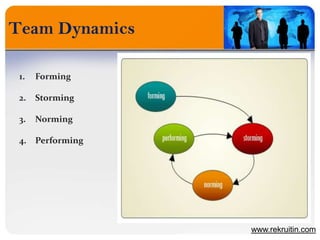
1. Forming
2. Storming
3. Norming
4. Performing
Forming
www.rekruitin.com
 Forming process make use of suitable stresses like compression, tension,
shear or combined stresses to cause plastic deformation of the materials to
produce required shapes.
 Individual roles and responsibilities are not clear. Team requires clear aims
and objectives from a leader.
Storming
 Every group will next enter the storming stage in which different ideas
compete for consideration.
 The team addresses issues such as what problems they are really
supposed to solve, how they will function independently and together
and what leadership model they will accept.
 Team members open up to each other and confront each other's ideas
and perspectives. In some cases storming can be resolved quickly.
 Supervisors of the team during this phase may be more accessible, but
tend to remain directive in their guidance of decision-making and
professional behavior, the team members will therefore resolve their
differences and members will be able to participate with one another
more comfortably.
www.rekruitin.com
Norming
www.rekruitin.com
 The team manages to have one goal and come to a mutual plan for the
team at this stage.
 Some may have to give up their own ideas and agree with others in order
to make the team function.
 In this stage, all team members take the responsibility and have the
ambition to work for the success of the team's goals.
 The danger here is that members may be so focused on preventing
conflict that they are reluctant to share controversial ideas.
 The unhealthy potential for "group think" exists as well.
Performing
www.rekruitin.com
 It is possible for some teams to reach the performing stage.
 These high-performing teams are able to function as a unit as they find
ways to get the job done smoothly and effectively without inappropriate
conflict or the need for external supervision.
 The team members are now competent, autonomous and able to handle
the decision-making process without supervision.
 Supervisors of the team during this phase are almost always
participative. Even the most high-performing teams will revert to earlier
stages in certain circumstances.
 Many long-standing teams go through these cycles many times as they
react to changing circumstances.
 For example, a change in leadership may cause the team to revert to
storming as the new people challenge the existing norms and dynamics
of the team.
www.rekruitin.com
Developing your Team
1. Individuals need ongoing training and development to help them
become more effective, and take on bigger and more significant
challenges.
2. By building your team you increase your organization's competitiveness
and this will give you an edge.
3. Effective team building activities should address the essential 'soft skills'
that bring teams together such as communication, trust, confidence, and
risk taking.
www.rekruitin.com
Observing Team member’s
@ Work
 Keep an eye on how well your team members are doing with key tasks.
 For instance, could they be quicker with key tasks, or are they
procrastinating on projects?
 This might indicate that they're not confident in their abilities, or are not
sufficiently well trained in key skill areas.
 Try to be fair and straightforward when you do this.
 If team members know that you're watching them, they might act
differently, but if they discover that you're watching secretly, it could
damage the trust they have in you.
www.rekruitin.com
 Be sensitive, ask open questions, and, where appropriate, explain your
actions.
 Once you've observed people working, it can be useful to confirm your
assessment by setting specific, time-bound tasks that give them the
opportunity to demonstrate their skills and abilities.
 Do this positively, though – don't set people up to fail.
www.rekruitin.com
www.rekruitin.com
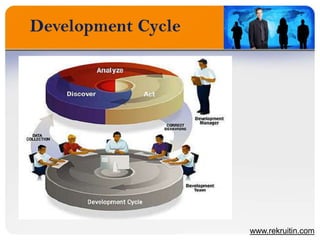
Development Cycle
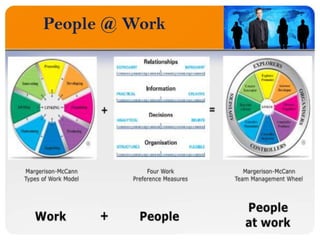
People @ Work
Reach Us @
For more details, Please log on to www.rekruitin.com
Customer Care : 8855041500
Career Guidance : 9823205144
Tech Support : 7758806112
Human Resource : 9823204144
You can also Find us on:
Facebook : https://www.facebook.com/ReKruiTInJobs
LinkedIn : http://www.linkedin.com/company/rekruitin-com
Twitter : https://twitter.com/ReKruiTIn1
Blogger : http://rekruitin.blogspot.co.uk/
Team management

Team management

  • 1.
  • 2.
    Improving Team Effectiveness 1.Teamwork has a dramatic affect on organizational performance. 2. An effective team can help an organization achieve incredible results. 3. A team that is not working can cause unnecessary disruption, failed delivery and strategic failure. 4. Nowadays it is almost impossible to avoid being a member of team. 5. It's important for your personal and career development to know your team working strengths and weaknesses. www.rekruitin.com
  • 3.
    Team Dynamics www.rekruitin.com 1. Forming 2.Storming 3. Norming 4. Performing
  • 4.
    Forming www.rekruitin.com  Forming processmake use of suitable stresses like compression, tension, shear or combined stresses to cause plastic deformation of the materials to produce required shapes.  Individual roles and responsibilities are not clear. Team requires clear aims and objectives from a leader.
  • 5.
    Storming  Every groupwill next enter the storming stage in which different ideas compete for consideration.  The team addresses issues such as what problems they are really supposed to solve, how they will function independently and together and what leadership model they will accept.  Team members open up to each other and confront each other's ideas and perspectives. In some cases storming can be resolved quickly.  Supervisors of the team during this phase may be more accessible, but tend to remain directive in their guidance of decision-making and professional behavior, the team members will therefore resolve their differences and members will be able to participate with one another more comfortably. www.rekruitin.com
  • 6.
    Norming www.rekruitin.com  The teammanages to have one goal and come to a mutual plan for the team at this stage.  Some may have to give up their own ideas and agree with others in order to make the team function.  In this stage, all team members take the responsibility and have the ambition to work for the success of the team's goals.  The danger here is that members may be so focused on preventing conflict that they are reluctant to share controversial ideas.  The unhealthy potential for "group think" exists as well.
  • 7.
    Performing www.rekruitin.com  It ispossible for some teams to reach the performing stage.  These high-performing teams are able to function as a unit as they find ways to get the job done smoothly and effectively without inappropriate conflict or the need for external supervision.  The team members are now competent, autonomous and able to handle the decision-making process without supervision.
  • 8.
     Supervisors ofthe team during this phase are almost always participative. Even the most high-performing teams will revert to earlier stages in certain circumstances.  Many long-standing teams go through these cycles many times as they react to changing circumstances.  For example, a change in leadership may cause the team to revert to storming as the new people challenge the existing norms and dynamics of the team. www.rekruitin.com
  • 9.
    Developing your Team 1.Individuals need ongoing training and development to help them become more effective, and take on bigger and more significant challenges. 2. By building your team you increase your organization's competitiveness and this will give you an edge. 3. Effective team building activities should address the essential 'soft skills' that bring teams together such as communication, trust, confidence, and risk taking. www.rekruitin.com
  • 10.
    Observing Team member’s @Work  Keep an eye on how well your team members are doing with key tasks.  For instance, could they be quicker with key tasks, or are they procrastinating on projects?  This might indicate that they're not confident in their abilities, or are not sufficiently well trained in key skill areas.  Try to be fair and straightforward when you do this.  If team members know that you're watching them, they might act differently, but if they discover that you're watching secretly, it could damage the trust they have in you. www.rekruitin.com
  • 11.
     Be sensitive,ask open questions, and, where appropriate, explain your actions.  Once you've observed people working, it can be useful to confirm your assessment by setting specific, time-bound tasks that give them the opportunity to demonstrate their skills and abilities.  Do this positively, though – don't set people up to fail. www.rekruitin.com
  • 12.
  • 13.
  • 14.
    Reach Us @ Formore details, Please log on to www.rekruitin.com Customer Care : 8855041500 Career Guidance : 9823205144 Tech Support : 7758806112 Human Resource : 9823204144 You can also Find us on: Facebook : https://www.facebook.com/ReKruiTInJobs LinkedIn : http://www.linkedin.com/company/rekruitin-com Twitter : https://twitter.com/ReKruiTIn1 Blogger : http://rekruitin.blogspot.co.uk/