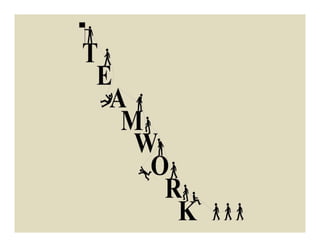
Team Building

    Psychometric Analyst & Trainer: Tina Karkhanis


1
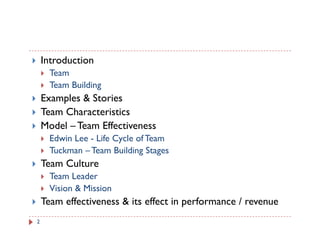
Introduction
      Team
      Team Building
    Examples & Stories
    Team Characteristics
    Model – Team Effectiveness
      Edwin Lee - Life Cycle of Team
      Tuckman – Team Building Stages
    Team Culture
      Team Leader
      Vision & Mission
    Team effectiveness & its effect in performance / revenue
2
Check in
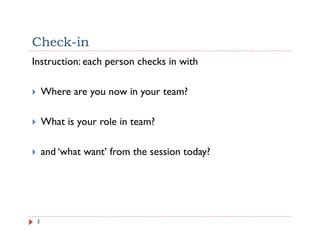
Check-in
Instruction: each person checks in with

     Where are you now in your team?

     What is your role in team?

     and ‘what want’ from the session today?


 3
4
Team
    Benefits of Team Work   Lack of Team Work


5
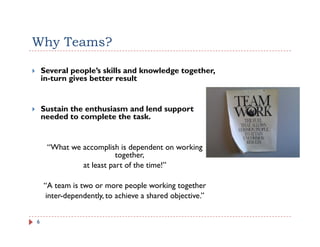
Why Teams?

    Several people’s skills and knowledge together,
    in-turn gives better result
    i t      i    b tt        lt


    Sustain the enthusiasm and lend support
    needed to complete the task.


     “What we accomplish is dependent on working
                         together,
              at least part of the time!”

    “A team is two or more people working together
     inter-dependently, to achieve a shared objective.”


6
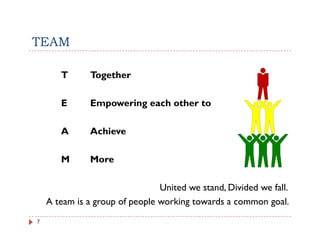
TEAM

       T       Together

       E       Empowering each other to
                 p      g

       A       Achieve

       M       More

                                United we stand, Divided we fall.
    A team is a group of people working towards a common goal
                                                           goal.
7
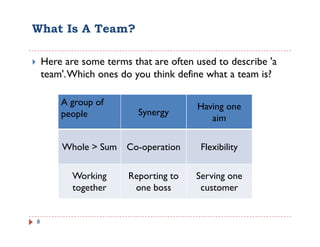
What Is A Team?

    Here are some terms that are often used to describe 'a
    team .
    team'. Which ones do you think define what a team is?

        A group of                     Having one
        people            Synergy
                                          aim

        Whole > Sum    Co-operation     Flexibility

           Working      Reporting to   Serving one
           together      one boss       customer


8
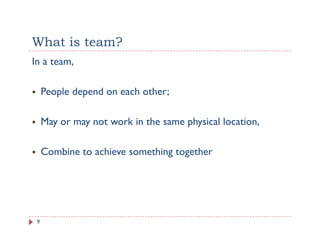
What is team?
In a team,

     People depend on each other;

     May or may not work in the same physical location,

     Combine to achieve something together


 9
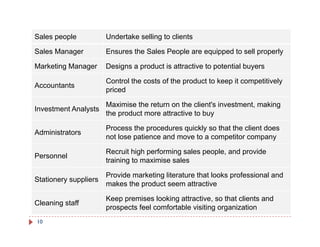
Sales people           Undertake selling to clients

Sales Manager          Ensures the Sales People are equipped to sell properly

Marketing Manager      Designs a product is attractive to potential buyers

                       Control the costs of the product to keep it competitively
Accountants
                       priced

                       Maximise the return on the client's investment, making
                                                                     ,      g
Investment Analysts
                       the product more attractive to buy

                       Process the procedures quickly so that the client does
Administrators
                       not lose patience and move to a competitor company

                       Recruit high performing sales people, and provide
Personnel
                       training to maximise sales

                       Provide marketing literature that looks professional and
Stationery suppliers
                       makes the product seem attractive

                       Keep premises looking attractive, so that clients and
                           pp               g            ,
Cleaning staff
Cl   i    t ff
                       prospects feel comfortable visiting organization
10
11
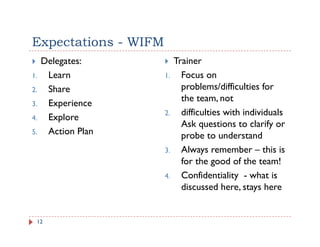
Expectations - WIFM
     Delegates:            Trainer
1.
1     Learn           1.
                      1      Focus on
2.    Share                  problems/difficulties for
                             the team, not
3.    Experience
         p
                      2.     difficulties with individuals
4.    Explore
                             Ask questions to clarify or
5.    Action Plan            p
                             probe to understand
                      3.     Always remember – this is
                             for the good of the team!
                      4.     Confidentiality - what is
                             discussed here, stays here


 12
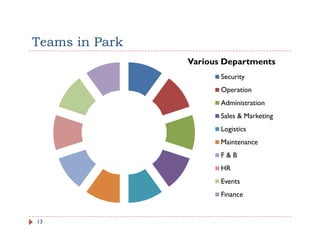
Teams in Park
                Various Departments
                       Security
                       Operation
                       Administration
                       Sales & Marketing
                       Logistics
                       Maintenance
                       F&B
                       HR
                       Events
                       Finance


13
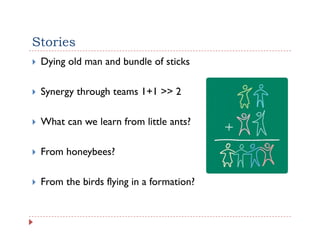
Stories
 Dying old man and bundle of sticks

 Synergy through teams 1+1 >> 2

 What can we learn from little ants?

 From honeybees?

 From the birds flying in a formation?
THE MAGIC OF SYNERGY
 Normally, 1+1=2.
 But,
 B sometimes when we work as a TEAM,
                    h         k   TEAM
 1+1 may become 11, 111, or even 1111! In
 fact, there i no li it
 f t th      is   limit.
 That is called SYNERGY;
 It is
 I i SYNCHRONISED ENERGY.ENERGY
 It has a MULITIPLIER EFFECT.
 It
 I grows in GEOMETRIC PROGRESSION, or
                           PROGRESSION
 even EXPONENTIAL
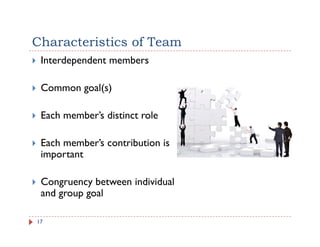
Characteristics of Team
 Interdependent members

 Common goal(s)

 Each member’s distinct role

 Each
 E h member’s contribution is
           b ’      b
 important

 Congruency between individual
 and group goal

17
How do Teams Work Best?

 Commitment to common objectives

 Defined roles and responsibilities

 Effective decision systems, communication and work
 procedures

 Good personal relationships.


18
TEAM EFFECTIVENESS MODEL
 Teams can continuously improve their effectiveness by
 focusing on improving their functioning in five key areas:
 Goals: What the team aspires to achieve
 Roles: The part each member p y in achieving the
              p                  plays            g
 team goals
 Procedures: The methods that help the team conduct
 its work together
 Relationships: How the team members ‘get along” with
 each other
     h th
 Leadership: How the leader supports the team in
 achieving results
           results.
19
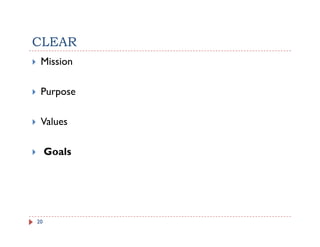
CLEAR
 Mission

 Purpose

 Values

     Goals


20
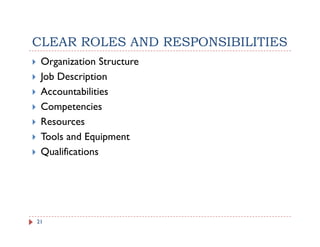
CLEAR ROLES AND RESPONSIBILITIES
 Organization Structure
 Job Description
 Accountabilities
 Competencies
 Resources
 Tools and Equipment
 Qualifications


21
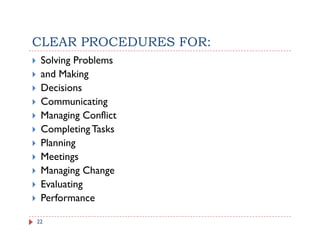
CLEAR PROCEDURES FOR:
 Solving Problems
 and Making
 Decisions
 Communicating
 Managing Conflict
 Completing Tasks
 Planning
 Pl
 Meetings
 Managing Change
 Evaluating
 Performance

22
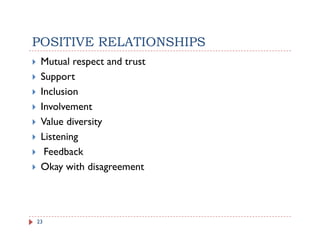
POSITIVE RELATIONSHIPS
 Mutual respect and trust
 Support
 Inclusion
 Involvement
 Value diversity
 Listening
  Feedback
 Okay with disagreement
      y          g


23
STRONG LEADERSHIP
 Personal Credibility
 Strategic Focus
 Clear Expectations
 Clear Communication
 Engagement and Involvement
 Develop People and Team
 All members responsible and accountable
 Manage Change
      g       g
 Recognition


24
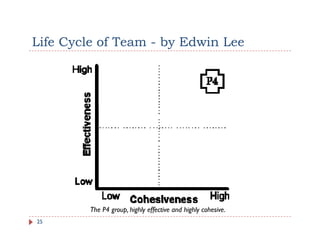
Life Cycle of Team - by Edwin Lee


         The P4 group, highly effective and highly cohesive.
25
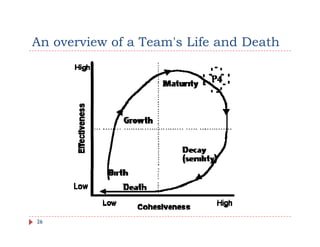
An overview of a Team's Life and Death
                 Team s


26
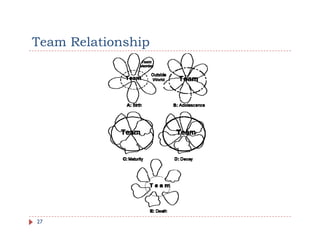
Team Relationship


27
Little Learning with the above theory with
examples….1
     When a team is formed it focuses on the future.
     Once it succeeds it focuses on the past.

 IBM lost most of the PC market (new challenge) because
                                  (          g )
 its key business decisions were made by people who
 succeeded with mainframes (past successes).


28
Little Learning with the above theory with
examples…..2
      Success breeds failure.

The IBM PC (success) was followed by PC Jr. (abject failure).

      Apple II (success) was followed by Lisa (failure)!


 29
Little Learning with the above theory with
examples…..3
     Failure can breed success.

     Norman Schwartzkopf and Colin Powell endured the
     failure of Vietnam. They learned from that, and fought
                            y                  ,        g
     Desert Storm with the wisdom and anxiety that
     Vietnam fostered.


30
Little Learning with the above theory with
examples…..4
 Term limits of no more than 8 years for executives
 and executive teams would improve business
 effectiveness more than any other management
 change.


31
Effective teams are always
 aware of and responsive to
    both th i internal and
    b th their i t    l d
 their external environment

32
How to make Team more EFFECTIVE
        Answer to this question is Team Building.


                                            TEAM BUILDING


  The
  Th process of making team effective is called team b ildi
                f k             ff           ll d       building.
'Team Building' is the process of enabling the group of people to
                                                  reach their goal.

33
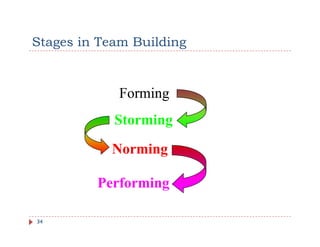
Stages in Team Building


             Forming
            Storming

           Norming

         Performing

34
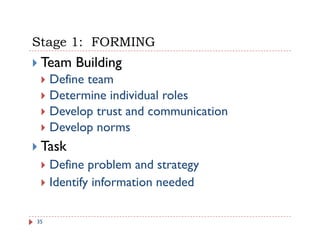
Stage 1: FORMING
 Team Building
     Define team
     D fi t
     Determine individual roles
     Develop
     D l trust and communication
                     d          i i
     Develop norms
 Task
     Define problem and strategy
             p                 gy
     Identify information needed

35
Team Norms

 How do we support each other?

 What do we do when we have problems?

 What are my responsibilities to the team?


36
From Individuals                        A Group
Help members understand each other: How can I
 become a better team member?

  Keep the broader picture in mind rather than getting
  absorbed i ‘my’ ‘own’ task
   b b d in ‘ ’ ‘         ’ k
  My efforts should add value to the team
  My goal not achieved if team goal is not
  Use resources just sufficient to complete my part of the
  team task
  ‘Sail on’, rather than ‘pass on’
  Create cooperative, friendly climate in team

 37
Stage 2: STORMING
During the Storming stage team members:

     Realize that the task is more difficult than
     they i
      h imagined;
               i d
     Have fluctuations in attitude about chances
     of success;
      f
     May be resistant to the task; and,
     Have poor collaboration.
     H             ll b     i


38
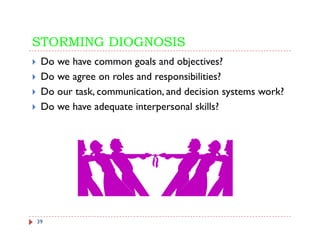
STORMING DIOGNOSIS
 Do we have common goals and objectives?
 Do we agree on roles and responsibilities?
 Do our task, communication, and decision systems work?
 Do we have adequate interpersonal skills?


39
Negotiating Conflict

 Separate problem issues from people issues
                                     issues.

 Be soft on people, hard on problem.
            people          problem

 Look for underlying needs, goals of each party rather than
 specific solutions.
Addressing the Problem

 State your views in clear non judgmental language
                           non-judgmental language.


 Clarify the core issues.


 Listen carefully to each person’s point of view.


 Check understanding by restating the core issues.
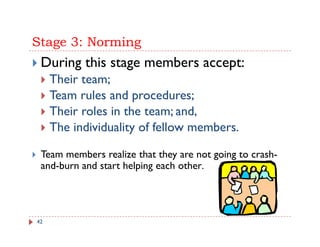
Stage 3: Norming
 During this stage members accept:
     Their team;
     Th i t
     Team rules and procedures;
     Their l in h
     Th i roles i the team; and, d
     The individuality of fellow members.

 Team members realize that they are not going to crash-
 and-burn and start helping each other.
                       p g


42
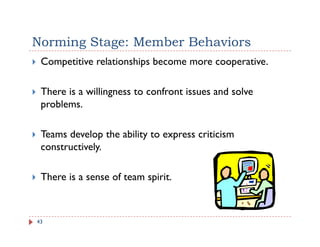
Norming Stage: Member Behaviors
 Competitive relationships become more cooperative.

 There is a willingness to confront issues and solve
 p
 problems.

 Teams develop the ability to express criticism
               p         y      p
 constructively.

 There is a sense of team spirit.


43
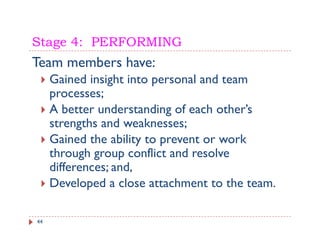
Stage 4: PERFORMING
Team members have:
     Gained insight i t
     G i d i i ht into personal and t
                                 l d team
     processes;
     A better understanding of each other’s
                                     other s
     strengths and weaknesses;
     Gained the ability to prevent or work
     through group conflict and resolve
     differences; and,
     Developed a close attachment to the team.

44
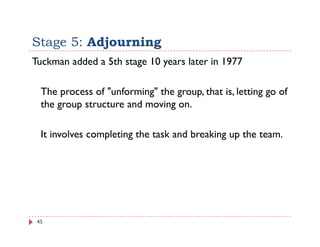
Stage 5: Adjourning
Tuckman added a 5th stage 10 years later in 1977

  The process of "unforming" the group, that is, letting go of
  the group structure and moving on.
      g p                      g

  It involves completing the task and breaking up the team.
                 p     g                     g p


 45
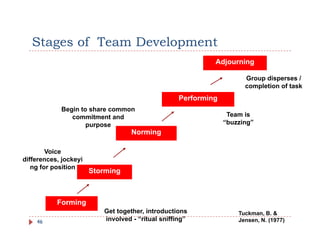
Stages of Team Development
                                                            Adjourning

                                                                      Group disperses /
                                                                      G     di
                                                                      completion of task
                                                   Performing
            Begin t h
            B i to share common
               commitment and                                    Team is
                   purpose                                      “buzzing”
                                   Norming

        Voice
differences, jockeyi
   ng for position
    g     p
                       Storming


           Forming
                          Get together, introductions               Tuckman, B. &
    46                    involved - “ritual sniffing”              Jensen, N. (1977)
47
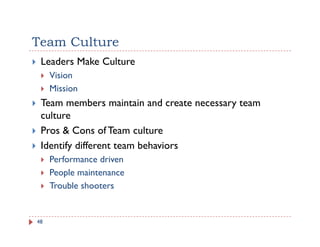
Team Culture
 Leaders Make Culture
     Vision
     Mission
 Team members maintain and create necessary team
                                          y
 culture
 Pros & Cons of Team culture
 Identify different team behaviors
     Performance driven
     People maintenance
     P    l    i
     Trouble shooters


48
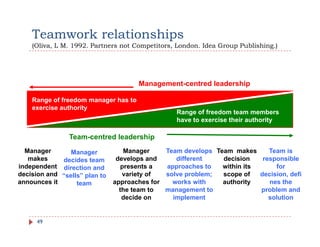
Teamwork relationships
    (Oliva, M 1992
    (Oliva L M. 1992. Partners not Competitors, London. Idea Group Publishing.)
                                   Competitors London              Publishing )


                                      Management-centred leadership

    Range of freedom manager has to
    exercise authority
                                                 Range of freedom team members
                                                 have to exercise their authority

                Team centred
                Team-centred leadership
  Manager      Manager             Manager    Team develops Team makes      Team is
   makes     decides team       develops and     different    decision    responsible
independent direction and         presents a  approaches to   within its      for
decision and “sells” plan to      variety of  solve problem;  scope of   decision, defi
announces it      team         approaches for   works with    authority     nes the
                                 the team to  management to              problem and
                                  decide on     implement                   solution


      49
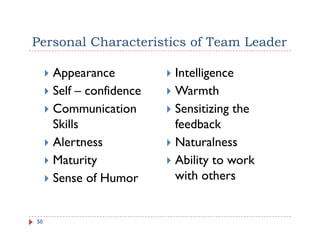
Personal Characteristics of Team Leader

     Appearance          Intelligence
     Self – confidence   Warmth
     Communication       Sensitizing the
     Skills              feedback
     Alertness
     Al                  Naturalness
                         N       l
     Maturity            Ability to work
     Sense of Humor      with others


50
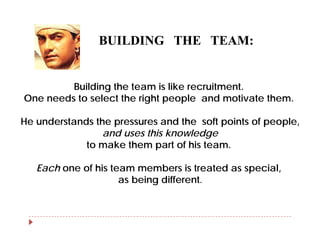
BUILDING THE TEAM:


         Building the team is like recruitment.
One needs to select the right people and motivate them.

He understands the pressures and the soft points of people,
                 and uses this knowledge
             to make them part of his team.

   Each one of his team members is treated as special,
                     as being different.
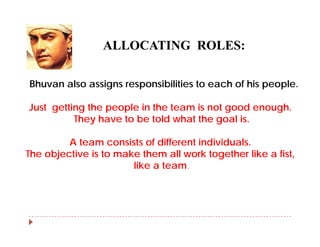
ALLOCATING ROLES:

Bhuvan also assigns responsibilities to each of his people.

Just getting the people in the team is not good enough
                                                 enough.
          They have to be told what the goal is.

         A team consists of different individuals.
           t          i t f diff     t i di id l
The objective is to make them all work together like a fist,
                        like a team.
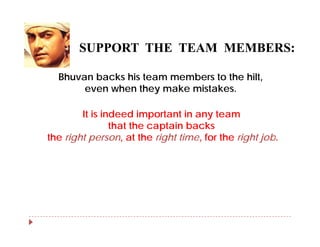
SUPPORT THE TEAM MEMBERS:
                        MEMBERS

  Bhuvan backs his team members to the hilt
                                       hilt,
       even when they make mistakes.

        It is indeed important in any team
                that the captain backs
the right person at the right time for the right job
          person,              time,             job.
Lets Find out our Role in Team Building
 Team Building Test

     Instructions: Below is list of statement describing
     p
     possible contributions to effective team. Score each
     statement according to following scale.


       1 – Not very often true to me
       2 – Sometimes true to me
       3 – Very often true to me


54
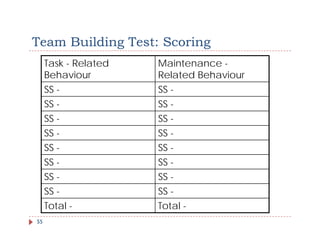
Team Building Test: Scoring
     Task - Related   Maintenance -
     Behaviour        Related Behaviour
     SS -             SS -
     SS -             SS -
     SS -             SS -
     SS -             SS -
     SS -             SS -
     SS -             SS -
     SS -             SS -
     SS -             SS -
     Total -          Total -
55
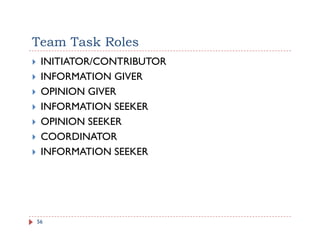
Team Task Roles
 INITIATOR/CONTRIBUTOR
 INFORMATION GIVER
 OPINION GIVER
 INFORMATION SEEKER
 OPINION SEEKER
 COORDINATOR
 INFORMATION SEEKER


56
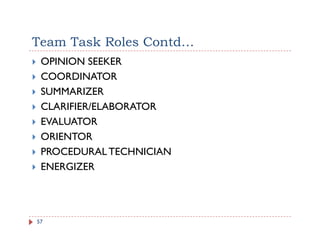
Team Task Roles Contd…
 OPINION SEEKER
 COORDINATOR
 SUMMARIZER
 CLARIFIER/ELABORATOR
 EVALUATOR
 ORIENTOR
 PROCEDURAL TECHNICIAN
 ENERGIZER


57
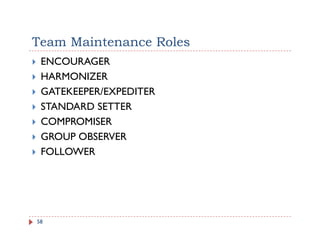
Team Maintenance Roles
 ENCOURAGER
 HARMONIZER
 GATEKEEPER/EXPEDITER
 STANDARD SETTER
 COMPROMISER
 GROUP OBSERVER
 FOLLOWER


58
“Coming together is a
      Coming
          beginning
      Keeping together is
      K   i   t   th i
        p g
        progress; and
      Working together is
           success
           success”


59

Team building

  • 1.
    Team Building Psychometric Analyst & Trainer: Tina Karkhanis 1
  • 2.
    Introduction Team Team Building Examples & Stories Team Characteristics Model – Team Effectiveness Edwin Lee - Life Cycle of Team Tuckman – Team Building Stages Team Culture Team Leader Vision & Mission Team effectiveness & its effect in performance / revenue 2
  • 3.
    Check in Check-in Instruction: eachperson checks in with Where are you now in your team? What is your role in team? and ‘what want’ from the session today? 3
  • 4.
  • 5.
    Team Benefits of Team Work Lack of Team Work 5
  • 6.
    Why Teams? Several people’s skills and knowledge together, in-turn gives better result i t i b tt lt Sustain the enthusiasm and lend support needed to complete the task. “What we accomplish is dependent on working together, at least part of the time!” “A team is two or more people working together inter-dependently, to achieve a shared objective.” 6
  • 7.
    TEAM T Together E Empowering each other to p g A Achieve M More United we stand, Divided we fall. A team is a group of people working towards a common goal goal. 7
  • 8.
    What Is ATeam? Here are some terms that are often used to describe 'a team . team'. Which ones do you think define what a team is? A group of Having one people Synergy aim Whole > Sum Co-operation Flexibility Working Reporting to Serving one together one boss customer 8
  • 9.
    What is team? Ina team, People depend on each other; May or may not work in the same physical location, Combine to achieve something together 9
  • 10.
    Sales people Undertake selling to clients Sales Manager Ensures the Sales People are equipped to sell properly Marketing Manager Designs a product is attractive to potential buyers Control the costs of the product to keep it competitively Accountants priced Maximise the return on the client's investment, making , g Investment Analysts the product more attractive to buy Process the procedures quickly so that the client does Administrators not lose patience and move to a competitor company Recruit high performing sales people, and provide Personnel training to maximise sales Provide marketing literature that looks professional and Stationery suppliers makes the product seem attractive Keep premises looking attractive, so that clients and pp g , Cleaning staff Cl i t ff prospects feel comfortable visiting organization 10
  • 11.
  • 12.
    Expectations - WIFM Delegates: Trainer 1. 1 Learn 1. 1 Focus on 2. Share problems/difficulties for the team, not 3. Experience p 2. difficulties with individuals 4. Explore Ask questions to clarify or 5. Action Plan p probe to understand 3. Always remember – this is for the good of the team! 4. Confidentiality - what is discussed here, stays here 12
  • 13.
    Teams in Park Various Departments Security Operation Administration Sales & Marketing Logistics Maintenance F&B HR Events Finance 13
  • 15.
    Stories Dying oldman and bundle of sticks Synergy through teams 1+1 >> 2 What can we learn from little ants? From honeybees? From the birds flying in a formation?
  • 16.
    THE MAGIC OFSYNERGY Normally, 1+1=2. But, B sometimes when we work as a TEAM, h k TEAM 1+1 may become 11, 111, or even 1111! In fact, there i no li it f t th is limit. That is called SYNERGY; It is I i SYNCHRONISED ENERGY.ENERGY It has a MULITIPLIER EFFECT. It I grows in GEOMETRIC PROGRESSION, or PROGRESSION even EXPONENTIAL
  • 17.
    Characteristics of Team Interdependent members Common goal(s) Each member’s distinct role Each E h member’s contribution is b ’ b important Congruency between individual and group goal 17
  • 18.
    How do TeamsWork Best? Commitment to common objectives Defined roles and responsibilities Effective decision systems, communication and work procedures Good personal relationships. 18
  • 19.
    TEAM EFFECTIVENESS MODEL Teams can continuously improve their effectiveness by focusing on improving their functioning in five key areas: Goals: What the team aspires to achieve Roles: The part each member p y in achieving the p plays g team goals Procedures: The methods that help the team conduct its work together Relationships: How the team members ‘get along” with each other h th Leadership: How the leader supports the team in achieving results results. 19
  • 20.
    CLEAR Mission Purpose Values Goals 20
  • 21.
    CLEAR ROLES ANDRESPONSIBILITIES Organization Structure Job Description Accountabilities Competencies Resources Tools and Equipment Qualifications 21
  • 22.
    CLEAR PROCEDURES FOR: Solving Problems and Making Decisions Communicating Managing Conflict Completing Tasks Planning Pl Meetings Managing Change Evaluating Performance 22
  • 23.
    POSITIVE RELATIONSHIPS Mutualrespect and trust Support Inclusion Involvement Value diversity Listening Feedback Okay with disagreement y g 23
  • 24.
    STRONG LEADERSHIP PersonalCredibility Strategic Focus Clear Expectations Clear Communication Engagement and Involvement Develop People and Team All members responsible and accountable Manage Change g g Recognition 24
  • 25.
    Life Cycle ofTeam - by Edwin Lee The P4 group, highly effective and highly cohesive. 25
  • 26.
    An overview ofa Team's Life and Death Team s 26
  • 27.
  • 28.
    Little Learning withthe above theory with examples….1 When a team is formed it focuses on the future. Once it succeeds it focuses on the past. IBM lost most of the PC market (new challenge) because ( g ) its key business decisions were made by people who succeeded with mainframes (past successes). 28
  • 29.
    Little Learning withthe above theory with examples…..2 Success breeds failure. The IBM PC (success) was followed by PC Jr. (abject failure). Apple II (success) was followed by Lisa (failure)! 29
  • 30.
    Little Learning withthe above theory with examples…..3 Failure can breed success. Norman Schwartzkopf and Colin Powell endured the failure of Vietnam. They learned from that, and fought y , g Desert Storm with the wisdom and anxiety that Vietnam fostered. 30
  • 31.
    Little Learning withthe above theory with examples…..4 Term limits of no more than 8 years for executives and executive teams would improve business effectiveness more than any other management change. 31
  • 32.
    Effective teams arealways aware of and responsive to both th i internal and b th their i t l d their external environment 32
  • 33.
    How to makeTeam more EFFECTIVE Answer to this question is Team Building. TEAM BUILDING The Th process of making team effective is called team b ildi f k ff ll d building. 'Team Building' is the process of enabling the group of people to reach their goal. 33
  • 34.
    Stages in TeamBuilding Forming Storming Norming Performing 34
  • 35.
    Stage 1: FORMING Team Building Define team D fi t Determine individual roles Develop D l trust and communication d i i Develop norms Task Define problem and strategy p gy Identify information needed 35
  • 36.
    Team Norms Howdo we support each other? What do we do when we have problems? What are my responsibilities to the team? 36
  • 37.
    From Individuals A Group Help members understand each other: How can I become a better team member? Keep the broader picture in mind rather than getting absorbed i ‘my’ ‘own’ task b b d in ‘ ’ ‘ ’ k My efforts should add value to the team My goal not achieved if team goal is not Use resources just sufficient to complete my part of the team task ‘Sail on’, rather than ‘pass on’ Create cooperative, friendly climate in team 37
  • 38.
    Stage 2: STORMING Duringthe Storming stage team members: Realize that the task is more difficult than they i h imagined; i d Have fluctuations in attitude about chances of success; f May be resistant to the task; and, Have poor collaboration. H ll b i 38
  • 39.
    STORMING DIOGNOSIS Dowe have common goals and objectives? Do we agree on roles and responsibilities? Do our task, communication, and decision systems work? Do we have adequate interpersonal skills? 39
  • 40.
    Negotiating Conflict Separateproblem issues from people issues issues. Be soft on people, hard on problem. people problem Look for underlying needs, goals of each party rather than specific solutions.
  • 41.
    Addressing the Problem State your views in clear non judgmental language non-judgmental language. Clarify the core issues. Listen carefully to each person’s point of view. Check understanding by restating the core issues.
  • 42.
    Stage 3: Norming During this stage members accept: Their team; Th i t Team rules and procedures; Their l in h Th i roles i the team; and, d The individuality of fellow members. Team members realize that they are not going to crash- and-burn and start helping each other. p g 42
  • 43.
    Norming Stage: MemberBehaviors Competitive relationships become more cooperative. There is a willingness to confront issues and solve p problems. Teams develop the ability to express criticism p y p constructively. There is a sense of team spirit. 43
  • 44.
    Stage 4: PERFORMING Teammembers have: Gained insight i t G i d i i ht into personal and t l d team processes; A better understanding of each other’s other s strengths and weaknesses; Gained the ability to prevent or work through group conflict and resolve differences; and, Developed a close attachment to the team. 44
  • 45.
    Stage 5: Adjourning Tuckmanadded a 5th stage 10 years later in 1977 The process of "unforming" the group, that is, letting go of the group structure and moving on. g p g It involves completing the task and breaking up the team. p g g p 45
  • 46.
    Stages of TeamDevelopment Adjourning Group disperses / G di completion of task Performing Begin t h B i to share common commitment and Team is purpose “buzzing” Norming Voice differences, jockeyi ng for position g p Storming Forming Get together, introductions Tuckman, B. & 46 involved - “ritual sniffing” Jensen, N. (1977)
  • 47.
  • 48.
    Team Culture LeadersMake Culture Vision Mission Team members maintain and create necessary team y culture Pros & Cons of Team culture Identify different team behaviors Performance driven People maintenance P l i Trouble shooters 48
  • 49.
    Teamwork relationships (Oliva, M 1992 (Oliva L M. 1992. Partners not Competitors, London. Idea Group Publishing.) Competitors London Publishing ) Management-centred leadership Range of freedom manager has to exercise authority Range of freedom team members have to exercise their authority Team centred Team-centred leadership Manager Manager Manager Team develops Team makes Team is makes decides team develops and different decision responsible independent direction and presents a approaches to within its for decision and “sells” plan to variety of solve problem; scope of decision, defi announces it team approaches for works with authority nes the the team to management to problem and decide on implement solution 49
  • 50.
    Personal Characteristics ofTeam Leader Appearance Intelligence Self – confidence Warmth Communication Sensitizing the Skills feedback Alertness Al Naturalness N l Maturity Ability to work Sense of Humor with others 50
  • 51.
    BUILDING THE TEAM: Building the team is like recruitment. One needs to select the right people and motivate them. He understands the pressures and the soft points of people, and uses this knowledge to make them part of his team. Each one of his team members is treated as special, as being different.
  • 52.
    ALLOCATING ROLES: Bhuvan alsoassigns responsibilities to each of his people. Just getting the people in the team is not good enough enough. They have to be told what the goal is. A team consists of different individuals. t i t f diff t i di id l The objective is to make them all work together like a fist, like a team.
  • 53.
    SUPPORT THE TEAMMEMBERS: MEMBERS Bhuvan backs his team members to the hilt hilt, even when they make mistakes. It is indeed important in any team that the captain backs the right person at the right time for the right job person, time, job.
  • 54.
    Lets Find outour Role in Team Building Team Building Test Instructions: Below is list of statement describing p possible contributions to effective team. Score each statement according to following scale. 1 – Not very often true to me 2 – Sometimes true to me 3 – Very often true to me 54
  • 55.
    Team Building Test:Scoring Task - Related Maintenance - Behaviour Related Behaviour SS - SS - SS - SS - SS - SS - SS - SS - SS - SS - SS - SS - SS - SS - SS - SS - Total - Total - 55
  • 56.
    Team Task Roles INITIATOR/CONTRIBUTOR INFORMATION GIVER OPINION GIVER INFORMATION SEEKER OPINION SEEKER COORDINATOR INFORMATION SEEKER 56
  • 57.
    Team Task RolesContd… OPINION SEEKER COORDINATOR SUMMARIZER CLARIFIER/ELABORATOR EVALUATOR ORIENTOR PROCEDURAL TECHNICIAN ENERGIZER 57
  • 58.
    Team Maintenance Roles ENCOURAGER HARMONIZER GATEKEEPER/EXPEDITER STANDARD SETTER COMPROMISER GROUP OBSERVER FOLLOWER 58
  • 59.
    “Coming together isa Coming beginning Keeping together is K i t th i p g progress; and Working together is success success” 59