Team Effectiveness


      Consulting 101
Learning Objectives

  Help you identify acknowledge your personal working
   preferences
  Observe and appreciate the work preferences exhibited
   by your team members
  Acknowledge that no one working style is better than
   another
  Recognise the potential for friction and/or conflict in the
   workplace
  Respond to friction/conflict in a proactive and open
   communicative style
  Maintain your independence in an interdependent work
   environment
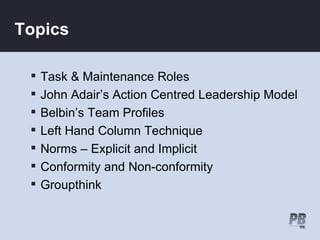
Topics

    Task & Maintenance Roles
    John Adair’s Action Centred Leadership Model
    Belbin’s Team Profiles
    Left Hand Column Technique
    Norms – Explicit and Implicit
    Conformity and Non-conformity
    Groupthink
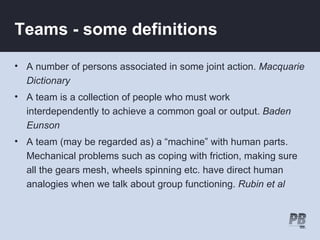
Teams - some definitions

• A number of persons associated in some joint action. Macquarie
  Dictionary
• A team is a collection of people who must work
  interdependently to achieve a common goal or output. Baden
  Eunson
• A team (may be regarded as) a “machine” with human parts.
  Mechanical problems such as coping with friction, making sure
  all the gears mesh, wheels spinning etc. have direct human
  analogies when we talk about group functioning. Rubin et al
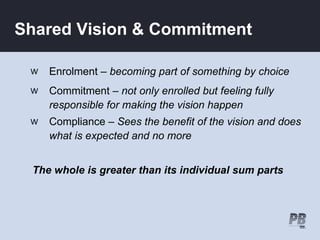
Shared Vision & Commitment

 w   Enrolment – becoming part of something by choice
 w   Commitment – not only enrolled but feeling fully
     responsible for making the vision happen
 w   Compliance – Sees the benefit of the vision and does
     what is expected and no more


 The whole is greater than its individual sum parts
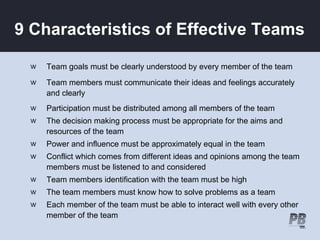
9 Characteristics of Effective Teams

 w   Team goals must be clearly understood by every member of the team
 w   Team members must communicate their ideas and feelings accurately
     and clearly
 w   Participation must be distributed among all members of the team
 w   The decision making process must be appropriate for the aims and
     resources of the team
 w   Power and influence must be approximately equal in the team
 w   Conflict which comes from different ideas and opinions among the team
     members must be listened to and considered
 w   Team members identification with the team must be high
 w   The team members must know how to solve problems as a team
 w   Each member of the team must be able to interact well with every other
     member of the team
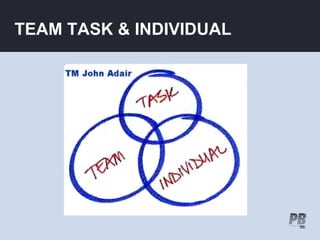
TEAM TASK & INDIVIDUAL
What factors influence your performance?


• Is the team more important than the task?
• Are you determined to achieve your goals?
• Is “getting the task done” your priority?
• Can you shift your focus among the three
  aspects?
• How do you achieve a balance among all three?
TASK & MAINTENANCE ROLES
TASK ROLES
•   Task roles refer to those aspects of the team’s behaviour that are
    directed towards getting things done and achieving the purpose of the
    team.


MAINTENANCE ROLES
•   Maintenance/Building roles refer to those behaviours that help make
    and keep the team together.
•   In an effective team there will be a balance between the two.
      As the team goes through various stages of development the relative
       emphasis will vary.
      Too great an emphasis on one or the other for long periods may lead to an
       ineffective team.
Belbin’s Team Roles
Plant
• An “ideas person”. A prime source of innovation and ideas. Can play a
   strategic role such as forward planning. Advances new ideas and
   strategies, with special attention to major issues. Looks for ways
   around problems.
     Key words: Inventive. Creative. Fun. Unorthodox. “Let’s play with
       the idea”

Monitor Evaluator
• A critic of ideas and suggestions. Evaluates new plans (which should
  seldom be acted on against their advice). Analyses problems. Assess
  ideas and options so that the team can make balanced decisions.
    Key words: Questions. Analytical. Prudent. Judgement. “Is it good
      enough?”
Team Norm’s

• Formal norms are those rules that are explicit in
  the way they define the group’s behaviour


• Informal norms are implicit in the way they define
  the group’s behaviour
Informal Team Norms

• You don’t dob on (report on) your mates to your superiors
• A fair day’s work here is x amount of output
• We trust each other a lot, and we can try out weird and
  wonderful ideas on the group without getting laughed at.
• We don’t express too much emotion when discussing
  things.
• This group’s output is a cut above what the others deliver,
  and we like it like that.
• We don’t like working with women (men)
Groupthink

• What is Groupthink?
   A pattern of defective decision making seen in
    groups
     critical evaluation is frowned upon;
     questioning an established position is avoided;
     potential threats against the established position are
      simply rationalised into obscurity