Presentation On  Team Challenge
Group Development STAGES   CHARACTERISTICS FORMING:   Define the group’s purpose, structure and leadership STORMING:  Discussions and intra-group conflicts NORMING:   Close relationships and cohesiveness PERFORMING:   Group becomes fully functional ADJOURNING:   Members are concerned with wrapping up  activities rather than task performance
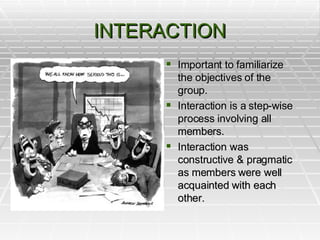
INTERACTION Important to familiarize the objectives of the group.  Interaction is a step-wise process involving all members. Interaction was constructive & pragmatic as members were well acquainted with each other.
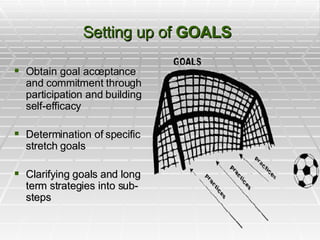
Setting up of  GOALS   Obtain goal acceptance and commitment through participation and building self-efficacy Determination of specific stretch goals Clarifying goals and long term strategies into sub-steps
 
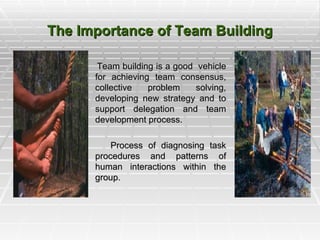
The Importance of Team Building Team building is a good  vehicle for achieving team consensus, collective problem solving, developing new strategy and to support delegation and team development process. Process of diagnosing task procedures and patterns of human interactions within the group.
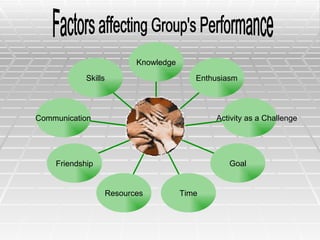
Factors affecting Group's Performance Skills Communication Friendship Resources Time Goal Activity as a Challenge Enthusiasm Knowledge
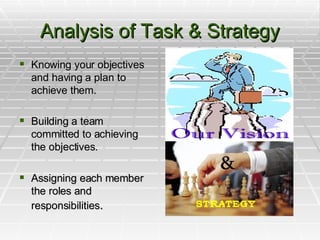
Analysis of Task & Strategy Knowing your objectives and having a plan to achieve them. Building a team committed to achieving the objectives. Assigning each member the roles and responsibilities .
Analysis of Task & Strategy  Estimation of the Required Resources. Having a contingency plan.  Different roles assigned to members varied : Chief architect Resource allocator Supervisor Ground work
Schmidt’s view of conflicts “ Conflict is a good thing! It is bad  only when managed badly .”  Functional Aspects   Better ideas produced  Clarification of individual views  Unleashing interest and creativity  Lookout for new approaches Dysfunctional Aspects   Distance between members increased  Climate of mistrust and suspicion developed  Members concentrate on their personal interest
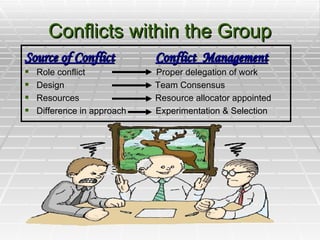
Conflicts within the Group Source of Conflict   Conflict  Management Role conflict  Proper delegation of work Design  Team Consensus  Resources  Resource allocator appointed Difference in approach  Experimentation & Selection
What we learnt about Leadership While Leadership is easy to explain, leadership is not so easy to practice As a leader our main priority is to get the job done, whatever the job is A good leader should know how to adapt and redefine new aims and priorities according to changing situations “… Praise loudly, blame softly…”. As a leader we should give the members credit for success and take responsibility for mistakes.
Communication  Communication is critical and It was made effective through the following ways: Listening Consulting Involving Explaining Nature of communication-   Pragmatic Barriers to communication Semantic barriers Psychological barriers Personal barriers
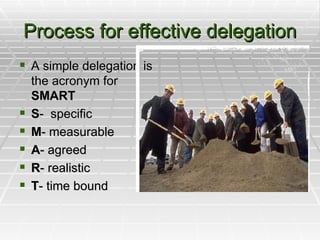
Process for effective delegation A simple delegation is the acronym for  SMART S -  specific M - measurable A - agreed R - realistic T - time bound
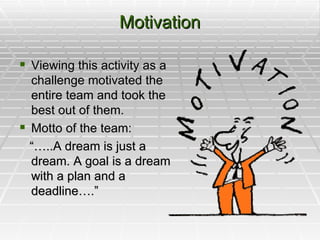
Motivation Viewing this activity as a challenge motivated the entire team and took the best out of them. Motto of the team:  “… ..A dream is just a dream. A goal is a dream with a plan and a deadline….”
Motivation (contd.) Each member of the group was given equal treatment, hence following Adam’s Equity theory. We followed the “Locke’s Goal theory” which focused much on the link between goal difficulty and performance.
Outcomes from this workshop How to work as  a team ,coordinate Achieve goals in a time frame Redefining aims and objectives according to situations. Leadership and motivational theories

Team Management

  • 1.
    Presentation On Team Challenge
  • 2.
    Group Development STAGES CHARACTERISTICS FORMING: Define the group’s purpose, structure and leadership STORMING: Discussions and intra-group conflicts NORMING: Close relationships and cohesiveness PERFORMING: Group becomes fully functional ADJOURNING: Members are concerned with wrapping up activities rather than task performance
  • 3.
    INTERACTION Important tofamiliarize the objectives of the group. Interaction is a step-wise process involving all members. Interaction was constructive & pragmatic as members were well acquainted with each other.
  • 4.
    Setting up of GOALS Obtain goal acceptance and commitment through participation and building self-efficacy Determination of specific stretch goals Clarifying goals and long term strategies into sub-steps
  • 5.
  • 6.
    The Importance ofTeam Building Team building is a good vehicle for achieving team consensus, collective problem solving, developing new strategy and to support delegation and team development process. Process of diagnosing task procedures and patterns of human interactions within the group.
  • 7.
    Factors affecting Group'sPerformance Skills Communication Friendship Resources Time Goal Activity as a Challenge Enthusiasm Knowledge
  • 8.
    Analysis of Task& Strategy Knowing your objectives and having a plan to achieve them. Building a team committed to achieving the objectives. Assigning each member the roles and responsibilities .
  • 9.
    Analysis of Task& Strategy Estimation of the Required Resources. Having a contingency plan. Different roles assigned to members varied : Chief architect Resource allocator Supervisor Ground work
  • 10.
    Schmidt’s view ofconflicts “ Conflict is a good thing! It is bad only when managed badly .” Functional Aspects Better ideas produced Clarification of individual views Unleashing interest and creativity Lookout for new approaches Dysfunctional Aspects Distance between members increased Climate of mistrust and suspicion developed Members concentrate on their personal interest
  • 11.
    Conflicts within theGroup Source of Conflict Conflict Management Role conflict Proper delegation of work Design Team Consensus Resources Resource allocator appointed Difference in approach Experimentation & Selection
  • 12.
    What we learntabout Leadership While Leadership is easy to explain, leadership is not so easy to practice As a leader our main priority is to get the job done, whatever the job is A good leader should know how to adapt and redefine new aims and priorities according to changing situations “… Praise loudly, blame softly…”. As a leader we should give the members credit for success and take responsibility for mistakes.
  • 13.
    Communication Communicationis critical and It was made effective through the following ways: Listening Consulting Involving Explaining Nature of communication- Pragmatic Barriers to communication Semantic barriers Psychological barriers Personal barriers
  • 14.
    Process for effectivedelegation A simple delegation is the acronym for SMART S - specific M - measurable A - agreed R - realistic T - time bound
  • 15.
    Motivation Viewing thisactivity as a challenge motivated the entire team and took the best out of them. Motto of the team: “… ..A dream is just a dream. A goal is a dream with a plan and a deadline….”
  • 16.
    Motivation (contd.) Eachmember of the group was given equal treatment, hence following Adam’s Equity theory. We followed the “Locke’s Goal theory” which focused much on the link between goal difficulty and performance.
  • 17.
    Outcomes from thisworkshop How to work as a team ,coordinate Achieve goals in a time frame Redefining aims and objectives according to situations. Leadership and motivational theories