Factors affecting team
Shourya anand sumit yadav
Bba 4th semester
communication
Effective team communication is vital to a productive
work environment. In fact, poor team
communication is a primary reason for a failed
career, according to the University of Northern Iowa.
Effective group communication relies on
understanding interpersonal communication basics
and how they can improve or hinder messages.
Interpersonal communication factors that influence
effective communication include ability to listen,
nonverbal communication, culture and conflict
resolution.
COHESIVENESS
Cohesiveness may by defined as “sticking
together.” Groups or teams are cohesive
when their participants identify with their
membership. Identification means that the
participants feel proud to be members,
inform outsiders that they are members, and
perceive the purposes and goals that the
group or team stands for as their own.
Significant advantages can be realized when
cohesiveness is high:
Member satisfaction with the group or team is high
Group or team goals are achieved more effectively
The quantity and quality of communication is high
The group or team exerts more influence over its
participants
CONFORMITY
Conformity means “going along.” Group conformity is
realized when participants abandon a particular position
contrary to other group or team members in favor of a
majority view. This abandonment, called conforming,
happens for many reasons including: pressure to
compromise, logical or emotional persuasion, coercion,
time constraints, personal frustration, or perceiving the
futility of continued argument.
COMPETITION AND CONFLICT
Productive conflict is also crucial to effective decision
making in groups or teams. Without debating and
questioning key issues through productive conflict,
groups or teams may make decisions that have not been
thoroughly tested or evaluated.
Cooperation and conflict can often go hand-in-hand.
Productive conflict is one of many means by which teams
or groups cooperate. By agreeing to debate, question,
test ideas, and evaluate proposals, members engaged in
conflict can form a cooperative enterprise.
LEADERSHIP
Strong groups and teams are supported by
strong leadership. Leadership is a process of
influence. Whenever one individual attempts to
influence the behavior of another, he or she
engages in leadership.
Shared leadership
There are many approaches and directions to leadership.
Shared leadership is the most important and powerful
approach that a grope or team can undertake. Effective
groups and teams share the leadership function among
several members. You may see many leadership
behaviors exhibited in a group or team that reflect
shared leadership. Leadership, in turn, depends on
effective communication skills. When you see
participants contribute frequently and openly, with
different members introducing various topics for
discussion, different ideas being challenged and debated,
you are witnessing shared leadership
Intellectual stimulation
Leaders can provide intellectual stimulation by
encouraging followers to think about old problems in
new ways. Leaders show more interest in creative ideas
than in routine processes. They are no longer the
crutch for the employee to lean on. When asked a
question, leaders in turn ask more questions and give
fewer answers, which encourages team work
*Loyalty
*Trust in the leader’s beliefs
*Similarity between leader and follower
opinions
and beliefs
*Affection and admiration for the leader
*Emotional involvement in the mission believed in by
the leader
*Perception that the leader takes risks and makes
sacrifices to achieve his or her vision
*Perception that the leader uses unconventional
strategies to achieve goals
Steps to build an
effective team
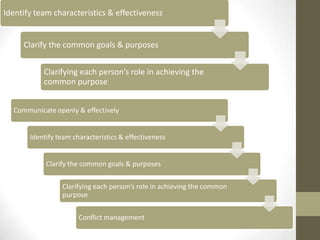
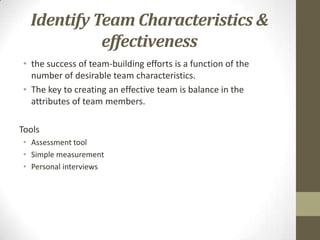
Identify team characteristics & effectiveness

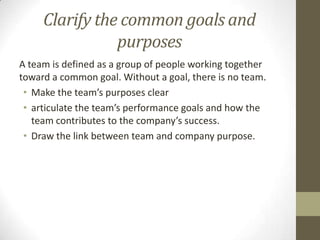
Clarify the common goals & purposes

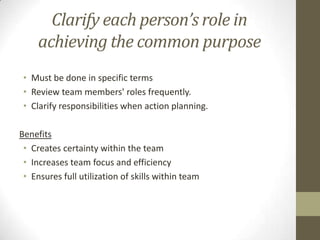
Clarifying each person’s role in achieving the
common purpose
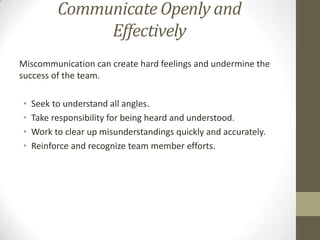
Communicate openly & effectively

Identify team characteristics & effectiveness

Clarify the common goals & purposes
Clarifying each person’s role in achieving the common
purpose

Conflict management
Identify Team Characteristics &
effectiveness
• the success of team-building efforts is a function of the
number of desirable team characteristics.
• The key to creating an effective team is balance in the
attributes of team members.
Tools
• Assessment tool
• Simple measurement
• Personal interviews
Clarify the common goals and
purposes
A team is defined as a group of people working together
toward a common goal. Without a goal, there is no team.
• Make the team’s purposes clear
• articulate the team’s performance goals and how the
team contributes to the company’s success.
• Draw the link between team and company purpose.
Clarify each person’s role in
achieving the common purpose
• Must be done in specific terms
• Review team members' roles frequently.
• Clarify responsibilities when action planning.
Benefits
• Creates certainty within the team
• Increases team focus and efficiency
• Ensures full utilization of skills within team
Communicate Openly and
Effectively
Miscommunication can create hard feelings and undermine the
success of the team.
•
•
•
•

Seek to understand all angles.
Take responsibility for being heard and understood.
Work to clear up misunderstandings quickly and accurately.
Reinforce and recognize team member efforts.
Deal with conflict situations
• Conflict within teams is natural
• Move quickly to manage conflict situations
• Conflict, handled well can produce constructive
ideas
• Handled poorly, can be destabilizing and
destructive
• Need to demonstrate strong leadership
Here are some ways to successfully resolve conflicts:
• each team member involved should have a chance to explain
the problem as he or she faces.
• Establish clear ground rules so that people can have their say
without being interrupted, rushed, mocked, or intimidated.
• Encourage employees to solve problems themselves when
they can so that leader aren’t always in the middle of every
conflict between team members.
• However, if they cannot solve them, it’s important that they
can count on leader to coach them through a problem-solving
framework that allows them to build conflict resolution skills
for the future.
Meetings – encourage
interaction
Make sure team members interact at meetings
• Encourage team members to ask for and offer help at
meetings
• Team members must feel comfortable about speaking
up
• Maximize knowledge
• Collaboration not competition
• Dominance by Manager can limit real synergy
• Allow room for minority or unpopular views
Appraise
• Appraise and reward the team as a whole.
• Compare team performance against targets
• Provide regular feedback on performance
• Plan small celebrations on achieving milestones
Communicate team successes
• Where possible, tell the whole company
(meetings, intranet, newsletter)
• Name people who made key contributions
• Include people outside immediate group
(reception, IT, finance etc.)
Steps to build an effective team

Steps to build an effective team

  • 1.
    Factors affecting team Shouryaanand sumit yadav Bba 4th semester
  • 2.
    communication Effective team communicationis vital to a productive work environment. In fact, poor team communication is a primary reason for a failed career, according to the University of Northern Iowa. Effective group communication relies on understanding interpersonal communication basics and how they can improve or hinder messages. Interpersonal communication factors that influence effective communication include ability to listen, nonverbal communication, culture and conflict resolution.
  • 3.
    COHESIVENESS Cohesiveness may bydefined as “sticking together.” Groups or teams are cohesive when their participants identify with their membership. Identification means that the participants feel proud to be members, inform outsiders that they are members, and perceive the purposes and goals that the group or team stands for as their own.
  • 4.
    Significant advantages canbe realized when cohesiveness is high: Member satisfaction with the group or team is high Group or team goals are achieved more effectively The quantity and quality of communication is high The group or team exerts more influence over its participants
  • 5.
    CONFORMITY Conformity means “goingalong.” Group conformity is realized when participants abandon a particular position contrary to other group or team members in favor of a majority view. This abandonment, called conforming, happens for many reasons including: pressure to compromise, logical or emotional persuasion, coercion, time constraints, personal frustration, or perceiving the futility of continued argument.
  • 6.
    COMPETITION AND CONFLICT Productiveconflict is also crucial to effective decision making in groups or teams. Without debating and questioning key issues through productive conflict, groups or teams may make decisions that have not been thoroughly tested or evaluated. Cooperation and conflict can often go hand-in-hand. Productive conflict is one of many means by which teams or groups cooperate. By agreeing to debate, question, test ideas, and evaluate proposals, members engaged in conflict can form a cooperative enterprise.
  • 7.
    LEADERSHIP Strong groups andteams are supported by strong leadership. Leadership is a process of influence. Whenever one individual attempts to influence the behavior of another, he or she engages in leadership.
  • 8.
    Shared leadership There aremany approaches and directions to leadership. Shared leadership is the most important and powerful approach that a grope or team can undertake. Effective groups and teams share the leadership function among several members. You may see many leadership behaviors exhibited in a group or team that reflect shared leadership. Leadership, in turn, depends on effective communication skills. When you see participants contribute frequently and openly, with different members introducing various topics for discussion, different ideas being challenged and debated, you are witnessing shared leadership
  • 9.
    Intellectual stimulation Leaders canprovide intellectual stimulation by encouraging followers to think about old problems in new ways. Leaders show more interest in creative ideas than in routine processes. They are no longer the crutch for the employee to lean on. When asked a question, leaders in turn ask more questions and give fewer answers, which encourages team work
  • 10.
    *Loyalty *Trust in theleader’s beliefs *Similarity between leader and follower opinions and beliefs *Affection and admiration for the leader *Emotional involvement in the mission believed in by the leader *Perception that the leader takes risks and makes sacrifices to achieve his or her vision *Perception that the leader uses unconventional strategies to achieve goals
  • 11.
    Steps to buildan effective team
  • 12.
    Identify team characteristics& effectiveness Clarify the common goals & purposes Clarifying each person’s role in achieving the common purpose Communicate openly & effectively Identify team characteristics & effectiveness Clarify the common goals & purposes Clarifying each person’s role in achieving the common purpose Conflict management
  • 13.
    Identify Team Characteristics& effectiveness • the success of team-building efforts is a function of the number of desirable team characteristics. • The key to creating an effective team is balance in the attributes of team members. Tools • Assessment tool • Simple measurement • Personal interviews
  • 14.
    Clarify the commongoals and purposes A team is defined as a group of people working together toward a common goal. Without a goal, there is no team. • Make the team’s purposes clear • articulate the team’s performance goals and how the team contributes to the company’s success. • Draw the link between team and company purpose.
  • 15.
    Clarify each person’srole in achieving the common purpose • Must be done in specific terms • Review team members' roles frequently. • Clarify responsibilities when action planning. Benefits • Creates certainty within the team • Increases team focus and efficiency • Ensures full utilization of skills within team
  • 16.
    Communicate Openly and Effectively Miscommunicationcan create hard feelings and undermine the success of the team. • • • • Seek to understand all angles. Take responsibility for being heard and understood. Work to clear up misunderstandings quickly and accurately. Reinforce and recognize team member efforts.
  • 17.
    Deal with conflictsituations • Conflict within teams is natural • Move quickly to manage conflict situations • Conflict, handled well can produce constructive ideas • Handled poorly, can be destabilizing and destructive • Need to demonstrate strong leadership
  • 18.
    Here are someways to successfully resolve conflicts: • each team member involved should have a chance to explain the problem as he or she faces. • Establish clear ground rules so that people can have their say without being interrupted, rushed, mocked, or intimidated. • Encourage employees to solve problems themselves when they can so that leader aren’t always in the middle of every conflict between team members. • However, if they cannot solve them, it’s important that they can count on leader to coach them through a problem-solving framework that allows them to build conflict resolution skills for the future.
  • 19.
    Meetings – encourage interaction Makesure team members interact at meetings • Encourage team members to ask for and offer help at meetings • Team members must feel comfortable about speaking up • Maximize knowledge • Collaboration not competition • Dominance by Manager can limit real synergy • Allow room for minority or unpopular views
  • 20.
    Appraise • Appraise andreward the team as a whole. • Compare team performance against targets • Provide regular feedback on performance • Plan small celebrations on achieving milestones
  • 21.
    Communicate team successes •Where possible, tell the whole company (meetings, intranet, newsletter) • Name people who made key contributions • Include people outside immediate group (reception, IT, finance etc.)

Editor's Notes