TEAM EFFECTIVENESS 
“There is no ‘I’ in TEAM! And this is the secret of a team SUCCESS !” 
www.humanikaconsulting.com
Table of contents 
What is Team Effectiveness? 
Team Effectiveness using the scaled comparison. 
Aspects of excellent team. 
Maxims of team management 
Boehm’s Principles 
What does Team Effectiveness measure? 
Structural Elements 
Positive Interdependent Behaviors 
Four strategies to improve Team Effectiveness 
Clarify your team mission 
Set team goals! 
Create a plan 
Conduct progress reviews. 
 Team effectiveness model
Background 
•Defining “Team” 
–Teams generally consist of two or more people who 
•Are interdependent 
•Exist for a purpose/task 
•Are mutually accountable to achieve that purpose/task 
•Perceive themselves as a social entity 
–Groups versus Teams?
15-5 
Groups, Teams and Organizational Effectiveness 
•Group 
–Two or more people who interact with each other to accomplish certain goals or meet certain needs.
Background 
•As noted previously (e.g., tutorials), ability to work in teams is essential in most modern organisations 
–Why? 
–Advantages of teams? 
–Disadvantages of teams?
Types of Teams 
•Departmental Teams 
•Production/Service/ Leadersip teams 
•Self-directed or autonomous teams 
•Advisory teams 
•Task force or project teams 
•Skunkworks (team who research & develop projects 
•Virtual teams 
•Communities of practice (share their knowledge & info)
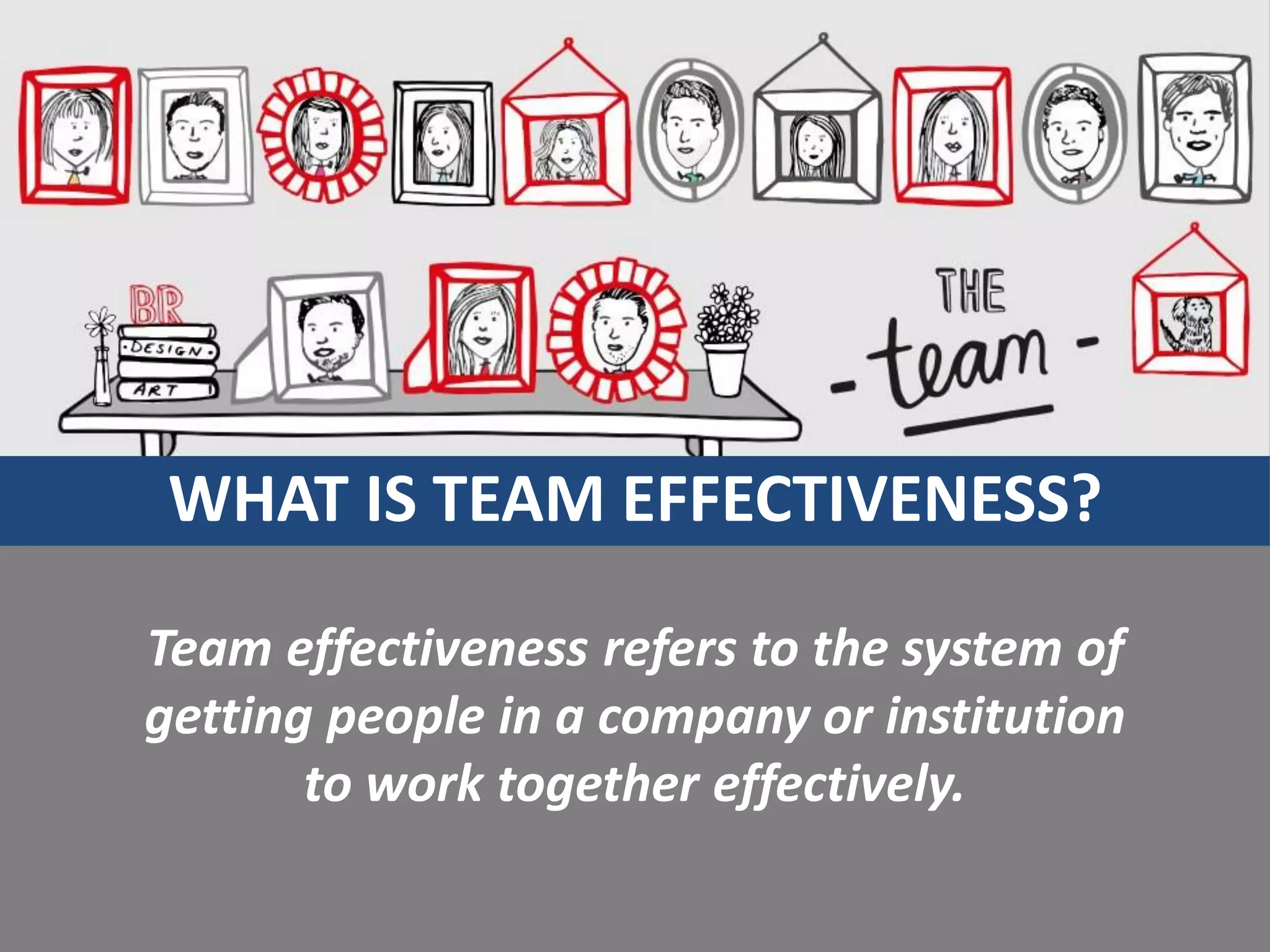
WHAT IS TEAM EFFECTIVENESS? 
Team effectiveness refers to the system of getting people in a company or institution to work together effectively.
9 
Characteristics of an Effective Team 
Effective teams operate in an environment in which there is two way trust in an environment of open and honest communication
10 
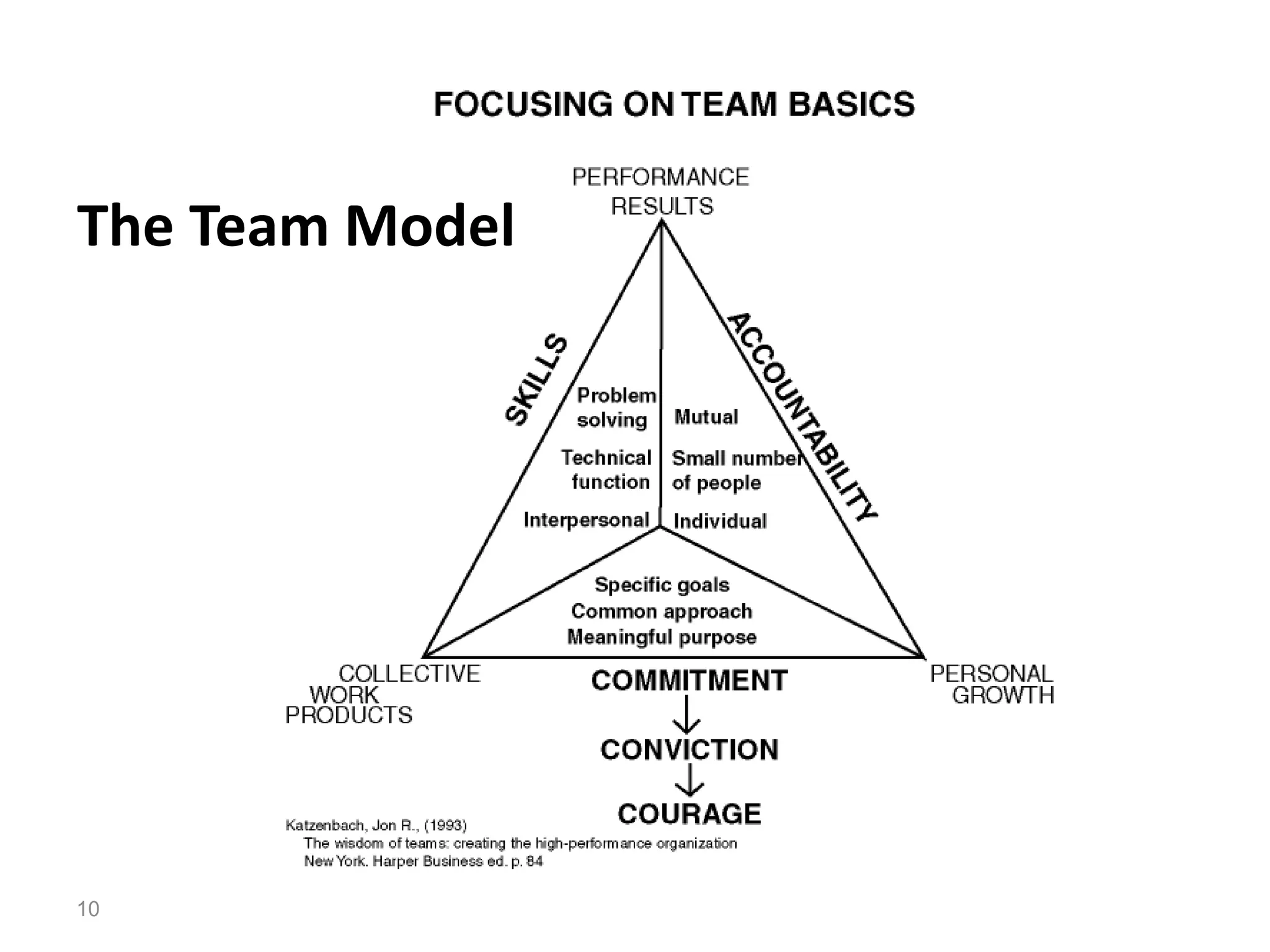
The Team Model
- 11 - 
Teamwork Represents Values that: 
•Encourage listening and responding constructively to the views expressed by others 
•Give others the benefit of the doubt 
•Provide support 
•Recognize the interests and achievements of others 
John R. Katzenbach and Douglas K. Smith, “The Discipline of Teams”, Harvard Business Review, March-April, 1993, pp. 111-120
- 12 - 
Characteristics of Losing Teams 
•Dominated by one individual 
•Compromise between two competing business strategies 
•Engage in groupthink 
•Not all team members contribute
- 13 - 
Winning Teams 
•Trust 
•Clear time frame and agreed upon goals 
•Get facts and do analyses before making decisions 
•Divide responsibilities 
•All team members contribute 
•Challenge and play devil’s advocate
Team Effectiveness: Potential for Process Gains 
•Potential advantages of using teams 
–As a whole, team has more knowledge, ability, effort than any single team member 
–Diversity of views, knowledge, experience can lead to innovation, fewer errors 
–Potential for constructive conflict – task conflict focused on issue and not personalised 
–Can increase individual motivation and engagement
Team Effectiveness: Potential for Process Losses 
•Potential disadvantages of using teams 
–Individuals better/faster at some tasks 
–Development and maintenance costs 
–Potential for destructive conflict – personalised or relationship conflict 
–Teams often don’t utilise all available knowledge 
•Drive to defend 
•Time constraints 
•Evaluation apprehension 
•Pressure to conform
Team Effectiveness: Potential for Process Losses 
•Social loafing can occur where people exert less effort when working in a team/group 
•Tips to reduce social loafing 
–Keep group size small 
–Increase identifiability and accountability 
–Specialise tasks to make individual efforts indispensible 
–Set clear, challenging goals 
–Increase involvement and engagement 
–Increase identification with the group
TEAM EFFECTIVENESS USING THE SCALED COMPARISON 
Team Effectiveness is a proven and practical diagnostic tool for assessing team effectiveness and improving work group performance. 
Team Effectiveness gives the team a very precise and reliable consensus as to what team members see going well and what needs improvement. 
Cont..
•Team Effectiveness helps team members to very quickly pinpoint the gap between where they are and where they need to be. 
•With Team Effectiveness, all team members participate in team improvement through a sharing of their views about team performance and needed improvement. 
•Unlike other diagnostic tools, Team Effectiveness works with teams as small as 5 to 7 members. 
TEAM EFFECTIVENESS USING THE SCALED COMPARISON
ASPECTS OF EXCELLENT TEAM 
Balance and Coverage are two of the most important aspects of excellent teams:- 
•Whenever team is out of balance, it is vulnerable. 
•Great teams need coverage across key positions with strong individual players.
BOEHM’S PRINCIPLES 
•The principle of top talent : Use better and fewer people 
•The principle of job matching : Fit the tasks to the skills and motivation of the people available. 
•The principle of career progression : An organization does best in the long run by helping its people to self- actualize. 
Cont..
•The principle of team balance : Select people who will complement and harmonize with one another. 
•The principle of phase out : Keeping a misfit on the team doesn’t benefit anyone. 
BOEHM’S PRINCIPLES
FACTORS AFFECTING TEAM EFFECTIVENESS 
•The right mix of skills:- Bringing together the people having different skills that complement each other. 
•The right motivation:- Team effectiveness is directly related to the interest that team is having on the project. 
•The ability to solve conflicts without compromising the quality of the project.
WHAT DOES TEAM EFFECTIVENESS MEASURE? 
Team Effectiveness assesses all of the major components of effective work groups, employing multiple statements for each of a number of basic elements. Some of the elements are :- 
•Structural Elements 
•Positive Interdependent Behaviors
•Structural Elements 
–Shared Team Vision 
–Clear Team Goals 
–Clear Team Roles 
–Effective Leadership Behavior 
WHAT DOES TEAM EFFECTIVENESS MEASURE? 
•Positive Interdependent Behaviors 
–Effective Decision Making 
–Encouragement of Innovation 
–Effective Conflict Management 
–Natural Collaboration 
–Effective Meeting Management
Team Processes 
•What happens when our team members get to work? 
•One major issue is Group/Team Development 
–How do teams develop and change over time?
Team Processes: Development 
•Tuckman’s Model of Group Development (1965) 
Performing 
Adjourning 
Norming 
Storming 
Forming 
Return to Independence 
Dependence/ interdependence 
Independence 
Is this a good model for the teams you’ve experienced? Does it fit all teams?
Team Process Development
Team Processes: Development 
•Other models suggest that groups don’t go through stages at all but complex cycles 
•Punctuated Equilibrium (Gersick) 
–Long periods of little or no development 
–Important times (e.g., looming deadlines, halfway point) spur activity and change
•Regardless of model, central processes occur during team development 
•Team membership formation 
–Development of cohesion and bonding to group 
–Start to think of team as part of social identity 
•Team competence 
–Form routines, roles, norms, that improve effectiveness 
–Form shared mental models about resources, goals, etc. 
Team Processes: Development
Team Processes: Cohesion 
•Cohesion – attraction to group or task and desire to remain a member 
–Results from both cognitive and emotional processes 
•Cohesion increases when 
–Members are similar 
–Teams are smaller 
–Members interact frequently 
–Somewhat difficult to enter the team 
–Team success 
–External competition
Team Processes: Cohesion 
•Cohesion is generally beneficial 
–More motivation 
–More willing to share information 
–Can resolve conflict effectively 
–Better interpersonal relationships within team 
–Better performance (if team norms aligned with organisation norms) 
•Cohesion can be harmful when 
–Team members stop doing above to ‘protect’ group 
–Team norms inconsistent with organisation norms
Team Processes: Trust 
•Trust refers to positive expectations of another person in situations involving risk 
•Three levels of trust 
–Calculus-based trust 
–Knowledge-based trust 
–Identification-based trust 
•Based on emotional bond and mutual understanding 
•Likely to be present in highly effective teams
STRATEGIES TO IMPROVE TEAM EFFECTIVENESS 
The task of building better teams and improving their effectiveness can be broken down into four simple and straightforward steps: 
1) Clarify Your Team Mission 
2) Set Team Goals! 
3) Create A Plan 
4) Conduct Progress Reviews.
CLARIFY YOUR TEAM MISSION 
Make sure that your mission is the team's reason for being - its purpose! 
For example:- 
•If your team is responsible for new products, your mission might be to create innovative products and services that make the client's life easier and more enjoyable -- Or products and service that save the client money, Etc.
•Every team should have definite objectives or goals. 
•There are some guidelines for setting up the team goals. 
SET TEAM
SETTING UP TEAM GOALS 
1)The goals should support the team's mission or purpose. 
2)Goals should be measurable. For example, instead of saying, we want to increase sales this month; a specific goal should be set. A measurable goal might be, this month we will increase sales by fifteen percent over last month's sales totals. 
3)Goals should have a date.
CREATE A PLAN 
A team plan is simply a written blueprint for the team's success. 
•spell's out the team's mission, 
•outlines the teams goals, and 
•It lays out a strategy for fulfilling the team mission and reaching the goals. 
•It states the responsibilities of each person on the team, what they do, and how they do it. 
•It should outline what each person does, and how he or she is accountable.
CONDUCT PROGRESS REVIEWS 
These are simply meetings where the team members come together to discuss the team's results and future plans.
ITEMS TO BE COVERED IN TEAM PROGRESS REVIEW 
•Check to make sure the team is effectively accomplishing its mission. 
•Review the team's goals and make necessary adjustments. This is a great time to keep the team goals out in front of everyone. 
•Set a date for the next Progress Review.
• Review the team plan and determine if any updates or changes need to be made to make the team more effective. Talk about the things that are working well, and discuss what areas need to be improved. 
•Clarify responsibilities for each team member and the actions they need to take next. 
ITEMS TO BE COVERED IN TEAM PROGRESS REVIEW
TEAM EFFECTIVENESS MODEL 
Teams can continuously improve their effectiveness by focusing on improving their 
functioning in five key areas: Goals, Roles, Procedures, Relationships and Leadership
5 key areas for Team Improvement 
•Goals: What the team aspires to achieve 
•Roles: The part each member plays in achieving the team goals 
•Procedures: The methods that help the team conduct its work together 
•Relationships: How the team members ‘get along” with each other 
•Leadership: How the leader supports the team in achieving results.
•CLEAR 
•PROCEDURES 
•FOR: 
•Solving Problems 
•and Making 
•Decisions 
•Communicating 
•Managing Conflict 
•Completing Tasks 
•Planning 
•Meetings 
•Managing Change 
•Evaluating 
•Performance 
CLEAR PROCEDURES FOR: Solving Problems and Making Decisions Communicating Managing Conflict Completing Tasks Planning Meetings Managing Change Evaluating Performance 
CLEAR GOALS 
Vision 
Mission 
Values 
Plans 
CLEAR ROLES AND 
RESPONSIBILITIES 
Organization Structure 
Job Description 
Accountabilities 
Resources 
Tools and Equipment 
Qualifications 
CLEAR PROCEDURES FOR Solving Problems and Making Decisions Communicating Managing Conflict Completing Tasks Planning Meetings Managing Change Evaluating Performance 
POSITIVE 
RELATIONSHIPS 
Mutual respect and trust 
Support 
Inclusion 
Involvement 
Value diversity 
Listening 
Feedback 
Okay with disagreement 
STRONG LEADERSHIP 
Personal Credibility 
Clear Expectations 
Clear Communication 
Engagement and Involvement 
Develop People and Team 
All members responsible and accountable 
Manage Change 
Recognition
What can you do as a leader ?
51 
Leaders should have two main concerns: people and production 
•High concern for people motivates the team and they become more productive, 
•High concern for production creates sense of achievement and satisfaction 
“Strong, decisive and knowledgeable or quiet, supportive, and cooperative”
What’s your style ?
The Commander 
Commanders make and influence most decisions. The downside of this leadership style is that the leader can demotivate and annoy people. Often decisions are not optimal - they don’t consider all available information, options and perspectives. This style is effective in short-term, in long- term it could be dangerous for people and projects.
The Coach 
Coaches tend to be concerned with growing people, creating and enabling a trusting environment. This leader makes decisions collectively with a team while explaining rationale behind decisions. They listen and provides feedback. 
Coaches encourages personal growth and looks to build long- term capabilities in an effort to prepare the team and individuals for independent work. 
The coach is needed when team lacks focus, expertise and understanding what should be done and how.
The Supporter 
They tend to make joint decisions with the team as equals, delegating majority of decisions to the team. 
In addition, the Coach is concerned with the creation of harmony and balance between team members. 
Supporters are needed to help teams. 
They help remove barriers and coordinate activities. 
The Supporter is an ego-less, quiet leader and facilitator
The Self Organizing Team 
A motivated and confident Team doesn’t need formal leaders. The team makes most decisions. Any member could step in and become leader in specific areas and situations. People on these teams tend to be highly capable, committed and self-driven. 
Teams will transcend through previous steps and become truly self-organized after experiencing victories and failures, growing and gaining experience together.
Which style of leader do you need to be?
Team Effectiveness

Team Effectiveness

  • 1.
    TEAM EFFECTIVENESS “Thereis no ‘I’ in TEAM! And this is the secret of a team SUCCESS !” www.humanikaconsulting.com
  • 3.
    Table of contents What is Team Effectiveness? Team Effectiveness using the scaled comparison. Aspects of excellent team. Maxims of team management Boehm’s Principles What does Team Effectiveness measure? Structural Elements Positive Interdependent Behaviors Four strategies to improve Team Effectiveness Clarify your team mission Set team goals! Create a plan Conduct progress reviews.  Team effectiveness model
  • 4.
    Background •Defining “Team” –Teams generally consist of two or more people who •Are interdependent •Exist for a purpose/task •Are mutually accountable to achieve that purpose/task •Perceive themselves as a social entity –Groups versus Teams?
  • 5.
    15-5 Groups, Teamsand Organizational Effectiveness •Group –Two or more people who interact with each other to accomplish certain goals or meet certain needs.
  • 6.
    Background •As notedpreviously (e.g., tutorials), ability to work in teams is essential in most modern organisations –Why? –Advantages of teams? –Disadvantages of teams?
  • 7.
    Types of Teams •Departmental Teams •Production/Service/ Leadersip teams •Self-directed or autonomous teams •Advisory teams •Task force or project teams •Skunkworks (team who research & develop projects •Virtual teams •Communities of practice (share their knowledge & info)
  • 8.
    WHAT IS TEAMEFFECTIVENESS? Team effectiveness refers to the system of getting people in a company or institution to work together effectively.
  • 9.
    9 Characteristics ofan Effective Team Effective teams operate in an environment in which there is two way trust in an environment of open and honest communication
  • 10.
  • 11.
    - 11 - Teamwork Represents Values that: •Encourage listening and responding constructively to the views expressed by others •Give others the benefit of the doubt •Provide support •Recognize the interests and achievements of others John R. Katzenbach and Douglas K. Smith, “The Discipline of Teams”, Harvard Business Review, March-April, 1993, pp. 111-120
  • 12.
    - 12 - Characteristics of Losing Teams •Dominated by one individual •Compromise between two competing business strategies •Engage in groupthink •Not all team members contribute
  • 13.
    - 13 - Winning Teams •Trust •Clear time frame and agreed upon goals •Get facts and do analyses before making decisions •Divide responsibilities •All team members contribute •Challenge and play devil’s advocate
  • 14.
    Team Effectiveness: Potentialfor Process Gains •Potential advantages of using teams –As a whole, team has more knowledge, ability, effort than any single team member –Diversity of views, knowledge, experience can lead to innovation, fewer errors –Potential for constructive conflict – task conflict focused on issue and not personalised –Can increase individual motivation and engagement
  • 15.
    Team Effectiveness: Potentialfor Process Losses •Potential disadvantages of using teams –Individuals better/faster at some tasks –Development and maintenance costs –Potential for destructive conflict – personalised or relationship conflict –Teams often don’t utilise all available knowledge •Drive to defend •Time constraints •Evaluation apprehension •Pressure to conform
  • 16.
    Team Effectiveness: Potentialfor Process Losses •Social loafing can occur where people exert less effort when working in a team/group •Tips to reduce social loafing –Keep group size small –Increase identifiability and accountability –Specialise tasks to make individual efforts indispensible –Set clear, challenging goals –Increase involvement and engagement –Increase identification with the group
  • 17.
    TEAM EFFECTIVENESS USINGTHE SCALED COMPARISON Team Effectiveness is a proven and practical diagnostic tool for assessing team effectiveness and improving work group performance. Team Effectiveness gives the team a very precise and reliable consensus as to what team members see going well and what needs improvement. Cont..
  • 18.
    •Team Effectiveness helpsteam members to very quickly pinpoint the gap between where they are and where they need to be. •With Team Effectiveness, all team members participate in team improvement through a sharing of their views about team performance and needed improvement. •Unlike other diagnostic tools, Team Effectiveness works with teams as small as 5 to 7 members. TEAM EFFECTIVENESS USING THE SCALED COMPARISON
  • 19.
    ASPECTS OF EXCELLENTTEAM Balance and Coverage are two of the most important aspects of excellent teams:- •Whenever team is out of balance, it is vulnerable. •Great teams need coverage across key positions with strong individual players.
  • 20.
    BOEHM’S PRINCIPLES •Theprinciple of top talent : Use better and fewer people •The principle of job matching : Fit the tasks to the skills and motivation of the people available. •The principle of career progression : An organization does best in the long run by helping its people to self- actualize. Cont..
  • 21.
    •The principle ofteam balance : Select people who will complement and harmonize with one another. •The principle of phase out : Keeping a misfit on the team doesn’t benefit anyone. BOEHM’S PRINCIPLES
  • 22.
    FACTORS AFFECTING TEAMEFFECTIVENESS •The right mix of skills:- Bringing together the people having different skills that complement each other. •The right motivation:- Team effectiveness is directly related to the interest that team is having on the project. •The ability to solve conflicts without compromising the quality of the project.
  • 23.
    WHAT DOES TEAMEFFECTIVENESS MEASURE? Team Effectiveness assesses all of the major components of effective work groups, employing multiple statements for each of a number of basic elements. Some of the elements are :- •Structural Elements •Positive Interdependent Behaviors
  • 24.
    •Structural Elements –SharedTeam Vision –Clear Team Goals –Clear Team Roles –Effective Leadership Behavior WHAT DOES TEAM EFFECTIVENESS MEASURE? •Positive Interdependent Behaviors –Effective Decision Making –Encouragement of Innovation –Effective Conflict Management –Natural Collaboration –Effective Meeting Management
  • 25.
    Team Processes •Whathappens when our team members get to work? •One major issue is Group/Team Development –How do teams develop and change over time?
  • 26.
    Team Processes: Development •Tuckman’s Model of Group Development (1965) Performing Adjourning Norming Storming Forming Return to Independence Dependence/ interdependence Independence Is this a good model for the teams you’ve experienced? Does it fit all teams?
  • 27.
  • 29.
    Team Processes: Development •Other models suggest that groups don’t go through stages at all but complex cycles •Punctuated Equilibrium (Gersick) –Long periods of little or no development –Important times (e.g., looming deadlines, halfway point) spur activity and change
  • 30.
    •Regardless of model,central processes occur during team development •Team membership formation –Development of cohesion and bonding to group –Start to think of team as part of social identity •Team competence –Form routines, roles, norms, that improve effectiveness –Form shared mental models about resources, goals, etc. Team Processes: Development
  • 31.
    Team Processes: Cohesion •Cohesion – attraction to group or task and desire to remain a member –Results from both cognitive and emotional processes •Cohesion increases when –Members are similar –Teams are smaller –Members interact frequently –Somewhat difficult to enter the team –Team success –External competition
  • 32.
    Team Processes: Cohesion •Cohesion is generally beneficial –More motivation –More willing to share information –Can resolve conflict effectively –Better interpersonal relationships within team –Better performance (if team norms aligned with organisation norms) •Cohesion can be harmful when –Team members stop doing above to ‘protect’ group –Team norms inconsistent with organisation norms
  • 33.
    Team Processes: Trust •Trust refers to positive expectations of another person in situations involving risk •Three levels of trust –Calculus-based trust –Knowledge-based trust –Identification-based trust •Based on emotional bond and mutual understanding •Likely to be present in highly effective teams
  • 34.
    STRATEGIES TO IMPROVETEAM EFFECTIVENESS The task of building better teams and improving their effectiveness can be broken down into four simple and straightforward steps: 1) Clarify Your Team Mission 2) Set Team Goals! 3) Create A Plan 4) Conduct Progress Reviews.
  • 36.
    CLARIFY YOUR TEAMMISSION Make sure that your mission is the team's reason for being - its purpose! For example:- •If your team is responsible for new products, your mission might be to create innovative products and services that make the client's life easier and more enjoyable -- Or products and service that save the client money, Etc.
  • 37.
    •Every team shouldhave definite objectives or goals. •There are some guidelines for setting up the team goals. SET TEAM
  • 39.
    SETTING UP TEAMGOALS 1)The goals should support the team's mission or purpose. 2)Goals should be measurable. For example, instead of saying, we want to increase sales this month; a specific goal should be set. A measurable goal might be, this month we will increase sales by fifteen percent over last month's sales totals. 3)Goals should have a date.
  • 43.
    CREATE A PLAN A team plan is simply a written blueprint for the team's success. •spell's out the team's mission, •outlines the teams goals, and •It lays out a strategy for fulfilling the team mission and reaching the goals. •It states the responsibilities of each person on the team, what they do, and how they do it. •It should outline what each person does, and how he or she is accountable.
  • 44.
    CONDUCT PROGRESS REVIEWS These are simply meetings where the team members come together to discuss the team's results and future plans.
  • 45.
    ITEMS TO BECOVERED IN TEAM PROGRESS REVIEW •Check to make sure the team is effectively accomplishing its mission. •Review the team's goals and make necessary adjustments. This is a great time to keep the team goals out in front of everyone. •Set a date for the next Progress Review.
  • 46.
    • Review theteam plan and determine if any updates or changes need to be made to make the team more effective. Talk about the things that are working well, and discuss what areas need to be improved. •Clarify responsibilities for each team member and the actions they need to take next. ITEMS TO BE COVERED IN TEAM PROGRESS REVIEW
  • 47.
    TEAM EFFECTIVENESS MODEL Teams can continuously improve their effectiveness by focusing on improving their functioning in five key areas: Goals, Roles, Procedures, Relationships and Leadership
  • 48.
    5 key areasfor Team Improvement •Goals: What the team aspires to achieve •Roles: The part each member plays in achieving the team goals •Procedures: The methods that help the team conduct its work together •Relationships: How the team members ‘get along” with each other •Leadership: How the leader supports the team in achieving results.
  • 49.
    •CLEAR •PROCEDURES •FOR: •Solving Problems •and Making •Decisions •Communicating •Managing Conflict •Completing Tasks •Planning •Meetings •Managing Change •Evaluating •Performance CLEAR PROCEDURES FOR: Solving Problems and Making Decisions Communicating Managing Conflict Completing Tasks Planning Meetings Managing Change Evaluating Performance CLEAR GOALS Vision Mission Values Plans CLEAR ROLES AND RESPONSIBILITIES Organization Structure Job Description Accountabilities Resources Tools and Equipment Qualifications CLEAR PROCEDURES FOR Solving Problems and Making Decisions Communicating Managing Conflict Completing Tasks Planning Meetings Managing Change Evaluating Performance POSITIVE RELATIONSHIPS Mutual respect and trust Support Inclusion Involvement Value diversity Listening Feedback Okay with disagreement STRONG LEADERSHIP Personal Credibility Clear Expectations Clear Communication Engagement and Involvement Develop People and Team All members responsible and accountable Manage Change Recognition
  • 50.
    What can youdo as a leader ?
  • 51.
    51 Leaders shouldhave two main concerns: people and production •High concern for people motivates the team and they become more productive, •High concern for production creates sense of achievement and satisfaction “Strong, decisive and knowledgeable or quiet, supportive, and cooperative”
  • 52.
  • 53.
    The Commander Commandersmake and influence most decisions. The downside of this leadership style is that the leader can demotivate and annoy people. Often decisions are not optimal - they don’t consider all available information, options and perspectives. This style is effective in short-term, in long- term it could be dangerous for people and projects.
  • 54.
    The Coach Coachestend to be concerned with growing people, creating and enabling a trusting environment. This leader makes decisions collectively with a team while explaining rationale behind decisions. They listen and provides feedback. Coaches encourages personal growth and looks to build long- term capabilities in an effort to prepare the team and individuals for independent work. The coach is needed when team lacks focus, expertise and understanding what should be done and how.
  • 55.
    The Supporter Theytend to make joint decisions with the team as equals, delegating majority of decisions to the team. In addition, the Coach is concerned with the creation of harmony and balance between team members. Supporters are needed to help teams. They help remove barriers and coordinate activities. The Supporter is an ego-less, quiet leader and facilitator
  • 56.
    The Self OrganizingTeam A motivated and confident Team doesn’t need formal leaders. The team makes most decisions. Any member could step in and become leader in specific areas and situations. People on these teams tend to be highly capable, committed and self-driven. Teams will transcend through previous steps and become truly self-organized after experiencing victories and failures, growing and gaining experience together.
  • 57.
    Which style ofleader do you need to be?