Acid-Base Reactions & Salt
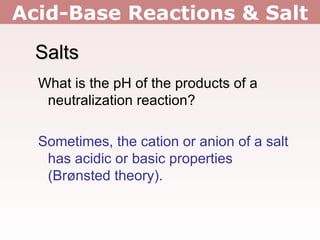
Acid-Base Reactions & Salt Salts What is the pH of the products of a neutralization reaction? Sometimes, the cation or anion of a salt has acidic or basic properties (Brønsted theory).
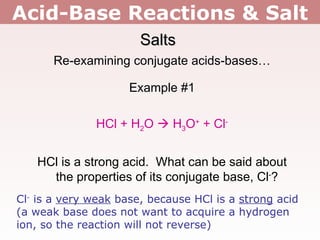
Acid-Base Reactions & Salt Salts Re-examining conjugate acids-bases… Example #1 HCl + H 2 O    H 3 O +  + Cl - HCl is a strong acid.  What can be said about the properties of its conjugate base, Cl - ? Cl -  is a  very weak  base, because HCl is a  strong  acid (a weak base does not want to acquire a hydrogen ion, so the reaction will not reverse)
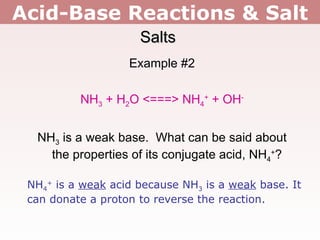
Acid-Base Reactions & Salt Salts Example #2 NH 3  + H 2 O <===> NH 4 +  + OH - NH 3  is a weak base.  What can be said about the properties of its conjugate acid, NH 4 + ? NH 4 +  is a  weak  acid because NH 3  is a  weak  base. It can donate a proton to reverse the reaction.
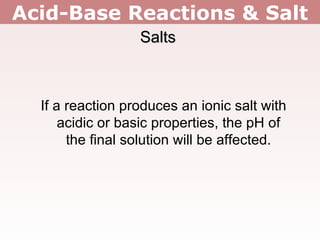
Acid-Base Reactions & Salt Salts If a reaction produces an ionic salt with acidic or basic properties, the pH of the final solution will be affected.
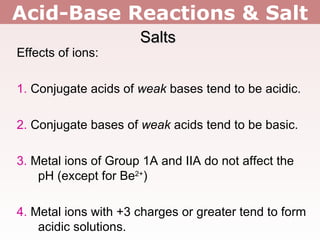
Acid-Base Reactions & Salt Salts Effects of ions: 1.  Conjugate acids of  weak  bases tend to be acidic. 2.  Conjugate bases of  weak  acids tend to be basic. 3.  Metal ions of Group 1A and IIA do not affect the pH (except for Be 2+ ) 4.  Metal ions with +3 charges or greater tend to form acidic solutions.
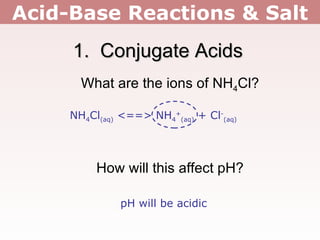
Acid-Base Reactions & Salt 1.  Conjugate Acids What are the ions of NH 4 Cl? How will this affect pH? NH 4 Cl (aq)  <==> NH 4 + (aq)  + Cl - (aq) pH will be acidic
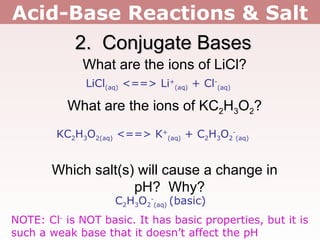
Acid-Base Reactions & Salt 2.  Conjugate Bases What are the ions of LiCl? What are the ions of KC 2 H 3 O 2 ? Which salt(s) will cause a change in pH?  Why? LiCl (aq)  <==> Li + (aq)  + Cl - (aq) KC 2 H 3 O 2(aq)  <==> K + (aq)  + C 2 H 3 O 2 - (aq) C 2 H 3 O 2 - (aq)  (basic) NOTE: Cl -  is NOT basic. It has basic properties, but it is such a weak base that it doesn’t affect the pH
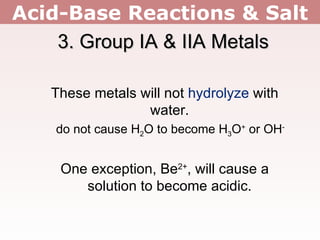
Acid-Base Reactions & Salt 3. Group IA & IIA Metals These metals will not  hydrolyze  with water. do not cause H 2 O to become H 3 O +  or OH - One exception, Be 2+ , will cause a solution to become acidic.
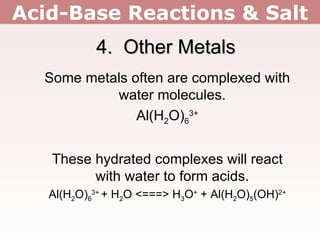
Acid-Base Reactions & Salt 4.  Other Metals Some metals often are complexed with water molecules. Al(H 2 O) 6 3+ These hydrated complexes will react with water to form acids. Al(H 2 O) 6 3+  + H 2 O <===> H 3 O +  + Al(H 2 O) 5 (OH) 2+
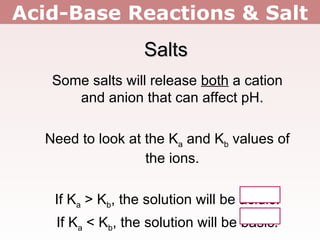
Acid-Base Reactions & Salt Salts Some salts will release  both  a cation and anion that can affect pH. Need to look at the K a  and K b  values of the ions. If K a  > K b , the solution will be acidic. If K a  < K b , the solution will be basic.
Acid-Base Reactions & Salt Example #1 Salt:  NH 4 CN NH 4 +  K a  = 5.8 x 10 -18 CN -  K b  = 1.6 x 10 -5 K a <K b , .: the salt forms a basic solution

Tang 06 salt acid-base 2

  • 1.
  • 2.
    Acid-Base Reactions &Salt Salts What is the pH of the products of a neutralization reaction? Sometimes, the cation or anion of a salt has acidic or basic properties (Brønsted theory).
  • 3.
    Acid-Base Reactions &Salt Salts Re-examining conjugate acids-bases… Example #1 HCl + H 2 O  H 3 O + + Cl - HCl is a strong acid. What can be said about the properties of its conjugate base, Cl - ? Cl - is a very weak base, because HCl is a strong acid (a weak base does not want to acquire a hydrogen ion, so the reaction will not reverse)
  • 4.
    Acid-Base Reactions &Salt Salts Example #2 NH 3 + H 2 O <===> NH 4 + + OH - NH 3 is a weak base. What can be said about the properties of its conjugate acid, NH 4 + ? NH 4 + is a weak acid because NH 3 is a weak base. It can donate a proton to reverse the reaction.
  • 5.
    Acid-Base Reactions &Salt Salts If a reaction produces an ionic salt with acidic or basic properties, the pH of the final solution will be affected.
  • 6.
    Acid-Base Reactions &Salt Salts Effects of ions: 1. Conjugate acids of weak bases tend to be acidic. 2. Conjugate bases of weak acids tend to be basic. 3. Metal ions of Group 1A and IIA do not affect the pH (except for Be 2+ ) 4. Metal ions with +3 charges or greater tend to form acidic solutions.
  • 7.
    Acid-Base Reactions &Salt 1. Conjugate Acids What are the ions of NH 4 Cl? How will this affect pH? NH 4 Cl (aq) <==> NH 4 + (aq) + Cl - (aq) pH will be acidic
  • 8.
    Acid-Base Reactions &Salt 2. Conjugate Bases What are the ions of LiCl? What are the ions of KC 2 H 3 O 2 ? Which salt(s) will cause a change in pH? Why? LiCl (aq) <==> Li + (aq) + Cl - (aq) KC 2 H 3 O 2(aq) <==> K + (aq) + C 2 H 3 O 2 - (aq) C 2 H 3 O 2 - (aq) (basic) NOTE: Cl - is NOT basic. It has basic properties, but it is such a weak base that it doesn’t affect the pH
  • 9.
    Acid-Base Reactions &Salt 3. Group IA & IIA Metals These metals will not hydrolyze with water. do not cause H 2 O to become H 3 O + or OH - One exception, Be 2+ , will cause a solution to become acidic.
  • 10.
    Acid-Base Reactions &Salt 4. Other Metals Some metals often are complexed with water molecules. Al(H 2 O) 6 3+ These hydrated complexes will react with water to form acids. Al(H 2 O) 6 3+ + H 2 O <===> H 3 O + + Al(H 2 O) 5 (OH) 2+
  • 11.
    Acid-Base Reactions &Salt Salts Some salts will release both a cation and anion that can affect pH. Need to look at the K a and K b values of the ions. If K a > K b , the solution will be acidic. If K a < K b , the solution will be basic.
  • 12.
    Acid-Base Reactions &Salt Example #1 Salt: NH 4 CN NH 4 + K a = 5.8 x 10 -18 CN - K b = 1.6 x 10 -5 K a <K b , .: the salt forms a basic solution