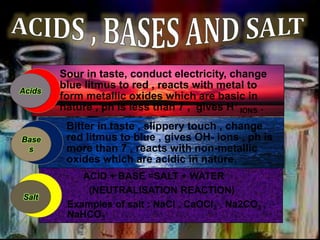
Sour in taste, conduct electricity, change
blue litmus to red , reacts with metal to
form metallic oxides which are basic in
nature , ph is less than 7 , gives H+
IONS .
Bitter in taste , slippery touch , change
red litmus to blue , gives OH- ions , ph is
more than 7 , reacts with non-metallic
oxides which are acidic in nature.
ACID + BASE =SALT + WATER
(NEUTRALISATION REACTION)
Examples of salt : NaCl , CaOCl2 , Na2CO3 ,
NaHCO3
Acids
Salt
Base
s
ACIDS /BASE + METAL = SALT+ HYDROGEN GAS
ACIDS + METAL CARBONATE = SALT +CO2+WATER
ACIDS + BASE = SALT +WATER
ACIDS + METAL LIC OXIDES = SALT +WATER
BASES + NON-METALLIC OXIDES = SALT +WATER
HOW STRONG ARE ACID OR BASE
SOLUTIONS?A pH scale is a measure of how acidic or basic a
substance is. While the pH scale formally measures
the activity of hydrogen ions in a substance or
solution, it is typically approximated as the
concentration of hydrogen ions.
The process of dissolving an acid or a base in water is a
highly
exothermic one. Care must be taken while mixing
concentrated nitric
acid or sulphuric acid with water. The acid must always be
added slowly to water with constant stirring. If water is added
to a concentrated acid, the heat generated may cause the
mixture to splash out and cause burns. The glass container
may also break due to excessive local heating. Look out for
the warning sign on the can of concentrated sulphuric acid
and on the bottle of sodium hydroxide pellets. Mixing an acid
or base with water results in decrease in the concentration of
ions (H3O+/OH– ) per unit volume. Such a process is called
dilution and the acid or the base is said to be diluted.
DISSOLVING ACID OR BASE IN WATER
MORE ABOUT SALTS
1.Bleaching powder : CaOCl2
2. Baking soda : NaHCO3
3. Washing soda: Na2CO3.10H2O
4. Plaster of Paris : CaSO4.1/2H2O
5. Gypsum: CaSO4.2H20

ACIDS , BASES AND SALT

  • 1.
    Sour in taste,conduct electricity, change blue litmus to red , reacts with metal to form metallic oxides which are basic in nature , ph is less than 7 , gives H+ IONS . Bitter in taste , slippery touch , change red litmus to blue , gives OH- ions , ph is more than 7 , reacts with non-metallic oxides which are acidic in nature. ACID + BASE =SALT + WATER (NEUTRALISATION REACTION) Examples of salt : NaCl , CaOCl2 , Na2CO3 , NaHCO3 Acids Salt Base s
  • 2.
    ACIDS /BASE +METAL = SALT+ HYDROGEN GAS ACIDS + METAL CARBONATE = SALT +CO2+WATER ACIDS + BASE = SALT +WATER ACIDS + METAL LIC OXIDES = SALT +WATER BASES + NON-METALLIC OXIDES = SALT +WATER
  • 3.
    HOW STRONG AREACID OR BASE SOLUTIONS?A pH scale is a measure of how acidic or basic a substance is. While the pH scale formally measures the activity of hydrogen ions in a substance or solution, it is typically approximated as the concentration of hydrogen ions.
  • 4.
    The process ofdissolving an acid or a base in water is a highly exothermic one. Care must be taken while mixing concentrated nitric acid or sulphuric acid with water. The acid must always be added slowly to water with constant stirring. If water is added to a concentrated acid, the heat generated may cause the mixture to splash out and cause burns. The glass container may also break due to excessive local heating. Look out for the warning sign on the can of concentrated sulphuric acid and on the bottle of sodium hydroxide pellets. Mixing an acid or base with water results in decrease in the concentration of ions (H3O+/OH– ) per unit volume. Such a process is called dilution and the acid or the base is said to be diluted. DISSOLVING ACID OR BASE IN WATER
  • 5.
    MORE ABOUT SALTS 1.Bleachingpowder : CaOCl2 2. Baking soda : NaHCO3 3. Washing soda: Na2CO3.10H2O 4. Plaster of Paris : CaSO4.1/2H2O 5. Gypsum: CaSO4.2H20