LEARNING OUTCOMES
Define acid and acid anhydride
Investigate the reactions of non-oxidising acids with
metals, carbonates, hydrogen carbonates and bases
Define base and alkali
Investigate the reaction of bases with ammonium
salts
Relate acidity and alkalinity to the pH scale
Discuss the strength of acids and alkalis on the
basis of their completeness of ionisation
Define acidic, basic, amphoteric and neutral oxides
Chapter 10
Acids, Bases and Salts
LEARNING OUTCOMES
Define salt
Identify an appropriate method of salt preparation
based on the solubility of the salt
Distinguish between acidic and normal salts
Investigate neutralisation reactions using indicators
and temperature changes
Chapter 10
Acids, Bases and Salts
Chapter 10
Acids, Bases and Salts
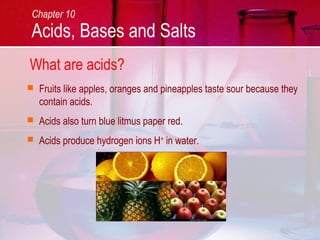
What are acids?
 Fruits like apples, oranges and pineapples taste sour because they
contain acids.
 Acids also turn blue litmus paper red.
 Acids produce hydrogen ions H+
in water.
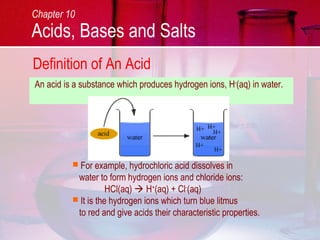
An acid is a substance which produces hydrogen ions, H+
(aq) in water.
Definition of An Acid
 For example, hydrochloric acid dissolves in
water to form hydrogen ions and chloride ions:
HCl(aq)  H+
(aq) + Cl-
(aq)
 It is the hydrogen ions which turn blue litmus
to red and give acids their characteristic properties.
Chapter 10
Acids, Bases and Salts
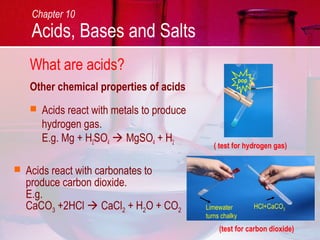
 Acids react with metals to produce
hydrogen gas.
E.g. Mg + H2SO4  MgSO4 + H2
Other chemical properties of acids
 Acids react with carbonates to
produce carbon dioxide.
E.g.
CaCO3 +2HCl  CaCl2 + H2O + CO2
Chapter 10
Acids, Bases and Salts
What are acids?
( test for hydrogen gas)
(test for carbon dioxide)
Limewater
turns chalky
HCl+CaCO3
pop
Other chemical properties of acids
 Acids react with bases to form a salt and water only.
 E.g. sulphuric acid reacts with copper(II) oxide to form a salt
called copper(II) sulphate and water:
H2SO4 + CuO  CuSO4 + H2O
 This reaction is called neutralisation.
What are acids?
Chapter 10
Acids, Bases and Salts
A Strong Acid
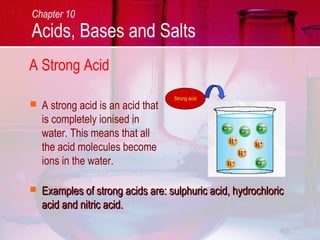
 A strong acid is an acid that
is completely ionised in
water. This means that all
the acid molecules become
ions in the water.
 Examples of strong acids are: sulphuric acid, hydrochloricExamples of strong acids are: sulphuric acid, hydrochloric
acid and nitric acid.acid and nitric acid.
Strong acid
Chapter 10
Acids, Bases and Salts
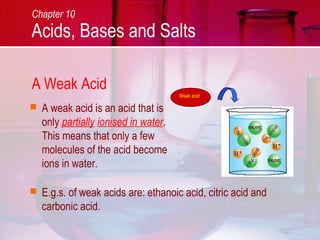
A Weak Acid
 E.g.s. of weak acids are: ethanoic acid, citric acid and
carbonic acid.
Weak acid
 A weak acid is an acid that is
only partially ionised in water.
This means that only a few
molecules of the acid become
ions in water.
Chapter 10
Acids, Bases and Salts
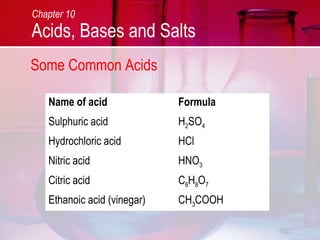
Some Common Acids
Name of acid Formula
Sulphuric acid H2SO4
Hydrochloric acid HCl
Nitric acid HNO3
Citric acid C6H8O7
Ethanoic acid (vinegar) CH3COOH
Chapter 10
Acids, Bases and Salts
 Ethanoic acid is used in vinegar for cooking and
to preserve food such as vegetables.
Uses of Acids
 Hydrochloric acid is used in the industry to remove
rust from metals before they are painted.
 Sulphuric acid is used to make fertilisers and
detergents.
 Citric acid is used in making fruit salts.
Chapter 10
Acids, Bases and Salts
Quick check 1
1. What ions do acids produce in water?
2. State three properties of acids.
3. Explain what is meant by a strong acid. Give one
example of a strong acid.
4. Explain what is meant by a weak acid. Give one example
of a weak acid.
5. Some dry citric acid crystals are placed on a dry piece of
litmus paper. Will there be a colour change? Explain your
answer.
Solution
Chapter 10
Acids, Bases and Salts
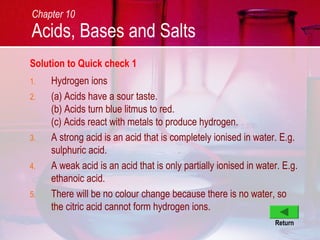
Solution to Quick check 1
1. Hydrogen ions
2. (a) Acids have a sour taste.
(b) Acids turn blue litmus to red.
(c) Acids react with metals to produce hydrogen.
3. A strong acid is an acid that is completely ionised in water. E.g.
sulphuric acid.
4. A weak acid is an acid that is only partially ionised in water. E.g.
ethanoic acid.
5. There will be no colour change because there is no water, so
the citric acid cannot form hydrogen ions.
Return
Chapter 10
Acids, Bases and Salts
13
Bases
 A base is an oxide or hydroxide of a metal.
 Examples of bases are:
sodium oxide, sodium hydroxide, copper(II)
oxide, copper(II) hydroxide, etc.
 A base reacts with an acid to form a salt and
water only.
E.g. CuO + H2SO4  CuSO4 + H2O
 This process is called neutralisation.
Chapter 10
Acids, Bases and Salts
14
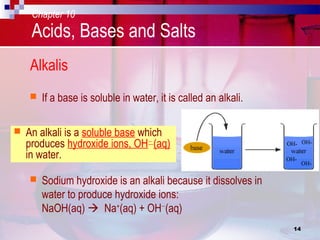
 If a base is soluble in water, it is called an alkali.
Alkalis
 Sodium hydroxide is an alkali because it dissolves in
water to produce hydroxide ions:
NaOH(aq)  Na+
(aq) + OH−
(aq)
 An alkali is a soluble base which
produces hydroxide ions, OH−
(aq)
in water.
Chapter 10
Acids, Bases and Salts
15
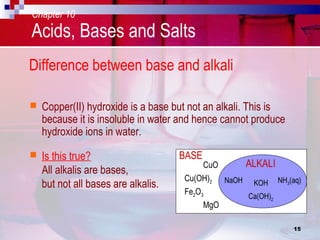
 Copper(II) hydroxide is a base but not an alkali. This is
because it is insoluble in water and hence cannot produce
hydroxide ions in water.
Difference between base and alkali
BASE
ALKALICuO
MgO
Ca(OH)2
NaOH KOH NH3(aq)
Fe2O3
Cu(OH)2
 Is this true?
All alkalis are bases,
but not all bases are alkalis.
Chapter 10
Acids, Bases and Salts
16
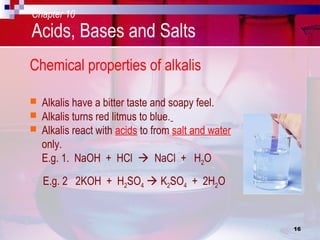
 Alkalis have a bitter taste and soapy feel.
 Alkalis turns red litmus to blue.
Chemical properties of alkalis
 Alkalis react with acids to from salt and water
only.
E.g. 1. NaOH + HCl  NaCl + H2O
E.g. 2 2KOH + H2SO4  K2SO4 + 2H2O
Chapter 10
Acids, Bases and Salts
17
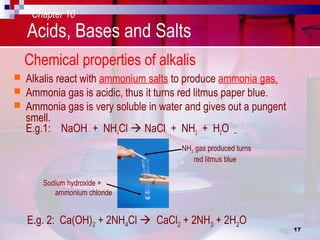
 Alkalis react with ammonium salts to produce ammonia gas.
 Ammonia gas is acidic, thus it turns red litmus paper blue.
 Ammonia gas is very soluble in water and gives out a pungent
smell.
E.g.1: NaOH + NH4Cl  NaCl + NH3 + H2O
Chemical properties of alkalis
Sodium hydroxide +
ammonium chloride
E.g. 2: Ca(OH)2 + 2NH4Cl  CaCl2 + 2NH3 + 2H2O
NH3 gas produced turns
red litmus blue
Chapter 10
Acids, Bases and Salts
18
 Sodium hydroxide and potassium hydroxide are used in
making soaps.
Uses of Bases
 Ammonia solution is used in window cleaners.
 Magnesium hydroxide is used in toothpastes to neutralise
the acid produced by bacteria.
 Calcium hydroxide (slaked lime) is used to neutralise
acids found in acidic soil.
Chapter 10
Acids, Bases and Salts
19
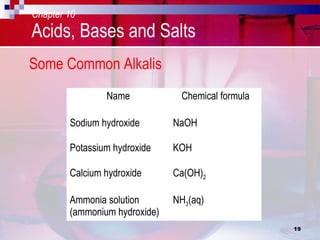
Some Common Alkalis
Name Chemical formula
Sodium hydroxide NaOH
Potassium hydroxide KOH
Calcium hydroxide Ca(OH)2
Ammonia solution
(ammonium hydroxide)
NH3(aq)
Chapter 10
Acids, Bases and Salts
20
Quick check 2
1. What is a base? Give 3 examples of bases.
2. Define what is an alkali. Give 3 examples of alkalis.
3. State 3 properties of alkalis.
4. Explain why iron(II) hydroxide is a base, but not an alkali.
5. Write balanced chemical equations for the following
reactions:
(a) potassium hydroxide + ammonium chloride
(b) calcium hydroxide + ammonium chloride
Solution
Chapter 10
Acids, Bases and Salts
21
Solution to Quick check 2
1. A base is an oxide or hydroxide of a metal.
E.g. sodium oxide, copper(II) oxide, calcium hydroxide.
2. An alkali is a soluble base which produces hydroxide ions in water.
E.g. sodium hydroxide, potassium hydroxide, calcium hydroxide.
3. (i) Alkalis turn red litmus blue.
(ii) Alkalis react with acids to produce a salt and water.
(iii) Alkalis react with ammonium salts to produce ammonia.
4. Iron(II) hydroxide is a base, but not an alkali because it is insoluble
in water, so it cannot produce hydroxide ions in water.
5. (a) KOH + NH4Cl  KCl + H2O + NH3
(b) Ca(OH)2 + 2NH4Cl  CaCl2 + 2H2O + 2NH3
Return
Chapter 10
Acids, Bases and Salts
22
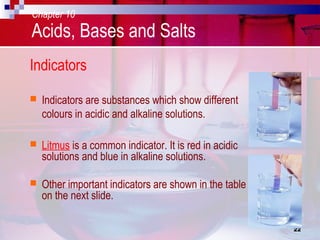
Indicators
 Indicators are substances which show different
colours in acidic and alkaline solutions.
 Litmus is a common indicator. It is red in acidic
solutions and blue in alkaline solutions.
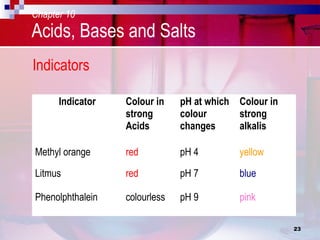
 Other important indicators are shown in the table
on the next slide.
Chapter 10
Acids, Bases and Salts
23
Indicators
Indicator Colour in
strong
Acids
pH at which
colour
changes
Colour in
strong
alkalis
Methyl orange red pH 4 yellow
Litmus red pH 7 blue
Phenolphthalein colourless pH 9 pink
Chapter 10
Acids, Bases and Salts
24
 The pH of a solution tells us how acidic or alkaline a
solution is.
 The pH is a measurement of the hydrogen ion concentration
in a solution.
 The pH scale ranges from 0 to 14.
 The pH of a solution can be measured with a pH meter.
The pH Scale
Chapter 10
Acids, Bases and Salts
25
 The lower the pH, the more acidic the solution is.
 The higher the pH, the more alkaline the solution is.
 pH 7 is neutral.
 Distilled water, sugar solution and most salt solutions are
neutral (pH 7).
The pH Scale
Chapter 10
Acids, Bases and Salts
26
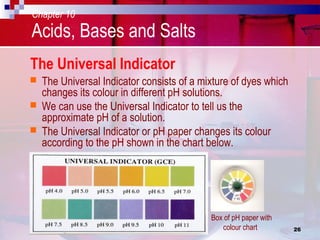
 The Universal Indicator consists of a mixture of dyes which
changes its colour in different pH solutions.
 We can use the Universal Indicator to tell us the
approximate pH of a solution.
 The Universal Indicator or pH paper changes its colour
according to the pH shown in the chart below.
The Universal Indicator
Box of pH paper with
colour chart
Chapter 10
Acids, Bases and Salts
27
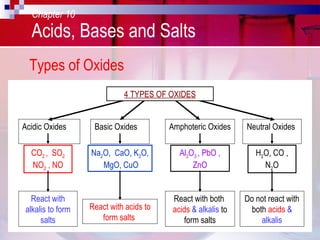
Types of Oxides
 Elements burn or react with oxygen to form oxides.
 There are 4 types of oxides: acidic oxides, basic oxides, amphoteric
oxides and neutral oxides.
 An acidic oxide is an oxide of a non-metal. It dissolves in water to form an
acid. Acidic oxides react with alkalis to form salts .
 A basic oxide is an oxide of a metal. If soluble, it will dissolve in water to
form an alkali. Basic oxides react with acids to form salts.
 An amphoteric oxide is an oxide which can react with both acids and
alkalis to form salts.
 A neutral oxide does not react with either acids or alkalis.
Chapter 10
Acids, Bases and Salts
28
Types of Oxides
Chapter 10
Acids, Bases and Salts
Acidic Oxides Basic Oxides Amphoteric Oxides
CO2 , SO2
NO2 , NO
Na2O, CaO, K2O,
MgO, CuO
Al2O3 , PbO ,
ZnO
React with
alkalis to form
salts
React with acids to
form salts
React with both
acids & alkalis to
form salts
Neutral Oxides
H2O, CO ,
N2O
Do not react with
both acids &
alkalis
4 TYPES OF OXIDES
29
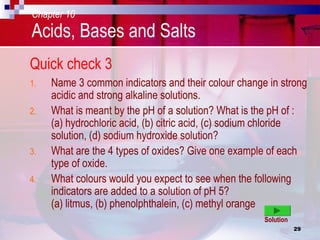
Quick check 3
1. Name 3 common indicators and their colour change in strong
acidic and strong alkaline solutions.
2. What is meant by the pH of a solution? What is the pH of :
(a) hydrochloric acid, (b) citric acid, (c) sodium chloride
solution, (d) sodium hydroxide solution?
3. What are the 4 types of oxides? Give one example of each
type of oxide.
4. What colours would you expect to see when the following
indicators are added to a solution of pH 5?
(a) litmus, (b) phenolphthalein, (c) methyl orange
Solution
Chapter 10
Acids, Bases and Salts
30
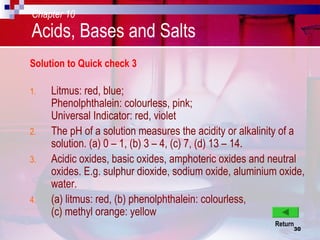
Solution to Quick check 3
1. Litmus: red, blue;
Phenolphthalein: colourless, pink;
Universal Indicator: red, violet
2. The pH of a solution measures the acidity or alkalinity of a
solution. (a) 0 – 1, (b) 3 – 4, (c) 7, (d) 13 – 14.
3. Acidic oxides, basic oxides, amphoteric oxides and neutral
oxides. E.g. sulphur dioxide, sodium oxide, aluminium oxide,
water.
4. (a) litmus: red, (b) phenolphthalein: colourless,
(c) methyl orange: yellow
Return
Chapter 10
Acids, Bases and Salts
31
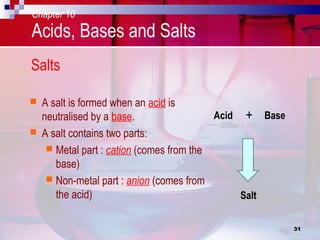
 A salt is formed when an acid is
neutralised by a base.
 A salt contains two parts:
 Metal part : cation (comes from the
base)
 Non-metal part : anion (comes from
the acid)
Salts
+Acid Base
Salt
Chapter 10
Acids, Bases and Salts
32
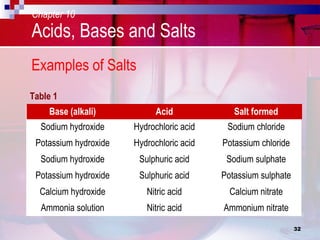
Examples of Salts
Base (alkali) Acid Salt formed
Sodium hydroxide Hydrochloric acid Sodium chloride
Potassium hydroxide Hydrochloric acid Potassium chloride
Sodium hydroxide Sulphuric acid Sodium sulphate
Potassium hydroxide Sulphuric acid Potassium sulphate
Calcium hydroxide Nitric acid Calcium nitrate
Ammonia solution Nitric acid Ammonium nitrate
Table 1
Chapter 10
Acids, Bases and Salts
33
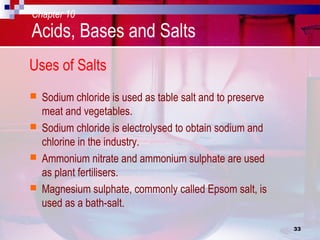
 Sodium chloride is used as table salt and to preserve
meat and vegetables.
 Sodium chloride is electrolysed to obtain sodium and
chlorine in the industry.
 Ammonium nitrate and ammonium sulphate are used
as plant fertilisers.
Uses of Salts
 Magnesium sulphate, commonly called Epsom salt, is
used as a bath-salt.
Chapter 10
Acids, Bases and Salts
34
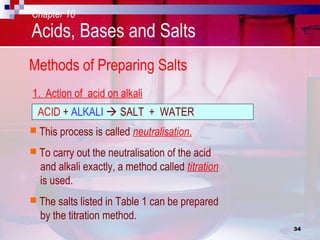
Methods of Preparing Salts
ACID + ALKALI  SALT + WATER
1. Action of acid on alkali
 This process is called neutralisation.
 To carry out the neutralisation of the acid
and alkali exactly, a method called titration
is used.
 The salts listed in Table 1 can be prepared
by the titration method.
Chapter 10
Acids, Bases and Salts
35
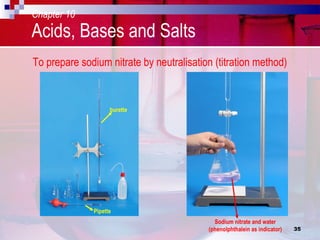
To prepare sodium nitrate by neutralisation (titration method)
Chapter 10
Acids, Bases and Salts
Sodium nitrate and water
(phenolphthalein as indicator)
burette
Pipette
36
Chapter 10
Acids, Bases and Salts
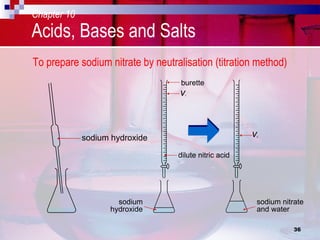
To prepare sodium nitrate by neutralisation (titration method)
37
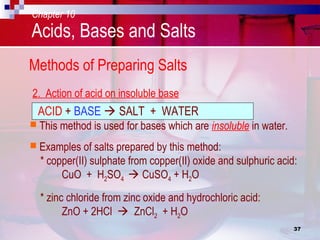
ACID + BASE  SALT + WATER
2. Action of acid on insoluble base
 This method is used for bases which are insoluble in water.
 Examples of salts prepared by this method:
* copper(II) sulphate from copper(II) oxide and sulphuric acid:
CuO + H2SO4  CuSO4 + H2O
* zinc chloride from zinc oxide and hydrochloric acid:
ZnO + 2HCl  ZnCl2 + H2O
Chapter 10
Acids, Bases and Salts
Methods of Preparing Salts
38
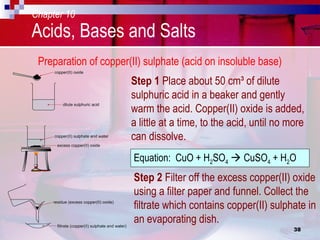
Preparation of copper(II) sulphate (acid on insoluble base)
Chapter 10
Acids, Bases and Salts
Step 1 Place about 50 cm³ of dilute
sulphuric acid in a beaker and gently
warm the acid. Copper(II) oxide is added,
a little at a time, to the acid, until no more
can dissolve.
Equation: CuO + H2SO4  CuSO4 + H2O
Step 2 Filter off the excess copper(II) oxide
using a filter paper and funnel. Collect the
filtrate which contains copper(II) sulphate in
an evaporating dish.
39
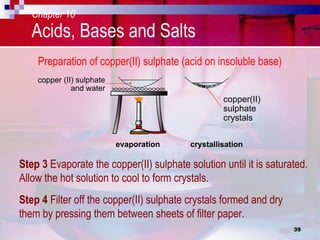
Preparation of copper(II) sulphate (acid on insoluble base)
Chapter 10
Acids, Bases and Salts
Step 3 Evaporate the copper(II) sulphate solution until it is saturated.
Allow the hot solution to cool to form crystals.
Step 4 Filter off the copper(II) sulphate crystals formed and dry
them by pressing them between sheets of filter paper.
40
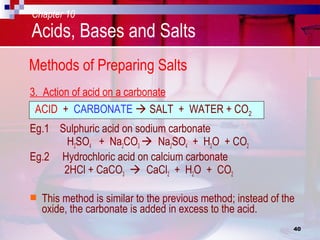
Eg.1 Sulphuric acid on sodium carbonate
H2SO4 + Na2CO3  Na2SO4 + H2O + CO2
Eg.2 Hydrochloric acid on calcium carbonate
2HCl + CaCO3  CaCl2 + H2O + CO2
 This method is similar to the previous method; instead of the
oxide, the carbonate is added in excess to the acid.
3. Action of acid on a carbonate
ACID + CARBONATE  SALT + WATER + CO2
Chapter 10
Acids, Bases and Salts
Methods of Preparing Salts
41
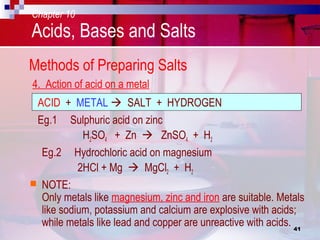
Eg.1 Sulphuric acid on zinc
H2SO4 + Zn  ZnSO4 + H2
Eg.2 Hydrochloric acid on magnesium
2HCl + Mg  MgCl2 + H2
 NOTE:
Only metals like magnesium, zinc and iron are suitable. Metals
like sodium, potassium and calcium are explosive with acids;
while metals like lead and copper are unreactive with acids.
4. Action of acid on a metal
ACID + METAL  SALT + HYDROGEN
Chapter 10
Acids, Bases and Salts
Methods of Preparing Salts
42
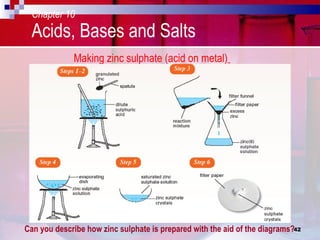
Making zinc sulphate (acid on metal)
Chapter 10
Acids, Bases and Salts
Can you describe how zinc sulphate is prepared with the aid of the diagrams?
43
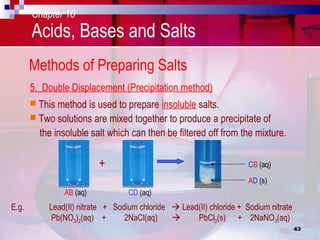
5. Double Displacement (Precipitation method)
 This method is used to prepare insoluble salts.
 Two solutions are mixed together to produce a precipitate of
the insoluble salt which can then be filtered off from the mixture.
+
AD (s)
AB (aq) CD (aq)
CB (aq)
E.g. Lead(II) nitrate + Sodium chloride  Lead(II) chloride + Sodium nitrate
Pb(NO3)2(aq) + 2NaCl(aq)  PbCl2(s) + 2NaNO3(aq)
Chapter 10
Acids, Bases and Salts
Methods of Preparing Salts
44
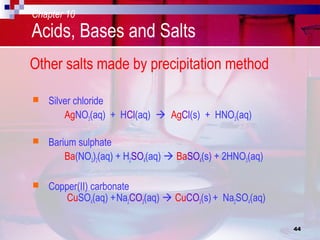
 Silver chloride
AgNO3(aq) + HCl(aq)  AgCl(s) + HNO3(aq)
 Barium sulphate
Ba(NO3)2(aq) + H2SO4(aq)  BaSO4(s) + 2HNO3(aq)
 Copper(II) carbonate
CuSO4(aq) +Na2CO3(aq)  CuCO3(s) + Na2SO4(aq)
Other salts made by precipitation method
Chapter 10
Acids, Bases and Salts
45
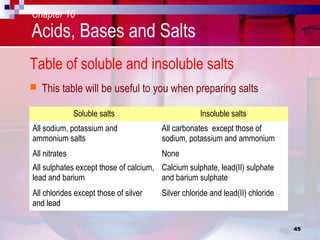
Table of soluble and insoluble salts
Soluble salts Insoluble salts
All sodium, potassium and
ammonium salts
All carbonates except those of
sodium, potassium and ammonium
All nitrates None
All sulphates except those of calcium,
lead and barium
Calcium sulphate, lead(II) sulphate
and barium sulphate
All chlorides except those of silver
and lead
Silver chloride and lead(II) chloride
 This table will be useful to you when preparing salts
Chapter 10
Acids, Bases and Salts
46
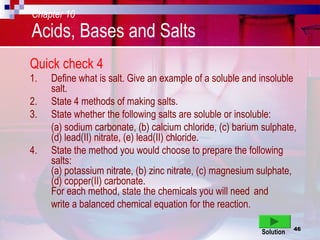
Quick check 4
1. Define what is salt. Give an example of a soluble and insoluble
salt.
2. State 4 methods of making salts.
3. State whether the following salts are soluble or insoluble:
(a) sodium carbonate, (b) calcium chloride, (c) barium sulphate,
(d) lead(II) nitrate, (e) lead(II) chloride.
4. State the method you would choose to prepare the following
salts:
(a) potassium nitrate, (b) zinc nitrate, (c) magnesium sulphate,
(d) copper(II) carbonate.
For each method, state the chemicals you will need and
write a balanced chemical equation for the reaction.
Solution
Chapter 10
Acids, Bases and Salts
47
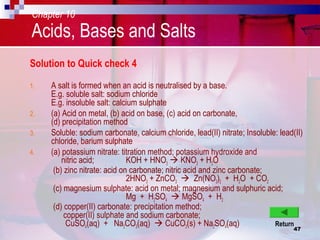
Solution to Quick check 4
1. A salt is formed when an acid is neutralised by a base.
E.g. soluble salt: sodium chloride
E.g. insoluble salt: calcium sulphate
2. (a) Acid on metal, (b) acid on base, (c) acid on carbonate,
(d) precipitation method
3. Soluble: sodium carbonate, calcium chloride, lead(II) nitrate; Insoluble: lead(II)
chloride, barium sulphate
4. (a) potassium nitrate: titration method; potassium hydroxide and
nitric acid; KOH + HNO3  KNO3 + H2O
(b) zinc nitrate: acid on carbonate; nitric acid and zinc carbonate;
2HNO3 + ZnCO3  Zn(NO3)2 + H2O + CO2
(c) magnesium sulphate: acid on metal; magnesium and sulphuric acid;
Mg + H2SO4  MgSO4 + H2
(d) copper(II) carbonate: precipitation method;
copper(II) sulphate and sodium carbonate;
CuSO4(aq) + Na2CO3(aq)  CuCO3(s) + Na2SO4(aq)
Chapter 10
Acids, Bases and Salts
Return
48
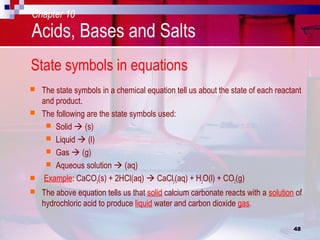
 The state symbols in a chemical equation tell us about the state of each reactant
and product.
 The following are the state symbols used:
 Solid  (s)
 Liquid  (l)
 Gas  (g)
 Aqueous solution  (aq)
 Example: CaCO3(s) + 2HCl(aq)  CaCl2(aq) + H2O(l) + CO2(g)
 The above equation tells us that solid calcium carbonate reacts with a solution of
hydrochloric acid to produce liquid water and carbon dioxide gas.
State symbols in equations
Chapter 10
Acids, Bases and Salts
49
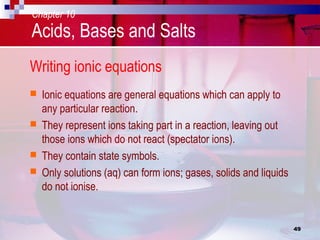
 Ionic equations are general equations which can apply to
any particular reaction.
 They represent ions taking part in a reaction, leaving out
those ions which do not react (spectator ions).
 They contain state symbols.
 Only solutions (aq) can form ions; gases, solids and liquids
do not ionise.
Writing ionic equations
Chapter 10
Acids, Bases and Salts
50
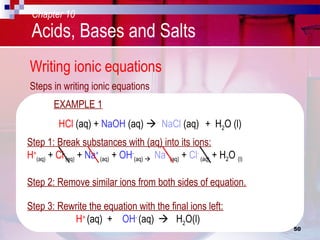
Steps in writing ionic equations
Step 3: Rewrite the equation with the final ions left:
H+
(aq) + OH-
(aq)  H2O(l)
EXAMPLE 1
HCl (aq) + NaOH (aq)  NaCl (aq) + H2O (l)
Step 1: Break substances with (aq) into its ions:
H+
(aq) + Cl-
(aq) + Na+
(aq) + OH-
(aq)  Na+
(aq) + Cl-
(aq) + H2O (l)
Step 2: Remove similar ions from both sides of equation.
Chapter 10
Acids, Bases and Salts
Writing ionic equations
51
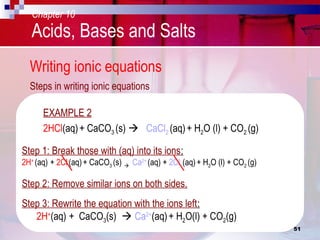
EXAMPLE 2
2HCl(aq)+ CaCO3 (s)  CaCl2 (aq)+ H2O (l) + CO2 (g)
Step 1: Break those with (aq) into its ions:
2H+
(aq) + 2Cl-
(aq)+ CaCO3 (s)  Ca2+
(aq) + 2Cl-
(aq)+ H2O (l) + CO2 (g)
Step 2: Remove similar ions on both sides.
Step 3: Rewrite the equation with the ions left:
2H+
(aq) + CaCO3(s)  Ca2+
(aq)+ H2O(l) + CO2(g)
Steps in writing ionic equations
Chapter 10
Acids, Bases and Salts
Writing ionic equations
52
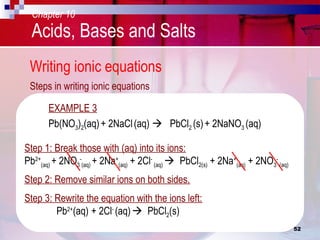
EXAMPLE 3
Pb(NO3)2(aq)+ 2NaCl(aq)  PbCl2 (s)+ 2NaNO3 (aq)
Step 1: Break those with (aq) into its ions:
Pb2+
(aq) + 2NO3
-
(aq) + 2Na+
(aq) + 2Cl-
(aq)  PbCl2(s) + 2Na+
(aq) + 2NO3
-
(aq)
Step 2: Remove similar ions on both sides.
Step 3: Rewrite the equation with the ions left:
Pb2+
(aq) + 2Cl-
(aq) PbCl2(s)
Steps in writing ionic equations
Chapter 10
Acids, Bases and Salts
Writing ionic equations
53
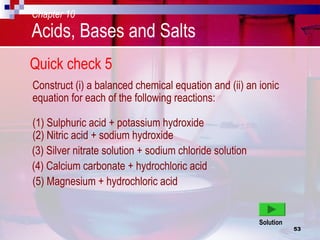
Quick check 5
Construct (i) a balanced chemical equation and (ii) an ionic
equation for each of the following reactions:
(1) Sulphuric acid + potassium hydroxide
(2) Nitric acid + sodium hydroxide
(3) Silver nitrate solution + sodium chloride solution
(4) Calcium carbonate + hydrochloric acid
(5) Magnesium + hydrochloric acid
Solution
Chapter 10
Acids, Bases and Salts
54
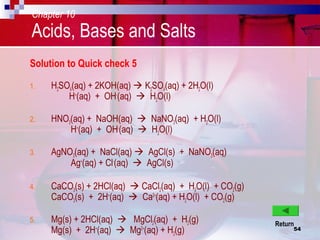
Solution to Quick check 5
1. H2SO4(aq) + 2KOH(aq)  K2SO4(aq) + 2H2O(l)
H+
(aq) + OH-
(aq)  H2O(l)
2. HNO3(aq) + NaOH(aq)  NaNO3(aq) + H2O(l)
H+
(aq) + OH-
(aq)  H2O(l)
3. AgNO3(aq) + NaCl(aq)  AgCl(s) + NaNO3(aq)
Ag+
(aq) + Cl-
(aq)  AgCl(s)
4. CaCO3(s) + 2HCl(aq)  CaCl2(aq) + H2O(l) + CO2(g)
CaCO3(s) + 2H+
(aq)  Ca2+
(aq) + H2O(l) + CO2(g)
5. Mg(s) + 2HCl(aq)  MgCl2(aq) + H2(g)
Mg(s) + 2H+
(aq)  Mg2+
(aq) + H2(g)
Chapter 10
Acids, Bases and Salts
Return
55
1. http://www.sciencebyjones.com/acids_bases_salts.htm
2. http://ull.chemistry.uakron.edu/genobc/Chapter_09/
3. http://www.chem.ubc.ca/courseware/pH/index.html
To learn more about Acids, Bases and Salts,
click on the links below!
Chapter 10
Acids, Bases and Salts
References
 Chemistry for CSEC Examinations by
Mike Taylor and Tania Chung
 Longman Chemistry for CSEC by Jim
Clark and Ray Oliver
56

C10 acids, bases and salts

  • 1.
    LEARNING OUTCOMES Define acidand acid anhydride Investigate the reactions of non-oxidising acids with metals, carbonates, hydrogen carbonates and bases Define base and alkali Investigate the reaction of bases with ammonium salts Relate acidity and alkalinity to the pH scale Discuss the strength of acids and alkalis on the basis of their completeness of ionisation Define acidic, basic, amphoteric and neutral oxides Chapter 10 Acids, Bases and Salts
  • 2.
    LEARNING OUTCOMES Define salt Identifyan appropriate method of salt preparation based on the solubility of the salt Distinguish between acidic and normal salts Investigate neutralisation reactions using indicators and temperature changes Chapter 10 Acids, Bases and Salts
  • 3.
    Chapter 10 Acids, Basesand Salts What are acids?  Fruits like apples, oranges and pineapples taste sour because they contain acids.  Acids also turn blue litmus paper red.  Acids produce hydrogen ions H+ in water.
  • 4.
    An acid isa substance which produces hydrogen ions, H+ (aq) in water. Definition of An Acid  For example, hydrochloric acid dissolves in water to form hydrogen ions and chloride ions: HCl(aq)  H+ (aq) + Cl- (aq)  It is the hydrogen ions which turn blue litmus to red and give acids their characteristic properties. Chapter 10 Acids, Bases and Salts
  • 5.
     Acids reactwith metals to produce hydrogen gas. E.g. Mg + H2SO4  MgSO4 + H2 Other chemical properties of acids  Acids react with carbonates to produce carbon dioxide. E.g. CaCO3 +2HCl  CaCl2 + H2O + CO2 Chapter 10 Acids, Bases and Salts What are acids? ( test for hydrogen gas) (test for carbon dioxide) Limewater turns chalky HCl+CaCO3 pop
  • 6.
    Other chemical propertiesof acids  Acids react with bases to form a salt and water only.  E.g. sulphuric acid reacts with copper(II) oxide to form a salt called copper(II) sulphate and water: H2SO4 + CuO  CuSO4 + H2O  This reaction is called neutralisation. What are acids? Chapter 10 Acids, Bases and Salts
  • 7.
    A Strong Acid A strong acid is an acid that is completely ionised in water. This means that all the acid molecules become ions in the water.  Examples of strong acids are: sulphuric acid, hydrochloricExamples of strong acids are: sulphuric acid, hydrochloric acid and nitric acid.acid and nitric acid. Strong acid Chapter 10 Acids, Bases and Salts
  • 8.
    A Weak Acid E.g.s. of weak acids are: ethanoic acid, citric acid and carbonic acid. Weak acid  A weak acid is an acid that is only partially ionised in water. This means that only a few molecules of the acid become ions in water. Chapter 10 Acids, Bases and Salts
  • 9.
    Some Common Acids Nameof acid Formula Sulphuric acid H2SO4 Hydrochloric acid HCl Nitric acid HNO3 Citric acid C6H8O7 Ethanoic acid (vinegar) CH3COOH Chapter 10 Acids, Bases and Salts
  • 10.
     Ethanoic acidis used in vinegar for cooking and to preserve food such as vegetables. Uses of Acids  Hydrochloric acid is used in the industry to remove rust from metals before they are painted.  Sulphuric acid is used to make fertilisers and detergents.  Citric acid is used in making fruit salts. Chapter 10 Acids, Bases and Salts
  • 11.
    Quick check 1 1.What ions do acids produce in water? 2. State three properties of acids. 3. Explain what is meant by a strong acid. Give one example of a strong acid. 4. Explain what is meant by a weak acid. Give one example of a weak acid. 5. Some dry citric acid crystals are placed on a dry piece of litmus paper. Will there be a colour change? Explain your answer. Solution Chapter 10 Acids, Bases and Salts
  • 12.
    Solution to Quickcheck 1 1. Hydrogen ions 2. (a) Acids have a sour taste. (b) Acids turn blue litmus to red. (c) Acids react with metals to produce hydrogen. 3. A strong acid is an acid that is completely ionised in water. E.g. sulphuric acid. 4. A weak acid is an acid that is only partially ionised in water. E.g. ethanoic acid. 5. There will be no colour change because there is no water, so the citric acid cannot form hydrogen ions. Return Chapter 10 Acids, Bases and Salts
  • 13.
    13 Bases  A baseis an oxide or hydroxide of a metal.  Examples of bases are: sodium oxide, sodium hydroxide, copper(II) oxide, copper(II) hydroxide, etc.  A base reacts with an acid to form a salt and water only. E.g. CuO + H2SO4  CuSO4 + H2O  This process is called neutralisation. Chapter 10 Acids, Bases and Salts
  • 14.
    14  If abase is soluble in water, it is called an alkali. Alkalis  Sodium hydroxide is an alkali because it dissolves in water to produce hydroxide ions: NaOH(aq)  Na+ (aq) + OH− (aq)  An alkali is a soluble base which produces hydroxide ions, OH− (aq) in water. Chapter 10 Acids, Bases and Salts
  • 15.
    15  Copper(II) hydroxideis a base but not an alkali. This is because it is insoluble in water and hence cannot produce hydroxide ions in water. Difference between base and alkali BASE ALKALICuO MgO Ca(OH)2 NaOH KOH NH3(aq) Fe2O3 Cu(OH)2  Is this true? All alkalis are bases, but not all bases are alkalis. Chapter 10 Acids, Bases and Salts
  • 16.
    16  Alkalis havea bitter taste and soapy feel.  Alkalis turns red litmus to blue. Chemical properties of alkalis  Alkalis react with acids to from salt and water only. E.g. 1. NaOH + HCl  NaCl + H2O E.g. 2 2KOH + H2SO4  K2SO4 + 2H2O Chapter 10 Acids, Bases and Salts
  • 17.
    17  Alkalis reactwith ammonium salts to produce ammonia gas.  Ammonia gas is acidic, thus it turns red litmus paper blue.  Ammonia gas is very soluble in water and gives out a pungent smell. E.g.1: NaOH + NH4Cl  NaCl + NH3 + H2O Chemical properties of alkalis Sodium hydroxide + ammonium chloride E.g. 2: Ca(OH)2 + 2NH4Cl  CaCl2 + 2NH3 + 2H2O NH3 gas produced turns red litmus blue Chapter 10 Acids, Bases and Salts
  • 18.
    18  Sodium hydroxideand potassium hydroxide are used in making soaps. Uses of Bases  Ammonia solution is used in window cleaners.  Magnesium hydroxide is used in toothpastes to neutralise the acid produced by bacteria.  Calcium hydroxide (slaked lime) is used to neutralise acids found in acidic soil. Chapter 10 Acids, Bases and Salts
  • 19.
    19 Some Common Alkalis NameChemical formula Sodium hydroxide NaOH Potassium hydroxide KOH Calcium hydroxide Ca(OH)2 Ammonia solution (ammonium hydroxide) NH3(aq) Chapter 10 Acids, Bases and Salts
  • 20.
    20 Quick check 2 1.What is a base? Give 3 examples of bases. 2. Define what is an alkali. Give 3 examples of alkalis. 3. State 3 properties of alkalis. 4. Explain why iron(II) hydroxide is a base, but not an alkali. 5. Write balanced chemical equations for the following reactions: (a) potassium hydroxide + ammonium chloride (b) calcium hydroxide + ammonium chloride Solution Chapter 10 Acids, Bases and Salts
  • 21.
    21 Solution to Quickcheck 2 1. A base is an oxide or hydroxide of a metal. E.g. sodium oxide, copper(II) oxide, calcium hydroxide. 2. An alkali is a soluble base which produces hydroxide ions in water. E.g. sodium hydroxide, potassium hydroxide, calcium hydroxide. 3. (i) Alkalis turn red litmus blue. (ii) Alkalis react with acids to produce a salt and water. (iii) Alkalis react with ammonium salts to produce ammonia. 4. Iron(II) hydroxide is a base, but not an alkali because it is insoluble in water, so it cannot produce hydroxide ions in water. 5. (a) KOH + NH4Cl  KCl + H2O + NH3 (b) Ca(OH)2 + 2NH4Cl  CaCl2 + 2H2O + 2NH3 Return Chapter 10 Acids, Bases and Salts
  • 22.
    22 Indicators  Indicators aresubstances which show different colours in acidic and alkaline solutions.  Litmus is a common indicator. It is red in acidic solutions and blue in alkaline solutions.  Other important indicators are shown in the table on the next slide. Chapter 10 Acids, Bases and Salts
  • 23.
    23 Indicators Indicator Colour in strong Acids pHat which colour changes Colour in strong alkalis Methyl orange red pH 4 yellow Litmus red pH 7 blue Phenolphthalein colourless pH 9 pink Chapter 10 Acids, Bases and Salts
  • 24.
    24  The pHof a solution tells us how acidic or alkaline a solution is.  The pH is a measurement of the hydrogen ion concentration in a solution.  The pH scale ranges from 0 to 14.  The pH of a solution can be measured with a pH meter. The pH Scale Chapter 10 Acids, Bases and Salts
  • 25.
    25  The lowerthe pH, the more acidic the solution is.  The higher the pH, the more alkaline the solution is.  pH 7 is neutral.  Distilled water, sugar solution and most salt solutions are neutral (pH 7). The pH Scale Chapter 10 Acids, Bases and Salts
  • 26.
    26  The UniversalIndicator consists of a mixture of dyes which changes its colour in different pH solutions.  We can use the Universal Indicator to tell us the approximate pH of a solution.  The Universal Indicator or pH paper changes its colour according to the pH shown in the chart below. The Universal Indicator Box of pH paper with colour chart Chapter 10 Acids, Bases and Salts
  • 27.
    27 Types of Oxides Elements burn or react with oxygen to form oxides.  There are 4 types of oxides: acidic oxides, basic oxides, amphoteric oxides and neutral oxides.  An acidic oxide is an oxide of a non-metal. It dissolves in water to form an acid. Acidic oxides react with alkalis to form salts .  A basic oxide is an oxide of a metal. If soluble, it will dissolve in water to form an alkali. Basic oxides react with acids to form salts.  An amphoteric oxide is an oxide which can react with both acids and alkalis to form salts.  A neutral oxide does not react with either acids or alkalis. Chapter 10 Acids, Bases and Salts
  • 28.
    28 Types of Oxides Chapter10 Acids, Bases and Salts Acidic Oxides Basic Oxides Amphoteric Oxides CO2 , SO2 NO2 , NO Na2O, CaO, K2O, MgO, CuO Al2O3 , PbO , ZnO React with alkalis to form salts React with acids to form salts React with both acids & alkalis to form salts Neutral Oxides H2O, CO , N2O Do not react with both acids & alkalis 4 TYPES OF OXIDES
  • 29.
    29 Quick check 3 1.Name 3 common indicators and their colour change in strong acidic and strong alkaline solutions. 2. What is meant by the pH of a solution? What is the pH of : (a) hydrochloric acid, (b) citric acid, (c) sodium chloride solution, (d) sodium hydroxide solution? 3. What are the 4 types of oxides? Give one example of each type of oxide. 4. What colours would you expect to see when the following indicators are added to a solution of pH 5? (a) litmus, (b) phenolphthalein, (c) methyl orange Solution Chapter 10 Acids, Bases and Salts
  • 30.
    30 Solution to Quickcheck 3 1. Litmus: red, blue; Phenolphthalein: colourless, pink; Universal Indicator: red, violet 2. The pH of a solution measures the acidity or alkalinity of a solution. (a) 0 – 1, (b) 3 – 4, (c) 7, (d) 13 – 14. 3. Acidic oxides, basic oxides, amphoteric oxides and neutral oxides. E.g. sulphur dioxide, sodium oxide, aluminium oxide, water. 4. (a) litmus: red, (b) phenolphthalein: colourless, (c) methyl orange: yellow Return Chapter 10 Acids, Bases and Salts
  • 31.
    31  A saltis formed when an acid is neutralised by a base.  A salt contains two parts:  Metal part : cation (comes from the base)  Non-metal part : anion (comes from the acid) Salts +Acid Base Salt Chapter 10 Acids, Bases and Salts
  • 32.
    32 Examples of Salts Base(alkali) Acid Salt formed Sodium hydroxide Hydrochloric acid Sodium chloride Potassium hydroxide Hydrochloric acid Potassium chloride Sodium hydroxide Sulphuric acid Sodium sulphate Potassium hydroxide Sulphuric acid Potassium sulphate Calcium hydroxide Nitric acid Calcium nitrate Ammonia solution Nitric acid Ammonium nitrate Table 1 Chapter 10 Acids, Bases and Salts
  • 33.
    33  Sodium chlorideis used as table salt and to preserve meat and vegetables.  Sodium chloride is electrolysed to obtain sodium and chlorine in the industry.  Ammonium nitrate and ammonium sulphate are used as plant fertilisers. Uses of Salts  Magnesium sulphate, commonly called Epsom salt, is used as a bath-salt. Chapter 10 Acids, Bases and Salts
  • 34.
    34 Methods of PreparingSalts ACID + ALKALI  SALT + WATER 1. Action of acid on alkali  This process is called neutralisation.  To carry out the neutralisation of the acid and alkali exactly, a method called titration is used.  The salts listed in Table 1 can be prepared by the titration method. Chapter 10 Acids, Bases and Salts
  • 35.
    35 To prepare sodiumnitrate by neutralisation (titration method) Chapter 10 Acids, Bases and Salts Sodium nitrate and water (phenolphthalein as indicator) burette Pipette
  • 36.
    36 Chapter 10 Acids, Basesand Salts To prepare sodium nitrate by neutralisation (titration method)
  • 37.
    37 ACID + BASE SALT + WATER 2. Action of acid on insoluble base  This method is used for bases which are insoluble in water.  Examples of salts prepared by this method: * copper(II) sulphate from copper(II) oxide and sulphuric acid: CuO + H2SO4  CuSO4 + H2O * zinc chloride from zinc oxide and hydrochloric acid: ZnO + 2HCl  ZnCl2 + H2O Chapter 10 Acids, Bases and Salts Methods of Preparing Salts
  • 38.
    38 Preparation of copper(II)sulphate (acid on insoluble base) Chapter 10 Acids, Bases and Salts Step 1 Place about 50 cm³ of dilute sulphuric acid in a beaker and gently warm the acid. Copper(II) oxide is added, a little at a time, to the acid, until no more can dissolve. Equation: CuO + H2SO4  CuSO4 + H2O Step 2 Filter off the excess copper(II) oxide using a filter paper and funnel. Collect the filtrate which contains copper(II) sulphate in an evaporating dish.
  • 39.
    39 Preparation of copper(II)sulphate (acid on insoluble base) Chapter 10 Acids, Bases and Salts Step 3 Evaporate the copper(II) sulphate solution until it is saturated. Allow the hot solution to cool to form crystals. Step 4 Filter off the copper(II) sulphate crystals formed and dry them by pressing them between sheets of filter paper.
  • 40.
    40 Eg.1 Sulphuric acidon sodium carbonate H2SO4 + Na2CO3  Na2SO4 + H2O + CO2 Eg.2 Hydrochloric acid on calcium carbonate 2HCl + CaCO3  CaCl2 + H2O + CO2  This method is similar to the previous method; instead of the oxide, the carbonate is added in excess to the acid. 3. Action of acid on a carbonate ACID + CARBONATE  SALT + WATER + CO2 Chapter 10 Acids, Bases and Salts Methods of Preparing Salts
  • 41.
    41 Eg.1 Sulphuric acidon zinc H2SO4 + Zn  ZnSO4 + H2 Eg.2 Hydrochloric acid on magnesium 2HCl + Mg  MgCl2 + H2  NOTE: Only metals like magnesium, zinc and iron are suitable. Metals like sodium, potassium and calcium are explosive with acids; while metals like lead and copper are unreactive with acids. 4. Action of acid on a metal ACID + METAL  SALT + HYDROGEN Chapter 10 Acids, Bases and Salts Methods of Preparing Salts
  • 42.
    42 Making zinc sulphate(acid on metal) Chapter 10 Acids, Bases and Salts Can you describe how zinc sulphate is prepared with the aid of the diagrams?
  • 43.
    43 5. Double Displacement(Precipitation method)  This method is used to prepare insoluble salts.  Two solutions are mixed together to produce a precipitate of the insoluble salt which can then be filtered off from the mixture. + AD (s) AB (aq) CD (aq) CB (aq) E.g. Lead(II) nitrate + Sodium chloride  Lead(II) chloride + Sodium nitrate Pb(NO3)2(aq) + 2NaCl(aq)  PbCl2(s) + 2NaNO3(aq) Chapter 10 Acids, Bases and Salts Methods of Preparing Salts
  • 44.
    44  Silver chloride AgNO3(aq)+ HCl(aq)  AgCl(s) + HNO3(aq)  Barium sulphate Ba(NO3)2(aq) + H2SO4(aq)  BaSO4(s) + 2HNO3(aq)  Copper(II) carbonate CuSO4(aq) +Na2CO3(aq)  CuCO3(s) + Na2SO4(aq) Other salts made by precipitation method Chapter 10 Acids, Bases and Salts
  • 45.
    45 Table of solubleand insoluble salts Soluble salts Insoluble salts All sodium, potassium and ammonium salts All carbonates except those of sodium, potassium and ammonium All nitrates None All sulphates except those of calcium, lead and barium Calcium sulphate, lead(II) sulphate and barium sulphate All chlorides except those of silver and lead Silver chloride and lead(II) chloride  This table will be useful to you when preparing salts Chapter 10 Acids, Bases and Salts
  • 46.
    46 Quick check 4 1.Define what is salt. Give an example of a soluble and insoluble salt. 2. State 4 methods of making salts. 3. State whether the following salts are soluble or insoluble: (a) sodium carbonate, (b) calcium chloride, (c) barium sulphate, (d) lead(II) nitrate, (e) lead(II) chloride. 4. State the method you would choose to prepare the following salts: (a) potassium nitrate, (b) zinc nitrate, (c) magnesium sulphate, (d) copper(II) carbonate. For each method, state the chemicals you will need and write a balanced chemical equation for the reaction. Solution Chapter 10 Acids, Bases and Salts
  • 47.
    47 Solution to Quickcheck 4 1. A salt is formed when an acid is neutralised by a base. E.g. soluble salt: sodium chloride E.g. insoluble salt: calcium sulphate 2. (a) Acid on metal, (b) acid on base, (c) acid on carbonate, (d) precipitation method 3. Soluble: sodium carbonate, calcium chloride, lead(II) nitrate; Insoluble: lead(II) chloride, barium sulphate 4. (a) potassium nitrate: titration method; potassium hydroxide and nitric acid; KOH + HNO3  KNO3 + H2O (b) zinc nitrate: acid on carbonate; nitric acid and zinc carbonate; 2HNO3 + ZnCO3  Zn(NO3)2 + H2O + CO2 (c) magnesium sulphate: acid on metal; magnesium and sulphuric acid; Mg + H2SO4  MgSO4 + H2 (d) copper(II) carbonate: precipitation method; copper(II) sulphate and sodium carbonate; CuSO4(aq) + Na2CO3(aq)  CuCO3(s) + Na2SO4(aq) Chapter 10 Acids, Bases and Salts Return
  • 48.
    48  The statesymbols in a chemical equation tell us about the state of each reactant and product.  The following are the state symbols used:  Solid  (s)  Liquid  (l)  Gas  (g)  Aqueous solution  (aq)  Example: CaCO3(s) + 2HCl(aq)  CaCl2(aq) + H2O(l) + CO2(g)  The above equation tells us that solid calcium carbonate reacts with a solution of hydrochloric acid to produce liquid water and carbon dioxide gas. State symbols in equations Chapter 10 Acids, Bases and Salts
  • 49.
    49  Ionic equationsare general equations which can apply to any particular reaction.  They represent ions taking part in a reaction, leaving out those ions which do not react (spectator ions).  They contain state symbols.  Only solutions (aq) can form ions; gases, solids and liquids do not ionise. Writing ionic equations Chapter 10 Acids, Bases and Salts
  • 50.
    50 Steps in writingionic equations Step 3: Rewrite the equation with the final ions left: H+ (aq) + OH- (aq)  H2O(l) EXAMPLE 1 HCl (aq) + NaOH (aq)  NaCl (aq) + H2O (l) Step 1: Break substances with (aq) into its ions: H+ (aq) + Cl- (aq) + Na+ (aq) + OH- (aq)  Na+ (aq) + Cl- (aq) + H2O (l) Step 2: Remove similar ions from both sides of equation. Chapter 10 Acids, Bases and Salts Writing ionic equations
  • 51.
    51 EXAMPLE 2 2HCl(aq)+ CaCO3(s)  CaCl2 (aq)+ H2O (l) + CO2 (g) Step 1: Break those with (aq) into its ions: 2H+ (aq) + 2Cl- (aq)+ CaCO3 (s)  Ca2+ (aq) + 2Cl- (aq)+ H2O (l) + CO2 (g) Step 2: Remove similar ions on both sides. Step 3: Rewrite the equation with the ions left: 2H+ (aq) + CaCO3(s)  Ca2+ (aq)+ H2O(l) + CO2(g) Steps in writing ionic equations Chapter 10 Acids, Bases and Salts Writing ionic equations
  • 52.
    52 EXAMPLE 3 Pb(NO3)2(aq)+ 2NaCl(aq) PbCl2 (s)+ 2NaNO3 (aq) Step 1: Break those with (aq) into its ions: Pb2+ (aq) + 2NO3 - (aq) + 2Na+ (aq) + 2Cl- (aq)  PbCl2(s) + 2Na+ (aq) + 2NO3 - (aq) Step 2: Remove similar ions on both sides. Step 3: Rewrite the equation with the ions left: Pb2+ (aq) + 2Cl- (aq) PbCl2(s) Steps in writing ionic equations Chapter 10 Acids, Bases and Salts Writing ionic equations
  • 53.
    53 Quick check 5 Construct(i) a balanced chemical equation and (ii) an ionic equation for each of the following reactions: (1) Sulphuric acid + potassium hydroxide (2) Nitric acid + sodium hydroxide (3) Silver nitrate solution + sodium chloride solution (4) Calcium carbonate + hydrochloric acid (5) Magnesium + hydrochloric acid Solution Chapter 10 Acids, Bases and Salts
  • 54.
    54 Solution to Quickcheck 5 1. H2SO4(aq) + 2KOH(aq)  K2SO4(aq) + 2H2O(l) H+ (aq) + OH- (aq)  H2O(l) 2. HNO3(aq) + NaOH(aq)  NaNO3(aq) + H2O(l) H+ (aq) + OH- (aq)  H2O(l) 3. AgNO3(aq) + NaCl(aq)  AgCl(s) + NaNO3(aq) Ag+ (aq) + Cl- (aq)  AgCl(s) 4. CaCO3(s) + 2HCl(aq)  CaCl2(aq) + H2O(l) + CO2(g) CaCO3(s) + 2H+ (aq)  Ca2+ (aq) + H2O(l) + CO2(g) 5. Mg(s) + 2HCl(aq)  MgCl2(aq) + H2(g) Mg(s) + 2H+ (aq)  Mg2+ (aq) + H2(g) Chapter 10 Acids, Bases and Salts Return
  • 55.
    55 1. http://www.sciencebyjones.com/acids_bases_salts.htm 2. http://ull.chemistry.uakron.edu/genobc/Chapter_09/ 3.http://www.chem.ubc.ca/courseware/pH/index.html To learn more about Acids, Bases and Salts, click on the links below! Chapter 10 Acids, Bases and Salts
  • 56.
    References  Chemistry forCSEC Examinations by Mike Taylor and Tania Chung  Longman Chemistry for CSEC by Jim Clark and Ray Oliver 56