TYPES OF REACTIONS
Review!!
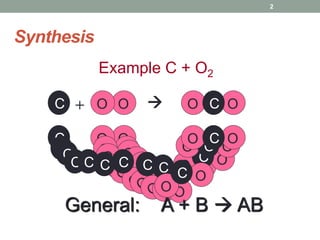
Synthesis
Example C + O2
2
OOC +  O OC
OOC
OOCC
C C C C C C C
C
C
C
General: A + B  AB
C
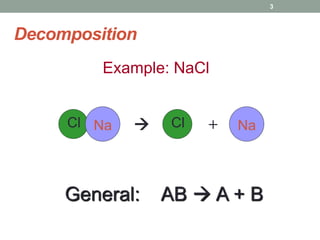
Decomposition
Example: NaCl
3
General: AB  A + B
Cl Na Cl + Na
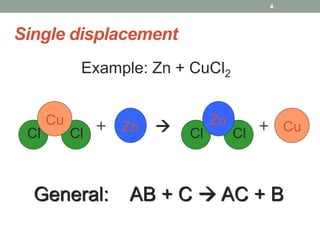
Single displacement
Example: Zn + CuCl2
4
ZnClCl
Cu +
General: AB + C  AC + B
ClCl
Zn Cu+
Double displacement
Example: MgO + CaS
5
General: AB + CD  AD + CB
SO
Mg Ca
+
OS
Mg Ca
+
Combustion Reaction
• A reaction that releases carbon dioxide and
water
• A hydrocarbon and oxygen combine to form
CO2 and H2O.
CH4 + 2O2  CO2 + 2H2O
General: AB + CD  CO2 + H2O
ACID BASE REACTIONS
Metals, Non-metals & Neutralizations
METALS
Metal + O2  metal oxide + H2O  Base
• Metals react with oxygen to form metal
oxides
• Metal oxides always form solids
• Metal oxides also called basic oxides or basic
anhydrides
• Metal oxides react in water to form bases
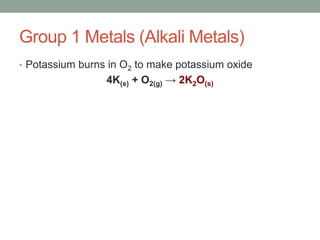
Group 1 Metals (Alkali Metals)
• Potassium burns in O2 to make potassium oxide
4K(s) + O2(g) → 2K2O(s)
Group 1 Metals (Alkali Metals)
• Potassium burns in O2 to make potassium oxide
4K(s) + O2(g) → 2K2O(s)
• Potassium oxide dissolves in H2O
K2O(s) + H2O(l) → 2KOH(aq)
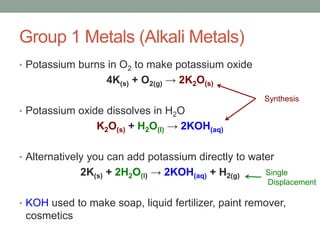
Group 1 Metals (Alkali Metals)
• Potassium burns in O2 to make potassium oxide
4K(s) + O2(g) → 2K2O(s)
• Potassium oxide dissolves in H2O
K2O(s) + H2O(l) → 2KOH(aq)
• Alternatively you can add potassium directly to water
2K(s) + 2H2O(l) → 2KOH(aq) + H2(g)
• KOH used to make soap, liquid fertilizer, paint remover,
cosmetics
Synthesis
Single
Displacement
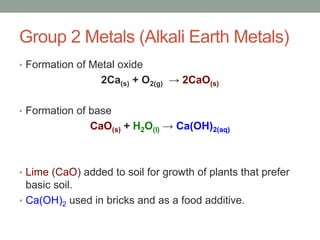
Group 2 Metals (Alkali Earth Metals)
• Formation of Metal oxide
2Ca(s) + O2(g) → 2CaO(s)
• Formation of base
CaO(s) + H2O(l) → Ca(OH)2(aq)
• Lime (CaO) added to soil for growth of plants that prefer
basic soil.
• Ca(OH)2 used in bricks and as a food additive.
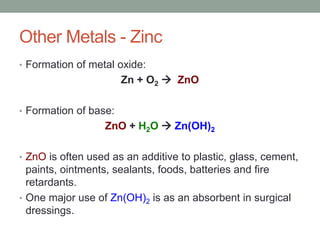
Other Metals - Zinc
• Formation of metal oxide:
Zn + O2  ZnO
• Formation of base:
ZnO + H2O  Zn(OH)2
• ZnO is often used as an additive to plastic, glass, cement,
paints, ointments, sealants, foods, batteries and fire
retardants.
• One major use of Zn(OH)2 is as an absorbent in surgical
dressings.
NON-METALS
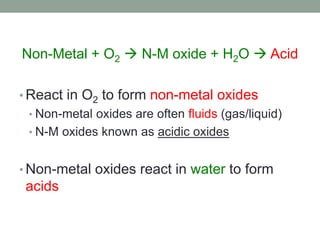
Non-Metal + O2  N-M oxide + H2O  Acid
• React in O2 to form non-metal oxides
• Non-metal oxides are often fluids (gas/liquid)
• N-M oxides known as acidic oxides
• Non-metal oxides react in water to form
acids
Nitrogen
• Nitrogen reacts with O2 to make nitrogen dioxide
N2(g) + 2O2(g) → 2NO2(g)
• Nitrogen dioxide dissolves in H2O to form nitric acid
3NO2(g) + H2O(l) → 2HNO3(aq) + NO(g)
• Nitrogen dioxide contributes to air pollution.
• Nitric acid can be used in explosives for munitions and
demolition. It can also be used for pigments in inks and
dyes.
Synthesis
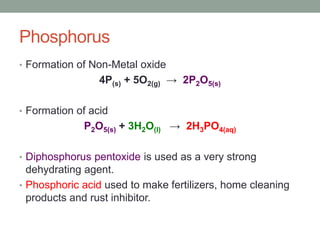
Phosphorus
• Formation of Non-Metal oxide
4P(s) + 5O2(g) → 2P2O5(s)
• Formation of acid
P2O5(s) + 3H2O(l) → 2H3PO4(aq)
• Diphosphorus pentoxide is used as a very strong
dehydrating agent.
• Phosphoric acid used to make fertilizers, home cleaning
products and rust inhibitor.
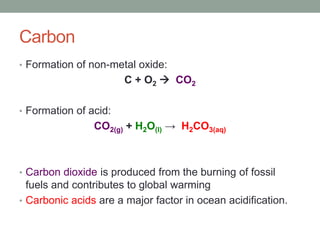
Carbon
• Formation of non-metal oxide:
C + O2  CO2
• Formation of acid:
CO2(g) + H2O(l) → H2CO3(aq)
• Carbon dioxide is produced from the burning of fossil
fuels and contributes to global warming
• Carbonic acids are a major factor in ocean acidification.
NEUTRALIZATION
REACTIONS
Acids + Bases
• The H+ ions from the acid can combine with the OH- ions
from the base
H+
(aq) + OH-
(aq) --> HOH(l)
This process is called Neutralization
the resulting solution is neutral
(because water is set to pH 7)
• The reaction of an acid and a base produces a salt and
water
Acid + Base  Salt + Water
• The reaction of an acid and a base produces a salt and
water
Acid + Base  Salt + Water
2HCl(aq) + Mg(OH)2(s)  MgCl2(aq) + H2O(l)
Stomach acid Antacid No more heartburn!!
• A salt is a compound made up of
oppositely-charged ions
Neutralization = double displacement reactions
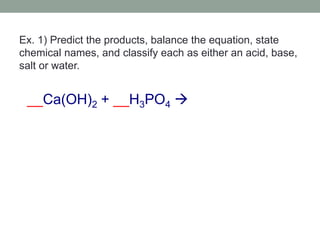
Ex. 1) Predict the products, balance the equation, state
chemical names, and classify each as either an acid, base,
salt or water.
__Ca(OH)2 + __H3PO4 
Ex. 1) Predict the products, balance the equation, state
chemical names, and classify each as either an acid, base,
salt or water.
_Ca(OH)2 + _H3PO4  _Ca3(PO4)2 + _H2O
Ex. 1) Predict the products, balance the equation, state
chemical names, and classify each as either an acid, base,
salt or water.
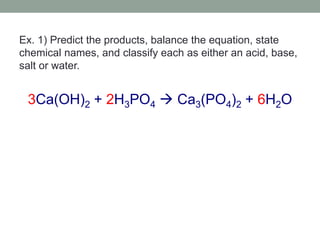
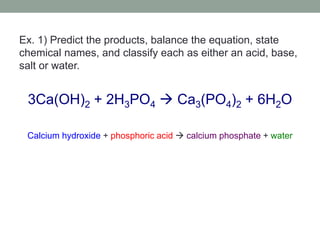
3Ca(OH)2 + 2H3PO4  Ca3(PO4)2 + 6H2O
Ex. 1) Predict the products, balance the equation, state
chemical names, and classify each as either an acid, base,
salt or water.
3Ca(OH)2 + 2H3PO4  Ca3(PO4)2 + 6H2O
Calcium hydroxide + phosphoric acid  calcium phosphate + water
Ex. 1) Predict the products, balance the equation, state
chemical names, and classify each as either an acid, base,
salt or water.
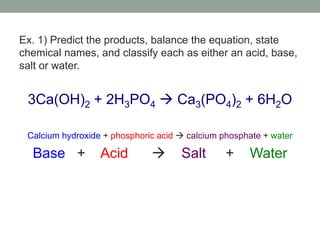
3Ca(OH)2 + 2H3PO4  Ca3(PO4)2 + 6H2O
Calcium hydroxide + phosphoric acid  calcium phosphate + water
Base + Acid  Salt + Water
Ex. 2) In there is an industrial accident, a whole barrel of
sulfuric acid (a dangerously strong acid) was spilled. Show
putting a strong base, such as calcium hydroxide, can
neutralize the acid.
Sulfuric acid + calcium hydroxide 
Ex. 2) In there is an industrial accident, a whole barrel of
sulfuric acid (a dangerously strong acid) was spilled. Show
putting a strong base, such as calcium hydroxide, can
neutralize the acid.
Sulfuric acid + calcium hydroxide  calcium sulfate + water
Ex. 2) In there is an industrial accident, a whole barrel of
sulfuric acid (a dangerously strong acid) was spilled. Show
putting a strong base, such as calcium hydroxide, can
neutralize the acid.
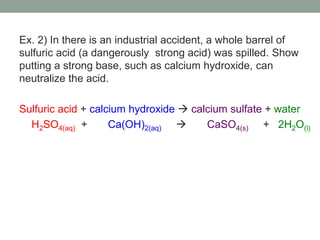
Sulfuric acid + calcium hydroxide  calcium sulfate + water
H2SO4(aq) + Ca(OH)2(aq)  CaSO4(s) + 2H2O(l)

3 acid base reactions

  • 1.
  • 2.
    Synthesis Example C +O2 2 OOC +  O OC OOC OOCC C C C C C C C C C C General: A + B  AB C
  • 3.
  • 4.
    Single displacement Example: Zn+ CuCl2 4 ZnClCl Cu + General: AB + C  AC + B ClCl Zn Cu+
  • 5.
    Double displacement Example: MgO+ CaS 5 General: AB + CD  AD + CB SO Mg Ca + OS Mg Ca +
  • 6.
    Combustion Reaction • Areaction that releases carbon dioxide and water • A hydrocarbon and oxygen combine to form CO2 and H2O. CH4 + 2O2  CO2 + 2H2O General: AB + CD  CO2 + H2O
  • 7.
    ACID BASE REACTIONS Metals,Non-metals & Neutralizations
  • 8.
  • 9.
    Metal + O2 metal oxide + H2O  Base • Metals react with oxygen to form metal oxides • Metal oxides always form solids • Metal oxides also called basic oxides or basic anhydrides • Metal oxides react in water to form bases
  • 10.
    Group 1 Metals(Alkali Metals) • Potassium burns in O2 to make potassium oxide 4K(s) + O2(g) → 2K2O(s)
  • 11.
    Group 1 Metals(Alkali Metals) • Potassium burns in O2 to make potassium oxide 4K(s) + O2(g) → 2K2O(s) • Potassium oxide dissolves in H2O K2O(s) + H2O(l) → 2KOH(aq)
  • 12.
    Group 1 Metals(Alkali Metals) • Potassium burns in O2 to make potassium oxide 4K(s) + O2(g) → 2K2O(s) • Potassium oxide dissolves in H2O K2O(s) + H2O(l) → 2KOH(aq) • Alternatively you can add potassium directly to water 2K(s) + 2H2O(l) → 2KOH(aq) + H2(g) • KOH used to make soap, liquid fertilizer, paint remover, cosmetics Synthesis Single Displacement
  • 13.
    Group 2 Metals(Alkali Earth Metals) • Formation of Metal oxide 2Ca(s) + O2(g) → 2CaO(s) • Formation of base CaO(s) + H2O(l) → Ca(OH)2(aq) • Lime (CaO) added to soil for growth of plants that prefer basic soil. • Ca(OH)2 used in bricks and as a food additive.
  • 14.
    Other Metals -Zinc • Formation of metal oxide: Zn + O2  ZnO • Formation of base: ZnO + H2O  Zn(OH)2 • ZnO is often used as an additive to plastic, glass, cement, paints, ointments, sealants, foods, batteries and fire retardants. • One major use of Zn(OH)2 is as an absorbent in surgical dressings.
  • 15.
  • 16.
    Non-Metal + O2 N-M oxide + H2O  Acid • React in O2 to form non-metal oxides • Non-metal oxides are often fluids (gas/liquid) • N-M oxides known as acidic oxides • Non-metal oxides react in water to form acids
  • 17.
    Nitrogen • Nitrogen reactswith O2 to make nitrogen dioxide N2(g) + 2O2(g) → 2NO2(g) • Nitrogen dioxide dissolves in H2O to form nitric acid 3NO2(g) + H2O(l) → 2HNO3(aq) + NO(g) • Nitrogen dioxide contributes to air pollution. • Nitric acid can be used in explosives for munitions and demolition. It can also be used for pigments in inks and dyes. Synthesis
  • 18.
    Phosphorus • Formation ofNon-Metal oxide 4P(s) + 5O2(g) → 2P2O5(s) • Formation of acid P2O5(s) + 3H2O(l) → 2H3PO4(aq) • Diphosphorus pentoxide is used as a very strong dehydrating agent. • Phosphoric acid used to make fertilizers, home cleaning products and rust inhibitor.
  • 19.
    Carbon • Formation ofnon-metal oxide: C + O2  CO2 • Formation of acid: CO2(g) + H2O(l) → H2CO3(aq) • Carbon dioxide is produced from the burning of fossil fuels and contributes to global warming • Carbonic acids are a major factor in ocean acidification.
  • 20.
  • 21.
    Acids + Bases •The H+ ions from the acid can combine with the OH- ions from the base H+ (aq) + OH- (aq) --> HOH(l) This process is called Neutralization the resulting solution is neutral (because water is set to pH 7)
  • 22.
    • The reactionof an acid and a base produces a salt and water Acid + Base  Salt + Water
  • 23.
    • The reactionof an acid and a base produces a salt and water Acid + Base  Salt + Water 2HCl(aq) + Mg(OH)2(s)  MgCl2(aq) + H2O(l) Stomach acid Antacid No more heartburn!!
  • 24.
    • A saltis a compound made up of oppositely-charged ions Neutralization = double displacement reactions
  • 25.
    Ex. 1) Predictthe products, balance the equation, state chemical names, and classify each as either an acid, base, salt or water. __Ca(OH)2 + __H3PO4 
  • 26.
    Ex. 1) Predictthe products, balance the equation, state chemical names, and classify each as either an acid, base, salt or water. _Ca(OH)2 + _H3PO4  _Ca3(PO4)2 + _H2O
  • 27.
    Ex. 1) Predictthe products, balance the equation, state chemical names, and classify each as either an acid, base, salt or water. 3Ca(OH)2 + 2H3PO4  Ca3(PO4)2 + 6H2O
  • 28.
    Ex. 1) Predictthe products, balance the equation, state chemical names, and classify each as either an acid, base, salt or water. 3Ca(OH)2 + 2H3PO4  Ca3(PO4)2 + 6H2O Calcium hydroxide + phosphoric acid  calcium phosphate + water
  • 29.
    Ex. 1) Predictthe products, balance the equation, state chemical names, and classify each as either an acid, base, salt or water. 3Ca(OH)2 + 2H3PO4  Ca3(PO4)2 + 6H2O Calcium hydroxide + phosphoric acid  calcium phosphate + water Base + Acid  Salt + Water
  • 30.
    Ex. 2) Inthere is an industrial accident, a whole barrel of sulfuric acid (a dangerously strong acid) was spilled. Show putting a strong base, such as calcium hydroxide, can neutralize the acid. Sulfuric acid + calcium hydroxide 
  • 31.
    Ex. 2) Inthere is an industrial accident, a whole barrel of sulfuric acid (a dangerously strong acid) was spilled. Show putting a strong base, such as calcium hydroxide, can neutralize the acid. Sulfuric acid + calcium hydroxide  calcium sulfate + water
  • 32.
    Ex. 2) Inthere is an industrial accident, a whole barrel of sulfuric acid (a dangerously strong acid) was spilled. Show putting a strong base, such as calcium hydroxide, can neutralize the acid. Sulfuric acid + calcium hydroxide  calcium sulfate + water H2SO4(aq) + Ca(OH)2(aq)  CaSO4(s) + 2H2O(l)