Chapter 1 Acids, Bases & Buffers Pharmaceutical Chemistry-I Chetan V. Jain (M-Pharma)
1.1 | P a g e
CHAPTER 1 ACIDS, BASES, BUFFERS
Acids, Bases are defined by four main theories
1. Traditional theory / concept
2. Arrhenius theory
3. Bronsted and Lowry theory
4. Lewis theory
1. Traditional theory / concept
 Acid : are the substance
o Which converts blue litmus paper to red
o Having the PH < 7
o Sour Taste
o React with bases to form salts and Water
o Eg :- Hydrochloric acid (HCl)
 Base : are the substance
o which converts red litmus paper to blue
o Having the PH >7
o Bitter taste
o React with Acids to form salts and water
o Eg: Sodium Hydroxide (NaOH)
2. Arrhenius theory*
 In 1884 of Svante Arrhenius Also known as, Arrhenius theory of
ionization
 Electron dissociation theory
 This theory define acids & bases according to their formation of ions
when dissolved in water
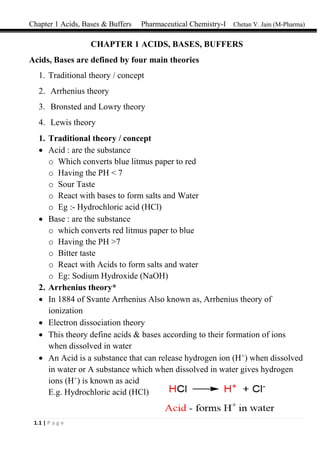
 An Acid is a substance that can release hydrogen ion (H+
) when dissolved
in water or A substance which when dissolved in water gives hydrogen
ions (H+
) is known as acid
E.g. Hydrochloric acid (HCl)
Chapter 1 Acids, Bases & Buffers Pharmaceutical Chemistry-I Chetan V. Jain (M-Pharma)
1.2 | P a g e
 A Base is a substance that can release a Hydroxyl ion (OH-
) when
dissolved in water Or A substance which when dissolved in water gives
Hydroxyl ion (OH-
)is known as Base
Eg: Sodium Hydroxide [NaOH]
 Neutralization reaction :
o Acids react with Base and form Salt & Water
o Eg: Hydrochloric acid react sodium hydroxide and form Sodium
chloride (Salt) & water
NaOH + HCl = NaCl + H2O
(BASE) + (ACID) = (SALT) + (WATER)
 Limitation of Arrhenius theory
o Water is essential
o Not explain Acidity or Basisity of non aqueous Solvent Eg :Benzene
o Basisity of Ammonia (No OH-
ion) is not explained
o Acidity of BF3,AlCl3 (No H+
ion) is not explained
3. Bronsted and Lowry theory
 Bronsted in Copenhagen and Lowry in London independently in 1923
proposed simultaneously new definition of acid and base
 Acid: is a substance that can donate a proton i.e. acid is a proton donor.
 Base: is a substance that can accept a proton i.e. base is a proton acceptor.
Chapter 1 Acids, Bases & Buffers Pharmaceutical Chemistry-I Chetan V. Jain (M-Pharma)
1.3 | P a g e
4. Lewis theory
 One of the simplest bonding theories was developed by G.N. Lewis and
is called Lewis Theory.
 Acid: is a molecule or ion that can accept a lone pair of electrons.
 Base: is a molecule or ion that has a lone pair of electrons which is
donated.
 Strong & Weak Acid and Base
o Strong Acid: Produce more amounts of H+
ions in water. E.g. HCl
o Weak Acid: Produce fewer amounts of H+
ions in water. E.g. CH3COOH
o Strong Base: Produce more amounts of OH-
ions in water. E.g. NaOH
o Weak Base: Produce fewer amounts of OH-
ions in water. E.g. NH4OH
Acids Bases
Strong Weak Strong Weak
HCl CH3COOH NaOH NH4OH
H2SO4 HCN KOH NaHCO3
NHO3 C6H5COOH CaO C6H5NH2
HCIO4 HCOOH Na2CO3 CH3NH2
HCIO3 H2CO3 - -
HBr C6H5OH - -
HI - - -
Chapter 1 Acids, Bases & Buffers Pharmaceutical Chemistry-I Chetan V. Jain (M-Pharma)
1.4 | P a g e
 Buffer Solution
o It is capable to resist / appose / prevent the change in pH or pOH
value when adding in small amount of acid & base.
 Types of Buffer Solutions
o Acidic Buffer: solution contains weak acid and salt known as acidic
buffer.
o Basic Buffer: solution contains weak base and salt known as basic
buffer.
 pH and pOH
o pH : - log
o pOH : - log
o Therefore pH + pOH = 14
7 + 7 = 14
Some Official Acids & Bases
 Acids
o Boric Acid [H3BO3]
o Hydrochloric Acid [HCl] Conc. & Dil
 Bases
o Strong Ammonium Hydroxide [NH4OH]
o Calcium Hydroxide [Ca(OH)2]
o Sodium Hydroxide [NaOH]
Chapter 1 Acids, Bases & Buffers Pharmaceutical Chemistry-I Chetan V. Jain (M-Pharma)
1.5 | P a g e
Boric Acid: (H3BO3)
o Synonym : Boracic Acid , Orthoboric Acid
o Limit: It contains not less than 99% & not more than 100.5% of H3BO3.
o Preparation: Borax with Sulphuric acid in presence of water.
Na2B4O7 + H2SO4 + 5H2O = 4H3BO3 + Na2SO4
o Properties:
 White crystalline powder.
 Odorless.
 Insoluble in water.
 Soluble in Ethanol.
 Soluble in glycerin.
o Uses:
 Local anti-infective.
 To maintain acidic pH medium in Medicament.
 Preparation of buffer solution.
 In ophthalmic preparation.
 Dusting powder.
 Preparation of ointment.
Conc. Hydrochloric Acid [HCl]
o Synonym : Muriatic Acid
o Limit: It contains not less than 35% and not more than 38% of HCl.
o Preparation: Conc Sulfuric acid reacts with sodium chloride.
NaCl + H2SO4 = HCl + NaHSO4
o Properties:
 Clear Colorless Liquid.
 Pungent Odor.
 Miscible with water and alcohol.
 Fuming liquid.
o Uses:
 As a Pharmaceucal Aid (Afacidifying Agent)
 As a solvent in Industry
 As a reagent in Laboratory
 For manufacturing of basic Pharmaceuticals.
o Storage: temp not exceeding 30 C in a glass stopped container.
Chapter 1 Acids, Bases & Buffers Pharmaceutical Chemistry-I Chetan V. Jain (M-Pharma)
1.6 | P a g e
Dil. Hydrochloric Acid [HCl]
o Synonym , Limit, Properties, uses and storage same as Conc.
Hydrochloric Acid [HCl]
o Preparation: 10 ml Conc. HCl + up to 100 ml Water.
Strong Ammonium Hydroxide [NH4OH]
o Synonym : Ammonium hydroxide, strong ammonium water, liquor
ammoniae forties
o Limit: It contains not less than 25% of ammonia.
o Preparation: By mixing ammonium chloride with slaked lime.
NH4Cl + Ca(OH)2 =NH4OH + CaCl2
o Properties:
 Clear colorless liquid
 Pungent odor
 Characteristic taste
 Miscible with water
 Aqueous solution is strongly
 Alkaline in nature.
o Uses:
 Alkalizing agent
 Reflux stimulant (fainted person)
 Vasoconstrictor
 Strong base
 Antacid
 Reagent in Laboratory.
o Storage: temp store in umber color bottle with rubber stopper.
Chapter 1 Acids, Bases & Buffers Pharmaceutical Chemistry-I Chetan V. Jain (M-Pharma)
1.7 | P a g e
Calcium Hydroxide [Ca(OH)2]
o Synonym : Slaked Lime, Lime water
o Preparation: By treating calcium chloride with sodium hydroxide.
CaCl2 + 2NaOH = Ca(OH)2 + 2NaCl
o Properties:
 White amorphous powder,
 Slight bitter taste,
 Slightly soluble in Water,
 Insoluble in Alcohol
 Soluble in Glycerin.
o Uses:
 Antacid
 Astringent
 Fluid electrolyte
 Emulsifying agent
 Absorb carbon dioxide
 Making of glass
 White washing of cloth.
Sodium Hydroxide [NaOH]
o Synonym : Caustic soda, soda lye
o Preparation: By treating sodium carbonate with lime water.
Na2CO3 + Ca(OH)2 = 2NaOH + CaCO3
o Properties:
 White amorphous pellets
 Slight bitter taste
 Soluble in water, alcohol and glycerin &
 Deliquescent in nature.
o Uses:
 Alkalizing agent
 Disinfectant for animal houses
 For preparation of soap
 Absorb CO2 gas
 Common laboratory reagent.
o Storage: well closed container & protect from moisture & CO2.
Chapter 1 Acids, Bases & Buffers Pharmaceutical Chemistry-I Chetan V. Jain (M-Pharma)
1.8 | P a g e
Question Bank
 Explain
o Traditional acid-base theory with examples,
o Discuss Arrhenius acid-base theory with example and list
limitations for it.
or
o Define acid and base as per Arrhenius theory and write
drawbacks of it.
o Bronsted and Lowry acid-base theory with examples,
o Lewis acid-base theory with examples.
 Give Monograph for: all Official Acid as well as base
 Define with examples
o Strong & Weak Acid
o Strong & Weak Base
 Define and give types of Buffer Solutions

Chapter No 1 : Acids, Bases and Buffers

  • 1.
    Chapter 1 Acids,Bases & Buffers Pharmaceutical Chemistry-I Chetan V. Jain (M-Pharma) 1.1 | P a g e CHAPTER 1 ACIDS, BASES, BUFFERS Acids, Bases are defined by four main theories 1. Traditional theory / concept 2. Arrhenius theory 3. Bronsted and Lowry theory 4. Lewis theory 1. Traditional theory / concept  Acid : are the substance o Which converts blue litmus paper to red o Having the PH < 7 o Sour Taste o React with bases to form salts and Water o Eg :- Hydrochloric acid (HCl)  Base : are the substance o which converts red litmus paper to blue o Having the PH >7 o Bitter taste o React with Acids to form salts and water o Eg: Sodium Hydroxide (NaOH) 2. Arrhenius theory*  In 1884 of Svante Arrhenius Also known as, Arrhenius theory of ionization  Electron dissociation theory  This theory define acids & bases according to their formation of ions when dissolved in water  An Acid is a substance that can release hydrogen ion (H+ ) when dissolved in water or A substance which when dissolved in water gives hydrogen ions (H+ ) is known as acid E.g. Hydrochloric acid (HCl)
  • 2.
    Chapter 1 Acids,Bases & Buffers Pharmaceutical Chemistry-I Chetan V. Jain (M-Pharma) 1.2 | P a g e  A Base is a substance that can release a Hydroxyl ion (OH- ) when dissolved in water Or A substance which when dissolved in water gives Hydroxyl ion (OH- )is known as Base Eg: Sodium Hydroxide [NaOH]  Neutralization reaction : o Acids react with Base and form Salt & Water o Eg: Hydrochloric acid react sodium hydroxide and form Sodium chloride (Salt) & water NaOH + HCl = NaCl + H2O (BASE) + (ACID) = (SALT) + (WATER)  Limitation of Arrhenius theory o Water is essential o Not explain Acidity or Basisity of non aqueous Solvent Eg :Benzene o Basisity of Ammonia (No OH- ion) is not explained o Acidity of BF3,AlCl3 (No H+ ion) is not explained 3. Bronsted and Lowry theory  Bronsted in Copenhagen and Lowry in London independently in 1923 proposed simultaneously new definition of acid and base  Acid: is a substance that can donate a proton i.e. acid is a proton donor.  Base: is a substance that can accept a proton i.e. base is a proton acceptor.
  • 3.
    Chapter 1 Acids,Bases & Buffers Pharmaceutical Chemistry-I Chetan V. Jain (M-Pharma) 1.3 | P a g e 4. Lewis theory  One of the simplest bonding theories was developed by G.N. Lewis and is called Lewis Theory.  Acid: is a molecule or ion that can accept a lone pair of electrons.  Base: is a molecule or ion that has a lone pair of electrons which is donated.  Strong & Weak Acid and Base o Strong Acid: Produce more amounts of H+ ions in water. E.g. HCl o Weak Acid: Produce fewer amounts of H+ ions in water. E.g. CH3COOH o Strong Base: Produce more amounts of OH- ions in water. E.g. NaOH o Weak Base: Produce fewer amounts of OH- ions in water. E.g. NH4OH Acids Bases Strong Weak Strong Weak HCl CH3COOH NaOH NH4OH H2SO4 HCN KOH NaHCO3 NHO3 C6H5COOH CaO C6H5NH2 HCIO4 HCOOH Na2CO3 CH3NH2 HCIO3 H2CO3 - - HBr C6H5OH - - HI - - -
  • 4.
    Chapter 1 Acids,Bases & Buffers Pharmaceutical Chemistry-I Chetan V. Jain (M-Pharma) 1.4 | P a g e  Buffer Solution o It is capable to resist / appose / prevent the change in pH or pOH value when adding in small amount of acid & base.  Types of Buffer Solutions o Acidic Buffer: solution contains weak acid and salt known as acidic buffer. o Basic Buffer: solution contains weak base and salt known as basic buffer.  pH and pOH o pH : - log o pOH : - log o Therefore pH + pOH = 14 7 + 7 = 14 Some Official Acids & Bases  Acids o Boric Acid [H3BO3] o Hydrochloric Acid [HCl] Conc. & Dil  Bases o Strong Ammonium Hydroxide [NH4OH] o Calcium Hydroxide [Ca(OH)2] o Sodium Hydroxide [NaOH]
  • 5.
    Chapter 1 Acids,Bases & Buffers Pharmaceutical Chemistry-I Chetan V. Jain (M-Pharma) 1.5 | P a g e Boric Acid: (H3BO3) o Synonym : Boracic Acid , Orthoboric Acid o Limit: It contains not less than 99% & not more than 100.5% of H3BO3. o Preparation: Borax with Sulphuric acid in presence of water. Na2B4O7 + H2SO4 + 5H2O = 4H3BO3 + Na2SO4 o Properties:  White crystalline powder.  Odorless.  Insoluble in water.  Soluble in Ethanol.  Soluble in glycerin. o Uses:  Local anti-infective.  To maintain acidic pH medium in Medicament.  Preparation of buffer solution.  In ophthalmic preparation.  Dusting powder.  Preparation of ointment. Conc. Hydrochloric Acid [HCl] o Synonym : Muriatic Acid o Limit: It contains not less than 35% and not more than 38% of HCl. o Preparation: Conc Sulfuric acid reacts with sodium chloride. NaCl + H2SO4 = HCl + NaHSO4 o Properties:  Clear Colorless Liquid.  Pungent Odor.  Miscible with water and alcohol.  Fuming liquid. o Uses:  As a Pharmaceucal Aid (Afacidifying Agent)  As a solvent in Industry  As a reagent in Laboratory  For manufacturing of basic Pharmaceuticals. o Storage: temp not exceeding 30 C in a glass stopped container.
  • 6.
    Chapter 1 Acids,Bases & Buffers Pharmaceutical Chemistry-I Chetan V. Jain (M-Pharma) 1.6 | P a g e Dil. Hydrochloric Acid [HCl] o Synonym , Limit, Properties, uses and storage same as Conc. Hydrochloric Acid [HCl] o Preparation: 10 ml Conc. HCl + up to 100 ml Water. Strong Ammonium Hydroxide [NH4OH] o Synonym : Ammonium hydroxide, strong ammonium water, liquor ammoniae forties o Limit: It contains not less than 25% of ammonia. o Preparation: By mixing ammonium chloride with slaked lime. NH4Cl + Ca(OH)2 =NH4OH + CaCl2 o Properties:  Clear colorless liquid  Pungent odor  Characteristic taste  Miscible with water  Aqueous solution is strongly  Alkaline in nature. o Uses:  Alkalizing agent  Reflux stimulant (fainted person)  Vasoconstrictor  Strong base  Antacid  Reagent in Laboratory. o Storage: temp store in umber color bottle with rubber stopper.
  • 7.
    Chapter 1 Acids,Bases & Buffers Pharmaceutical Chemistry-I Chetan V. Jain (M-Pharma) 1.7 | P a g e Calcium Hydroxide [Ca(OH)2] o Synonym : Slaked Lime, Lime water o Preparation: By treating calcium chloride with sodium hydroxide. CaCl2 + 2NaOH = Ca(OH)2 + 2NaCl o Properties:  White amorphous powder,  Slight bitter taste,  Slightly soluble in Water,  Insoluble in Alcohol  Soluble in Glycerin. o Uses:  Antacid  Astringent  Fluid electrolyte  Emulsifying agent  Absorb carbon dioxide  Making of glass  White washing of cloth. Sodium Hydroxide [NaOH] o Synonym : Caustic soda, soda lye o Preparation: By treating sodium carbonate with lime water. Na2CO3 + Ca(OH)2 = 2NaOH + CaCO3 o Properties:  White amorphous pellets  Slight bitter taste  Soluble in water, alcohol and glycerin &  Deliquescent in nature. o Uses:  Alkalizing agent  Disinfectant for animal houses  For preparation of soap  Absorb CO2 gas  Common laboratory reagent. o Storage: well closed container & protect from moisture & CO2.
  • 8.
    Chapter 1 Acids,Bases & Buffers Pharmaceutical Chemistry-I Chetan V. Jain (M-Pharma) 1.8 | P a g e Question Bank  Explain o Traditional acid-base theory with examples, o Discuss Arrhenius acid-base theory with example and list limitations for it. or o Define acid and base as per Arrhenius theory and write drawbacks of it. o Bronsted and Lowry acid-base theory with examples, o Lewis acid-base theory with examples.  Give Monograph for: all Official Acid as well as base  Define with examples o Strong & Weak Acid o Strong & Weak Base  Define and give types of Buffer Solutions