Acids, Bases and
Salt
John Rey D. Ravago
BSED SCIENCE 1-A
Facts About Acids
 Have sour taste;
 Turn blue litmus dye to red;
 Colorless with phenolphthalein (often used as an indicator
in acid–base titrations);
 Corrosive, can dissolve metals; and
 React with metals to liberate hydrogen gas.
Facts About Bases
 Have bitter taste;
 Feel slippery or greasy to touch;
 Turn red litmus dye to blue;
 Magenta red color with phenolphthalein; and
 Strong bases liberate NH3 from ammonium salts.
DEFINITION OF ACIDS,
BASES, AND SALTS
A. The Arrhenius concept is based on the type of ions produced
in aqueous solution.
 Acid is a substance which yields hydrogen ions (H+) or
hydronium ions (H3O+) in aqueous solution.
Example of Arrhenius acids are HCl, NHO3, H2SO4,
HC2H3+O2.
 Base is a substance which yields hydroxide ions (OH-) in
aqueous solution.
Example of Arrhenius bases are KOH, NaOH, Mg(OH)2.
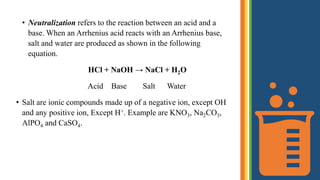
• Neutralization refers to the reaction between an acid and a
base. When an Arrhenius acid reacts with an Arrhenius base,
salt and water are produced as shown in the following
equation.
HCl + NaOH → NaCl + H2O
Acid Base Salt Water
• Salt are ionic compounds made up of a negative ion, except OH
and any positive ion, Except H+. Example are KNO3, Na2CO3,
AlPO4 and CaSO4.
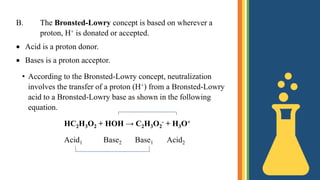
B. The Bronsted-Lowry concept is based on wherever a
proton, H+ is donated or accepted.
 Acid is a proton donor.
 Bases is a proton acceptor.
• According to the Bronsted-Lowry concept, neutralization
involves the transfer of a proton (H+) from a Bronsted-Lowry
acid to a Bronsted-Lowry base as shown in the following
equation.
HC2H3O2 + HOH → C2H3O2
- + H3O+
Acid1 Base2 Base1 Acid2
• Conjugate acids and Bases
Reactioon between a Bronsted-Lowry acid and a
Bronsted_Lowry base result in the formation of another Bronsted-Lowry
acid and base. For each reaction, there are two pairs of acids and bases,
where each pair differ only in the number of H+ or protons. The species
with one proton more is the acid while the species with has one proton
less is the base. Each pair is called conjugate acid-base pair. The
conjugate acid-base pairs in this particular neutralization reaction are:
 HC2H3O2 – C2H3O2
- or ascetic acid – acetate ion
 H3O+ − HOH or hydronium ion – water
• Water is said to be amphiprotic, which means it can act as an acid in
the presence of a strong base, and as a base in the presence of a strong
acid.
C. The Lewis concept is based on the shared electron pair.
 Acid is an electron pair acceptor.
 Base is an electron pair donor.
Example of Lewis acids are Ag+, BF3, AlCl3 while NH3
(ammonia) and RNH2 (amines) are classified as Lewis bases.
: NH3 + HCl → [H: NH3]+ Cl-
Base Acid Salt
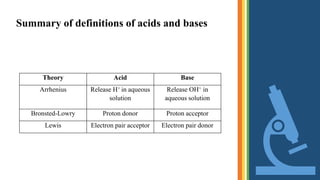
Summary of definitions of acids and bases
Theory Acid Base
Arrhenius Release H+ in aqueous
solution
Release OH+ in
aqueous solution
Bronsted-Lowry Proton donor Proton acceptor
Lewis Electron pair acceptor Electron pair donor
Mag Review !!!

Acids, bases and salt

  • 1.
    Acids, Bases and Salt JohnRey D. Ravago BSED SCIENCE 1-A
  • 2.
    Facts About Acids Have sour taste;  Turn blue litmus dye to red;  Colorless with phenolphthalein (often used as an indicator in acid–base titrations);  Corrosive, can dissolve metals; and  React with metals to liberate hydrogen gas.
  • 3.
    Facts About Bases Have bitter taste;  Feel slippery or greasy to touch;  Turn red litmus dye to blue;  Magenta red color with phenolphthalein; and  Strong bases liberate NH3 from ammonium salts.
  • 4.
  • 5.
    A. The Arrheniusconcept is based on the type of ions produced in aqueous solution.  Acid is a substance which yields hydrogen ions (H+) or hydronium ions (H3O+) in aqueous solution. Example of Arrhenius acids are HCl, NHO3, H2SO4, HC2H3+O2.  Base is a substance which yields hydroxide ions (OH-) in aqueous solution. Example of Arrhenius bases are KOH, NaOH, Mg(OH)2.
  • 6.
    • Neutralization refersto the reaction between an acid and a base. When an Arrhenius acid reacts with an Arrhenius base, salt and water are produced as shown in the following equation. HCl + NaOH → NaCl + H2O Acid Base Salt Water • Salt are ionic compounds made up of a negative ion, except OH and any positive ion, Except H+. Example are KNO3, Na2CO3, AlPO4 and CaSO4.
  • 7.
    B. The Bronsted-Lowryconcept is based on wherever a proton, H+ is donated or accepted.  Acid is a proton donor.  Bases is a proton acceptor. • According to the Bronsted-Lowry concept, neutralization involves the transfer of a proton (H+) from a Bronsted-Lowry acid to a Bronsted-Lowry base as shown in the following equation. HC2H3O2 + HOH → C2H3O2 - + H3O+ Acid1 Base2 Base1 Acid2
  • 8.
    • Conjugate acidsand Bases Reactioon between a Bronsted-Lowry acid and a Bronsted_Lowry base result in the formation of another Bronsted-Lowry acid and base. For each reaction, there are two pairs of acids and bases, where each pair differ only in the number of H+ or protons. The species with one proton more is the acid while the species with has one proton less is the base. Each pair is called conjugate acid-base pair. The conjugate acid-base pairs in this particular neutralization reaction are:  HC2H3O2 – C2H3O2 - or ascetic acid – acetate ion  H3O+ − HOH or hydronium ion – water • Water is said to be amphiprotic, which means it can act as an acid in the presence of a strong base, and as a base in the presence of a strong acid.
  • 9.
    C. The Lewisconcept is based on the shared electron pair.  Acid is an electron pair acceptor.  Base is an electron pair donor. Example of Lewis acids are Ag+, BF3, AlCl3 while NH3 (ammonia) and RNH2 (amines) are classified as Lewis bases. : NH3 + HCl → [H: NH3]+ Cl- Base Acid Salt
  • 10.
    Summary of definitionsof acids and bases Theory Acid Base Arrhenius Release H+ in aqueous solution Release OH+ in aqueous solution Bronsted-Lowry Proton donor Proton acceptor Lewis Electron pair acceptor Electron pair donor
  • 11.