APPROACH TO NARROW QRS 
COMPLEX TACHYCARDIA 
Dr Dharam Prakash Saran
STEP wise 
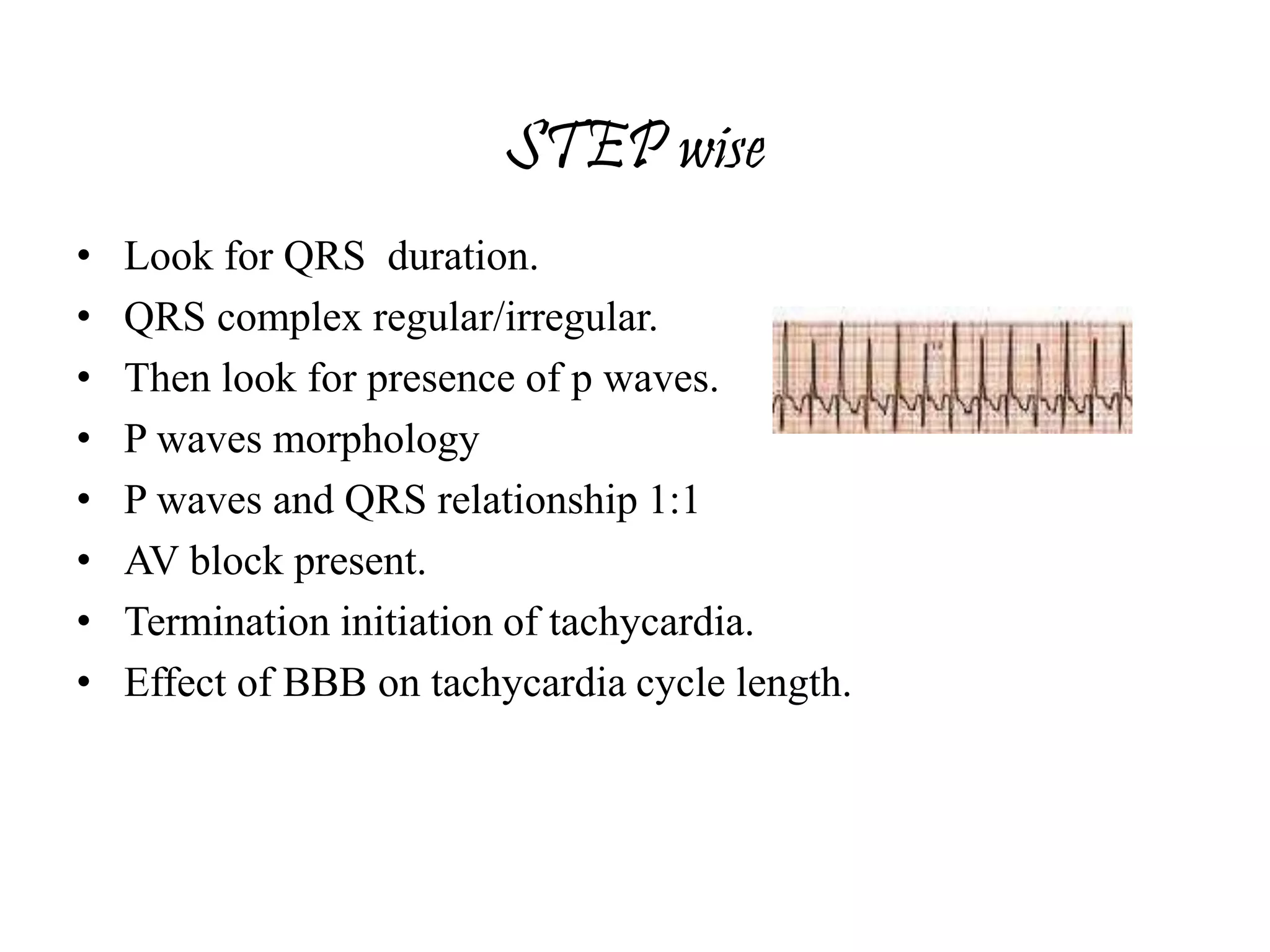
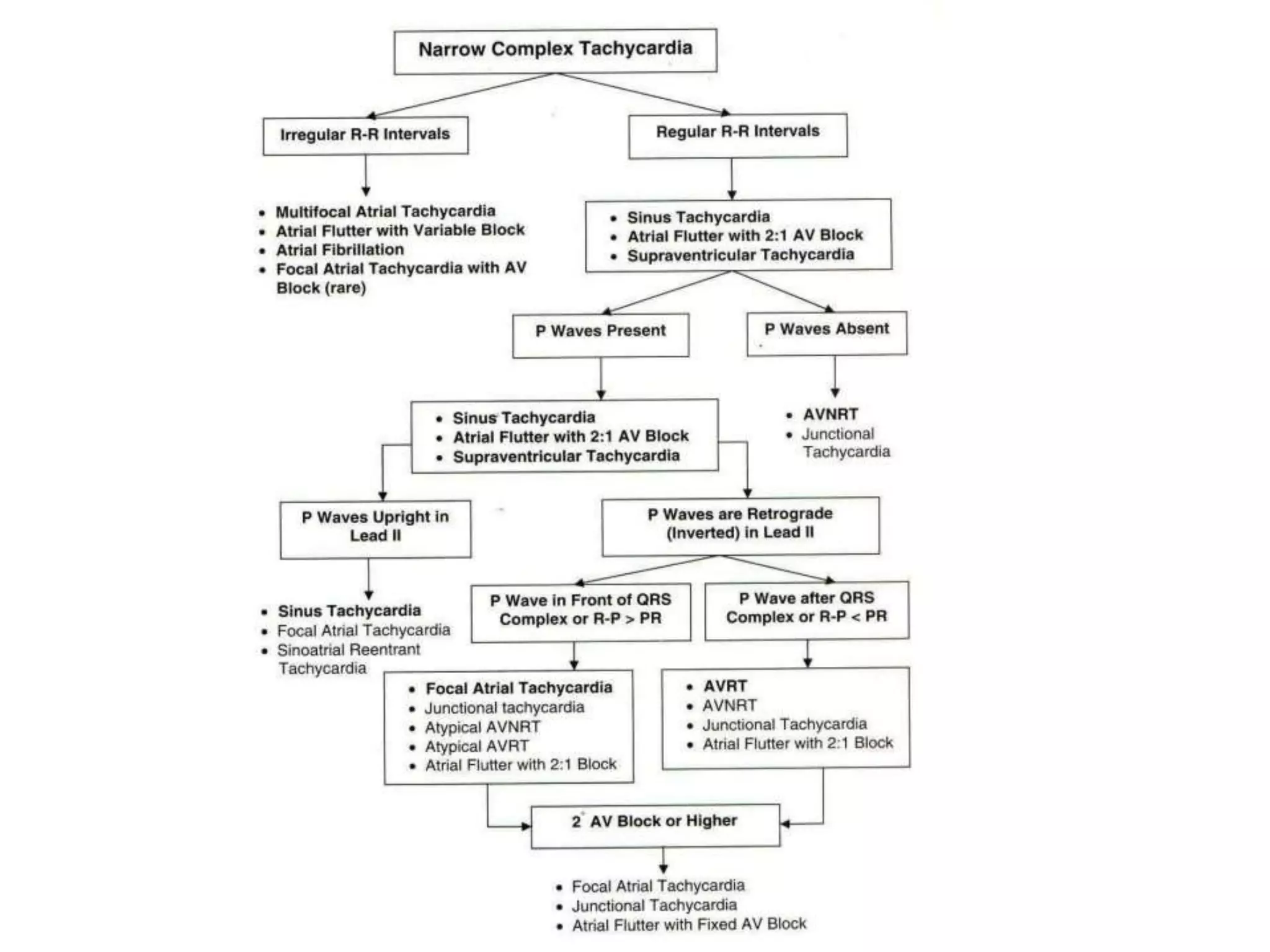
• Look for QRS duration. 
• QRS complex regular/irregular. 
• Then look for presence of p waves. 
• P waves morphology 
• P waves and QRS relationship 1:1 
• AV block present. 
• Termination initiation of tachycardia. 
• Effect of BBB on tachycardia cycle length.
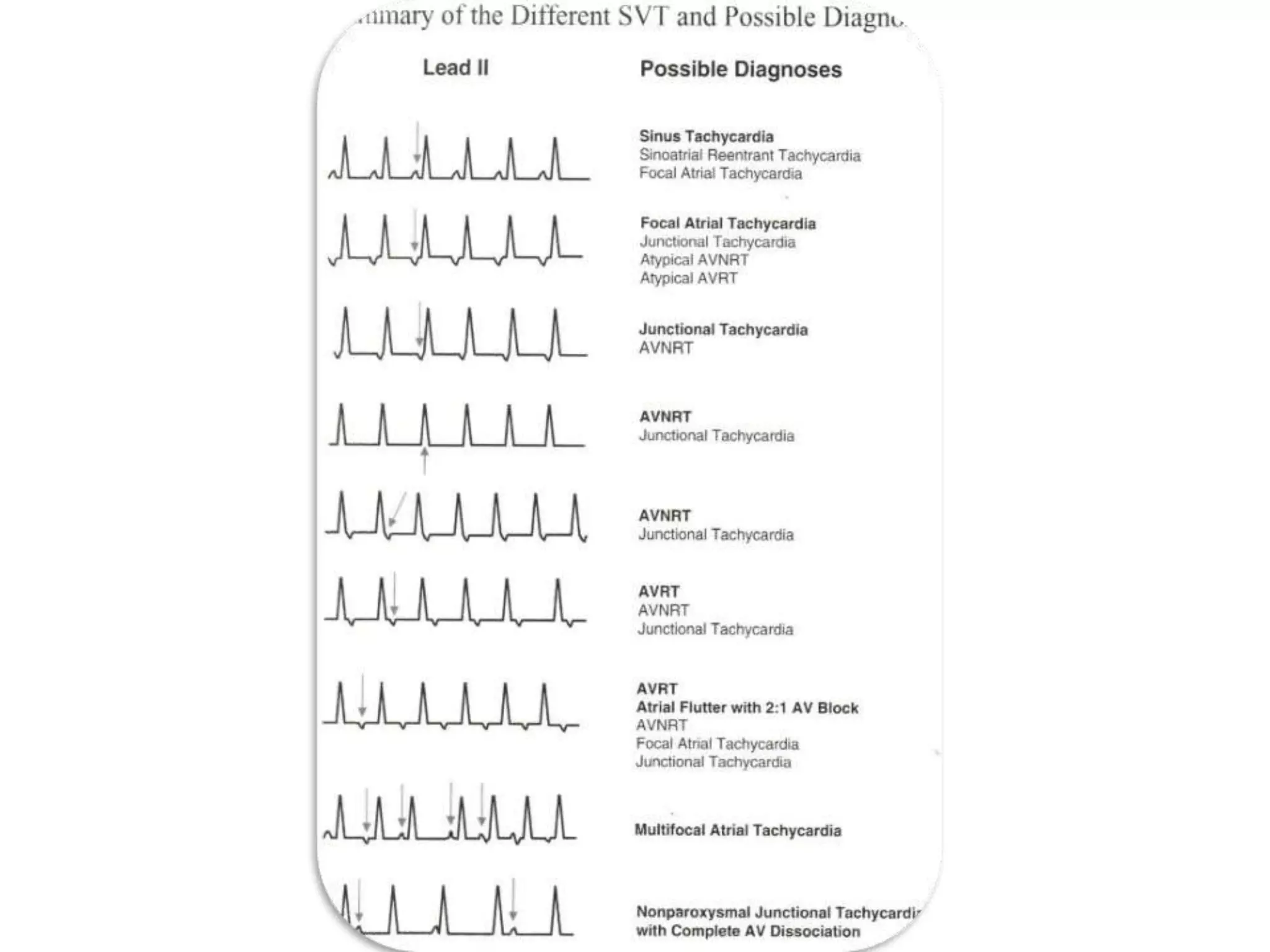
In brief from the diagram clues 
• Response to carotid sinus massage or adenosine –with 
termination of arrhythmia with Pwave –AVNRT 
• Tachycardia persists with AV block –AT,AFL,SANRT 
• Pseudo r ‘ wave in V1 –AVNRT 
• SHORT RP interval – AVNRT,AVRT 
• Long RP interval – AT,SANRT,AVNRT atypical
NARROW 
COMPLEX QRS 
TACHYCARDIA 
SHORT RP 
INTERVAL 
TYPICAL 
AVNRT 
AVRT 
LONG RP 
INTERVAL 
ATYPICAL AVNRT 
AVRT slow 
retrograde 
conduction 
Permanent Form 
junctional 
tachycardia 
ATRIAL 
TACHYCARDIA 
SANRT 
INAPPROPRIATE ST
ECG findings
Pwaves 
no 
Irregular 
R-R interval 
ATRIAL 
FIBRILLATION 
Regular 
R-R interval 
AVNRT 
yes 
NORMAL 
MORPHOLOGY 
SINUS TACHYCARDIA 
SINUS NODE REENTRY 
INAPPROPRIATE SINUS 
TACHYCARDIA
Differentiation of AVNRT from AVRT
P wave present but 
not of same 
morphology as sinus 
rhythm 
Pseudo r’ wave 
in 
V1 
AVNRT 
Pseudo S wave 
on lead II 
AVNRT 
Pwave 
ST-T changes 
Positive in lead 
I 
AVRT 
Right posteroseptal 
Accessory pathway 
Negative in 
lead I 
AVRT 
Left sided 
accessory 
pathway
AVNRT 
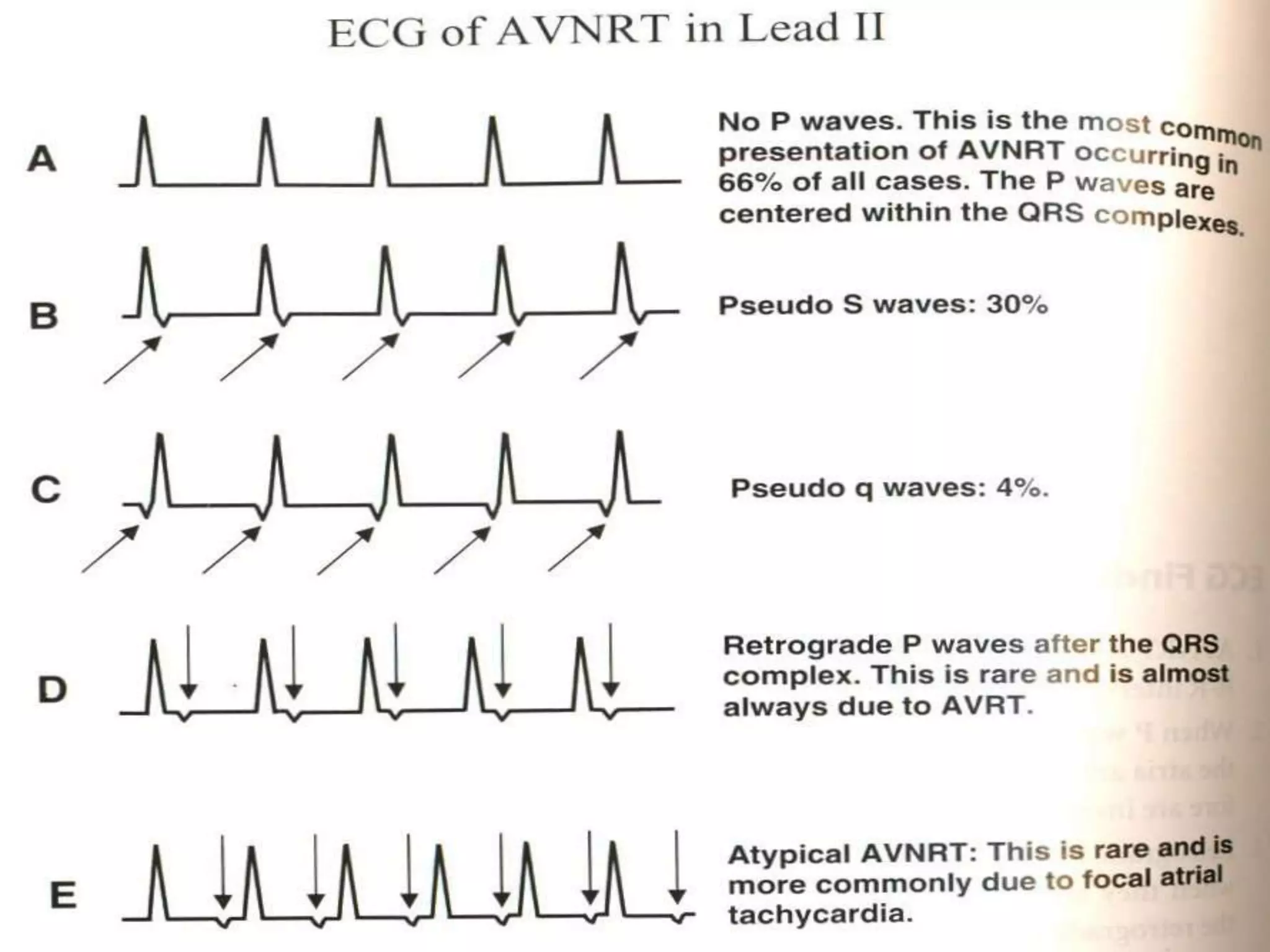
• Presence of a narrow complex tachycardia with regular R-R 
intervals and no visible p waves. 
• P waves are retrograde and are inverted in leads II,III,AVF. 
• P waves are buried in the QRS complexes –simultaneous 
activation of atria and ventricles – most common presentation 
of AVNRT –66%. 
• If not synchronous –pseudo s wave in inferior leads ,pseudo r’ 
wave in lead V1---30% cases . 
• P wave may be farther away from QRS complex distorting the 
ST segment ---AVNRT ,mostly AVRT.
AV NODAL REENTRANT TACHYCARDIA
AVRT 
• Typical – RP interval < PR interval 
• RP interval > 80 milli sec 
• Atypical –RP interval > PR interval 
• Concealed bypass tract – only retrograde conduction 
• Manifest bypass tract– both anterograde and retrograde. 
• Electrical alternans –the amplitude of QRS complexes 
varies by 5 mm alternatively. 
• Rate related BBB occuring and the rate of tachycardia 
is decreasing –then the bypass tract is on the same side 
of the block.
AV REENTRANT TACHYCARDIA
WPW syndrome 
• Two types 
• Orthodromic 
• Antidromic 
• Antidromic is wide complex tachycardia 
• In NSR detected by delta wave. 
• Can ppt into AF and VF on use of AV nodal blockers 
• MEMBRANE ACTIVE ANTIARRHTYHMIC DRUGS are safe. 
• CONCEALED WPW syndrome – no delta wave .less risk of 
AF
Focal Atrial Tachycardia 
• P wave morphology changes. 
• PR interval > 0.12 sec . 
• Second,third degree AV block can occur. 
• Tachycardia terminates with a qrs complex .. 
• Right atrial origin– p wave inverted in V1. 
• Upright in lead AVL 
• Opposite if of left atrial origin 
• Superior origin –upright p waves in inferior leads 
• Inferior origin –p waves are inverted in inferior 
leads.
Multifocal Atrial Tachycardia 
• At least three consequtive p waves with different 
morphologies with a rate > 100 bpm to be present. 
• Isoelectric baseline between p waves. 
• Also called as choatic atrial tachycardia 
• Mostly seen in COPD ,electrolyte abn,theophylline 
• Rate usually does not exceed 130-140 bpm.
Multifocal Atrial Tachycardia
SANRT 
• Microreentrant tachycardia 
• Usually precipitated and terminated by 
premature atrial complexes. 
• Atrial rate is usually 120-150 bpm. 
• AV block can occur.
Junctional tachycardias 
• Non paroxysmal – accelerated junctional rhythm 
• Rate < 100 bpm Usually junctional node 40-60 bpm 
• Paroxysmal or focal junctional tachycardia is rare – 
automaticity. 
• 110-250bpm. 
• P waves may be before or after QRS complex 
• Infrequent and nonsustained episodes –no treatment 
• Acute termination of SVT establish the mechanism of SVT in 
case of acute setting. 
• Long term goal is abolishing the arryhthmia substrate. 
• Precipitating factors – electrolyte 
imbalance,hypoxia,ischemia,hyperthyroidism to be sought 
out.
TREATMENT OF SVT
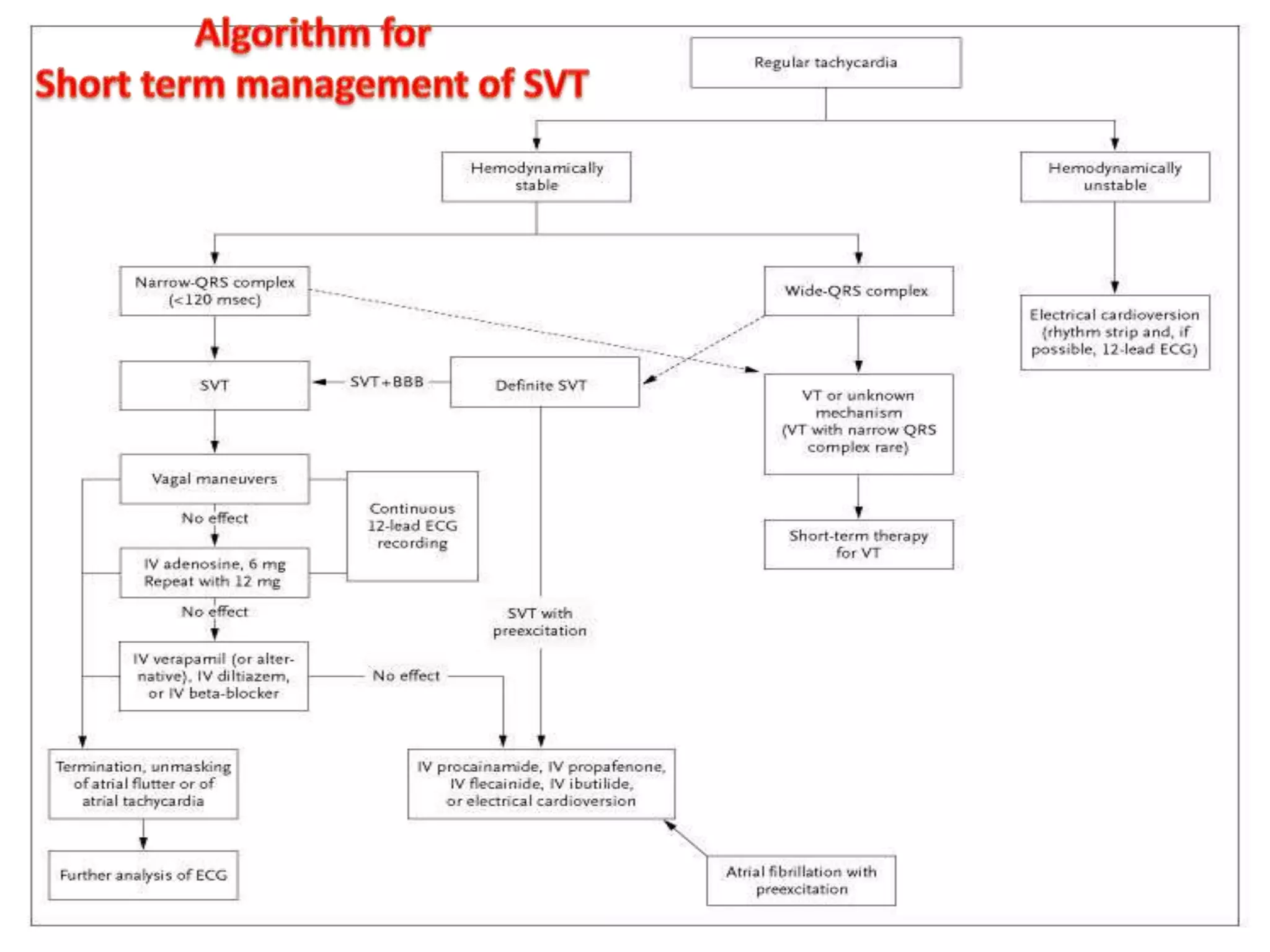
• A 12 lead ECG during tachycardia and NSR. 
• No delay in therapy if the mechanism of SVT is not 
known. 
• Perform CAROTID SINUS MASSAGE,or give 6mg 
bolus adenosine. 
• In case of severe hemodynamic compromise a 
synchronised cardioversion to be given.
Carotid sinus massage 
• Check for carotid bruit before massage. 
• At the level of cricoid cartilage,at the angle of mandible 
the carotid sinus is situated. 
• Gentle pressure is applied over the carotid sinus for 5 - 
10 seconds. 
• ECG recording to be present. 
• In case of no response – try on the other side. 
• Simultaneous pressure not to be applied both sides. 
• Alternative manuevres are valsalva,gag reflex,ice water 
pouring over the face.
• If SVT is suspected to be AVnode dependent – 
drug of choice is adenosine and CCBs 
verapamil and diltiazem. 
• But digoxin,BBs,CCBs better control of 
ventricular response in atrial tachycardias 
• Class I agents to be combined with AV nodal 
blocking drugs – to eliminate 1:1 conduction 
of atrial to ventricles.
HEMODYNAMIC 
STATUS 
STABLE BP 
>90/60 mmHg 
Narrow QRS 
and regular 
R-R 
Vagal maneuveres 
IV adenosine 
IV verapamil,diltiazem 
IV sotalol 
Refractory 
Wide QRS 
complex 
Vagal manuevres 
IV adenosine 
procainamide 
cardioversion 
Digoxin 
Verapamil 
UNSTABLE 
BP< 90/60 
mmHg 
Direct 
Are contraindicated
DRUG DOSE SIDE EFFECTS 
AV NODAL 
BLOCKERS 
ADENOSINE 6-12 mg bolus Flushing ,dyspnea 
Chest pain 
VERAPAMIL 0.15 mg/kg over 2 min Hypotension bradycardia 
DILTIAZEM 0.25-0.35 mg/kg -2 min same 
DIGOXIN 0.5-1.0 mg --- 2-10 min Digoxin toxicity 
PROPANOLOL 1-3mg over I min Hypotension bradycardia 
CLASS I AAD QUINIDINE 6-10MG/KG at 10 mg/min hypotension 
PROCAINAMIDE 10-15mg/kg at 50 mg/min hypotension 
DISOPYRAMIDE 1-2 mg/kg at 10 mg/min hypotension 
PROPAFENONE 1-2mg/min at 10 mg/min Bradycardia,GI disturbance 
FLECAINIDE 2 mg/kg at 10 mg/min Bradycardia,dizziness 
CLASS III SOTALOL 1-1.5mg/kg at 10 mg/min Hypotension,proarrythmic 
AMIODARONE 1.5 mg/kg during 15 min Hypotension,bradycardia
Pill in the pocket approach 
 In whom recurrences are infrequent. 
 But sustained.well tolerated hemodynamically. 
 Patients who have had only a single episode of SVT.. 
 100-200mg of flecainide at the onset of SVT is a reasonable 
approach…until he reaches the hospital. 
 40-160 mg verapamil –without preexcitation, 
 Betablockers 
 Propafenone 150-450 mg. 
 80% cases interrupted with a combination of CCBand BB in 2 
hrs…
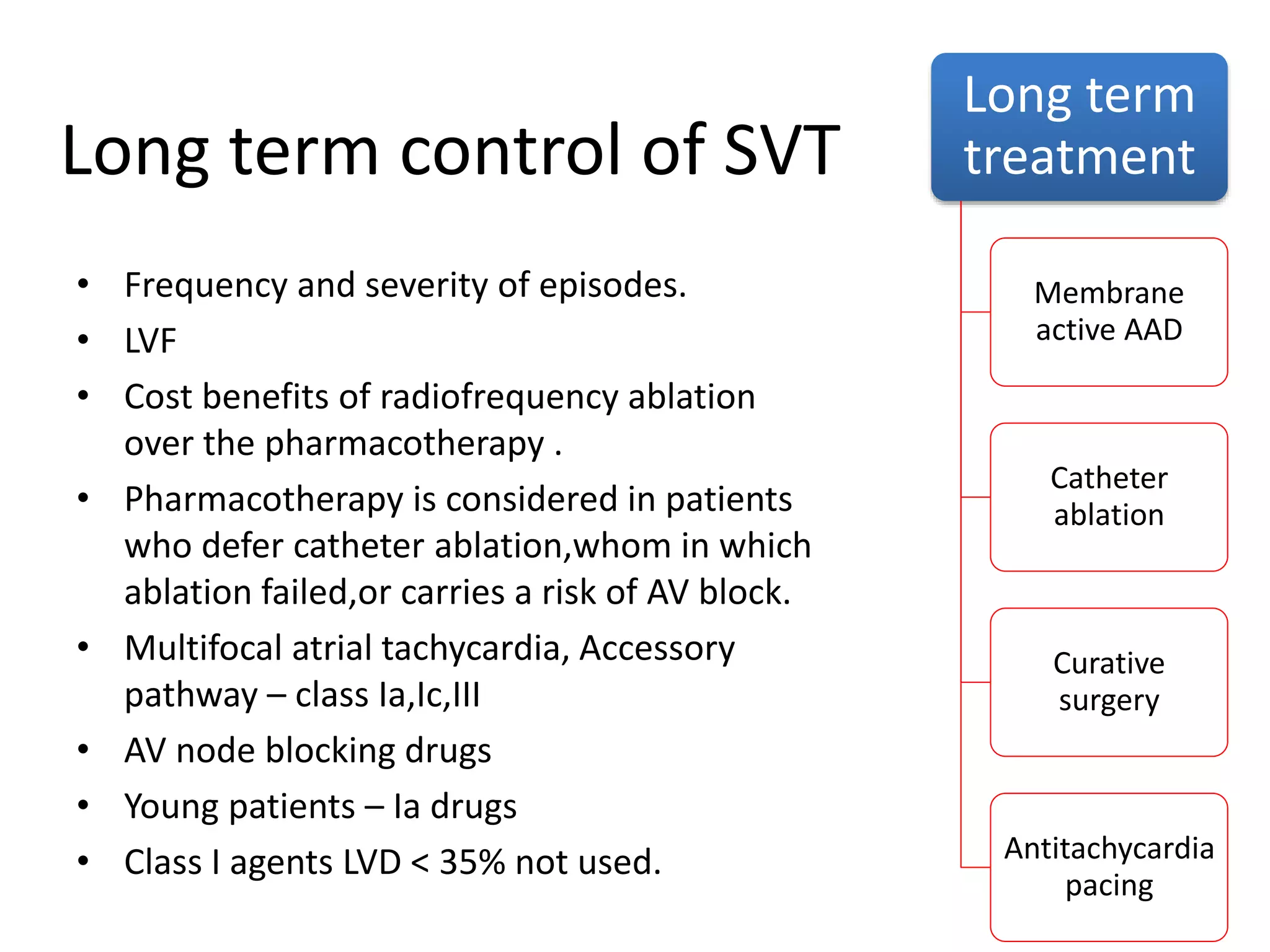
Long term control of SVT 
• Frequency and severity of episodes. 
• LVF 
• Cost benefits of radiofrequency ablation 
over the pharmacotherapy . 
• Pharmacotherapy is considered in patients 
who defer catheter ablation,whom in which 
ablation failed,or carries a risk of AV block. 
• Multifocal atrial tachycardia, Accessory 
pathway – class Ia,Ic,III 
• AV node blocking drugs 
• Young patients – Ia drugs 
• Class I agents LVD < 35% not used. 
Long term 
treatment 
Membrane 
active AAD 
Catheter 
ablation 
Curative 
surgery 
Antitachycardia 
pacing
Adenosine 
 not to be used in bronchospastic pulmonary 
disease. 
 Adenosine precipitates asthma 
 Given rapidly in 1-2 sec. 
 If given by peripheral vein uplift the arm.. 
 Max dose is 30 mg 
6- 12-12 mg 
Terminates AVNRT .AFL with 2:1 block 
 Potentiated by dipyradimole,carbamazepine – 
decrease dose to 3 mg.
Other drugs 
 Calcium channel blockers,beta blockers ,digoxin 
are the next drugs to be used if not responded to 
adenosine 
 Usually 60 % cases respond to a dose of 6 mg and 
95 % cases at 12 mg. 
Type 1 a AAD, 1c,iii,AMIODARONE in 
refractory cases. 
 Beta blockers not to used IV in heart failure. 
Long term treatment in case of recuurent 
episodes,hemodynamic instability.
Catheter guided 
Radiofrequency Ablation 
• Several multipolar catheters are introduced 
• High right atrium ,bundle of his 
,RVapex,Coronary sinus. 
• Radiofrequency is delivered at the site of earlier 
activation 
• Success is defined by elimination of the 
tachycardia or loss of pre excitation. 
• 90-98% success in AV node dependent 
• 60-80% in case of AV node independent. 
• Cryoablation more useful…
Catheter Ablation of Cardiac Arrhythmias.
Some important points 
• When the QRS complex is wide and VT is mistaken as 
SVT with ABERRANT conduction IV verapamil – not 
recommended decreases BP. 
• If DC cardioversion to be avoided because of possible 
adverse response to digitalis adm …pacing Rt atrium and 
ventricle via temp pacing. 
• In WPW syndrome avoid VERAPAMIL,LIDOCAINE . 
• Avoid digoxin. 
• In SANRT –class IA,IC ,BB 
• SANRT –digoxin.
Cont… 
• Rx of ectopic atrial tachycardia – consider digitalis 
toxicity,chronic lung disease,metabolic 
abn,electrolyte abnormalities,acute MI ----temporary 
pacing 
• Removal or reversal of inciting factor 
• Surgical excision of focus. 
• Rx of MAT –chronic lung disease,metabolic,rare is 
digitalis toxicity ---CCBS,BBs ..no role of 
cardioversion,devices ,surgery.
In case of WPW syndrome 
symptomatic concealed or 
manifested ..and evidence of 
preexcitation on NSR …send the 
patient for catheter ablation…
Special problems 
• 1.Coexisting Double Tachycardias 
• May not be identified during noninvasive testing ..needs EP 
study. 
• Ex—typical AVNRT and AT. 
• Concentric –eccentric –concentric. 
• AVNRT –both APC,VPC 
• AT only APC 
• 2.Pseudo AF- infrequent presentation of PSVT. 
• Occurs during onset and termination of tahcycardia. 
• Multiple accessory AV pathways. 
• In young who have AF without other risk factors. 
• 5% of AVNRT. 
• Group beating is seen
Thank 
you

Approch narrow complex tachycardia

  • 1.
    APPROACH TO NARROWQRS COMPLEX TACHYCARDIA Dr Dharam Prakash Saran
  • 2.
    STEP wise •Look for QRS duration. • QRS complex regular/irregular. • Then look for presence of p waves. • P waves morphology • P waves and QRS relationship 1:1 • AV block present. • Termination initiation of tachycardia. • Effect of BBB on tachycardia cycle length.
  • 6.
    In brief fromthe diagram clues • Response to carotid sinus massage or adenosine –with termination of arrhythmia with Pwave –AVNRT • Tachycardia persists with AV block –AT,AFL,SANRT • Pseudo r ‘ wave in V1 –AVNRT • SHORT RP interval – AVNRT,AVRT • Long RP interval – AT,SANRT,AVNRT atypical
  • 7.
    NARROW COMPLEX QRS TACHYCARDIA SHORT RP INTERVAL TYPICAL AVNRT AVRT LONG RP INTERVAL ATYPICAL AVNRT AVRT slow retrograde conduction Permanent Form junctional tachycardia ATRIAL TACHYCARDIA SANRT INAPPROPRIATE ST
  • 8.
  • 9.
    Pwaves no Irregular R-R interval ATRIAL FIBRILLATION Regular R-R interval AVNRT yes NORMAL MORPHOLOGY SINUS TACHYCARDIA SINUS NODE REENTRY INAPPROPRIATE SINUS TACHYCARDIA
  • 14.
  • 15.
    P wave presentbut not of same morphology as sinus rhythm Pseudo r’ wave in V1 AVNRT Pseudo S wave on lead II AVNRT Pwave ST-T changes Positive in lead I AVRT Right posteroseptal Accessory pathway Negative in lead I AVRT Left sided accessory pathway
  • 16.
    AVNRT • Presenceof a narrow complex tachycardia with regular R-R intervals and no visible p waves. • P waves are retrograde and are inverted in leads II,III,AVF. • P waves are buried in the QRS complexes –simultaneous activation of atria and ventricles – most common presentation of AVNRT –66%. • If not synchronous –pseudo s wave in inferior leads ,pseudo r’ wave in lead V1---30% cases . • P wave may be farther away from QRS complex distorting the ST segment ---AVNRT ,mostly AVRT.
  • 17.
    AV NODAL REENTRANTTACHYCARDIA
  • 20.
    AVRT • Typical– RP interval < PR interval • RP interval > 80 milli sec • Atypical –RP interval > PR interval • Concealed bypass tract – only retrograde conduction • Manifest bypass tract– both anterograde and retrograde. • Electrical alternans –the amplitude of QRS complexes varies by 5 mm alternatively. • Rate related BBB occuring and the rate of tachycardia is decreasing –then the bypass tract is on the same side of the block.
  • 21.
  • 25.
    WPW syndrome •Two types • Orthodromic • Antidromic • Antidromic is wide complex tachycardia • In NSR detected by delta wave. • Can ppt into AF and VF on use of AV nodal blockers • MEMBRANE ACTIVE ANTIARRHTYHMIC DRUGS are safe. • CONCEALED WPW syndrome – no delta wave .less risk of AF
  • 29.
    Focal Atrial Tachycardia • P wave morphology changes. • PR interval > 0.12 sec . • Second,third degree AV block can occur. • Tachycardia terminates with a qrs complex .. • Right atrial origin– p wave inverted in V1. • Upright in lead AVL • Opposite if of left atrial origin • Superior origin –upright p waves in inferior leads • Inferior origin –p waves are inverted in inferior leads.
  • 31.
    Multifocal Atrial Tachycardia • At least three consequtive p waves with different morphologies with a rate > 100 bpm to be present. • Isoelectric baseline between p waves. • Also called as choatic atrial tachycardia • Mostly seen in COPD ,electrolyte abn,theophylline • Rate usually does not exceed 130-140 bpm.
  • 32.
  • 33.
    SANRT • Microreentranttachycardia • Usually precipitated and terminated by premature atrial complexes. • Atrial rate is usually 120-150 bpm. • AV block can occur.
  • 34.
    Junctional tachycardias •Non paroxysmal – accelerated junctional rhythm • Rate < 100 bpm Usually junctional node 40-60 bpm • Paroxysmal or focal junctional tachycardia is rare – automaticity. • 110-250bpm. • P waves may be before or after QRS complex • Infrequent and nonsustained episodes –no treatment • Acute termination of SVT establish the mechanism of SVT in case of acute setting. • Long term goal is abolishing the arryhthmia substrate. • Precipitating factors – electrolyte imbalance,hypoxia,ischemia,hyperthyroidism to be sought out.
  • 35.
  • 36.
    • A 12lead ECG during tachycardia and NSR. • No delay in therapy if the mechanism of SVT is not known. • Perform CAROTID SINUS MASSAGE,or give 6mg bolus adenosine. • In case of severe hemodynamic compromise a synchronised cardioversion to be given.
  • 37.
    Carotid sinus massage • Check for carotid bruit before massage. • At the level of cricoid cartilage,at the angle of mandible the carotid sinus is situated. • Gentle pressure is applied over the carotid sinus for 5 - 10 seconds. • ECG recording to be present. • In case of no response – try on the other side. • Simultaneous pressure not to be applied both sides. • Alternative manuevres are valsalva,gag reflex,ice water pouring over the face.
  • 38.
    • If SVTis suspected to be AVnode dependent – drug of choice is adenosine and CCBs verapamil and diltiazem. • But digoxin,BBs,CCBs better control of ventricular response in atrial tachycardias • Class I agents to be combined with AV nodal blocking drugs – to eliminate 1:1 conduction of atrial to ventricles.
  • 39.
    HEMODYNAMIC STATUS STABLEBP >90/60 mmHg Narrow QRS and regular R-R Vagal maneuveres IV adenosine IV verapamil,diltiazem IV sotalol Refractory Wide QRS complex Vagal manuevres IV adenosine procainamide cardioversion Digoxin Verapamil UNSTABLE BP< 90/60 mmHg Direct Are contraindicated
  • 40.
    DRUG DOSE SIDEEFFECTS AV NODAL BLOCKERS ADENOSINE 6-12 mg bolus Flushing ,dyspnea Chest pain VERAPAMIL 0.15 mg/kg over 2 min Hypotension bradycardia DILTIAZEM 0.25-0.35 mg/kg -2 min same DIGOXIN 0.5-1.0 mg --- 2-10 min Digoxin toxicity PROPANOLOL 1-3mg over I min Hypotension bradycardia CLASS I AAD QUINIDINE 6-10MG/KG at 10 mg/min hypotension PROCAINAMIDE 10-15mg/kg at 50 mg/min hypotension DISOPYRAMIDE 1-2 mg/kg at 10 mg/min hypotension PROPAFENONE 1-2mg/min at 10 mg/min Bradycardia,GI disturbance FLECAINIDE 2 mg/kg at 10 mg/min Bradycardia,dizziness CLASS III SOTALOL 1-1.5mg/kg at 10 mg/min Hypotension,proarrythmic AMIODARONE 1.5 mg/kg during 15 min Hypotension,bradycardia
  • 44.
    Pill in thepocket approach  In whom recurrences are infrequent.  But sustained.well tolerated hemodynamically.  Patients who have had only a single episode of SVT..  100-200mg of flecainide at the onset of SVT is a reasonable approach…until he reaches the hospital.  40-160 mg verapamil –without preexcitation,  Betablockers  Propafenone 150-450 mg.  80% cases interrupted with a combination of CCBand BB in 2 hrs…
  • 45.
    Long term controlof SVT • Frequency and severity of episodes. • LVF • Cost benefits of radiofrequency ablation over the pharmacotherapy . • Pharmacotherapy is considered in patients who defer catheter ablation,whom in which ablation failed,or carries a risk of AV block. • Multifocal atrial tachycardia, Accessory pathway – class Ia,Ic,III • AV node blocking drugs • Young patients – Ia drugs • Class I agents LVD < 35% not used. Long term treatment Membrane active AAD Catheter ablation Curative surgery Antitachycardia pacing
  • 46.
    Adenosine  notto be used in bronchospastic pulmonary disease.  Adenosine precipitates asthma  Given rapidly in 1-2 sec.  If given by peripheral vein uplift the arm..  Max dose is 30 mg 6- 12-12 mg Terminates AVNRT .AFL with 2:1 block  Potentiated by dipyradimole,carbamazepine – decrease dose to 3 mg.
  • 47.
    Other drugs Calcium channel blockers,beta blockers ,digoxin are the next drugs to be used if not responded to adenosine  Usually 60 % cases respond to a dose of 6 mg and 95 % cases at 12 mg. Type 1 a AAD, 1c,iii,AMIODARONE in refractory cases.  Beta blockers not to used IV in heart failure. Long term treatment in case of recuurent episodes,hemodynamic instability.
  • 48.
    Catheter guided RadiofrequencyAblation • Several multipolar catheters are introduced • High right atrium ,bundle of his ,RVapex,Coronary sinus. • Radiofrequency is delivered at the site of earlier activation • Success is defined by elimination of the tachycardia or loss of pre excitation. • 90-98% success in AV node dependent • 60-80% in case of AV node independent. • Cryoablation more useful…
  • 49.
    Catheter Ablation ofCardiac Arrhythmias.
  • 50.
    Some important points • When the QRS complex is wide and VT is mistaken as SVT with ABERRANT conduction IV verapamil – not recommended decreases BP. • If DC cardioversion to be avoided because of possible adverse response to digitalis adm …pacing Rt atrium and ventricle via temp pacing. • In WPW syndrome avoid VERAPAMIL,LIDOCAINE . • Avoid digoxin. • In SANRT –class IA,IC ,BB • SANRT –digoxin.
  • 51.
    Cont… • Rxof ectopic atrial tachycardia – consider digitalis toxicity,chronic lung disease,metabolic abn,electrolyte abnormalities,acute MI ----temporary pacing • Removal or reversal of inciting factor • Surgical excision of focus. • Rx of MAT –chronic lung disease,metabolic,rare is digitalis toxicity ---CCBS,BBs ..no role of cardioversion,devices ,surgery.
  • 52.
    In case ofWPW syndrome symptomatic concealed or manifested ..and evidence of preexcitation on NSR …send the patient for catheter ablation…
  • 53.
    Special problems •1.Coexisting Double Tachycardias • May not be identified during noninvasive testing ..needs EP study. • Ex—typical AVNRT and AT. • Concentric –eccentric –concentric. • AVNRT –both APC,VPC • AT only APC • 2.Pseudo AF- infrequent presentation of PSVT. • Occurs during onset and termination of tahcycardia. • Multiple accessory AV pathways. • In young who have AF without other risk factors. • 5% of AVNRT. • Group beating is seen
  • 54.