SUPERFICIAL REFLEXES
INTRODUCTION
– They are elcited by stimulation of certain parts of the skin or mucous membrane and the end result being
contraction of one or more muscles.
- They are polysynaptic reflexes.
- They are lost in lesions of corticospinal tract.
OTHER METHODS OF ELICITING PLANTAR REFLEX
1. Squeezing the calf or pressing heavily along the inner border of the tibia (oppenheim’s Reflex)
2. Hard squeezed on the calf muscles (Gordon’s reflex)
3. Light stroke below the external malleous on the outer surface of the foot. (Chaddock Reflex)
4. Squeezing Achilles Tendon. (Schaefer’s Sign).
5. Pin pick on the dorsum of the foot. (Bing Sign).
CONDITIONS WHERE BABINSKI’S SIGN IS POSITIVE
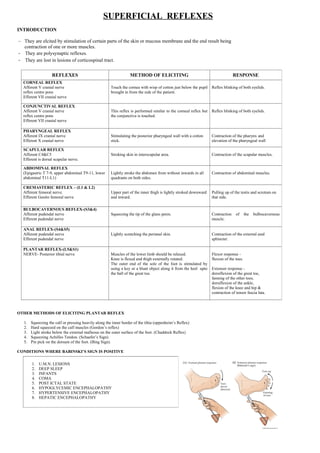
REFLEXES METHOD OF ELICITING RESPONSE
CORNEAL REFLEX
Afferent V cranial nerve
reflex centre pons
Efferent VII cranial nerve
Touch the cornea with wisp of cotton just below the pupil
brought in from the side of the patient.
Reflex blinking of both eyelids.
CONJUNCTIVAL REFLEX
Afferent V cranial nerve
reflex centre pons
Efferent VII cranial nerve
This reflex is performed similar to the corneal reflex but
the conjunctiva is touched.
Reflex blinking of both eyelids.
PHARYNGEAL REFLEX
Afferent IX cranial nerve
Efferent X cranial nerve
Stimulating the posterior pharyngeal wall with a cotton
stick.
Contraction of the pharynx and
elevation of the pharyngeal wall
SCAPULAR REFLEX
Afferent C4&C5
Efferent is dorsal scapular nerve.
Stroking skin in interscapular area. Contraction of the scapular muscles.
ABDOMINAL REFLEX
(Epigastric T 7-9, upper abdominal T9-11, lower
abdominal T11-L1)
Lightly stroke the abdomen from without inwards in all
quadrants on both sides.
Contraction of abdominal muscles.
CREMASTERIC REFLEX – (L1 & L2)
Afferent femoral nerve.
Efferent Genito femoral nerve
Upper part of the inner thigh is lightly stroked downward
and inward.
Pulling up of the testis and scrotum on
that side.
BULBOCAVERNOUS REFLEX-(S3&4)
Afferent pudendal nerve
Efferent pudendal nerve
Squeezing the tip of the glans penis. Contraction of the bulbocavernous
muscle.
ANAL REFLEX-(S4&S5)
Afferent pudendal nerve
Efferent pudendal nerve
Lightly scratching the perianal skin. Contraction of the external anal
sphincter.
PLANTAR REFLEX-(L5&S1)
NERVE- Posterior tibial nerve Muscles of the lower limb should be relaxed.
Knee is flexed and thigh externally rotated.
The outer end of the sole of the foot is stimulated by
using a key or a blunt object along it from the heel upto
the ball of the great toe.
Flexor response -
flexion of the toes.
Extensor response -
dorsiflexion of the great toe,
fanning of the other toes,
dorsiflexion of the ankle,
flexion of the knee and hip &
contraction of tensor fascia lata.
1. U.M.N. LESIONS
2. DEEP SLEEP
3. INFANTS
4. COMA
5. POST ICTAL STATE
6. HYPOGLYCEMIC ENCEPHALOPATHY
7. HYPERTENSIVE ENCEPHALOPATHY
8. HEPATIC ENCEPHALOPATHY

Superficial reflexes

  • 1.
    SUPERFICIAL REFLEXES INTRODUCTION – Theyare elcited by stimulation of certain parts of the skin or mucous membrane and the end result being contraction of one or more muscles. - They are polysynaptic reflexes. - They are lost in lesions of corticospinal tract. OTHER METHODS OF ELICITING PLANTAR REFLEX 1. Squeezing the calf or pressing heavily along the inner border of the tibia (oppenheim’s Reflex) 2. Hard squeezed on the calf muscles (Gordon’s reflex) 3. Light stroke below the external malleous on the outer surface of the foot. (Chaddock Reflex) 4. Squeezing Achilles Tendon. (Schaefer’s Sign). 5. Pin pick on the dorsum of the foot. (Bing Sign). CONDITIONS WHERE BABINSKI’S SIGN IS POSITIVE REFLEXES METHOD OF ELICITING RESPONSE CORNEAL REFLEX Afferent V cranial nerve reflex centre pons Efferent VII cranial nerve Touch the cornea with wisp of cotton just below the pupil brought in from the side of the patient. Reflex blinking of both eyelids. CONJUNCTIVAL REFLEX Afferent V cranial nerve reflex centre pons Efferent VII cranial nerve This reflex is performed similar to the corneal reflex but the conjunctiva is touched. Reflex blinking of both eyelids. PHARYNGEAL REFLEX Afferent IX cranial nerve Efferent X cranial nerve Stimulating the posterior pharyngeal wall with a cotton stick. Contraction of the pharynx and elevation of the pharyngeal wall SCAPULAR REFLEX Afferent C4&C5 Efferent is dorsal scapular nerve. Stroking skin in interscapular area. Contraction of the scapular muscles. ABDOMINAL REFLEX (Epigastric T 7-9, upper abdominal T9-11, lower abdominal T11-L1) Lightly stroke the abdomen from without inwards in all quadrants on both sides. Contraction of abdominal muscles. CREMASTERIC REFLEX – (L1 & L2) Afferent femoral nerve. Efferent Genito femoral nerve Upper part of the inner thigh is lightly stroked downward and inward. Pulling up of the testis and scrotum on that side. BULBOCAVERNOUS REFLEX-(S3&4) Afferent pudendal nerve Efferent pudendal nerve Squeezing the tip of the glans penis. Contraction of the bulbocavernous muscle. ANAL REFLEX-(S4&S5) Afferent pudendal nerve Efferent pudendal nerve Lightly scratching the perianal skin. Contraction of the external anal sphincter. PLANTAR REFLEX-(L5&S1) NERVE- Posterior tibial nerve Muscles of the lower limb should be relaxed. Knee is flexed and thigh externally rotated. The outer end of the sole of the foot is stimulated by using a key or a blunt object along it from the heel upto the ball of the great toe. Flexor response - flexion of the toes. Extensor response - dorsiflexion of the great toe, fanning of the other toes, dorsiflexion of the ankle, flexion of the knee and hip & contraction of tensor fascia lata. 1. U.M.N. LESIONS 2. DEEP SLEEP 3. INFANTS 4. COMA 5. POST ICTAL STATE 6. HYPOGLYCEMIC ENCEPHALOPATHY 7. HYPERTENSIVE ENCEPHALOPATHY 8. HEPATIC ENCEPHALOPATHY