Narrow complex tachycardia
Domina Petric, MD
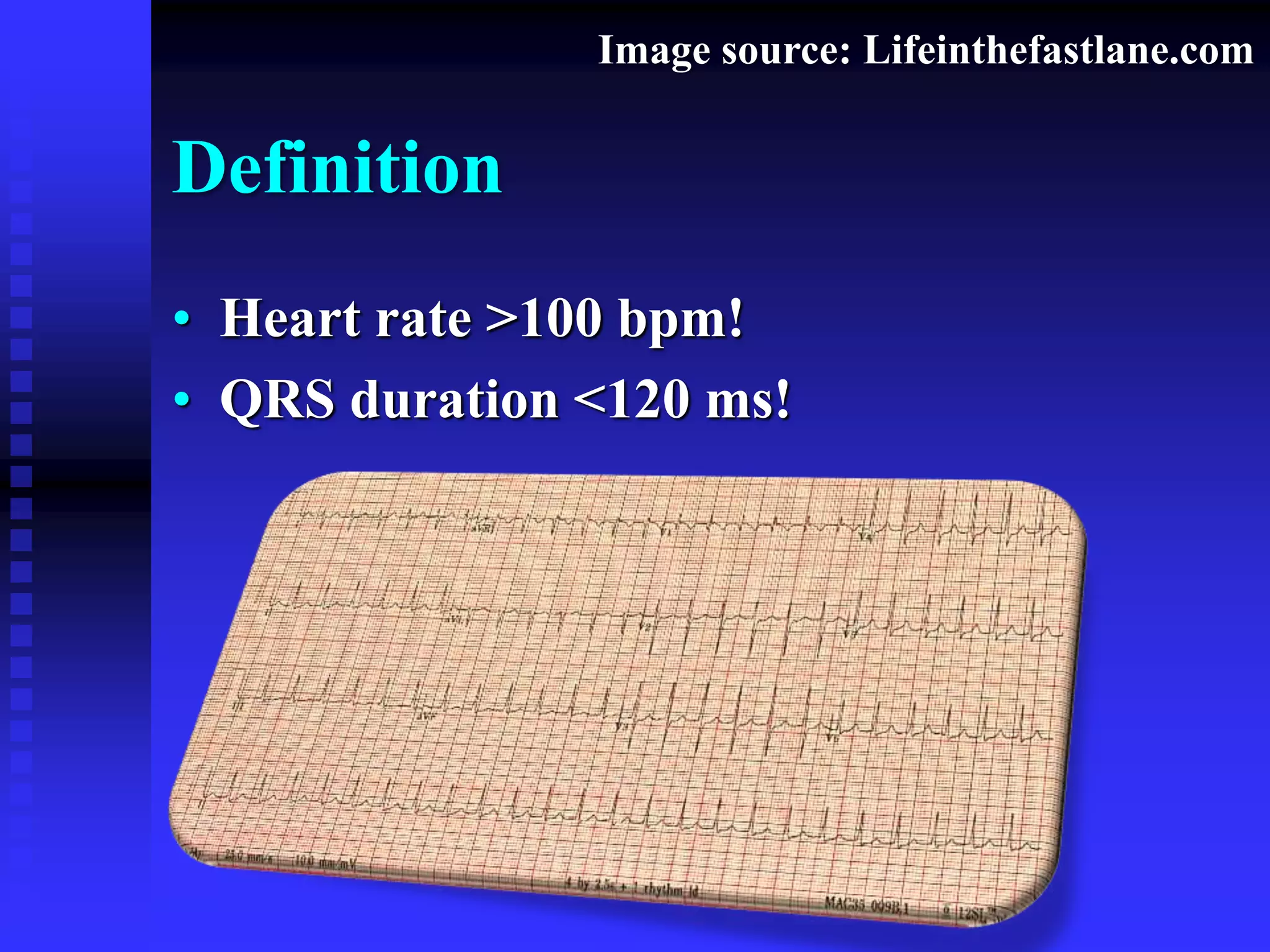
Definition
• Heart rate >100 bpm!
• QRS duration <120 ms!
Image source: Lifeinthefastlane.com
Types of tachycardia
Sinus tachycardia: normal P wave
followed by normal QRS.
Supraventricular tachycardia
(SVT): P wave absent or inverted
after QRS.
Types of tachycardia
• Atrial fibrillation: absent P wave,
irregular QRS complexes.
• Atrial flutter: atrial rate usually 300 bpm
with flutter waves (sawtooth), ventricular
rate 150 bpm (2:1 block).
• Atrial tachycardia: abnormally shaped P
waves, may outnumber QRS complexes.
Types of tachycardia
• Multifocal atrial tachycardia: three
or more P wave morphologies,
irregular QRS complexes.
• Junctional tachycardia: rate 150-
250 bpm, P wave eaither buried in
QRS complex or occurring after
QRS complex.
Management of SVT
Vagal manoeuvres:
• breath holding
• valsalva manoeuvre
• carotid massage
Management of SVT
Vagal manoeuvres can be
used only if the patient is
haemodynamically
stable.
Management of SVT
Adenosine iv. is next step:
• 6 mg iv. bolus into a big vein
• saline flush
• recording a rhythm strip
• after 1-2 min, 12 mg iv. if necessary
Adenosine
• Side effects are transient chest tightness,
dyspnoea, headache and flushing.
• Contraindications: asthma AV block of
second and third degree, sinoatrial
disease (without pacemaker).
• Important drug interactions:
dipyridamole increase levels,
theophylline antagonises adenosine.
Management of SVT
• If adenosine is not effective, verapamil
can be used in dose of 5 mg iv. over 2
minutes (over 3 minutes in elderly).
• Verapamil can not be used if the patient
is taking beta blockers.
• If there is no response, dose of 5 mg iv.
can be repeated after 5-10 minutes.
Management of SVT
Alternatives:
• atenolol 2,5 mg iv. at 1 mg/min repeated
at 5 minutes intervals to a maximum dose
of 10 mg
• sotalol 20-60 mg iv. over 10 minutes in
patients with estimated glomerular
filtration rate more than 60
• DC cardioversion
Atrial tachycardia
Multifocal atrial tachycardia
• Most commonly occurs in COPD.
• There are at least 3 morphologically
distinct P waves with irregular P-P
intervals.
• It is very important to correct hypoxia
and hypercapnia.
• If heart rate >110 bpm, verapamil or a
BB can be used as well.
Image source: lifeinthefastlane.com
There are at least 3
morphologically distinct P
waves with irregular P-P
intervals.
Junctional tachycardia
AV nodal re-entry tachycardia (AVNRT)
AV re-entry tachycardia (AVRT)
His bundle tachycardia
Junctional tachycardia
• Vagal manoeuvres in cases of
anterograde conduction through
the AV node.
• Adenosine!
• Beta blockers or amiodarone!
• Radiofrequency ablation!
Wolff-Parkinson-White
syndrome (WPW)
• It is caused by congenital accessory
conduction pathway between atria
and ventricles.
• ECG: short PR interval, wide QRS
complex due to slurred upstroke
(delta wave) and ST-T changes.
Wolff-Parkinson-White
syndrome (WPW)
• WPW type A: positive delta wave in V1.
• WPW type B: negative delta wave in V1.
Delta wave
Wolff-Parkinson-White
syndrome (WPW)
• Patients may present with SVT.
• Tachycardia may be due to an
AVRT, pre-excited atrial
fibrillation or flutter.
• Electrophysiological testing and
ablation of accessory pathway!
Long Ganong Levine syndrome
It is similar to WPW
syndrome, except
there is no delta
waves!
Holiday heart syndrome
• Binge drinking in a person without
any clinical evidence of heart disease
may result in acute cardiac rhythm
and conduction disturbances.
• Recreational use of marijuana may
have similar effects.
Holiday heart syndrome
Stop heavy
drinking!
Literature
• Oxford Handbook of Clinical Medicine.
Longmore M. Wilkinson I. B. Baldwin A.
Elizabeth W. Ninth edition.
• Lifeinthefastlane.com
• Ecgcore.com

Narrow complex tachycardia

  • 1.
  • 2.
    Definition • Heart rate>100 bpm! • QRS duration <120 ms! Image source: Lifeinthefastlane.com
  • 3.
    Types of tachycardia Sinustachycardia: normal P wave followed by normal QRS. Supraventricular tachycardia (SVT): P wave absent or inverted after QRS.
  • 4.
    Types of tachycardia •Atrial fibrillation: absent P wave, irregular QRS complexes. • Atrial flutter: atrial rate usually 300 bpm with flutter waves (sawtooth), ventricular rate 150 bpm (2:1 block). • Atrial tachycardia: abnormally shaped P waves, may outnumber QRS complexes.
  • 5.
    Types of tachycardia •Multifocal atrial tachycardia: three or more P wave morphologies, irregular QRS complexes. • Junctional tachycardia: rate 150- 250 bpm, P wave eaither buried in QRS complex or occurring after QRS complex.
  • 6.
    Management of SVT Vagalmanoeuvres: • breath holding • valsalva manoeuvre • carotid massage
  • 7.
    Management of SVT Vagalmanoeuvres can be used only if the patient is haemodynamically stable.
  • 8.
    Management of SVT Adenosineiv. is next step: • 6 mg iv. bolus into a big vein • saline flush • recording a rhythm strip • after 1-2 min, 12 mg iv. if necessary
  • 9.
    Adenosine • Side effectsare transient chest tightness, dyspnoea, headache and flushing. • Contraindications: asthma AV block of second and third degree, sinoatrial disease (without pacemaker). • Important drug interactions: dipyridamole increase levels, theophylline antagonises adenosine.
  • 10.
    Management of SVT •If adenosine is not effective, verapamil can be used in dose of 5 mg iv. over 2 minutes (over 3 minutes in elderly). • Verapamil can not be used if the patient is taking beta blockers. • If there is no response, dose of 5 mg iv. can be repeated after 5-10 minutes.
  • 11.
    Management of SVT Alternatives: •atenolol 2,5 mg iv. at 1 mg/min repeated at 5 minutes intervals to a maximum dose of 10 mg • sotalol 20-60 mg iv. over 10 minutes in patients with estimated glomerular filtration rate more than 60 • DC cardioversion
  • 12.
  • 13.
    Multifocal atrial tachycardia •Most commonly occurs in COPD. • There are at least 3 morphologically distinct P waves with irregular P-P intervals. • It is very important to correct hypoxia and hypercapnia. • If heart rate >110 bpm, verapamil or a BB can be used as well.
  • 14.
    Image source: lifeinthefastlane.com Thereare at least 3 morphologically distinct P waves with irregular P-P intervals.
  • 15.
    Junctional tachycardia AV nodalre-entry tachycardia (AVNRT) AV re-entry tachycardia (AVRT) His bundle tachycardia
  • 16.
    Junctional tachycardia • Vagalmanoeuvres in cases of anterograde conduction through the AV node. • Adenosine! • Beta blockers or amiodarone! • Radiofrequency ablation!
  • 17.
    Wolff-Parkinson-White syndrome (WPW) • Itis caused by congenital accessory conduction pathway between atria and ventricles. • ECG: short PR interval, wide QRS complex due to slurred upstroke (delta wave) and ST-T changes.
  • 18.
    Wolff-Parkinson-White syndrome (WPW) • WPWtype A: positive delta wave in V1. • WPW type B: negative delta wave in V1. Delta wave
  • 19.
    Wolff-Parkinson-White syndrome (WPW) • Patientsmay present with SVT. • Tachycardia may be due to an AVRT, pre-excited atrial fibrillation or flutter. • Electrophysiological testing and ablation of accessory pathway!
  • 20.
    Long Ganong Levinesyndrome It is similar to WPW syndrome, except there is no delta waves!
  • 21.
    Holiday heart syndrome •Binge drinking in a person without any clinical evidence of heart disease may result in acute cardiac rhythm and conduction disturbances. • Recreational use of marijuana may have similar effects.
  • 22.
  • 23.
  • 24.
    Literature • Oxford Handbookof Clinical Medicine. Longmore M. Wilkinson I. B. Baldwin A. Elizabeth W. Ninth edition. • Lifeinthefastlane.com • Ecgcore.com