TACHYARRYTHMIAS
Dr RAVI KANTH
DEFINITION
ANATOMY OF CONDUCTION
ELECTROPHYSIOLOGY
DIAGNOSTIC APPROACH
TREATMENT MODALITIES
DESCRIPTION ABOUT INDIVIDUAL ARRYTHMIAS
2
DEFINITION
 Any disturbance of the heart's rhythm,
regular or irregular, resulting by
convention in a rate over 100 beats/min .
3
CONDUCTION SYSTEM OF THE HEART AND
ELECTROCARDIOGRAPHY
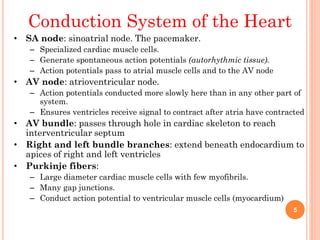
Conduction System of the Heart
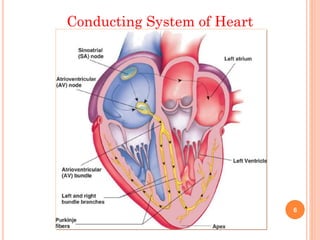
• SA node: sinoatrial node. The pacemaker.
– Specialized cardiac muscle cells.
– Generate spontaneous action potentials (autorhythmic tissue).
– Action potentials pass to atrial muscle cells and to the AV node
• AV node: atrioventricular node.
– Action potentials conducted more slowly here than in any other part of
system.
– Ensures ventricles receive signal to contract after atria have contracted
• AV bundle: passes through hole in cardiac skeleton to reach
interventricular septum
• Right and left bundle branches: extend beneath endocardium to
apices of right and left ventricles
• Purkinje fibers:
– Large diameter cardiac muscle cells with few myofibrils.
– Many gap junctions.
– Conduct action potential to ventricular muscle cells (myocardium)
5
Conducting System of Heart
6
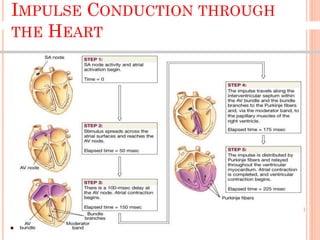
IMPULSE CONDUCTION THROUGH
THE HEART
7
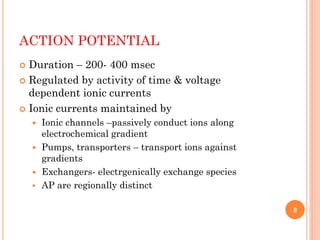
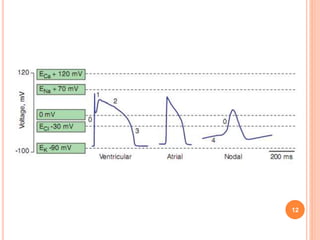
ACTION POTENTIAL
 Duration – 200- 400 msec
 Regulated by activity of time & voltage
dependent ionic currents
 Ionic currents maintained by
 Ionic channels –passively conduct ions along
electrochemical gradient
 Pumps, transporters – transport ions against
gradients
 Exchangers- electrgenically exchange species
 AP are regionally distinct
8
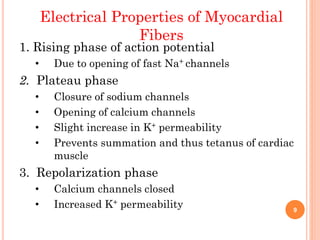
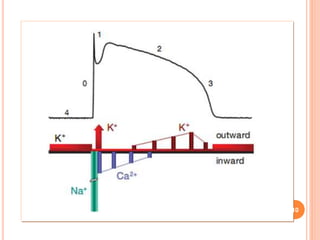
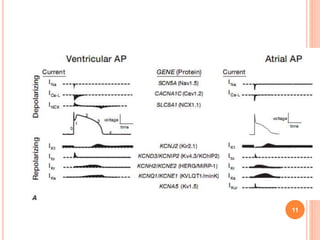
Electrical Properties of Myocardial
Fibers
1. Rising phase of action potential
• Due to opening of fast Na+ channels
2. Plateau phase
• Closure of sodium channels
• Opening of calcium channels
• Slight increase in K+ permeability
• Prevents summation and thus tetanus of cardiac
muscle
3. Repolarization phase
• Calcium channels closed
• Increased K+ permeability 9
10
11
12
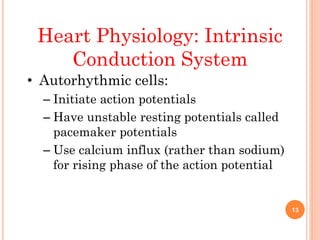
Heart Physiology: Intrinsic
Conduction System
• Autorhythmic cells:
– Initiate action potentials
– Have unstable resting potentials called
pacemaker potentials
– Use calcium influx (rather than sodium)
for rising phase of the action potential
13
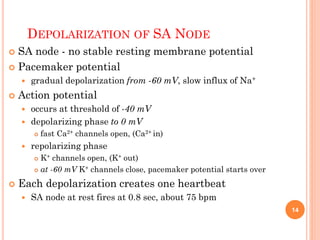
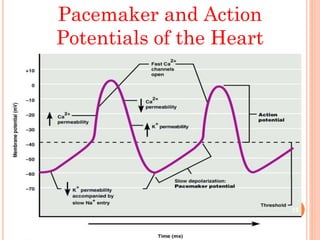
DEPOLARIZATION OF SA NODE
 SA node - no stable resting membrane potential
 Pacemaker potential
 gradual depolarization from -60 mV, slow influx of Na+
 Action potential
 occurs at threshold of -40 mV
 depolarizing phase to 0 mV
 fast Ca2+ channels open, (Ca2+ in)
 repolarizing phase
 K+ channels open, (K+ out)
 at -60 mV K+ channels close, pacemaker potential starts over
 Each depolarization creates one heartbeat
 SA node at rest fires at 0.8 sec, about 75 bpm
14
Pacemaker and Action
Potentials of the Heart
15
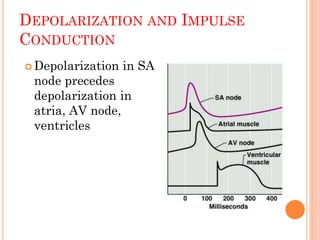
DEPOLARIZATION AND IMPULSE
CONDUCTION
 Depolarization in SA
node precedes
depolarization in
atria, AV node,
ventricles
16
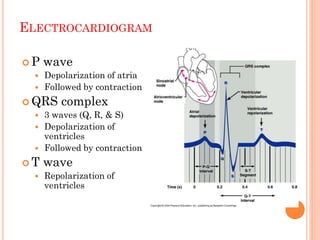
ELECTROCARDIOGRAM
 P wave
 Depolarization of atria
 Followed by contraction
 QRS complex
 3 waves (Q, R, & S)
 Depolarization of
ventricles
 Followed by contraction
 T wave
 Repolarization of
ventricles
17
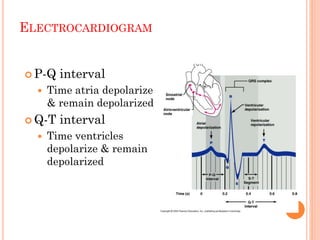
ELECTROCARDIOGRAM
 P-Q interval
 Time atria depolarize
& remain depolarized
 Q-T interval
 Time ventricles
depolarize & remain
depolarized
18
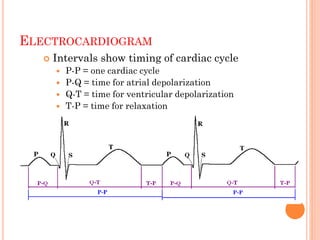
ELECTROCARDIOGRAM
 Intervals show timing of cardiac cycle
 P-P = one cardiac cycle
 P-Q = time for atrial depolarization
 Q-T = time for ventricular depolarization
 T-P = time for relaxation
19
MECHANISMS OF
ARRYTHMOGENESIS
 Some tacyarythmias start by one mechanism &
gets perpetuated by another mechanism
 Some caused by one mechanism can precipitate
another episode caused by different mechanism
 Mechanisms are
 Disorders of impulse formation
 Disorders of impulse conduction
 both
20
 DISORDERS OF IMPULSE FORMATION
 Characterised by
 Inappropriate discharge rate of normal pacemaker
 Inappropriate discharge of ectopic pacemaker
21
Abnormal automaticity
 Arise from cells that have reduced maximum
diastolic potentials
 Don’t need prior stimulation
Triggered activity
 Initiated by after depolarisations
 Induced by one or more preceding action
potentials
22
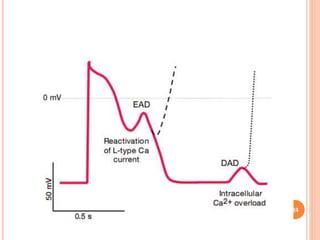
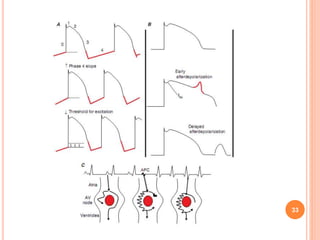
After depolarisations are of two types
 Early after depolarisation- occurs during
phase 2 & phase 3
 Delayed after depolarisation- occurs during
phase 4
 All depolariations doesn’t reach threshold
potential but if they reach they trigger another
after depolarisation & thus perpetuate
23
24
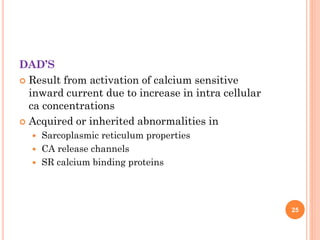
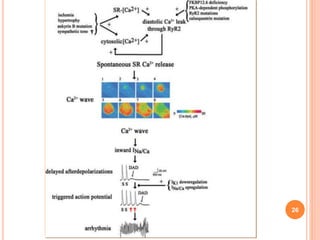
DAD’S
 Result from activation of calcium sensitive
inward current due to increase in intra cellular
ca concentrations
 Acquired or inherited abnormalities in
 Sarcoplasmic reticulum properties
 CA release channels
 SR calcium binding proteins
25
26
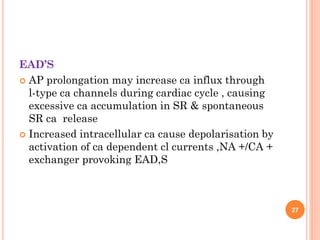
EAD’S
 AP prolongation may increase ca influx through
l-type ca channels during cardiac cycle , causing
excessive ca accumulation in SR & spontaneous
SR ca release
 Increased intracellular ca cause depolarisation by
activation of ca dependent cl currents ,NA +/CA +
exchanger provoking EAD,S
27
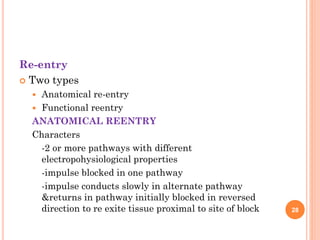
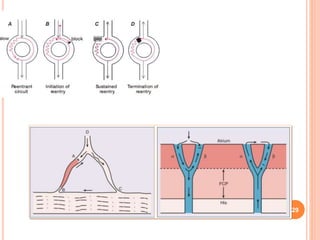
Re-entry
 Two types
 Anatomical re-entry
 Functional reentry
ANATOMICAL REENTRY
Characters
-2 or more pathways with different
electropohysiological properties
-impulse blocked in one pathway
-impulse conducts slowly in alternate pathway
&returns in pathway initially blocked in reversed
direction to re exite tissue proximal to site of block 28
29
 For re entry to occur anatomical length of circuit
should be greater than reentrant wave length
 Conditions that depress conduction velocity &
refractory period promote development of re
entry[λ = c.v x rp]
 Sustained reentry occurs due to excitable gap
between activating head & recovery tail.
30
Fuctional reentry
 Occur in fibres that exhibit functionally different
EP properties caused by local differences in
transmembrane AP
 functional heterogenities can be fixed or change
dynamically
31
 Mechanisms of termination are
 When conduction & recovery characters of circuit
change
 When activating head of wave collides with tail
32
33
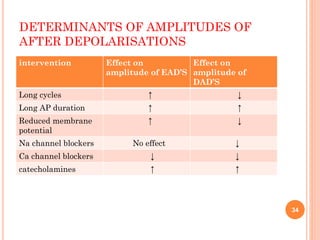
DETERMINANTS OF AMPLITUDES OF
AFTER DEPOLARISATIONS
intervention Effect on
amplitude of EAD’S
Effect on
amplitude of
DAD’S
Long cycles ↑ ↓
Long AP duration ↑ ↑
Reduced membrane
potential
↑ ↓
Na channel blockers No effect ↓
Ca channel blockers ↓ ↓
catecholamines ↑ ↑
34
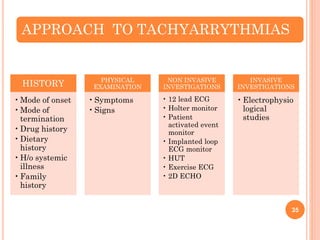
APPROACH TO TACHYARRYTHMIAS
HISTORY
•Mode of onset
•Mode of
termination
•Drug history
•Dietary
history
•H/o systemic
illness
•Family
history
PHYSICAL
EXAMINATION
•Symptoms
•Signs
NON INVASIVE
INVESTIGATIONS
• 12 lead ECG
• Holter monitor
• Patient
activated event
monitor
• Implanted loop
ECG monitor
• HUT
• Exercise ECG
• 2D ECHO
INVASIVE
INVESTIGATIONS
•Electrophysio
logical
studies
35
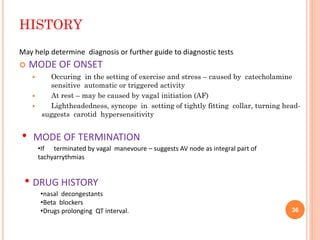
HISTORY
 MODE OF ONSET
 Occuring in the setting of exercise and stress – caused by catecholamine
sensitive automatic or triggered activity
 At rest – may be caused by vagal initiation (AF)
 Lightheadedness, syncope in setting of tightly fitting collar, turning head-
suggests carotid hypersensitivity
• MODE OF TERMINATION
•If terminated by vagal manevoure – suggests AV node as integral part of
tachyarrythmias
May help determine diagnosis or further guide to diagnostic tests
• DRUG HISTORY
•nasal decongestants
•Beta blockers
•Drugs prolonging QT interval. 36
 DIETARY HISTORY
 Alcoholic intake
 Food containing Ephedrine
 H/O SYSTEMIC ILLNESS
 COPD
 Thyrotoxicosis
 Pericarditis
 Congestive heart failure
 FAMILY HISTORY
 HOCM
 Long QT syndromes
 Myotonic dystrophies
37
PHYSICAL EXAMINATION
MORE HELPFUL IF DONE DURING SYMPTOMATIC PERIOD
 HR
 >100
 Regularly irregular
 Irregularly irregular
 JVP
 Increased JVP
 Cannon waves
 Heart sounds
 Variable heart sounds
 murmurs
 BP -- Variable
 Physical manoeveurs– Can have diagnostic and therapeutic value.
Valsalva/Carotid sinus massage - terminate or slow tachyarrythmias that depend
on AV node. 38
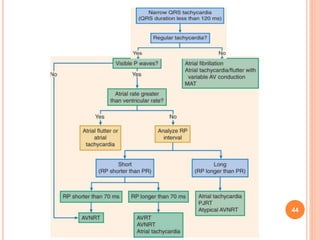
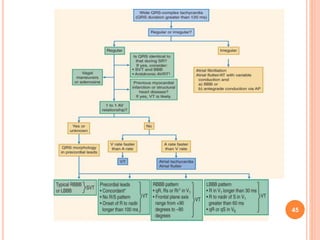
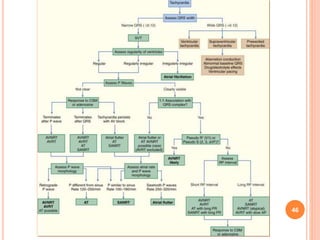
12 LEAD ECG
 Primary tool in arrhythmia analysis
 3 steps in diagnosing tachyarrythmia.
 Step 1 – determine if QRS complex is narrow or wide.
 Step 2 – determine if QRS complex is regular or irregular.
 Step 3 -- look for p waves and relation to QRS complex.
 Major branch point in DD is QRS duration.
 QRS < .12 – always almost SVT
 QRS >.12 – often VT
39
 24 hr Holter monitoring - for patients with daily symptoms
 Patient activated event monitor – for patients with
intermittent symptoms
 Implanted loop ECG monitor – for patients with infrequent
severe symptoms
 Exercise ECG - to determine myocardial ischemia
-For analysis of morphology of QT interval.
 HUT – used in patients with recurrent syncope
Syncope with injuries in absence of heart disease
 2D ECHO – for cardiac chamber size and function.
To rule out valvular diseases.
40
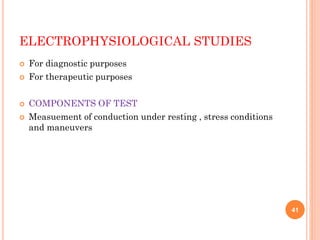
ELECTROPHYSIOLOGICAL STUDIES
 For diagnostic purposes
 For therapeutic purposes
 COMPONENTS OF TEST
 Measuement of conduction under resting , stress conditions
and maneuvers
41
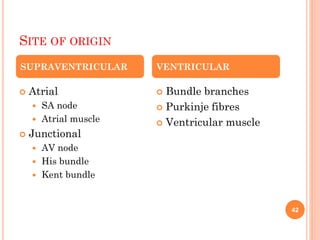
SITE OF ORIGIN
 Atrial
 SA node
 Atrial muscle
 Junctional
 AV node
 His bundle
 Kent bundle
 Bundle branches
 Purkinje fibres
 Ventricular muscle
SUPRAVENTRICULAR VENTRICULAR
42
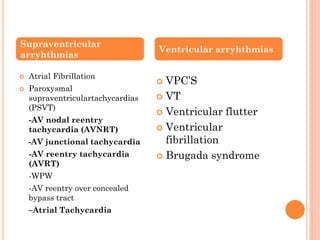
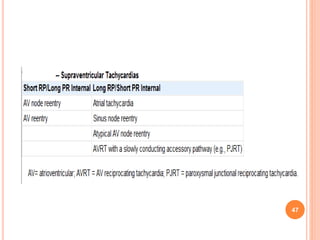
 Atrial Fibrillation
 Paroxysmal
supraventriculartachycardias
(PSVT)
-AV nodal reentry
tachycardia (AVNRT)
-AV junctional tachycardia
-AV reentry tachycardia
(AVRT)
-WPW
-AV reentry over concealed
bypass tract
–Atrial Tachycardia
 VPC’S
 VT
 Ventricular flutter
 Ventricular
fibrillation
 Brugada syndrome
Supraventricular
arryhthmias
Ventricular arryhthmias
44
45
46
47
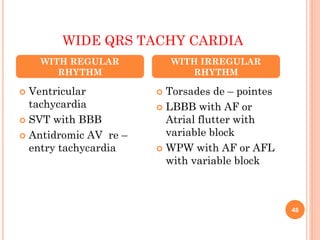
WIDE QRS TACHY CARDIA
 Ventricular
tachycardia
 SVT with BBB
 Antidromic AV re –
entry tachycardia
 Torsades de – pointes
 LBBB with AF or
Atrial flutter with
variable block
 WPW with AF or AFL
with variable block
WITH REGULAR
RHYTHM
WITH IRREGULAR
RHYTHM
48
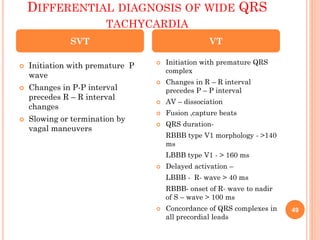
DIFFERENTIAL DIAGNOSIS OF WIDE QRS
TACHYCARDIA
 Initiation with premature P
wave
 Changes in P-P interval
precedes R – R interval
changes
 Slowing or termination by
vagal maneuvers
 Initiation with premature QRS
complex
 Changes in R – R interval
precedes P – P interval
 AV – dissociation
 Fusion ,capture beats
 QRS duration-
RBBB type V1 morphology - >140
ms
LBBB type V1 - > 160 ms
 Delayed activation –
LBBB - R- wave > 40 ms
RBBB- onset of R- wave to nadir
of S – wave > 100 ms
 Concordance of QRS complexes in
all precordial leads
SVT VT
49
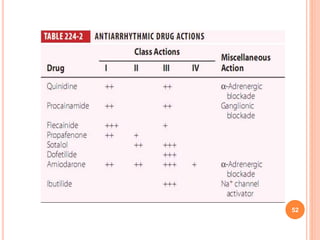
ANTIARRYHTHMIC DRUGS
Class IA.
 This includes drugs that reduce V.max (rate of rise of action
potential upstroke [phase 0]) and prolong action potential
duration
Eg-quinidine, procainamide, disopyramide.
Class IB.
 This class of drugs does not reduce V.max and shortens
action potential duration—
Eg-mexiletine, phenytoin, and lidocaine.
Class IC.
 This class of drugs can reduce V.max, primarily slow
conduction, and prolong refractoriness minimall
Eg-flecainide, propafenone, and moricizine. 50
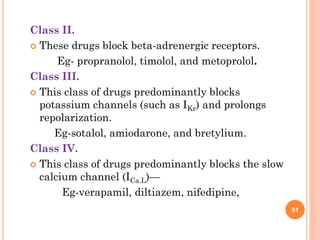
Class II.
 These drugs block beta-adrenergic receptors.
Eg- propranolol, timolol, and metoprolol.
Class III.
 This class of drugs predominantly blocks
potassium channels (such as IKr) and prolongs
repolarization.
Eg-sotalol, amiodarone, and bretylium.
Class IV.
 This class of drugs predominantly blocks the slow
calcium channel (ICa.L)—
Eg-verapamil, diltiazem, nifedipine,
51
52
53
54
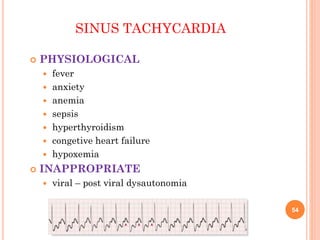
SINUS TACHYCARDIA
 PHYSIOLOGICAL
 fever
 anxiety
 anemia
 sepsis
 hyperthyroidism
 congetive heart failure
 hypoxemia
 INAPPROPRIATE
 viral – post viral dysautonomia
TREATMENT
 Treat underlying
cause
 Beta blockers
 Increase hydration
 Beta blockers
 Catheter
ablation/pacing
PHYSIOLOGICAL INAPPROPRIATE
55
56
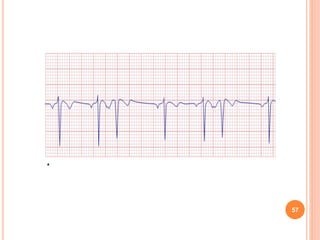
APC’S –
 Incidence increases with age
ECG –
 Premature & abnormal P wave
 Short PR interval
 Precedes normal QRS complex
 Compensatory pause is incomplete
TREATMENT –
 No treatment needed
 If severely symptomatic –
 Β-blocker, Catheter ablation .
57
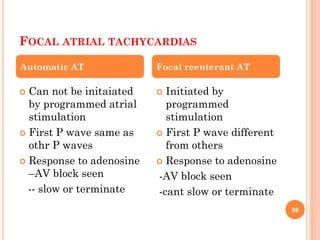
FOCAL ATRIAL TACHYCARDIAS
 Can not be initaiated
by programmed atrial
stimulation
 First P wave same as
othr P waves
 Response to adenosine
–AV block seen
-- slow or terminate
 Initiated by
programmed
stimulation
 First P wave different
from others
 Response to adenosine
-AV block seen
-cant slow or terminate
Automatic AT Focal reenterant AT
58
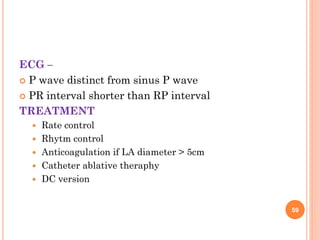
ECG –
 P wave distinct from sinus P wave
 PR interval shorter than RP interval
TREATMENT
 Rate control
 Rhytm control
 Anticoagulation if LA diameter > 5cm
 Catheter ablative theraphy
 DC version
59
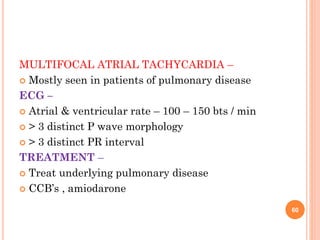
MULTIFOCAL ATRIAL TACHYCARDIA –
 Mostly seen in patients of pulmonary disease
ECG –
 Atrial & ventricular rate – 100 – 150 bts / min
 > 3 distinct P wave morphology
 > 3 distinct PR interval
TREATMENT –
 Treat underlying pulmonary disease
 CCB’s , amiodarone
60
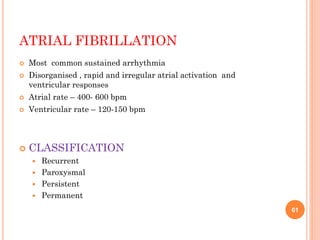
ATRIAL FIBRILLATION
 Most common sustained arrhythmia
 Disorganised , rapid and irregular atrial activation and
ventricular responses
 Atrial rate – 400- 600 bpm
 Ventricular rate – 120-150 bpm
 CLASSIFICATION
 Recurrent
 Paroxysmal
 Persistent
 Permanent
61
 CAUSES
 RHD
 Ischaemic heart disease
 Hypertension
 Constrictive pericarditis
 Hyperthyroidism
 Acute alcoholism
 Vascular,abdominal and thoracic surgery
 Anemia
 Acute vagotonic episode
 Lone atrial fibrillation ( no structural heart disease)
62
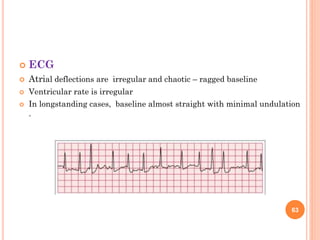
 ECG
 Atrial deflections are irregular and chaotic – ragged baseline
 Ventricular rate is irregular
 In longstanding cases, baseline almost straight with minimal undulation
.
63
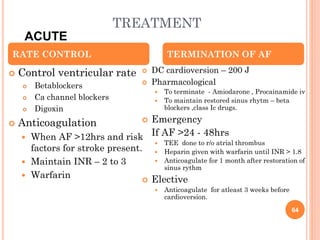
TREATMENT
 Control ventricular rate
 Betablockers
 Ca channel blockers
 Digoxin
 Anticoagulation
 When AF >12hrs and risk
factors for stroke present.
 Maintain INR – 2 to 3
 Warfarin
 DC cardioversion – 200 J
 Pharmacological
 To terminate - Amiodarone , Procainamide iv
 To maintain restored sinus rhytm – beta
blockers ,class Ic drugs.
 Emergency
If AF >24 - 48hrs
 TEE done to r/o atrial thrombus
 Heparin given with warfarin until INR > 1.8
 Anticoagulate for 1 month after restoration of
sinus rythm
 Elective
 Anticoagulate for atleast 3 weeks before
cardioversion.
RATE CONTROL TERMINATION OF AF
ACUTE
64
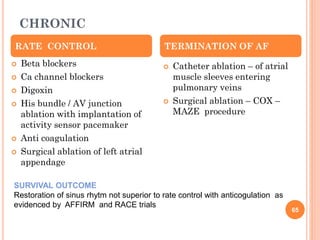
CHRONIC
 Beta blockers
 Ca channel blockers
 Digoxin
 His bundle / AV junction
ablation with implantation of
activity sensor pacemaker
 Anti coagulation
 Surgical ablation of left atrial
appendage
 Catheter ablation – of atrial
muscle sleeves entering
pulmonary veins
 Surgical ablation – COX –
MAZE procedure
RATE CONTROL TERMINATION OF AF
SURVIVAL OUTCOME
Restoration of sinus rhytm not superior to rate control with anticogulation as
evidenced by AFFIRM and RACE trials
65
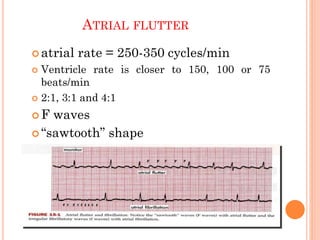
ATRIAL FLUTTER
 atrial rate = 250-350 cycles/min
 Ventricle rate is closer to 150, 100 or 75
beats/min
 2:1, 3:1 and 4:1
 F waves
 “sawtooth” shape
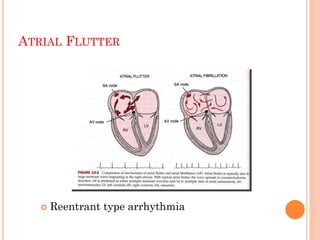
ATRIAL FLUTTER
 Reentrant type arrhythmia
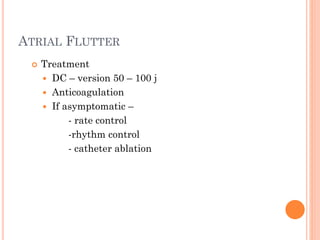
ATRIAL FLUTTER
 Treatment
 DC – version 50 – 100 j
 Anticoagulation
 If asymptomatic –
- rate control
-rhythm control
- catheter ablation
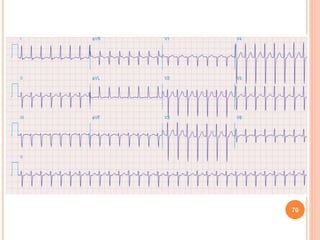
AV NOAL RE ENTERANT TACHYCARDIA –
 Most common
 Mostly in women
 Repetitive activation down slow pathway & up
fast pathway results in tachycardia
ECG –
 Rate – 120 – 150
 P waves negative
 Narrow QRS complexes
 P wave not visible or distorts QRS complex 69
70
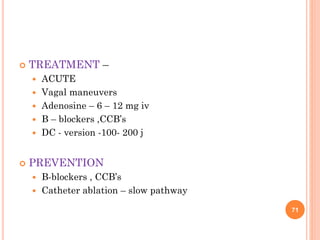
 TREATMENT –
 ACUTE
 Vagal maneuvers
 Adenosine – 6 – 12 mg iv
 B – blockers ,CCB’s
 DC - version -100- 200 j
 PREVENTION
 B-blockers , CCB’s
 Catheter ablation – slow pathway
71
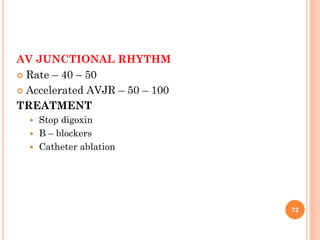
AV JUNCTIONAL RHYTHM
 Rate – 40 – 50
 Accelerated AVJR – 50 – 100
TREATMENT
 Stop digoxin
 B – blockers
 Catheter ablation
72
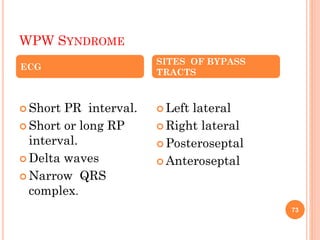
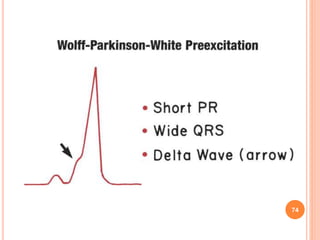
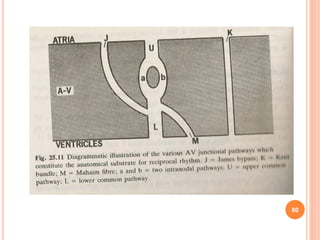
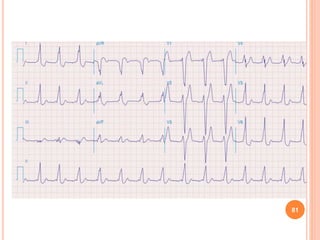
WPW SYNDROME
ECG
 Short PR interval.
 Short or long RP
interval.
 Delta waves
 Narrow QRS
complex.
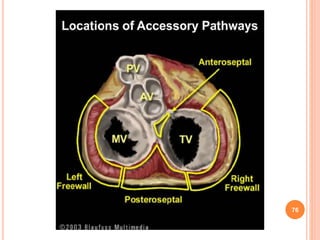
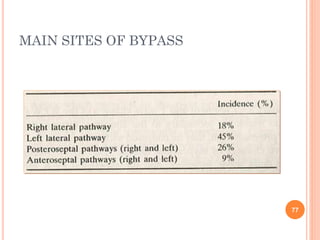
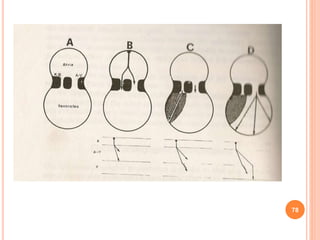
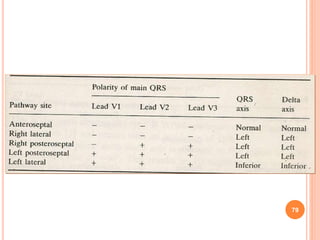
SITES OF BYPASS
TRACTS
 Left lateral
 Right lateral
 Posteroseptal
 Anteroseptal
73
74
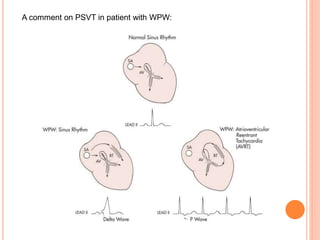
A comment on PSVT in patient with WPW:
76
MAIN SITES OF BYPASS
77
78
79
80
81
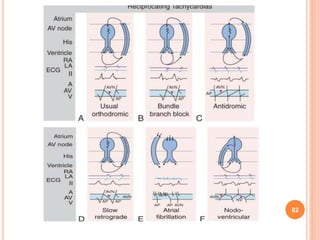
82
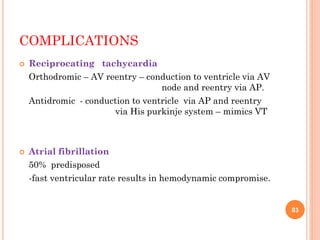
COMPLICATIONS
 Reciprocating tachycardia
Orthodromic – AV reentry – conduction to ventricle via AV
node and reentry via AP.
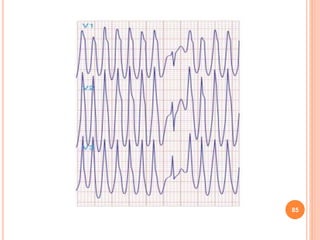
Antidromic - conduction to ventricle via AP and reentry
via His purkinje system – mimics VT
 Atrial fibrillation
50% predisposed
-fast ventricular rate results in hemodynamic compromise.
83
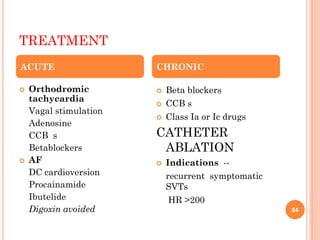
TREATMENT
ACUTE
 Orthodromic
tachycardia
Vagal stimulation
Adenosine
CCB s
Betablockers
 AF
DC cardioversion
Procainamide
Ibutelide
Digoxin avoided
CHRONIC
 Beta blockers
 CCB s
 Class Ia or Ic drugs
CATHETER
ABLATION
 Indications --
recurrent symptomatic
SVTs
HR >200
84
85
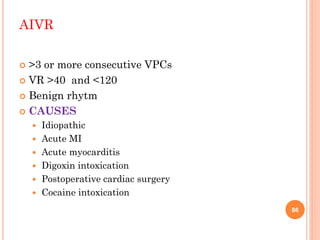
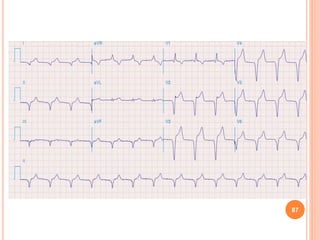
AIVR
 >3 or more consecutive VPCs
 VR >40 and <120
 Benign rhytm
 CAUSES
 Idiopathic
 Acute MI
 Acute myocarditis
 Digoxin intoxication
 Postoperative cardiac surgery
 Cocaine intoxication
86
87
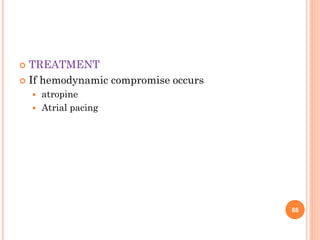
 TREATMENT
 If hemodynamic compromise occurs
 atropine
 Atrial pacing
88
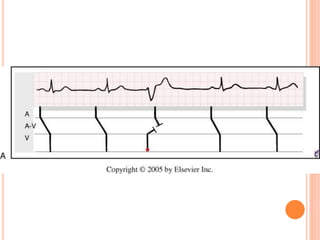
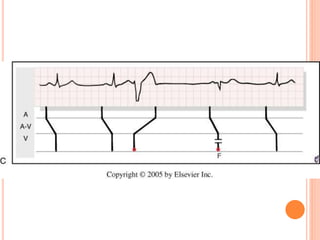
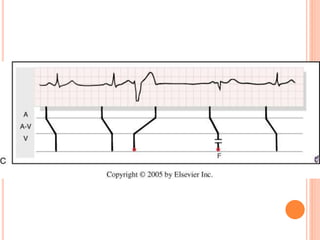
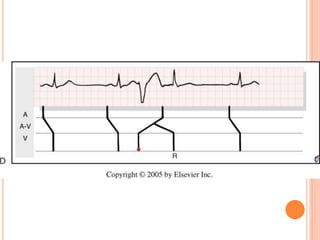
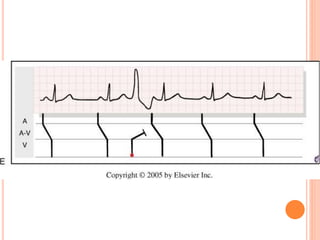
PREMATURE VENTRICULAR
COMLEXES
 Broad QRS > 120ms
 T wave is large ,opposite in direction to QRS
 No preceding p waves
 Compensatory or noncompensatory pause
 Fixed or variable coupling interval.
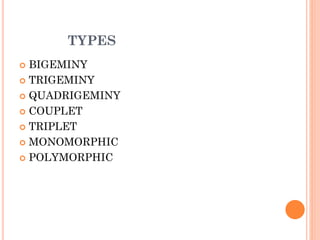
TYPES
 BIGEMINY
 TRIGEMINY
 QUADRIGEMINY
 COUPLET
 TRIPLET
 MONOMORPHIC
 POLYMORPHIC
 Incidence >60% of healthy males during 24hr
Holter
 >80% post MI
 Benign ectopics disappear on exercise
 Pts –normal life span.
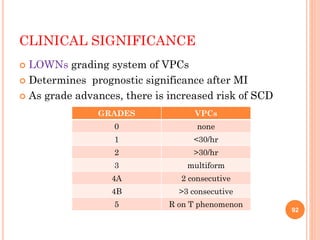
CLINICAL SIGNIFICANCE
 LOWNs grading system of VPCs
 Determines prognostic significance after MI
 As grade advances, there is increased risk of SCD
92
GRADES VPCs
0 none
1 <30/hr
2 >30/hr
3 multiform
4A 2 consecutive
4B >3 consecutive
5 R on T phenomenon
MANAGEMENT
In Normal heart
 Asym- No treatment
 Sym - betablockers
Structural heart disease
 betablockers
 Class IA, III drugs
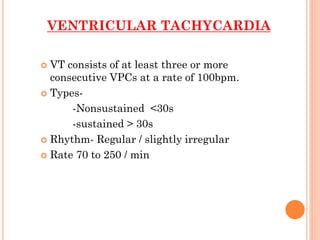
VENTRICULAR TACHYCARDIA
 VT consists of at least three or more
consecutive VPCs at a rate of 100bpm.
 Types-
-Nonsustained <30s
-sustained > 30s
 Rhythm- Regular / slightly irregular
 Rate 70 to 250 / min
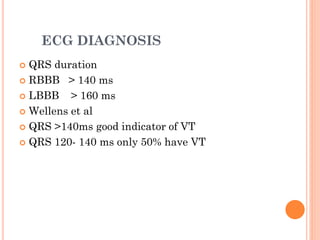
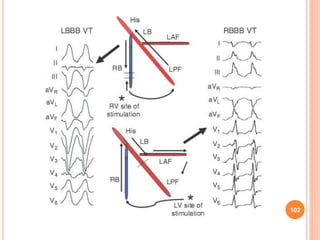
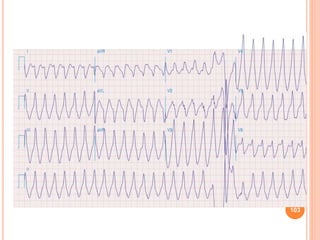
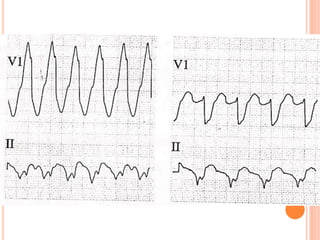
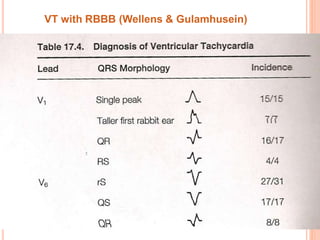
ECG DIAGNOSIS
 QRS duration
 RBBB > 140 ms
 LBBB > 160 ms
 Wellens et al
 QRS >140ms good indicator of VT
 QRS 120- 140 ms only 50% have VT
102
103
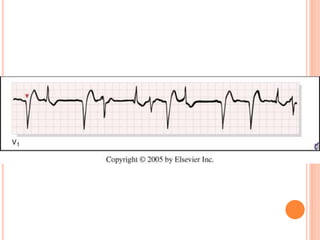
VT with RBBB (Wellens & Gulamhusein)
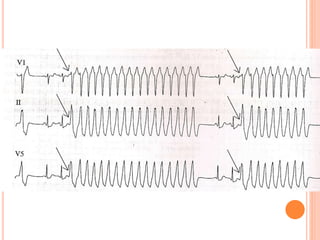
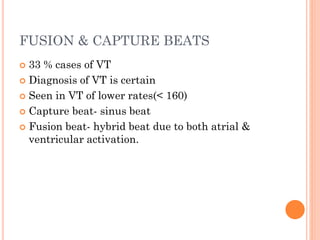
FUSION & CAPTURE BEATS
 33 % cases of VT
 Diagnosis of VT is certain
 Seen in VT of lower rates(< 160)
 Capture beat- sinus beat
 Fusion beat- hybrid beat due to both atrial &
ventricular activation.
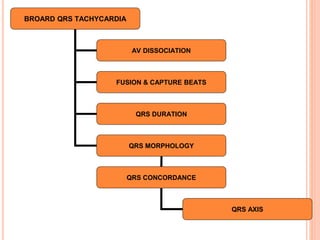
BROARD QRS TACHYCARDIA
AV DISSOCIATION
FUSION & CAPTURE BEATS
QRS DURATION
QRS MORPHOLOGY
QRS CONCORDANCE
QRS AXIS
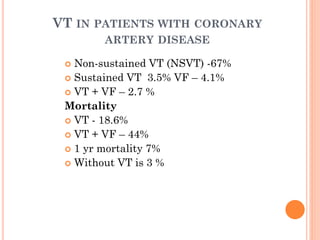
VT IN PATIENTS WITH CORONARY
ARTERY DISEASE
 Non-sustained VT (NSVT) -67%
 Sustained VT 3.5% VF – 4.1%
 VT + VF – 2.7 %
Mortality
 VT - 18.6%
 VT + VF – 44%
 1 yr mortality 7%
 Without VT is 3 %
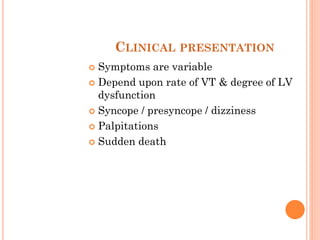
CLINICAL PRESENTATION
 Symptoms are variable
 Depend upon rate of VT & degree of LV
dysfunction
 Syncope / presyncope / dizziness
 Palpitations
 Sudden death
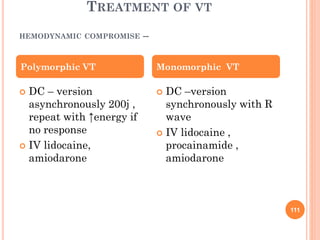
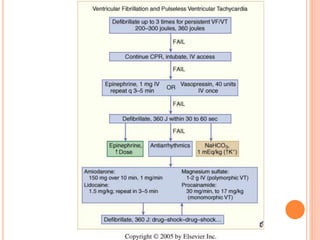
TREATMENT OF VT
HEMODYNAMIC COMPROMISE --
 DC – version
asynchronously 200j ,
repeat with ↑energy if
no response
 IV lidocaine,
amiodarone
 DC –version
synchronously with R
wave
 IV lidocaine ,
procainamide ,
amiodarone
Polymorphic VT Monomorphic VT
111
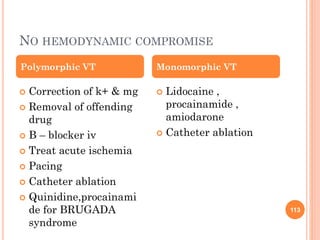
NO HEMODYNAMIC COMPROMISE
 Correction of k+ & mg
 Removal of offending
drug
 B – blocker iv
 Treat acute ischemia
 Pacing
 Catheter ablation
 Quinidine,procainami
de for BRUGADA
syndrome
 Lidocaine ,
procainamide ,
amiodarone
 Catheter ablation
Polymorphic VT Monomorphic VT
113
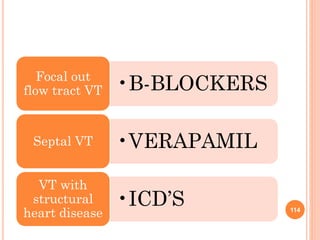
•B-BLOCKERSFocal out
flow tract VT
•VERAPAMILSeptal VT
•ICD’S
VT with
structural
heart disease 114
SPECIFIC TYPES OF VT
ARRHYTHMOGENIC RT
VENTRICULAR DYSPLASIA(0.4%)
 LBBB contour with right axis deviation
during VT
 ICRBBB ,T waves inverted over the right
precordial leads
 Type of Cardiomyopathy, possibly familial,
with hypokinetic thin walled RV
 Abnormality in Chr 1 & Chr 10 -apoptosis
 Imp cause of VT in children & young adults
with normal hearts
 Rt heart failure or asymptomatic rt
ventricular enlargement can be present
with normal pulmonary vasculature
 Males predominate
 Pathology- Fatty & fibrofatty infiltration
OR myocardial atrophy
 Preferentially affects rt ventricular inflow &
outflow tracts & the apex
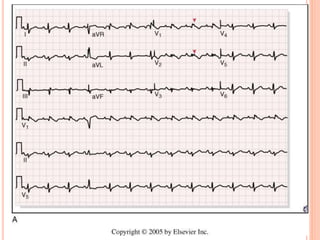
 ECG- T wave inversion in V1 to V3, Terminal
notch in QRS called “epsilon” wave can be
present due to slowed intra ventricular
conduction
 ICDs are preferable to pharmacological
 Radio frequency catheter ablation is often not
successful
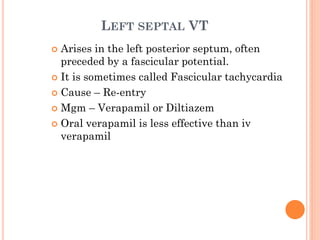
LEFT SEPTAL VT
 Arises in the left posterior septum, often
preceded by a fascicular potential.
 It is sometimes called Fascicular tachycardia
 Cause – Re-entry
 Mgm – Verapamil or Diltiazem
 Oral verapamil is less effective than iv
verapamil
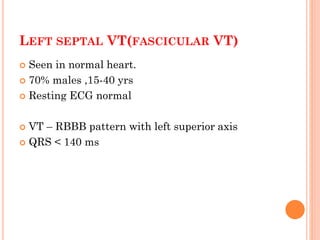
LEFT SEPTAL VT(FASCICULAR VT)
 Seen in normal heart.
 70% males ,15-40 yrs
 Resting ECG normal
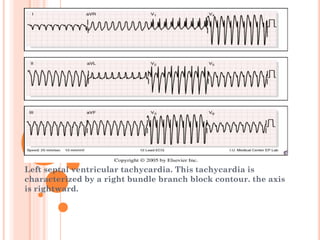
 VT – RBBB pattern with left superior axis
 QRS < 140 ms
Left septal ventricular tachycardia. This tachycardia is
characterized by a right bundle branch block contour. the axis
is rightward.
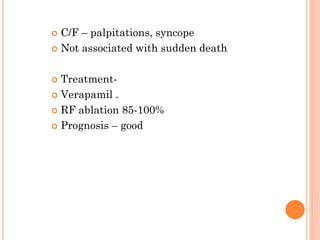
 C/F – palpitations, syncope
 Not associated with sudden death
 Treatment-
 Verapamil .
 RF ablation 85-100%
 Prognosis – good
CATECHOLAMINERGIC
POLYMORPHIC VT
 Uncommon form of inherited VT
 Occurs in children & adolescents without
any overt structural heart disease
 Adenosine sensitive
 Pts present with syncope or aborted sudden
death with highly reproducible stress
induced VT that is often bidirectional
 QT interval – Normal
 Family history present in 30%
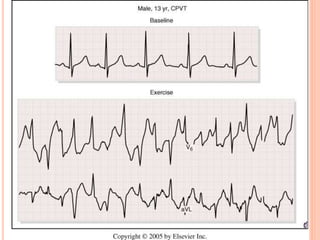
 During exercise typical responses, initial
sinus tachycardia & ventricular extrasystoles
followed by monomorphic or bidirectional VT,
which eventually leads to polymorphic VT as
exercise continues
 Mgm – Beta blockers & ICDs
 Lt cervicothoraic sympathetic ganglionectomy
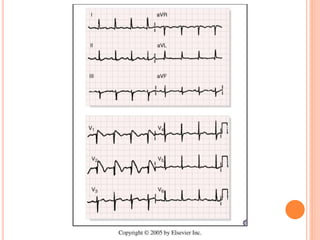
BRUGADA SYNDROME
 30-40% of idiopathic VF
 AD, M:F 8:1
 2-4th decade
 Distinct form of idiopathic VT,V fib
 RBBB & ST segment elevation in anterior
precordial leads
 No evidence of structural heart disease
 Mutation in gene responsible for sodium
channel
 Acceleration of Na channel recovery or
nonfunctional channels
 Common in apparently healthy south east
Asians – 40-60%
 Precise mechanism is not known
 Can be reproduced by sodium channel
blockers
 ICDs are the only effective treatment to
prevent sudden deaths
LONG QT SYNDROMES
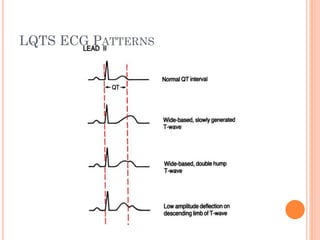
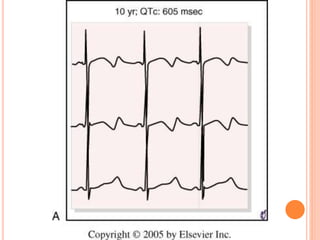
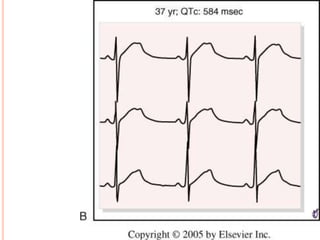
 Normal QT males - 440 ms females – 470ms
 Congenital
 Jervell Lange-Neilsen syndrome- AR with
deafness
 Ramano-Ward syndrome - AD with normal
hearing
 Defect in Na, K channels.
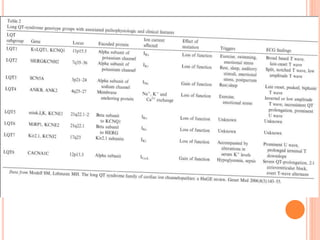
LQTS ECG PATTERNS
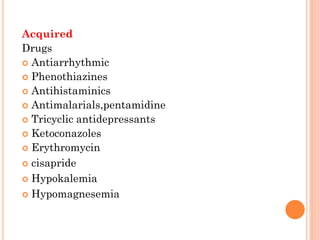
Acquired
Drugs
 Antiarrhythmic
 Phenothiazines
 Antihistaminics
 Antimalarials,pentamidine
 Tricyclic antidepressants
 Ketoconazoles
 Erythromycin
 cisapride
 Hypokalemia
 Hypomagnesemia
C/F
 Syncope, dizziness,sudden death
Treatment
 Underlying condition
 Betablockers
 ICD
CARDIOMYOPATHIES
DILATED CARDIOMYOPATHY
 Focus basal septum
 Mutiple macrorentry
 ICDs -life threatening ventricular
arrhythmias
 Comparing amiodarone v/s ICD, improved
survival was found with ICD
 In case bundle branch re-entry is the basis,
ablate the RBB
HYPERTROPHIC CARDIOMYOPATHY
 Risk of sudden death is increased by presence
of syncope, family h/o, sudden death in 1st
degree relative, septal thickness >3cms or
presence of non sustained VT in 24 hr
recordings
 Infrequent episodes of non sustained VT have
low mortality
 Amiodarone – Useful symptomatic non
sustained VT but not in improving survival
MITRAL VALVE PROLAPSE
 VT in MVP has good prognosis although sudden
death can occur
 Treated with betablockers.
CHD
 Can occur in pts some years after repair
 Sustained VT can be caused by re entry at the
site of surgery
 Mgm- resection or catheter ablation of the area
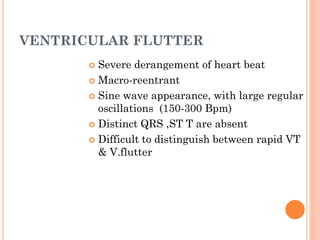
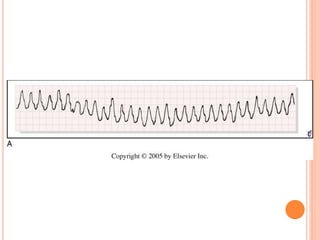
VENTRICULAR FLUTTER
 Severe derangement of heart beat
 Macro-reentrant
 Sine wave appearance, with large regular
oscillations (150-300 Bpm)
 Distinct QRS ,ST T are absent
 Difficult to distinguish between rapid VT
& V.flutter
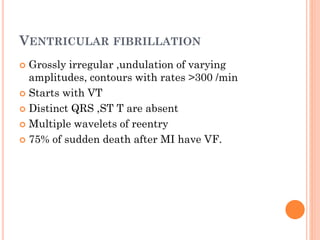
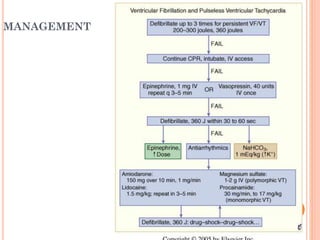
VENTRICULAR FIBRILLATION
 Grossly irregular ,undulation of varying
amplitudes, contours with rates >300 /min
 Starts with VT
 Distinct QRS ,ST T are absent
 Multiple wavelets of reentry
 75% of sudden death after MI have VF.
MANAGEMENT
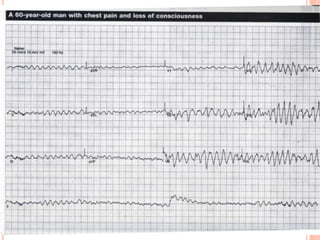
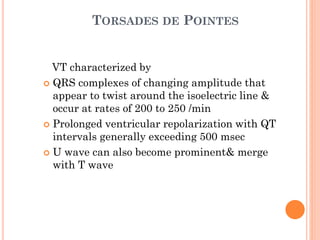
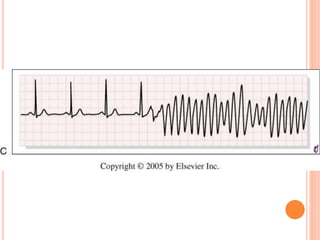
TORSADES DE POINTES
VT characterized by
 QRS complexes of changing amplitude that
appear to twist around the isoelectric line &
occur at rates of 200 to 250 /min
 Prolonged ventricular repolarization with QT
intervals generally exceeding 500 msec
 U wave can also become prominent& merge
with T wave
 Torsades de Pointes can terminate with
progressive prolongation in cycle length with
distinctly formed QRS complexes &
culminate into basal rhythm, ventricular
standstill, or VFib
Common causes
 Potassium depletion
 Congenital LQTS
 Antiarrhythmic drugs IA,IC,III
c/f
 Palpitations, syncope, death
 Women are at a greater risk
Management
 IV magnesium
 Temporary ventricular or atrial pacing+ ICD
 Lidocaine, mexiletine or phenytoin can be
tried
 K channel activating drugs pinacidil,
cromakalim
 Cause of long QT should be treated
REFERENCES
 BRAUNWALD ‘S HEART DISEASE 8 th ed
 HARRISONS INTERNAL MEDICINE 17 th ed
 HURST ‘S HEART DISEASES
 SHAMMROTH ECG
 MARRIOTS ECG
 MEDICINE UPDATE
150
tachyarrythmias d

tachyarrythmias d

  • 1.
  • 2.
    DEFINITION ANATOMY OF CONDUCTION ELECTROPHYSIOLOGY DIAGNOSTICAPPROACH TREATMENT MODALITIES DESCRIPTION ABOUT INDIVIDUAL ARRYTHMIAS 2
  • 3.
    DEFINITION  Any disturbanceof the heart's rhythm, regular or irregular, resulting by convention in a rate over 100 beats/min . 3
  • 4.
    CONDUCTION SYSTEM OFTHE HEART AND ELECTROCARDIOGRAPHY
  • 5.
    Conduction System ofthe Heart • SA node: sinoatrial node. The pacemaker. – Specialized cardiac muscle cells. – Generate spontaneous action potentials (autorhythmic tissue). – Action potentials pass to atrial muscle cells and to the AV node • AV node: atrioventricular node. – Action potentials conducted more slowly here than in any other part of system. – Ensures ventricles receive signal to contract after atria have contracted • AV bundle: passes through hole in cardiac skeleton to reach interventricular septum • Right and left bundle branches: extend beneath endocardium to apices of right and left ventricles • Purkinje fibers: – Large diameter cardiac muscle cells with few myofibrils. – Many gap junctions. – Conduct action potential to ventricular muscle cells (myocardium) 5
  • 6.
  • 7.
  • 8.
    ACTION POTENTIAL  Duration– 200- 400 msec  Regulated by activity of time & voltage dependent ionic currents  Ionic currents maintained by  Ionic channels –passively conduct ions along electrochemical gradient  Pumps, transporters – transport ions against gradients  Exchangers- electrgenically exchange species  AP are regionally distinct 8
  • 9.
    Electrical Properties ofMyocardial Fibers 1. Rising phase of action potential • Due to opening of fast Na+ channels 2. Plateau phase • Closure of sodium channels • Opening of calcium channels • Slight increase in K+ permeability • Prevents summation and thus tetanus of cardiac muscle 3. Repolarization phase • Calcium channels closed • Increased K+ permeability 9
  • 10.
  • 11.
  • 12.
  • 13.
    Heart Physiology: Intrinsic ConductionSystem • Autorhythmic cells: – Initiate action potentials – Have unstable resting potentials called pacemaker potentials – Use calcium influx (rather than sodium) for rising phase of the action potential 13
  • 14.
    DEPOLARIZATION OF SANODE  SA node - no stable resting membrane potential  Pacemaker potential  gradual depolarization from -60 mV, slow influx of Na+  Action potential  occurs at threshold of -40 mV  depolarizing phase to 0 mV  fast Ca2+ channels open, (Ca2+ in)  repolarizing phase  K+ channels open, (K+ out)  at -60 mV K+ channels close, pacemaker potential starts over  Each depolarization creates one heartbeat  SA node at rest fires at 0.8 sec, about 75 bpm 14
  • 15.
  • 16.
    DEPOLARIZATION AND IMPULSE CONDUCTION Depolarization in SA node precedes depolarization in atria, AV node, ventricles 16
  • 17.
    ELECTROCARDIOGRAM  P wave Depolarization of atria  Followed by contraction  QRS complex  3 waves (Q, R, & S)  Depolarization of ventricles  Followed by contraction  T wave  Repolarization of ventricles 17
  • 18.
    ELECTROCARDIOGRAM  P-Q interval Time atria depolarize & remain depolarized  Q-T interval  Time ventricles depolarize & remain depolarized 18
  • 19.
    ELECTROCARDIOGRAM  Intervals showtiming of cardiac cycle  P-P = one cardiac cycle  P-Q = time for atrial depolarization  Q-T = time for ventricular depolarization  T-P = time for relaxation 19
  • 20.
    MECHANISMS OF ARRYTHMOGENESIS  Sometacyarythmias start by one mechanism & gets perpetuated by another mechanism  Some caused by one mechanism can precipitate another episode caused by different mechanism  Mechanisms are  Disorders of impulse formation  Disorders of impulse conduction  both 20
  • 21.
     DISORDERS OFIMPULSE FORMATION  Characterised by  Inappropriate discharge rate of normal pacemaker  Inappropriate discharge of ectopic pacemaker 21
  • 22.
    Abnormal automaticity  Arisefrom cells that have reduced maximum diastolic potentials  Don’t need prior stimulation Triggered activity  Initiated by after depolarisations  Induced by one or more preceding action potentials 22
  • 23.
    After depolarisations areof two types  Early after depolarisation- occurs during phase 2 & phase 3  Delayed after depolarisation- occurs during phase 4  All depolariations doesn’t reach threshold potential but if they reach they trigger another after depolarisation & thus perpetuate 23
  • 24.
  • 25.
    DAD’S  Result fromactivation of calcium sensitive inward current due to increase in intra cellular ca concentrations  Acquired or inherited abnormalities in  Sarcoplasmic reticulum properties  CA release channels  SR calcium binding proteins 25
  • 26.
  • 27.
    EAD’S  AP prolongationmay increase ca influx through l-type ca channels during cardiac cycle , causing excessive ca accumulation in SR & spontaneous SR ca release  Increased intracellular ca cause depolarisation by activation of ca dependent cl currents ,NA +/CA + exchanger provoking EAD,S 27
  • 28.
    Re-entry  Two types Anatomical re-entry  Functional reentry ANATOMICAL REENTRY Characters -2 or more pathways with different electropohysiological properties -impulse blocked in one pathway -impulse conducts slowly in alternate pathway &returns in pathway initially blocked in reversed direction to re exite tissue proximal to site of block 28
  • 29.
  • 30.
     For reentry to occur anatomical length of circuit should be greater than reentrant wave length  Conditions that depress conduction velocity & refractory period promote development of re entry[λ = c.v x rp]  Sustained reentry occurs due to excitable gap between activating head & recovery tail. 30
  • 31.
    Fuctional reentry  Occurin fibres that exhibit functionally different EP properties caused by local differences in transmembrane AP  functional heterogenities can be fixed or change dynamically 31
  • 32.
     Mechanisms oftermination are  When conduction & recovery characters of circuit change  When activating head of wave collides with tail 32
  • 33.
  • 34.
    DETERMINANTS OF AMPLITUDESOF AFTER DEPOLARISATIONS intervention Effect on amplitude of EAD’S Effect on amplitude of DAD’S Long cycles ↑ ↓ Long AP duration ↑ ↑ Reduced membrane potential ↑ ↓ Na channel blockers No effect ↓ Ca channel blockers ↓ ↓ catecholamines ↑ ↑ 34
  • 35.
    APPROACH TO TACHYARRYTHMIAS HISTORY •Modeof onset •Mode of termination •Drug history •Dietary history •H/o systemic illness •Family history PHYSICAL EXAMINATION •Symptoms •Signs NON INVASIVE INVESTIGATIONS • 12 lead ECG • Holter monitor • Patient activated event monitor • Implanted loop ECG monitor • HUT • Exercise ECG • 2D ECHO INVASIVE INVESTIGATIONS •Electrophysio logical studies 35
  • 36.
    HISTORY  MODE OFONSET  Occuring in the setting of exercise and stress – caused by catecholamine sensitive automatic or triggered activity  At rest – may be caused by vagal initiation (AF)  Lightheadedness, syncope in setting of tightly fitting collar, turning head- suggests carotid hypersensitivity • MODE OF TERMINATION •If terminated by vagal manevoure – suggests AV node as integral part of tachyarrythmias May help determine diagnosis or further guide to diagnostic tests • DRUG HISTORY •nasal decongestants •Beta blockers •Drugs prolonging QT interval. 36
  • 37.
     DIETARY HISTORY Alcoholic intake  Food containing Ephedrine  H/O SYSTEMIC ILLNESS  COPD  Thyrotoxicosis  Pericarditis  Congestive heart failure  FAMILY HISTORY  HOCM  Long QT syndromes  Myotonic dystrophies 37
  • 38.
    PHYSICAL EXAMINATION MORE HELPFULIF DONE DURING SYMPTOMATIC PERIOD  HR  >100  Regularly irregular  Irregularly irregular  JVP  Increased JVP  Cannon waves  Heart sounds  Variable heart sounds  murmurs  BP -- Variable  Physical manoeveurs– Can have diagnostic and therapeutic value. Valsalva/Carotid sinus massage - terminate or slow tachyarrythmias that depend on AV node. 38
  • 39.
    12 LEAD ECG Primary tool in arrhythmia analysis  3 steps in diagnosing tachyarrythmia.  Step 1 – determine if QRS complex is narrow or wide.  Step 2 – determine if QRS complex is regular or irregular.  Step 3 -- look for p waves and relation to QRS complex.  Major branch point in DD is QRS duration.  QRS < .12 – always almost SVT  QRS >.12 – often VT 39
  • 40.
     24 hrHolter monitoring - for patients with daily symptoms  Patient activated event monitor – for patients with intermittent symptoms  Implanted loop ECG monitor – for patients with infrequent severe symptoms  Exercise ECG - to determine myocardial ischemia -For analysis of morphology of QT interval.  HUT – used in patients with recurrent syncope Syncope with injuries in absence of heart disease  2D ECHO – for cardiac chamber size and function. To rule out valvular diseases. 40
  • 41.
    ELECTROPHYSIOLOGICAL STUDIES  Fordiagnostic purposes  For therapeutic purposes  COMPONENTS OF TEST  Measuement of conduction under resting , stress conditions and maneuvers 41
  • 42.
    SITE OF ORIGIN Atrial  SA node  Atrial muscle  Junctional  AV node  His bundle  Kent bundle  Bundle branches  Purkinje fibres  Ventricular muscle SUPRAVENTRICULAR VENTRICULAR 42
  • 43.
     Atrial Fibrillation Paroxysmal supraventriculartachycardias (PSVT) -AV nodal reentry tachycardia (AVNRT) -AV junctional tachycardia -AV reentry tachycardia (AVRT) -WPW -AV reentry over concealed bypass tract –Atrial Tachycardia  VPC’S  VT  Ventricular flutter  Ventricular fibrillation  Brugada syndrome Supraventricular arryhthmias Ventricular arryhthmias
  • 44.
  • 45.
  • 46.
  • 47.
  • 48.
    WIDE QRS TACHYCARDIA  Ventricular tachycardia  SVT with BBB  Antidromic AV re – entry tachycardia  Torsades de – pointes  LBBB with AF or Atrial flutter with variable block  WPW with AF or AFL with variable block WITH REGULAR RHYTHM WITH IRREGULAR RHYTHM 48
  • 49.
    DIFFERENTIAL DIAGNOSIS OFWIDE QRS TACHYCARDIA  Initiation with premature P wave  Changes in P-P interval precedes R – R interval changes  Slowing or termination by vagal maneuvers  Initiation with premature QRS complex  Changes in R – R interval precedes P – P interval  AV – dissociation  Fusion ,capture beats  QRS duration- RBBB type V1 morphology - >140 ms LBBB type V1 - > 160 ms  Delayed activation – LBBB - R- wave > 40 ms RBBB- onset of R- wave to nadir of S – wave > 100 ms  Concordance of QRS complexes in all precordial leads SVT VT 49
  • 50.
    ANTIARRYHTHMIC DRUGS Class IA. This includes drugs that reduce V.max (rate of rise of action potential upstroke [phase 0]) and prolong action potential duration Eg-quinidine, procainamide, disopyramide. Class IB.  This class of drugs does not reduce V.max and shortens action potential duration— Eg-mexiletine, phenytoin, and lidocaine. Class IC.  This class of drugs can reduce V.max, primarily slow conduction, and prolong refractoriness minimall Eg-flecainide, propafenone, and moricizine. 50
  • 51.
    Class II.  Thesedrugs block beta-adrenergic receptors. Eg- propranolol, timolol, and metoprolol. Class III.  This class of drugs predominantly blocks potassium channels (such as IKr) and prolongs repolarization. Eg-sotalol, amiodarone, and bretylium. Class IV.  This class of drugs predominantly blocks the slow calcium channel (ICa.L)— Eg-verapamil, diltiazem, nifedipine, 51
  • 52.
  • 53.
  • 54.
    54 SINUS TACHYCARDIA  PHYSIOLOGICAL fever  anxiety  anemia  sepsis  hyperthyroidism  congetive heart failure  hypoxemia  INAPPROPRIATE  viral – post viral dysautonomia
  • 55.
    TREATMENT  Treat underlying cause Beta blockers  Increase hydration  Beta blockers  Catheter ablation/pacing PHYSIOLOGICAL INAPPROPRIATE 55
  • 56.
    56 APC’S –  Incidenceincreases with age ECG –  Premature & abnormal P wave  Short PR interval  Precedes normal QRS complex  Compensatory pause is incomplete TREATMENT –  No treatment needed  If severely symptomatic –  Β-blocker, Catheter ablation .
  • 57.
  • 58.
    FOCAL ATRIAL TACHYCARDIAS Can not be initaiated by programmed atrial stimulation  First P wave same as othr P waves  Response to adenosine –AV block seen -- slow or terminate  Initiated by programmed stimulation  First P wave different from others  Response to adenosine -AV block seen -cant slow or terminate Automatic AT Focal reenterant AT 58
  • 59.
    ECG –  Pwave distinct from sinus P wave  PR interval shorter than RP interval TREATMENT  Rate control  Rhytm control  Anticoagulation if LA diameter > 5cm  Catheter ablative theraphy  DC version 59
  • 60.
    MULTIFOCAL ATRIAL TACHYCARDIA–  Mostly seen in patients of pulmonary disease ECG –  Atrial & ventricular rate – 100 – 150 bts / min  > 3 distinct P wave morphology  > 3 distinct PR interval TREATMENT –  Treat underlying pulmonary disease  CCB’s , amiodarone 60
  • 61.
    ATRIAL FIBRILLATION  Mostcommon sustained arrhythmia  Disorganised , rapid and irregular atrial activation and ventricular responses  Atrial rate – 400- 600 bpm  Ventricular rate – 120-150 bpm  CLASSIFICATION  Recurrent  Paroxysmal  Persistent  Permanent 61
  • 62.
     CAUSES  RHD Ischaemic heart disease  Hypertension  Constrictive pericarditis  Hyperthyroidism  Acute alcoholism  Vascular,abdominal and thoracic surgery  Anemia  Acute vagotonic episode  Lone atrial fibrillation ( no structural heart disease) 62
  • 63.
     ECG  Atrialdeflections are irregular and chaotic – ragged baseline  Ventricular rate is irregular  In longstanding cases, baseline almost straight with minimal undulation . 63
  • 64.
    TREATMENT  Control ventricularrate  Betablockers  Ca channel blockers  Digoxin  Anticoagulation  When AF >12hrs and risk factors for stroke present.  Maintain INR – 2 to 3  Warfarin  DC cardioversion – 200 J  Pharmacological  To terminate - Amiodarone , Procainamide iv  To maintain restored sinus rhytm – beta blockers ,class Ic drugs.  Emergency If AF >24 - 48hrs  TEE done to r/o atrial thrombus  Heparin given with warfarin until INR > 1.8  Anticoagulate for 1 month after restoration of sinus rythm  Elective  Anticoagulate for atleast 3 weeks before cardioversion. RATE CONTROL TERMINATION OF AF ACUTE 64
  • 65.
    CHRONIC  Beta blockers Ca channel blockers  Digoxin  His bundle / AV junction ablation with implantation of activity sensor pacemaker  Anti coagulation  Surgical ablation of left atrial appendage  Catheter ablation – of atrial muscle sleeves entering pulmonary veins  Surgical ablation – COX – MAZE procedure RATE CONTROL TERMINATION OF AF SURVIVAL OUTCOME Restoration of sinus rhytm not superior to rate control with anticogulation as evidenced by AFFIRM and RACE trials 65
  • 66.
    ATRIAL FLUTTER  atrialrate = 250-350 cycles/min  Ventricle rate is closer to 150, 100 or 75 beats/min  2:1, 3:1 and 4:1  F waves  “sawtooth” shape
  • 67.
  • 68.
    ATRIAL FLUTTER  Treatment DC – version 50 – 100 j  Anticoagulation  If asymptomatic – - rate control -rhythm control - catheter ablation
  • 69.
    AV NOAL REENTERANT TACHYCARDIA –  Most common  Mostly in women  Repetitive activation down slow pathway & up fast pathway results in tachycardia ECG –  Rate – 120 – 150  P waves negative  Narrow QRS complexes  P wave not visible or distorts QRS complex 69
  • 70.
  • 71.
     TREATMENT – ACUTE  Vagal maneuvers  Adenosine – 6 – 12 mg iv  B – blockers ,CCB’s  DC - version -100- 200 j  PREVENTION  B-blockers , CCB’s  Catheter ablation – slow pathway 71
  • 72.
    AV JUNCTIONAL RHYTHM Rate – 40 – 50  Accelerated AVJR – 50 – 100 TREATMENT  Stop digoxin  B – blockers  Catheter ablation 72
  • 73.
    WPW SYNDROME ECG  ShortPR interval.  Short or long RP interval.  Delta waves  Narrow QRS complex. SITES OF BYPASS TRACTS  Left lateral  Right lateral  Posteroseptal  Anteroseptal 73
  • 74.
  • 75.
    A comment onPSVT in patient with WPW:
  • 76.
  • 77.
    MAIN SITES OFBYPASS 77
  • 78.
  • 79.
  • 80.
  • 81.
  • 82.
  • 83.
    COMPLICATIONS  Reciprocating tachycardia Orthodromic– AV reentry – conduction to ventricle via AV node and reentry via AP. Antidromic - conduction to ventricle via AP and reentry via His purkinje system – mimics VT  Atrial fibrillation 50% predisposed -fast ventricular rate results in hemodynamic compromise. 83
  • 84.
    TREATMENT ACUTE  Orthodromic tachycardia Vagal stimulation Adenosine CCBs Betablockers  AF DC cardioversion Procainamide Ibutelide Digoxin avoided CHRONIC  Beta blockers  CCB s  Class Ia or Ic drugs CATHETER ABLATION  Indications -- recurrent symptomatic SVTs HR >200 84
  • 85.
  • 86.
    AIVR  >3 ormore consecutive VPCs  VR >40 and <120  Benign rhytm  CAUSES  Idiopathic  Acute MI  Acute myocarditis  Digoxin intoxication  Postoperative cardiac surgery  Cocaine intoxication 86
  • 87.
  • 88.
     TREATMENT  Ifhemodynamic compromise occurs  atropine  Atrial pacing 88
  • 89.
    PREMATURE VENTRICULAR COMLEXES  BroadQRS > 120ms  T wave is large ,opposite in direction to QRS  No preceding p waves  Compensatory or noncompensatory pause  Fixed or variable coupling interval.
  • 90.
    TYPES  BIGEMINY  TRIGEMINY QUADRIGEMINY  COUPLET  TRIPLET  MONOMORPHIC  POLYMORPHIC
  • 91.
     Incidence >60%of healthy males during 24hr Holter  >80% post MI  Benign ectopics disappear on exercise  Pts –normal life span.
  • 92.
    CLINICAL SIGNIFICANCE  LOWNsgrading system of VPCs  Determines prognostic significance after MI  As grade advances, there is increased risk of SCD 92 GRADES VPCs 0 none 1 <30/hr 2 >30/hr 3 multiform 4A 2 consecutive 4B >3 consecutive 5 R on T phenomenon
  • 95.
    MANAGEMENT In Normal heart Asym- No treatment  Sym - betablockers Structural heart disease  betablockers  Class IA, III drugs
  • 100.
    VENTRICULAR TACHYCARDIA  VTconsists of at least three or more consecutive VPCs at a rate of 100bpm.  Types- -Nonsustained <30s -sustained > 30s  Rhythm- Regular / slightly irregular  Rate 70 to 250 / min
  • 101.
    ECG DIAGNOSIS  QRSduration  RBBB > 140 ms  LBBB > 160 ms  Wellens et al  QRS >140ms good indicator of VT  QRS 120- 140 ms only 50% have VT
  • 102.
  • 103.
  • 106.
    VT with RBBB(Wellens & Gulamhusein)
  • 107.
    FUSION & CAPTUREBEATS  33 % cases of VT  Diagnosis of VT is certain  Seen in VT of lower rates(< 160)  Capture beat- sinus beat  Fusion beat- hybrid beat due to both atrial & ventricular activation.
  • 108.
    BROARD QRS TACHYCARDIA AVDISSOCIATION FUSION & CAPTURE BEATS QRS DURATION QRS MORPHOLOGY QRS CONCORDANCE QRS AXIS
  • 109.
    VT IN PATIENTSWITH CORONARY ARTERY DISEASE  Non-sustained VT (NSVT) -67%  Sustained VT 3.5% VF – 4.1%  VT + VF – 2.7 % Mortality  VT - 18.6%  VT + VF – 44%  1 yr mortality 7%  Without VT is 3 %
  • 110.
    CLINICAL PRESENTATION  Symptomsare variable  Depend upon rate of VT & degree of LV dysfunction  Syncope / presyncope / dizziness  Palpitations  Sudden death
  • 111.
    TREATMENT OF VT HEMODYNAMICCOMPROMISE --  DC – version asynchronously 200j , repeat with ↑energy if no response  IV lidocaine, amiodarone  DC –version synchronously with R wave  IV lidocaine , procainamide , amiodarone Polymorphic VT Monomorphic VT 111
  • 113.
    NO HEMODYNAMIC COMPROMISE Correction of k+ & mg  Removal of offending drug  B – blocker iv  Treat acute ischemia  Pacing  Catheter ablation  Quinidine,procainami de for BRUGADA syndrome  Lidocaine , procainamide , amiodarone  Catheter ablation Polymorphic VT Monomorphic VT 113
  • 114.
    •B-BLOCKERSFocal out flow tractVT •VERAPAMILSeptal VT •ICD’S VT with structural heart disease 114
  • 115.
    SPECIFIC TYPES OFVT ARRHYTHMOGENIC RT VENTRICULAR DYSPLASIA(0.4%)  LBBB contour with right axis deviation during VT  ICRBBB ,T waves inverted over the right precordial leads  Type of Cardiomyopathy, possibly familial, with hypokinetic thin walled RV  Abnormality in Chr 1 & Chr 10 -apoptosis
  • 116.
     Imp causeof VT in children & young adults with normal hearts  Rt heart failure or asymptomatic rt ventricular enlargement can be present with normal pulmonary vasculature  Males predominate  Pathology- Fatty & fibrofatty infiltration OR myocardial atrophy
  • 117.
     Preferentially affectsrt ventricular inflow & outflow tracts & the apex  ECG- T wave inversion in V1 to V3, Terminal notch in QRS called “epsilon” wave can be present due to slowed intra ventricular conduction  ICDs are preferable to pharmacological  Radio frequency catheter ablation is often not successful
  • 119.
    LEFT SEPTAL VT Arises in the left posterior septum, often preceded by a fascicular potential.  It is sometimes called Fascicular tachycardia  Cause – Re-entry  Mgm – Verapamil or Diltiazem  Oral verapamil is less effective than iv verapamil
  • 120.
    LEFT SEPTAL VT(FASCICULARVT)  Seen in normal heart.  70% males ,15-40 yrs  Resting ECG normal  VT – RBBB pattern with left superior axis  QRS < 140 ms
  • 121.
    Left septal ventriculartachycardia. This tachycardia is characterized by a right bundle branch block contour. the axis is rightward.
  • 122.
     C/F –palpitations, syncope  Not associated with sudden death  Treatment-  Verapamil .  RF ablation 85-100%  Prognosis – good
  • 123.
    CATECHOLAMINERGIC POLYMORPHIC VT  Uncommonform of inherited VT  Occurs in children & adolescents without any overt structural heart disease  Adenosine sensitive  Pts present with syncope or aborted sudden death with highly reproducible stress induced VT that is often bidirectional  QT interval – Normal  Family history present in 30%
  • 124.
     During exercisetypical responses, initial sinus tachycardia & ventricular extrasystoles followed by monomorphic or bidirectional VT, which eventually leads to polymorphic VT as exercise continues  Mgm – Beta blockers & ICDs  Lt cervicothoraic sympathetic ganglionectomy
  • 126.
    BRUGADA SYNDROME  30-40%of idiopathic VF  AD, M:F 8:1  2-4th decade  Distinct form of idiopathic VT,V fib  RBBB & ST segment elevation in anterior precordial leads  No evidence of structural heart disease  Mutation in gene responsible for sodium channel
  • 127.
     Acceleration ofNa channel recovery or nonfunctional channels  Common in apparently healthy south east Asians – 40-60%  Precise mechanism is not known  Can be reproduced by sodium channel blockers  ICDs are the only effective treatment to prevent sudden deaths
  • 129.
    LONG QT SYNDROMES Normal QT males - 440 ms females – 470ms  Congenital  Jervell Lange-Neilsen syndrome- AR with deafness  Ramano-Ward syndrome - AD with normal hearing  Defect in Na, K channels.
  • 131.
  • 134.
    Acquired Drugs  Antiarrhythmic  Phenothiazines Antihistaminics  Antimalarials,pentamidine  Tricyclic antidepressants  Ketoconazoles  Erythromycin  cisapride  Hypokalemia  Hypomagnesemia
  • 135.
    C/F  Syncope, dizziness,suddendeath Treatment  Underlying condition  Betablockers  ICD
  • 136.
    CARDIOMYOPATHIES DILATED CARDIOMYOPATHY  Focusbasal septum  Mutiple macrorentry  ICDs -life threatening ventricular arrhythmias  Comparing amiodarone v/s ICD, improved survival was found with ICD  In case bundle branch re-entry is the basis, ablate the RBB
  • 137.
    HYPERTROPHIC CARDIOMYOPATHY  Riskof sudden death is increased by presence of syncope, family h/o, sudden death in 1st degree relative, septal thickness >3cms or presence of non sustained VT in 24 hr recordings  Infrequent episodes of non sustained VT have low mortality  Amiodarone – Useful symptomatic non sustained VT but not in improving survival
  • 138.
    MITRAL VALVE PROLAPSE VT in MVP has good prognosis although sudden death can occur  Treated with betablockers.
  • 139.
    CHD  Can occurin pts some years after repair  Sustained VT can be caused by re entry at the site of surgery  Mgm- resection or catheter ablation of the area
  • 140.
    VENTRICULAR FLUTTER  Severederangement of heart beat  Macro-reentrant  Sine wave appearance, with large regular oscillations (150-300 Bpm)  Distinct QRS ,ST T are absent  Difficult to distinguish between rapid VT & V.flutter
  • 142.
    VENTRICULAR FIBRILLATION  Grosslyirregular ,undulation of varying amplitudes, contours with rates >300 /min  Starts with VT  Distinct QRS ,ST T are absent  Multiple wavelets of reentry  75% of sudden death after MI have VF.
  • 144.
  • 145.
    TORSADES DE POINTES VTcharacterized by  QRS complexes of changing amplitude that appear to twist around the isoelectric line & occur at rates of 200 to 250 /min  Prolonged ventricular repolarization with QT intervals generally exceeding 500 msec  U wave can also become prominent& merge with T wave
  • 147.
     Torsades dePointes can terminate with progressive prolongation in cycle length with distinctly formed QRS complexes & culminate into basal rhythm, ventricular standstill, or VFib
  • 148.
    Common causes  Potassiumdepletion  Congenital LQTS  Antiarrhythmic drugs IA,IC,III c/f  Palpitations, syncope, death  Women are at a greater risk
  • 149.
    Management  IV magnesium Temporary ventricular or atrial pacing+ ICD  Lidocaine, mexiletine or phenytoin can be tried  K channel activating drugs pinacidil, cromakalim  Cause of long QT should be treated
  • 150.
    REFERENCES  BRAUNWALD ‘SHEART DISEASE 8 th ed  HARRISONS INTERNAL MEDICINE 17 th ed  HURST ‘S HEART DISEASES  SHAMMROTH ECG  MARRIOTS ECG  MEDICINE UPDATE 150