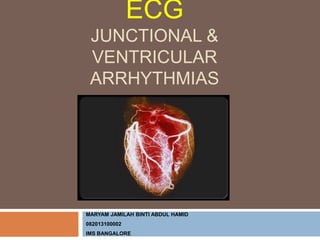
ECG
JUNCTIONAL &
VENTRICULAR
ARRHYTHMIAS

MARYAM JAMILAH BINTI ABDUL HAMID
082013100002
IMS BANGALORE
INTRODUCTION


Student should be able to understand what is
junctional and ventricular arrhythmias



Students should be able to identify these two

arrhythmias through electrocardiograph


Student should know the classification that

comes below these two arrhythmias
CLASSIFICATIONS
JUNCTIONAL
ARRHYTHMIA

AV Nodal Reentrant
Tachycardia

Junctional Rhythm

VENTRICULAR
ARRHYTHMIA

Premature Ventricular
Contraction

Ventricular tachycardia

Ventricular fibrillation
JUNCTIONAL ARRHYTHMIA
AV Nodal Reentrant Tachycardia
-A type of supraventricular tachycardia (SVT); above

the
bundle of His
-Reentry circuit forms within or just next to the AV node
-Slow pathway is located inferior and slightly posterior
to the
AV node, often following the anterior margin of
the coronary
sinus.
-common AVNRT; anterograde conduction is via the
slow pathway and the retrograde conduction is via the
fast pathway

-uncommon AVNRT; anterograde conduction is via the
fast pathway and the retrograde conduction is via the

slow pathway
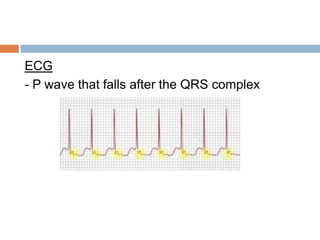
ECG
- P wave that falls after the QRS complex
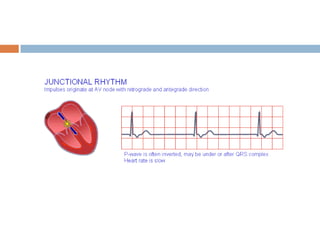
Junctional Rhythm
-Abnormal heart rhythm resulting from impulses
coming from a locus of tissue in the area of
the AV node
-AV node as the pacemaker
-Retrograde conduction
ECG
-

Without a P wave or with an inverted P wave.

-

Retrograde P waves refers to the depolarization from the AV node
back towards the SA node
VENTRICULAR ARRHYTHMIA
Cause:
1. Sudden electrical shock of the heart
2. Ischemia of the heart muscle, of its
specialized conducting system
3. Both
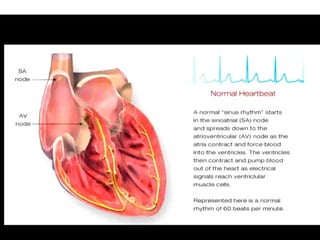
Normal person:
After electrical impulses reach the
ventricles, they die
off
 Because all the ventricular muscle is in
refractory phase
Types of Ventricular
Arrhythmias


Premature Ventricular Contraction



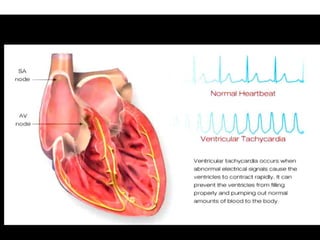
Ventricular Tachycardia




Ventricular Flutter




Up to 200 bpm

200-350 bpm

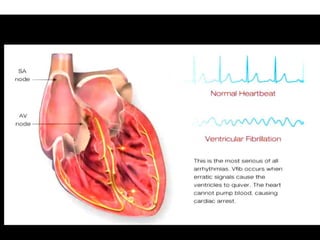
Ventricular Fibrillation


350-500 bpm
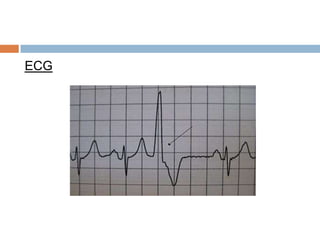
Premature Ventricular Contraction


Heartbeat is initiated by Purkinje fibres in
the ventricles rather than by the SA node



Ventricles contract first and before the atria
have optimally filled the ventricles with

blood, which means that circulation is
inefficient
ECG
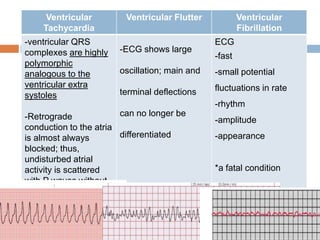
Ventricular
Tachycardia
-ventricular QRS
complexes are highly
polymorphic
analogous to the
ventricular extra
systoles

Ventricular Flutter

-ECG shows large

Ventricular
Fibrillation
ECG
-fast

oscillation; main and

-small potential

terminal deflections

fluctuations in rate
-rhythm

can no longer be
-Retrograde
conduction to the atria
differentiated
is almost always
blocked; thus,
undisturbed atrial
activity is scattered
with P waves without
any relation to QRS
complexes.

-amplitude
-appearance

*a fatal condition
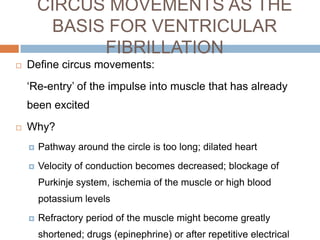
CIRCUS MOVEMENTS AS THE
BASIS FOR VENTRICULAR
FIBRILLATION


Define circus movements:
‘Re-entry’ of the impulse into muscle that has already
been excited



Why?


Pathway around the circle is too long; dilated heart



Velocity of conduction becomes decreased; blockage of
Purkinje system, ischemia of the muscle or high blood
potassium levels



Refractory period of the muscle might become greatly
shortened; drugs (epinephrine) or after repetitive electrical
CONCLUSION
Junctional arrhythmia;


AV nodal reentrant tachycardia



Junctional Rhythm

Ventricular arrhythmia;


Premature Ventricular Contraction



Ventricular Tachycardia



Ventricular Flutter



Ventricular Fibrillation
REFERENCES
1.

AK JAIN Medical Physiology, 3rd edition

2.

Davidson's Principles and Practice of Medicine, 21st Edition

3.

http://en.wikipedia.org/wiki/AV_nodal_reentrant_tachycardia

4.

http://en.wikipedia.org/wiki/Premature_ventricular_contraction

5.

American Heart Association. (2012, September 05).Ventricular fibrillation.
Retrieved from
http://www.heart.org/HEARTORG/Conditions/Arrhythmia/AboutArrhythmia/
Ventricular-Fibrillation_UCM_324063_Article.jsp

6.

Mayo Clinic Staff. (2011, November 01). Diseases and conditions
ventricular fibrillation. Retrieved from http://www.mayoclinic.org/diseasesconditions/ventricular-fibrillation/basics/definition/CON-20034473

7.

American Heart Association. (n.d.). Arrhythmias (ventricular fibrillation).
Retrieved from
http://watchlearnlive.heart.org/CVML_Player.php?moduleSelect=arrhyt

8.

http://www.drsegal.com/medstud/ecg/junction.htm

9.

http://en.wikipedia.org/wiki/Junctional_rhythm
ECG - Junctional Arrhythmia & Ventricular Arrhythmia

ECG - Junctional Arrhythmia & Ventricular Arrhythmia

  • 1.
    ECG JUNCTIONAL & VENTRICULAR ARRHYTHMIAS MARYAM JAMILAHBINTI ABDUL HAMID 082013100002 IMS BANGALORE
  • 2.
    INTRODUCTION  Student should beable to understand what is junctional and ventricular arrhythmias  Students should be able to identify these two arrhythmias through electrocardiograph  Student should know the classification that comes below these two arrhythmias
  • 3.
    CLASSIFICATIONS JUNCTIONAL ARRHYTHMIA AV Nodal Reentrant Tachycardia JunctionalRhythm VENTRICULAR ARRHYTHMIA Premature Ventricular Contraction Ventricular tachycardia Ventricular fibrillation
  • 4.
    JUNCTIONAL ARRHYTHMIA AV NodalReentrant Tachycardia -A type of supraventricular tachycardia (SVT); above the bundle of His -Reentry circuit forms within or just next to the AV node -Slow pathway is located inferior and slightly posterior to the AV node, often following the anterior margin of the coronary sinus.
  • 5.
    -common AVNRT; anterogradeconduction is via the slow pathway and the retrograde conduction is via the fast pathway -uncommon AVNRT; anterograde conduction is via the fast pathway and the retrograde conduction is via the slow pathway
  • 6.
    ECG - P wavethat falls after the QRS complex
  • 7.
    Junctional Rhythm -Abnormal heartrhythm resulting from impulses coming from a locus of tissue in the area of the AV node -AV node as the pacemaker -Retrograde conduction ECG - Without a P wave or with an inverted P wave. - Retrograde P waves refers to the depolarization from the AV node back towards the SA node
  • 9.
    VENTRICULAR ARRHYTHMIA Cause: 1. Suddenelectrical shock of the heart 2. Ischemia of the heart muscle, of its specialized conducting system 3. Both
  • 10.
    Normal person: After electricalimpulses reach the ventricles, they die off  Because all the ventricular muscle is in refractory phase
  • 11.
    Types of Ventricular Arrhythmias  PrematureVentricular Contraction  Ventricular Tachycardia   Ventricular Flutter   Up to 200 bpm 200-350 bpm Ventricular Fibrillation  350-500 bpm
  • 12.
    Premature Ventricular Contraction  Heartbeatis initiated by Purkinje fibres in the ventricles rather than by the SA node  Ventricles contract first and before the atria have optimally filled the ventricles with blood, which means that circulation is inefficient
  • 13.
  • 14.
    Ventricular Tachycardia -ventricular QRS complexes arehighly polymorphic analogous to the ventricular extra systoles Ventricular Flutter -ECG shows large Ventricular Fibrillation ECG -fast oscillation; main and -small potential terminal deflections fluctuations in rate -rhythm can no longer be -Retrograde conduction to the atria differentiated is almost always blocked; thus, undisturbed atrial activity is scattered with P waves without any relation to QRS complexes. -amplitude -appearance *a fatal condition
  • 17.
    CIRCUS MOVEMENTS ASTHE BASIS FOR VENTRICULAR FIBRILLATION  Define circus movements: ‘Re-entry’ of the impulse into muscle that has already been excited  Why?  Pathway around the circle is too long; dilated heart  Velocity of conduction becomes decreased; blockage of Purkinje system, ischemia of the muscle or high blood potassium levels  Refractory period of the muscle might become greatly shortened; drugs (epinephrine) or after repetitive electrical
  • 19.
    CONCLUSION Junctional arrhythmia;  AV nodalreentrant tachycardia  Junctional Rhythm Ventricular arrhythmia;  Premature Ventricular Contraction  Ventricular Tachycardia  Ventricular Flutter  Ventricular Fibrillation
  • 20.
    REFERENCES 1. AK JAIN MedicalPhysiology, 3rd edition 2. Davidson's Principles and Practice of Medicine, 21st Edition 3. http://en.wikipedia.org/wiki/AV_nodal_reentrant_tachycardia 4. http://en.wikipedia.org/wiki/Premature_ventricular_contraction 5. American Heart Association. (2012, September 05).Ventricular fibrillation. Retrieved from http://www.heart.org/HEARTORG/Conditions/Arrhythmia/AboutArrhythmia/ Ventricular-Fibrillation_UCM_324063_Article.jsp 6. Mayo Clinic Staff. (2011, November 01). Diseases and conditions ventricular fibrillation. Retrieved from http://www.mayoclinic.org/diseasesconditions/ventricular-fibrillation/basics/definition/CON-20034473 7. American Heart Association. (n.d.). Arrhythmias (ventricular fibrillation). Retrieved from http://watchlearnlive.heart.org/CVML_Player.php?moduleSelect=arrhyt 8. http://www.drsegal.com/medstud/ecg/junction.htm 9. http://en.wikipedia.org/wiki/Junctional_rhythm