Mathematical Geophysics:

Part 1- Linear Algebra
Contents:
Definition of Equation

System of Linear Algebraic Equation

Gauss-Jordan reduction method
Working Examples

Types of System of Algebraic Equation
according to solution types.
Dr. Amin Khalil
What is equation
stands for?
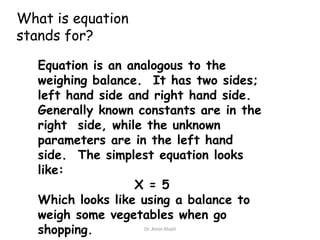
Equation is an analogous to the
weighing balance. It has two sides;
left hand side and right hand side.
Generally known constants are in the
right side, while the unknown
parameters are in the left hand
side. The simplest equation looks
like:
X = 5
Which looks like using a balance to
weigh some vegetables when go
Dr. Amin Khalil
shopping.
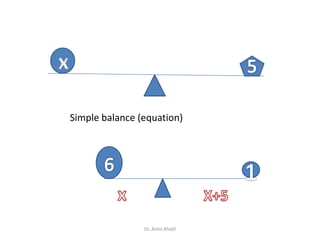
Simple balance (equation)

Dr. Amin Khalil
System of Linear
Algebraic Equation
A problem in numerical linear algebra that
requires the solution of n equations in the
unknowns x1, x2,…, xn of the form Ax = b
where A is a square n×n matrix. The solution obtained by computing
the inverse matrix and forming A–1b is less accurate and requires
more arithmetical operations than elimination methods. In
Gaussian elimination multiples of successive equations are added to
all succeeding ones to eliminate the unknowns x1, x2,…, xn–1 in turn.
Properly used, with row interchanges to avoid large multiples, this
leads to a solution that satisfies exactly a system close to the one
given, relative to the machine precision.

Dr. Amin Khalil
Einstein Summation
Convention:
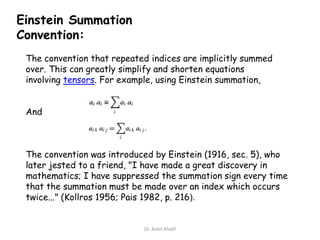
The convention that repeated indices are implicitly summed
over. This can greatly simplify and shorten equations
involving tensors. For example, using Einstein summation,
And

The convention was introduced by Einstein (1916, sec. 5), who
later jested to a friend, "I have made a great discovery in
mathematics; I have suppressed the summation sign every time
that the summation must be made over an index which occurs
twice..." (Kollros 1956; Pais 1982, p. 216).

Dr. Amin Khalil
With Einstein Summation Convention we can
reduce the system of linear algebraic
equation of the form:
A11 x1 +A12 x2 + . . . .+ A1n xn = c1
A21 x1 + A22 x2 + . . . . . +A2n xn = c2
. .
.
.
An1 x1 + An2 x2 . . . . . . .+ Ann xn = cn

Into
or simply Aij xi =cj

Dr. Amin Khalil
Gauss Elimination
Method:
Definition of row reduction makes use of elementary row
The process
operations, and can be divided into two parts. The first part
(sometimes called Forward Elimination) reduces a given system
to row echelon form, from which one can tell whether there are
no solutions, a unique solution, or infinitely many solutions. The
second part (sometimes called back substitution) continues to
use row operations until the solution is found; in other words, it
puts the matrix into reduced row echelon form.
Another point of view, which turns out to be very useful to
analyze the algorithm, is that row reduction produces a matrix
decomposition of the original matrix. The elementary row
operations may be viewed as the multiplication on the left of the
original matrix by elementary matrices. Then the first part of
the algorithm computes an LU decomposition, while the second
part writes the original matrix as the product of a uniquely
determined invertible matrix andKhaliluniquely determined reduced
Dr. Amin a
row echelon matrix.
Gauss elimination applies row
operations of the form:
Type 1: Swap the positions of two
rows.
Type 2: Multiply a row by a
nonzero scalar.
Type 3: Add to one row a scalar
multiple of another.
To produce the echelon form.

What is the echelon form?
Dr. Amin Khalil
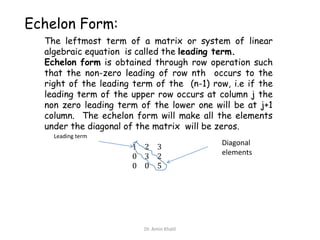
Echelon Form:
The leftmost term of a matrix or system of linear
algebraic equation is called the leading term.
Echelon form is obtained through row operation such
that the non-zero leading of row nth occurs to the
right of the leading term of the (n-1) row, i.e if the
leading term of the upper row occurs at column j the
non zero leading term of the lower one will be at j+1
column. The echelon form will make all the elements
under the diagonal of the matrix will be zeros.
Leading term

Diagonal
elements

Dr. Amin Khalil
Examples
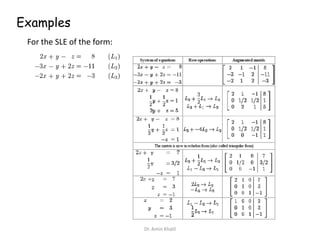
For the SLE of the form:

Dr. Amin Khalil
Dr. Amin Khalil
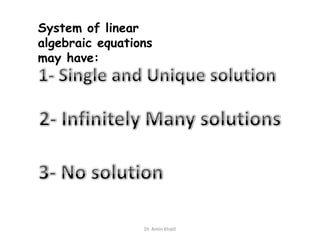
System of linear
algebraic equations
may have:

Dr. Amin Khalil
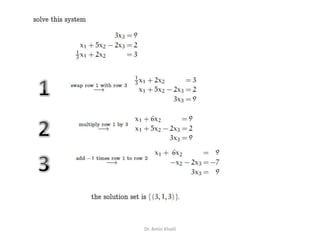
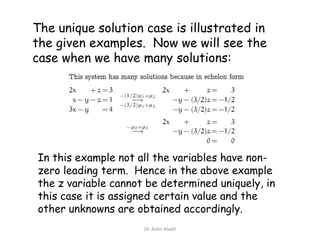
The unique solution case is illustrated in
the given examples. Now we will see the
case when we have many solutions:

In this example not all the variables have nonzero leading term. Hence in the above example
the z variable cannot be determined uniquely, in
this case it is assigned certain value and the
other unknowns are obtained accordingly.
Dr. Amin Khalil
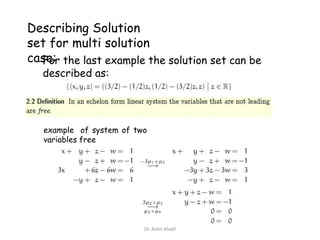
Describing Solution
set for multi solution
case: the last example the solution set can be
For
described as:

example of system of two
variables free

Dr. Amin Khalil
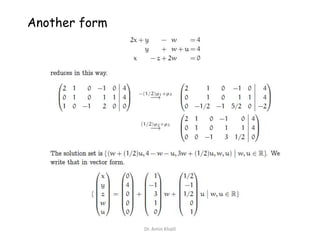
Another form

Dr. Amin Khalil
Dr. Amin Khalil

Math Geophysics-system of linear algebraic equations

  • 1.
    Mathematical Geophysics: Part 1-Linear Algebra Contents: Definition of Equation System of Linear Algebraic Equation Gauss-Jordan reduction method Working Examples Types of System of Algebraic Equation according to solution types. Dr. Amin Khalil
  • 2.
    What is equation standsfor? Equation is an analogous to the weighing balance. It has two sides; left hand side and right hand side. Generally known constants are in the right side, while the unknown parameters are in the left hand side. The simplest equation looks like: X = 5 Which looks like using a balance to weigh some vegetables when go Dr. Amin Khalil shopping.
  • 3.
  • 4.
    System of Linear AlgebraicEquation A problem in numerical linear algebra that requires the solution of n equations in the unknowns x1, x2,…, xn of the form Ax = b where A is a square n×n matrix. The solution obtained by computing the inverse matrix and forming A–1b is less accurate and requires more arithmetical operations than elimination methods. In Gaussian elimination multiples of successive equations are added to all succeeding ones to eliminate the unknowns x1, x2,…, xn–1 in turn. Properly used, with row interchanges to avoid large multiples, this leads to a solution that satisfies exactly a system close to the one given, relative to the machine precision. Dr. Amin Khalil
  • 5.
    Einstein Summation Convention: The conventionthat repeated indices are implicitly summed over. This can greatly simplify and shorten equations involving tensors. For example, using Einstein summation, And The convention was introduced by Einstein (1916, sec. 5), who later jested to a friend, "I have made a great discovery in mathematics; I have suppressed the summation sign every time that the summation must be made over an index which occurs twice..." (Kollros 1956; Pais 1982, p. 216). Dr. Amin Khalil
  • 6.
    With Einstein SummationConvention we can reduce the system of linear algebraic equation of the form: A11 x1 +A12 x2 + . . . .+ A1n xn = c1 A21 x1 + A22 x2 + . . . . . +A2n xn = c2 . . . . An1 x1 + An2 x2 . . . . . . .+ Ann xn = cn Into or simply Aij xi =cj Dr. Amin Khalil
  • 7.
    Gauss Elimination Method: Definition ofrow reduction makes use of elementary row The process operations, and can be divided into two parts. The first part (sometimes called Forward Elimination) reduces a given system to row echelon form, from which one can tell whether there are no solutions, a unique solution, or infinitely many solutions. The second part (sometimes called back substitution) continues to use row operations until the solution is found; in other words, it puts the matrix into reduced row echelon form. Another point of view, which turns out to be very useful to analyze the algorithm, is that row reduction produces a matrix decomposition of the original matrix. The elementary row operations may be viewed as the multiplication on the left of the original matrix by elementary matrices. Then the first part of the algorithm computes an LU decomposition, while the second part writes the original matrix as the product of a uniquely determined invertible matrix andKhaliluniquely determined reduced Dr. Amin a row echelon matrix.
  • 8.
    Gauss elimination appliesrow operations of the form: Type 1: Swap the positions of two rows. Type 2: Multiply a row by a nonzero scalar. Type 3: Add to one row a scalar multiple of another. To produce the echelon form. What is the echelon form? Dr. Amin Khalil
  • 9.
    Echelon Form: The leftmostterm of a matrix or system of linear algebraic equation is called the leading term. Echelon form is obtained through row operation such that the non-zero leading of row nth occurs to the right of the leading term of the (n-1) row, i.e if the leading term of the upper row occurs at column j the non zero leading term of the lower one will be at j+1 column. The echelon form will make all the elements under the diagonal of the matrix will be zeros. Leading term Diagonal elements Dr. Amin Khalil
  • 10.
    Examples For the SLEof the form: Dr. Amin Khalil
  • 11.
  • 12.
    System of linear algebraicequations may have: Dr. Amin Khalil
  • 13.
    The unique solutioncase is illustrated in the given examples. Now we will see the case when we have many solutions: In this example not all the variables have nonzero leading term. Hence in the above example the z variable cannot be determined uniquely, in this case it is assigned certain value and the other unknowns are obtained accordingly. Dr. Amin Khalil
  • 14.
    Describing Solution set formulti solution case: the last example the solution set can be For described as: example of system of two variables free Dr. Amin Khalil
  • 15.
  • 16.