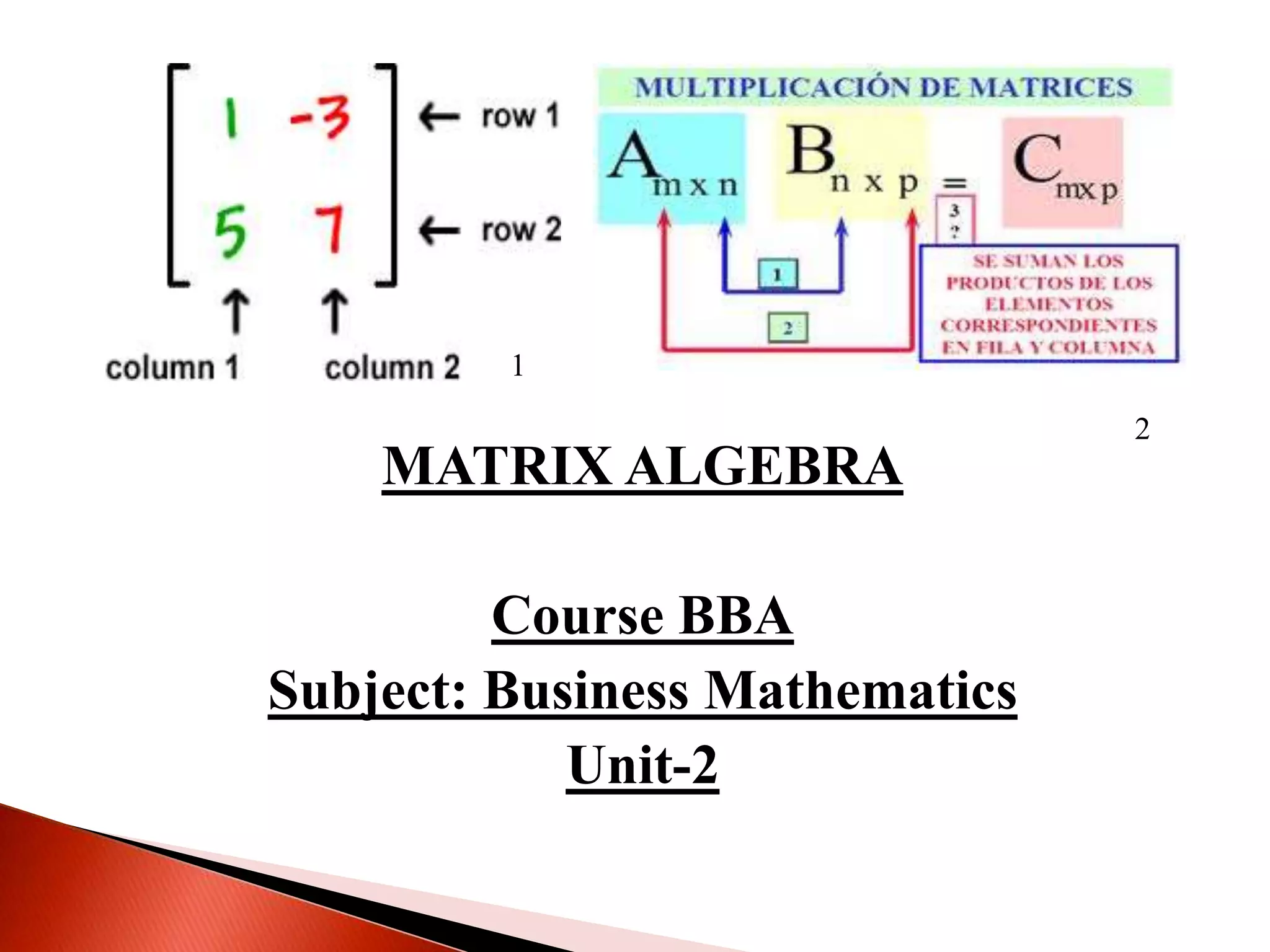
MATRIX ALGEBRA
Course BBA
Subject: Business Mathematics
Unit-2
1
2
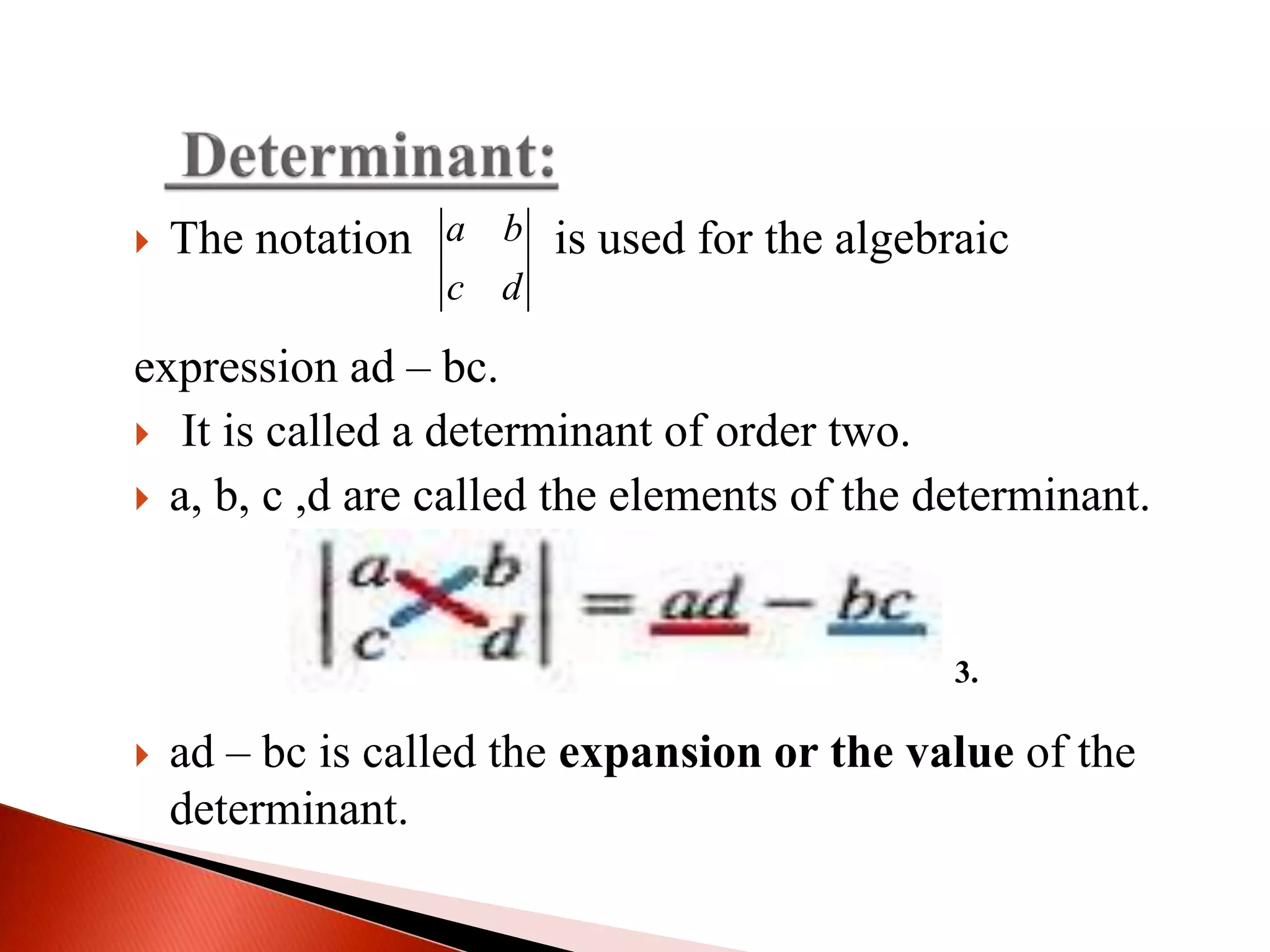
 The notation is used for the algebraic
expression ad – bc.
 It is called a determinant of order two.
 a, b, c ,d are called the elements of the determinant.
 ad – bc is called the expansion or the value of the
determinant.
a b
c d
3.
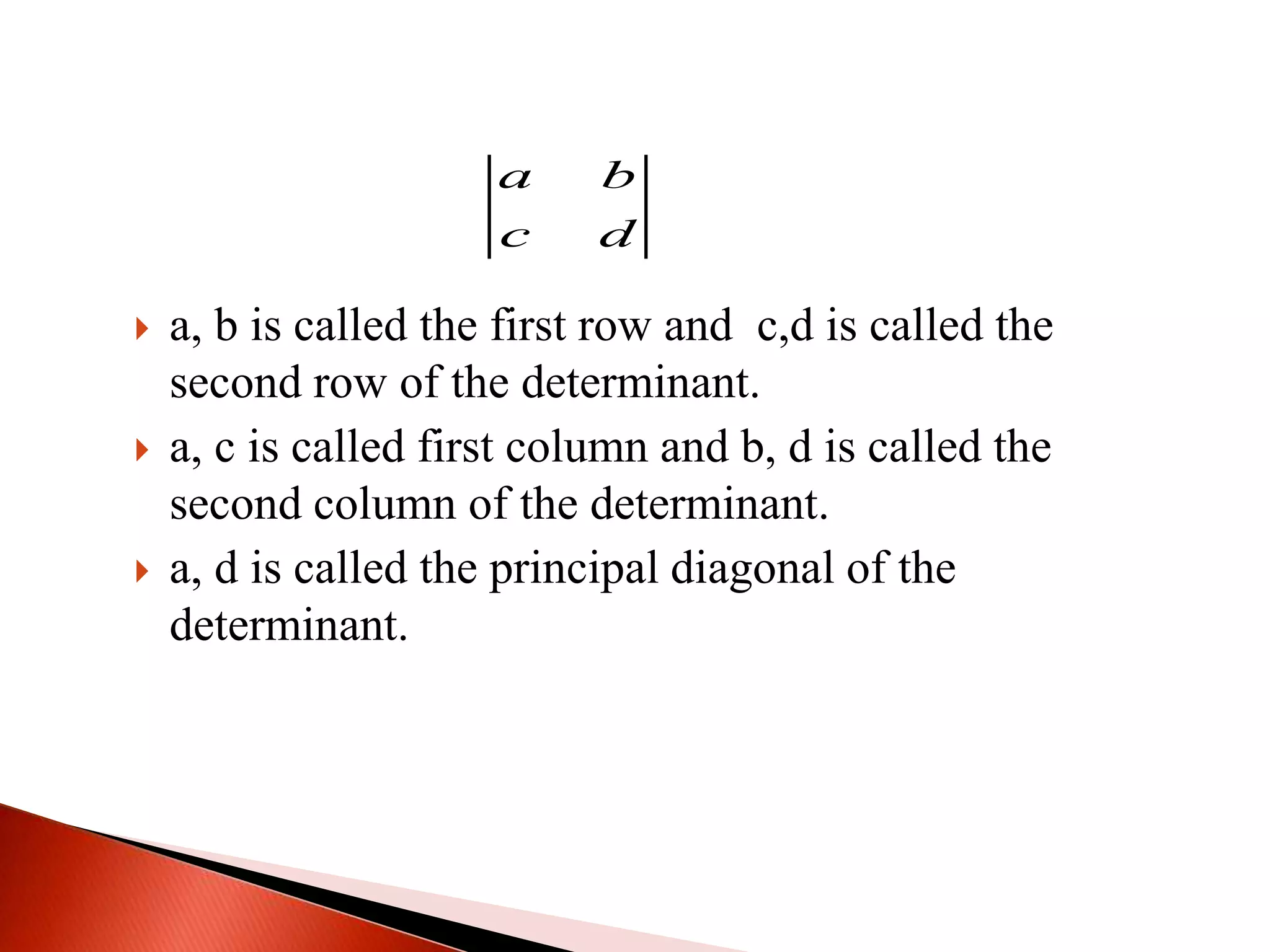
 a, b is called the first row and c,d is called the
second row of the determinant.
 a, c is called first column and b, d is called the
second column of the determinant.
 a, d is called the principal diagonal of the
determinant.
a b
c d
a b c
d e f
g h i
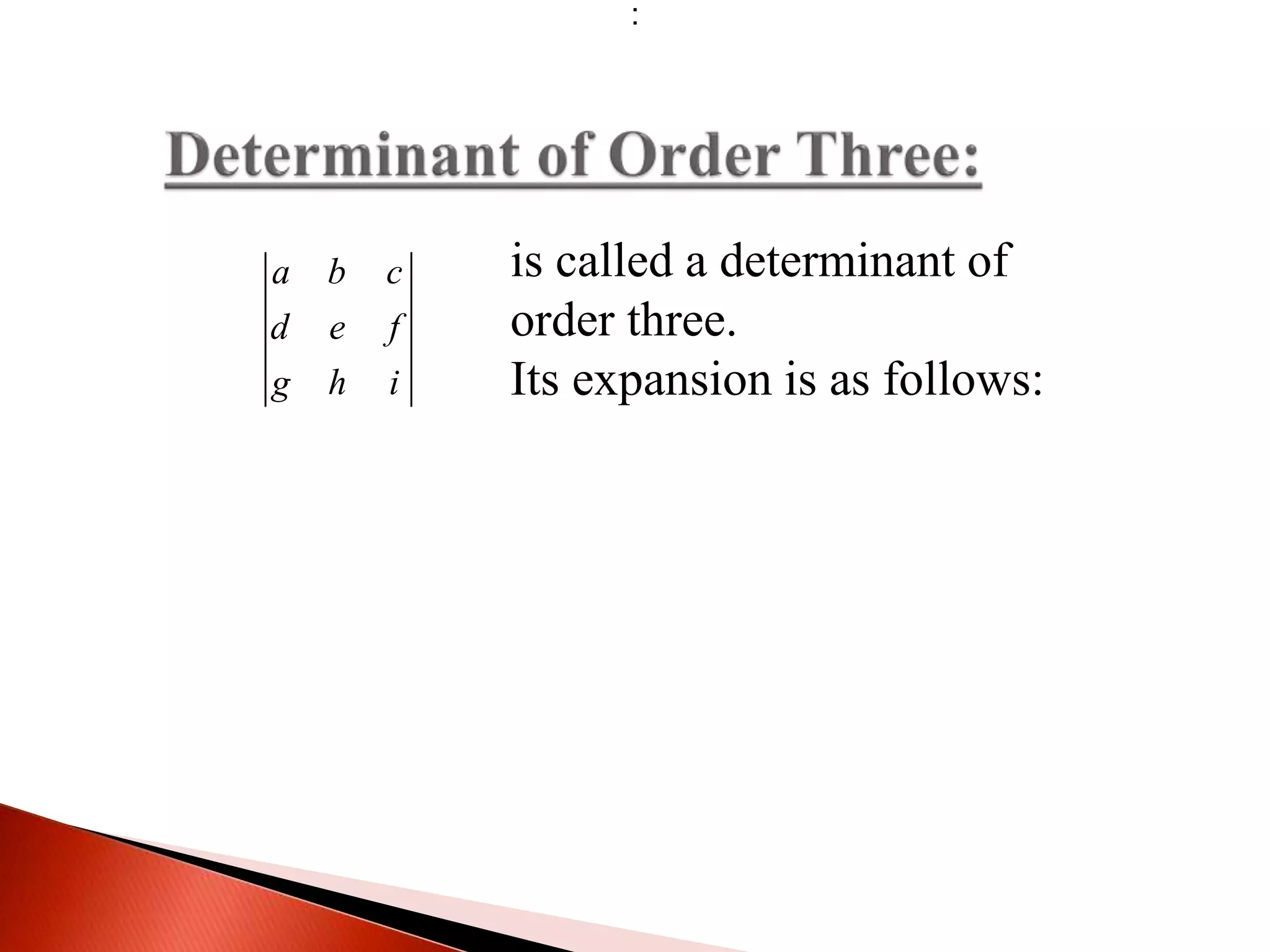
is called a determinant of
order three.
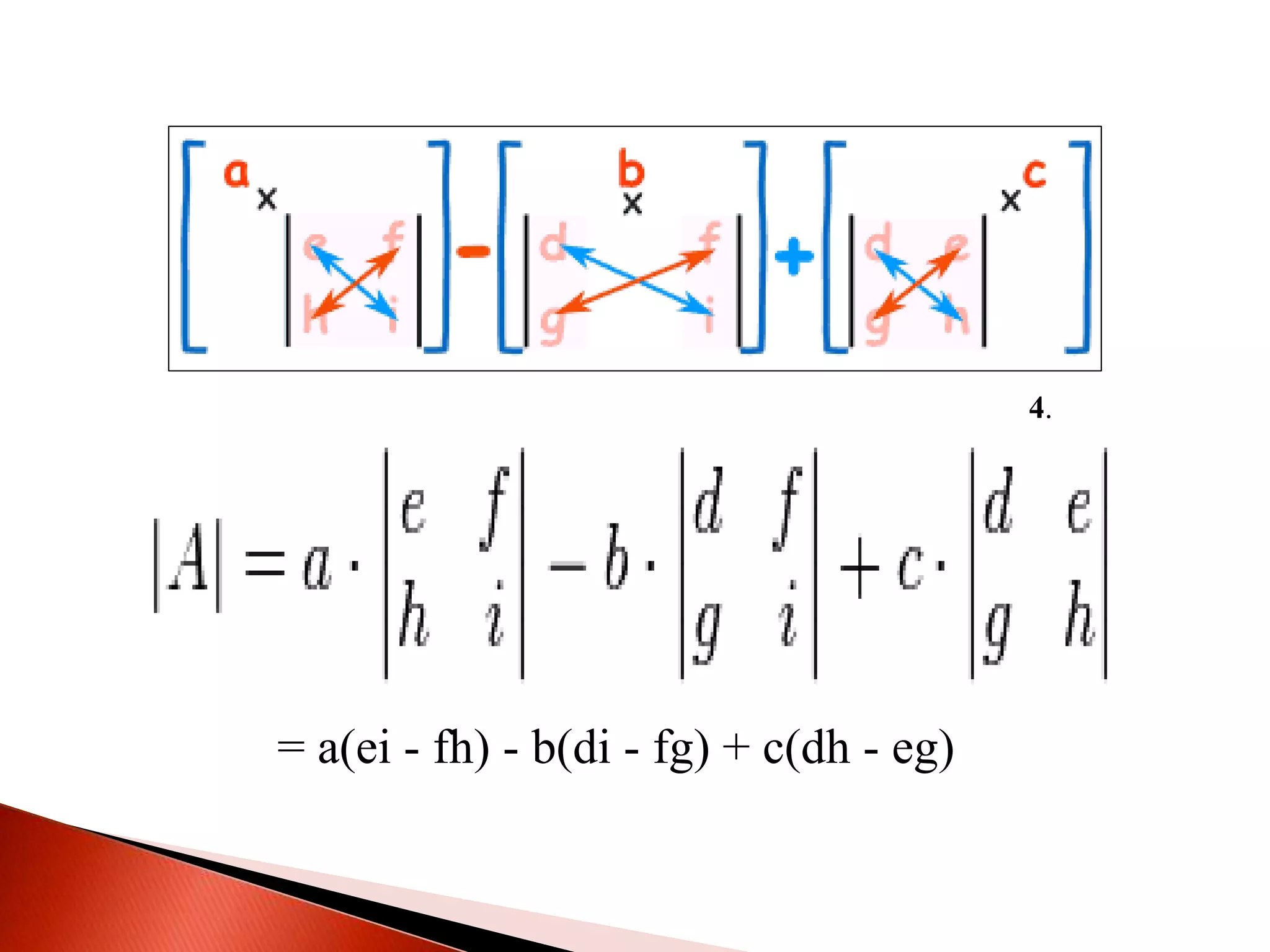
Its expansion is as follows:
:
= a(ei - fh) - b(di - fg) + c(dh - eg)
4.
(1) Find the value of
Answer:
= 1 - 2 + (-3)
= 1 [(4*5) – (6*2)] – 2[(5* 5) – (2 * -8)] – 3 [(5 * 6) – (4 *-8)]
= 1 [20 - 12] – 2 [25 + 16] – 3 [30 + 32]
= 1[8] – 2 [41] – 3 [62]
= 8 – 82 – 186 = -260
1 2 3
5 4 2
8 6 5


4 2
6 5
5 2
8 5
5 4
8 6
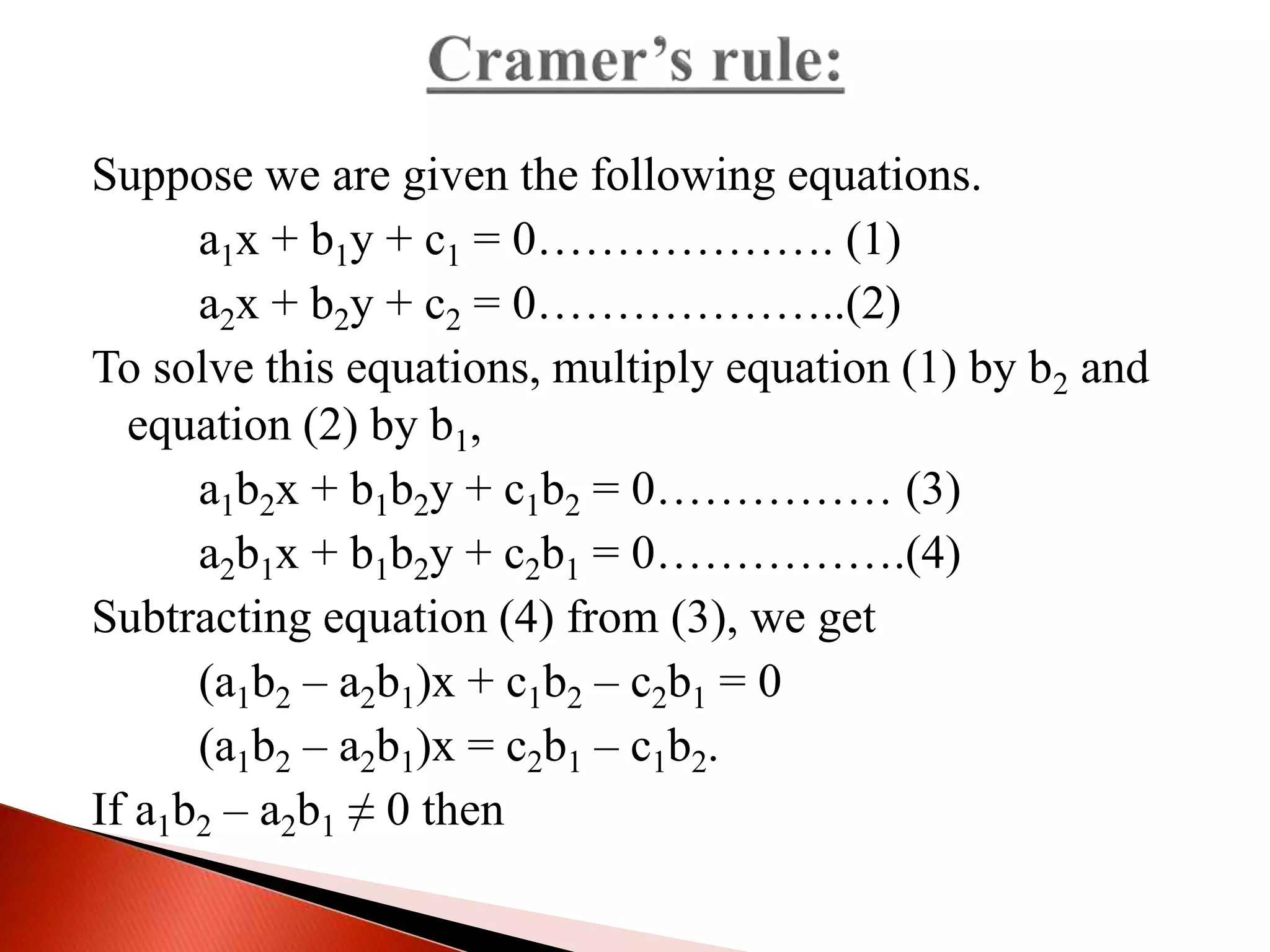
Suppose we are given the following equations.
a1x + b1y + c1 = 0………………. (1)
a2x + b2y + c2 = 0………………..(2)
To solve this equations, multiply equation (1) by b2 and
equation (2) by b1,
a1b2x + b1b2y + c1b2 = 0…………… (3)
a2b1x + b1b2y + c2b1 = 0…………….(4)
Subtracting equation (4) from (3), we get
(a1b2 – a2b1)x + c1b2 – c2b1 = 0
(a1b2 – a2b1)x = c2b1 – c1b2.
If a1b2 – a2b1 ≠ 0 then
1 2 2 1 1 2 2 1
1x
b c b c a b a b

 
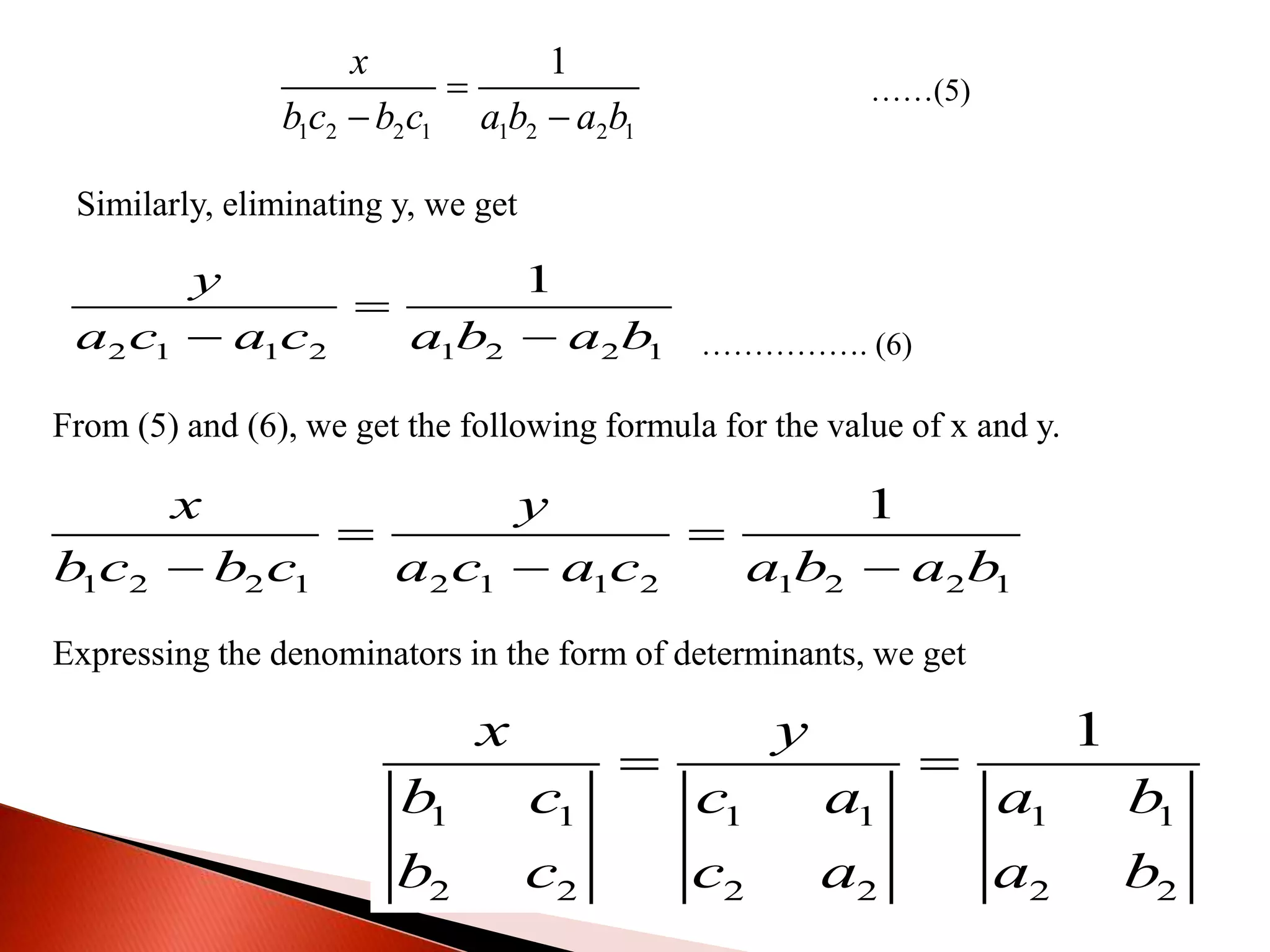
……(5)
Similarly, eliminating y, we get
2 1 1 2 1 2 2 1
1y
a c a c a b a b

  ……………. (6)
From (5) and (6), we get the following formula for the value of x and y.
1 2 2 1 2 1 1 2 1 2 2 1
1x y
b c b c a c a c a b a b
 
  
Expressing the denominators in the form of determinants, we get
1 1 1 1 1 1
2 2 2 2 2 2
1x y
b c c a a b
b c c a a b
 
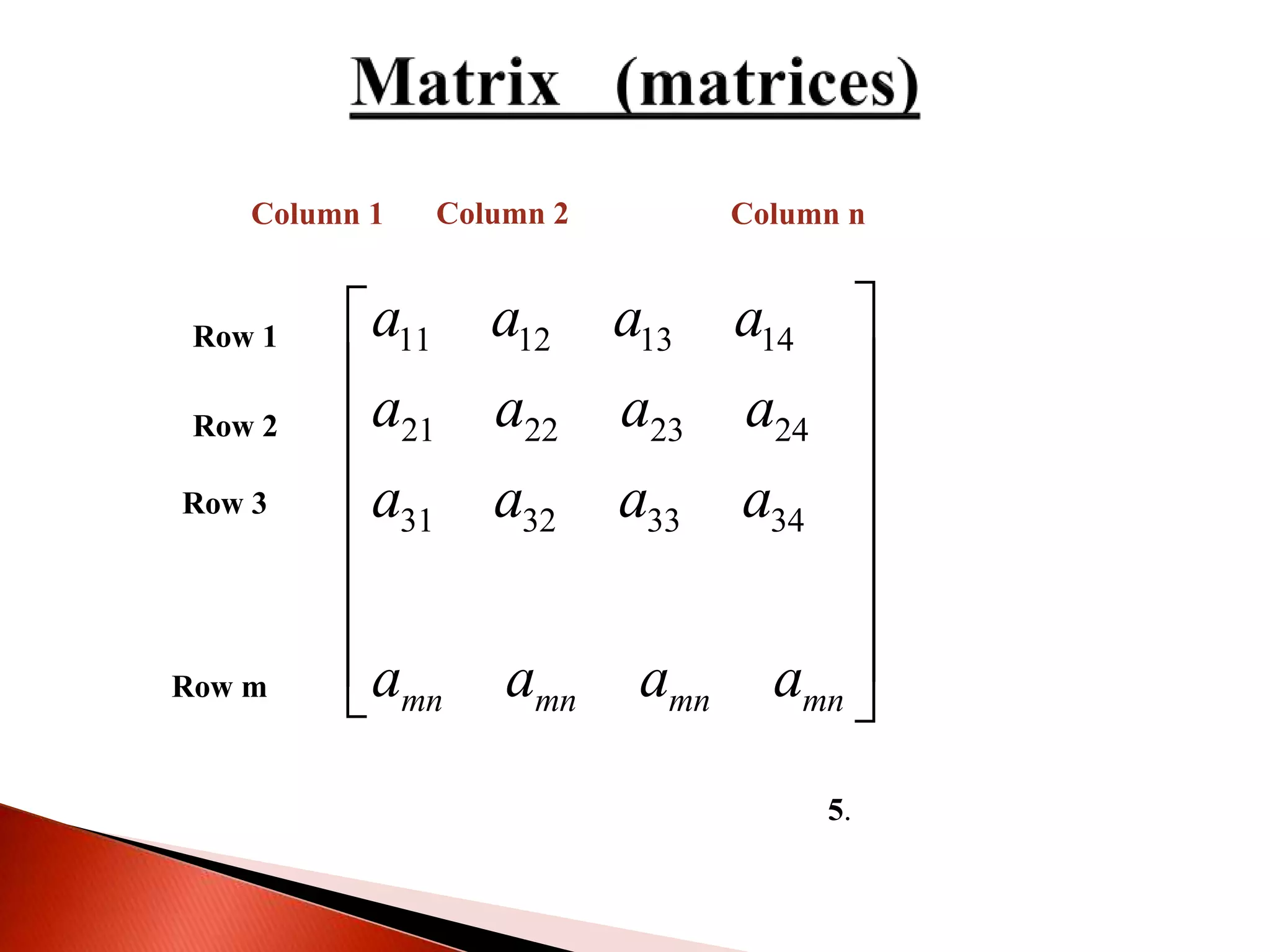
11 12 13 14
21 22 23 24
31 32 33 34
mn mn mn mn
a a a a
a a a a
a a a a
a a a a







 
Row 1
Row 2
Row 3
Row m
Column 2Column 1 Column n
5.
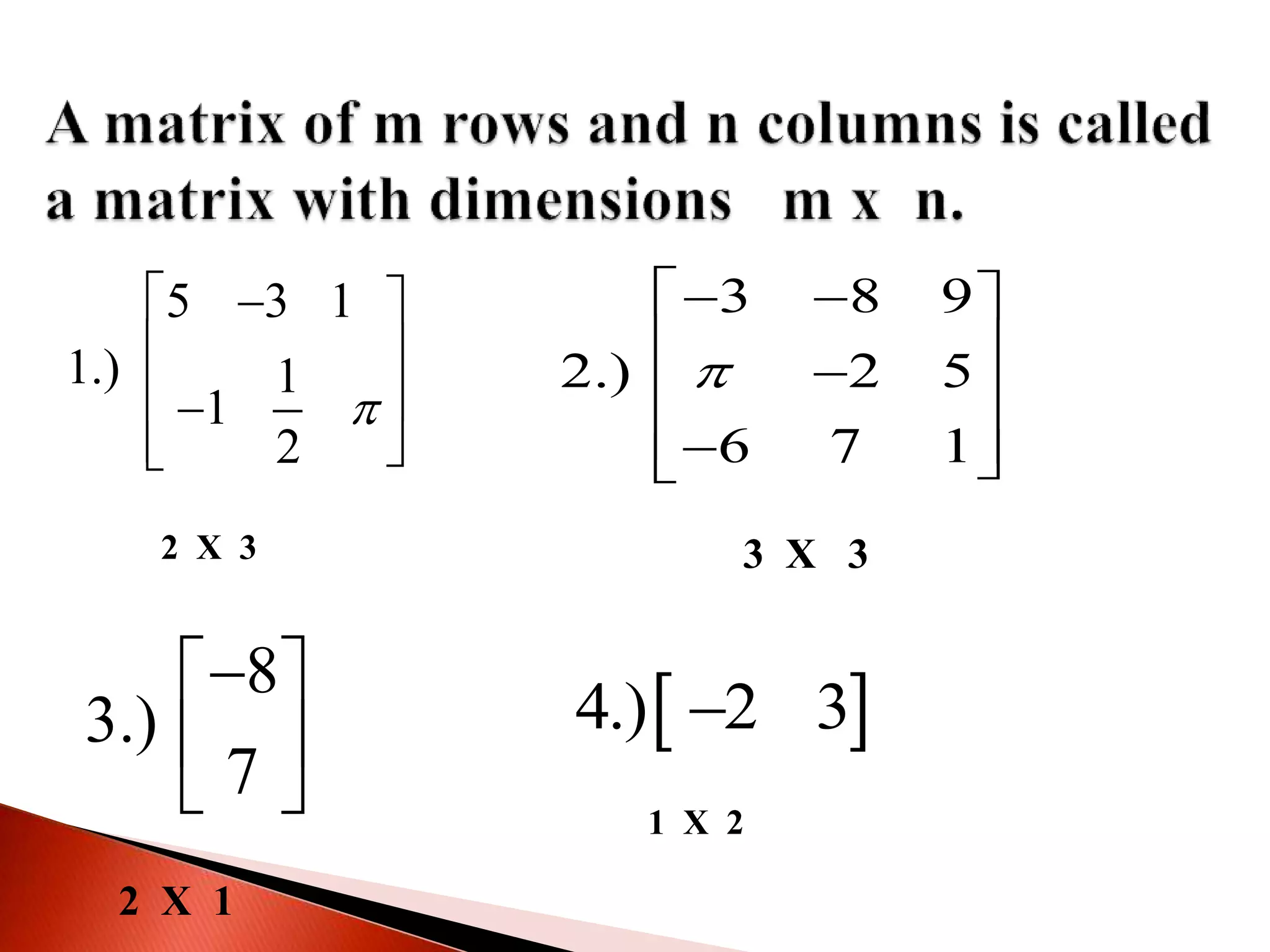
5 3 1
1.) 1
1
2

  
 
 
 
2 X 3
3 8 9
2.) 2 5
6 7 1

  
  
  
3 X 3
8
3.)
7
 
 
 
2 X 1
 4.) 2 3
1 X 2
(1) Row matrix:
 A 1 Χ n matrix of the type [ a11, a12, …….a1n] is called
a row matrix.
 This matrix has only one row and n columns.
(2) Column matrix:
 A m Χ 1 matrix of type is called a column matrix.
 This matrix has m rows and only one column.
11
21
1m
a
a
a
 
 
 
  
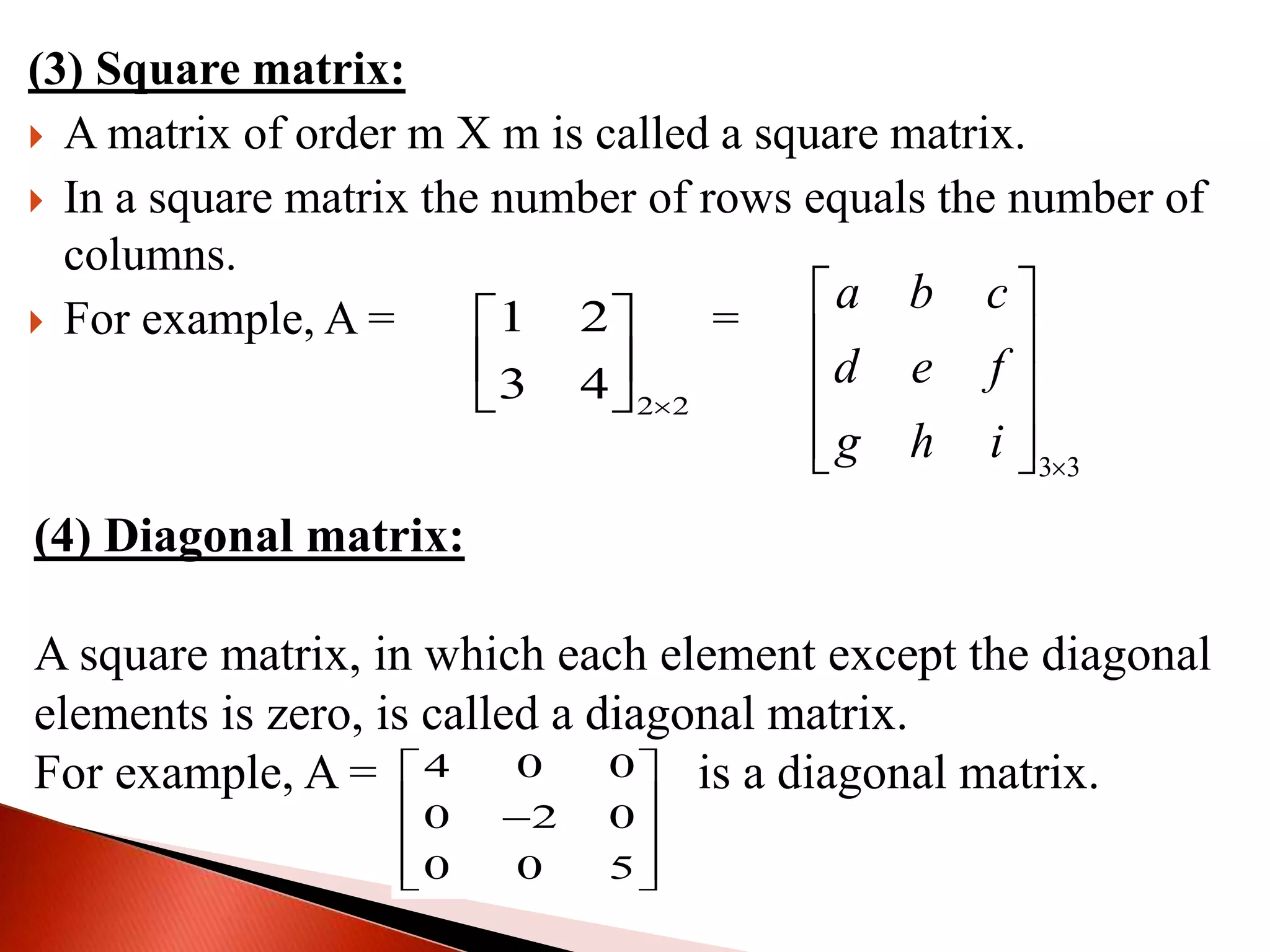
(3) Square matrix:
 A matrix of order m Χ m is called a square matrix.
 In a square matrix the number of rows equals the number of
columns.
 For example, A = B =
2 2
1 2
3 4 
 
 
 
3 3
a b c
d e f
g h i 
 
 
 
  
(4) Diagonal matrix:
A square matrix, in which each element except the diagonal
elements is zero, is called a diagonal matrix.
For example, A = is a diagonal matrix.4 0 0
0 2 0
0 0 5
 
  
  
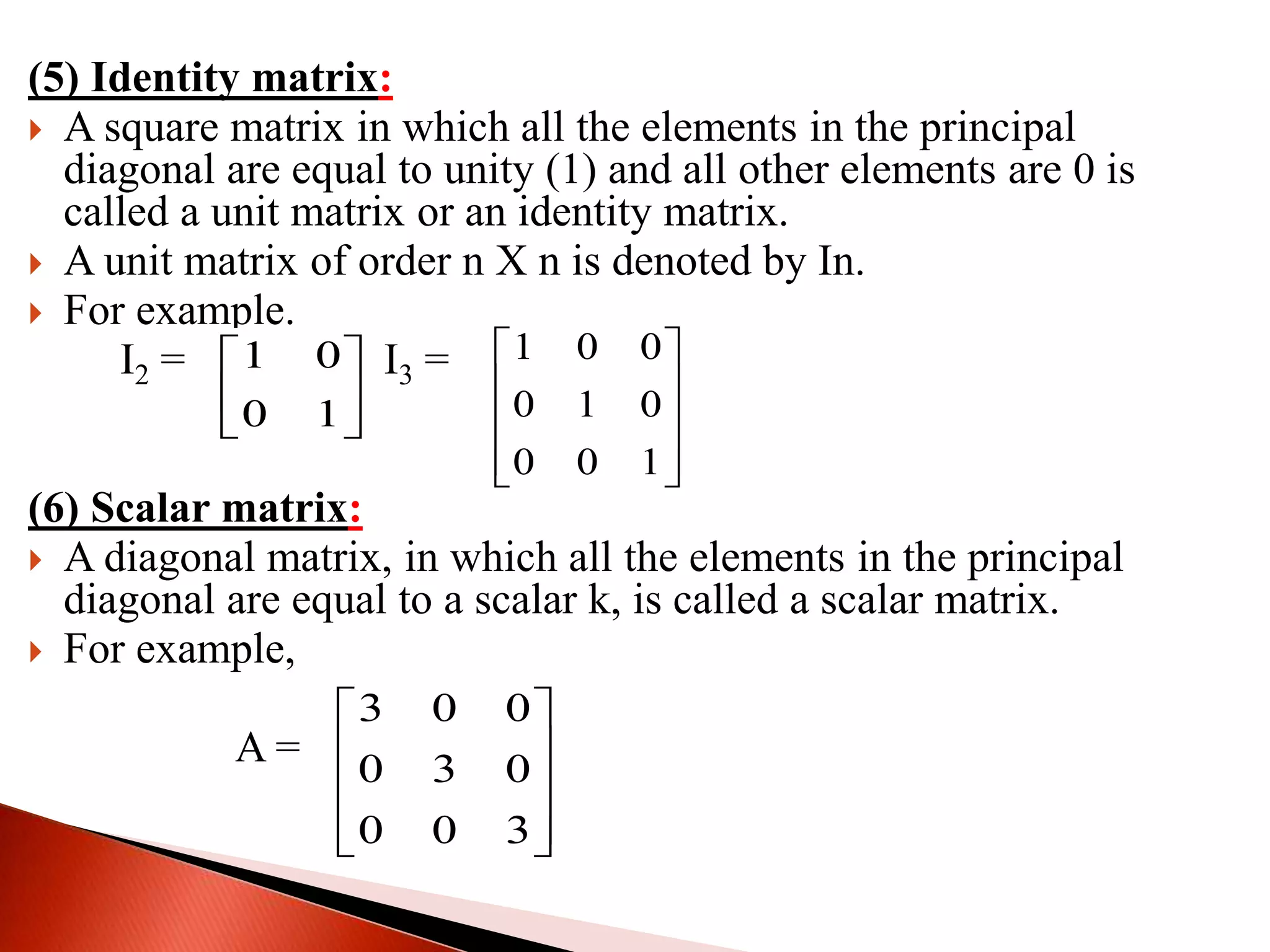
(5) Identity matrix:
 A square matrix in which all the elements in the principal
diagonal are equal to unity (1) and all other elements are 0 is
called a unit matrix or an identity matrix.
 A unit matrix of order n Χ n is denoted by In.
 For example.
I2 = I3 =
(6) Scalar matrix:
 A diagonal matrix, in which all the elements in the principal
diagonal are equal to a scalar k, is called a scalar matrix.
 For example,
A =
1 0
0 1
 
 
 
1 0 0
0 1 0
0 0 1
 
 
 
  
3 0 0
0 3 0
0 0 3
 
 
 
  
(7) Null matrix:
 A matrix having all its elements as zero is called a zero or a null
matrix.
 Null matrix can be square or rectangular.
 It is usually denoted by 0mΧn or just 0.
 For example 01Χ3 =
(8) Transpose of a matrix:
 The matrix obtained from any given matrix A by changing its rows
into corresponding columns is called the transpose of A and it is
denoted by A’ or AT.
 For example A = [1 2 3] then AT =
 0 0 0
1
2
3
 
 
 
  
(9) Symmetric matrix:
 If for a square matrix A = [aij], A’ = A, then A is called a
symmetric matrix.
 In a symmetric matrix, aij = aji for each pair (i, j).
 For example A = B =
(10) Skew symmetric matrix:
 If for a square matrix A = [aij], A’ = -A, then A is called
a skew symmetric matrix.
 In a skew symmetric matrix, aij = -aji for each pair (i, j).
 For example A =
1 3
3 2
 
 
 
3 6 7
6 5 4
7 4 8
 
 
 
  
0 3 2
3 0 5
2 5 0
 
  
  
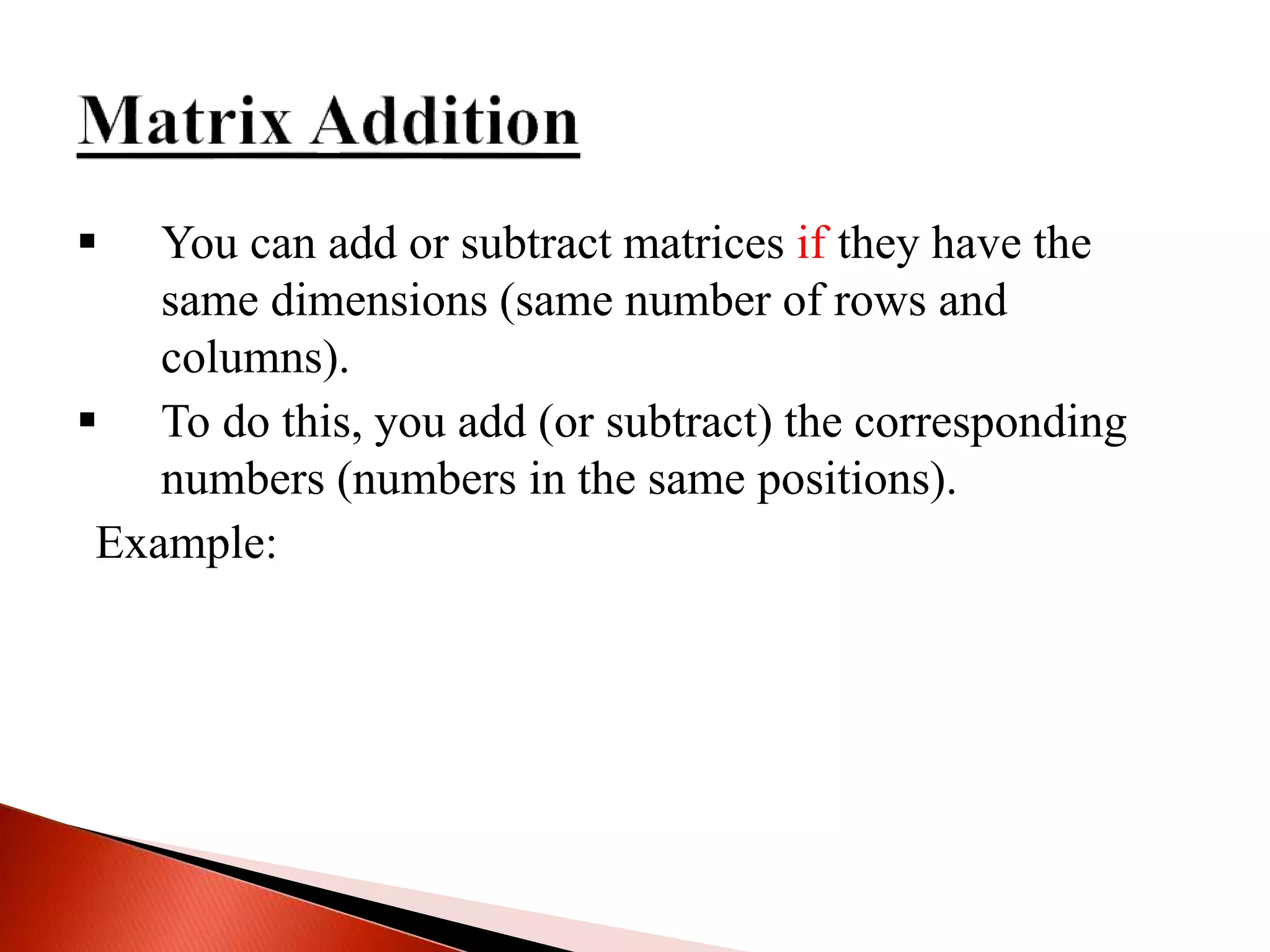
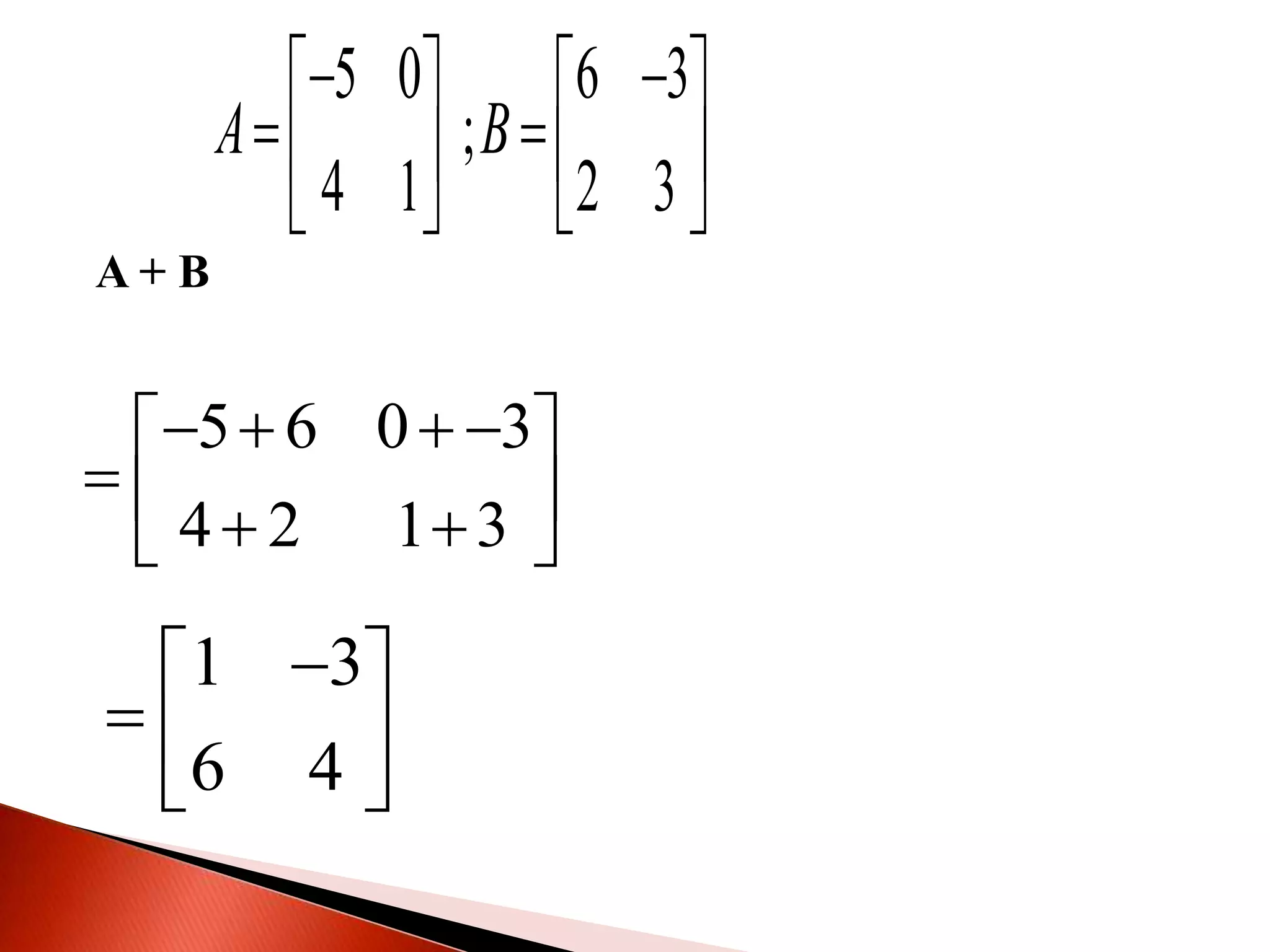
 You can add or subtract matrices if they have the
same dimensions (same number of rows and
columns).
 To do this, you add (or subtract) the corresponding
numbers (numbers in the same positions).
Example:
A + B
5 6 0 3
4 2 1 3
    
    
1 3
6 4
 
  
 
5 0 6 3
;
4 1 2 3
A B
    
    
   
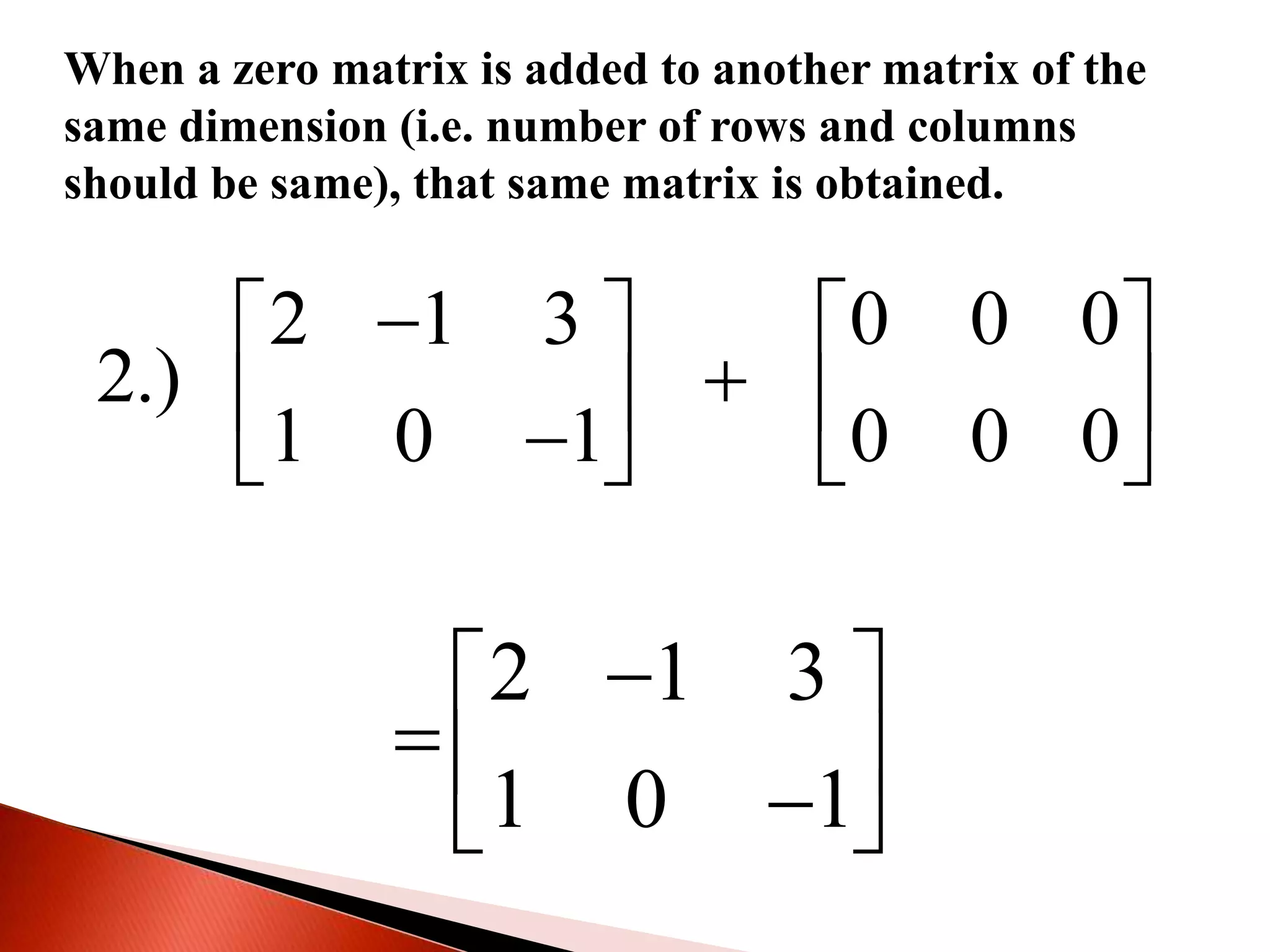
When a zero matrix is added to another matrix of the
same dimension (i.e. number of rows and columns
should be same), that same matrix is obtained.
2 1 3 0 0 0
2.)
1 0 1 0 0 0
   
      
2 1 3
1 0 1
 
  
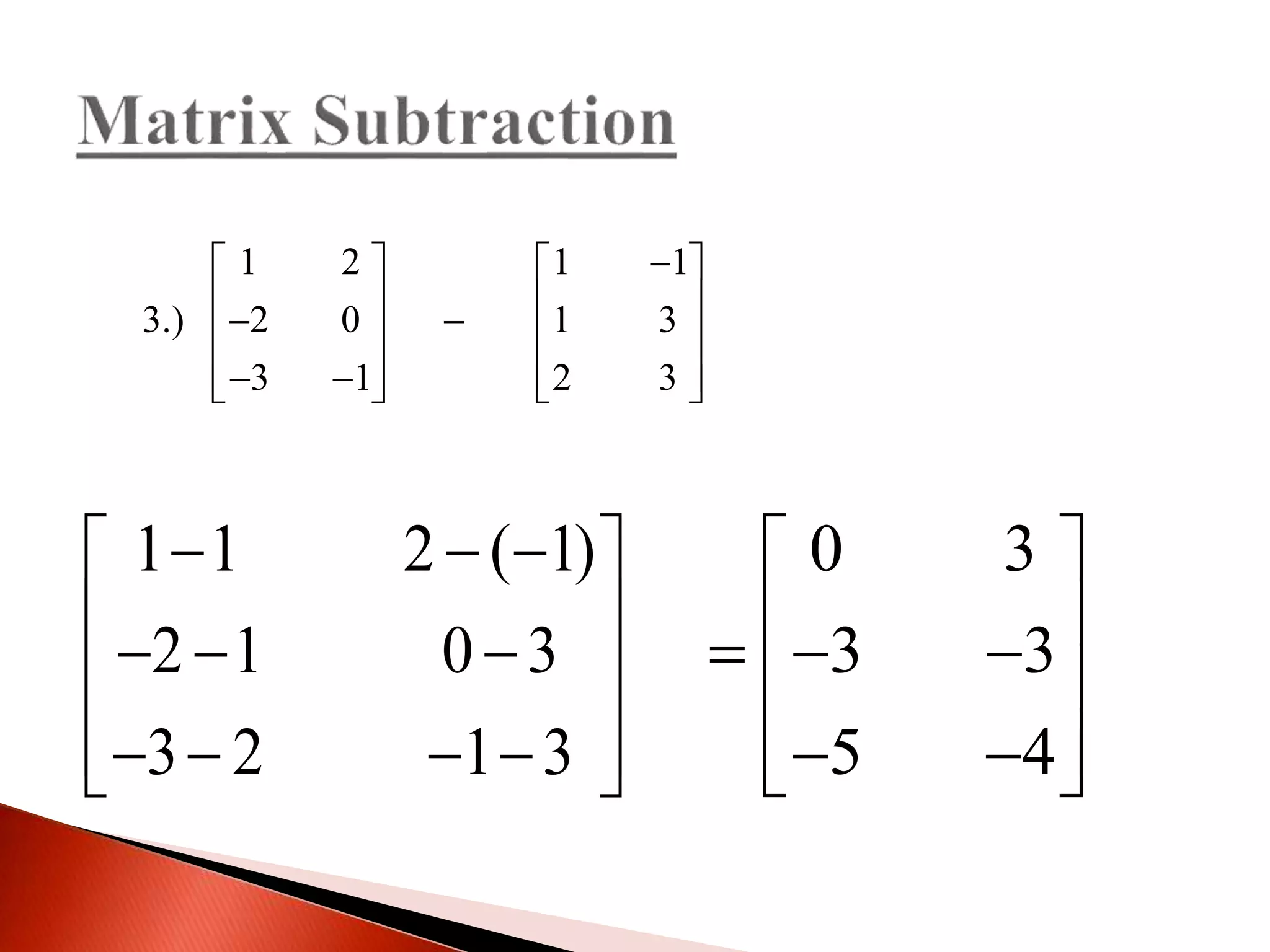
1 2 1 1
3.) 2 0 1 3
3 1 2 3
   
       
       
1 1 2 ( 1)
2 1 0 3
3 2 1 3
   
    
     
0 3
3 3
5 4
 
    
   
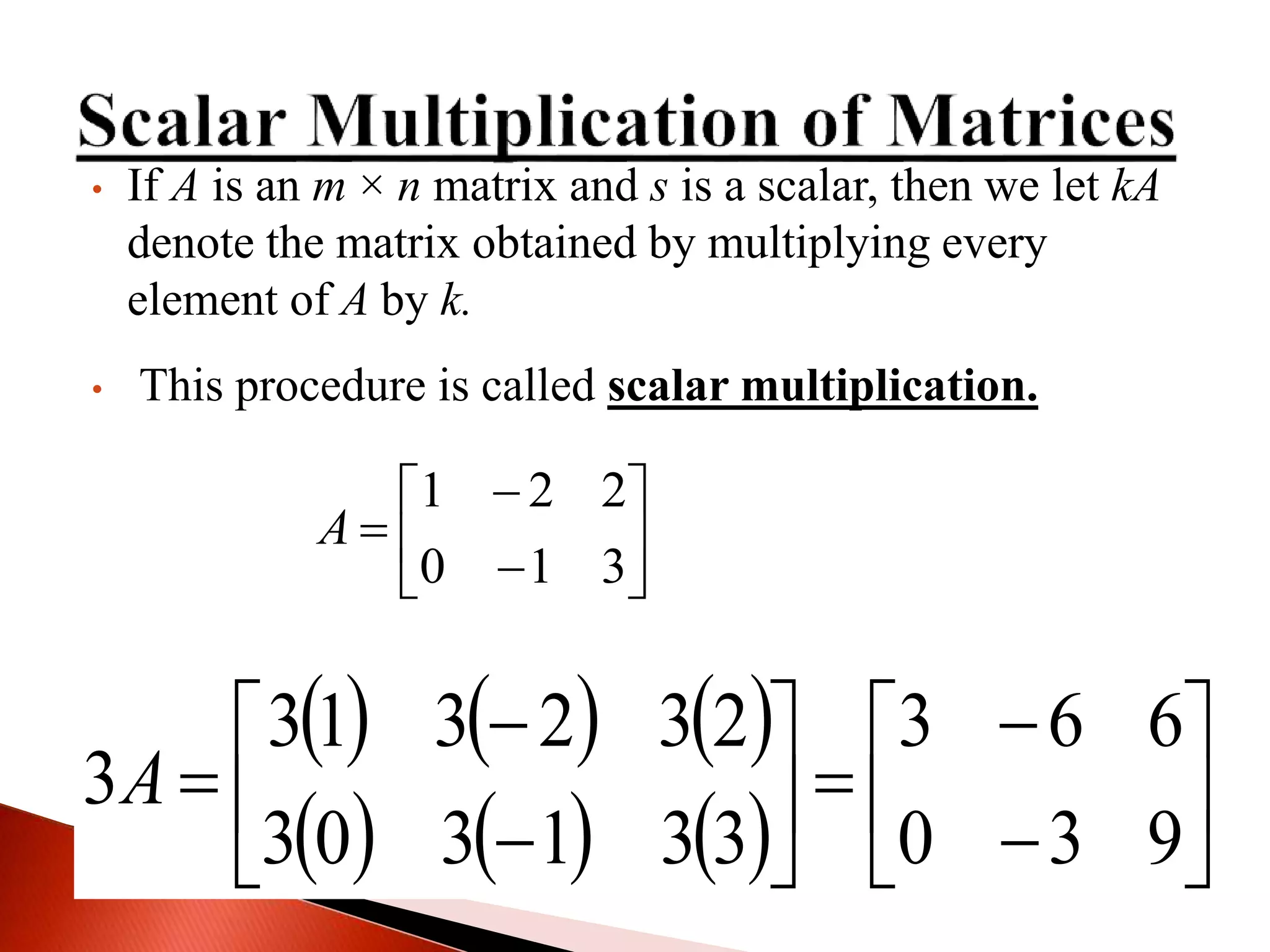
• If A is an m × n matrix and s is a scalar, then we let kA
denote the matrix obtained by multiplying every
element of A by k.
• This procedure is called scalar multiplication.









310
221
A
     
      
















930
663
331303
232313
3A
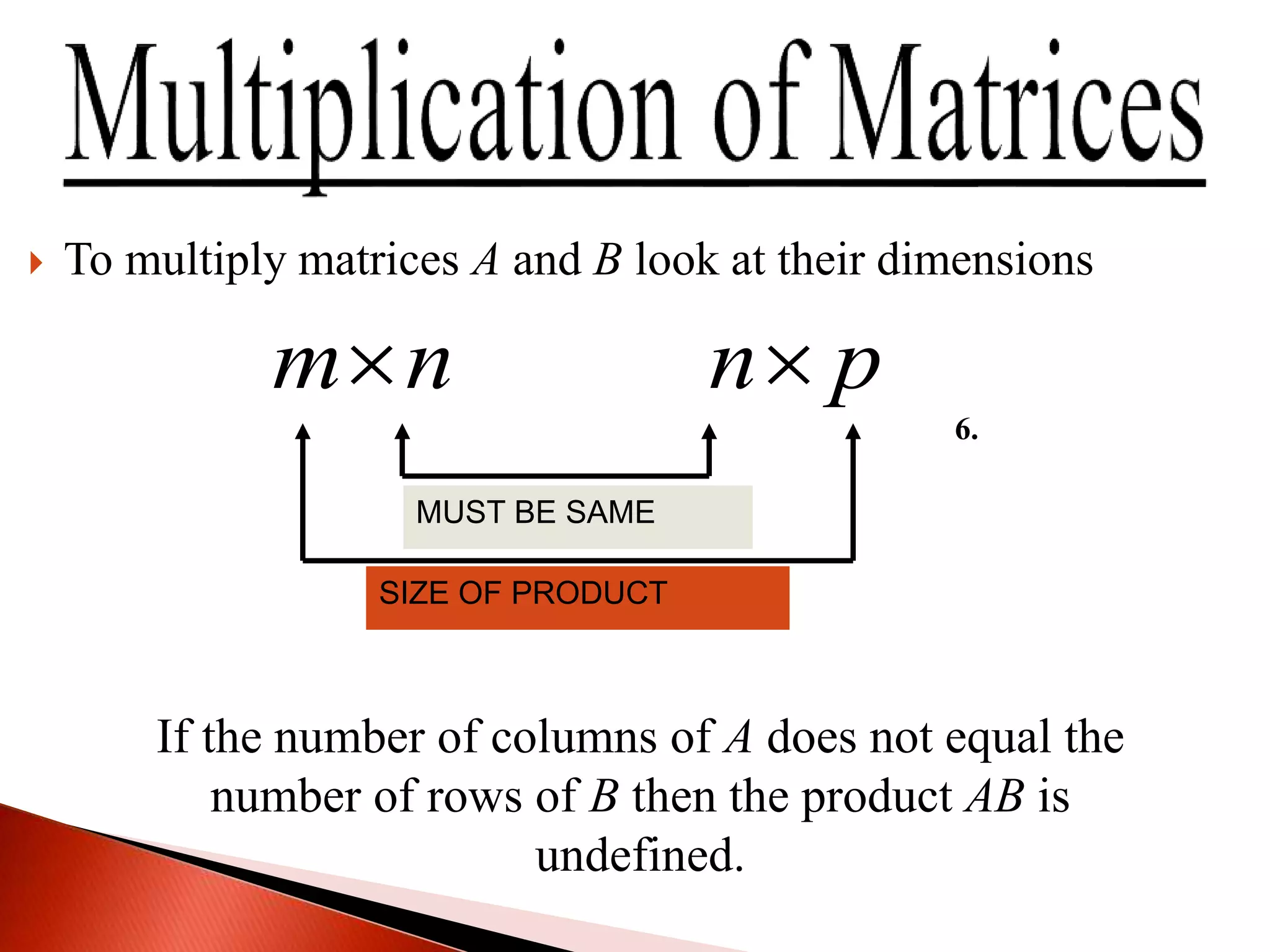
 To multiply matrices A and B look at their dimensions
pnnm 
MUST BE SAME
SIZE OF PRODUCT
If the number of columns of A does not equal the
number of rows of B then the product AB is
undefined.
6.
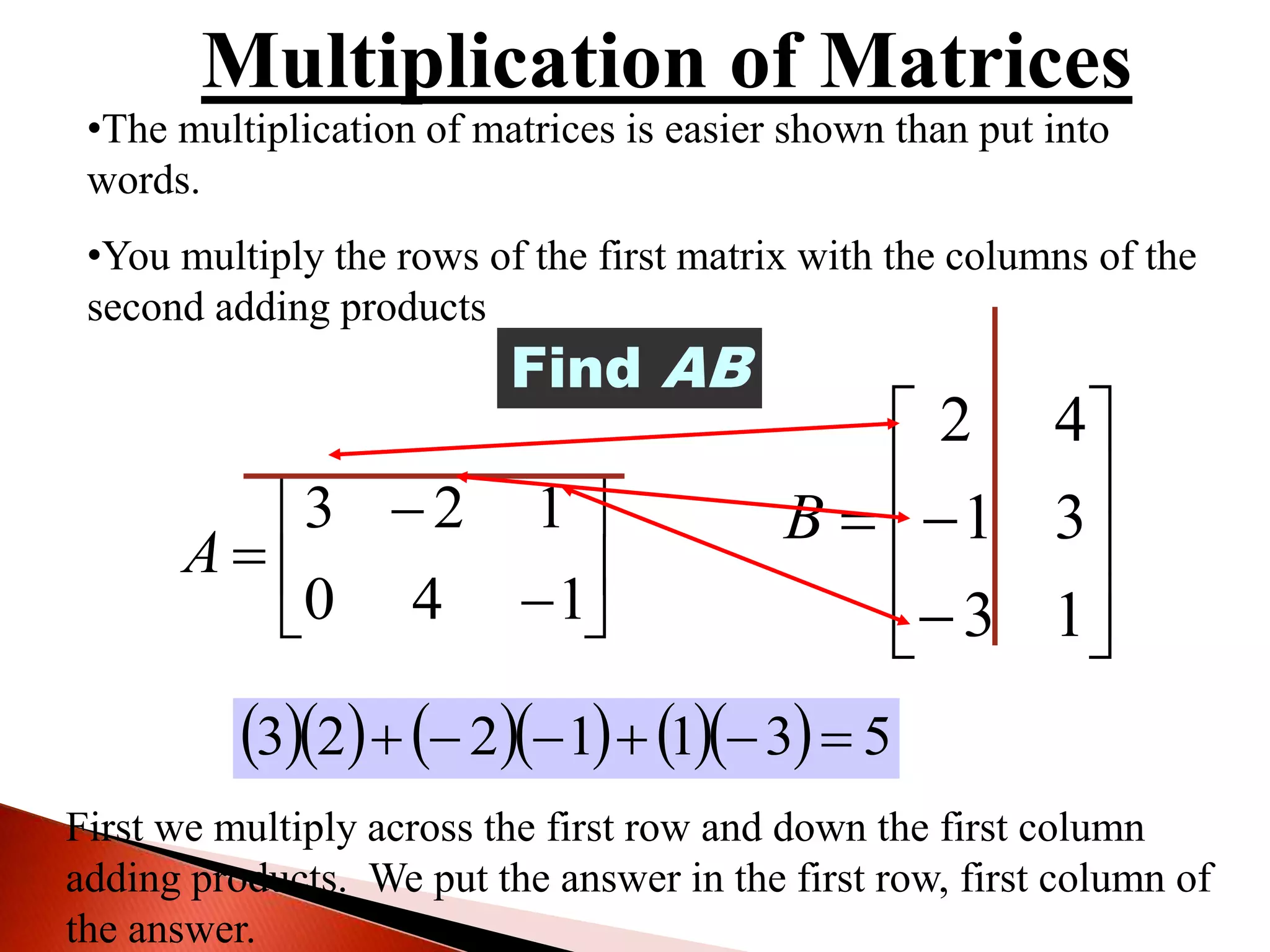
•The multiplication of matrices is easier shown than put into
words.
•You multiply the rows of the first matrix with the columns of the
second adding products









140
123
A












13
31
42
B
Find AB
First we multiply across the first row and down the first column
adding products. We put the answer in the first row, first column of
the answer.
 23    1223          5311223 









140
123
A












13
31
42
B
Find AB
We multiplied across first row and down first column so we put the
answer in the first row, first column.







5
AB
Now we multiply across the first row and down the second column and we’ll put
the answer in the first row, second column.
  43     3243          7113243 






75
AB
Now we multiply across the second row and down the first column and we’ll put
the answer in the second row, first column.
  20     1420          1311420 







1
75
AB
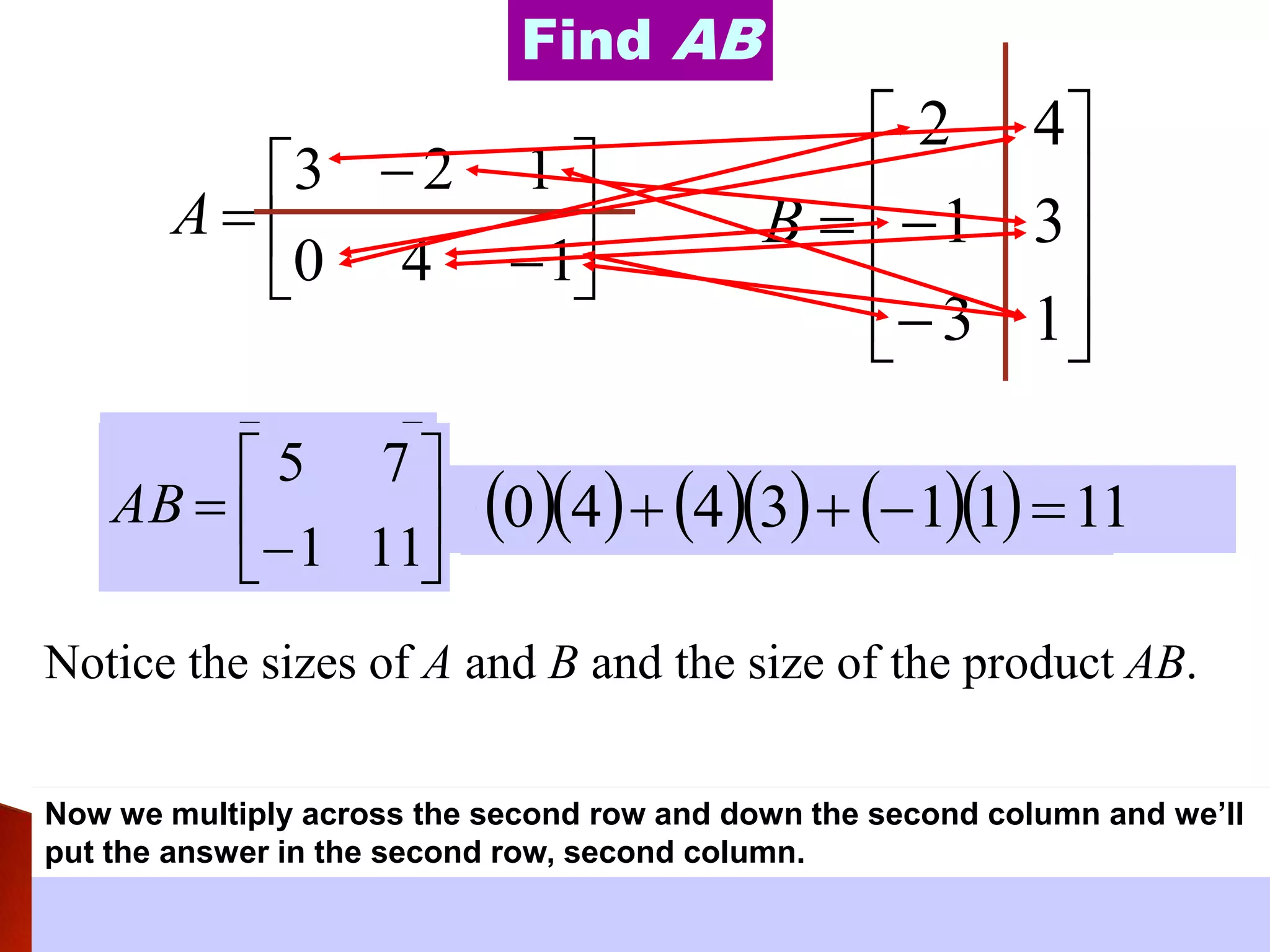
Now we multiply across the second row and down the second column and we’ll
put the answer in the second row, second column.
  40     3440          11113440 







111
75
AB
Notice the sizes of A and B and the size of the product AB.
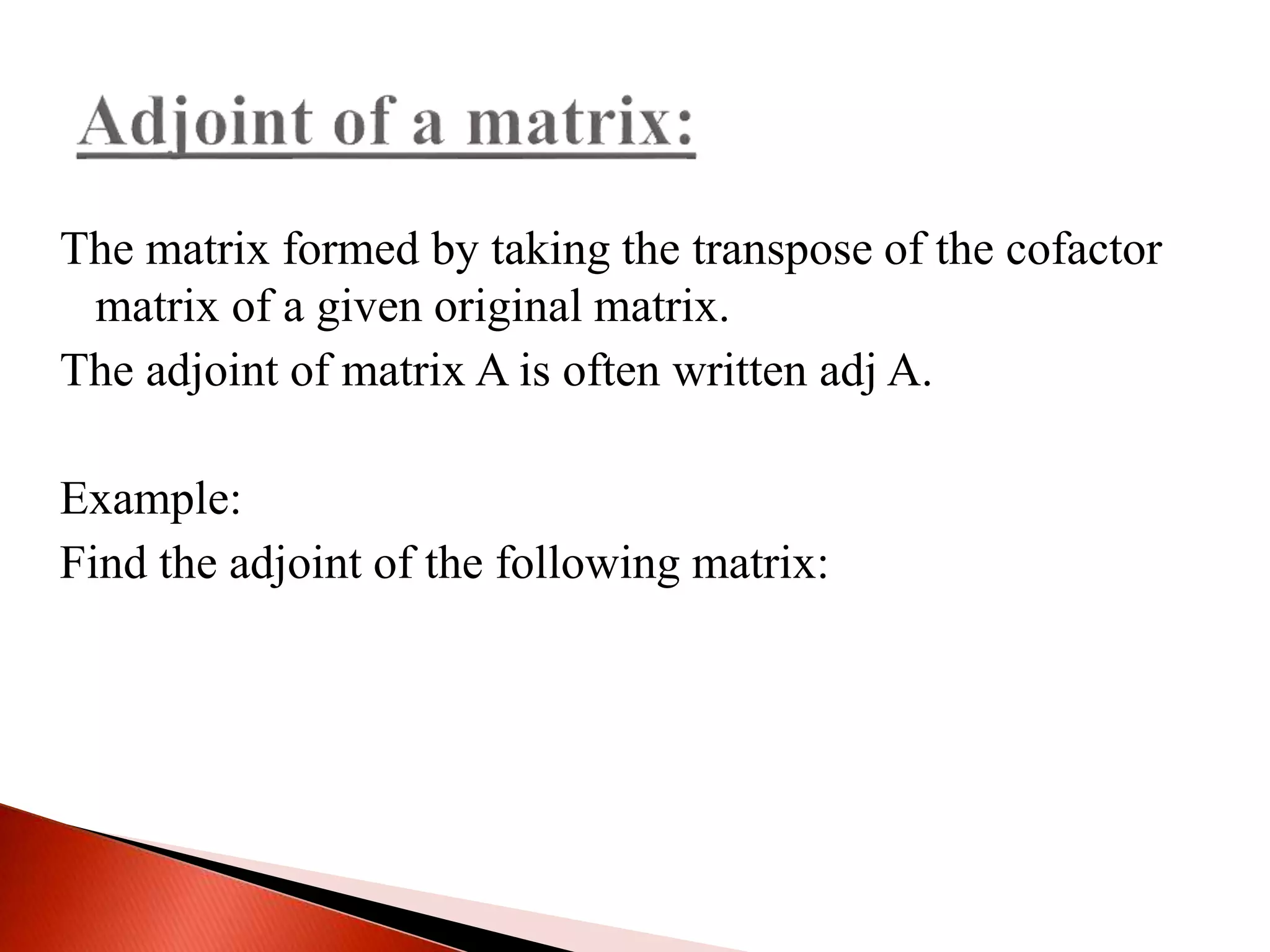
The matrix formed by taking the transpose of the cofactor
matrix of a given original matrix.
The adjoint of matrix A is often written adj A.
Example:
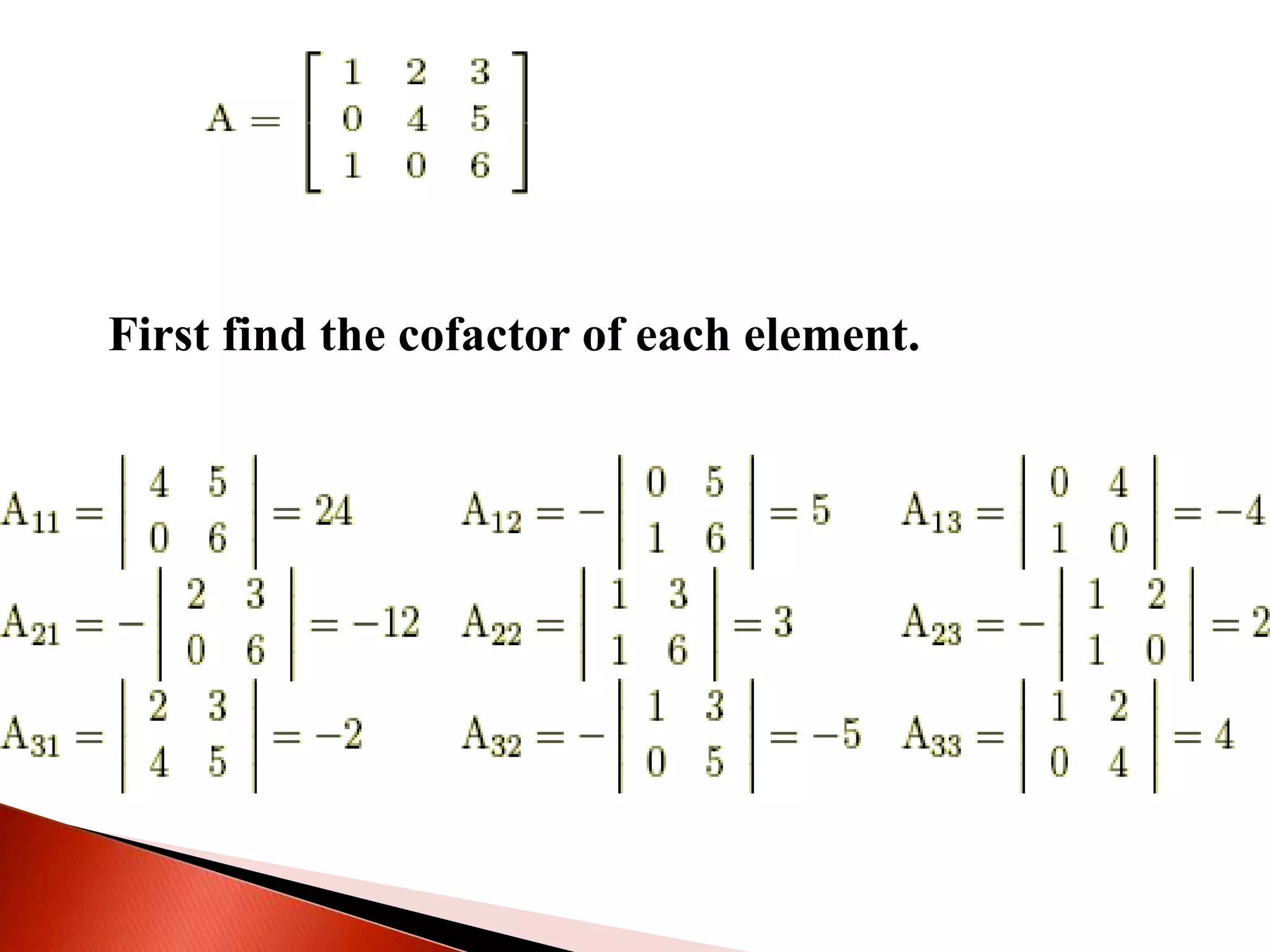
Find the adjoint of the following matrix:
First find the cofactor of each element.
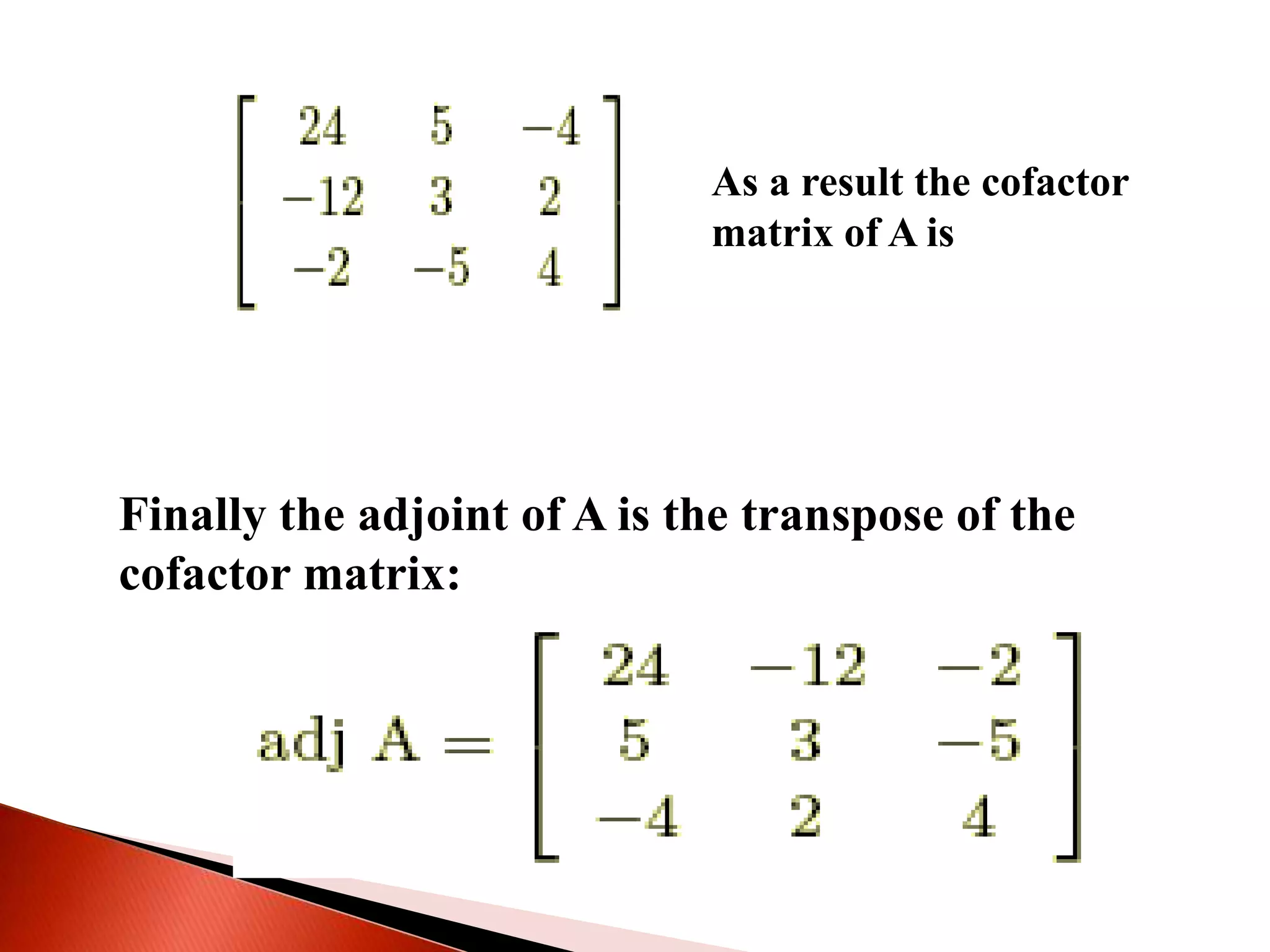
As a result the cofactor
matrix of A is
Finally the adjoint of A is the transpose of the
cofactor matrix:
If for a given square matrix A, there exists a matrix B
such that AB = I = BA, then the matrix B is called an
inverse of A.
It is denoted by A-1
Note: Inverse does not exist if product is not an identity .
1. Find determinant of matrix. If det. is not equal to 0,
then inverse of matrix exist.
2. Find adjoint of a matrix.
a. find cofactor
b. change sign. (if odd.. –ve sign & if even.. +ve
sign)
c. transpose.
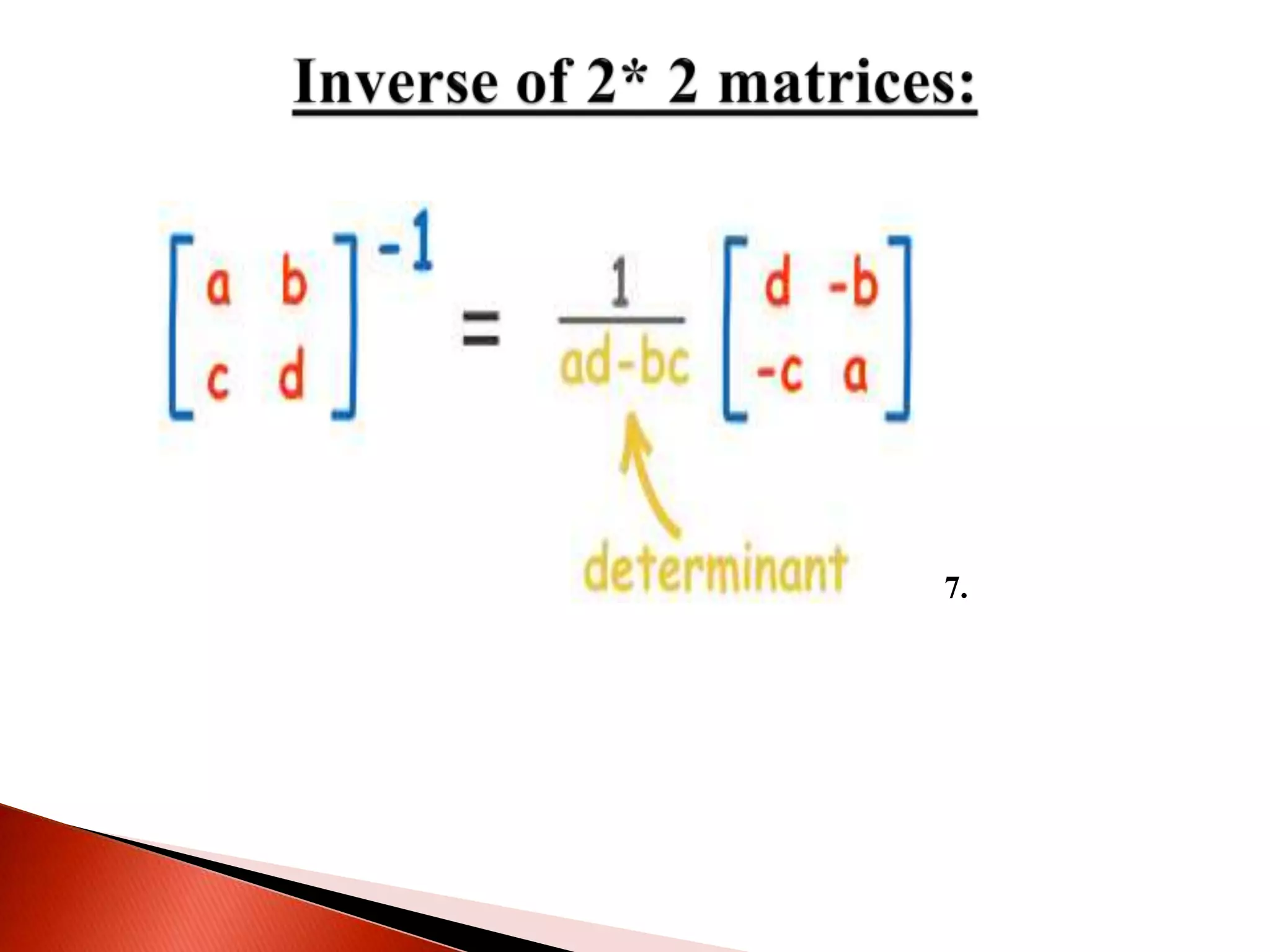
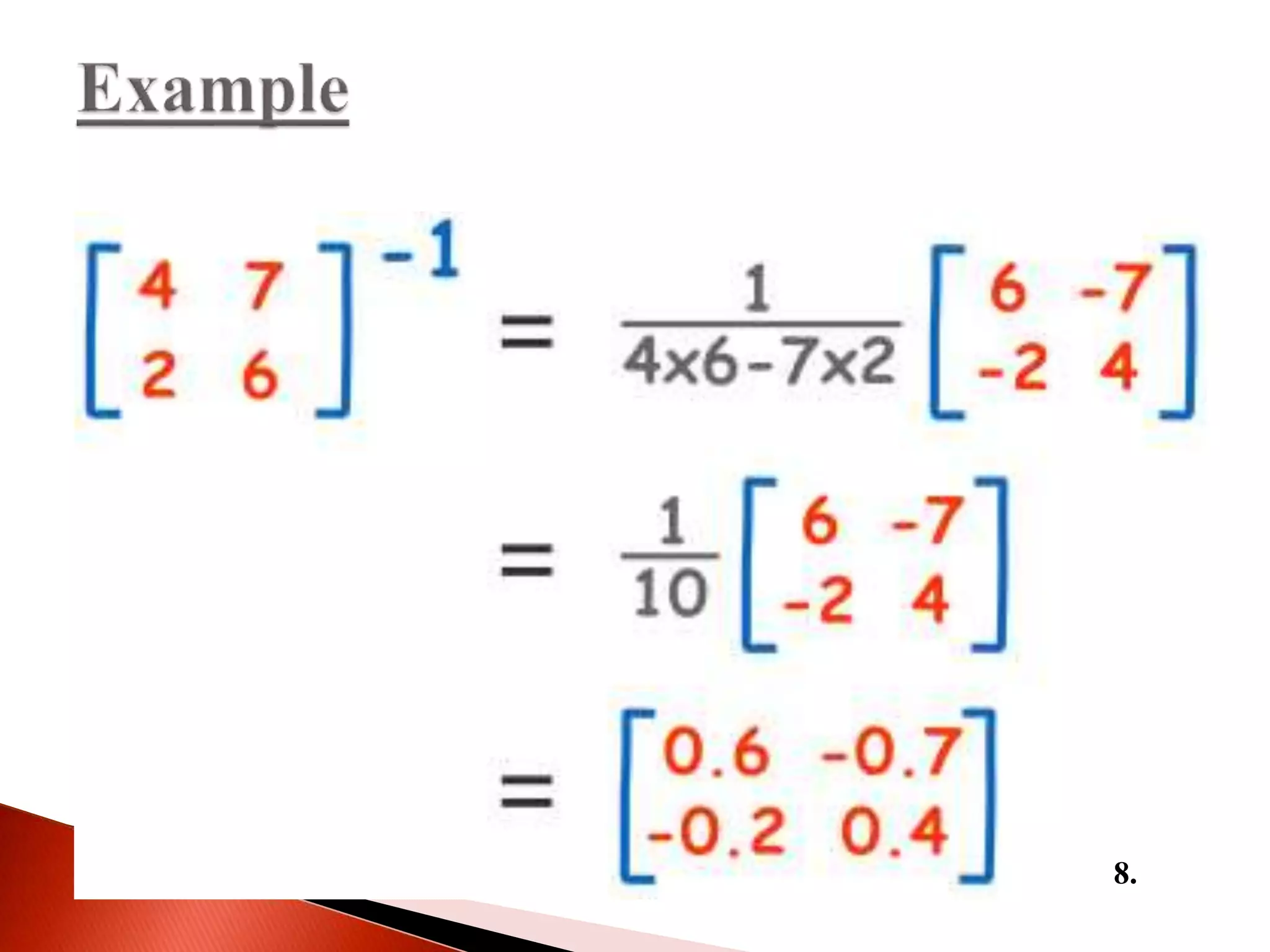
3. Find inverse. i.e. A-1 = (adjoint of A)
1
A
7.
8.
1 2 3
0 4 5
1 0 6
A
 
   
  
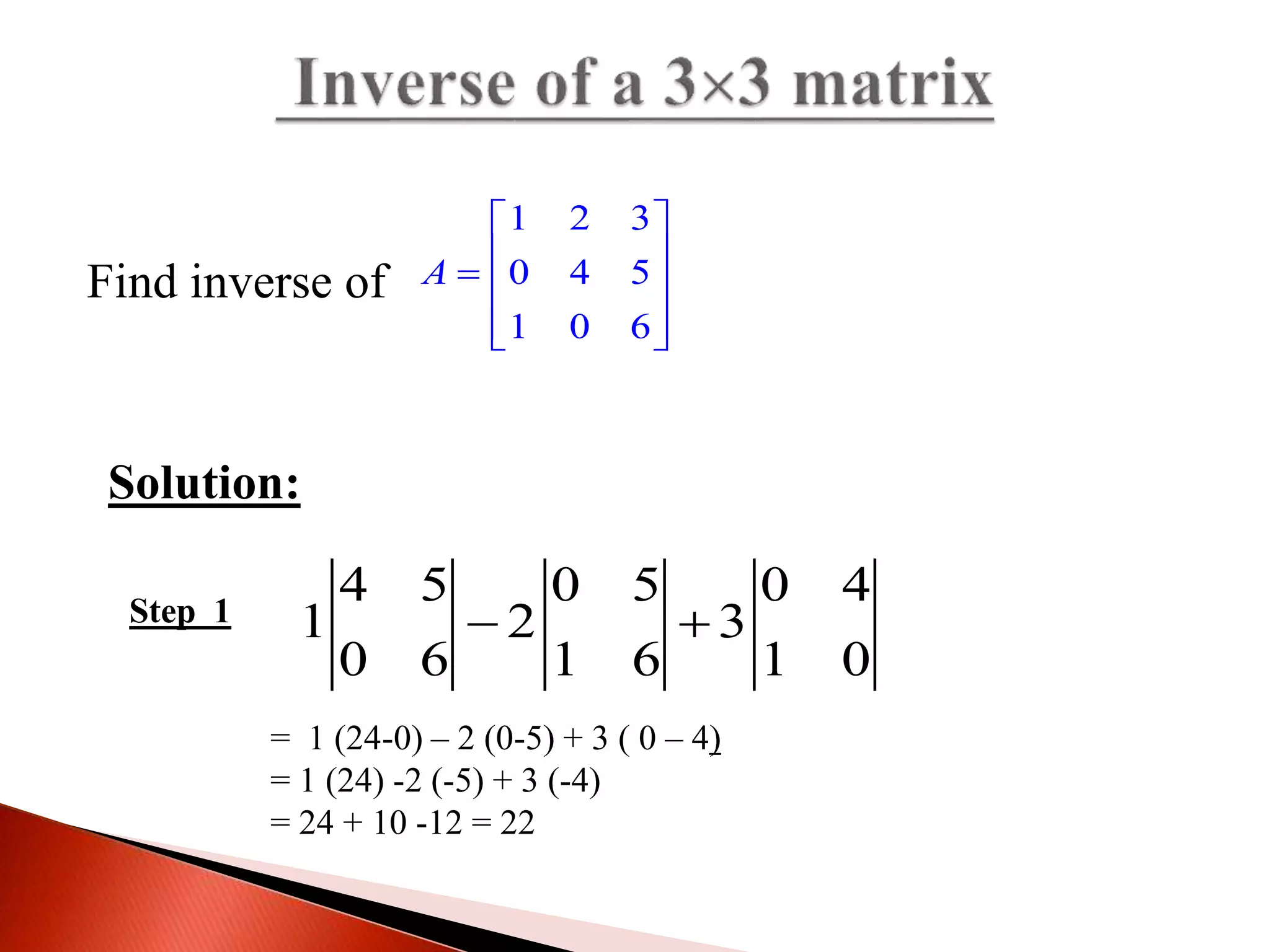
Find inverse of
Solution:
Step 1
= 1 (24-0) – 2 (0-5) + 3 ( 0 – 4)
= 1 (24) -2 (-5) + 3 (-4)
= 24 + 10 -12 = 22
4 5 0 5 0 4
1 2 3
0 6 1 6 1 0
 
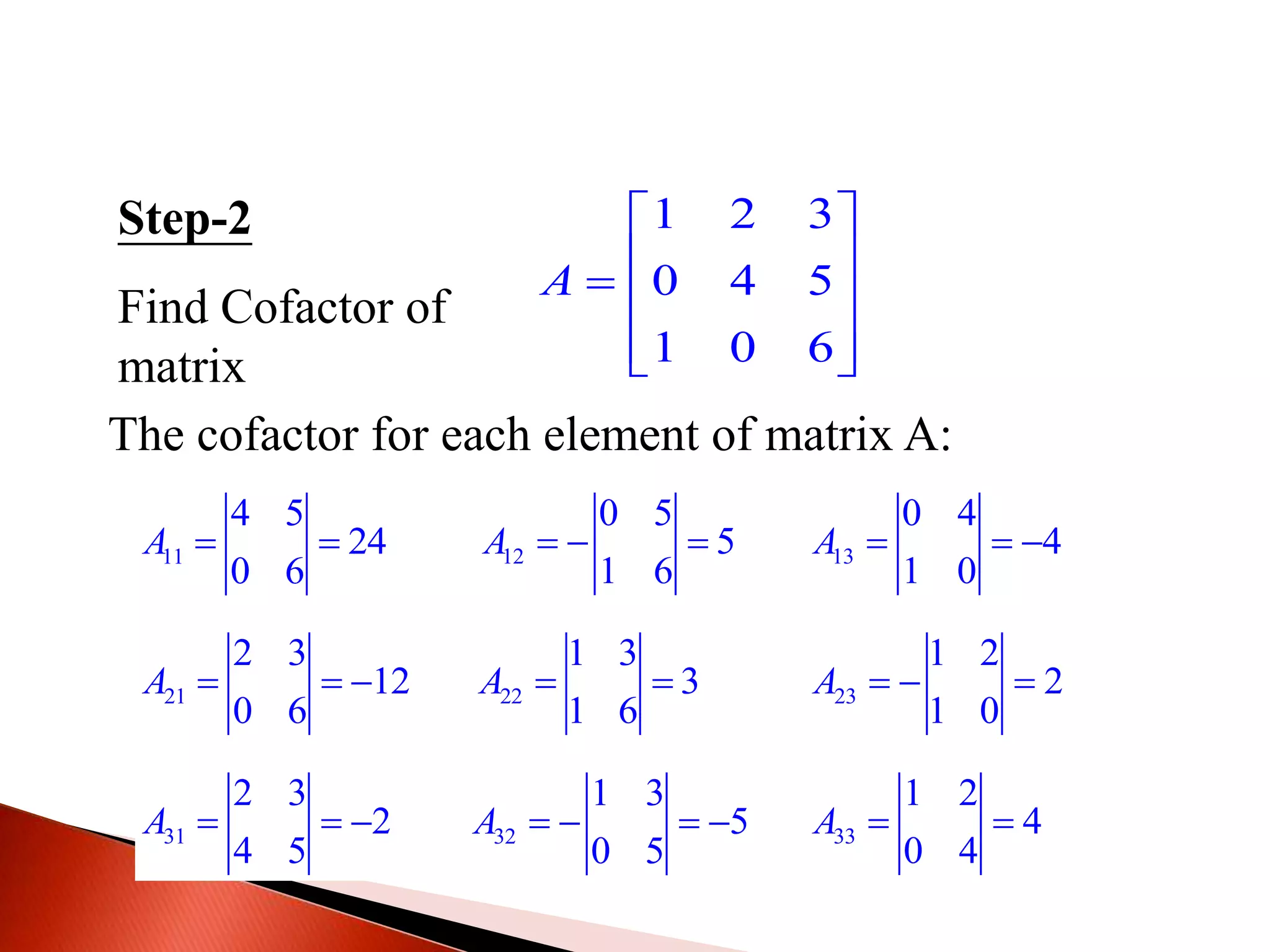
Step-2
Find Cofactor of
matrix
1 2 3
0 4 5
1 0 6
A
 
   
  
The cofactor for each element of matrix A:
11
4 5
24
0 6
A   12
0 5
5
1 6
A    13
0 4
4
1 0
A   
21
2 3
12
0 6
A    22
1 3
3
1 6
A   23
1 2
2
1 0
A   
31
2 3
2
4 5
A    32
1 3
5
0 5
A     33
1 2
4
0 4
A  
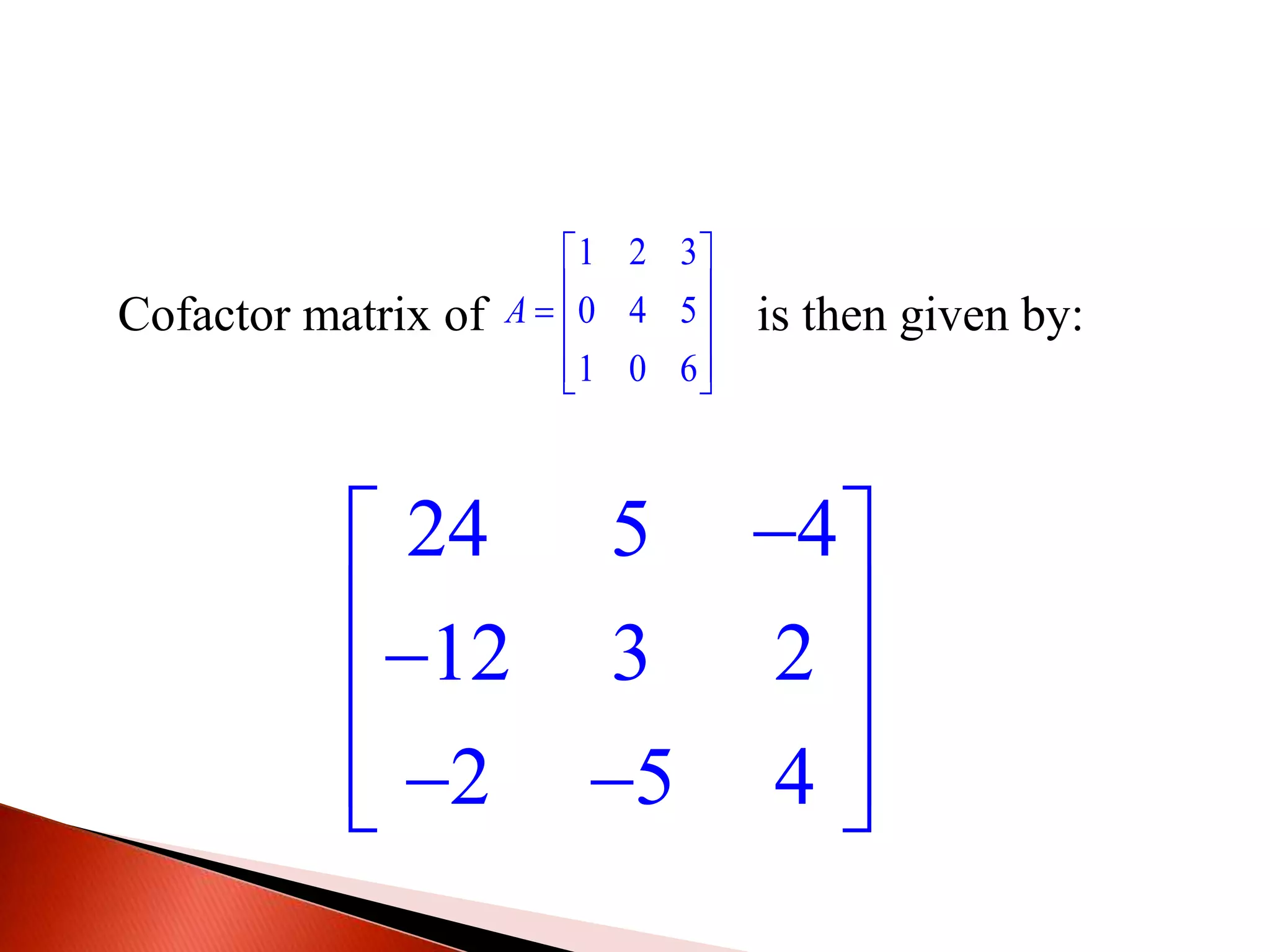
Cofactor matrix of is then given by:
1 2 3
0 4 5
1 0 6
A
 
   
  
24 5 4
12 3 2
2 5 4
 
  
   
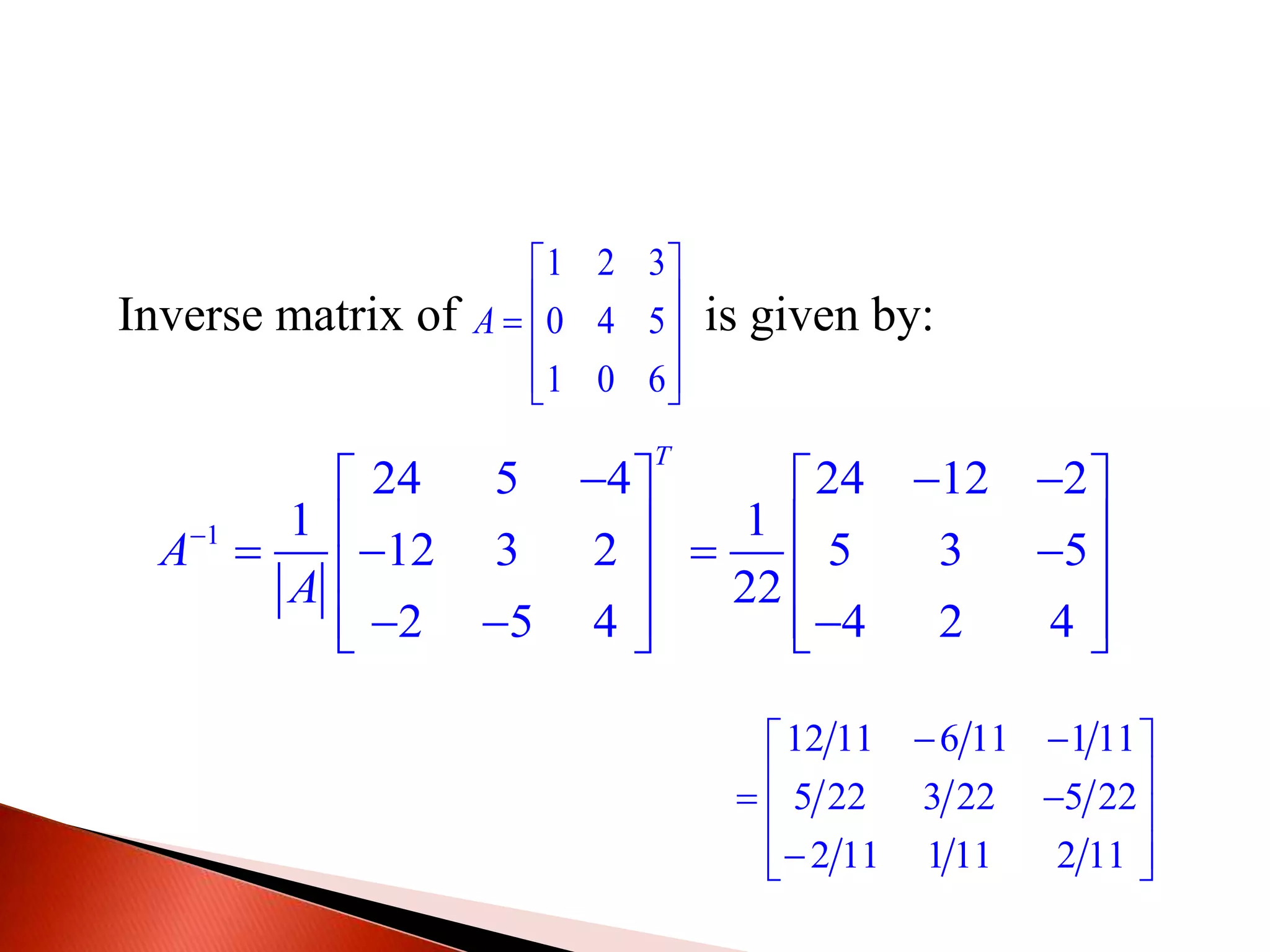
Inverse matrix of is given by:
1 2 3
0 4 5
1 0 6
A
 
   
  
1
24 5 4 24 12 2
1 1
12 3 2 5 3 5
22
2 5 4 4 2 4
T
A
A

     
         
        
12 11 6 11 1 11
5 22 3 22 5 22
2 11 1 11 2 11
  
   
  
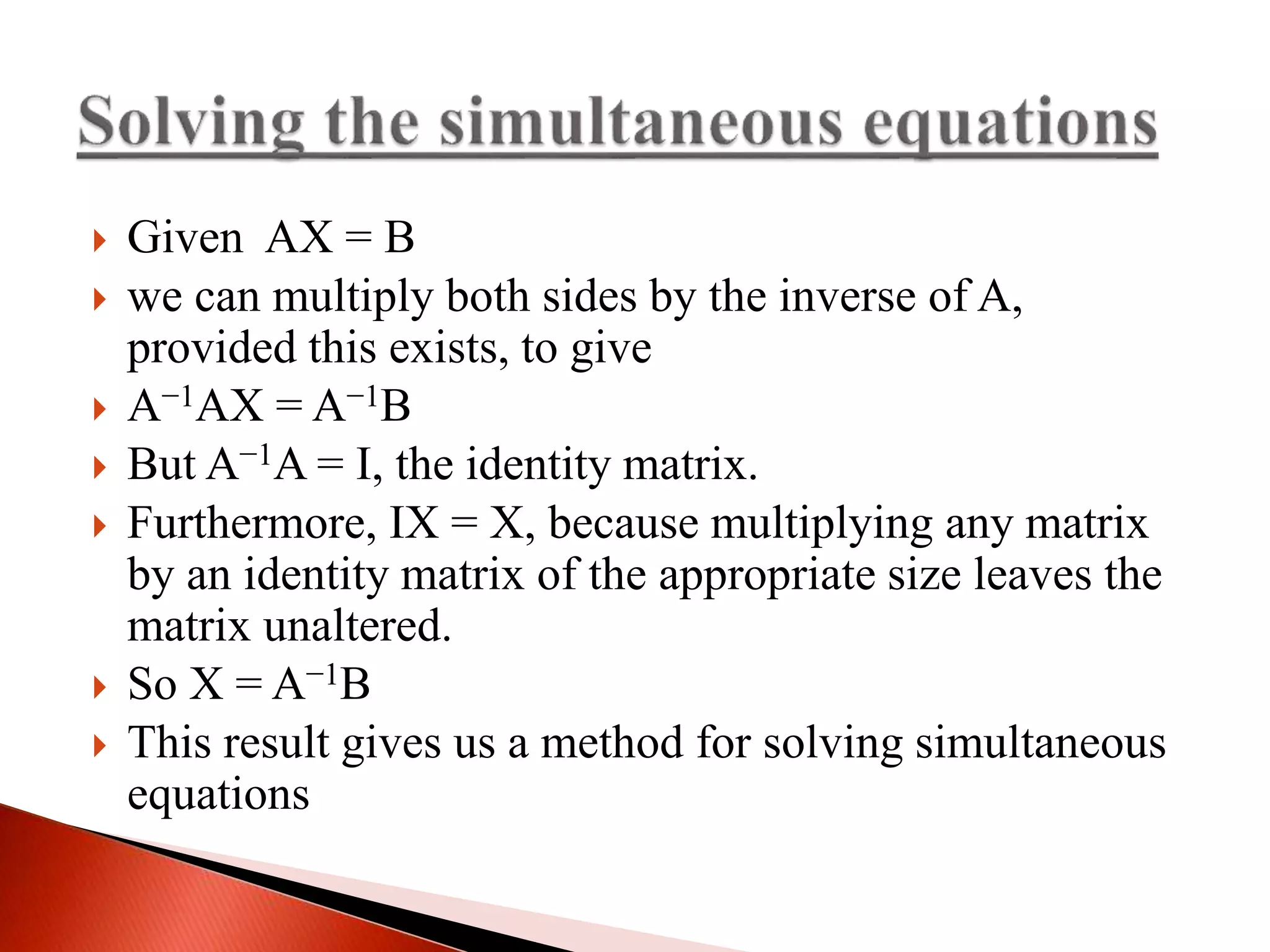
 Given AX = B
 we can multiply both sides by the inverse of A,
provided this exists, to give
 A−1AX = A−1B
 But A−1A = I, the identity matrix.
 Furthermore, IX = X, because multiplying any matrix
by an identity matrix of the appropriate size leaves the
matrix unaltered.
 So X = A−1B
 This result gives us a method for solving simultaneous
equations
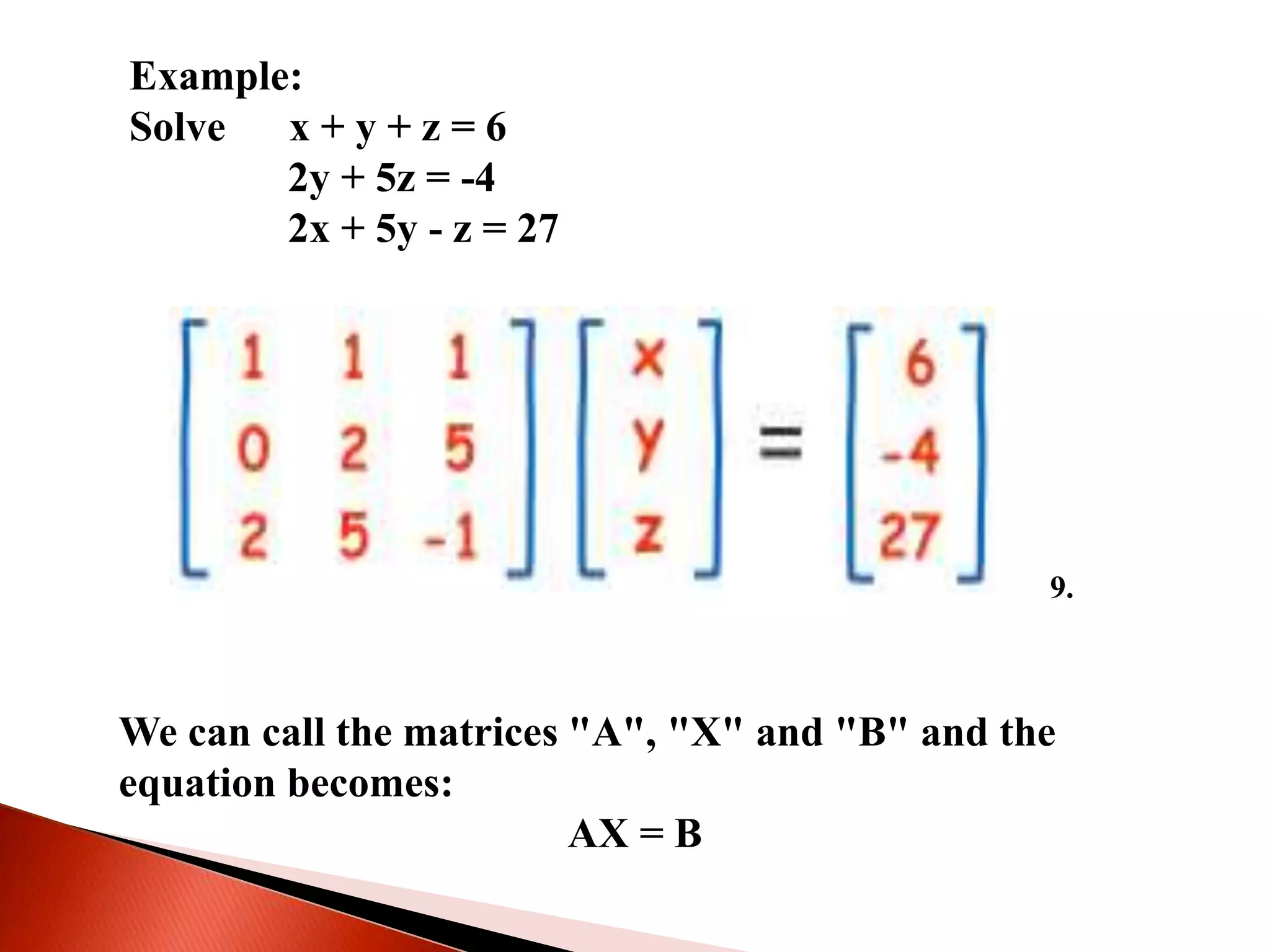
Example:
Solve x + y + z = 6
2y + 5z = -4
2x + 5y - z = 27
We can call the matrices "A", "X" and "B" and the
equation becomes:
AX = B
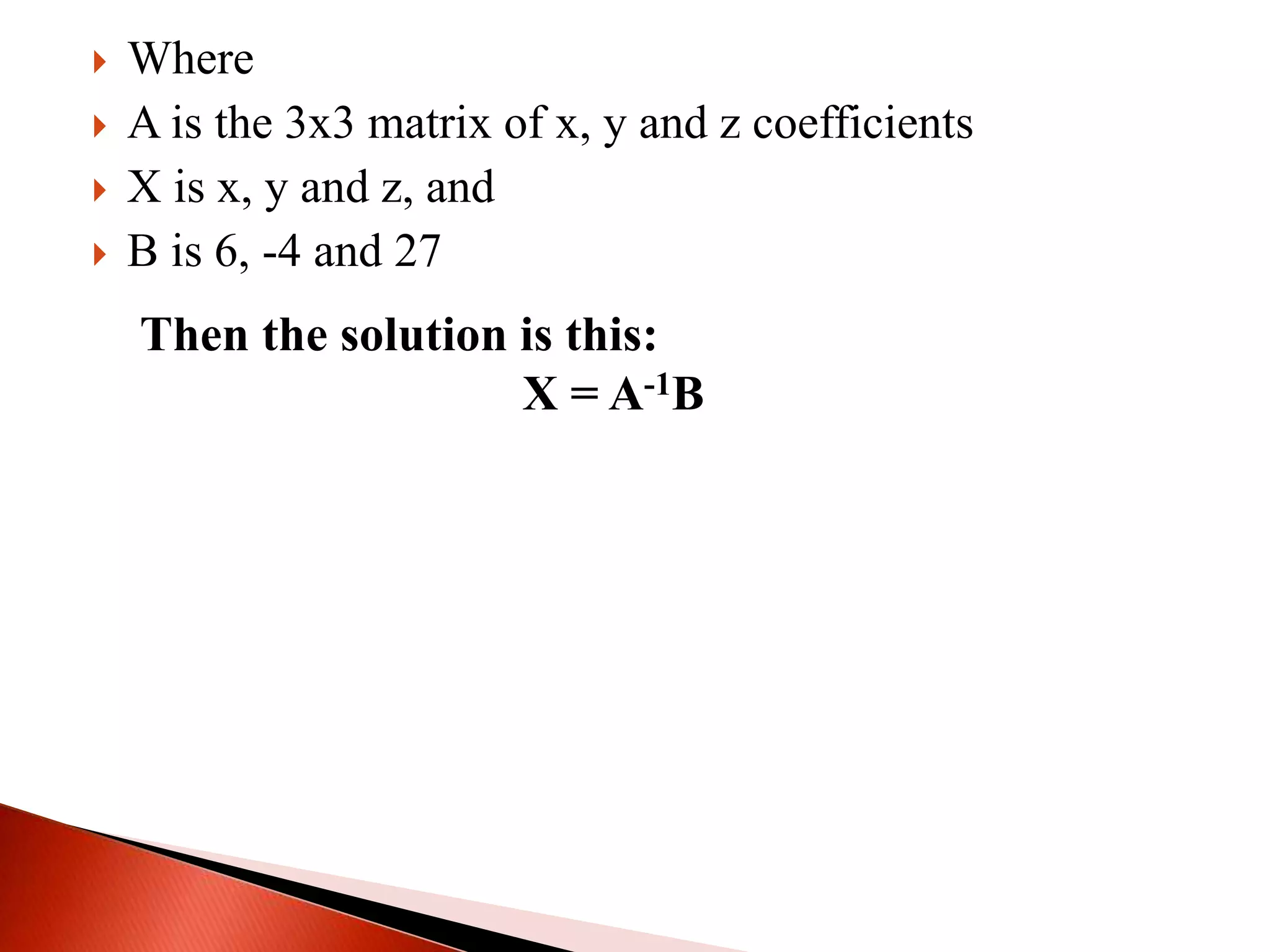
9.
 Where
 A is the 3x3 matrix of x, y and z coefficients
 X is x, y and z, and
 B is 6, -4 and 27
Then the solution is this:
X = A-1B
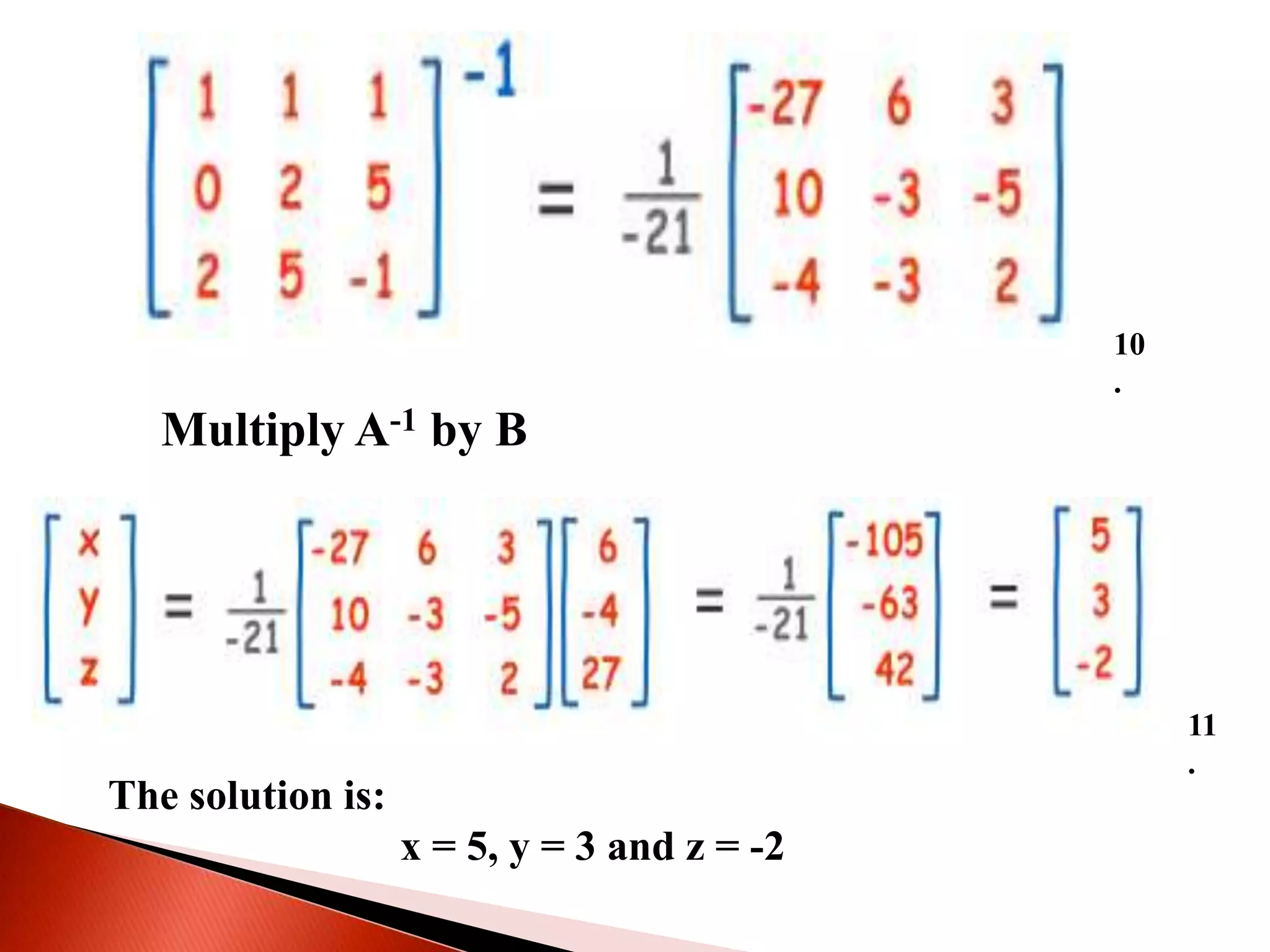
Multiply A-1 by B
The solution is:
x = 5, y = 3 and z = -2
10
.
11
.
(A) Online Sources (for images):
1.https://encryptedtbn3.gstatic.com/images?q=tbn:ANd9GcTJQw
7J0Ih3lz1g0FFGBevFpAra3nOrin6yt3PS6x_Qy--4E4U
2.https://encryptedtbn1.gstatic.com/images?q=tbn:ANd9GcR63s
F2Y25j6cI_FzdrRa_seWbKVuVv0qRTWuxtpv4YboHiZEW
3.https://lh6.ggpht.com/mpWaWXPYIoGjnGJd_Tb80X8QKKw
ROA7zCI0wKkJ627NBG6WYnSqwfF_cwbV5QJ8H_5o7=s12
6
4. http://www.mathsisfun.com/algebra/images/matrix-3x3-det-
c.gif
5.https://lh5.ggpht.com/n28coju14RsDs9cZL6_yJ3izr1tZ7FPnoJ
nMidvzy0sOIyBiOJw_hY4XBoCJG9m1OtE=s101
6.https://lh3.ggpht.com/CjbpIkLEbKk7bG4KhaQy5BXvU41TH8
ey7N6KjNI2ZQB6vLurlpd5BQhJU1P89LOOb3W4=s170
7.https://lh3.ggpht.com/J3U4zLqEcJYeURMDDNLnip7pS7Jp
5N4zgacY4a9RExc01eu3bUXqlQWqwmXfEMdZoiz3A=s1
70
8.https://lh5.ggpht.com/1s81cNv9QZDRIWiUKhzhxSAVRPX
DXtM5ICrpJpW9olN67Ch_fXggb9imB6w2ei7GGt8=s136
9. https://lh4.ggpht.com/_6VfrBUCjgni_ontV3K9dQVr-
KSQn1EPWMeqfgUpVKTGNzB4aOcVl3IEaLzRKKZ0CG
3T=s170
10.https://lh6.ggpht.com/iKzqvK9OQDvi_iFvgTl2J4UOyJhet_
ZTBsZ6XEbXYv75G2cCV9FmOkGxrpIA7JH2P=s170
11. https://lh4.ggpht.com/EWqyY09JwB3PSB-xe4xm0DQT7-
Z85pi2y2r_zGIE5avCQpoEixutD3L3bO_Mv5efyONQ=s17
0
1.www.mathxtc.com/Downloads/NumberAlg/files/Matri
x%20Algebra.ppt
2.www.dgelman.com/powerpoints/algebra/alg2/spitz/4.1
%20Matrices.ppt
1. Business Mathematics by A.G.Patel and G.C.Patel-
Atul Prakashan.

Bba i-bm-u-2- matrix -

  • 1.
    MATRIX ALGEBRA Course BBA Subject:Business Mathematics Unit-2 1 2
  • 2.
     The notationis used for the algebraic expression ad – bc.  It is called a determinant of order two.  a, b, c ,d are called the elements of the determinant.  ad – bc is called the expansion or the value of the determinant. a b c d 3.
  • 3.
     a, bis called the first row and c,d is called the second row of the determinant.  a, c is called first column and b, d is called the second column of the determinant.  a, d is called the principal diagonal of the determinant. a b c d
  • 4.
    a b c de f g h i is called a determinant of order three. Its expansion is as follows: :
  • 5.
    = a(ei -fh) - b(di - fg) + c(dh - eg) 4.
  • 6.
    (1) Find thevalue of Answer: = 1 - 2 + (-3) = 1 [(4*5) – (6*2)] – 2[(5* 5) – (2 * -8)] – 3 [(5 * 6) – (4 *-8)] = 1 [20 - 12] – 2 [25 + 16] – 3 [30 + 32] = 1[8] – 2 [41] – 3 [62] = 8 – 82 – 186 = -260 1 2 3 5 4 2 8 6 5   4 2 6 5 5 2 8 5 5 4 8 6
  • 7.
    Suppose we aregiven the following equations. a1x + b1y + c1 = 0………………. (1) a2x + b2y + c2 = 0………………..(2) To solve this equations, multiply equation (1) by b2 and equation (2) by b1, a1b2x + b1b2y + c1b2 = 0…………… (3) a2b1x + b1b2y + c2b1 = 0…………….(4) Subtracting equation (4) from (3), we get (a1b2 – a2b1)x + c1b2 – c2b1 = 0 (a1b2 – a2b1)x = c2b1 – c1b2. If a1b2 – a2b1 ≠ 0 then
  • 8.
    1 2 21 1 2 2 1 1x b c b c a b a b    ……(5) Similarly, eliminating y, we get 2 1 1 2 1 2 2 1 1y a c a c a b a b    ……………. (6) From (5) and (6), we get the following formula for the value of x and y. 1 2 2 1 2 1 1 2 1 2 2 1 1x y b c b c a c a c a b a b      Expressing the denominators in the form of determinants, we get 1 1 1 1 1 1 2 2 2 2 2 2 1x y b c c a a b b c c a a b  
  • 9.
    11 12 1314 21 22 23 24 31 32 33 34 mn mn mn mn a a a a a a a a a a a a a a a a          Row 1 Row 2 Row 3 Row m Column 2Column 1 Column n 5.
  • 10.
    5 3 1 1.)1 1 2           2 X 3 3 8 9 2.) 2 5 6 7 1           3 X 3 8 3.) 7       2 X 1  4.) 2 3 1 X 2
  • 11.
    (1) Row matrix: A 1 Χ n matrix of the type [ a11, a12, …….a1n] is called a row matrix.  This matrix has only one row and n columns. (2) Column matrix:  A m Χ 1 matrix of type is called a column matrix.  This matrix has m rows and only one column. 11 21 1m a a a         
  • 12.
    (3) Square matrix: A matrix of order m Χ m is called a square matrix.  In a square matrix the number of rows equals the number of columns.  For example, A = B = 2 2 1 2 3 4        3 3 a b c d e f g h i           (4) Diagonal matrix: A square matrix, in which each element except the diagonal elements is zero, is called a diagonal matrix. For example, A = is a diagonal matrix.4 0 0 0 2 0 0 0 5        
  • 13.
    (5) Identity matrix: A square matrix in which all the elements in the principal diagonal are equal to unity (1) and all other elements are 0 is called a unit matrix or an identity matrix.  A unit matrix of order n Χ n is denoted by In.  For example. I2 = I3 = (6) Scalar matrix:  A diagonal matrix, in which all the elements in the principal diagonal are equal to a scalar k, is called a scalar matrix.  For example, A = 1 0 0 1       1 0 0 0 1 0 0 0 1          3 0 0 0 3 0 0 0 3         
  • 14.
    (7) Null matrix: A matrix having all its elements as zero is called a zero or a null matrix.  Null matrix can be square or rectangular.  It is usually denoted by 0mΧn or just 0.  For example 01Χ3 = (8) Transpose of a matrix:  The matrix obtained from any given matrix A by changing its rows into corresponding columns is called the transpose of A and it is denoted by A’ or AT.  For example A = [1 2 3] then AT =  0 0 0 1 2 3         
  • 15.
    (9) Symmetric matrix: If for a square matrix A = [aij], A’ = A, then A is called a symmetric matrix.  In a symmetric matrix, aij = aji for each pair (i, j).  For example A = B = (10) Skew symmetric matrix:  If for a square matrix A = [aij], A’ = -A, then A is called a skew symmetric matrix.  In a skew symmetric matrix, aij = -aji for each pair (i, j).  For example A = 1 3 3 2       3 6 7 6 5 4 7 4 8          0 3 2 3 0 5 2 5 0        
  • 16.
     You canadd or subtract matrices if they have the same dimensions (same number of rows and columns).  To do this, you add (or subtract) the corresponding numbers (numbers in the same positions). Example:
  • 17.
    A + B 56 0 3 4 2 1 3           1 3 6 4        5 0 6 3 ; 4 1 2 3 A B              
  • 18.
    When a zeromatrix is added to another matrix of the same dimension (i.e. number of rows and columns should be same), that same matrix is obtained. 2 1 3 0 0 0 2.) 1 0 1 0 0 0            2 1 3 1 0 1     
  • 19.
    1 2 11 3.) 2 0 1 3 3 1 2 3                     1 1 2 ( 1) 2 1 0 3 3 2 1 3                0 3 3 3 5 4           
  • 20.
    • If Ais an m × n matrix and s is a scalar, then we let kA denote the matrix obtained by multiplying every element of A by k. • This procedure is called scalar multiplication.          310 221 A                              930 663 331303 232313 3A
  • 21.
     To multiplymatrices A and B look at their dimensions pnnm  MUST BE SAME SIZE OF PRODUCT If the number of columns of A does not equal the number of rows of B then the product AB is undefined. 6.
  • 22.
    •The multiplication ofmatrices is easier shown than put into words. •You multiply the rows of the first matrix with the columns of the second adding products          140 123 A             13 31 42 B Find AB First we multiply across the first row and down the first column adding products. We put the answer in the first row, first column of the answer.  23    1223          5311223 
  • 23.
             140 123 A             13 31 42 B Find AB We multipliedacross first row and down first column so we put the answer in the first row, first column.        5 AB Now we multiply across the first row and down the second column and we’ll put the answer in the first row, second column.   43     3243          7113243        75 AB Now we multiply across the second row and down the first column and we’ll put the answer in the second row, first column.   20     1420          1311420         1 75 AB Now we multiply across the second row and down the second column and we’ll put the answer in the second row, second column.   40     3440          11113440         111 75 AB Notice the sizes of A and B and the size of the product AB.
  • 24.
    The matrix formedby taking the transpose of the cofactor matrix of a given original matrix. The adjoint of matrix A is often written adj A. Example: Find the adjoint of the following matrix:
  • 25.
    First find thecofactor of each element.
  • 26.
    As a resultthe cofactor matrix of A is Finally the adjoint of A is the transpose of the cofactor matrix:
  • 27.
    If for agiven square matrix A, there exists a matrix B such that AB = I = BA, then the matrix B is called an inverse of A. It is denoted by A-1 Note: Inverse does not exist if product is not an identity .
  • 28.
    1. Find determinantof matrix. If det. is not equal to 0, then inverse of matrix exist. 2. Find adjoint of a matrix. a. find cofactor b. change sign. (if odd.. –ve sign & if even.. +ve sign) c. transpose. 3. Find inverse. i.e. A-1 = (adjoint of A) 1 A
  • 29.
  • 30.
  • 31.
    1 2 3 04 5 1 0 6 A          Find inverse of Solution: Step 1 = 1 (24-0) – 2 (0-5) + 3 ( 0 – 4) = 1 (24) -2 (-5) + 3 (-4) = 24 + 10 -12 = 22 4 5 0 5 0 4 1 2 3 0 6 1 6 1 0  
  • 32.
    Step-2 Find Cofactor of matrix 12 3 0 4 5 1 0 6 A          The cofactor for each element of matrix A: 11 4 5 24 0 6 A   12 0 5 5 1 6 A    13 0 4 4 1 0 A    21 2 3 12 0 6 A    22 1 3 3 1 6 A   23 1 2 2 1 0 A    31 2 3 2 4 5 A    32 1 3 5 0 5 A     33 1 2 4 0 4 A  
  • 33.
    Cofactor matrix ofis then given by: 1 2 3 0 4 5 1 0 6 A          24 5 4 12 3 2 2 5 4         
  • 34.
    Inverse matrix ofis given by: 1 2 3 0 4 5 1 0 6 A          1 24 5 4 24 12 2 1 1 12 3 2 5 3 5 22 2 5 4 4 2 4 T A A                           12 11 6 11 1 11 5 22 3 22 5 22 2 11 1 11 2 11          
  • 35.
     Given AX= B  we can multiply both sides by the inverse of A, provided this exists, to give  A−1AX = A−1B  But A−1A = I, the identity matrix.  Furthermore, IX = X, because multiplying any matrix by an identity matrix of the appropriate size leaves the matrix unaltered.  So X = A−1B  This result gives us a method for solving simultaneous equations
  • 36.
    Example: Solve x +y + z = 6 2y + 5z = -4 2x + 5y - z = 27 We can call the matrices "A", "X" and "B" and the equation becomes: AX = B 9.
  • 37.
     Where  Ais the 3x3 matrix of x, y and z coefficients  X is x, y and z, and  B is 6, -4 and 27 Then the solution is this: X = A-1B
  • 38.
    Multiply A-1 byB The solution is: x = 5, y = 3 and z = -2 10 . 11 .
  • 39.
    (A) Online Sources(for images): 1.https://encryptedtbn3.gstatic.com/images?q=tbn:ANd9GcTJQw 7J0Ih3lz1g0FFGBevFpAra3nOrin6yt3PS6x_Qy--4E4U 2.https://encryptedtbn1.gstatic.com/images?q=tbn:ANd9GcR63s F2Y25j6cI_FzdrRa_seWbKVuVv0qRTWuxtpv4YboHiZEW 3.https://lh6.ggpht.com/mpWaWXPYIoGjnGJd_Tb80X8QKKw ROA7zCI0wKkJ627NBG6WYnSqwfF_cwbV5QJ8H_5o7=s12 6 4. http://www.mathsisfun.com/algebra/images/matrix-3x3-det- c.gif 5.https://lh5.ggpht.com/n28coju14RsDs9cZL6_yJ3izr1tZ7FPnoJ nMidvzy0sOIyBiOJw_hY4XBoCJG9m1OtE=s101 6.https://lh3.ggpht.com/CjbpIkLEbKk7bG4KhaQy5BXvU41TH8 ey7N6KjNI2ZQB6vLurlpd5BQhJU1P89LOOb3W4=s170
  • 40.
  • 41.
  • 42.
    1. Business Mathematicsby A.G.Patel and G.C.Patel- Atul Prakashan.