Solving Equations
Unit Contents
• Revision on Linear Equation in One Variable
• Systems of Linear Equations in Two Variables
• Solving Non-linear Equations
• Applications of Equations
Introduction
Equations are like a balance weighing machine or scale. If you have
seen a weighing machine, you might have thought that an equal
amount of weight has to be placed on either side for the scale to be
considered “balanced”. If you add some weight to one side, the scale
will point on one side and the two sides are no more in balance.
Revision on linear equation in one variable
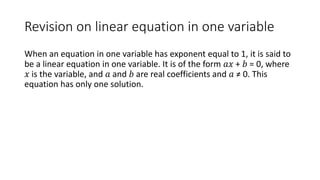
When an equation in one variable has exponent equal to 1, it is said to
be a linear equation in one variable. It is of the form 𝑎𝑥 + 𝑏 = 0, where
𝑥 is the variable, and 𝑎 and 𝑏 are real coefficients and 𝑎 ≠ 0. This
equation has only one solution.
Cont…
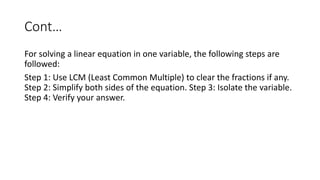
For solving a linear equation in one variable, the following steps are
followed:
Step 1: Use LCM (Least Common Multiple) to clear the fractions if any.
Step 2: Simplify both sides of the equation. Step 3: Isolate the variable.
Step 4: Verify your answer.
Cont…
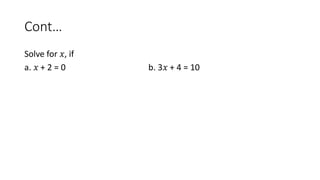
Solve for 𝑥, if
a. 𝑥 + 2 = 0 b. 3𝑥 + 4 = 10
Cont…
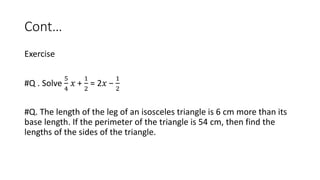
Exercise
#Q . Solve
5
4
𝑥 +
1
2
= 2𝑥 −
1
2
#Q. The length of the leg of an isosceles triangle is 6 cm more than its
base length. If the perimeter of the triangle is 54 cm, then find the
lengths of the sides of the triangle.
Systems of linear equations in two variables
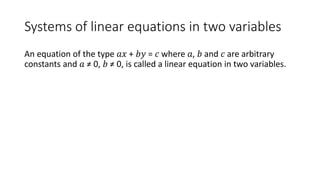
An equation of the type 𝑎𝑥 + 𝑏𝑦 = 𝑐 where 𝑎, 𝑏 and 𝑐 are arbitrary
constants and 𝑎 ≠ 0, 𝑏 ≠ 0, is called a linear equation in two variables.
Solving systems of linear equations in two
variables using tables
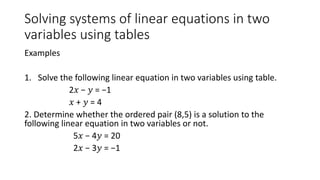
Examples
1. Solve the following linear equation in two variables using table.
2𝑥 − 𝑦 = −1
𝑥 + 𝑦 = 4
2. Determine whether the ordered pair (8,5) is a solution to the
following linear equation in two variables or not.
5𝑥 − 4𝑦 = 20
2𝑥 − 3𝑦 = −1
Solving systems of linear equations in two
variables by substitution
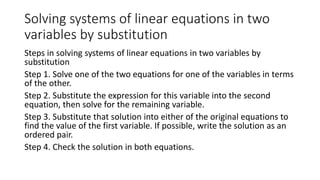
Steps in solving systems of linear equations in two variables by
substitution
Step 1. Solve one of the two equations for one of the variables in terms
of the other.
Step 2. Substitute the expression for this variable into the second
equation, then solve for the remaining variable.
Step 3. Substitute that solution into either of the original equations to
find the value of the first variable. If possible, write the solution as an
ordered pair.
Step 4. Check the solution in both equations.
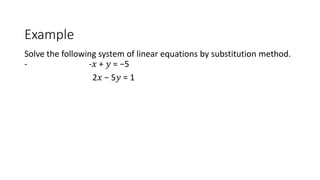
Example
Solve the following system of linear equations by substitution method.
- -𝑥 + 𝑦 = −5
2𝑥 − 5𝑦 = 1
Solving systems of linear equations in two
variables by Addition (Elimination) method
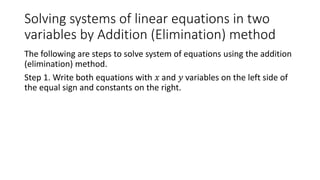
The following are steps to solve system of equations using the addition
(elimination) method.
Step 1. Write both equations with 𝑥 and 𝑦 variables on the left side of
the equal sign and constants on the right.
Cont…
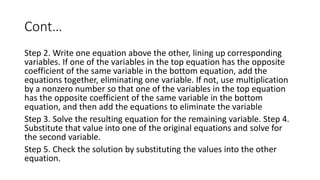
Step 2. Write one equation above the other, lining up corresponding
variables. If one of the variables in the top equation has the opposite
coefficient of the same variable in the bottom equation, add the
equations together, eliminating one variable. If not, use multiplication
by a nonzero number so that one of the variables in the top equation
has the opposite coefficient of the same variable in the bottom
equation, and then add the equations to eliminate the variable
Step 3. Solve the resulting equation for the remaining variable. Step 4.
Substitute that value into one of the original equations and solve for
the second variable.
Step 5. Check the solution by substituting the values into the other
equation.
Cont…
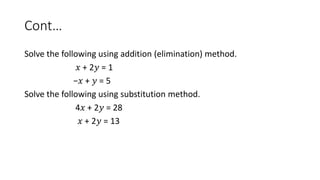
Solve the following using addition (elimination) method.
𝑥 + 2𝑦 = 1
−𝑥 + 𝑦 = 5
Solve the following using substitution method.
4𝑥 + 2𝑦 = 28
𝑥 + 2𝑦 = 13

math.pptx

  • 2.
    Solving Equations Unit Contents •Revision on Linear Equation in One Variable • Systems of Linear Equations in Two Variables • Solving Non-linear Equations • Applications of Equations
  • 3.
    Introduction Equations are likea balance weighing machine or scale. If you have seen a weighing machine, you might have thought that an equal amount of weight has to be placed on either side for the scale to be considered “balanced”. If you add some weight to one side, the scale will point on one side and the two sides are no more in balance.
  • 4.
    Revision on linearequation in one variable When an equation in one variable has exponent equal to 1, it is said to be a linear equation in one variable. It is of the form 𝑎𝑥 + 𝑏 = 0, where 𝑥 is the variable, and 𝑎 and 𝑏 are real coefficients and 𝑎 ≠ 0. This equation has only one solution.
  • 5.
    Cont… For solving alinear equation in one variable, the following steps are followed: Step 1: Use LCM (Least Common Multiple) to clear the fractions if any. Step 2: Simplify both sides of the equation. Step 3: Isolate the variable. Step 4: Verify your answer.
  • 6.
    Cont… Solve for 𝑥,if a. 𝑥 + 2 = 0 b. 3𝑥 + 4 = 10
  • 7.
    Cont… Exercise #Q . Solve 5 4 𝑥+ 1 2 = 2𝑥 − 1 2 #Q. The length of the leg of an isosceles triangle is 6 cm more than its base length. If the perimeter of the triangle is 54 cm, then find the lengths of the sides of the triangle.
  • 8.
    Systems of linearequations in two variables An equation of the type 𝑎𝑥 + 𝑏𝑦 = 𝑐 where 𝑎, 𝑏 and 𝑐 are arbitrary constants and 𝑎 ≠ 0, 𝑏 ≠ 0, is called a linear equation in two variables.
  • 9.
    Solving systems oflinear equations in two variables using tables Examples 1. Solve the following linear equation in two variables using table. 2𝑥 − 𝑦 = −1 𝑥 + 𝑦 = 4 2. Determine whether the ordered pair (8,5) is a solution to the following linear equation in two variables or not. 5𝑥 − 4𝑦 = 20 2𝑥 − 3𝑦 = −1
  • 10.
    Solving systems oflinear equations in two variables by substitution Steps in solving systems of linear equations in two variables by substitution Step 1. Solve one of the two equations for one of the variables in terms of the other. Step 2. Substitute the expression for this variable into the second equation, then solve for the remaining variable. Step 3. Substitute that solution into either of the original equations to find the value of the first variable. If possible, write the solution as an ordered pair. Step 4. Check the solution in both equations.
  • 11.
    Example Solve the followingsystem of linear equations by substitution method. - -𝑥 + 𝑦 = −5 2𝑥 − 5𝑦 = 1
  • 12.
    Solving systems oflinear equations in two variables by Addition (Elimination) method The following are steps to solve system of equations using the addition (elimination) method. Step 1. Write both equations with 𝑥 and 𝑦 variables on the left side of the equal sign and constants on the right.
  • 13.
    Cont… Step 2. Writeone equation above the other, lining up corresponding variables. If one of the variables in the top equation has the opposite coefficient of the same variable in the bottom equation, add the equations together, eliminating one variable. If not, use multiplication by a nonzero number so that one of the variables in the top equation has the opposite coefficient of the same variable in the bottom equation, and then add the equations to eliminate the variable Step 3. Solve the resulting equation for the remaining variable. Step 4. Substitute that value into one of the original equations and solve for the second variable. Step 5. Check the solution by substituting the values into the other equation.
  • 14.
    Cont… Solve the followingusing addition (elimination) method. 𝑥 + 2𝑦 = 1 −𝑥 + 𝑦 = 5 Solve the following using substitution method. 4𝑥 + 2𝑦 = 28 𝑥 + 2𝑦 = 13