Barnett/Ziegler/Byleen Finite Mathematics 11e 1
Learning Objectives for Section 4.2
Systems of Linear Equations and
Augmented Matrices
 The student will be able to use terms associated with matrices.
 The student will be able to set up and solve the augmented
matrix associated with a linear system in two variables.
 The student will be able to identify the three possible matrix
solution types for a linear system in two variables.
Barnett/Ziegler/Byleen Finite Mathematics 11e 2
Matrix Methods
It is impractical to solve more complicated linear
systems by hand. Computers and calculators now
have built in routines to solve larger and more
complex systems. Matrices, in conjunction with
graphing utilities and or computers are used for
solving more complex systems. In this section, we
will develop certain matrix methods for solving
two by two systems.
Barnett/Ziegler/Byleen Finite Mathematics 11e 3
Matrices
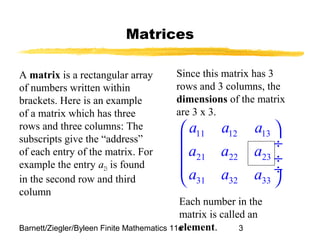
A matrix is a rectangular array
of numbers written within
brackets. Here is an example
of a matrix which has three
rows and three columns: The
subscripts give the “address”
of each entry of the matrix. For
example the entry a23 is found
in the second row and third
column
11 12 13
21 22 23
31 32 33
a a a
a a a
a a a
 
 ÷
 ÷
 ÷
 
Each number in the
matrix is called an
element.
Since this matrix has 3
rows and 3 columns, the
dimensions of the matrix
are 3 x 3.
Barnett/Ziegler/Byleen Finite Mathematics 11e 4
Matrix Solution of Linear Systems
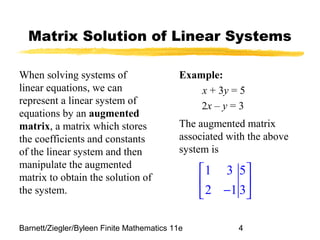
When solving systems of
linear equations, we can
represent a linear system of
equations by an augmented
matrix, a matrix which stores
the coefficients and constants
of the linear system and then
manipulate the augmented
matrix to obtain the solution of
the system.
Example:
x + 3y = 5
2x – y = 3
1 3 5
2 1 3
 
 
− 
The augmented matrix
associated with the above
system is
Barnett/Ziegler/Byleen Finite Mathematics 11e 5
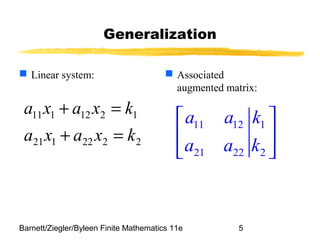
Generalization
 Linear system:  Associated
augmented matrix:
11 12 1
21 22 2
a a k
a a k
 
 
 
2222121
1212111
kxaxa
kxaxa
=+
=+
Barnett/Ziegler/Byleen Finite Mathematics 11e 6
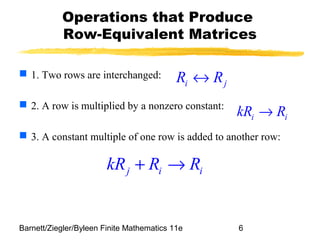
Operations that Produce
Row-Equivalent Matrices
 1. Two rows are interchanged:
 2. A row is multiplied by a nonzero constant:
 3. A constant multiple of one row is added to another row:
i jR R↔
i ikR R→
j i ikR R R+ →
Barnett/Ziegler/Byleen Finite Mathematics 11e 7
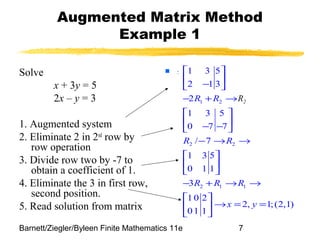
Augmented Matrix Method
Example 1
Solve
x + 3y = 5
2x – y = 3
1. Augmented system
2. Eliminate 2 in 2nd
row by
row operation
3. Divide row two by -7 to
obtain a coefficient of 1.
4. Eliminate the 3 in first row,
second position.
5. Read solution from matrix
 :
1 2
2 2
2 1 1
1 3 5
2 1 3
2
1 3 5
0 7 7
/ 7
1 3 5
0 1 1
3
10 2
2, 1;(2,1)
01 1
R R
R R
R R R
x y
 
 
− 
− + →
 
 
− − 
− → →
 
 
 
− + → →
 
→ = = 
 
R2
Barnett/Ziegler/Byleen Finite Mathematics 11e 8
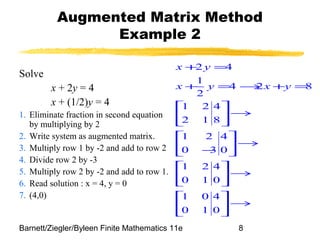
Augmented Matrix Method
Example 2
Solve
x + 2y = 4
x + (1/2)y = 4
1. Eliminate fraction in second equation
by multiplying by 2
2. Write system as augmented matrix.
3. Multiply row 1 by -2 and add to row 2
4. Divide row 2 by -3
5. Multiply row 2 by -2 and add to row 1.
6. Read solution : x = 4, y = 0
7. (4,0)
2 4
1
4 2 8
2
1 2 4
2 1 8
1 2 4
0 3 0
1 2 4
0 1 0
1 0 4
0 1 0
x y
x y x y
+ =
+ = → + =
 
→ 
 
 
→ 
− 
 
→ 
 
 
→ 
 
Barnett/Ziegler/Byleen Finite Mathematics 11e 9
Augmented Matrix Method
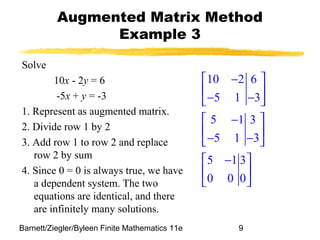
Example 3
Solve
10x - 2y = 6
-5x + y = -3
1. Represent as augmented matrix.
2. Divide row 1 by 2
3. Add row 1 to row 2 and replace
row 2 by sum
4. Since 0 = 0 is always true, we have
a dependent system. The two
equations are identical, and there
are infinitely many solutions.
10 2 6
5 1 3
5 1 3
5 1 3
5 1 3
0 0 0
 − 
 
− − 
 − 
 
− − 
 − 
 
 
Barnett/Ziegler/Byleen Finite Mathematics 11e 10
Augmented Matrix Method
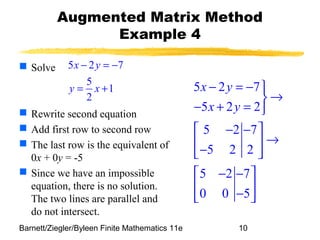
Example 4
 Solve
 Rewrite second equation
 Add first row to second row
 The last row is the equivalent of
0x + 0y = -5
 Since we have an impossible
equation, there is no solution.
The two lines are parallel and
do not intersect.
5 2 7
5
1
2
x y
y x
− = −
= + 5 2 7
5 2 2
5 2 7
5 2 2
5 2 7
0 0 5
x y
x y
− = − 
→
− + = 
 − − 
→ 
− 
 − − 
 
− 
Barnett/Ziegler/Byleen Finite Mathematics 11e 11
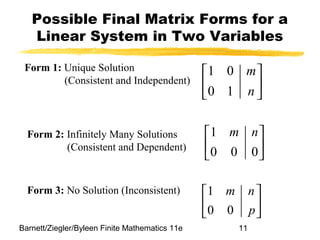
Possible Final Matrix Forms for a
Linear System in Two Variables
Form 1: Unique Solution
(Consistent and Independent)
1 0
0 1
m
n
 
 
 
Form 2: Infinitely Many Solutions
(Consistent and Dependent)
1
0 0 0
m n 
 
 
Form 3: No Solution (Inconsistent) 1
0 0
m n
p
 
 
 

Systems of linear equations and augmented matrices

  • 1.
    Barnett/Ziegler/Byleen Finite Mathematics11e 1 Learning Objectives for Section 4.2 Systems of Linear Equations and Augmented Matrices  The student will be able to use terms associated with matrices.  The student will be able to set up and solve the augmented matrix associated with a linear system in two variables.  The student will be able to identify the three possible matrix solution types for a linear system in two variables.
  • 2.
    Barnett/Ziegler/Byleen Finite Mathematics11e 2 Matrix Methods It is impractical to solve more complicated linear systems by hand. Computers and calculators now have built in routines to solve larger and more complex systems. Matrices, in conjunction with graphing utilities and or computers are used for solving more complex systems. In this section, we will develop certain matrix methods for solving two by two systems.
  • 3.
    Barnett/Ziegler/Byleen Finite Mathematics11e 3 Matrices A matrix is a rectangular array of numbers written within brackets. Here is an example of a matrix which has three rows and three columns: The subscripts give the “address” of each entry of the matrix. For example the entry a23 is found in the second row and third column 11 12 13 21 22 23 31 32 33 a a a a a a a a a    ÷  ÷  ÷   Each number in the matrix is called an element. Since this matrix has 3 rows and 3 columns, the dimensions of the matrix are 3 x 3.
  • 4.
    Barnett/Ziegler/Byleen Finite Mathematics11e 4 Matrix Solution of Linear Systems When solving systems of linear equations, we can represent a linear system of equations by an augmented matrix, a matrix which stores the coefficients and constants of the linear system and then manipulate the augmented matrix to obtain the solution of the system. Example: x + 3y = 5 2x – y = 3 1 3 5 2 1 3     −  The augmented matrix associated with the above system is
  • 5.
    Barnett/Ziegler/Byleen Finite Mathematics11e 5 Generalization  Linear system:  Associated augmented matrix: 11 12 1 21 22 2 a a k a a k       2222121 1212111 kxaxa kxaxa =+ =+
  • 6.
    Barnett/Ziegler/Byleen Finite Mathematics11e 6 Operations that Produce Row-Equivalent Matrices  1. Two rows are interchanged:  2. A row is multiplied by a nonzero constant:  3. A constant multiple of one row is added to another row: i jR R↔ i ikR R→ j i ikR R R+ →
  • 7.
    Barnett/Ziegler/Byleen Finite Mathematics11e 7 Augmented Matrix Method Example 1 Solve x + 3y = 5 2x – y = 3 1. Augmented system 2. Eliminate 2 in 2nd row by row operation 3. Divide row two by -7 to obtain a coefficient of 1. 4. Eliminate the 3 in first row, second position. 5. Read solution from matrix  : 1 2 2 2 2 1 1 1 3 5 2 1 3 2 1 3 5 0 7 7 / 7 1 3 5 0 1 1 3 10 2 2, 1;(2,1) 01 1 R R R R R R R x y     −  − + →     − −  − → →       − + → →   → = =    R2
  • 8.
    Barnett/Ziegler/Byleen Finite Mathematics11e 8 Augmented Matrix Method Example 2 Solve x + 2y = 4 x + (1/2)y = 4 1. Eliminate fraction in second equation by multiplying by 2 2. Write system as augmented matrix. 3. Multiply row 1 by -2 and add to row 2 4. Divide row 2 by -3 5. Multiply row 2 by -2 and add to row 1. 6. Read solution : x = 4, y = 0 7. (4,0) 2 4 1 4 2 8 2 1 2 4 2 1 8 1 2 4 0 3 0 1 2 4 0 1 0 1 0 4 0 1 0 x y x y x y + = + = → + =   →      →  −    →      →   
  • 9.
    Barnett/Ziegler/Byleen Finite Mathematics11e 9 Augmented Matrix Method Example 3 Solve 10x - 2y = 6 -5x + y = -3 1. Represent as augmented matrix. 2. Divide row 1 by 2 3. Add row 1 to row 2 and replace row 2 by sum 4. Since 0 = 0 is always true, we have a dependent system. The two equations are identical, and there are infinitely many solutions. 10 2 6 5 1 3 5 1 3 5 1 3 5 1 3 0 0 0  −    − −   −    − −   −     
  • 10.
    Barnett/Ziegler/Byleen Finite Mathematics11e 10 Augmented Matrix Method Example 4  Solve  Rewrite second equation  Add first row to second row  The last row is the equivalent of 0x + 0y = -5  Since we have an impossible equation, there is no solution. The two lines are parallel and do not intersect. 5 2 7 5 1 2 x y y x − = − = + 5 2 7 5 2 2 5 2 7 5 2 2 5 2 7 0 0 5 x y x y − = −  → − + =   − −  →  −   − −    − 
  • 11.
    Barnett/Ziegler/Byleen Finite Mathematics11e 11 Possible Final Matrix Forms for a Linear System in Two Variables Form 1: Unique Solution (Consistent and Independent) 1 0 0 1 m n       Form 2: Infinitely Many Solutions (Consistent and Dependent) 1 0 0 0 m n      Form 3: No Solution (Inconsistent) 1 0 0 m n p      