UNIT 2: THEORY OF EQUATIONS
Mr.T.SOMASUNDARAM
ASSISTANT PROFESSOR
DEPARTMENT OF MANAGEMENT
KRISTU JAYANTI COLLEGE, BANGALORE
UNIT 2: THEORY OF EQUATIONS
Introduction, Types of Equations –
Simple, Linear and Simultaneous
equations (Only two variables),
Elimination & Substitution method,
Quadratic equation – Factorization &
Formula method (ax2 + bx + c = 0),
Problems on Commercial applications.
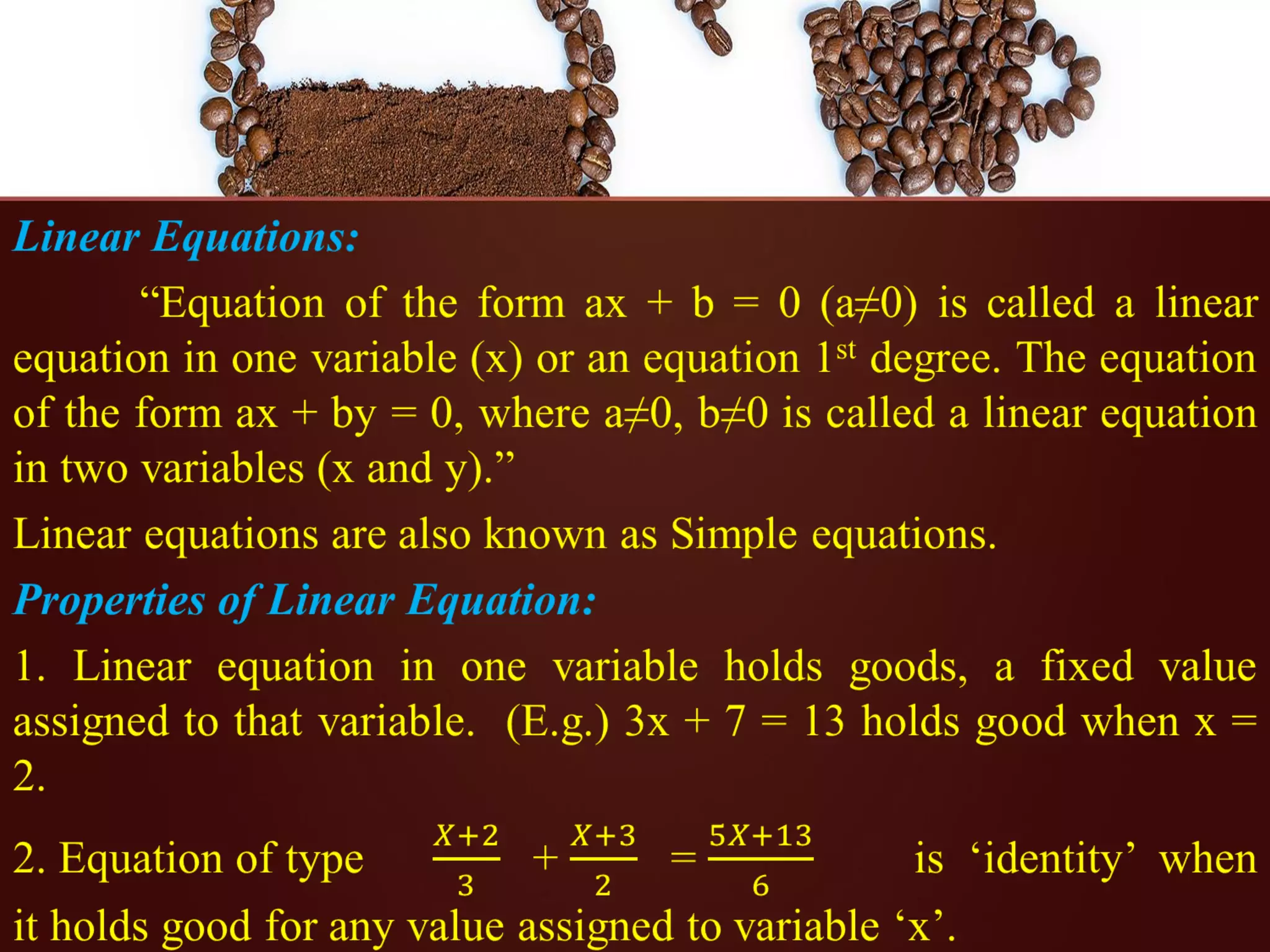
Equation:
“Equation is a statement that the values of two mathematical
expressions are equal.” (indicated by sign =). It is the process of equating one
thing with another.
Polynomial Equation:
Polynomial Equation is expressed in form of
aoxn + a1xn-1 + a2xn-2 + ………………..+ an = 0
where a0, a1, a2, a3……. an are constants (a0 ≠ 0) is called a Polynomial
Equation of degree ‘n’ in the variable ‘x’.
(E.g.) 3x – 5 = 0 is polynomial equation of degree 1.
2x2 – 4x + 3 = 0 is polynomial equation of degree 2.
4x3 – 3x2 + 2x + 1 = 0 is polynomial equation of degree 3.
• The equations of 1st, 2nd, 3rd & 4th degree are called Linear, Quadratic, Cubic
and Biquadratic equations.
Roots of Equation:
“The value of ‘x’ that satisfy the equation is called the
root of the equation.”
Two theorem of Roots of Equation:
Theorem 1: Every polynomial equation of degree greater than
or equal to one have atleast one root.
Theorem 2: An nth degree polynomial equation will have at
the most ‘n’ roots.
(E.g.) 1st degree equation can have only one root, a 2nd degree
of equation can have only two roots and thus an nth degree
equation can have almost ‘n’ number roots.
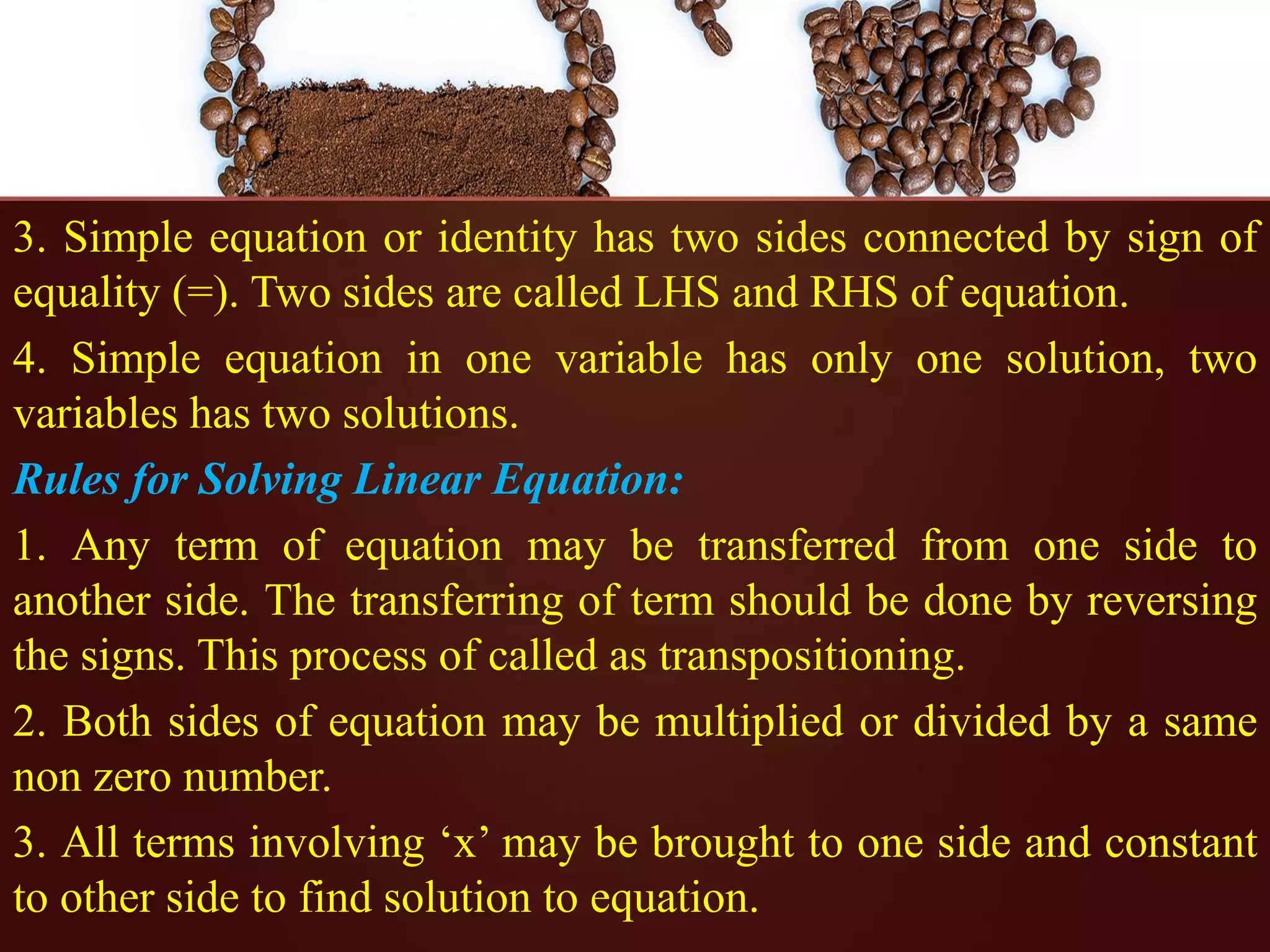
3. Simple equation or identity has two sides connected by sign of
equality (=). Two sides are called LHS and RHS of equation.
4. Simple equation in one variable has only one solution, two
variables has two solutions.
Rules for Solving Linear Equation:
1. Any term of equation may be transferred from one side to
another side. The transferring of term should be done by reversing
the signs. This process of called as transpositioning.
2. Both sides of equation may be multiplied or divided by a same
non zero number.
3. All terms involving ‘x’ may be brought to one side and constant
to other side to find solution to equation.
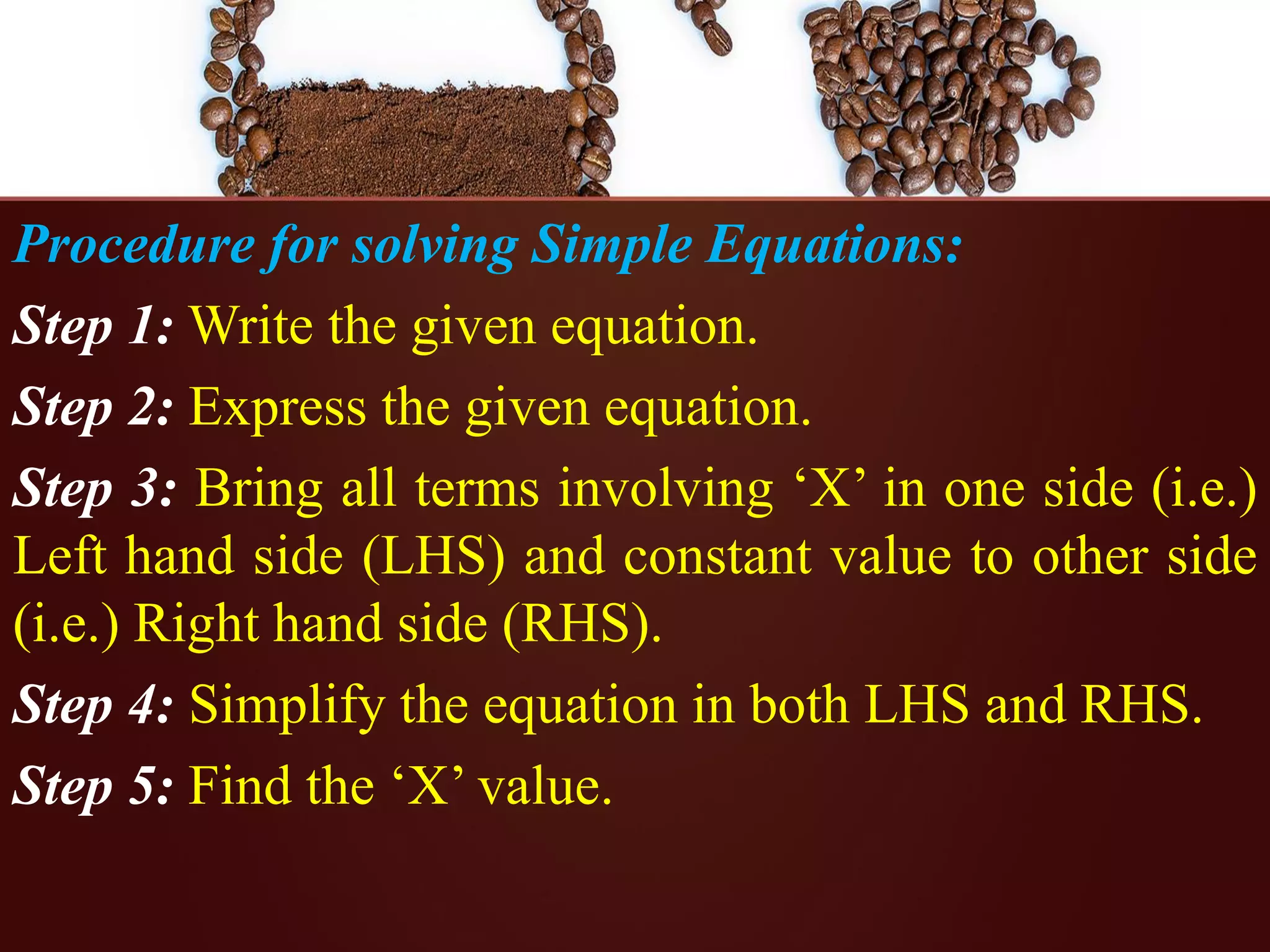
Procedure for solving Simple Equations:
Step 1: Write the given equation.
Step 2: Express the given equation.
Step 3: Bring all terms involving ‘X’ in one side (i.e.)
Left hand side (LHS) and constant value to other side
(i.e.) Right hand side (RHS).
Step 4: Simplify the equation in both LHS and RHS.
Step 5: Find the ‘X’ value.
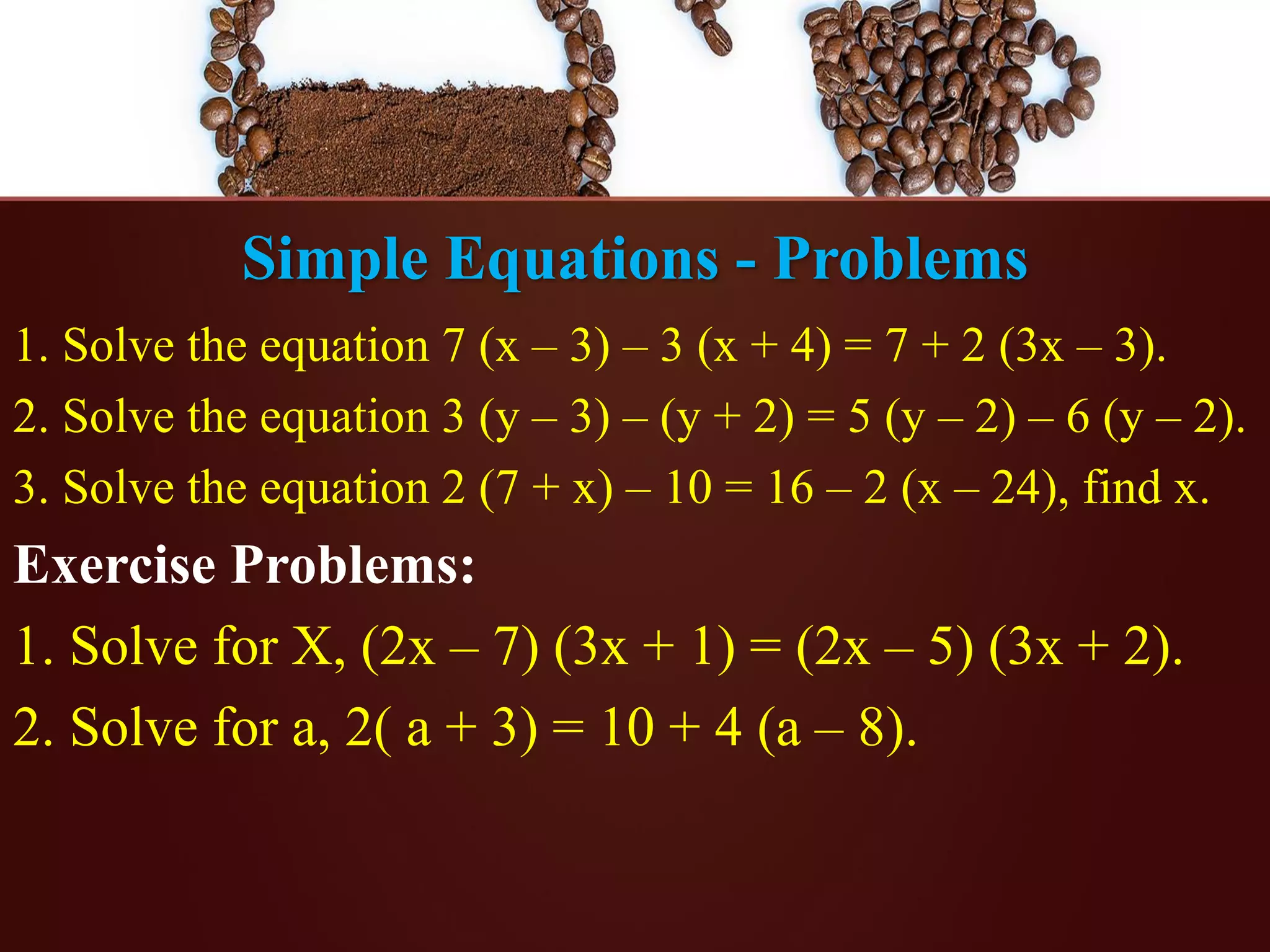
Simple Equations - Problems
1. Solve the equation 7 (x – 3) – 3 (x + 4) = 7 + 2 (3x – 3).
2. Solve the equation 3 (y – 3) – (y + 2) = 5 (y – 2) – 6 (y – 2).
3. Solve the equation 2 (7 + x) – 10 = 16 – 2 (x – 24), find x.
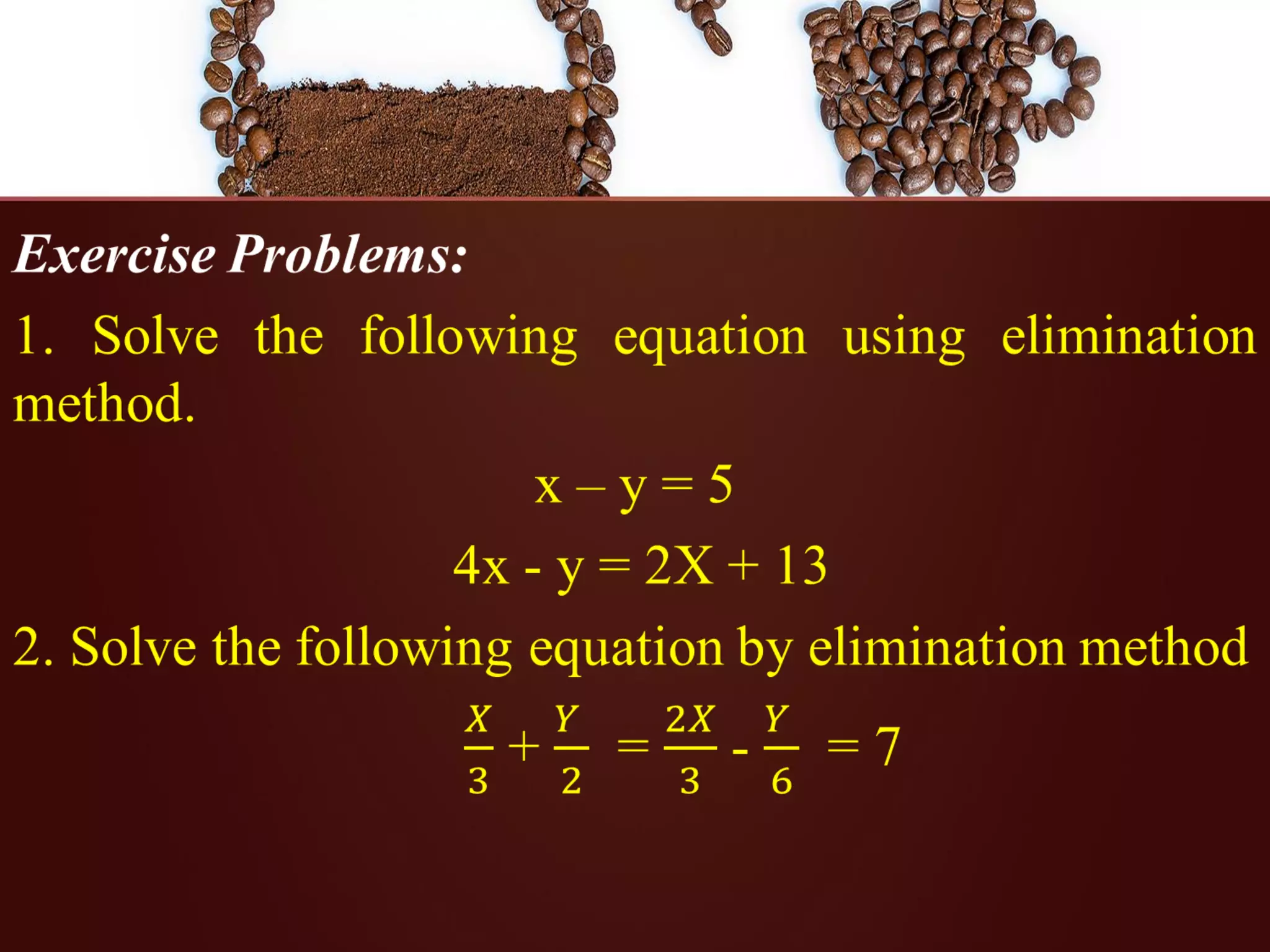
Exercise Problems:
1. Solve for X, (2x – 7) (3x + 1) = (2x – 5) (3x + 2).
2. Solve for a, 2( a + 3) = 10 + 4 (a – 8).
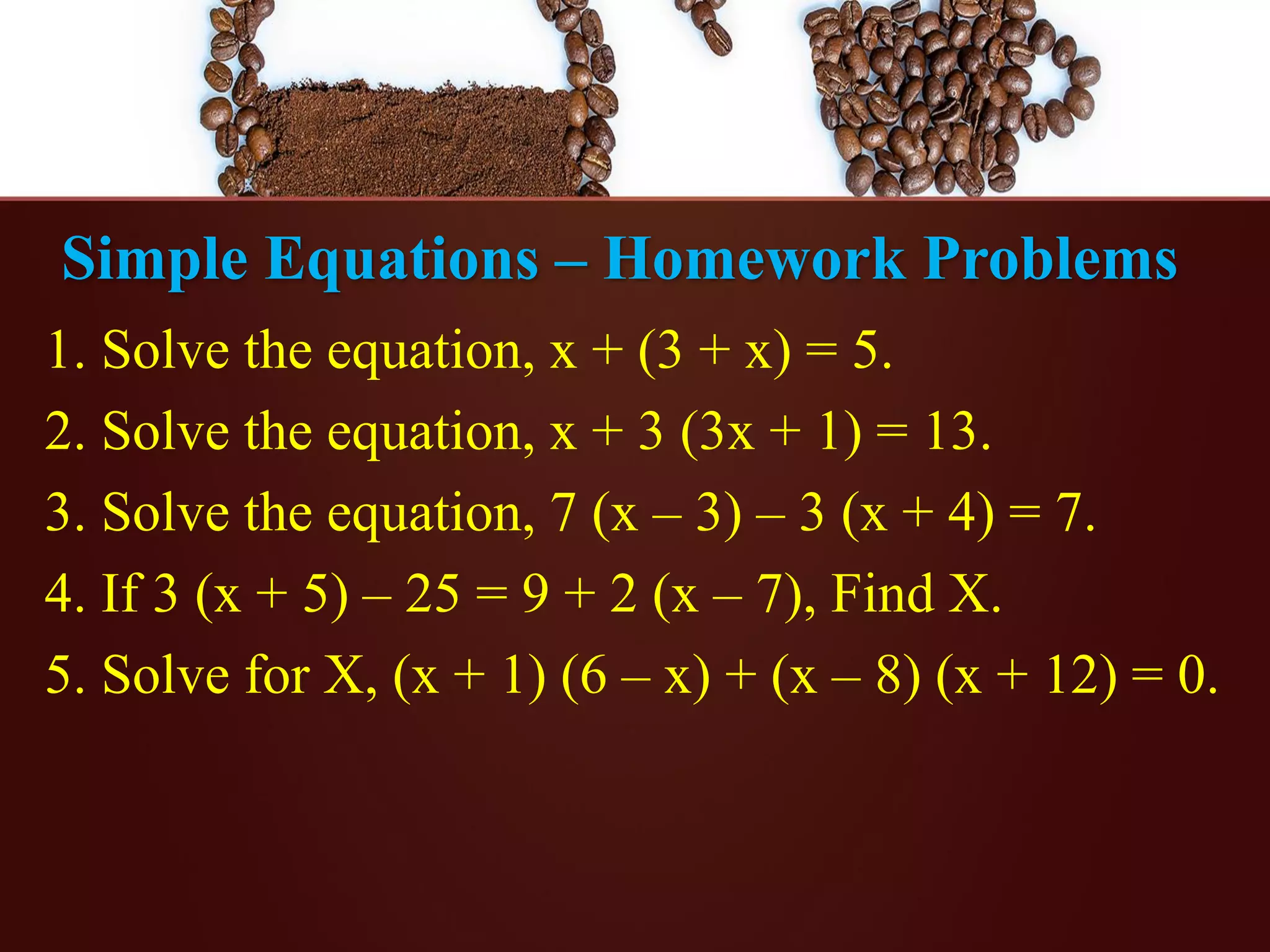
Simple Equations – Homework Problems
1. Solve the equation, x + (3 + x) = 5.
2. Solve the equation, x + 3 (3x + 1) = 13.
3. Solve the equation, 7 (x – 3) – 3 (x + 4) = 7.
4. If 3 (x + 5) – 25 = 9 + 2 (x – 7), Find X.
5. Solve for X, (x + 1) (6 – x) + (x – 8) (x + 12) = 0.
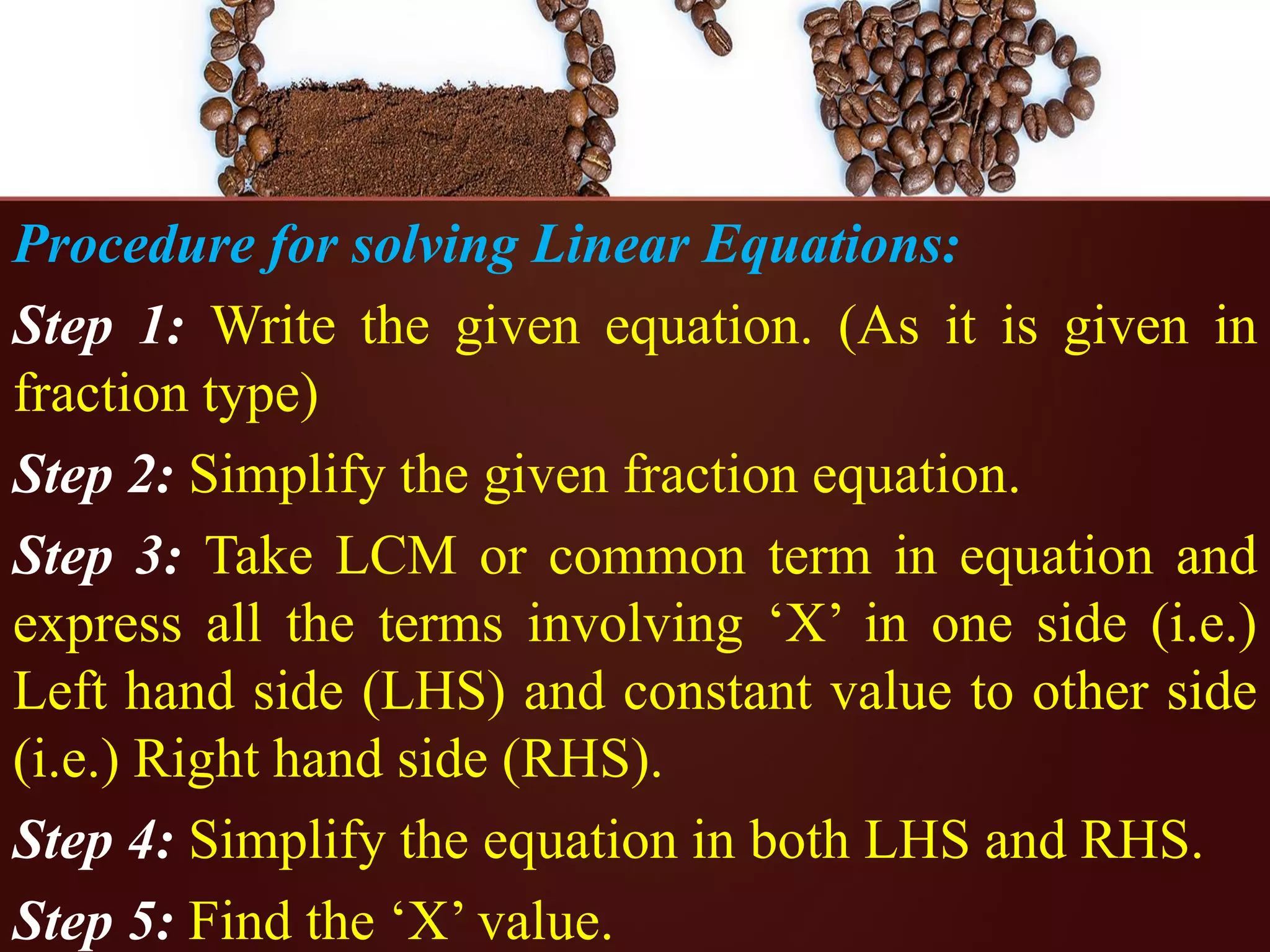
Procedure for solving Linear Equations:
Step 1: Write the given equation. (As it is given in
fraction type)
Step 2: Simplify the given fraction equation.
Step 3: Take LCM or common term in equation and
express all the terms involving ‘X’ in one side (i.e.)
Left hand side (LHS) and constant value to other side
(i.e.) Right hand side (RHS).
Step 4: Simplify the equation in both LHS and RHS.
Step 5: Find the ‘X’ value.
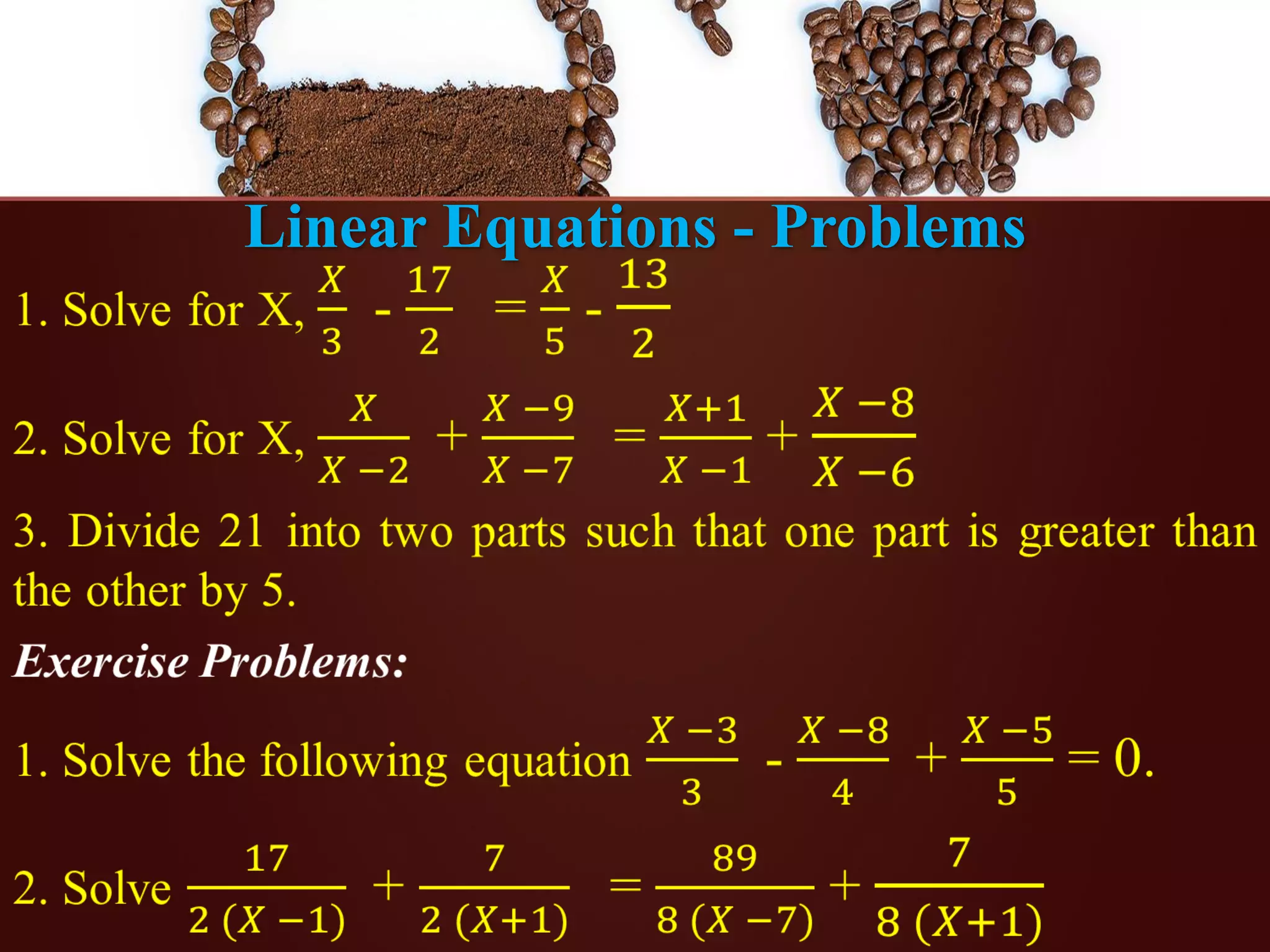
Linear Equations - Problems
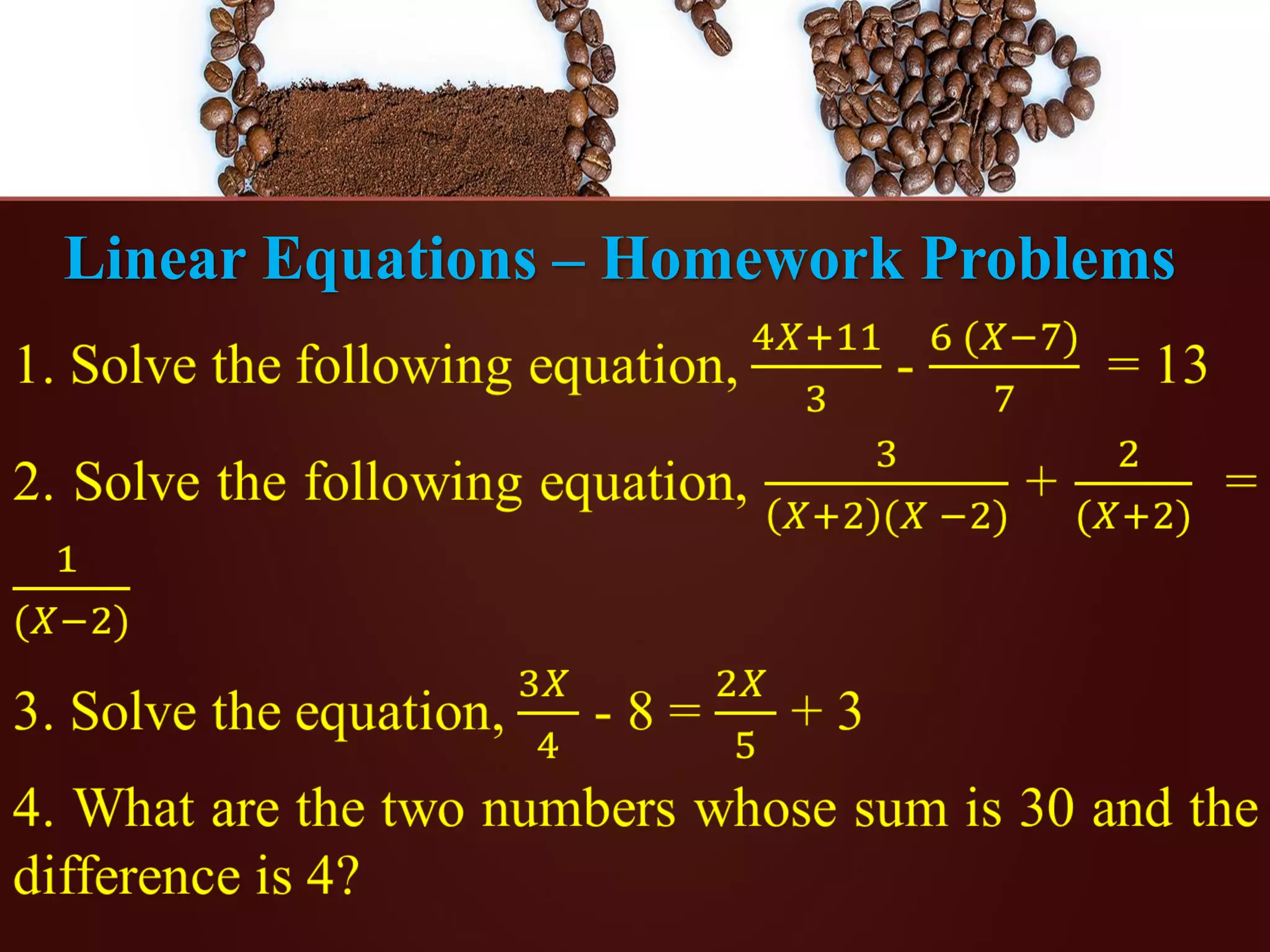
Linear Equations – Homework Problems
Linear Equations – Exercise Problems
1. The sum of three successive odd numbers is 177.
Find the number.
2. Divide 81 into three parts in such a way that half of
the first, one-third of the second and one-fourth of the
third are equal.
3. An Indian text cricketer scored a century in his 11th
test innings and thereby bettered his average scored by
5 runs. What is the average score after the 11th
innings?
Simultaneous Equation:
“Two or more linear equations in two variables, ‘x’ and ‘y’ are
called linear simultaneous equations or simple simultaneous
equations.”
The values of ‘x’ and ‘y’ that satisfy these equations is called the
solution of simple simultaneous equations.
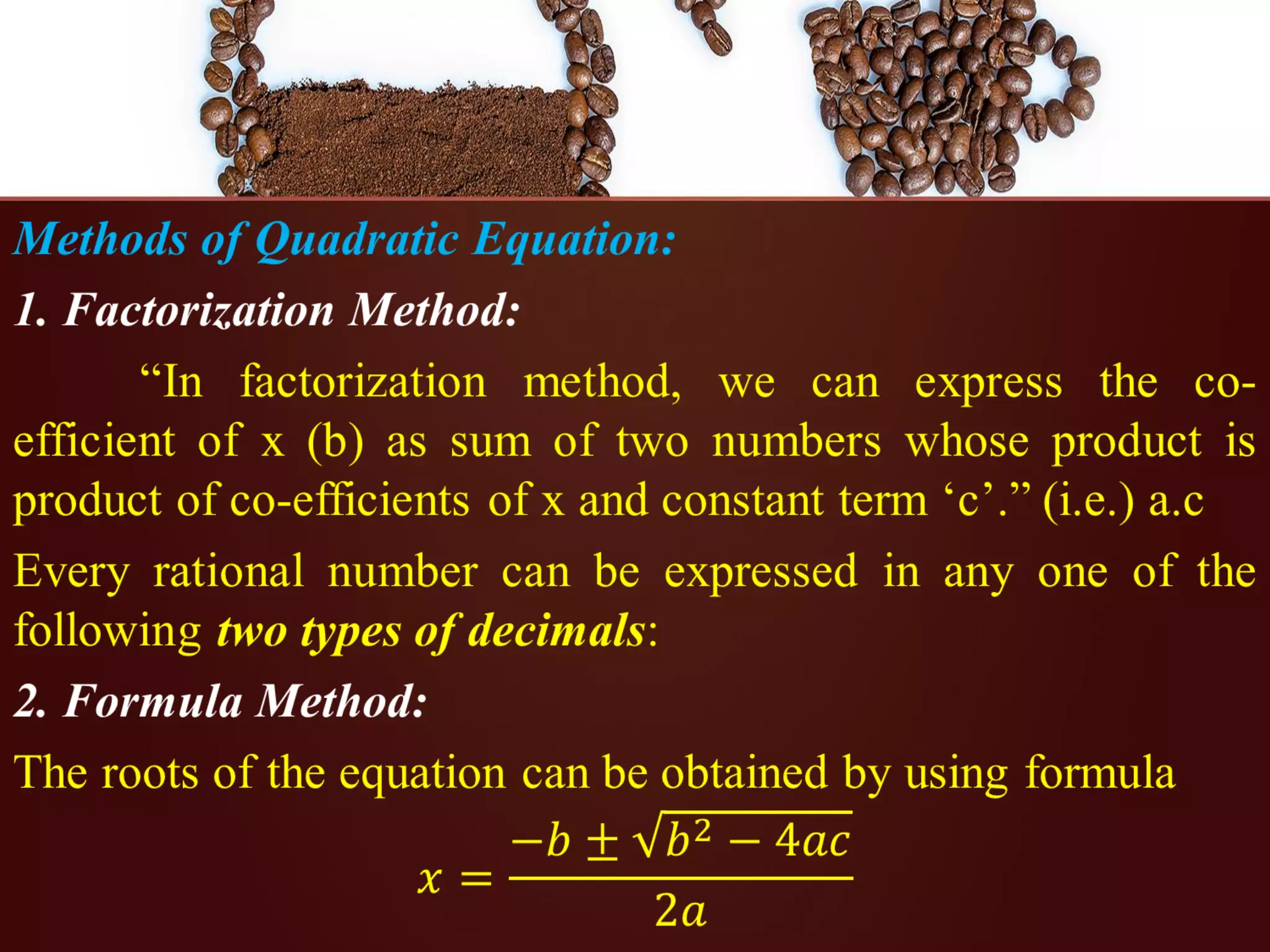
Methods of Simultaneous Equations:
1. Method of Elimination (or) Elimination method:
“In this method one of the two variables is eliminated by
making their co-efficients equal. This can be done by multiplying or
dividing the co-efficients by a required number. After elimination of
one of the variables, the equation reduces to a simple equation in one
variable which can be solved.”
2. Method of Substitution (or) Substitution method:
“In this method, taking value of any one variable from
one equation and substituting in second equation to find the
values of other variable.”
Simultaneous Equation – Elimination method (Classwork
Problems)
1. Solve the following equation using elimination method.
3x – 2y = 7
x + 2y = 5
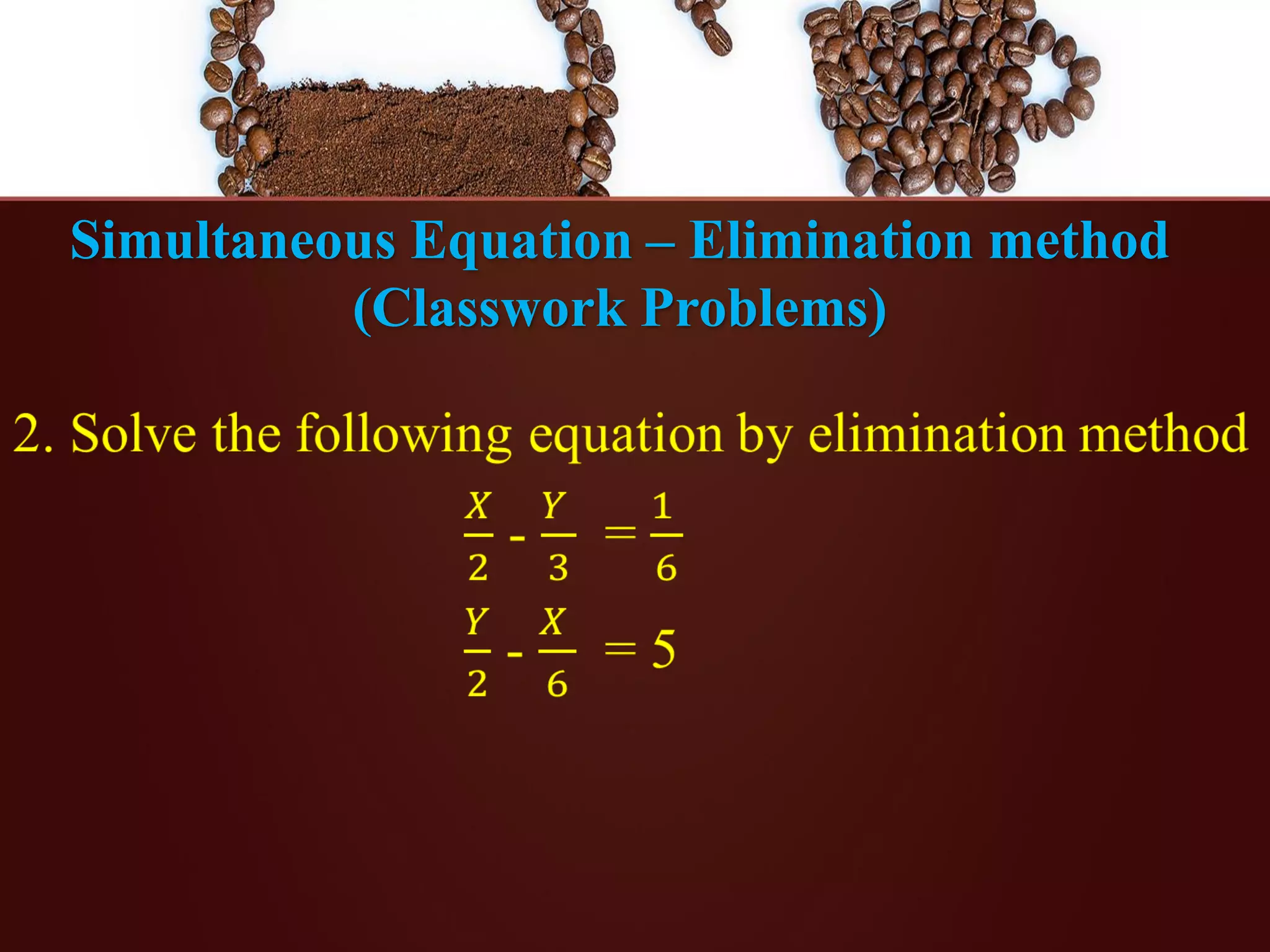
Simultaneous Equation – Elimination method
(Classwork Problems)
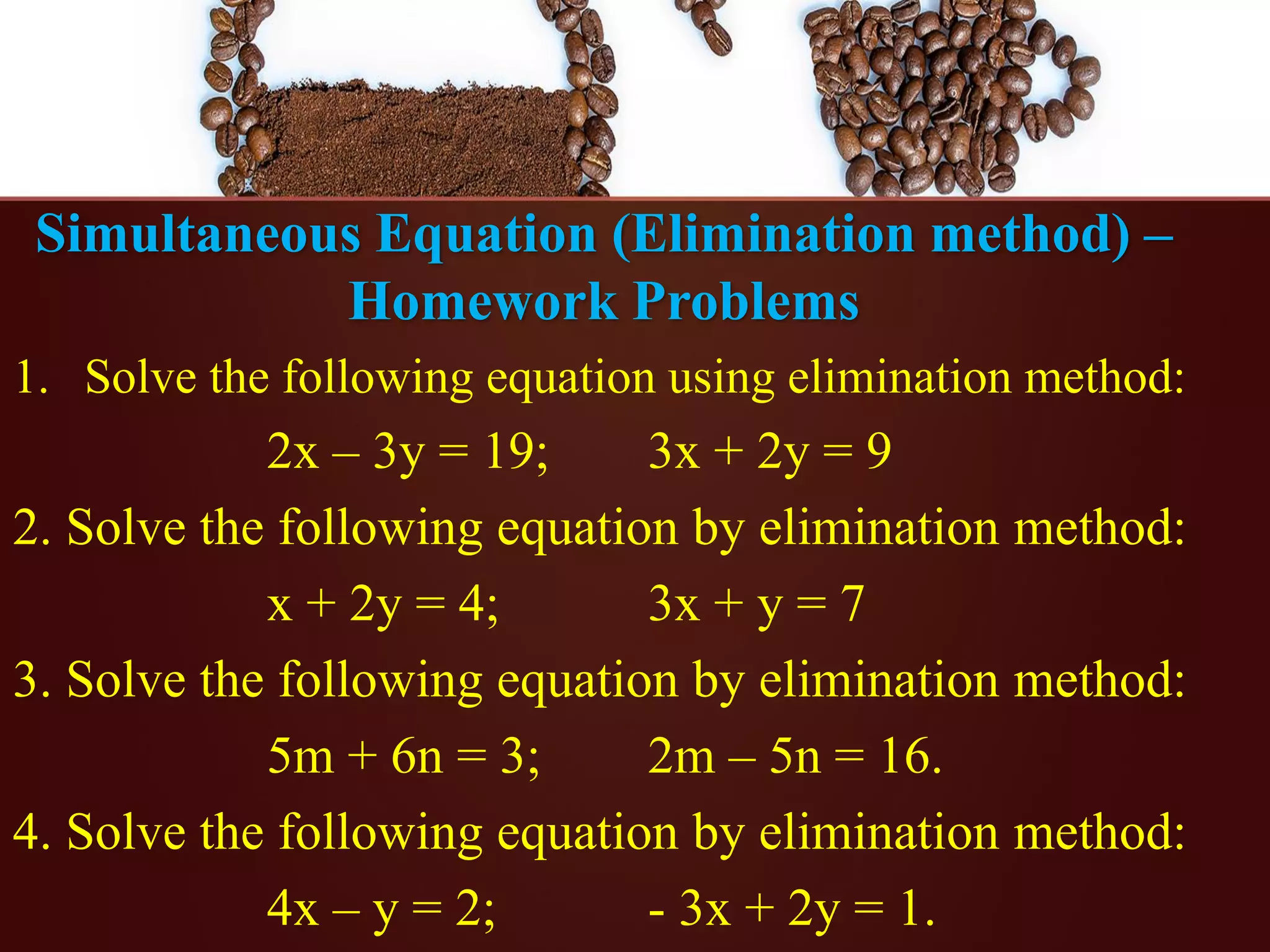
Simultaneous Equation (Elimination method) –
Homework Problems
1. Solve the following equation using elimination method:
2x – 3y = 19; 3x + 2y = 9
2. Solve the following equation by elimination method:
x + 2y = 4; 3x + y = 7
3. Solve the following equation by elimination method:
5m + 6n = 3; 2m – 5n = 16.
4. Solve the following equation by elimination method:
4x – y = 2; - 3x + 2y = 1.
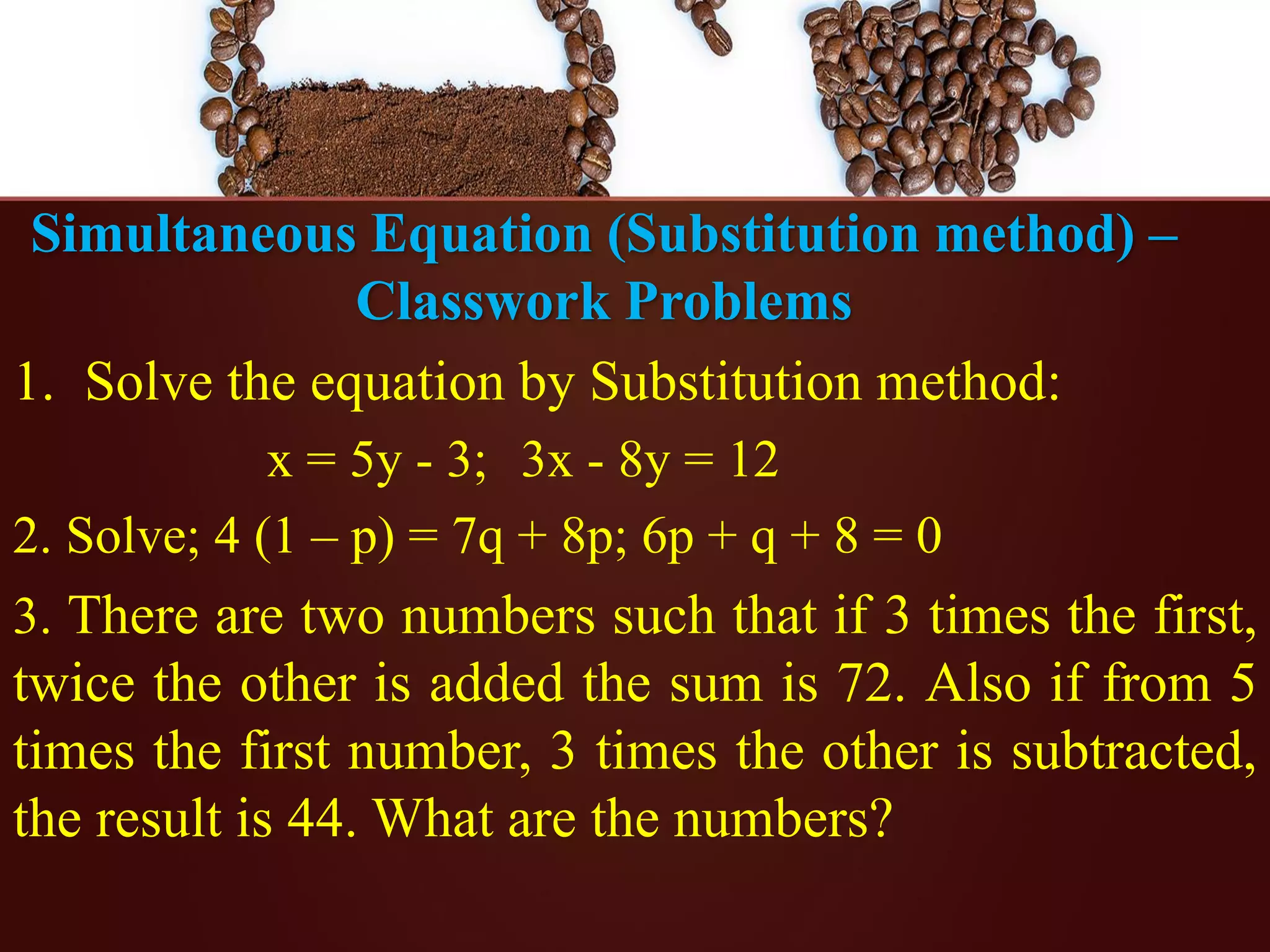
Simultaneous Equation (Substitution method) –
Classwork Problems
1. Solve the equation by Substitution method:
x = 5y - 3; 3x - 8y = 12
2. Solve; 4 (1 – p) = 7q + 8p; 6p + q + 8 = 0
3. There are two numbers such that if 3 times the first,
twice the other is added the sum is 72. Also if from 5
times the first number, 3 times the other is subtracted,
the result is 44. What are the numbers?
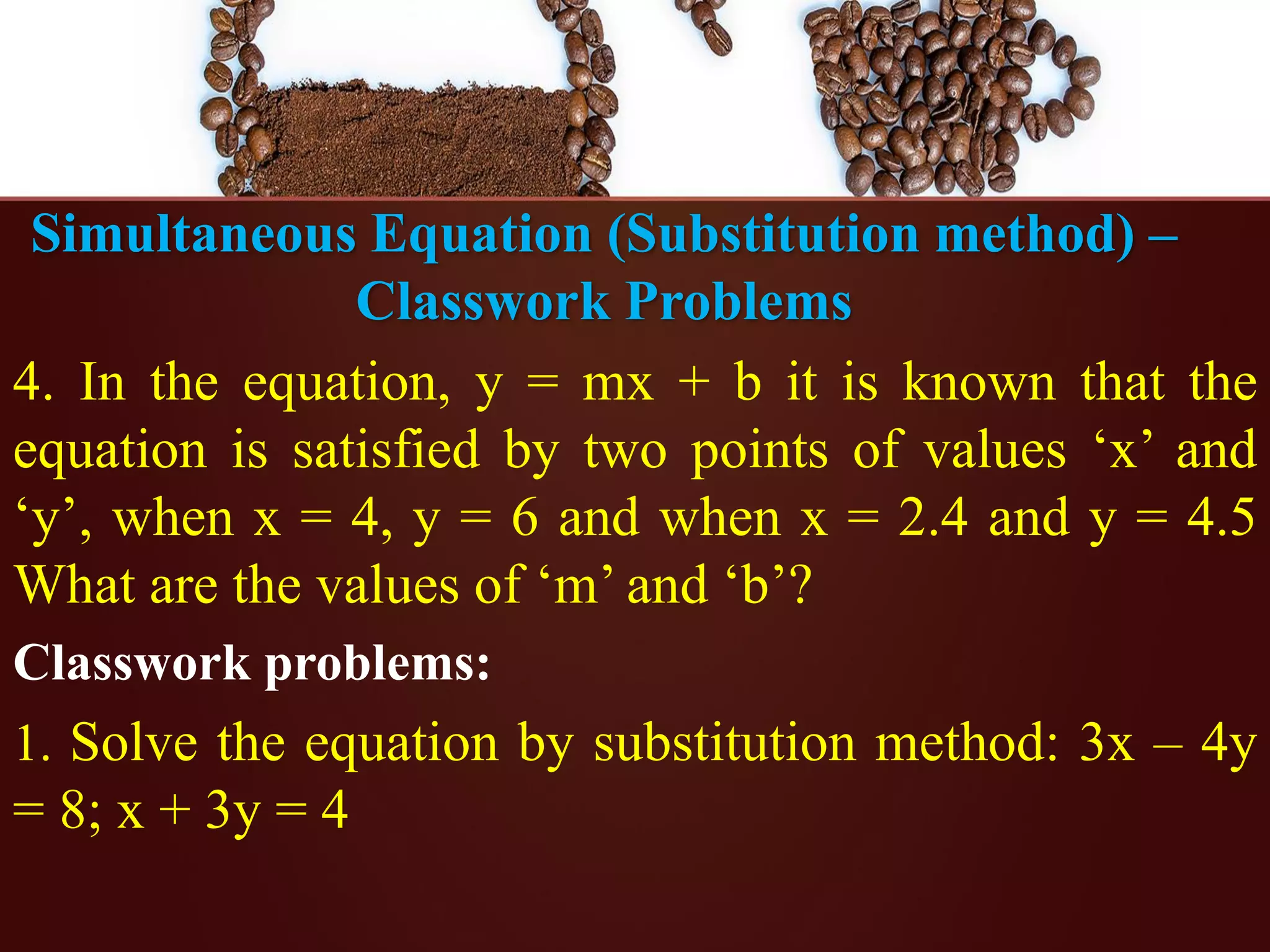
Simultaneous Equation (Substitution method) –
Classwork Problems
4. In the equation, y = mx + b it is known that the
equation is satisfied by two points of values ‘x’ and
‘y’, when x = 4, y = 6 and when x = 2.4 and y = 4.5
What are the values of ‘m’ and ‘b’?
Classwork problems:
1. Solve the equation by substitution method: 3x – 4y
= 8; x + 3y = 4
Simultaneous Equation (Substitution method) –
Homework Problems
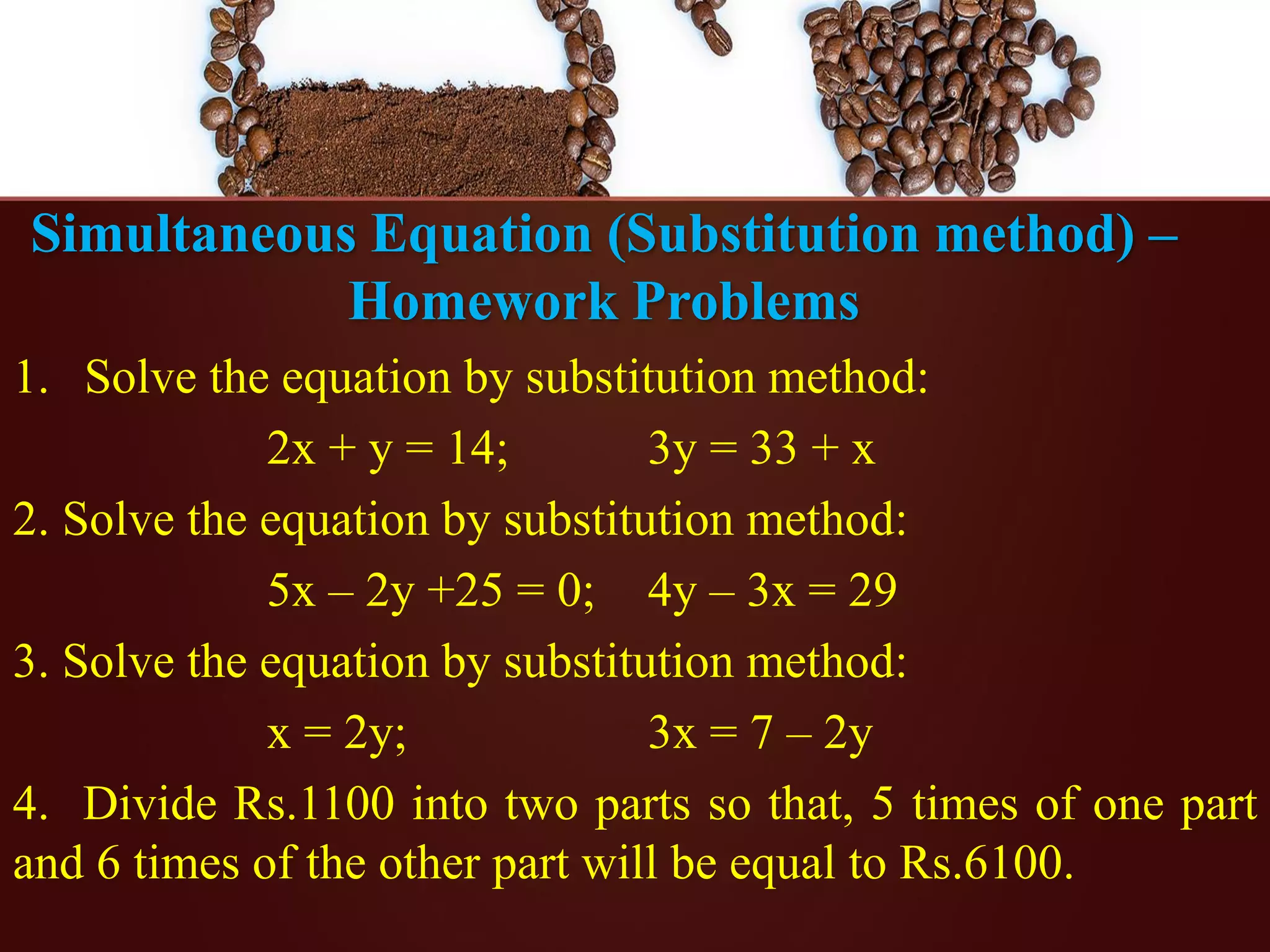
1. Solve the equation by substitution method:
2x + y = 14; 3y = 33 + x
2. Solve the equation by substitution method:
5x – 2y +25 = 0; 4y – 3x = 29
3. Solve the equation by substitution method:
x = 2y; 3x = 7 – 2y
4. Divide Rs.1100 into two parts so that, 5 times of one part
and 6 times of the other part will be equal to Rs.6100.
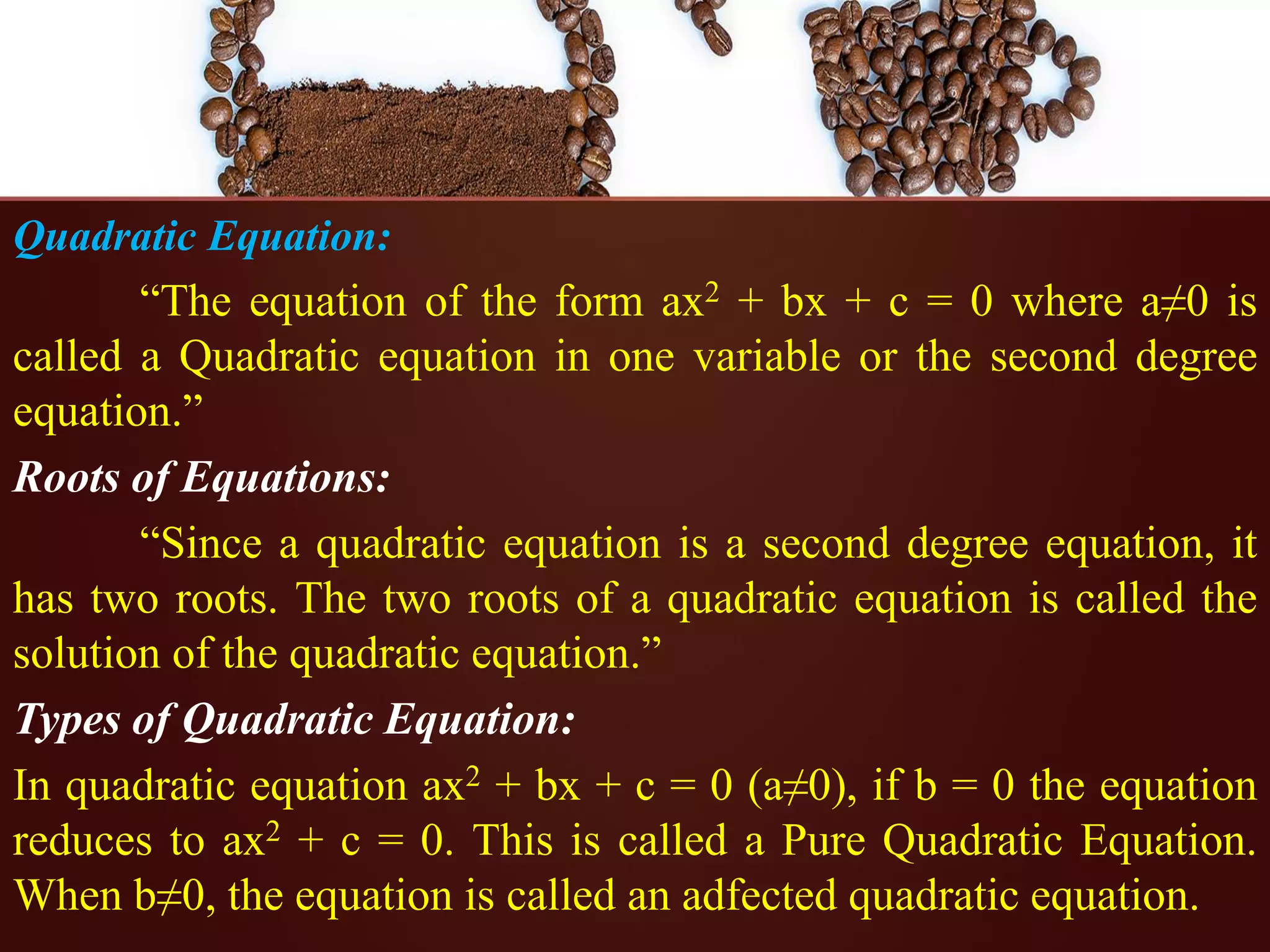
Quadratic Equation:
“The equation of the form ax2 + bx + c = 0 where a≠0 is
called a Quadratic equation in one variable or the second degree
equation.”
Roots of Equations:
“Since a quadratic equation is a second degree equation, it
has two roots. The two roots of a quadratic equation is called the
solution of the quadratic equation.”
Types of Quadratic Equation:
In quadratic equation ax2 + bx + c = 0 (a≠0), if b = 0 the equation
reduces to ax2 + c = 0. This is called a Pure Quadratic Equation.
When b≠0, the equation is called an adfected quadratic equation.
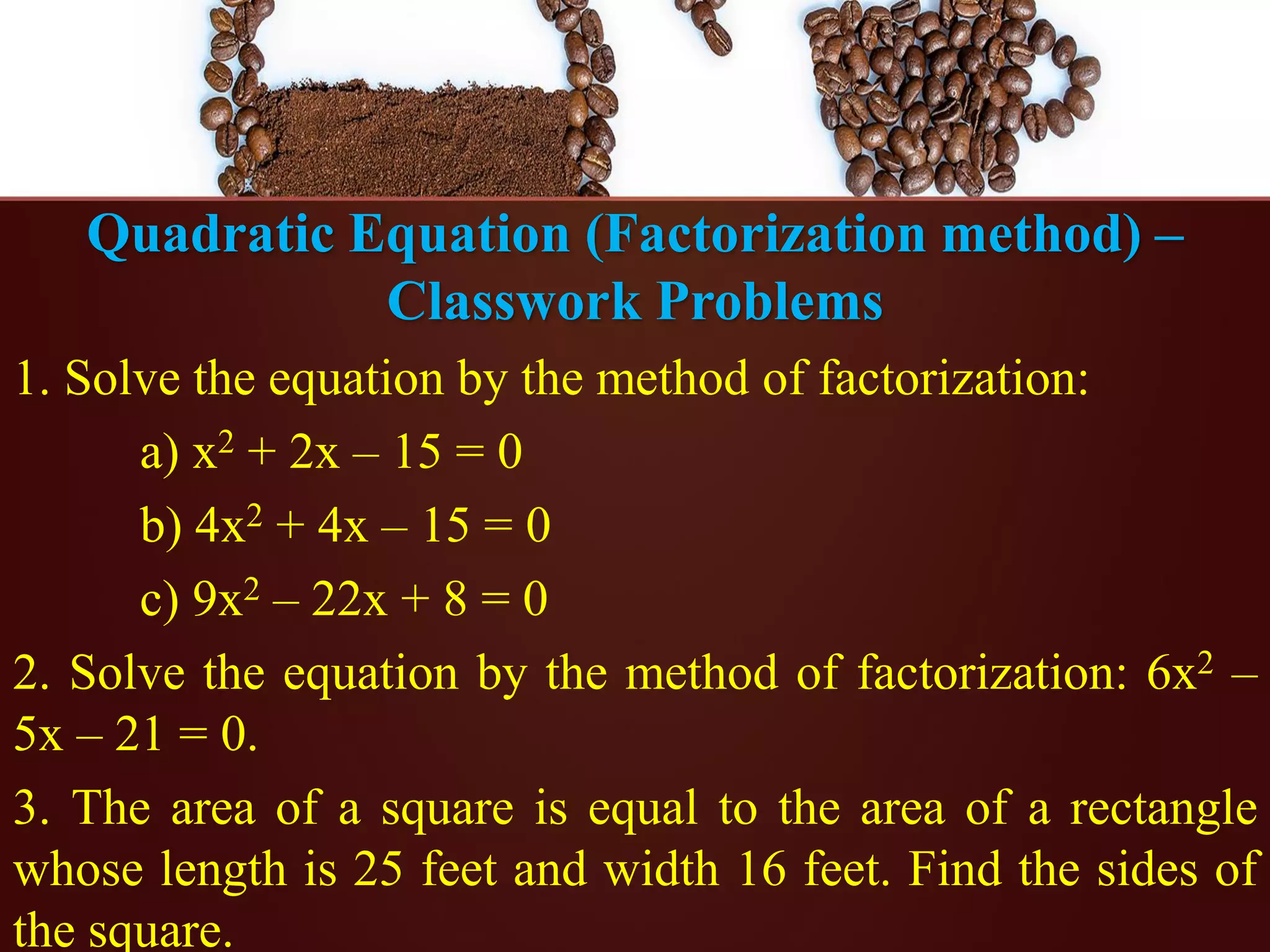
Quadratic Equation (Factorization method) –
Classwork Problems
1. Solve the equation by the method of factorization:
a) x2 + 2x – 15 = 0
b) 4x2 + 4x – 15 = 0
c) 9x2 – 22x + 8 = 0
2. Solve the equation by the method of factorization: 6x2 –
5x – 21 = 0.
3. The area of a square is equal to the area of a rectangle
whose length is 25 feet and width 16 feet. Find the sides of
the square.
Quadratic Equation (Factorization method) –
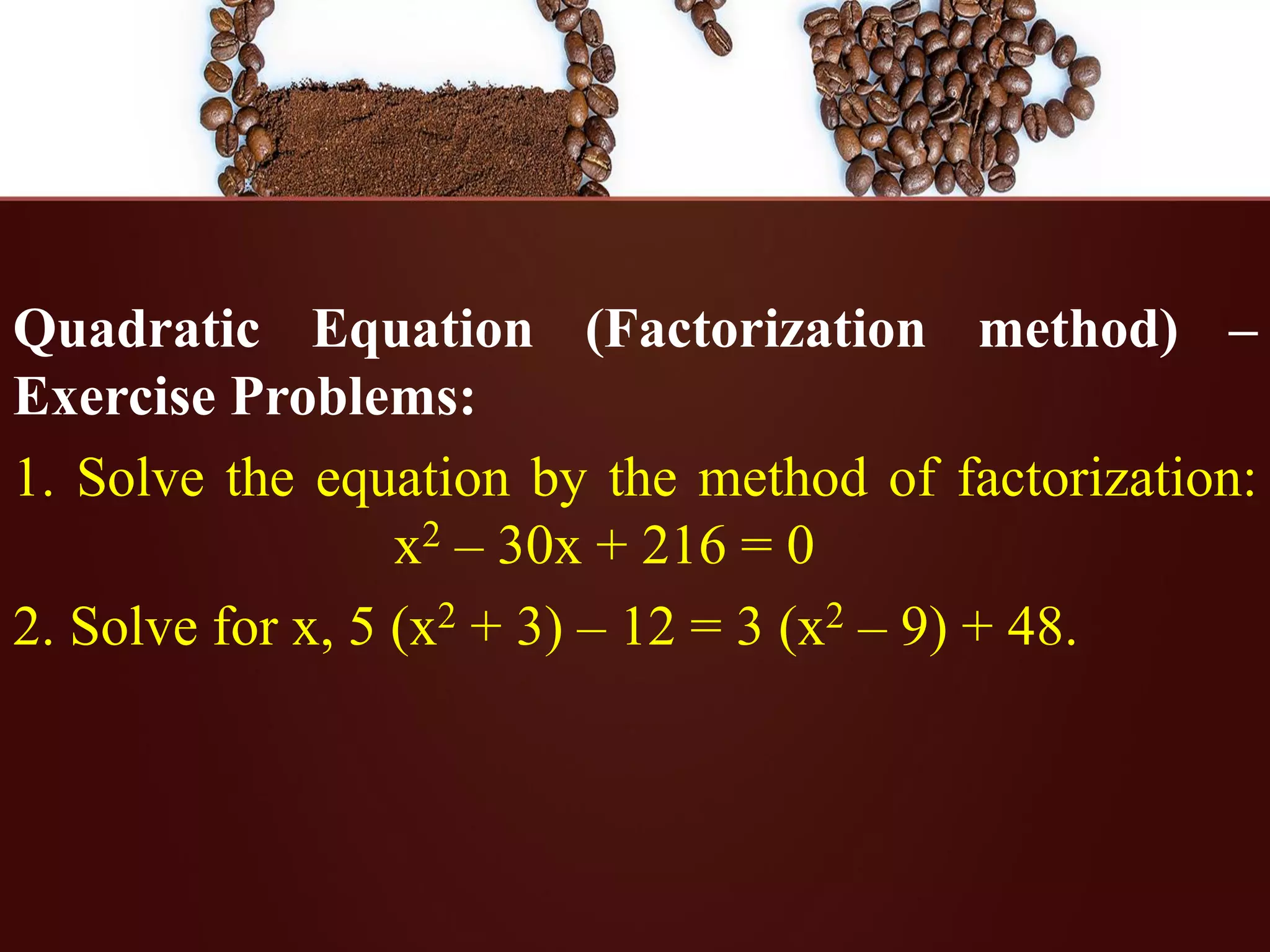
Exercise Problems:
1. Solve the equation by the method of factorization:
x2 – 30x + 216 = 0
2. Solve for x, 5 (x2 + 3) – 12 = 3 (x2 – 9) + 48.
Quadratic Equation (Factorization method) –
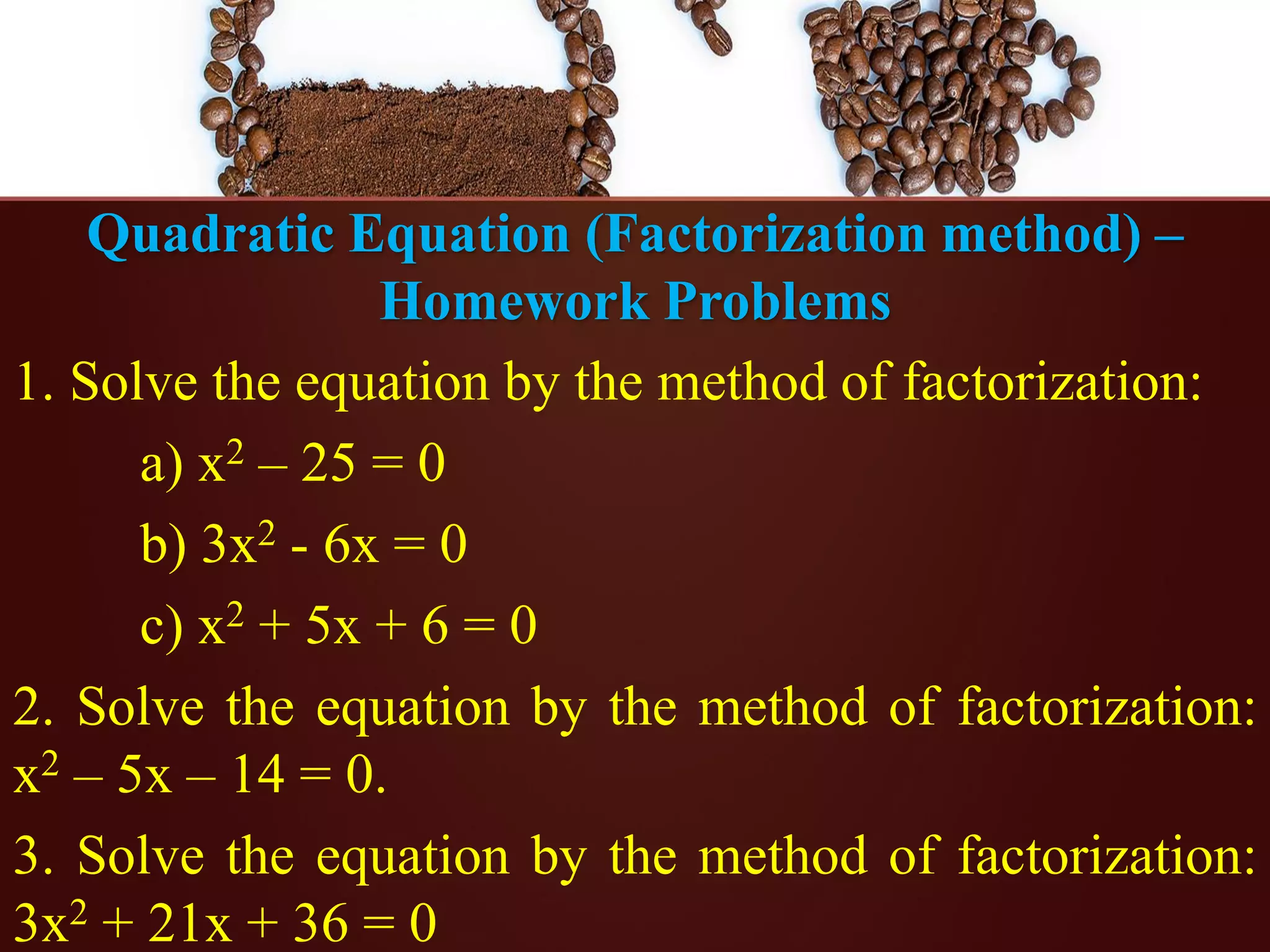
Homework Problems
1. Solve the equation by the method of factorization:
a) x2 – 25 = 0
b) 3x2 - 6x = 0
c) x2 + 5x + 6 = 0
2. Solve the equation by the method of factorization:
x2 – 5x – 14 = 0.
3. Solve the equation by the method of factorization:
3x2 + 21x + 36 = 0
Quadratic Equation (Formula method) –
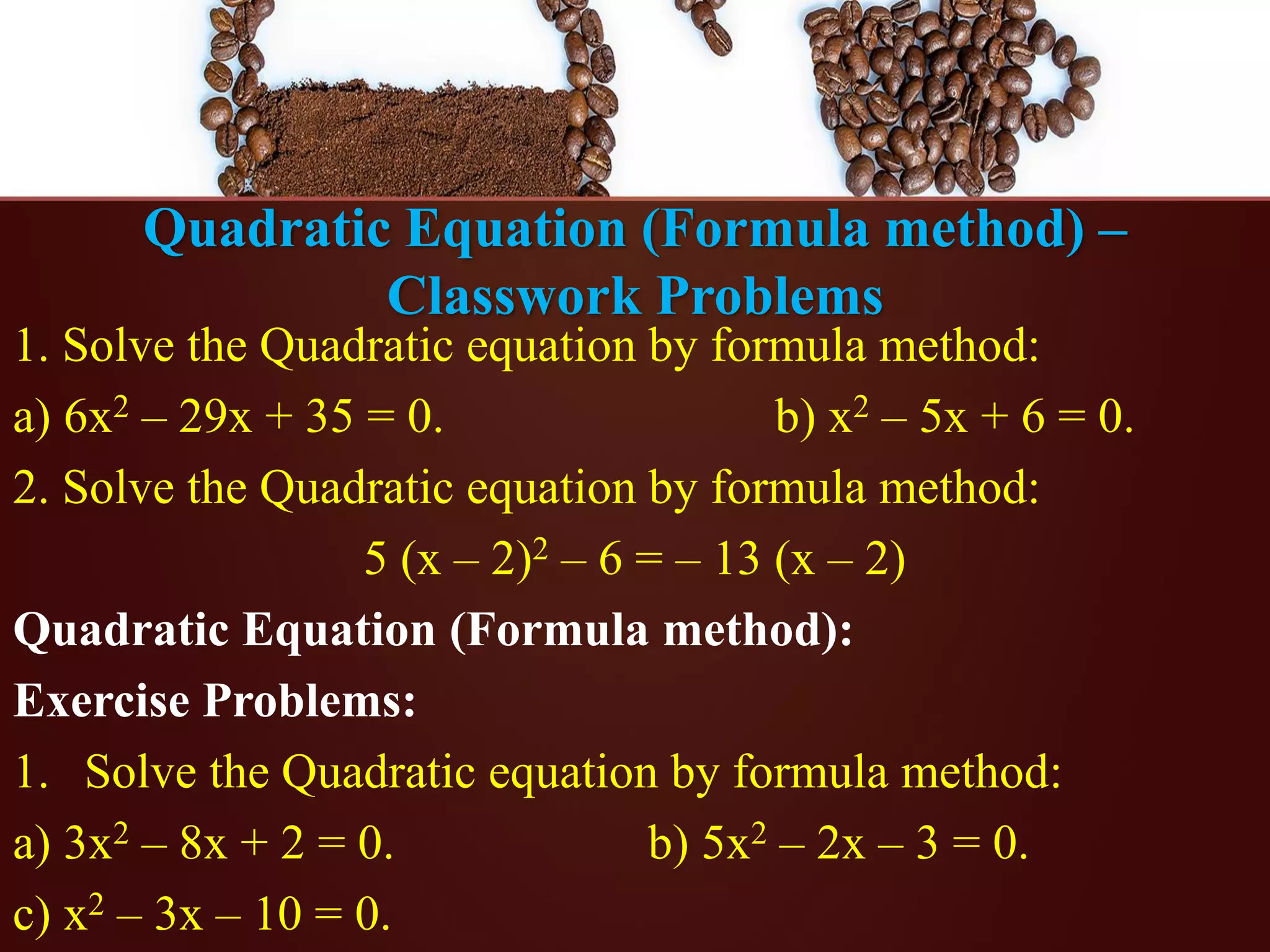
Classwork Problems
1. Solve the Quadratic equation by formula method:
a) 6x2 – 29x + 35 = 0. b) x2 – 5x + 6 = 0.
2. Solve the Quadratic equation by formula method:
5 (x – 2)2 – 6 = – 13 (x – 2)
Quadratic Equation (Formula method):
Exercise Problems:
1. Solve the Quadratic equation by formula method:
a) 3x2 – 8x + 2 = 0. b) 5x2 – 2x – 3 = 0.
c) x2 – 3x – 10 = 0.
Quadratic Equation (Formula method) –
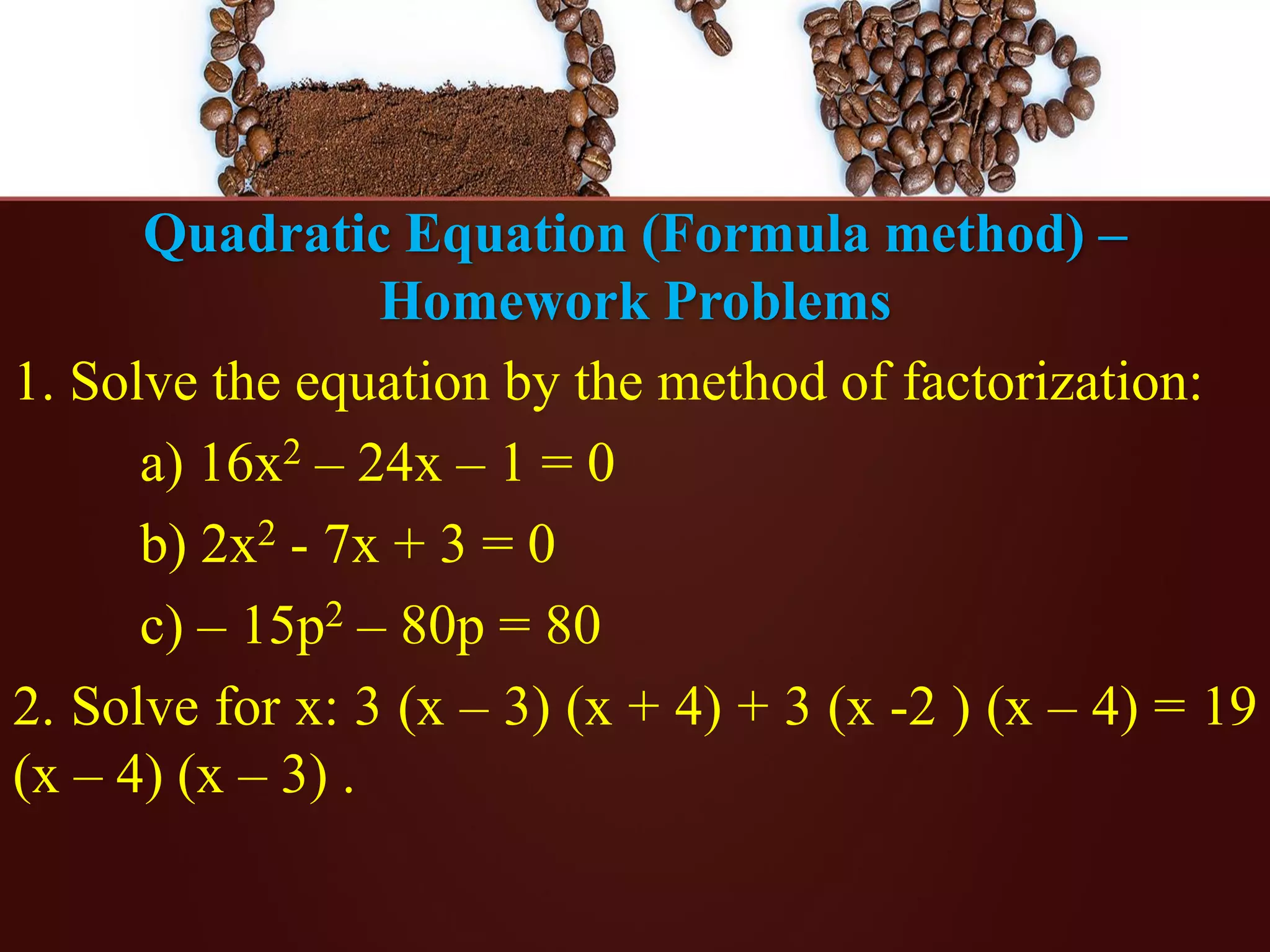
Homework Problems
1. Solve the equation by the method of factorization:
a) 16x2 – 24x – 1 = 0
b) 2x2 - 7x + 3 = 0
c) – 15p2 – 80p = 80
2. Solve for x: 3 (x – 3) (x + 4) + 3 (x -2 ) (x – 4) = 19
(x – 4) (x – 3) .
Problems on Commercial Applications – Classwork
problems
Linear Equations:
1. Ten years ago the age of the father was four times of
his son. Ten years from now the age of the father will
be double that of his son. What are the present ages of
father and son?
2. A number exceeds another by 7. If 2 is added to the
greater number, the sum is three times the difference if
5 is subtracted from the smaller. What are the
numbers?
Problems on Commercial Applications – Classwork
problems
Simultaneous Equations:
1. A book seller has a number of books, the published price
of which is Rs.25. After selling a certain number at this price
he sells the remainder at Rs.20 each and his total sales were
Rs.1100. If the numbers sold at the price were reversed, his
sales would be Rs.1150. How many books had he in all and
how many were originally sold at Rs.25.
2. A father’s age is 4 times that of his son. Before 8 years the
father’s age was 16 times that of a son. Find the present
ages.
3. The sum of the digit of a number less than 100 is 6. If
the digits are reversed then the resulting number will be
less by 18 than the original number. Find the number.
Problems on Commercial Applications –
Homework problems
Linear Equations:
1. A mother is 32 years older than her son. In 4 years the
mothers age will be 8 years more than twice that of her son.
Find their present age.
2. 5 times a number increased by 10 gives 50. Find the
number.
Simultaneous Equations:
1. The age of a man is 3 times the sum of the ages of his 2
sons and 5 years hence his age will be double the sum of their
ages. Find his present ages.
Simultaneous Equations:
2. Find two numbers whose sum is 480 & ratio is 5:3.
Problems on Commercial Applications – Classwork
problems
Quadratic Equations:
1. Three consecutive natural numbers are such that the square
of the middle number exceeds the difference of the squares of
the other two by 96. Find the numbers.
2. The product of the consecutive odd integers is 255. Find the
integers.
3. In a house of 50 members, the monthly expenses was increased
by Rs.76, when the number of members were increased by 14, the
average monthly expenses were there for reduced by Rs.1 per head.
Find the original rate of expenses per head per month.
Problems on Commercial Applications – Classwork
problems
Quadratic Equations:
4. On a weekday, the manager of a theatre finds that his
collection for a matinee show was Rs.1620. He charges Rs.20
per ticket in the men’s enclosure and Rs.15 per ticket in the
women’s enclosure. His gate keeper told him that women are
in more number then men by 10. What is the total number of
spectators present in the picture hall?
Problems on Commercial Applications – Classwork
problems
Quadratic Equations:
5. A motorist travels a distance of 84 km. He finds, if
on the return journey he increases the average speed
by 4 kmph, he will take half an hour less. What was
his average speed for the first part of the journey and
how long did he take for the double journey?
Problems on Commercial Applications –
Homework problems
Quadratic Equations:
1. A number which when decreased by 20 is equal to 69 times the
reciprocal of the number. Find the number.
2. Two years ago, a man’s age was three times the square of his son’s
age. After 3 years, his age will be four time his son’s age. Find their
present ages.
3. A travelling salesman gets conveyance allowance Rs.5 per km from
his employer. The salesman is travelling from Bangalore to Chennai.
While going to Chennai he travels at an average speed of 64kmph and on
his return his average speed is 80 kmph. He takes 9 hours for the double
journey. What is the distance between Bangalore and Chennai? How
much can be claim as travelling allowance from his employer?
End of the Unit 2
Thank You

Theory of Equation

  • 1.
    UNIT 2: THEORYOF EQUATIONS Mr.T.SOMASUNDARAM ASSISTANT PROFESSOR DEPARTMENT OF MANAGEMENT KRISTU JAYANTI COLLEGE, BANGALORE
  • 2.
    UNIT 2: THEORYOF EQUATIONS Introduction, Types of Equations – Simple, Linear and Simultaneous equations (Only two variables), Elimination & Substitution method, Quadratic equation – Factorization & Formula method (ax2 + bx + c = 0), Problems on Commercial applications.
  • 3.
    Equation: “Equation is astatement that the values of two mathematical expressions are equal.” (indicated by sign =). It is the process of equating one thing with another. Polynomial Equation: Polynomial Equation is expressed in form of aoxn + a1xn-1 + a2xn-2 + ………………..+ an = 0 where a0, a1, a2, a3……. an are constants (a0 ≠ 0) is called a Polynomial Equation of degree ‘n’ in the variable ‘x’. (E.g.) 3x – 5 = 0 is polynomial equation of degree 1. 2x2 – 4x + 3 = 0 is polynomial equation of degree 2. 4x3 – 3x2 + 2x + 1 = 0 is polynomial equation of degree 3. • The equations of 1st, 2nd, 3rd & 4th degree are called Linear, Quadratic, Cubic and Biquadratic equations.
  • 4.
    Roots of Equation: “Thevalue of ‘x’ that satisfy the equation is called the root of the equation.” Two theorem of Roots of Equation: Theorem 1: Every polynomial equation of degree greater than or equal to one have atleast one root. Theorem 2: An nth degree polynomial equation will have at the most ‘n’ roots. (E.g.) 1st degree equation can have only one root, a 2nd degree of equation can have only two roots and thus an nth degree equation can have almost ‘n’ number roots.
  • 6.
    3. Simple equationor identity has two sides connected by sign of equality (=). Two sides are called LHS and RHS of equation. 4. Simple equation in one variable has only one solution, two variables has two solutions. Rules for Solving Linear Equation: 1. Any term of equation may be transferred from one side to another side. The transferring of term should be done by reversing the signs. This process of called as transpositioning. 2. Both sides of equation may be multiplied or divided by a same non zero number. 3. All terms involving ‘x’ may be brought to one side and constant to other side to find solution to equation.
  • 7.
    Procedure for solvingSimple Equations: Step 1: Write the given equation. Step 2: Express the given equation. Step 3: Bring all terms involving ‘X’ in one side (i.e.) Left hand side (LHS) and constant value to other side (i.e.) Right hand side (RHS). Step 4: Simplify the equation in both LHS and RHS. Step 5: Find the ‘X’ value.
  • 8.
    Simple Equations -Problems 1. Solve the equation 7 (x – 3) – 3 (x + 4) = 7 + 2 (3x – 3). 2. Solve the equation 3 (y – 3) – (y + 2) = 5 (y – 2) – 6 (y – 2). 3. Solve the equation 2 (7 + x) – 10 = 16 – 2 (x – 24), find x. Exercise Problems: 1. Solve for X, (2x – 7) (3x + 1) = (2x – 5) (3x + 2). 2. Solve for a, 2( a + 3) = 10 + 4 (a – 8).
  • 9.
    Simple Equations –Homework Problems 1. Solve the equation, x + (3 + x) = 5. 2. Solve the equation, x + 3 (3x + 1) = 13. 3. Solve the equation, 7 (x – 3) – 3 (x + 4) = 7. 4. If 3 (x + 5) – 25 = 9 + 2 (x – 7), Find X. 5. Solve for X, (x + 1) (6 – x) + (x – 8) (x + 12) = 0.
  • 10.
    Procedure for solvingLinear Equations: Step 1: Write the given equation. (As it is given in fraction type) Step 2: Simplify the given fraction equation. Step 3: Take LCM or common term in equation and express all the terms involving ‘X’ in one side (i.e.) Left hand side (LHS) and constant value to other side (i.e.) Right hand side (RHS). Step 4: Simplify the equation in both LHS and RHS. Step 5: Find the ‘X’ value.
  • 11.
  • 12.
    Linear Equations –Homework Problems
  • 13.
    Linear Equations –Exercise Problems 1. The sum of three successive odd numbers is 177. Find the number. 2. Divide 81 into three parts in such a way that half of the first, one-third of the second and one-fourth of the third are equal. 3. An Indian text cricketer scored a century in his 11th test innings and thereby bettered his average scored by 5 runs. What is the average score after the 11th innings?
  • 14.
    Simultaneous Equation: “Two ormore linear equations in two variables, ‘x’ and ‘y’ are called linear simultaneous equations or simple simultaneous equations.” The values of ‘x’ and ‘y’ that satisfy these equations is called the solution of simple simultaneous equations. Methods of Simultaneous Equations: 1. Method of Elimination (or) Elimination method: “In this method one of the two variables is eliminated by making their co-efficients equal. This can be done by multiplying or dividing the co-efficients by a required number. After elimination of one of the variables, the equation reduces to a simple equation in one variable which can be solved.”
  • 15.
    2. Method ofSubstitution (or) Substitution method: “In this method, taking value of any one variable from one equation and substituting in second equation to find the values of other variable.” Simultaneous Equation – Elimination method (Classwork Problems) 1. Solve the following equation using elimination method. 3x – 2y = 7 x + 2y = 5
  • 16.
    Simultaneous Equation –Elimination method (Classwork Problems)
  • 18.
    Simultaneous Equation (Eliminationmethod) – Homework Problems 1. Solve the following equation using elimination method: 2x – 3y = 19; 3x + 2y = 9 2. Solve the following equation by elimination method: x + 2y = 4; 3x + y = 7 3. Solve the following equation by elimination method: 5m + 6n = 3; 2m – 5n = 16. 4. Solve the following equation by elimination method: 4x – y = 2; - 3x + 2y = 1.
  • 19.
    Simultaneous Equation (Substitutionmethod) – Classwork Problems 1. Solve the equation by Substitution method: x = 5y - 3; 3x - 8y = 12 2. Solve; 4 (1 – p) = 7q + 8p; 6p + q + 8 = 0 3. There are two numbers such that if 3 times the first, twice the other is added the sum is 72. Also if from 5 times the first number, 3 times the other is subtracted, the result is 44. What are the numbers?
  • 20.
    Simultaneous Equation (Substitutionmethod) – Classwork Problems 4. In the equation, y = mx + b it is known that the equation is satisfied by two points of values ‘x’ and ‘y’, when x = 4, y = 6 and when x = 2.4 and y = 4.5 What are the values of ‘m’ and ‘b’? Classwork problems: 1. Solve the equation by substitution method: 3x – 4y = 8; x + 3y = 4
  • 21.
    Simultaneous Equation (Substitutionmethod) – Homework Problems 1. Solve the equation by substitution method: 2x + y = 14; 3y = 33 + x 2. Solve the equation by substitution method: 5x – 2y +25 = 0; 4y – 3x = 29 3. Solve the equation by substitution method: x = 2y; 3x = 7 – 2y 4. Divide Rs.1100 into two parts so that, 5 times of one part and 6 times of the other part will be equal to Rs.6100.
  • 22.
    Quadratic Equation: “The equationof the form ax2 + bx + c = 0 where a≠0 is called a Quadratic equation in one variable or the second degree equation.” Roots of Equations: “Since a quadratic equation is a second degree equation, it has two roots. The two roots of a quadratic equation is called the solution of the quadratic equation.” Types of Quadratic Equation: In quadratic equation ax2 + bx + c = 0 (a≠0), if b = 0 the equation reduces to ax2 + c = 0. This is called a Pure Quadratic Equation. When b≠0, the equation is called an adfected quadratic equation.
  • 24.
    Quadratic Equation (Factorizationmethod) – Classwork Problems 1. Solve the equation by the method of factorization: a) x2 + 2x – 15 = 0 b) 4x2 + 4x – 15 = 0 c) 9x2 – 22x + 8 = 0 2. Solve the equation by the method of factorization: 6x2 – 5x – 21 = 0. 3. The area of a square is equal to the area of a rectangle whose length is 25 feet and width 16 feet. Find the sides of the square.
  • 25.
    Quadratic Equation (Factorizationmethod) – Exercise Problems: 1. Solve the equation by the method of factorization: x2 – 30x + 216 = 0 2. Solve for x, 5 (x2 + 3) – 12 = 3 (x2 – 9) + 48.
  • 26.
    Quadratic Equation (Factorizationmethod) – Homework Problems 1. Solve the equation by the method of factorization: a) x2 – 25 = 0 b) 3x2 - 6x = 0 c) x2 + 5x + 6 = 0 2. Solve the equation by the method of factorization: x2 – 5x – 14 = 0. 3. Solve the equation by the method of factorization: 3x2 + 21x + 36 = 0
  • 27.
    Quadratic Equation (Formulamethod) – Classwork Problems 1. Solve the Quadratic equation by formula method: a) 6x2 – 29x + 35 = 0. b) x2 – 5x + 6 = 0. 2. Solve the Quadratic equation by formula method: 5 (x – 2)2 – 6 = – 13 (x – 2) Quadratic Equation (Formula method): Exercise Problems: 1. Solve the Quadratic equation by formula method: a) 3x2 – 8x + 2 = 0. b) 5x2 – 2x – 3 = 0. c) x2 – 3x – 10 = 0.
  • 28.
    Quadratic Equation (Formulamethod) – Homework Problems 1. Solve the equation by the method of factorization: a) 16x2 – 24x – 1 = 0 b) 2x2 - 7x + 3 = 0 c) – 15p2 – 80p = 80 2. Solve for x: 3 (x – 3) (x + 4) + 3 (x -2 ) (x – 4) = 19 (x – 4) (x – 3) .
  • 29.
    Problems on CommercialApplications – Classwork problems Linear Equations: 1. Ten years ago the age of the father was four times of his son. Ten years from now the age of the father will be double that of his son. What are the present ages of father and son? 2. A number exceeds another by 7. If 2 is added to the greater number, the sum is three times the difference if 5 is subtracted from the smaller. What are the numbers?
  • 30.
    Problems on CommercialApplications – Classwork problems Simultaneous Equations: 1. A book seller has a number of books, the published price of which is Rs.25. After selling a certain number at this price he sells the remainder at Rs.20 each and his total sales were Rs.1100. If the numbers sold at the price were reversed, his sales would be Rs.1150. How many books had he in all and how many were originally sold at Rs.25. 2. A father’s age is 4 times that of his son. Before 8 years the father’s age was 16 times that of a son. Find the present ages.
  • 31.
    3. The sumof the digit of a number less than 100 is 6. If the digits are reversed then the resulting number will be less by 18 than the original number. Find the number.
  • 32.
    Problems on CommercialApplications – Homework problems Linear Equations: 1. A mother is 32 years older than her son. In 4 years the mothers age will be 8 years more than twice that of her son. Find their present age. 2. 5 times a number increased by 10 gives 50. Find the number. Simultaneous Equations: 1. The age of a man is 3 times the sum of the ages of his 2 sons and 5 years hence his age will be double the sum of their ages. Find his present ages.
  • 33.
    Simultaneous Equations: 2. Findtwo numbers whose sum is 480 & ratio is 5:3.
  • 34.
    Problems on CommercialApplications – Classwork problems Quadratic Equations: 1. Three consecutive natural numbers are such that the square of the middle number exceeds the difference of the squares of the other two by 96. Find the numbers. 2. The product of the consecutive odd integers is 255. Find the integers. 3. In a house of 50 members, the monthly expenses was increased by Rs.76, when the number of members were increased by 14, the average monthly expenses were there for reduced by Rs.1 per head. Find the original rate of expenses per head per month.
  • 35.
    Problems on CommercialApplications – Classwork problems Quadratic Equations: 4. On a weekday, the manager of a theatre finds that his collection for a matinee show was Rs.1620. He charges Rs.20 per ticket in the men’s enclosure and Rs.15 per ticket in the women’s enclosure. His gate keeper told him that women are in more number then men by 10. What is the total number of spectators present in the picture hall?
  • 36.
    Problems on CommercialApplications – Classwork problems Quadratic Equations: 5. A motorist travels a distance of 84 km. He finds, if on the return journey he increases the average speed by 4 kmph, he will take half an hour less. What was his average speed for the first part of the journey and how long did he take for the double journey?
  • 37.
    Problems on CommercialApplications – Homework problems Quadratic Equations: 1. A number which when decreased by 20 is equal to 69 times the reciprocal of the number. Find the number. 2. Two years ago, a man’s age was three times the square of his son’s age. After 3 years, his age will be four time his son’s age. Find their present ages. 3. A travelling salesman gets conveyance allowance Rs.5 per km from his employer. The salesman is travelling from Bangalore to Chennai. While going to Chennai he travels at an average speed of 64kmph and on his return his average speed is 80 kmph. He takes 9 hours for the double journey. What is the distance between Bangalore and Chennai? How much can be claim as travelling allowance from his employer?
  • 38.
    End of theUnit 2 Thank You