1
ENEM602 Spring 2007
Dr. Eng. Mohammad Tawfik
Linear Algebraic Equations
Gauss Elimination
ENEM602 Spring 2007
Dr. Eng. Mohammad Tawfik
Objectives
• Knowing how to solve a system of linear
equations
• Understanding how to implement Gauss
elimination method
• Understanding the concepts of singularity
and ill-conditioning
2
ENEM602 Spring 2007
Dr. Eng. Mohammad Tawfik
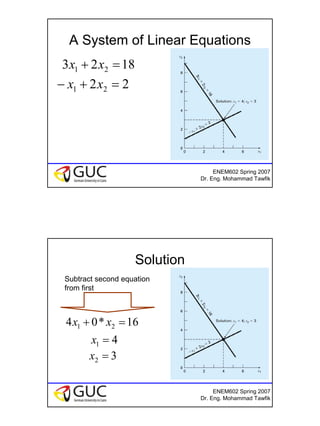
A System of Linear Equations
1823 21 =+ xx
22 21 =+− xx
ENEM602 Spring 2007
Dr. Eng. Mohammad Tawfik
Solution
Subtract second equation
from first
16*04 21 =+ xx
41 =x
32 =x
3
ENEM602 Spring 2007
Dr. Eng. Mohammad Tawfik
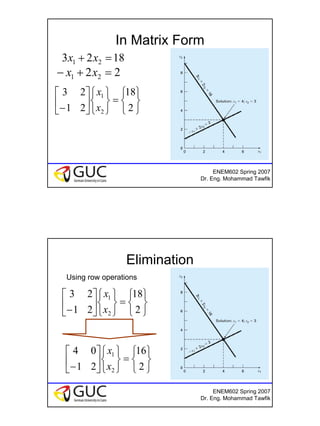
In Matrix Form






=












− 2
18
21
23
2
1
x
x
1823 21 =+ xx
22 21 =+− xx
ENEM602 Spring 2007
Dr. Eng. Mohammad Tawfik
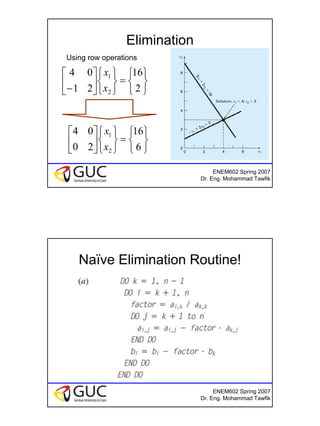
Elimination






=












− 2
18
21
23
2
1
x
x
Using row operations






=












− 2
16
21
04
2
1
x
x
4
ENEM602 Spring 2007
Dr. Eng. Mohammad Tawfik
Elimination
Using row operations






=












− 2
16
21
04
2
1
x
x






=












6
16
20
04
2
1
x
x
ENEM602 Spring 2007
Dr. Eng. Mohammad Tawfik
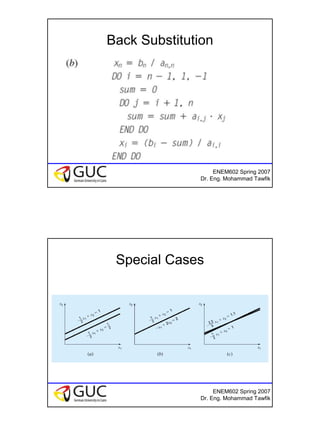
Naïve Elimination Routine!
5
ENEM602 Spring 2007
Dr. Eng. Mohammad Tawfik
Back Substitution
ENEM602 Spring 2007
Dr. Eng. Mohammad Tawfik
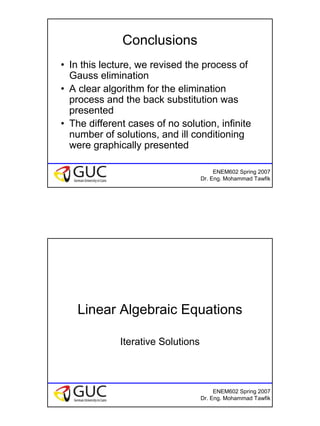
Special Cases
6
ENEM602 Spring 2007
Dr. Eng. Mohammad Tawfik
Conclusions
• In this lecture, we revised the process of
Gauss elimination
• A clear algorithm for the elimination
process and the back substitution was
presented
• The different cases of no solution, infinite
number of solutions, and ill conditioning
were graphically presented
ENEM602 Spring 2007
Dr. Eng. Mohammad Tawfik
Linear Algebraic Equations
Iterative Solutions
7
ENEM602 Spring 2007
Dr. Eng. Mohammad Tawfik
Objectives
• Recognize the need for iterative solutions
• Understand the difference between
different iterative methods for solving
systems of linear equations
• Apply iterative methods to solve a system
of linear equations
ENEM602 Spring 2007
Dr. Eng. Mohammad Tawfik
Why Iterative Methods?
• When system of equations is sparse; too many
zero elements. Such systems are produced
when approximately solving differential
equations; finite difference, finite element, etc…
• We already have sources of error in the solution;
model errors, approximation errors, truncation
errors, etc…, so why not use approximate
method any way
• Saves on time!
8
ENEM602 Spring 2007
Dr. Eng. Mohammad Tawfik
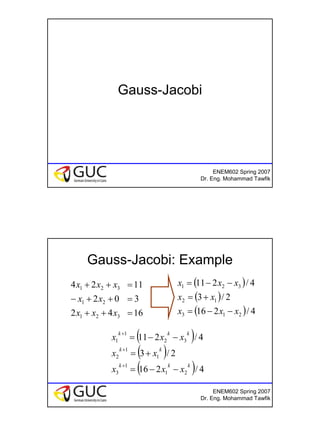
Gauss-Jacobi
ENEM602 Spring 2007
Dr. Eng. Mohammad Tawfik
Gauss-Jacobi: Example
1642
302
1124
321
21
321
=++
=++−
=++
xxx
xx
xxx ( )
( )
( ) 4/216
2/3
4/211
213
12
321
xxx
xx
xxx
−−=
+=
−−=
( )
( )
( ) 4/216
2/3
4/211
21
1
3
1
1
2
32
1
1
kkk
kk
kkk
xxx
xx
xxx
−−=
+=
−−=
+
+
+
9
ENEM602 Spring 2007
Dr. Eng. Mohammad Tawfik
Is that really going to work?!!!
ENEM602 Spring 2007
Dr. Eng. Mohammad Tawfik
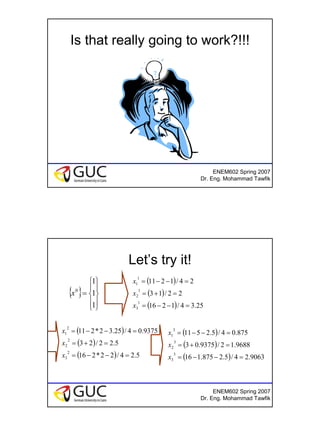
Let’s try it!
{ }










=
1
1
1
0
x
( )
( )
( ) 25.34/1216
22/13
24/1211
1
3
1
2
1
1
=−−=
=+=
=−−=
x
x
x
( )
( )
( ) 5.24/22*216
5.22/23
9375.04/25.32*211
2
3
2
2
2
1
=−−=
=+=
=−−=
x
x
x ( )
( )
( ) 9063.24/5.2875.116
9688.12/9375.03
875.04/5.2511
3
3
3
2
3
1
=−−=
=+=
=−−=
x
x
x
10
ENEM602 Spring 2007
Dr. Eng. Mohammad Tawfik
In General!
ENEM602 Spring 2007
Dr. Eng. Mohammad Tawfik
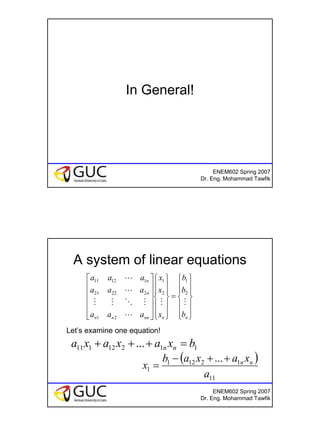
A system of linear equations














=


























nnnnnn
n
n
b
b
b
x
x
x
aaa
aaa
aaa
MM
L
MOMM
L
L
2
1
2
1
21
22221
11211
Let’s examine one equation!
11212111 ... bxaxaxa nn =+++
( )
11
12121
1
...
a
xaxab
x nn++−
=
11
ENEM602 Spring 2007
Dr. Eng. Mohammad Tawfik
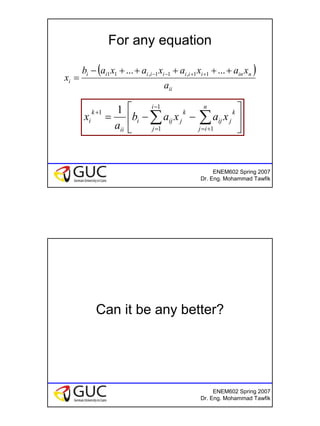
For any equation






−−= ∑∑ +=
−
=
+
n
ij
k
jij
i
j
k
jiji
ii
k
i xaxab
a
x
1
1
1
1 1
( )
ii
niniiiiiiii
i
a
xaxaxaxab
x
+++++−
= ++−− ...... 11,11,11
ENEM602 Spring 2007
Dr. Eng. Mohammad Tawfik
Can it be any better?
12
ENEM602 Spring 2007
Dr. Eng. Mohammad Tawfik
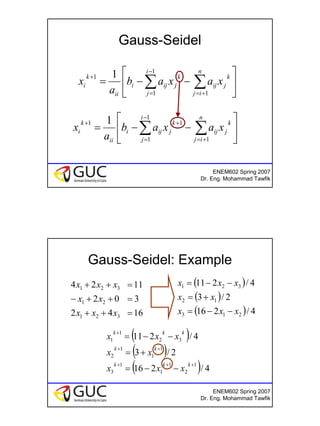
Gauss-Seidel






−−= ∑∑ +=
−
=
+
n
ij
k
jij
i
j
k
jiji
ii
k
i xaxab
a
x
1
1
1
1 1






−−= ∑∑ +=
−
=
++
n
ij
k
jij
i
j
k
jiji
ii
k
i xaxab
a
x
1
1
1
11 1
ENEM602 Spring 2007
Dr. Eng. Mohammad Tawfik
Gauss-Seidel: Example
1642
302
1124
321
21
321
=++
=++−
=++
xxx
xx
xxx ( )
( )
( ) 4/216
2/3
4/211
213
12
321
xxx
xx
xxx
−−=
+=
−−=
( )
( )
( ) 4/216
2/3
4/211
1
2
1
1
1
3
1
1
1
2
32
1
1
+++
++
+
−−=
+=
−−=
kkk
kk
kkk
xxx
xx
xxx
13
ENEM602 Spring 2007
Dr. Eng. Mohammad Tawfik
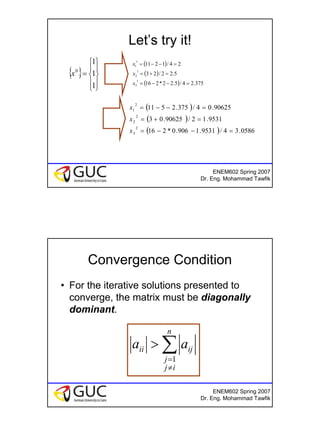
Let’s try it!
{ }










=
1
1
1
0
x
( )
( )
( ) 375.24/5.22*216
5.22/23
24/1211
1
3
1
2
1
1
=−−=
=+=
=−−=
x
x
x
( )
( )
( ) 0586.34/9531.1906.0*216
9531.12/90625.03
90625.04/375.2511
2
3
2
2
2
1
=−−=
=+=
=−−=
x
x
x
ENEM602 Spring 2007
Dr. Eng. Mohammad Tawfik
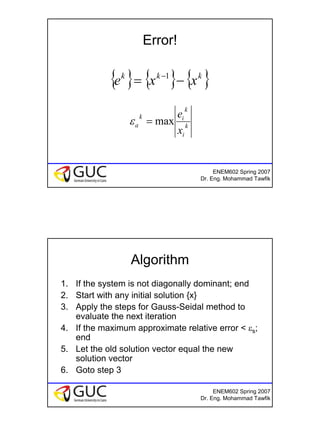
Convergence Condition
• For the iterative solutions presented to
converge, the matrix must be diagonally
dominant.
∑
≠
=
>
n
ij
j
ijii aa
1
14
ENEM602 Spring 2007
Dr. Eng. Mohammad Tawfik
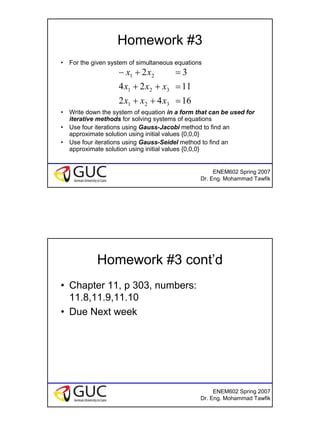
Error!
{ } { } { }kkk
xxe −= −1
k
i
k
ik
a
x
e
max=ε
ENEM602 Spring 2007
Dr. Eng. Mohammad Tawfik
Algorithm
1. If the system is not diagonally dominant; end
2. Start with any initial solution {x}
3. Apply the steps for Gauss-Seidal method to
evaluate the next iteration
4. If the maximum approximate relative error < εs;
end
5. Let the old solution vector equal the new
solution vector
6. Goto step 3
15
ENEM602 Spring 2007
Dr. Eng. Mohammad Tawfik
Homework #3
• For the given system of simultaneous equations
• Write down the system of equation in a form that can be used for
iterative methods for solving systems of equations
• Use four iterations using Gauss-Jacobi method to find an
approximate solution using initial values {0,0,0}
• Use four iterations using Gauss-Seidel method to find an
approximate solution using initial values {0,0,0}
1642
1124
32
321
321
21
=++
=++
=+−
xxx
xxx
xx
ENEM602 Spring 2007
Dr. Eng. Mohammad Tawfik
Homework #3 cont’d
• Chapter 11, p 303, numbers:
11.8,11.9,11.10
• Due Next week

04 gaussmethods

  • 1.
    1 ENEM602 Spring 2007 Dr.Eng. Mohammad Tawfik Linear Algebraic Equations Gauss Elimination ENEM602 Spring 2007 Dr. Eng. Mohammad Tawfik Objectives • Knowing how to solve a system of linear equations • Understanding how to implement Gauss elimination method • Understanding the concepts of singularity and ill-conditioning
  • 2.
    2 ENEM602 Spring 2007 Dr.Eng. Mohammad Tawfik A System of Linear Equations 1823 21 =+ xx 22 21 =+− xx ENEM602 Spring 2007 Dr. Eng. Mohammad Tawfik Solution Subtract second equation from first 16*04 21 =+ xx 41 =x 32 =x
  • 3.
    3 ENEM602 Spring 2007 Dr.Eng. Mohammad Tawfik In Matrix Form       =             − 2 18 21 23 2 1 x x 1823 21 =+ xx 22 21 =+− xx ENEM602 Spring 2007 Dr. Eng. Mohammad Tawfik Elimination       =             − 2 18 21 23 2 1 x x Using row operations       =             − 2 16 21 04 2 1 x x
  • 4.
    4 ENEM602 Spring 2007 Dr.Eng. Mohammad Tawfik Elimination Using row operations       =             − 2 16 21 04 2 1 x x       =             6 16 20 04 2 1 x x ENEM602 Spring 2007 Dr. Eng. Mohammad Tawfik Naïve Elimination Routine!
  • 5.
    5 ENEM602 Spring 2007 Dr.Eng. Mohammad Tawfik Back Substitution ENEM602 Spring 2007 Dr. Eng. Mohammad Tawfik Special Cases
  • 6.
    6 ENEM602 Spring 2007 Dr.Eng. Mohammad Tawfik Conclusions • In this lecture, we revised the process of Gauss elimination • A clear algorithm for the elimination process and the back substitution was presented • The different cases of no solution, infinite number of solutions, and ill conditioning were graphically presented ENEM602 Spring 2007 Dr. Eng. Mohammad Tawfik Linear Algebraic Equations Iterative Solutions
  • 7.
    7 ENEM602 Spring 2007 Dr.Eng. Mohammad Tawfik Objectives • Recognize the need for iterative solutions • Understand the difference between different iterative methods for solving systems of linear equations • Apply iterative methods to solve a system of linear equations ENEM602 Spring 2007 Dr. Eng. Mohammad Tawfik Why Iterative Methods? • When system of equations is sparse; too many zero elements. Such systems are produced when approximately solving differential equations; finite difference, finite element, etc… • We already have sources of error in the solution; model errors, approximation errors, truncation errors, etc…, so why not use approximate method any way • Saves on time!
  • 8.
    8 ENEM602 Spring 2007 Dr.Eng. Mohammad Tawfik Gauss-Jacobi ENEM602 Spring 2007 Dr. Eng. Mohammad Tawfik Gauss-Jacobi: Example 1642 302 1124 321 21 321 =++ =++− =++ xxx xx xxx ( ) ( ) ( ) 4/216 2/3 4/211 213 12 321 xxx xx xxx −−= += −−= ( ) ( ) ( ) 4/216 2/3 4/211 21 1 3 1 1 2 32 1 1 kkk kk kkk xxx xx xxx −−= += −−= + + +
  • 9.
    9 ENEM602 Spring 2007 Dr.Eng. Mohammad Tawfik Is that really going to work?!!! ENEM602 Spring 2007 Dr. Eng. Mohammad Tawfik Let’s try it! { }           = 1 1 1 0 x ( ) ( ) ( ) 25.34/1216 22/13 24/1211 1 3 1 2 1 1 =−−= =+= =−−= x x x ( ) ( ) ( ) 5.24/22*216 5.22/23 9375.04/25.32*211 2 3 2 2 2 1 =−−= =+= =−−= x x x ( ) ( ) ( ) 9063.24/5.2875.116 9688.12/9375.03 875.04/5.2511 3 3 3 2 3 1 =−−= =+= =−−= x x x
  • 10.
    10 ENEM602 Spring 2007 Dr.Eng. Mohammad Tawfik In General! ENEM602 Spring 2007 Dr. Eng. Mohammad Tawfik A system of linear equations               =                           nnnnnn n n b b b x x x aaa aaa aaa MM L MOMM L L 2 1 2 1 21 22221 11211 Let’s examine one equation! 11212111 ... bxaxaxa nn =+++ ( ) 11 12121 1 ... a xaxab x nn++− =
  • 11.
    11 ENEM602 Spring 2007 Dr.Eng. Mohammad Tawfik For any equation       −−= ∑∑ += − = + n ij k jij i j k jiji ii k i xaxab a x 1 1 1 1 1 ( ) ii niniiiiiiii i a xaxaxaxab x +++++− = ++−− ...... 11,11,11 ENEM602 Spring 2007 Dr. Eng. Mohammad Tawfik Can it be any better?
  • 12.
    12 ENEM602 Spring 2007 Dr.Eng. Mohammad Tawfik Gauss-Seidel       −−= ∑∑ += − = + n ij k jij i j k jiji ii k i xaxab a x 1 1 1 1 1       −−= ∑∑ += − = ++ n ij k jij i j k jiji ii k i xaxab a x 1 1 1 11 1 ENEM602 Spring 2007 Dr. Eng. Mohammad Tawfik Gauss-Seidel: Example 1642 302 1124 321 21 321 =++ =++− =++ xxx xx xxx ( ) ( ) ( ) 4/216 2/3 4/211 213 12 321 xxx xx xxx −−= += −−= ( ) ( ) ( ) 4/216 2/3 4/211 1 2 1 1 1 3 1 1 1 2 32 1 1 +++ ++ + −−= += −−= kkk kk kkk xxx xx xxx
  • 13.
    13 ENEM602 Spring 2007 Dr.Eng. Mohammad Tawfik Let’s try it! { }           = 1 1 1 0 x ( ) ( ) ( ) 375.24/5.22*216 5.22/23 24/1211 1 3 1 2 1 1 =−−= =+= =−−= x x x ( ) ( ) ( ) 0586.34/9531.1906.0*216 9531.12/90625.03 90625.04/375.2511 2 3 2 2 2 1 =−−= =+= =−−= x x x ENEM602 Spring 2007 Dr. Eng. Mohammad Tawfik Convergence Condition • For the iterative solutions presented to converge, the matrix must be diagonally dominant. ∑ ≠ = > n ij j ijii aa 1
  • 14.
    14 ENEM602 Spring 2007 Dr.Eng. Mohammad Tawfik Error! { } { } { }kkk xxe −= −1 k i k ik a x e max=ε ENEM602 Spring 2007 Dr. Eng. Mohammad Tawfik Algorithm 1. If the system is not diagonally dominant; end 2. Start with any initial solution {x} 3. Apply the steps for Gauss-Seidal method to evaluate the next iteration 4. If the maximum approximate relative error < εs; end 5. Let the old solution vector equal the new solution vector 6. Goto step 3
  • 15.
    15 ENEM602 Spring 2007 Dr.Eng. Mohammad Tawfik Homework #3 • For the given system of simultaneous equations • Write down the system of equation in a form that can be used for iterative methods for solving systems of equations • Use four iterations using Gauss-Jacobi method to find an approximate solution using initial values {0,0,0} • Use four iterations using Gauss-Seidel method to find an approximate solution using initial values {0,0,0} 1642 1124 32 321 321 21 =++ =++ =+− xxx xxx xx ENEM602 Spring 2007 Dr. Eng. Mohammad Tawfik Homework #3 cont’d • Chapter 11, p 303, numbers: 11.8,11.9,11.10 • Due Next week