Determinants
Made by:
Rivan Patel
10-H
Roll No:27
DEFINITION
In linear algebra, the determinant is a useful value that can be computed from the elements of a
square matrix.The determinant of a matrix A is denoted det(A), det A, or |A|.
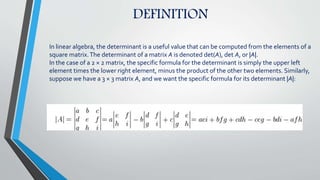
In the case of a 2 × 2 matrix, the specific formula for the determinant is simply the upper left
element times the lower right element, minus the product of the other two elements. Similarly,
suppose we have a 3 × 3 matrix A, and we want the specific formula for its determinant |A|:
|:
Determinants occur throughout mathematics. For example, a matrix is often used to represent
the coefficients in a system of linear equations, and the determinant can be used to solve those
equations, although more efficient techniques are actually used, some of which are
determinant-revealing and consist of computationally effective ways of computing the
determinant itself.The use of determinants in calculus includes the Jacobian determinant in the
change of variables rule for integrals of functions of several variables. Determinants are also
used to define the characteristic polynomial of a matrix, which is essential for eigenvalue
problems in linear algebra. In analytical geometry, determinants express the signed n-
dimensional volumes of n-dimensional parallelepipeds. Sometimes, determinants are used
merely as a compact notation for expressions that would otherwise be unwieldy to write down.
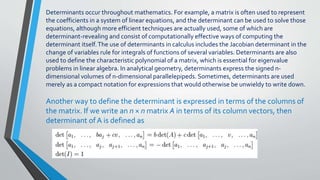
Another way to define the determinant is expressed in terms of the columns of
the matrix. If we write an n × n matrix A in terms of its column vectors, then
determinant of A is defined as
MATRICES
The determinant of a 2 × 2 matrix is defined by-
|:
The determinant of a 3 × 3 matrix is defined by-
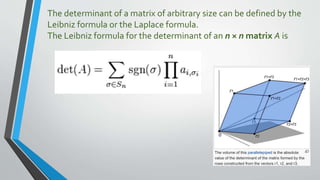
The determinant of a matrix of arbitrary size can be defined by the
Leibniz formula or the Laplace formula.
The Leibniz formula for the determinant of an n × n matrix A is
PROPRERTIES OF DETERMINANT|:
MULTIPLICAVITY AND MATRIX GROUPS
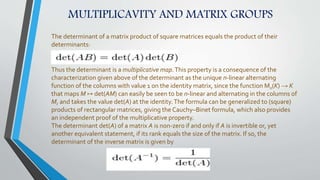
The determinant of a matrix product of square matrices equals the product of their
determinants:
|:
Thus the determinant is a multiplicative map.This property is a consequence of the
characterization given above of the determinant as the unique n-linear alternating
function of the columns with value 1 on the identity matrix, since the function Mn(K) → K
that maps M ↦ det(AM) can easily be seen to be n-linear and alternating in the columns of
M, and takes the value det(A) at the identity.The formula can be generalized to (square)
products of rectangular matrices, giving the Cauchy–Binet formula, which also provides
an independent proof of the multiplicative property.
The determinant det(A) of a matrix A is non-zero if and only if A is invertible or, yet
another equivalent statement, if its rank equals the size of the matrix. If so, the
determinant of the inverse matrix is given by
THANK YOU
THE END

Determinants

  • 1.
  • 2.
    DEFINITION In linear algebra,the determinant is a useful value that can be computed from the elements of a square matrix.The determinant of a matrix A is denoted det(A), det A, or |A|. In the case of a 2 × 2 matrix, the specific formula for the determinant is simply the upper left element times the lower right element, minus the product of the other two elements. Similarly, suppose we have a 3 × 3 matrix A, and we want the specific formula for its determinant |A|: |:
  • 3.
    Determinants occur throughoutmathematics. For example, a matrix is often used to represent the coefficients in a system of linear equations, and the determinant can be used to solve those equations, although more efficient techniques are actually used, some of which are determinant-revealing and consist of computationally effective ways of computing the determinant itself.The use of determinants in calculus includes the Jacobian determinant in the change of variables rule for integrals of functions of several variables. Determinants are also used to define the characteristic polynomial of a matrix, which is essential for eigenvalue problems in linear algebra. In analytical geometry, determinants express the signed n- dimensional volumes of n-dimensional parallelepipeds. Sometimes, determinants are used merely as a compact notation for expressions that would otherwise be unwieldy to write down. Another way to define the determinant is expressed in terms of the columns of the matrix. If we write an n × n matrix A in terms of its column vectors, then determinant of A is defined as
  • 4.
    MATRICES The determinant ofa 2 × 2 matrix is defined by- |: The determinant of a 3 × 3 matrix is defined by-
  • 5.
    The determinant ofa matrix of arbitrary size can be defined by the Leibniz formula or the Laplace formula. The Leibniz formula for the determinant of an n × n matrix A is
  • 6.
  • 7.
    MULTIPLICAVITY AND MATRIXGROUPS The determinant of a matrix product of square matrices equals the product of their determinants: |: Thus the determinant is a multiplicative map.This property is a consequence of the characterization given above of the determinant as the unique n-linear alternating function of the columns with value 1 on the identity matrix, since the function Mn(K) → K that maps M ↦ det(AM) can easily be seen to be n-linear and alternating in the columns of M, and takes the value det(A) at the identity.The formula can be generalized to (square) products of rectangular matrices, giving the Cauchy–Binet formula, which also provides an independent proof of the multiplicative property. The determinant det(A) of a matrix A is non-zero if and only if A is invertible or, yet another equivalent statement, if its rank equals the size of the matrix. If so, the determinant of the inverse matrix is given by
  • 8.