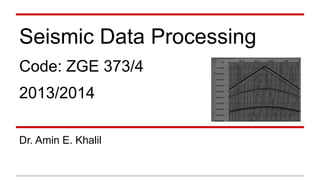
Seismic Data Processing
Code: ZGE 373/4
2013/2014
Dr. Amin E. Khalil
Protocol
The protocol of the lecture is as follow:
1- There nothing called stupid question so don’t hesitate to ask a
question because it is the shortest way to learn something.
2- There will be two periods during the lecture for questions and
discussion.
Syllabus
1- Mathematical Basis for Fourier transform
2- Sampling considerations of seismic time series
3- Main processing sequence
4- Velocity analysis
5- Deconvolution, convolution, filtering and migration in space and time (prestack).
6- Acquisition of seismic data ( land and sea).
7- 3-D seismic data processing
8- Radon transform, tau-p processing, Hilbert transform and AVO
Refernces
1- Yilmaz, O., 2001. Seismic Data Processing. Soceity of Exploration
Geophysicist (SEG)
2- Mayeda, W., 1993. Digital Signal Processing. Prentice-Hall.
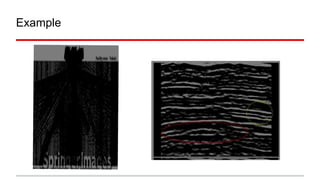
Why Seismic Data Processing is important?
Because reflection seismic energy arrive later, it might be obscured by another
seismic signals like ground roll and direct waves. Hence we apply Seismic data
Processing
1- To remove unwanted Signals and Noises
2- To Enhance Signal to Noise ratio
Example
Part I: Mathematical Basis for Fourier transform
•Complex Numbers
•Vectors
•Linear vector spaces
•Linear systems
•Matrices
•Determinants
•Eigenvalue problems
•Singular values
•Matrix inversion
•Series
•Taylor
•Fourier
•Delta Function
•Fourier integrals
The idea is to illustrate
these mathematical tools with
examples from seismology
Lecture One
Complex Numbers
●Definition & operations
●Representation
●Operations
●Complex Conjugate
●Importance
Complex numbers; Definition & operations
Definition:
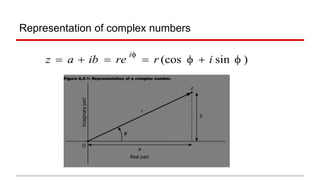
A combination of a real and an imaginary number in the form a + bi,
where a and b are real, and i is the "unit imaginary number" √(-1),
The values a and b can be zero.
Examples:
1 + i, 2 - 6i, -5.2i, 4
imaginary number is that real number that give negative number
when it’s squared
Representation of complex numbers
Complex numbers: Basic Operations
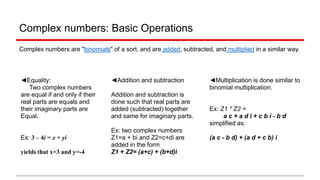
Complex numbers are "binomials" of a sort, and are added, subtracted, and multiplied in a similar way.
◄Equality:
Two complex numbers
are equal if and only if their
real parts are equals and
their imaginary parts are
Equal.
Ex: 3 – 4i = x + yi
yields that x=3 and y=-4
◄Addition and subtraction
Addition and subtraction is
done such that real parts are
added (subtracted) together
and same for imaginary parts.
Ex: two complex numbers
Z1=a + bi and Z2=c+di are
added in the form
Z1 + Z2= (a+c) + (b+d)i
◄Multiplication is done similar to
binomial multiplication.
Ex: Z1 * Z2 =
a c + a d i + c b i - b d
simplified as:
(a c - b d) + (a d + c b) i
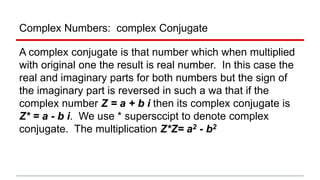
Complex Numbers: complex Conjugate
A complex conjugate is that number which when multiplied
with original one the result is real number. In this case the
real and imaginary parts for both numbers but the sign of
the imaginary part is reversed in such a wa that if the
complex number Z = a + b i then its complex conjugate is
Z* = a - b i. We use * supersccipt to denote complex
conjugate. The multiplication Z*Z= a2 - b2
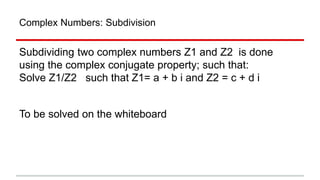
Complex Numbers: Subdivision
Subdividing two complex numbers Z1 and Z2 is done
using the complex conjugate property; such that:
Solve Z1/Z2 such that Z1= a + b i and Z2 = c + d i
To be solved on the whiteboard
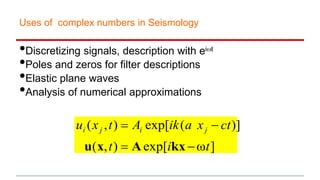
Uses of complex numbers in Seismology
•Discretizing signals, description with eiwt
•Poles and zeros for filter descriptions
•Elastic plane waves
•Analysis of numerical approximations
Vectors
•Linear Vector Spaces.
•Linear Systems.
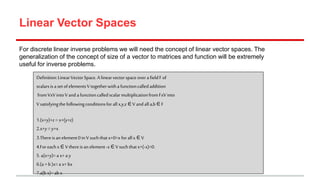
Linear Vector Spaces
For discrete linear inverse problems we will need the concept of linear vector spaces. The
generalization of the concept of size of a vector to matrices and function will be extremely
useful for inverse problems.
Definition:LinearVectorSpace.A linearvectorspaceoverafieldFof
scalarsisa setofelementsVtogetherwithafunctioncalledaddition
fromVxV intoVand afunctioncalledscalarmultiplicationfromFxVinto
Vsatisfyingthefollowingconditionsforallx,y,z ∈V andalla,b ∈ F
1.(x+y)+z = x+(y+z)
2.x+y =y+x
3.Thereisan element0inV suchthatx+0=xforallx ∈ V
4.Foreachx ∈ Vthereisan element-x∈ Vsuchthatx+(-x)=0.
5. a(x+y)=a x+a y
6.(a +b )x=a x+ bx
7.a(bx)= ab x
Comparing Vectors
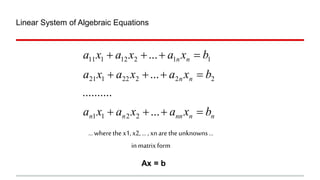
Linear System of Algebraic Equations
... wherethex1,x2, ... , xnare theunknowns...
inmatrixform
Ax = b
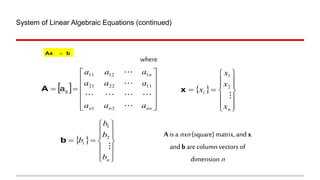
System of Linear Algebraic Equations (continued)
where
A is anxn(square) matrix,andx
andbare columnvectors of
dimensionn
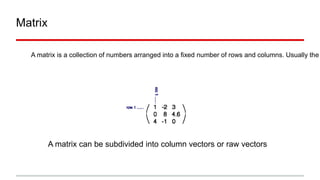
Matrix
A matrix is a collection of numbers arranged into a fixed number of rows and columns. Usually the
A matrix can be subdivided into column vectors or raw vectors
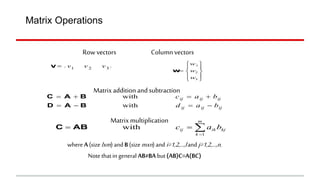
Rowvectors Columnvectors
Matrixadditionandsubtraction
Matrixmultiplication
whereA (size lxm) andB (sizemxn) andi=1,2,...,land j=1,2,...,n.
Note thatingeneral AB≠BA but(AB)C=A(BC)
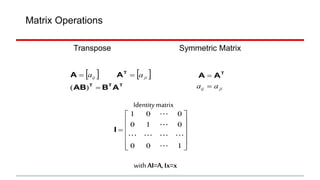
Matrix Operations
Matrix Operations
Identitymatrix
withAI=A,Ix=x
Transpose Symmetric Matrix
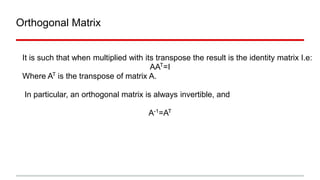
Orthogonal Matrix
It is such that when multiplied with its transpose the result is the identity matrix I.e:
AAT
=I
Where AT
is the transpose of matrix A.
In particular, an orthogonal matrix is always invertible, and
A-1
=AT
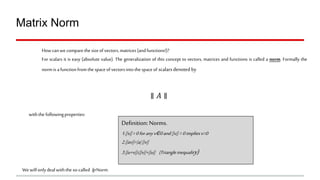
Matrix Norm
Howcan wecomparethesizeofvectors,matrices(andfunctions!)?
For scalars it is easy (absolute value). The generalization of this concept to vectors, matrices and functions is called a norm. Formally the
normis afunctionfromthespaceofvectorsintothespaceof scalarsdenoted by
withthefollowingproperties:
Definition:Norms.
1.||v||>0foranyv∈0and||v||=0impliesv=0
2.||av||=|a|||v||
3.||u+v||≤||v||+||u|| (Triangleinequality)
Wewillonlydealwiththeso-called lpNorm.
∥ 𝐴 ∥
Thank you
End of Lecture

Seismic data processing

  • 1.
    Seismic Data Processing Code:ZGE 373/4 2013/2014 Dr. Amin E. Khalil
  • 2.
    Protocol The protocol ofthe lecture is as follow: 1- There nothing called stupid question so don’t hesitate to ask a question because it is the shortest way to learn something. 2- There will be two periods during the lecture for questions and discussion.
  • 3.
    Syllabus 1- Mathematical Basisfor Fourier transform 2- Sampling considerations of seismic time series 3- Main processing sequence 4- Velocity analysis 5- Deconvolution, convolution, filtering and migration in space and time (prestack). 6- Acquisition of seismic data ( land and sea). 7- 3-D seismic data processing 8- Radon transform, tau-p processing, Hilbert transform and AVO
  • 4.
    Refernces 1- Yilmaz, O.,2001. Seismic Data Processing. Soceity of Exploration Geophysicist (SEG) 2- Mayeda, W., 1993. Digital Signal Processing. Prentice-Hall.
  • 5.
    Why Seismic DataProcessing is important? Because reflection seismic energy arrive later, it might be obscured by another seismic signals like ground roll and direct waves. Hence we apply Seismic data Processing 1- To remove unwanted Signals and Noises 2- To Enhance Signal to Noise ratio
  • 6.
  • 7.
    Part I: MathematicalBasis for Fourier transform •Complex Numbers •Vectors •Linear vector spaces •Linear systems •Matrices •Determinants •Eigenvalue problems •Singular values •Matrix inversion •Series •Taylor •Fourier •Delta Function •Fourier integrals The idea is to illustrate these mathematical tools with examples from seismology
  • 8.
    Lecture One Complex Numbers ●Definition& operations ●Representation ●Operations ●Complex Conjugate ●Importance
  • 9.
    Complex numbers; Definition& operations Definition: A combination of a real and an imaginary number in the form a + bi, where a and b are real, and i is the "unit imaginary number" √(-1), The values a and b can be zero. Examples: 1 + i, 2 - 6i, -5.2i, 4 imaginary number is that real number that give negative number when it’s squared
  • 10.
  • 11.
    Complex numbers: BasicOperations Complex numbers are "binomials" of a sort, and are added, subtracted, and multiplied in a similar way. ◄Equality: Two complex numbers are equal if and only if their real parts are equals and their imaginary parts are Equal. Ex: 3 – 4i = x + yi yields that x=3 and y=-4 ◄Addition and subtraction Addition and subtraction is done such that real parts are added (subtracted) together and same for imaginary parts. Ex: two complex numbers Z1=a + bi and Z2=c+di are added in the form Z1 + Z2= (a+c) + (b+d)i ◄Multiplication is done similar to binomial multiplication. Ex: Z1 * Z2 = a c + a d i + c b i - b d simplified as: (a c - b d) + (a d + c b) i
  • 12.
    Complex Numbers: complexConjugate A complex conjugate is that number which when multiplied with original one the result is real number. In this case the real and imaginary parts for both numbers but the sign of the imaginary part is reversed in such a wa that if the complex number Z = a + b i then its complex conjugate is Z* = a - b i. We use * supersccipt to denote complex conjugate. The multiplication Z*Z= a2 - b2
  • 13.
    Complex Numbers: Subdivision Subdividingtwo complex numbers Z1 and Z2 is done using the complex conjugate property; such that: Solve Z1/Z2 such that Z1= a + b i and Z2 = c + d i To be solved on the whiteboard
  • 14.
    Uses of complexnumbers in Seismology •Discretizing signals, description with eiwt •Poles and zeros for filter descriptions •Elastic plane waves •Analysis of numerical approximations
  • 15.
  • 16.
    Linear Vector Spaces Fordiscrete linear inverse problems we will need the concept of linear vector spaces. The generalization of the concept of size of a vector to matrices and function will be extremely useful for inverse problems. Definition:LinearVectorSpace.A linearvectorspaceoverafieldFof scalarsisa setofelementsVtogetherwithafunctioncalledaddition fromVxV intoVand afunctioncalledscalarmultiplicationfromFxVinto Vsatisfyingthefollowingconditionsforallx,y,z ∈V andalla,b ∈ F 1.(x+y)+z = x+(y+z) 2.x+y =y+x 3.Thereisan element0inV suchthatx+0=xforallx ∈ V 4.Foreachx ∈ Vthereisan element-x∈ Vsuchthatx+(-x)=0. 5. a(x+y)=a x+a y 6.(a +b )x=a x+ bx 7.a(bx)= ab x
  • 17.
  • 18.
    Linear System ofAlgebraic Equations ... wherethex1,x2, ... , xnare theunknowns... inmatrixform Ax = b
  • 19.
    System of LinearAlgebraic Equations (continued) where A is anxn(square) matrix,andx andbare columnvectors of dimensionn
  • 20.
    Matrix A matrix isa collection of numbers arranged into a fixed number of rows and columns. Usually the A matrix can be subdivided into column vectors or raw vectors
  • 21.
    Rowvectors Columnvectors Matrixadditionandsubtraction Matrixmultiplication whereA (sizelxm) andB (sizemxn) andi=1,2,...,land j=1,2,...,n. Note thatingeneral AB≠BA but(AB)C=A(BC) Matrix Operations
  • 22.
  • 23.
    Orthogonal Matrix It issuch that when multiplied with its transpose the result is the identity matrix I.e: AAT =I Where AT is the transpose of matrix A. In particular, an orthogonal matrix is always invertible, and A-1 =AT
  • 24.
    Matrix Norm Howcan wecomparethesizeofvectors,matrices(andfunctions!)? Forscalars it is easy (absolute value). The generalization of this concept to vectors, matrices and functions is called a norm. Formally the normis afunctionfromthespaceofvectorsintothespaceof scalarsdenoted by withthefollowingproperties: Definition:Norms. 1.||v||>0foranyv∈0and||v||=0impliesv=0 2.||av||=|a|||v|| 3.||u+v||≤||v||+||u|| (Triangleinequality) Wewillonlydealwiththeso-called lpNorm. ∥ 𝐴 ∥
  • 25.